
Judicious Classroom Barbara Mc Ewan Landau Alissa Nergaard
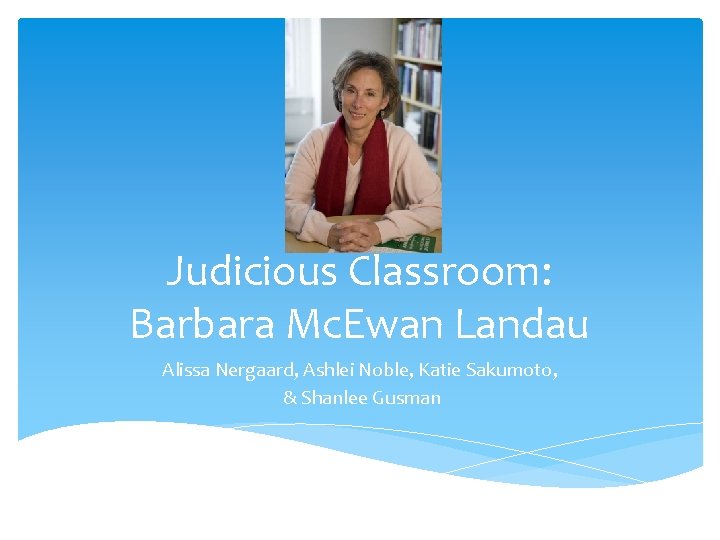
Judicious Classroom: Barbara Mc. Ewan Landau Alissa Nergaard, Ashlei Noble, Katie Sakumoto, & Shanlee Gusman
The Art of Classroom Management Example “The message we are sending children is that while teachers may, students may not. Children are not allowed to yell, hit, or treat others with disrespect. Teachers are allowed to do all those things, by virtue of being older and bigger, for purposes of being in charge. So the message to students becomes, 'When you are big, this is how you get to act. ” -Barbara Mc. Ewan Landau
Philosophy Barbara Mc. Ewan Landau disagrees with the behaviorist method of classroom management. Rather she implements judicious discipline. She believes in empowering students to make the right decision rather than belittling them. She does this by creating a classroom environment of mutual respect, caring, and equity where they can exercise their rights and responsibilities.
Judicious Discipline Comprehensive approach to democratic classroom based upon constitutional principles of personal rights balanced against social needs Supporting equitable, respectful, and safe classroom environments Incorporating the language of citizen rights and responsibilities into class meetings to teach positive goal setting and peaceful conflict resolution Constitutional language is promoted to promote reasoned decision making and a peaceful school climate
The Classroom Meeting: Overview 1. Determine who can call meeting and when it should be held 2. Seat students and teachers so they can see faces of all participants 3. Establish the expectation that names will never be used in class meetings 4. Establish the expectation that the meeting will stay on topic 5. Never coerce students into participating during a class meeting Every student should be able to “pass” 6. Maintain class-meeting journals
1. Determine Who and When Some teachers allow any student to call a meeting at any time Other teachers determine a specific time and place for a meeting Make sure meeting includes topics suggested by students This helps ensure genuine input from the students
2. See All Faces Sit in a way (most likely a circle) so that everyone can see everyone’s face. This ensures all students are involved Rows can be unintentionally exclusive and also allows for students to exclude themselves
3. No Names The purpose of a meeting is to discuss issues, not individuals. Using names is accusatory action that makes people defensive Causes ill feelings Rule should be clearly stated and its rationale understood before any meeting occurs. The class will need practice doing this!
4. Stay on Topic Class meetings are not times for personal stories about themselves or families These should be addressed individually with either the teacher or a counselor
5. Never Coerce Students should have the opportunity to “pass” when he or she feels the need to do so
6. Maintain Journal Immediately following the meeting, both teachers and students should record their thoughts about what took place Could include concerns, clarifications, delights, and topics for future discussion
Young or Old The younger the students, the more “concrete” and brief the meeting should be. Cite specific examples Use clear models Structured role playing, story telling, or using puppets or flannel board figures can help students understand model issues. For older students, meetings can be less frequent and discussions more abstract
Why meetings? Help students practice skills of compromise and mediation Teachers can use the format to model respect and trust by actively listening to and acting on the ideas shared by their students Help students learn how to develop and achieve goals Mutual respect among teachers and students Promotes student empowerment Helps students develop an internal moral compass Teaches students about the American judicial system Teaches students about their rights and responsibilities
Questions?
- Slides: 14