
Judicial Workload Measurement as a Tool for Judicial

- Slides: 14
Judicial Workload Measurement as a Tool for Judicial Resource Allocation and Performance Management Sergii Suchenko, USAID New Justice Program Legal and Judicial Administration Specialist 1/31/2022 FOOTER GOES HERE 1
USAID NEW JUSTICE PROGRAM OBJECTIVES • Judicial independence and self governance strengthened • Accountability and transparency of the judiciary to citizens and the rule of law increased • Administration of justice enhanced • Quality of legal education strengthened • Access to justice expanded and human rights protected 1/31/2022 USAID NEW JUTICE PROGRAM 2
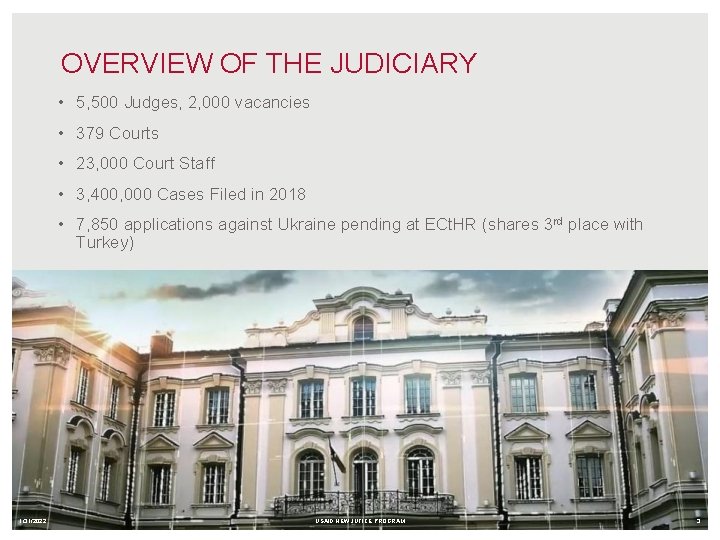
OVERVIEW OF THE JUDICIARY • 5, 500 Judges, 2, 000 vacancies • 379 Courts • 23, 000 Court Staff • 3, 400, 000 Cases Filed in 2018 • 7, 850 applications against Ukraine pending at ECt. HR (shares 3 rd place with Turkey) 1/31/2022 USAID NEW JUTICE PROGRAM 3
Workload Measurement Tools • Case weights are mathematical estimates of the average amount of time judges actually spend, from filing to termination, on cases of particular types. Case weights provide a more accurate and useful measure of the required judicial work than a mere count of filings because cases of different types may require, on average, different amounts of judicial time. 1/31/2022 FOOTER GOES HERE 4
A case weighting system could help: • Determine the number of judges needed overall to process the cases filed in each court type (civil/criminal, administrative, economic) and level (first instance, courts of appeals, high court, Supreme Court); • Determine how those judges should be allocated across court locations (e. g. , how many judges are needed in each of the 666 local courts); • Balance the workload of judges within and across courts; • Determine how many judges and how much time would be needed to process any backlog of cases in the courts; and • Prepare and provide objective support for budgetary requests by the courts. 1/31/2022 FOOTER GOES HERE 5
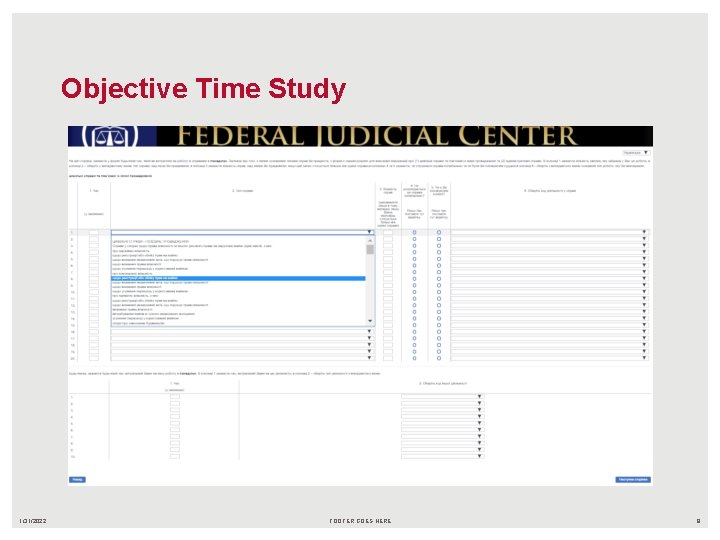
Methodology (developed by Federal Judicial Center, Dr. Elizabeth M. Wiggins) 1. Estimation Study Judges provide their estimates on how much time consideration of cases takes 2. Objective time study Judges keep time logs over a certain period of time to record their activities 1/31/2022 FOOTER GOES HERE 6
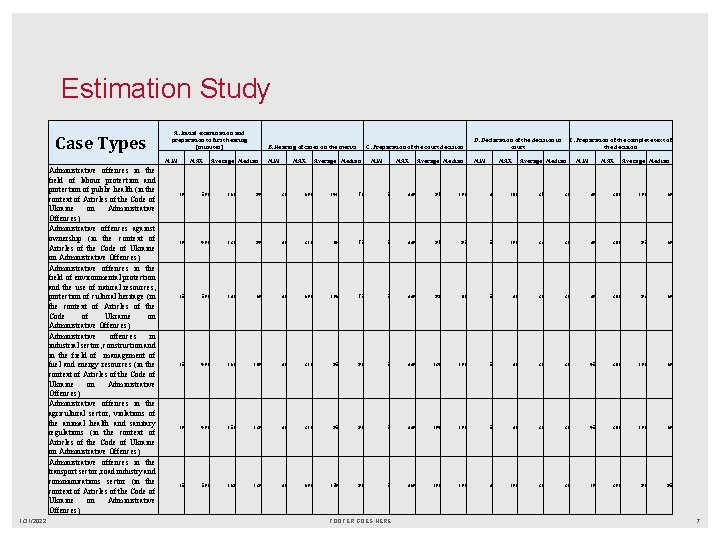
Estimation Study Case Types A. Initial examination and preparation to first hearing (minutes) MIN Administrative offences in the field of labour protection and protection of public health (in the context of Articles of the Code of Ukraine on Administrative Offences) Administrative offences against ownership (in the context of Articles of the Code of Ukraine on Administrative Offences) Administrative offences in the field of environmental protection and the use of natural resources, protection of cultural heritage (in the context of Articles of the Code of Ukraine on Administrative Offences) Administrative offences in industrial sector, construction and in the field of management of fuel and energy resources (in the context of Articles of the Code of Ukraine on Administrative Offences) Administrative offences in the agricultural sector, violations of the animal health and sanitary regulations (in the context of Articles of the Code of Ukraine on Administrative Offences) Administrative offences in the transport sector, road industry and communications sector (in the context of Articles of the Code of Ukraine on Administrative Offences) 1/31/2022 MAX B. Hearing of cases on the merits Average Median MIN MAX C. Preparation of the court decision Average Median MIN MAX Average Median D. Declaration of the decision in court MIN MAX E. Preparation of the complete text of the decision Average Median MIN MAX Average Median 10 500 161 90 20 600 141 70 5 330 97 100 3 180 27 20 30 280 100 60 10 400 126 90 30 210 84 75 5 330 97 95 5 100 23 20 30 280 95 60 15 500 131 60 30 600 106 75 5 330 99 80 5 30 20 20 30 280 92 60 15 400 166 180 30 210 95 90 5 330 124 100 5 30 21 20 45 280 108 60 10 400 150 120 30 210 95 90 5 330 104 100 5 30 21 20 45 280 108 60 15 500 169 120 30 600 159 90 5 360 108 100 3 100 28 20 10 200 98 95 FOOTER GOES HERE 7
Objective Time Study 1/31/2022 FOOTER GOES HERE 8
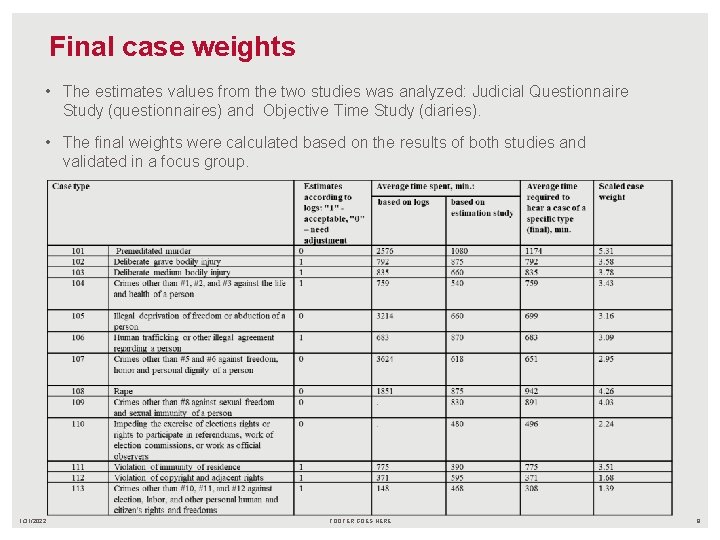
Final case weights • The estimates values from the two studies was analyzed: Judicial Questionnaire Study (questionnaires) and Objective Time Study (diaries). • The final weights were calculated based on the results of both studies and validated in a focus group. 1/31/2022 FOOTER GOES HERE 9
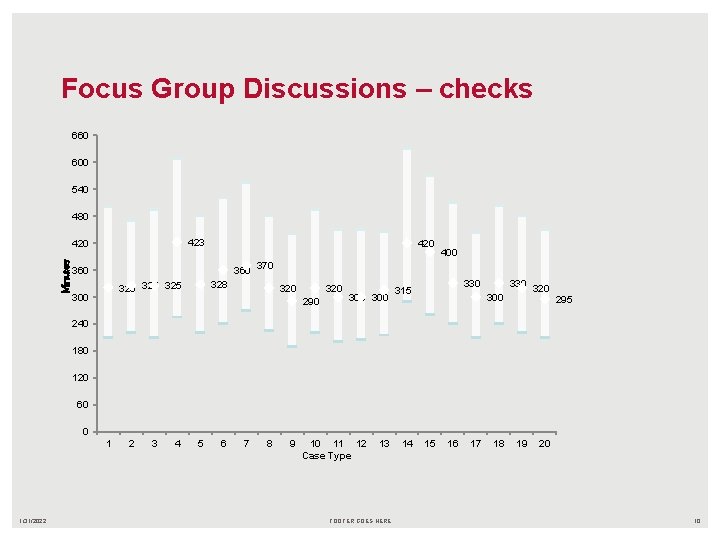
Focus Group Discussions – checks 660 600 540 480 423 Minutes 420 400 360 370 360 328 320 325 300 320 290 300 330 315 300 330 320 295 240 180 120 60 0 1 1/31/2022 2 3 4 5 6 7 8 9 10 11 12 Case Type 13 FOOTER GOES HERE 14 15 16 17 18 19 20 10
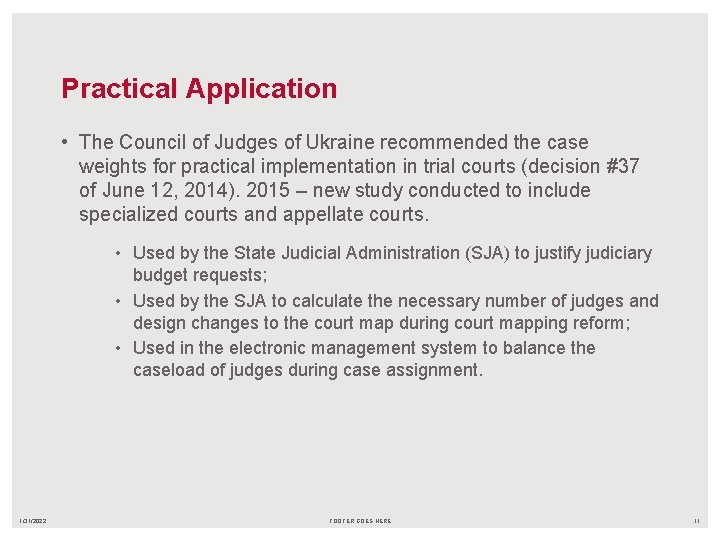
Practical Application • The Council of Judges of Ukraine recommended the case weights for practical implementation in trial courts (decision #37 of June 12, 2014). 2015 – new study conducted to include specialized courts and appellate courts. • Used by the State Judicial Administration (SJA) to justify judiciary budget requests; • Used by the SJA to calculate the necessary number of judges and design changes to the court map during court mapping reform; • Used in the electronic management system to balance the caseload of judges during case assignment. 1/31/2022 FOOTER GOES HERE 11
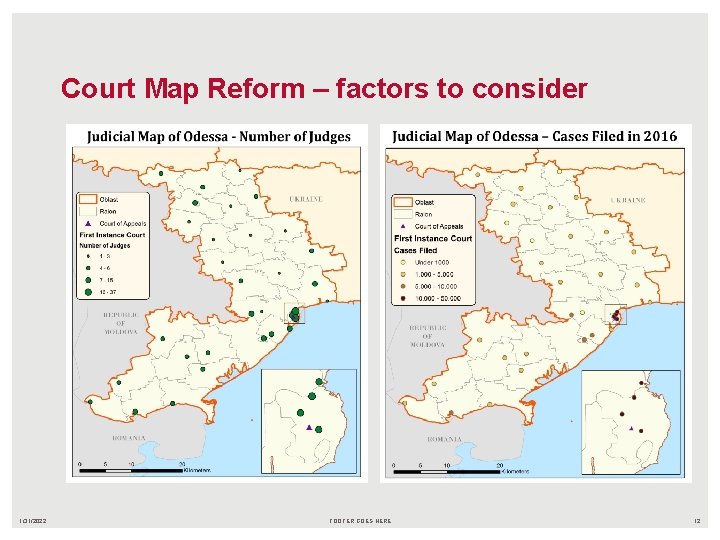
Court Map Reform – factors to consider 1/31/2022 FOOTER GOES HERE 12
LESSONS LEARNED • Lengthy data analysis because of numerous input errors and huge data volume; • Use modern data collection tools such as electronic surveys; • Check data reliability; • Focus groups are a must; • Update to reflect changes in procedure. 1/31/2022 FOOTER GOES HERE 13
THANK YOU! 1/31/2022 FOOTER GOES HERE 14