
Judicial Review and Disclosure Martin Chamberlain QC Emily
Judicial Review and Disclosure Martin Chamberlain QC, Emily Mac. Kenzie, Jennifer Mac. Leod Brick Court Chambers 9 th October 2014 brickcourt. co. uk +44 (0)20 7379 3550
Introduction to Judicial Review Jennifer Mac. Leod Brick Court Chambers 9 October 2014 brickcourt. co. uk +44 (0)20 7379 3550
Judicial Review § A pain in the backside? • • “A lucrative industry” “A legal delaying tactic” Part of the “campaigner’s armoury” A way for campaigners to “get media coverage for their cause” -Chris Grayling, The judicial review system is not a promotional tool for countless Left-wing campaigners, Daily Mail, 11 September 2013. § Or a constitutional fundamental? • “one of the most important means by which the Government and other public bodies are held legally accountable for the lawfulness of their decisions and actions, including their compatibility with the requirements of human rights law” - Joint Committee on Human Rights, The implications for access to justice of the Government’s proposals to reform judicial review, 2014 brickcourt. co. uk +44 (0)20 7379 3550
What is a judicial review claim? § “a ‘claim for judicial review’ means a claim to review the lawfulness of- i) an enactment; or ii) a decision, action or failure to act in relation to the exercise of a public function” (CPR 54. 1(2)(a)) brickcourt. co. uk +44 (0)20 7379 3550
Who can be reviewed? § A body exercising a “public function” • Focus on the substance and effects of function rather than personality of defendant § In the case of a human rights claim; a “public authority” (Human Rights Act 1998, s 7) § In other words: Tf. L brickcourt. co. uk +44 (0)20 7379 3550
What can be reviewed? (1) § Essentially, the acts of public bodies • Includes delegated legislation, legislative acts by the EU, and, exceptionally, Acts of Parliament. § Decisions • • Broad concept Includes failure to take action In many cases, a decision will be “elicited” by an applicant Examples: • • Taking regulatory/disciplinary action Granting or refusing a licence/subsidy Failure to discharge/exercise a statutory power Extreme delay in reaching a decision when that harms the applicant brickcourt. co. uk +44 (0)20 7379 3550
What can be reviewed? (2) § Policies or guidance documents • Includes non-binding recommendations and advice • Could include the issuance or failure to issue general guidelines or policy brickcourt. co. uk +44 (0)20 7379 3550
On what grounds can an act be reviewed? (1) § Two broad categories: procedural and substantive unlawfulness § Procedural grounds (1): • Failure to provide a fair hearing • A “fair hearing” depends on the context • Failure to provide adequate reasons • Must have reasons • Reasons must enable the reader to understand: i) why the matter was decided as it was; (ii) what conclusions were reached on main issues; and iii) how issues of fact were resolved • Must not give rise to doubt as to error of law • Failure to provide access to relevant documents • Again, depends on what is fair in the context. • Sometimes, confidentiality can override brickcourt. co. uk +44 (0)20 7379 3550
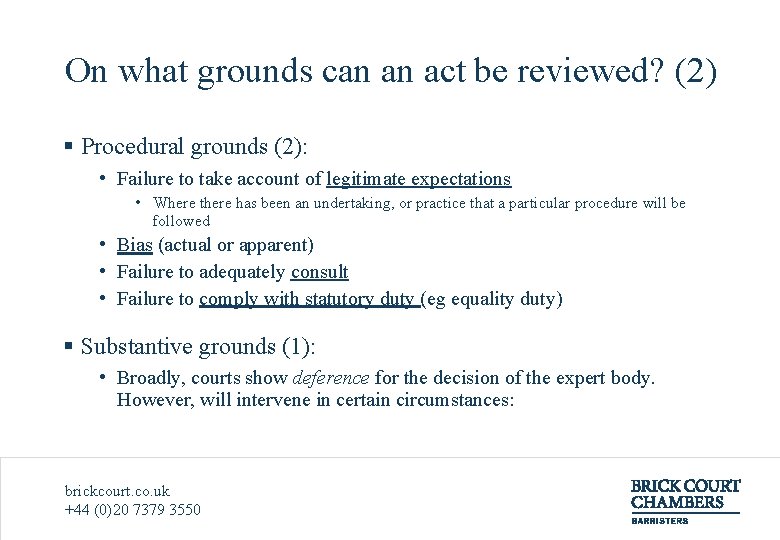
On what grounds can an act be reviewed? (2) § Procedural grounds (2): • Failure to take account of legitimate expectations • Where there has been an undertaking, or practice that a particular procedure will be followed • Bias (actual or apparent) • Failure to adequately consult • Failure to comply with statutory duty (eg equality duty) § Substantive grounds (1): • Broadly, courts show deference for the decision of the expert body. However, will intervene in certain circumstances: brickcourt. co. uk +44 (0)20 7379 3550
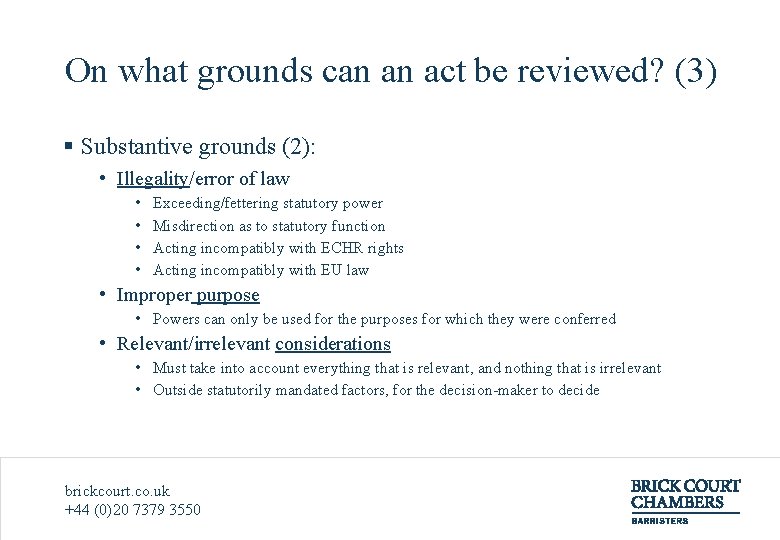
On what grounds can an act be reviewed? (3) § Substantive grounds (2): • Illegality/error of law • • Exceeding/fettering statutory power Misdirection as to statutory function Acting incompatibly with ECHR rights Acting incompatibly with EU law • Improper purpose • Powers can only be used for the purposes for which they were conferred • Relevant/irrelevant considerations • Must take into account everything that is relevant, and nothing that is irrelevant • Outside statutorily mandated factors, for the decision-maker to decide brickcourt. co. uk +44 (0)20 7379 3550
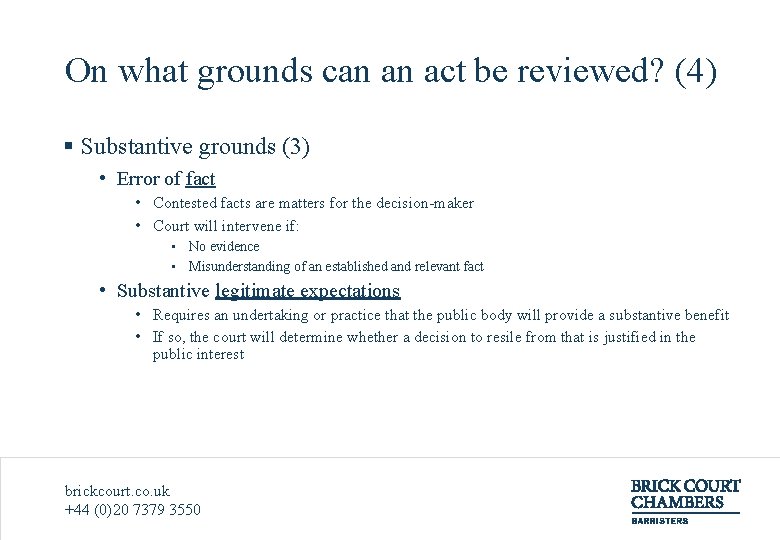
On what grounds can an act be reviewed? (4) § Substantive grounds (3) • Error of fact • Contested facts are matters for the decision-maker • Court will intervene if: • No evidence • Misunderstanding of an established and relevant fact • Substantive legitimate expectations • Requires an undertaking or practice that the public body will provide a substantive benefit • If so, the court will determine whether a decision to resile from that is justified in the public interest brickcourt. co. uk +44 (0)20 7379 3550
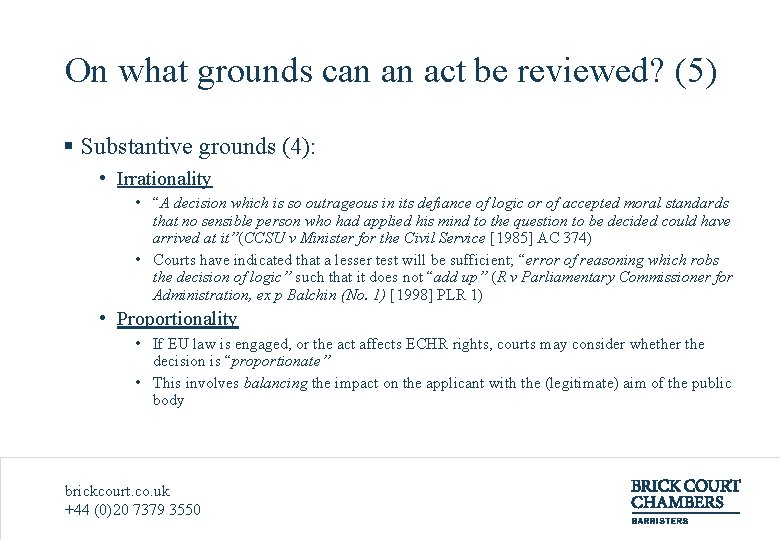
On what grounds can an act be reviewed? (5) § Substantive grounds (4): • Irrationality • “A decision which is so outrageous in its defiance of logic or of accepted moral standards that no sensible person who had applied his mind to the question to be decided could have arrived at it”(CCSU v Minister for the Civil Service [1985] AC 374) • Courts have indicated that a lesser test will be sufficient; “error of reasoning which robs the decision of logic” such that it does not “add up” (R v Parliamentary Commissioner for Administration, ex p Balchin (No. 1) [1998] PLR 1) • Proportionality • If EU law is engaged, or the act affects ECHR rights, courts may consider whether the decision is “proportionate” • This involves balancing the impact on the applicant with the (legitimate) aim of the public body brickcourt. co. uk +44 (0)20 7379 3550
Who can bring a claim for judicial review? § Governed by rules on standing • Applicant must have “sufficient interest” (Senior Courts Act 1981, s 31(3)) • Or, if claim rights have been violated, must be a “victim” (Human Rights Act 1998, s 7) • Can include: • a public spirited citizen (if serious issue of public importance (R v SS for Foreign and Commonwealth Affairs Ex p. Lord Rees-Mogg [1994] QB 552) • Campaign organisations (eg R v SS for Foreign and Commonwealth Affairs Ex p World Development Movement Ltd [1995] 1 WLR 386) brickcourt. co. uk +44 (0)20 7379 3550
Procedure of judicial review § Pre-Action Protocol • Letter before action • Respondent normally has to respond in 14 days § Time limit • A claim must be filed “promptly”, and “in any event not later than 3 months after the grounds to make the claim first arose” (CPR r 54. 5(1)) • Thus can be shorter than 3 months (R v Independent Television Commission Ex p. TV NI Ltd, The Times, December 30, 1991) § 2 Stage process • Permission (normally on the papers alone, can request reconsideration at an oral permission hearing) • Merits brickcourt. co. uk +44 (0)20 7379 3550
Disclosure in judicial review (1) § Disclosure generally • Proceedings are adversarial, not investigative, but a move towards “cards on the table” litigation • Part of this comes from “disclosure”; providing the other side with the relevant documents • Two stage process: 1) Documents are “disclosed” in different categories; and 2) Documents can then be “inspected” § Disclosure in relation to JR • • CPR Part 31 (governing disclosure) does not apply to JR (CPR PD 54 A(12. 1)) Disclosure is “not required unless the court orders otherwise” (CPR PD 54 A(12. 1)) However, public authorities who are respondents are subject to a “duty of candour” Ordinarily, no need for an order, because Defendants are expected to comply with their duty, but can be granted if further disclosure is sought or needed brickcourt. co. uk +44 (0)20 7379 3550
Disclosure in judicial review (2) § Disclosure in relation to JR • Made by way of application if not agreed • More likely if there are disputes of fact (more likely in human rights cases), or if there are concerns over volume or confidentiality • The test is whether disclosure “appears to be necessary in order to resolve the matter fairly and justly” or it is “necessary for fairly disposing of the case” (Tweed v Parades Commission [2007] 1 AC 650, paras 3 and 38) • Risk: if proper disclosure is not made, costs orders may follow (see eg R (Al-Sweady) v Secretary of State for Defence [2009] EWHC 1687) • In essence, disclosure in judicial review can now be ordered in a similar way to an ordinary action (see R (Al-Sweady) v SS for Defence [2009] EWHC 2387 (Admin), para 27), and can include pre-action disclosure in exceptional circumstances (British Union for the Abolition of Vivisection v SSHD [2014] EWHC 43 (Admin)) brickcourt. co. uk +44 (0)20 7379 3550
Disclosure in judicial review (3) § Duty of Candour: • The duty of candour: “A public authority’s objective must not be to win the litigation at all costs but to assist the court in reaching the correct result and thereby to improve standards in public administration” • Public authority must be open and honest in disclosing the facts and information needed for the fair determination of the issue • Ordinarily meets this duty by way of a witness statement exhibiting key documents (see Tsol’s 2010 Guidance). This witness statement should be clear. • If intending to rely on a document, should always be exhibited (Tweed, para 4) • Duty extends to documents/information that will assist the applicant’s case • Duty extends to documents giving rise to additional grounds of challenge • Applies throughout proceedings: includes documents that comes to light late in proceedings • Duty rests on the lawyer to ensure proper disclosure. brickcourt. co. uk +44 (0)20 7379 3550
Disclosure in judicial review (4) § Duty of Candour: Tsol’s “Golden Rules” • Litigation case-handler must have overall responsibility for the disclosure exercise • Take steps to preserve all potentially relevant documents as soon as proceedings are likely • Start early, and formulate, record and implement a strategy for conducting the disclosure exercise based on an understanding of the issues in the case and knowledge of the systems for record-keeping • Maintain a record of what has been seen and by whom and the decisions taken • A document which is disclosable must be disclosed even if it is embarrassing or damaging to a party’s case • Before giving inspection look at the output of the disclosure as the claimant will; see what is not there as well as what is there • Devote sufficient resources from the outset to ensure that the process can be, and is, conducted on time and properly § Tsol’s 2010 Guidance on Discharging the Duty of Candour and Disclosure in Judicial Review Proceedings brickcourt. co. uk +44 (0)20 7379 3550
Judicial Review Remedies § If successful, court can order a remedy at its discretion § Can make/order a: • • Quashing order (often quashed and remitted to decision maker) Prohibiting order Mandatory order Declaration Injunction Damages Interim relief brickcourt. co. uk +44 (0)20 7379 3550
Reform of Judicial Review: History § Governmental concern regarding increasing volume of judicial review cases § Government consulted on reforms to JR in 2013. Included in particular: • • • Restrictions on standing Restrictions on legal aid and protective costs orders Restrictions on cases where there was no difference to the outcome Questioned the need for a public sector equality duty See Judicial Review: Proposals for further reform (Cm 8703, September 2013) § Sparked significant concern in the legal community • See the Joint Committee for Human Rights, The implications for access to justice of the Government’s proposals to reform judicial review brickcourt. co. uk +44 (0)20 7379 3550
Reform of Judicial Review: Current Proposals § Current (watered down) proposal includes: • Restrictions on claims that can be brought where a change in the procedure would have been unlikely to make a difference to the outcome • A “tough package of reform to financial provisions…to deter weak claims from being brought or pursued” • • - Restriction on legal aid unless claims are granted permission Costs awards against unsuccessful claimants at oral permission hearings A stricter approach to protective costs orders Costs consequences for interveners Greater powers to identify “non-parties” involved with a claim and ensure they cannot avoid liability for costs - More provision for “leapfrogging” appeals-straight to the UKSC - Ministry of Justice, Judicial Review – proposals for further reform: the Government Response, February 2014 brickcourt. co. uk +44 (0)20 7379 3550

Thank you Jennifer Mac. Leod www. brickcourt. co. uk +44 (0)20 7379 3550
The Duty to Consult and The Public Sector Equality Duty Emily Mac. Kenzie Brick Court Chambers 9 October 2014 brickcourt. co. uk +44 (0)20 7379 3550
Consultation brickcourt. co. uk +44 (0)20 7379 3550
Cabinet Office Consultation Principles § Published July 17, 2012 § No legal force (i. e. cannot prevail over statutory or mandatory external requirements) § But should generally be regarded as binding on UK departments/agencies, unless exceptional circumstances require a departure from them brickcourt. co. uk +44 (0)20 7379 3550
What is the point of consultation? ‘There may be a number of reasons to consult: to garner views and preferences, to understand possible unintended consequences of a policy or to get views on implementation. Increasing the level of transparency and increasing engagement with interested parties improves the quality of policy making by bringing to bear expertise and alternative perspectives, and identifying unintended effects and practical problems. ’ (Cabinet Office Consultation Principles) brickcourt. co. uk +44 (0)20 7379 3550
Case-study: proposed changes to bus routes § Tf. L is considering amending bus provision on a particular route by: • Altering the route to decrease journey times; and • Changing the frequency of buses, to provide more buses at peak hours and fewer at off-peak hours. § Benefits of consultation: • Identify those affected and scale of impact upon them • Identify potential unforeseen consequences – e. g. school routes, access to facilities, impact on vulnerable stakeholders. brickcourt. co. uk +44 (0)20 7379 3550
General guidance on when you should consult ‘There may be circumstances where formal consultation is not appropriate, for example, where the measure is necessary to deal with a court judgment or where adequate consultation has taken place at an earlier stage for minor or technical amendments to regulation or existing policy frameworks. However, longer and more detailed consultation will be needed in situations where smaller, more vulnerable organisations such as small charities could be affected. The principles of the Compact between government and the voluntary and community sector must continue to be respected. ’ (Cabinet Office Consultation Principles) brickcourt. co. uk +44 (0)20 7379 3550
When is there a duty to consult? § Imposed by statute (e. g. Greater London Authority Act 1999, section 183) § If represent that a consultation will take place § If represent that concerns and wishes will be taken into account § Note: • Come under a duty to carry out a consultation properly once one is embarked upon • Cannot rely upon limited scope of statutory duty if embark upon fuller consultation brickcourt. co. uk +44 (0)20 7379 3550
Who to consult? § Imposed by statute? E. g. Greater London Authority Act 1999, section 183 provides that Tf. L must consult with: • the commissioner or commissioners of police affected, • the London authorities affected, • the London Transport Users' Committee, and • ‘any other person whom Transport for London considers it appropriate to consult. ’ brickcourt. co. uk +44 (0)20 7379 3550
Who to consult cont. § Attempt to identify stakeholders in policy/proposed policy § Consultation must attempt to capture the full range § Consider how to engage vulnerable/hard to reach groups – e. g. if the bus route to be altered runs past a nursing home? brickcourt. co. uk +44 (0)20 7379 3550
What does the duty comprise? ‘To be proper, consultation must be undertaken at a time when proposals are still at a formative stage; it must include sufficient reasons for particular proposals to allow those consulted to give intelligent consideration and an intelligent response; adequate time must be given for this purpose; and the product of consultation must be conscientiously taken into account when the ultimate decision is taken. ’ (R. v North and East Devon HA Ex p. Coughlan, [2001] Q. B. 213, [208]) See also the ‘Sedley requirements’ (R. v Brent LBC ex parte Gunning (1985) 84 LGR 168) brickcourt. co. uk +44 (0)20 7379 3550
Timing and length of consultation When? § When proposals are at a formative stage § When views can genuinely be taken into account § Ensure consulted party able to address concerns of decision-maker § Have regard to holiday periods and other busy periods – e. g. elections How long for? § Proportionality – realistic timeframe to allow considered response § Usually between 2 and 12 weeks brickcourt. co. uk +44 (0)20 7379 3550
Content of the consultation § Will depend on wording and statutory context where duty is imposed by statute § General principles: • Must clearly state purpose and policy areas capable of being influenced • Must include consultation on every viable option • If phased, must have opportunity to consider full package at some stage • Must be on specific proposals, not general ideas • Consultees must be aware of pertinent criteria/factors and their relative importance § Duties of disclosure: • ‘Candid disclosure’ of reasons behind proposals • Must disclose documents material to determination to be made, if public has ‘legitimate interest’ brickcourt. co. uk +44 (0)20 7379 3550
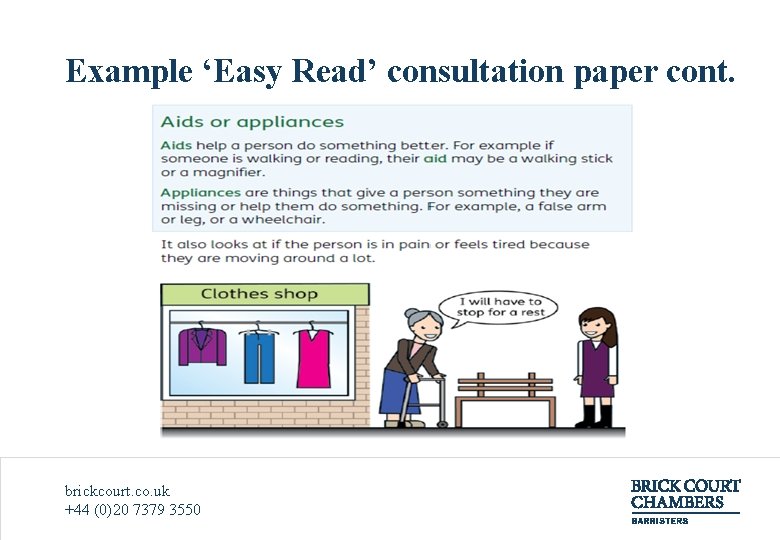
Method of consulting § Information should be easy to comprehend § Consider informal methods – e. g. e-mail, web forum, public meeting , working group, focus group, surveys (Cabinet Office Consultation Principles) § Tailor information provision for vulnerable stakeholders § House on. GOV. UK web platform brickcourt. co. uk +44 (0)20 7379 3550
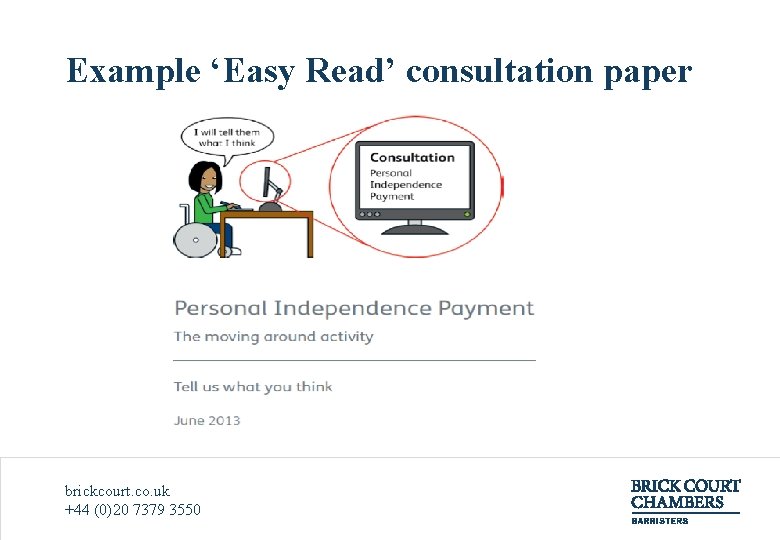
Example ‘Easy Read’ consultation paper brickcourt. co. uk +44 (0)20 7379 3550
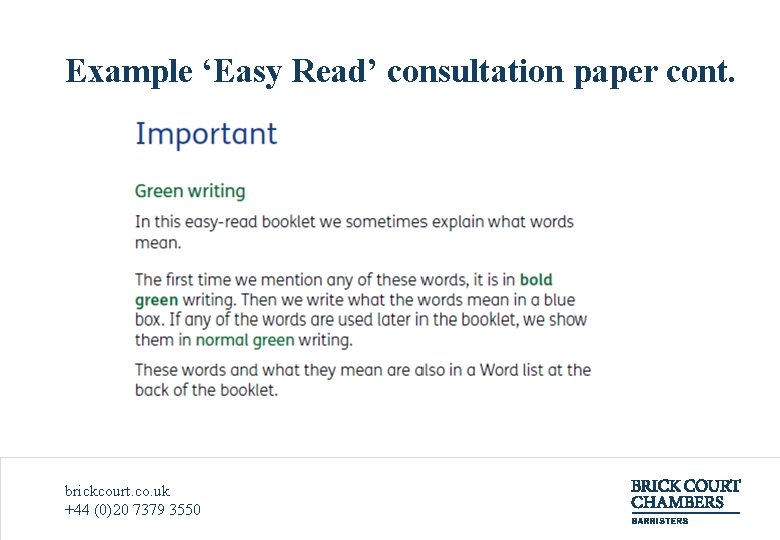
Example ‘Easy Read’ consultation paper cont. brickcourt. co. uk +44 (0)20 7379 3550
Example ‘Easy Read’ consultation paper cont. brickcourt. co. uk +44 (0)20 7379 3550
Considering representations and publishing results Duty of ‘conscientious consideration’ of representations § Have written representations before decision-maker § Generate evidence that all representations have been considered – e. g. minutes of meetings § Address representations in a report What to do with the results? § Publish document summarising responses § Publish detailed response (usually within 12 weeks) brickcourt. co. uk +44 (0)20 7379 3550
The duty to re-consult § Fundamental difference between proposals you consulted on and proposals you wish to adopt § Material or factor of potential significance § Vitiation of consultation brickcourt. co. uk +44 (0)20 7379 3550
Public Sector Equality Duty brickcourt. co. uk +44 (0)20 7379 3550
The duty Equality Act 2010, section 149: (1) A public authority must, in the exercise of its functions, have due regard to the need to— a) eliminate discrimination, harassment, victimisation and any other conduct that is prohibited by or under this Act; b) advance equality of opportunity between persons who share a relevant protected characteristic and persons who do not share it; c) foster good relations between persons who share a relevant protected characteristic and persons who do not share it. brickcourt. co. uk +44 (0)20 7379 3550
The protected characteristics 1. 2. 3. 4. 5. 6. 7. 8. age disability gender reassignment pregnancy and maternity race religion or belief sexual orientation (Equality Act 2010, s. 149(7)) brickcourt. co. uk +44 (0)20 7379 3550
A duty of ‘due regard’ § Not a duty to achieve particular results, or take particular steps § But still mandatory to consider it § Not mere ‘box-ticking’, but substantial, rigorous, open-minded consideration § Due regard to need to ‘eliminate’, ‘advance’, ‘foster’, rather than simply to ‘promote’ brickcourt. co. uk +44 (0)20 7379 3550
What is equality of opportunity? Having due regard to the need to advance equality of opportunity between persons who share a relevant protected characteristic and persons who do not share it involves having due regard, in particular, to the need to— a) remove or minimise disadvantages suffered by persons who share a relevant protected characteristic that are connected to that characteristic; b) take steps to meet the needs of persons who share a relevant protected characteristic that are different from the needs of persons who do not share it; c) encourage persons who share a relevant protected characteristic to participate in public life or in any other activity in which participation by such persons is disproportionately low. (Equality Act 2010, s. 149(2)) brickcourt. co. uk +44 (0)20 7379 3550
How to foster good relations Having due regard to the need to foster good relations between persons who share a relevant protected characteristic and persons who do not share it involves having due regard, in particular, to the need to— a) tackle prejudice, and b) promote understanding. (Equality Act 2010, s. 149(3)) brickcourt. co. uk +44 (0)20 7379 3550
When to consider the duty? § ‘In the exercise of its functions’ § Before and at the time that policy/change is being considered § Must be possible for due regard to influence outcome of decision brickcourt. co. uk +44 (0)20 7379 3550
Judicial review of compliance with the duty § Not highly susceptible to review. § But some common pitfalls: • Not having regard to the duty at all, or having no evidence of regard • Inadequate regard – e. g. failure to consider practical impact, insufficiently conscientious regard • Unreasonable/irrational assessment of the weight of equality factors countervailing the policy choice brickcourt. co. uk +44 (0)20 7379 3550
Equality Impact Assessments § Not a box-ticking exercise § A bad example: ‘We have considered whether the proposed changes to the bus route would have a particular impact upon persons with disabilities. However, as the number of wheelchair spaces on buses will continue to exceed the average number of wheelchair users on this bus route, we do not consider that persons with disabilities will be disproportionately disadvantaged by the changes. ’ brickcourt. co. uk +44 (0)20 7379 3550
Equality Impact Assessments cont. § Ask more nuanced questions: • • • What about disabled people who do not use wheelchairs? Are persons with disabilities more likely to travel at a particular time? What is the impact of bus stop waiting times on disabled persons? What will be the effect of the route change on disabled persons? Are disabled persons more likely to make shorter journeys, and therefore to find a bus route with fewer stops less useful? • Alternative provisions to mitigate the impact? brickcourt. co. uk +44 (0)20 7379 3550

Thank you Emily Mac. Kenzie www. brickcourt. co. uk +44 (0)20 7379 3550
How to take and present decisions in a way that minimises the risk of public law challenge Martin Chamberlain QC Brick Court Chambers 9 th October 2014 brickcourt. co. uk +44 (0)20 7379 3550
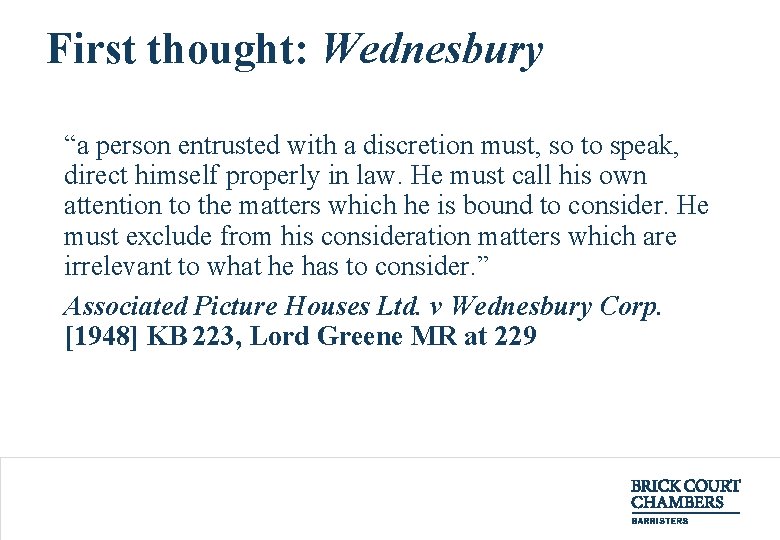
First thought: Wednesbury “a person entrusted with a discretion must, so to speak, direct himself properly in law. He must call his own attention to the matters which he is bound to consider. He must exclude from his consideration matters which are irrelevant to what he has to consider. ” Associated Picture Houses Ltd. v Wednesbury Corp. [1948] KB 223, Lord Greene MR at 229
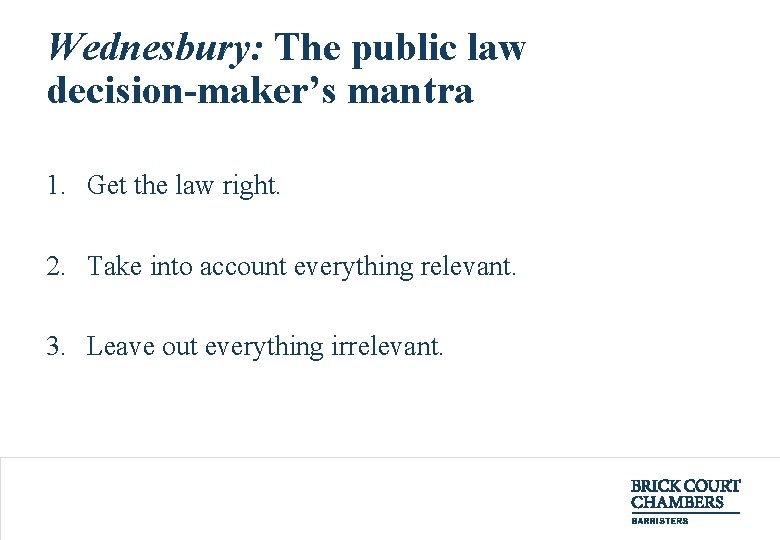
Wednesbury: The public law decision-maker’s mantra 1. Get the law right. 2. Take into account everything relevant. 3. Leave out everything irrelevant.
Getting the law right 1. Identify the primary and/or secondary statutory source for the function you are exercising. 2. Does it impose a duty or confer a power? 3. Are there any statutory preconditions?
Widgets S. 1 of the Widgets (Miscellaneous Provisions) Act 2012: “(1) Any person may apply to Transport for London for a London widgets licence. (2) Transport for London shall grant a London widgets licence to the applicant if it is satisfied that— (a) the applicant is a fit and proper person to hold a London widgets licence; and (b) any further requirements that may be prescribed are met. ”
An attempt at setting out the legal test “Tf. L is empowered by s. 1 of the Widgets (Miscellaneous Provisions) Act 2012 to issue licences to persons it considers suitable and qualified to make and sell widgets. ”
Mistake #1 “Empowered” suggests a power, but s. 1(2) imposes a duty to grant where the preconditions are satisfied.
Mistake #2 “Suitable and qualified” sounds like a reasonable synonym for “fit and proper”, but is it? Could someone be fit and proper but not qualified?
How to set out the test in a JR-proof way “Section 1(2) of the Widgets (Miscellaneous Provisions) Act 2012 requires Tf. L to grant you a London widgets licence if it is satisfied that you are a fit and proper person to hold such a licence. ”
Rules for setting out the statutory test • Read the statute carefully. • Do not omit any important words. • Do NOT paraphrase or add qualifying words.
Identifying the relevant factors “. . . what is and what is not a relevant consideration for a public decision-maker to have in mind is (absent a statutory code of compulsory considerations) for the decision-maker, not the court, to decide” R (Al Rawi) v Secretary of State for Foreign and Commonwealth Affairs [2008] QB 289, Laws LJ at [131]
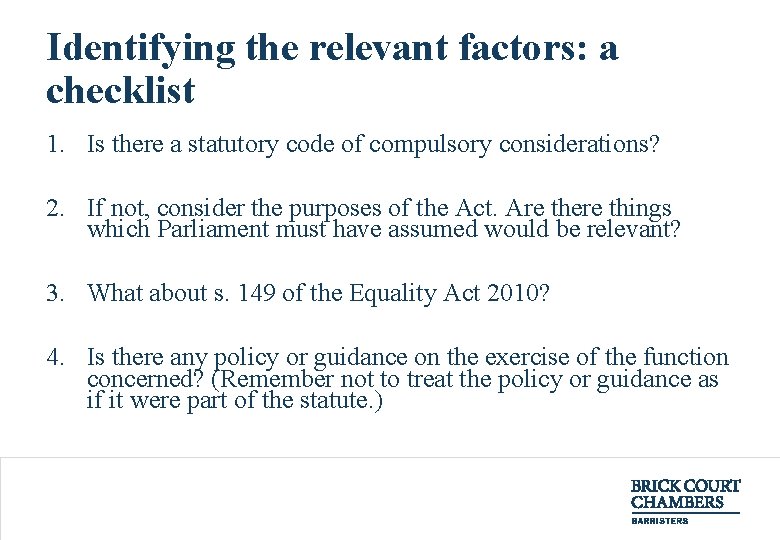
Identifying the relevant factors: a checklist 1. Is there a statutory code of compulsory considerations? 2. If not, consider the purposes of the Act. Are there things which Parliament must have assumed would be relevant? 3. What about s. 149 of the Equality Act 2010? 4. Is there any policy or guidance on the exercise of the function concerned? (Remember not to treat the policy or guidance as if it were part of the statute. )
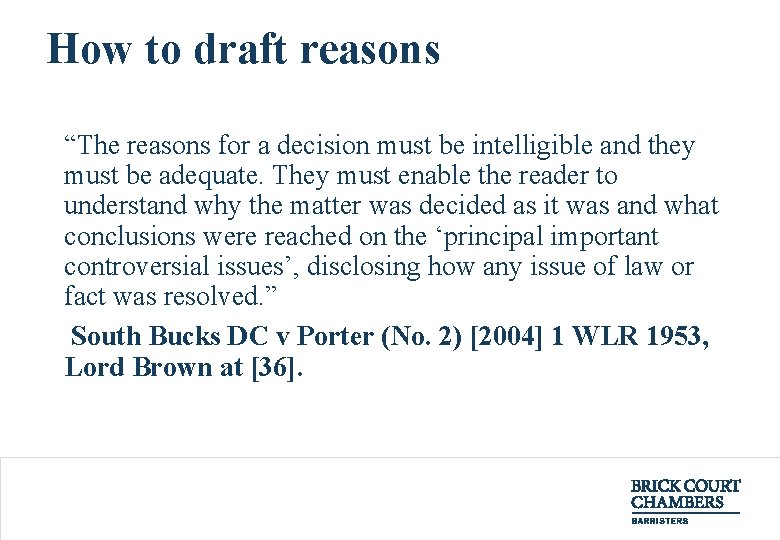
How to draft reasons “The reasons for a decision must be intelligible and they must be adequate. They must enable the reader to understand why the matter was decided as it was and what conclusions were reached on the ‘principal important controversial issues’, disclosing how any issue of law or fact was resolved. ” South Bucks DC v Porter (No. 2) [2004] 1 WLR 1953, Lord Brown at [36].
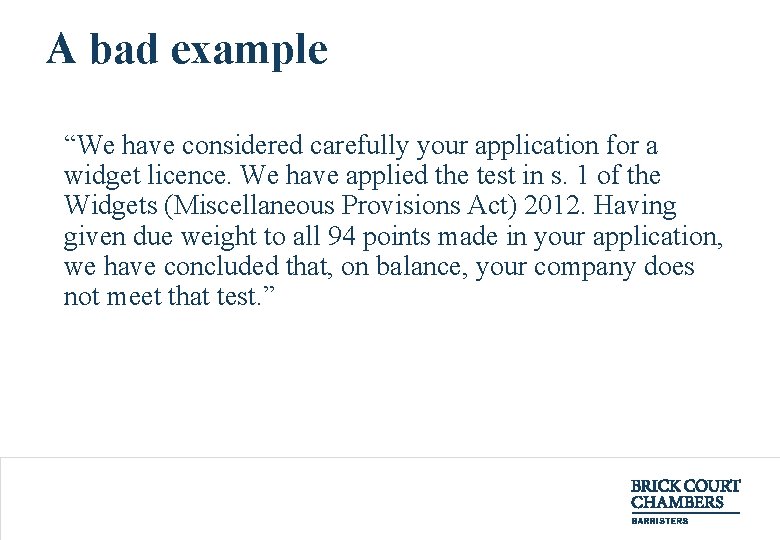
A bad example “We have considered carefully your application for a widget licence. We have applied the test in s. 1 of the Widgets (Miscellaneous Provisions Act) 2012. Having given due weight to all 94 points made in your application, we have concluded that, on balance, your company does not meet that test. ”
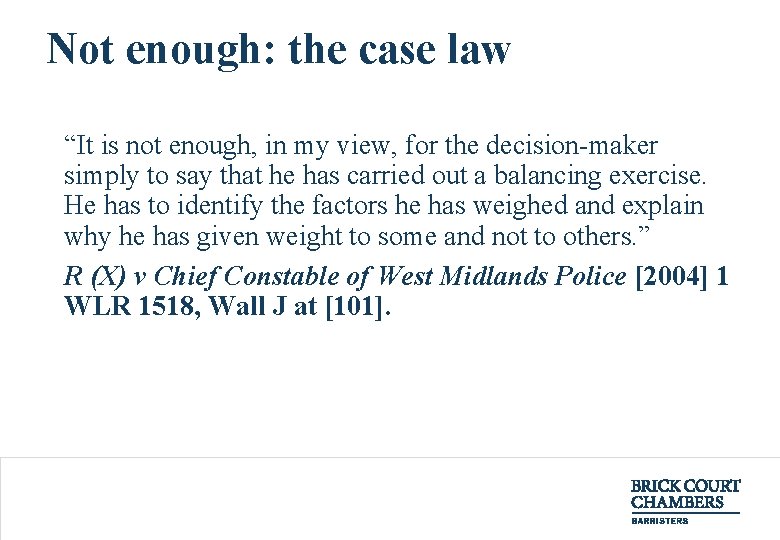
Not enough: the case law “It is not enough, in my view, for the decision-maker simply to say that he has carried out a balancing exercise. He has to identify the factors he has weighed and explain why he has given weight to some and not to others. ” R (X) v Chief Constable of West Midlands Police [2004] 1 WLR 1518, Wall J at [101].
Tip #1 • A decision letter is not a political statement or a press release. It is not an exercise in spin. • Your task is to take everything relevant into account and show it. • So make sure you pay particular attention to the points tending against the decision you are making (rather than the points in favour).
Cutting the widget subsidy: the press release/political statement “In this Olympic year, the Mayor has decided to focus funding on the areas where it will benefit Londoners most. He has every confidence that the widget industry will go from strength to strength in the year ahead without the need for bloated public subsidies. ”
Cutting the widget subsidy: the decision letter “The Mayor has given careful consideration to the representations made in your letter. He accepts that his decision may mean that some widget-makers will go out of business. He accepts also, on the basis of the statistical evidence you have provided, that these are likely to be drawn disproportionately from black and minority ethnic communities. ”
The decision letter continued “However, the Mayor has decided that, despite these adverse effects, the financial constraints imposed upon him are such that continuing to subsidise widget manufacturers at this time would inevitably entail the withdrawal of funding from other important programmes, including some that are of direct and disproportionate benefit to black and minority ethnic communities. ”
Tip #2 • Don’t reach firm conclusions on points that don’t matter.
The elephant trap “You claim that the words ‘fit and proper’ are apt to cover issues of character only (such as cases where the applicant has relevant criminal convictions). We disagree. In our view, the test is a broad one. It enables us to refuse a licence for any reason if we consider the applicant to be unsuitable or unqualified to make and sell widgets. ”
Sidestepping the elephant trap “For the purposes of this decision, Tf. L does not need to express any view on the question of statutory interpretation raised in your letter. Even if, as you have submitted, the words ‘fit and proper’ are limited to issues of character (such as cases where the applicant has relevant criminal convictions), your company’s conviction for the fraudulent sale of widgets without a licence would be a sufficient basis to conclude that you do not meet the statutory test. ”
Tip #3 • Think hard before categorising representations as irrelevant. • If you are going to do so, say what conclusion you would have reached if they had been relevant.
How not to be caught out on relevance “We note the point you make in paragraphs 64 -87 of your representations about the effects of a decision not to grant a licence on your employees and existing customers. We doubt that there points are ones which we are permitted to take into account under the statutory scheme. But even if they were, they would not, in our view, outweigh the matters set out above. ”
Tip #4 • If you have several reasons, say whether they are cumulative or free-standing.
Cumulative reasons “Tf. L has decided, on balance, that it is not satisfied that you are a fit and proper person to hold a London widget licence. It has reached that decision taking into account three principal factors. . . ” The decision will be amenable to challenge if any of the three factors is legally (or, in certain circumstances, factually) flawed.
Free-standing reasons “In reaching its conclusion that you are not a fit and proper person to hold a widget licence, Tf. L relies on three matters, any of which alone would be sufficient to justify the conclusion. ” The decision will be amenable to challenge only if all three matters are flawed.
Case study: electric taxis • Tf. L has power to prescribe conditions of fitness for London taxis. • The current conditions of fitness include a requirement that a taxi must be able to accommodate a standard size wheelchair. • A manufacturer of electric vehicles proposes a new electric taxi, with zero emissions. But for technological reasons, it has to be smaller and cannot accommodate a wheelchair.
Equality considerations • Section 149(1) Equality Act 2010. Must have due regard to the need to (a) eliminate discrimination, (b) advance equality of opportunity between disabled and non-disabled. • That includes (a) removing or minimising disadvantages, (b) taking steps to meet the needs of disabled persons, (c) encouraging disabled persons to participate in activities in which participation is disproportionately low.
Other considerations? • Other equality considerations? • Air quality? • Climate change? • Any applicable Mayoral policies?
The press release/political statement (ie how not to write a decision letter) “The Mayor is delighted to be able to usher in a new breed of silent, sleek, efficient electric taxis. They will be a brilliant addition to London’s existing fleet, giving all Londoners an additional modern green transport option. ”

Thank you Martin Chamberlain QC www. brickcourt. co. uk +44 (0)20 7379 3550
- Slides: 83