
Judicial Internship Info Session Office of Career Development

- Slides: 32
Judicial Internship Info Session Office of Career Development & Public Service October 22, 2020 Blair Edwards, Associate Director for Judicial Clerkships & the Private Sector – edwards 2@bu. edu Caroline Brantley, Sr. Program Coordinator for Judicial Clerkships & Pro Bono clerkltr@bu. edu
Overview
What is a judicial internship? • Summer position where a law student serves as a “quasi-law clerk” to a judge. • Judicial interns: – prepare bench memoranda and drafts of opinions; – attend court proceedings; and – interact with judge, law clerks, court staff, and members of the bar.
What are the benefits of a judicial internship? • Great legal experience – Develop research and writing skills; – Gain exposure to many types of law; and – Get insight into advocacy styles and how judges think. • Practical benefits: – Obtain a writing sample (with judge’s permission only); – Secure a reference (with judge’s permission only); and – Position yourself for a post-graduate clerkship. • FUN!!
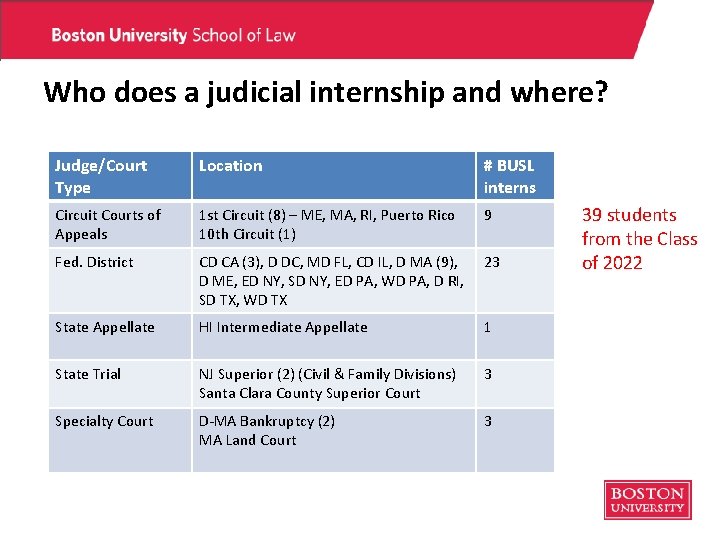
Who does a judicial internship and where? Judge/Court Type Location # BUSL interns Circuit Courts of Appeals 1 st Circuit (8) – ME, MA, RI, Puerto Rico 10 th Circuit (1) 9 Fed. District CD CA (3), D DC, MD FL, CD IL, D MA (9), D ME, ED NY, SD NY, ED PA, WD PA, D RI, SD TX, WD TX 23 State Appellate HI Intermediate Appellate 1 State Trial NJ Superior (2) (Civil & Family Divisions) Santa Clara County Superior Court 3 Specialty Court D-MA Bankruptcy (2) MA Land Court 3 39 students from the Class of 2022
How important are grades? • Many judges/courts hire before first semester grades come out, so law school grades are not as important. • Judges/courts focus on: – Academic and work experience; – Writing skills (cover letter and writing sample); – Discretion and confidentiality; – Personality fit; and – Ability to work independently and meet deadlines.
Will I get paid? • Judicial internships are unpaid. No PIP grants. • Other funding options: – Supplement with a paid Research Assistant position – ABA’s Judicial Intern Opportunity Program – “Just the Beginning” Fellowship Program – Dr. M. L. “Hank” Henry Jr. Fund for Judicial Fellowships – See additional resources on CDO Judicial Internships website
Deciding Where to Apply
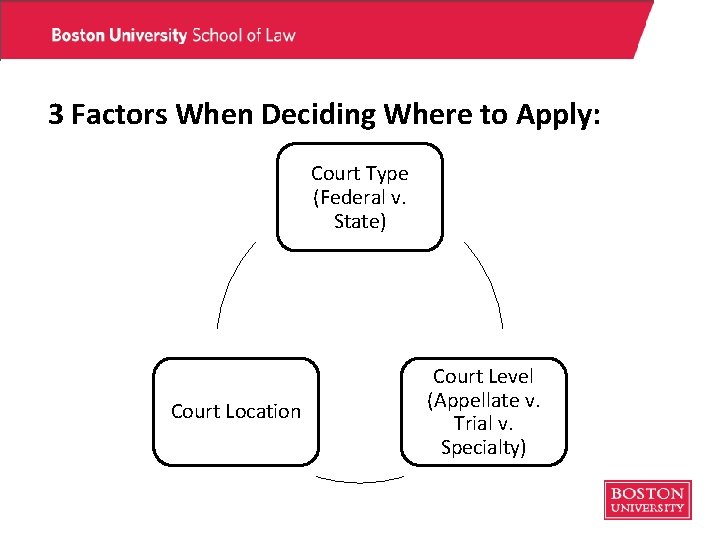
3 Factors When Deciding Where to Apply: Court Type (Federal v. State) Court Location Court Level (Appellate v. Trial v. Specialty)
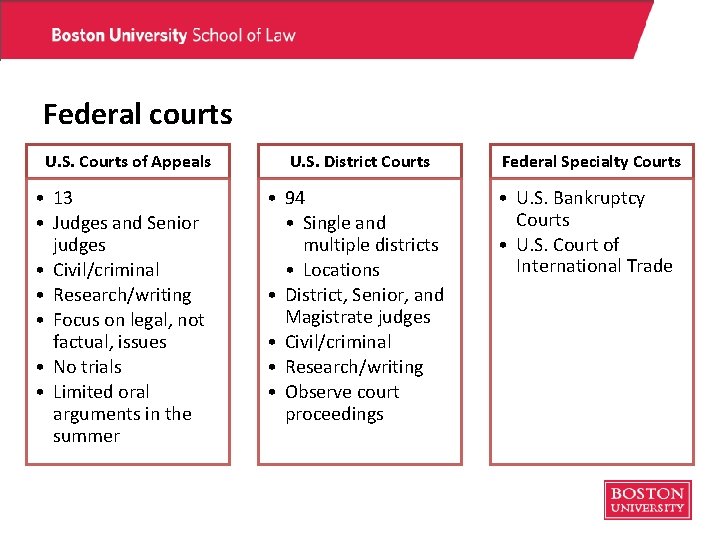
Federal courts U. S. Courts of Appeals • 13 • Judges and Senior judges • Civil/criminal • Research/writing • Focus on legal, not factual, issues • No trials • Limited oral arguments in the summer U. S. District Courts • 94 • Single and multiple districts • Locations • District, Senior, and Magistrate judges • Civil/criminal • Research/writing • Observe court proceedings Federal Specialty Courts • U. S. Bankruptcy Courts • U. S. Court of International Trade
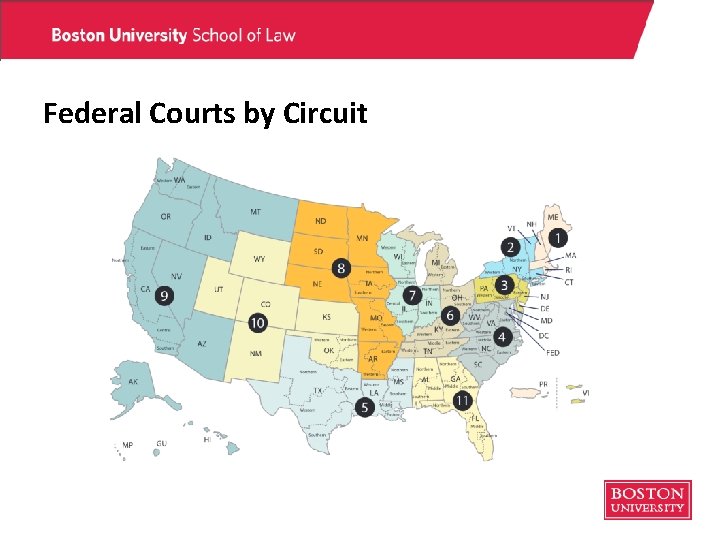
Federal Courts by Circuit
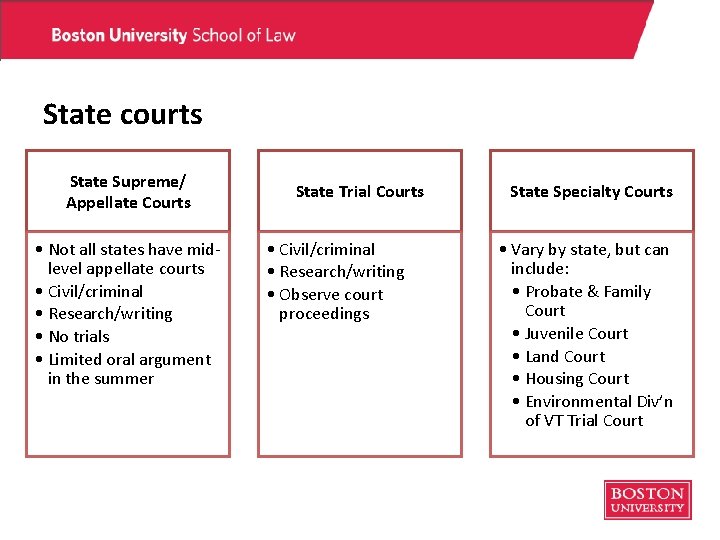
State courts State Supreme/ Appellate Courts • Not all states have midlevel appellate courts • Civil/criminal • Research/writing • No trials • Limited oral argument in the summer State Trial Courts • Civil/criminal • Research/writing • Observe court proceedings State Specialty Courts • Vary by state, but can include: • Probate & Family Court • Juvenile Court • Land Court • Housing Court • Environmental Div’n of VT Trial Court
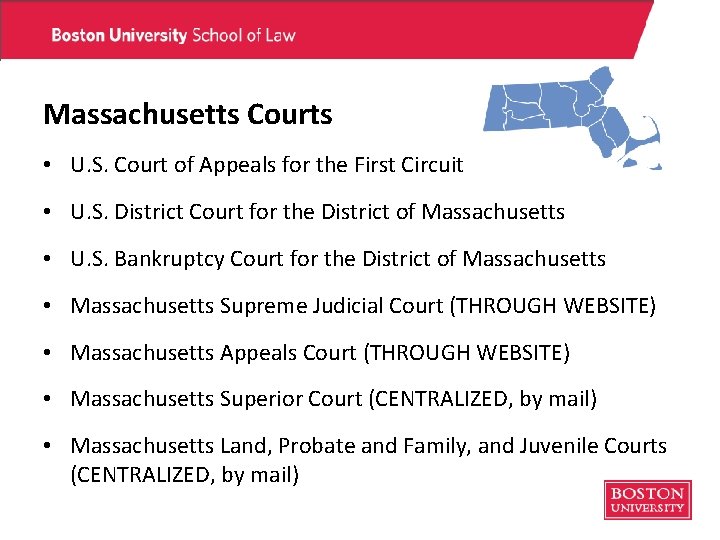
Massachusetts Courts • U. S. Court of Appeals for the First Circuit • U. S. District Court for the District of Massachusetts • U. S. Bankruptcy Court for the District of Massachusetts • Massachusetts Supreme Judicial Court (THROUGH WEBSITE) • Massachusetts Appeals Court (THROUGH WEBSITE) • Massachusetts Superior Court (CENTRALIZED, by mail) • Massachusetts Land, Probate and Family, and Juvenile Courts (CENTRALIZED, by mail)
How do I Identify Judges to Apply to? • Nat’l Center for State Courts’ Browse by State • Courts’ websites • Where 1 Ls Have Worked • CDO Website: Judicial Internship tab – Visit the section on the website titled “Application Process for Judicial Internships” and select “How do I apply for a judicial internship? ” – Step 1: Use the federal and state judges spreadsheets to identify judges who accept judicial interns (+ their mailing addresses)
Preparing Your Application
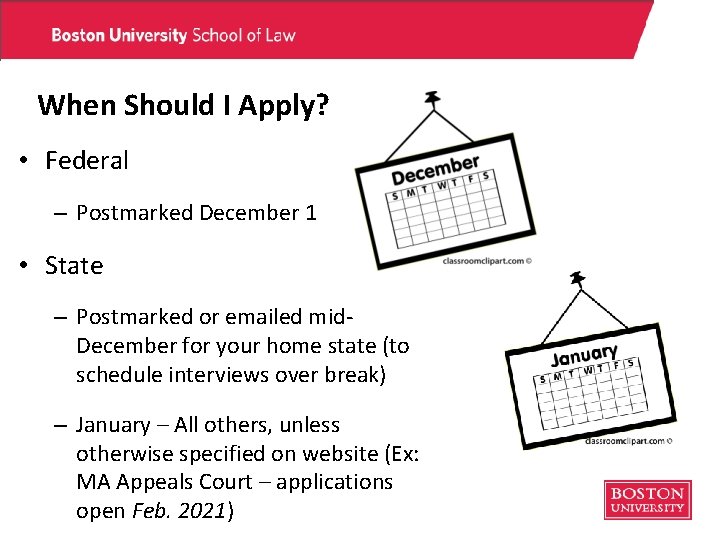
When Should I Apply? • Federal – Postmarked December 1 • State – Postmarked or emailed mid. December for your home state (to schedule interviews over break) – January – All others, unless otherwise specified on website (Ex: MA Appeals Court – applications open Feb. 2021)
How Do I Apply? Step 1: Identify application method • Federal: Send applications directly to each judge. • State: Send applications either: • Directly to each judge or through a centralized application process, via mail or email. • Check court’s website for details and instructions.
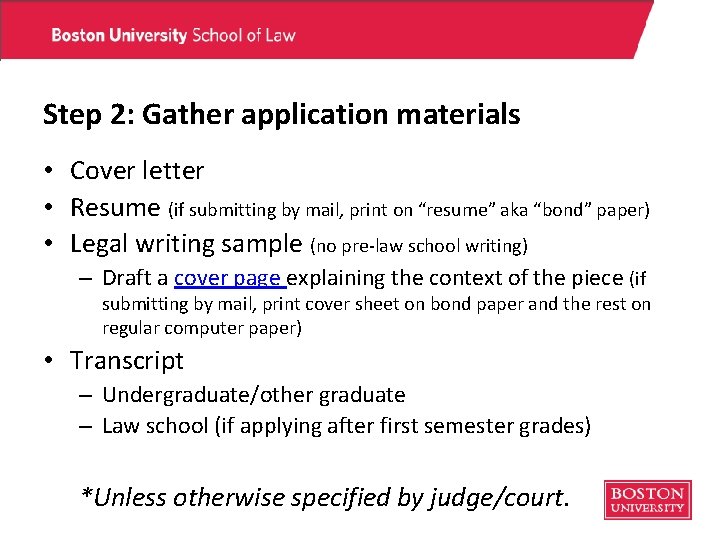
Step 2: Gather application materials • Cover letter • Resume (if submitting by mail, print on “resume” aka “bond” paper) • Legal writing sample (no pre-law school writing) – Draft a cover page explaining the context of the piece (if submitting by mail, print cover sheet on bond paper and the rest on regular computer paper) • Transcript – Undergraduate/other graduate – Law school (if applying after first semester grades) *Unless otherwise specified by judge/court.
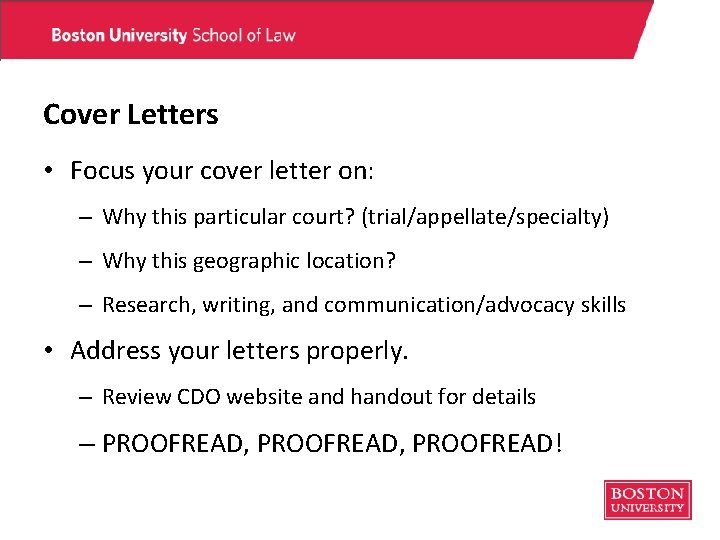
Cover Letters • Focus your cover letter on: – Why this particular court? (trial/appellate/specialty) – Why this geographic location? – Research, writing, and communication/advocacy skills • Address your letters properly. – Review CDO website and handout for details – PROOFREAD, PROOFREAD!
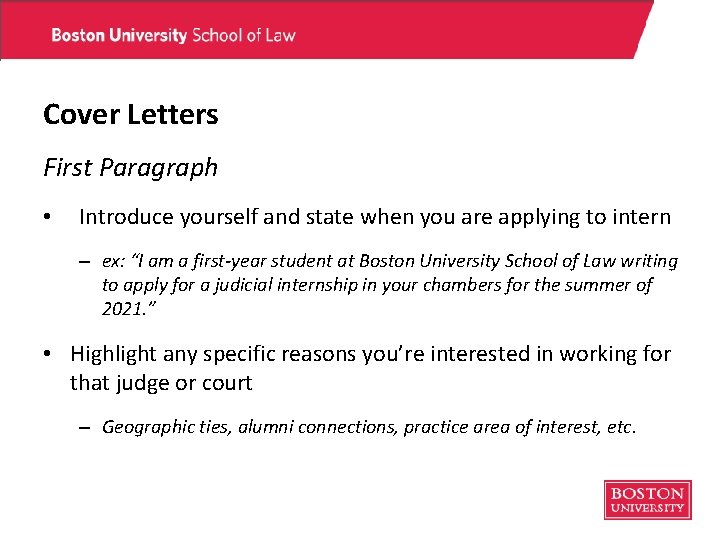
Cover Letters First Paragraph • Introduce yourself and state when you are applying to intern – ex: “I am a first-year student at Boston University School of Law writing to apply for a judicial internship in your chambers for the summer of 2021. ” • Highlight any specific reasons you’re interested in working for that judge or court – Geographic ties, alumni connections, practice area of interest, etc.
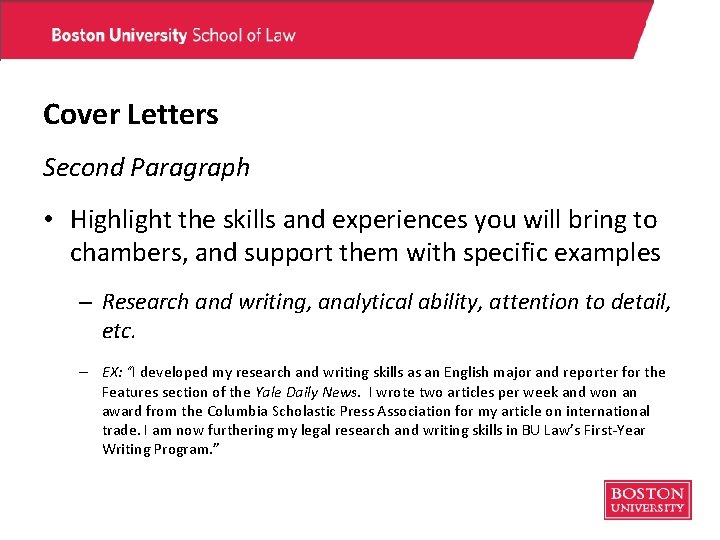
Cover Letters Second Paragraph • Highlight the skills and experiences you will bring to chambers, and support them with specific examples – Research and writing, analytical ability, attention to detail, etc. – EX: “I developed my research and writing skills as an English major and reporter for the Features section of the Yale Daily News. I wrote two articles per week and won an award from the Columbia Scholastic Press Association for my article on international trade. I am now furthering my legal research and writing skills in BU Law’s First-Year Writing Program. ”
Cover Letters Third Paragraph • Conclusion and availability to interview – Ex: “I am excited about the prospect of putting my research, writing, and communication skills to use in your chambers this summer. I would appreciate the opportunity to interview with you. I will be home in Connecticut from December 22 to January 3, but am available at your convenience. Thank you for your consideration. ”
Step 3: Submit Applications – By Email • Send all documents as 1 PDF, in this order: – – Cover letter Resume Transcript(s) (unofficial are fine) Writing sample • The following courts are accepting email applications for 2021: Courts Accepting Email Applications. docx • Do not submit federal court applications by email.
Step 3: Submit Applications – By Mail • Send hard copies via U. S. Mail unless otherwise specified. Federal applications should be mailed on December 1. • Print resume and cover sheet to writing sample on bond paper. Staple your cover sheet to your writing sample. Do not staple other components together. • Use manila envelopes. • Do not call/email chambers to confirm receipt or check the status of your application, regardless of how you submitted it.
Interviews and Offers
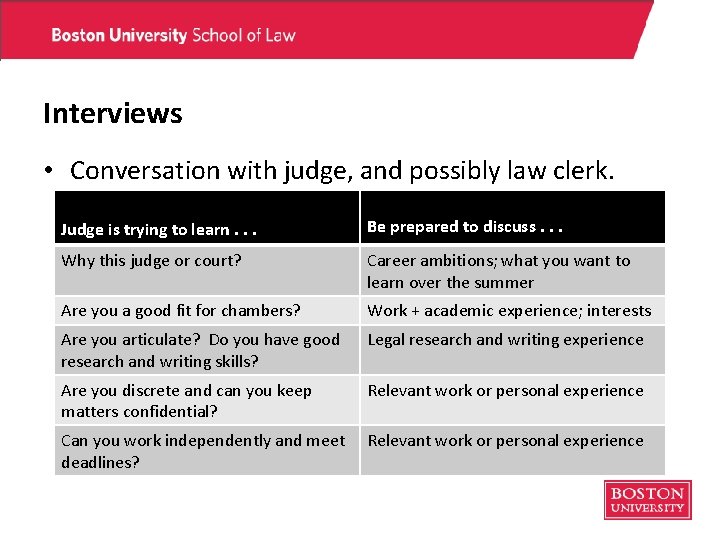
Interviews • Conversation with judge, and possibly law clerk. Judge is trying to learn. . . Be prepared to discuss. . . Why this judge or court? Career ambitions; what you want to learn over the summer Are you a good fit for chambers? Work + academic experience; interests Are you articulate? Do you have good research and writing skills? Legal research and writing experience Are you discrete and can you keep matters confidential? Relevant work or personal experience Can you work independently and meet deadlines? Relevant work or personal experience
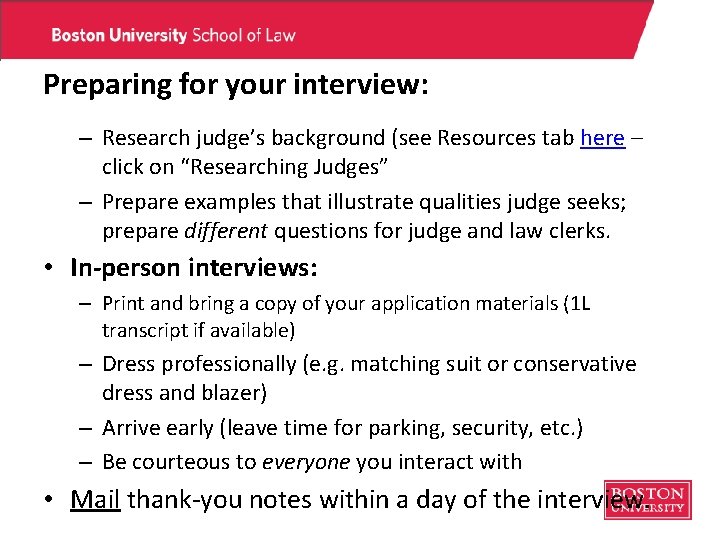
Preparing for your interview: – Research judge’s background (see Resources tab here – click on “Researching Judges” – Prepare examples that illustrate qualities judge seeks; prepare different questions for judge and law clerks. • In-person interviews: – Print and bring a copy of your application materials (1 L transcript if available) – Dress professionally (e. g. matching suit or conservative dress and blazer) – Arrive early (leave time for parking, security, etc. ) – Be courteous to everyone you interact with • Mail thank-you notes within a day of the interview.
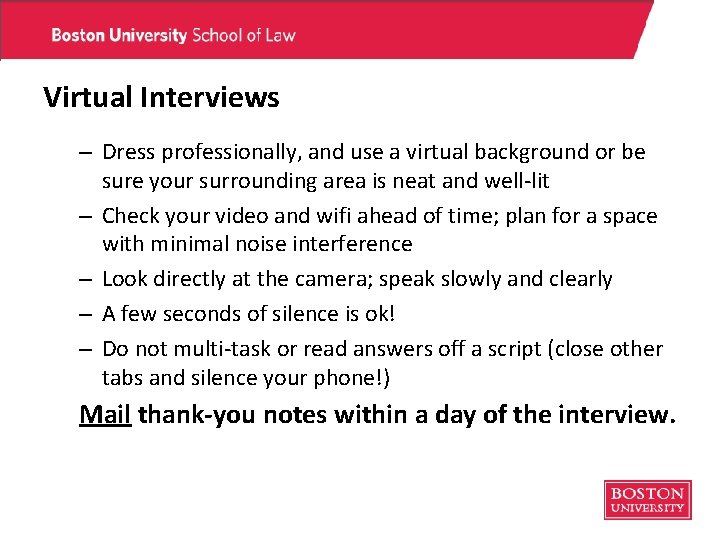
Virtual Interviews – Dress professionally, and use a virtual background or be sure your surrounding area is neat and well-lit – Check your video and wifi ahead of time; plan for a space with minimal noise interference – Look directly at the camera; speak slowly and clearly – A few seconds of silence is ok! – Do not multi-task or read answers off a script (close other tabs and silence your phone!) Mail thank-you notes within a day of the interview.
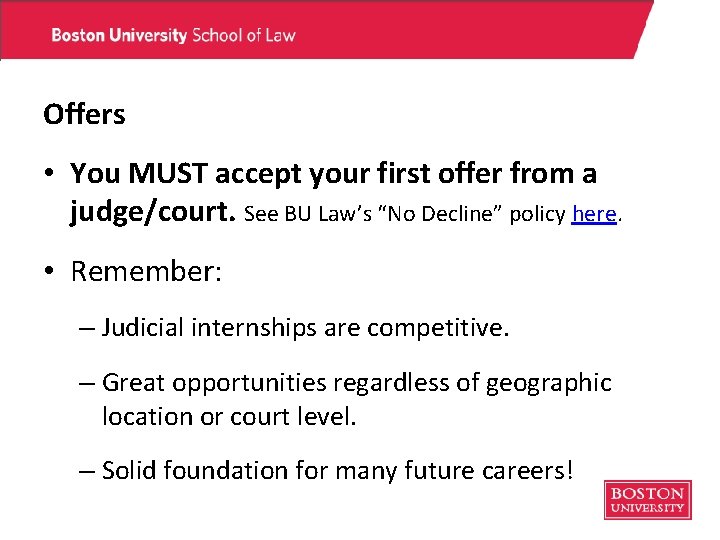
Offers • You MUST accept your first offer from a judge/court. See BU Law’s “No Decline” policy here. • Remember: – Judicial internships are competitive. – Great opportunities regardless of geographic location or court level. – Solid foundation for many future careers!
Sign up for a Judicial Internship Mentor! https: //docs. google. com/forms/d/1 g 08 st. Fyx. Wvi g. At. Cyz. KTSh 6 Om. CK 6 mq. Xb. GY 4 Eb. I 3 ewl 70/ Forms due by Monday, 10. 26 at 5 pm
Hear from Former Judicial Interns! Anyela Perez, 3 L, anperez@bu. edu Hon. Susan Wigenton, D-NJ Seth Montgomery, 2 L, sethmont@bu. edu Hon. Harris Hartz, 10 th Circuit (Albuquerque, NM) Megan Kira, 2 L, mkira@bu. edu Hon. Keith Hiraoka, Hawaii Appeals Court
Questions? This Power. Point and Zoom recording will be emailed to all RSVP’d students a couple days after the event.