
JUDICIAL BRANCH Judicial Branch clip TRUE OR FALSE
JUDICIAL BRANCH Judicial Branch clip
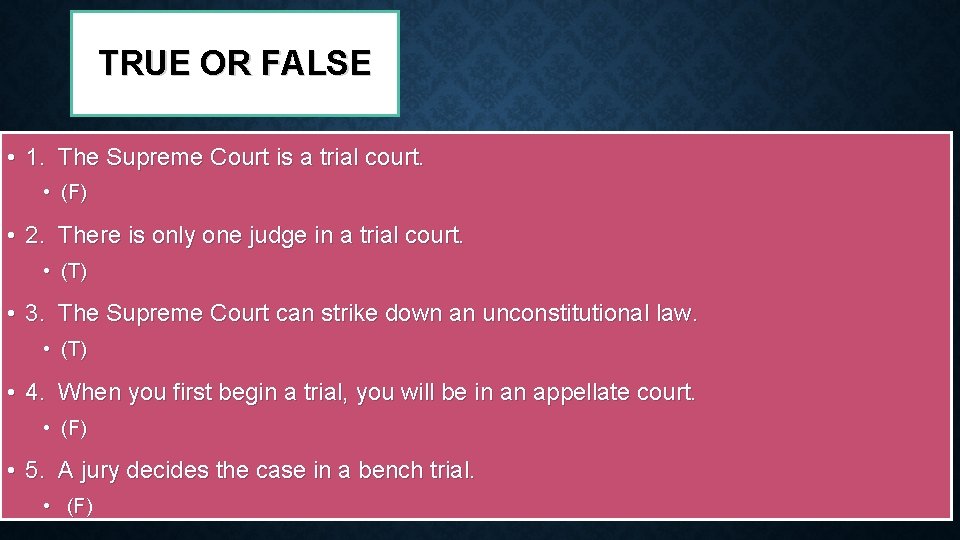
TRUE OR FALSE • 1. The Supreme Court is a trial court. • (F) • 2. There is only one judge in a trial court. • (T) • 3. The Supreme Court can strike down an unconstitutional law. • (T) • 4. When you first begin a trial, you will be in an appellate court. • (F) • 5. A jury decides the case in a bench trial. • (F)

• 6. The Supreme Court must take every case that gets appealed to it. • (F) • 7. If you break a state law, your case will probably be in a state court system. • (T) • 8. The Supreme Court’s power to decide if something is constitutional is called judicial review. • (T) • 9. It would be easy to prove a case without evidence. • (F) • 10. If the Court of Appeals remands a case, that means the court says the verdict was right. • (F)
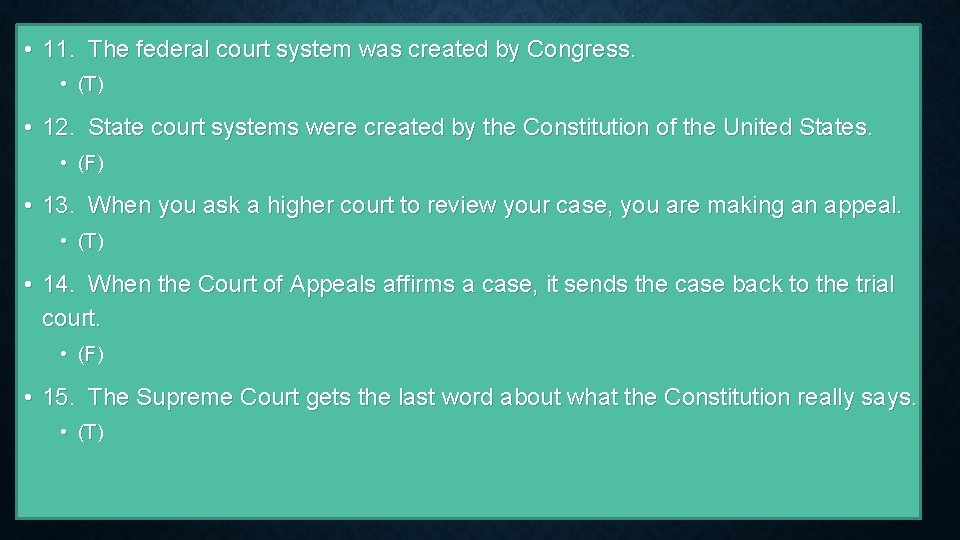
• 11. The federal court system was created by Congress. • (T) • 12. State court systems were created by the Constitution of the United States. • (F) • 13. When you ask a higher court to review your case, you are making an appeal. • (T) • 14. When the Court of Appeals affirms a case, it sends the case back to the trial court. • (F) • 15. The Supreme Court gets the last word about what the Constitution really says. • (T)
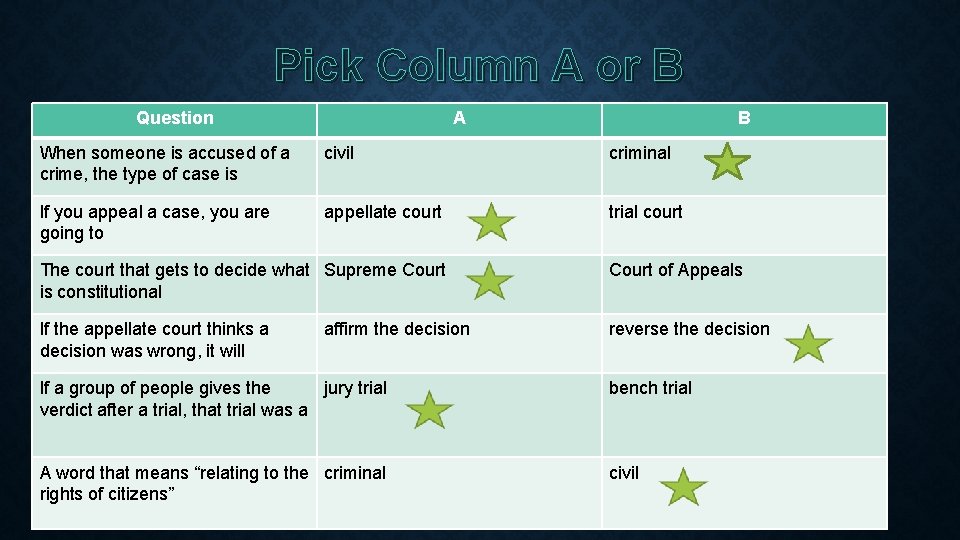
Pick Column A or B Question A B When someone is accused of a crime, the type of case is civil criminal If you appeal a case, you are going to appellate court trial court The court that gets to decide what Supreme Court is constitutional Court of Appeals If the appellate court thinks a decision was wrong, it will reverse the decision affirm the decision If a group of people gives the jury trial verdict after a trial, that trial was a bench trial A word that means “relating to the criminal rights of citizens” civil
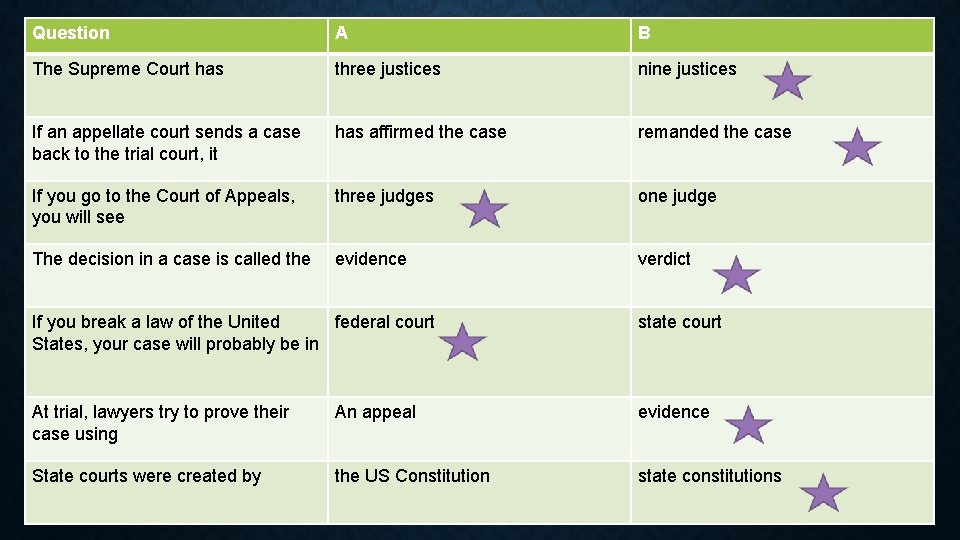
Question A B The Supreme Court has three justices nine justices If an appellate court sends a case back to the trial court, it has affirmed the case remanded the case If you go to the Court of Appeals, you will see three judges one judge The decision in a case is called the evidence verdict If you break a law of the United federal court States, your case will probably be in state court At trial, lawyers try to prove their case using An appeal evidence State courts were created by the US Constitution state constitutions
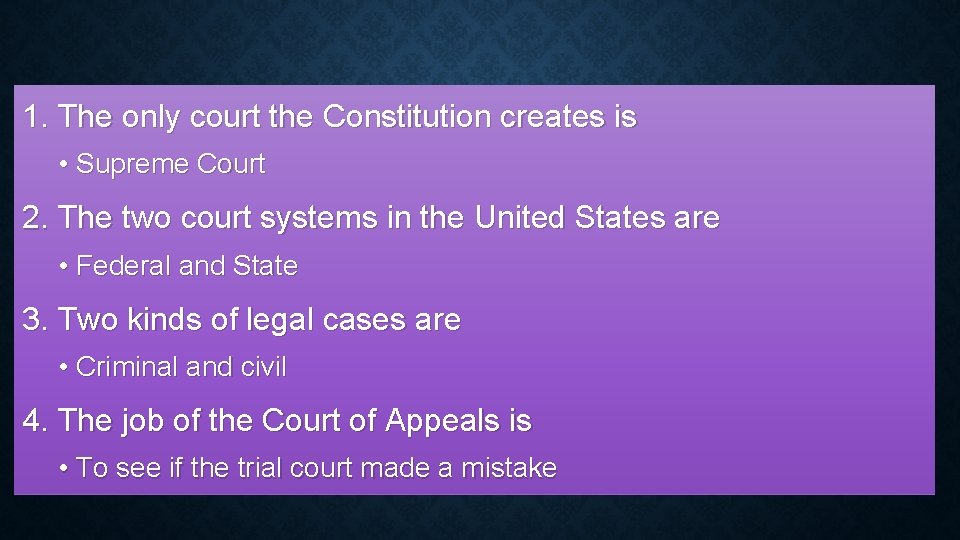
1. The only court the Constitution creates is • Supreme Court 2. The two court systems in the United States are • Federal and State 3. Two kinds of legal cases are • Criminal and civil 4. The job of the Court of Appeals is • To see if the trial court made a mistake

5. It’s difficult to take a case to the Supreme Court because • They choose which cases to hear and they don’t hear very many. 6. If you lose a case in the trial court, you can • Appeal to a higher court 7. If an appellate court affirms a case, it means • The verdict stays the same
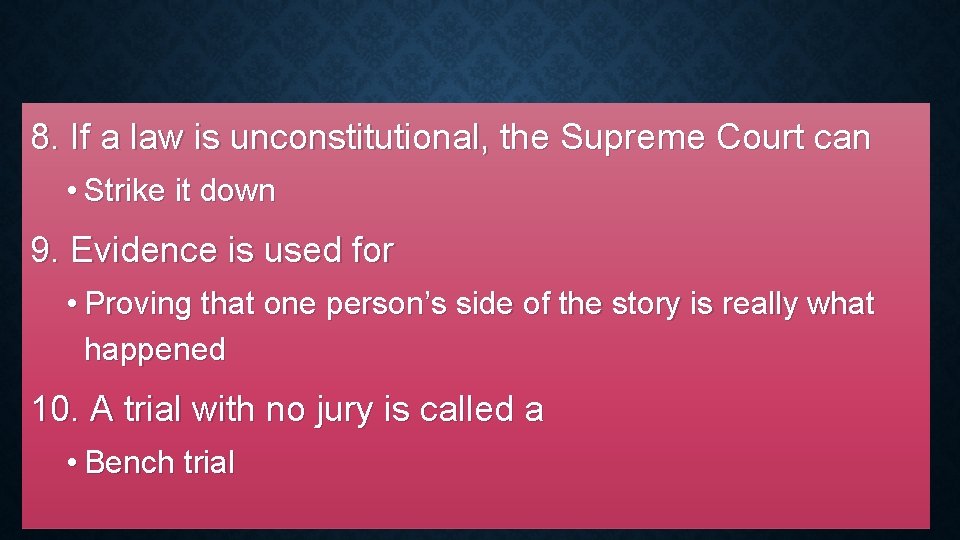
8. If a law is unconstitutional, the Supreme Court can • Strike it down 9. Evidence is used for • Proving that one person’s side of the story is really what happened 10. A trial with no jury is called a • Bench trial
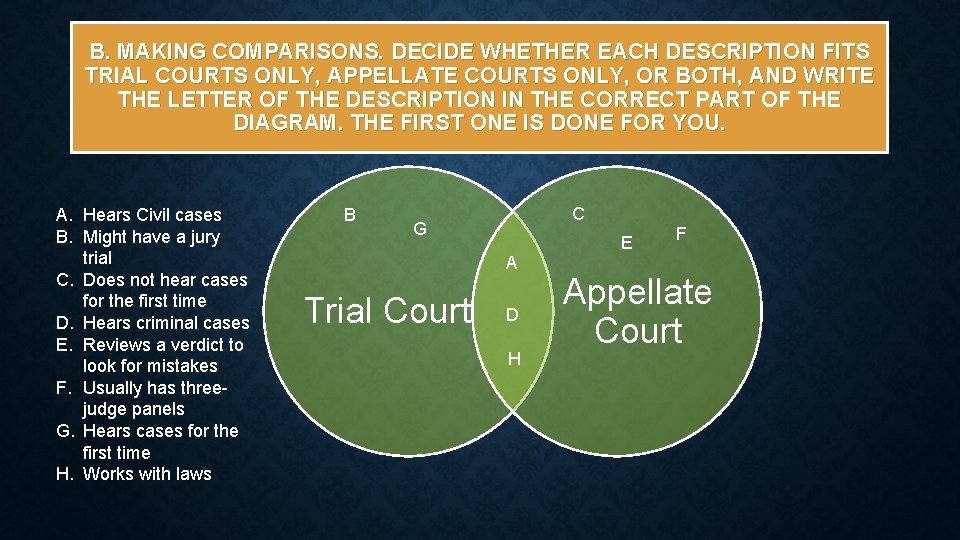
B. MAKING COMPARISONS. DECIDE WHETHER EACH DESCRIPTION FITS TRIAL COURTS ONLY, APPELLATE COURTS ONLY, OR BOTH, AND WRITE THE LETTER OF THE DESCRIPTION IN THE CORRECT PART OF THE DIAGRAM. THE FIRST ONE IS DONE FOR YOU. A. Hears Civil cases B. Might have a jury trial C. Does not hear cases for the first time D. Hears criminal cases E. Reviews a verdict to look for mistakes F. Usually has threejudge panels G. Hears cases for the first time H. Works with laws B C G E A Trial Court D H F Appellate Court
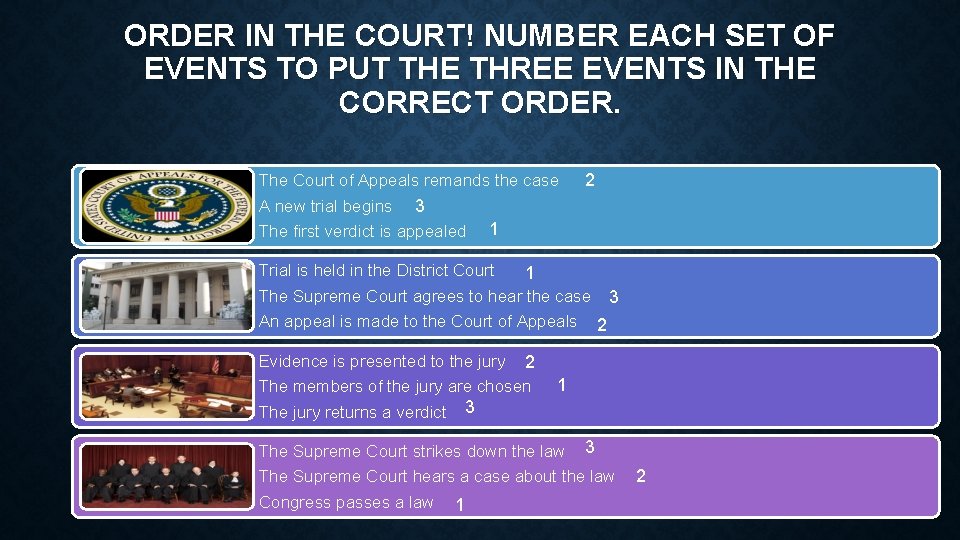
ORDER IN THE COURT! NUMBER EACH SET OF EVENTS TO PUT THE THREE EVENTS IN THE CORRECT ORDER. The Court of Appeals remands the case A new trial begins 3 The first verdict is appealed 1 2 Trial is held in the District Court 1 The Supreme Court agrees to hear the case An appeal is made to the Court of Appeals Evidence is presented to the jury 2 The members of the jury are chosen The jury returns a verdict 3 2 1 3 The Supreme Court strikes down the law 3 The Supreme Court hears a case about the law Congress passes a law 1 2
- Slides: 11