
Judicial Branch Interpreting the Laws What are laws
Judicial Branch Interpreting the Laws
What are laws • Laws are a set of rules that allow people to live together • Most important job of the law is to keep peace and prevent violent acts Think: Where do laws come from?
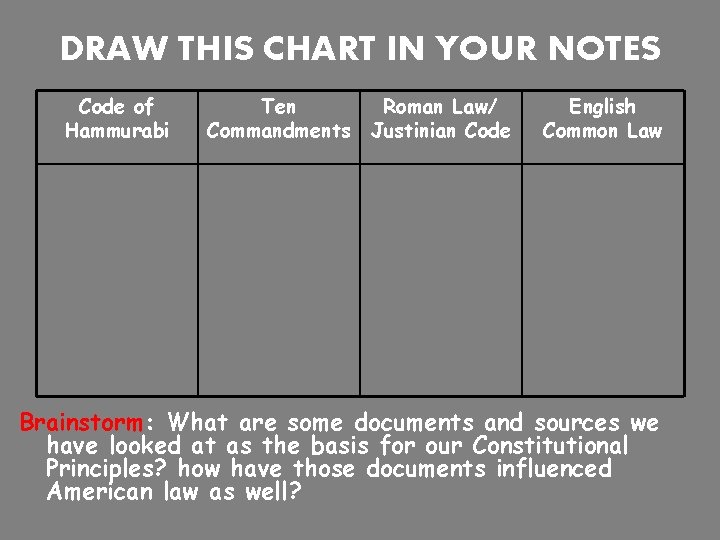
DRAW THIS CHART IN YOUR NOTES Code of Hammurabi Ten Commandments Roman Law/ Justinian Code English Common Law Brainstorm: What are some documents and sources we have looked at as the basis for our Constitutional Principles? how have those documents influenced American law as well?
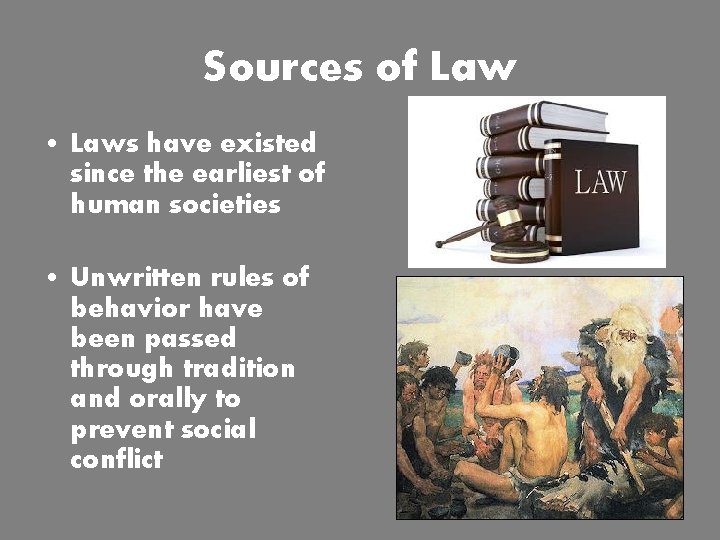
Sources of Law • Laws have existed since the earliest of human societies • Unwritten rules of behavior have been passed through tradition and orally to prevent social conflict
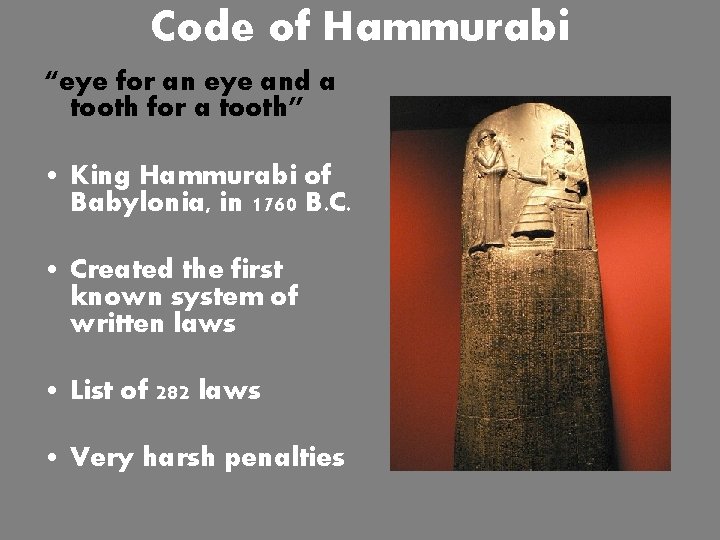
Code of Hammurabi “eye for an eye and a tooth for a tooth” • King Hammurabi of Babylonia, in 1760 B. C. • Created the first known system of written laws • List of 282 laws • Very harsh penalties
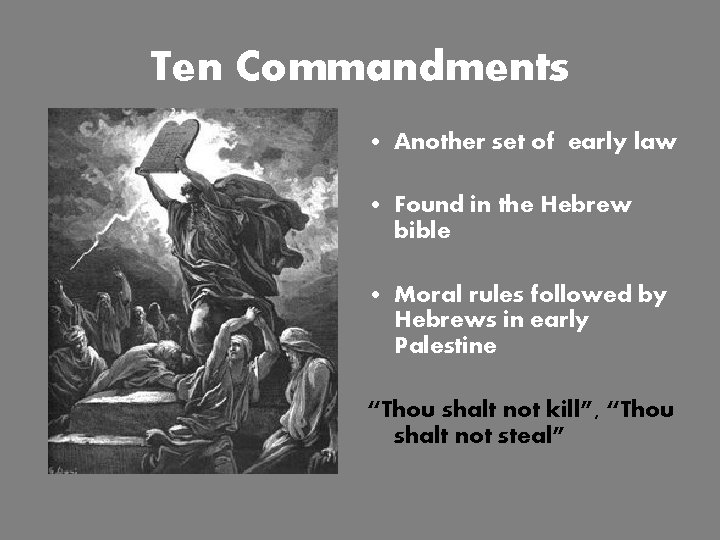
Ten Commandments • Another set of early law • Found in the Hebrew bible • Moral rules followed by Hebrews in early Palestine “Thou shalt not kill”, “Thou shalt not steal”
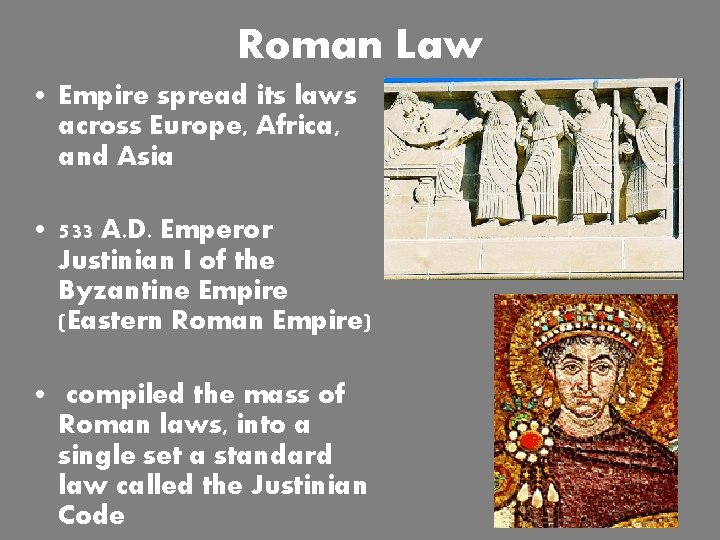
Roman Law • Empire spread its laws across Europe, Africa, and Asia • 533 A. D. Emperor Justinian I of the Byzantine Empire (Eastern Roman Empire) • compiled the mass of Roman laws, into a single set a standard law called the Justinian Code
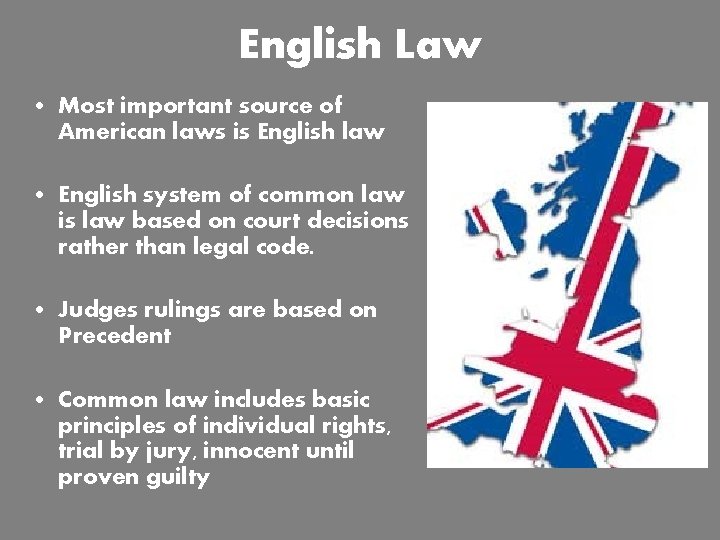
English Law • Most important source of American laws is English law • English system of common law is law based on court decisions rather than legal code. • Judges rulings are based on Precedent • Common law includes basic principles of individual rights, trial by jury, innocent until proven guilty
Types of Laws Criminal and Civil
Criminal Law • Government is the PLAINTIFF the party that brings the charges against the accused • The individual or group accused of a crime is the DEFENDANT • Crimes are rated as either FELONIES or MISDEMEANORS – -Felonies are serious crimes (rape, murder, arson, robbery) – Misdemeanors are minor offenses (Vandalism or petty theft)
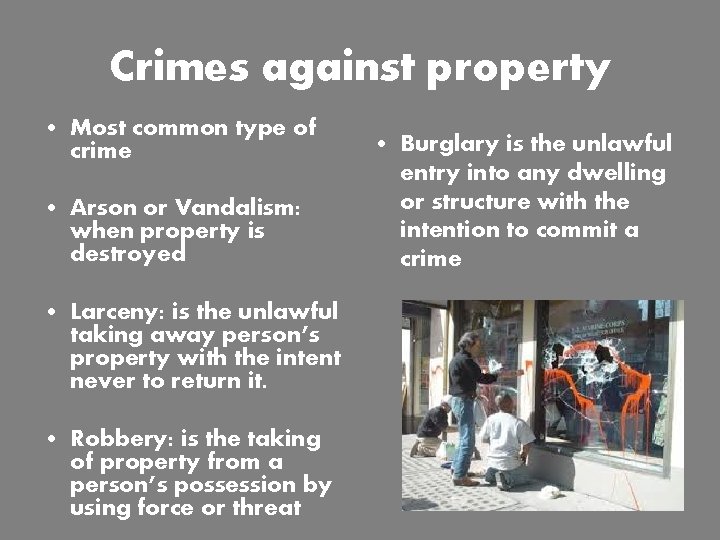
Crimes against property • Most common type of crime • Arson or Vandalism: when property is destroyed • Larceny: is the unlawful taking away person’s property with the intent never to return it. • Robbery: is the taking of property from a person’s possession by using force or threat • Burglary is the unlawful entry into any dwelling or structure with the intention to commit a crime
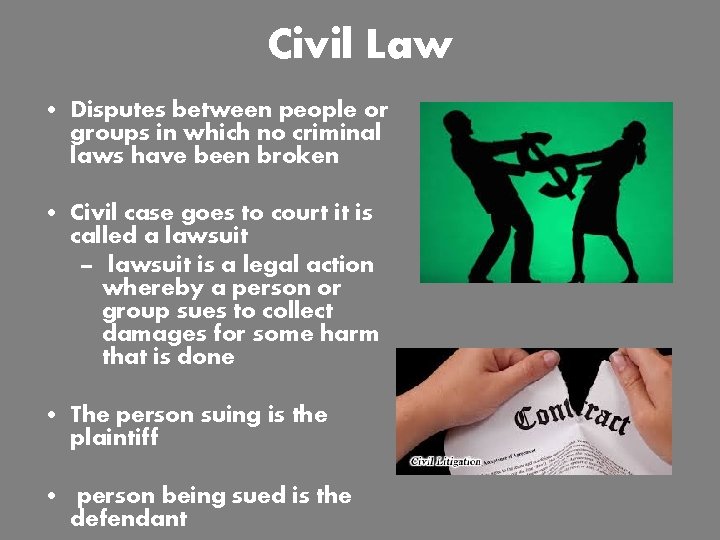
Civil Law • Disputes between people or groups in which no criminal laws have been broken • Civil case goes to court it is called a lawsuit – lawsuit is a legal action whereby a person or group sues to collect damages for some harm that is done • The person suing is the plaintiff • person being sued is the defendant
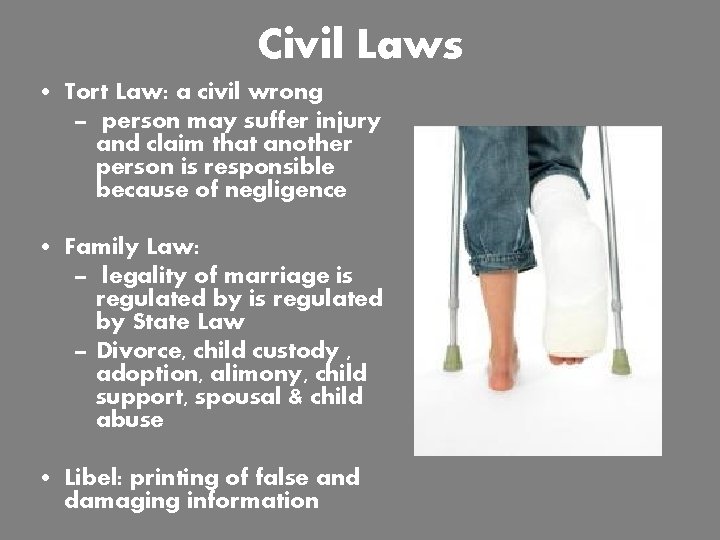
Civil Laws • Tort Law: a civil wrong – person may suffer injury and claim that another person is responsible because of negligence • Family Law: – legality of marriage is regulated by State Law – Divorce, child custody , adoption, alimony, child support, spousal & child abuse • Libel: printing of false and damaging information
Other Types of Law • Constitutional Law: limits of governmental power and individual rights • Administrative Law: rules and regulations that the executive branch makes to carryout laws • Statutory Law: statutes are written laws created by a legislative branch – Ex: speed limit, drinking age
North Carolina Courts State and Local Judicial Branch
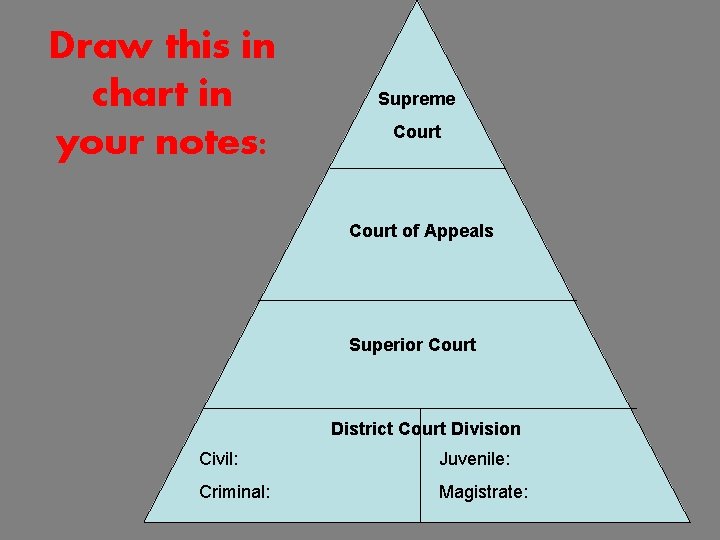
Draw this in chart in your notes: Supreme Court of Appeals Superior Court District Court Division Civil: Juvenile: Criminal: Magistrate:
Types of Trial Court • Hear evidence, arguments and deliver a decision • North Carolina has 2 kinds of trial courts: – District Courts – Superior courts • Other court related officials in each county to support trial courts work: – police and sheriff departments – district attorneys and magistrates
• NC counties are grouped into court districts. District Courts • Cases in district court includes juvenile law, • Counties with larger divorce and other populations are singlefamily law, traffic county districts. counties violations, civil cases, or with smaller disputes involving less populations create than $10, 000, multicounty districts misdemeanors, and initial hearing for felonies trials. • district court the judge that hears the case decides the verdict. • Each district has one or There is no jury more district court judges, depending on the number of people in • Voters elect these the district judges for a four-year terms.
Superior Courts • Handle civil cases involving more than 10, 000 dollars and felonies. • These cases take longer to try the district court cases. Most involve jury trials • Those found guilty of misdemeanor in district court can request a retrial by jury in superior court • Judicial District: – state divided into 8 judicial divisions – each containing several superior court districts – Voters elect superior court judges for eight year terms. – Governor also appoints 15 special superior court judges to serve as needed
Other Judicial Officers • Clerk of the superior court. – Voters elect – wills – Foreclosures • Magistrate – Each county has at least one – issues search warrants and arrest warrants– are appointed by the resident superior court judge • district attorney – Voters elect – represents the state in all criminal cases in a district and superior courts. • public defenders – is a full time state employee whose responsibility is to represent extremely lw income person who are accused of a crime
Appellate Courts • hear disputes about whether the decision of a trial court should be overturned. • Decisions of each states highest courts are final unless overruled by the supreme court of the United States • NC has two appeal late courts: – the court of appeals – the state supreme court
North Carolina Court of Appeals • Court of appeals hears most of the cases appealed from the states trial courts • Voters elect 15 appeals court judges • Judges hear cases in groups of there called panels – At least two of the three judges must agree in order to reach a decision. – Elected statewide for terms of 8 years
North Carolina Supreme Court • Final level of state appeals • Reviews cases and interprets the state constitution and laws • Consist of seven justices • Head of court is called chief justice – voters elect the chief justice and six associate justices for 8 year terms • Decide which of the cases being appealed should be heard – those they decide not to hear is decided by NC court of appeals • Hears all appeals of death sentences • Majority of all seven must agree to a decision • State supreme court say is final • Supervises all NC courts
Federal Courts National Level
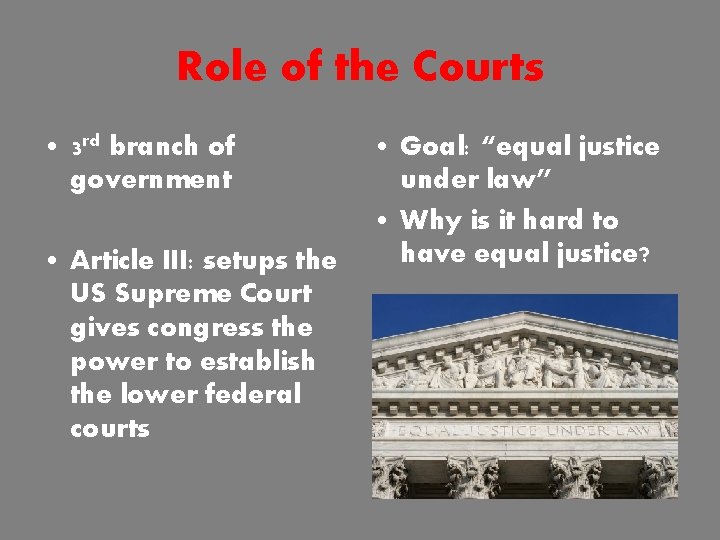
Role of the Courts • 3 rd branch of government • Article III: setups the US Supreme Court gives congress the power to establish the lower federal courts • Goal: “equal justice under law” • Why is it hard to have equal justice?
• 1789: passed the Judiciary Act, establishing federal district and circuit courts of appeals • Federal Court system has three levels: • 1891 Congress created system of federal appeals courts and the circuits (districts) they serve. • Exist along with 50 state courts – District courts – Appeals courts – Supreme court
Jurisdiction • Jurisdiction: authority to hear and decide a case • Federal courts have jurisdiction… – Constitution, federal laws, interstate disputes, federal government, foreign governments and treaties, admiralty and maritime laws
Types of Jurisdiction • Exclusive jurisdiction: in cases when only the Federal government has the authority to hear and decide the case. • Concurrent jurisdiction: when both state and federal courts have jurisdiction • Original jurisdiction: court with the authority to hear the case for the first time
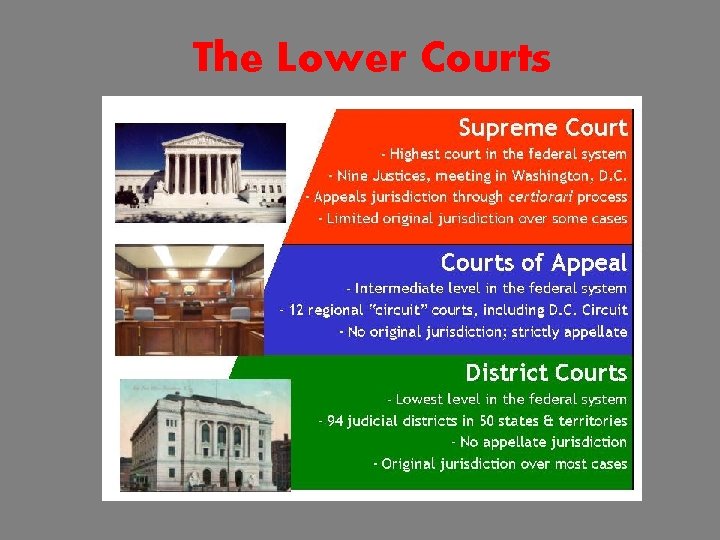
The Lower Courts
US District Courts • District Courts: are the federal courts in which trails are held and lawsuits begin • 94 district courts, every state has at least one and some have more • District courts have original jurisdiction • Responsible for determining the facts of a case, decide guilty or innocent based on evidence.
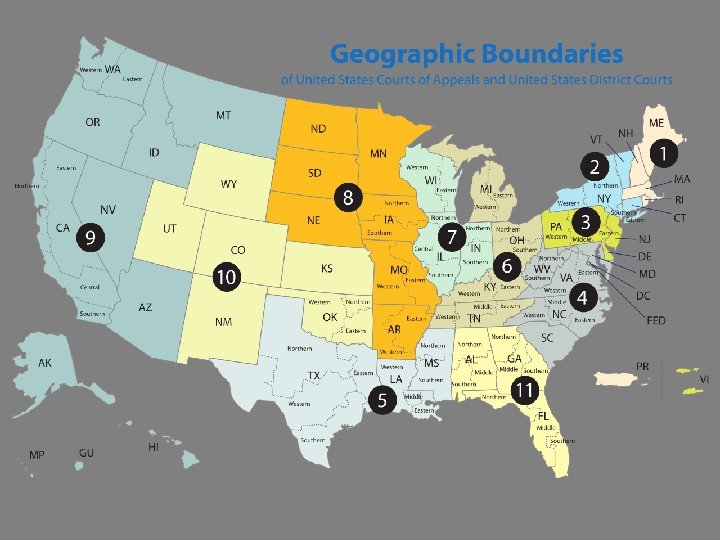
US Court of Appeals • Called: Federal appeals courts, circuit courts of appeals or appellate courts. • 12 circuit courts- has jurisdiction over a circuit (geographic area) • Appeals courts: review decisions made in lower district courts • 13 th appeals court: Court of Appeals for the Federal Circuit- has a nationwide jurisdiction to hear special cases • Appellate jurisdiction: authority of a court to hear a case from a lower court
Appeals Process • Don’t hold trials • Decide to appeal in 3 ways: – uphold original decision, – reverse the decision – remanding the case (sending it back to the lower court to be tried again) • Panel of 3 judges reviews the cases being appealed • Appeals court writes an opinion for the court. Opinion sets precedent for all other courts • Precedent: gives guidance to other judges by offering a model upon which to base their own decisions on similar cases
Federal Judges
Selecting a Judge • The presidents selects all federal judges with senatorial approval • Constitution sets no particular qualification for federal judges • Senatorial Courtesy: president submits a candidate to the senators from the candidates state before submitting to the whole senate
Tenure • Federal judges have their jobs for life • Can be removed from office only through the process of impeachment • decide cases apart from public or political pressure
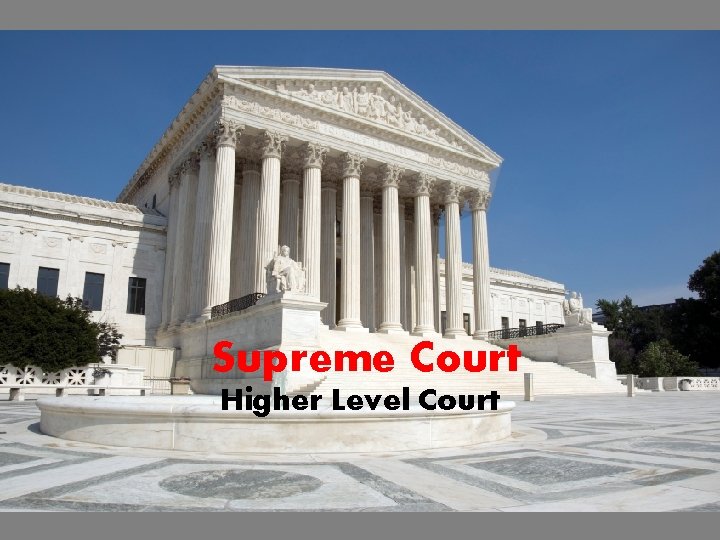
Supreme Court Higher Level Court
Jurisdiction • Has original jurisdiction in only two instances: – presides over cases that involve diplomats from foreign countries – in disputes between states • Supreme court hears courses appealed from the lower district courts or federal regulatory agencies • Supreme court chooses the cases it hears • Has final authority in any case involving the Constitution, acts of congress, and treaties with other nations
Organization and Duties • Made up of 8 associate justices led by a chief Justice. 9 Supreme court justices • Congress sets the number of judges and has the power to change it. • Main duty of justices is to hear and rule on a case and make important political decisions.
Selecting the Justices • The President appoints the Supreme Court justices, with approval of the Senate • Background: Are always lawyers, although no legal requirement- justice normally practice or teach law, judges or political position.
Powers of the Court • Judicial Review: Has the power to nullify or cancel a law or political action • Legislative and executive branch must follow the Supreme Court ruling. • Supreme court is suppose to be removed from politics and influence of special interest groups
Judicial Review • Judicial review: court can review any federal, state, or local law to see if it is constitutional • Constitution doesn’t give the Supreme Court the power of judicial review: – A provision of the Judiciary Act of 1789 gave the courts the power of judicial review for acts of state governments – 1803: Marbury v Madison established the Supreme Court had the power to decide whether laws passed by Congress were Constitutional
John Marshall’s Decision • The constitution is the Supreme law of the land • If there is a conflict, or disagreement between the Constitution and any other law the Constitution rules. • The Judicial branch has the duty to uphold the Constitution.
Limits on the Supreme Court • Court depends on the executive branch to uphold its and enforce its decisions • Congress can get around a ruling by passing a new law or changing the law • Congress and State legislatures can try to adopt new amendments • Can only decide and make rulings on a case that comes to them
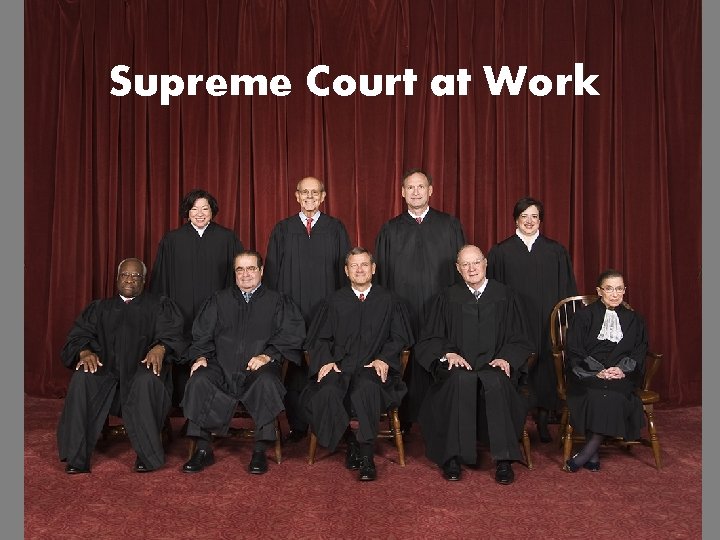
Supreme Court at Work
Reaching the Court • RULE OF FOUR: decides which cases should be put on the courts docket • Most cases reach the court by the WRIT OF CERTIORARI “to be certain” -an order by the supreme court to a lower court to send up the record of a case for review • Through CERTIFICATE when a lower court is not clear about the procedure or the rule of law • Most come from the highest state court or the federal courts of appeals • CASELOAD- number of cases handles in a given period
Supreme Court work • Sessions: – begins with the first Monday in October and last until June or July – Session is given the name of the year it began in – Special Sessions can be called • Oral arguments: – lawyers on both sides present oral arguments – Oral arguments limited to 30 minutes
BRIEFS • BRIEFS : are written documents filed with the Court before oral argument – detailed statements that support one side of the case (hundreds of pages) **AMICUS CURIAE briefs- “friend of the court” - filed by persons or groups who are not actual parties to a case but who an interest
Solicitor General • federal governments chief lawyer (Department of Justice) • Represents the United States in all cases to which it is a party in the Supreme Court • Decides which cases the Government should ask the Supreme Court to review, and also the position of the United Sates • Often files amicus curiae briefs
Conference • On Friday justices meet in secrecy to consider cases for which they have heard oral arguments • Chief Justice Presides over the conferencespeaks first and indicates how they will vote • Then each associate judges summarize their views in order of seniority
Opinions • Majority opinion: official court opinion. • Concurring opinion- justices that agree with the courts opinion, to make or emphasize a point • Dissenting opinions: those who do not agree with the courts majority decision • Opinions set precedent • Stare Decisis: “let the decision stand”-law is based on precedent
SUPREME COURT CASES • With your partner research your assigned court cases at oyez. org • You will present these cases to the class, make sure to include: – Description of the case (What happened, what parties were involved) – The issue (s) being addressed – the year, and name of the Chief Justice – The Courts opinion
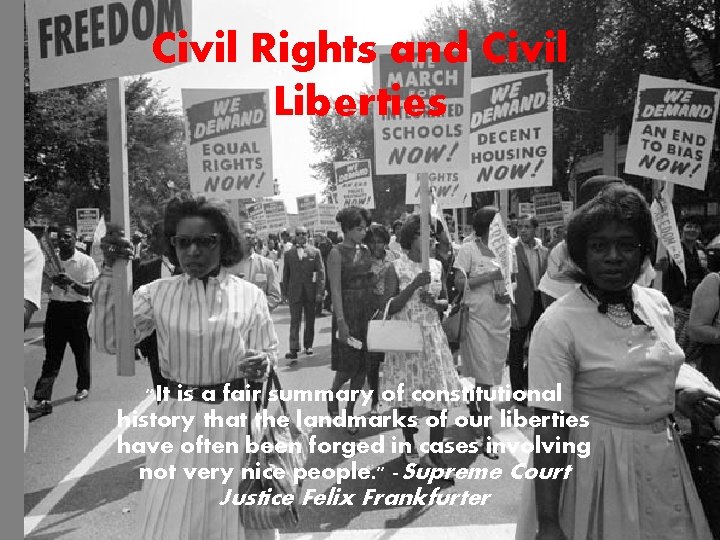
Civil Rights and Civil Liberties "It is a fair summary of constitutional history that the landmarks of our liberties have often been forged in cases involving not very nice people. " -Supreme Court Justice Felix Frankfurter
Listen • Governor Wallace: – http: //www. learnnc. org/lp/media/lessons/b rownvboard/george_wallace. mp 3 • Jesse Helms: – http: //www. learnnc. org/lp/media/lessons/b rownvboard/jesse_helms. mp 3 • Harriet Love: – http: //www. learnnc. org/lp/media/lessons/b rownvboard/harriet_love. mp 3
Think about it • What is a Civil Liberty? • What are some of the positives and negatives of integration? • What is Civil Rights? • In what ways did Brown v. the Board of Education change our nation both socially and politically?
• Civil liberties: protection against government action – What are examples of civil liberties? • Civil rights: positive actions of the government should take to create equal conditions for all Americans
Constitutional Equality • 14 th amendment: – Equal protection clause: “No state shall…deny to any person within its jurisdiction the equal protection of the laws. ” – 1868: Reconstruction Amendments (13 th, 14 th , 15 th ) – Newly freed slaves: given citizenship, and promised equal protection and due process
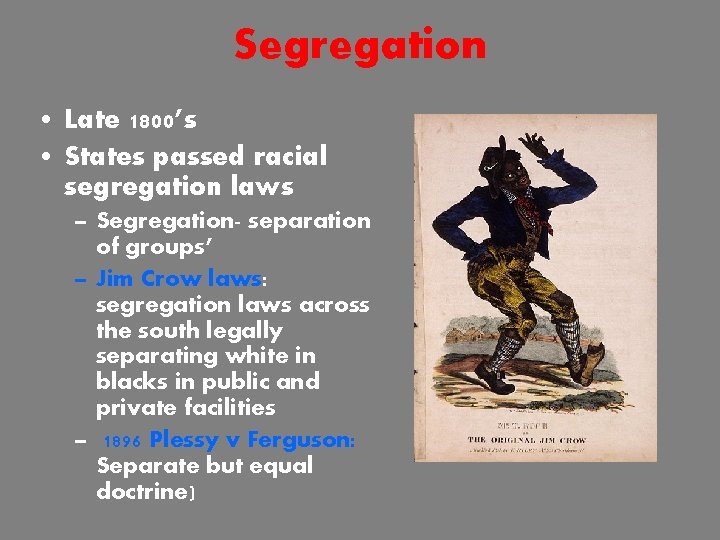
Segregation • Late 1800’s • States passed racial segregation laws – Segregation- separation of groups’ – Jim Crow laws: segregation laws across the south legally separating white in blacks in public and private facilities – 1896 Plessy v Ferguson: Separate but equal doctrine)
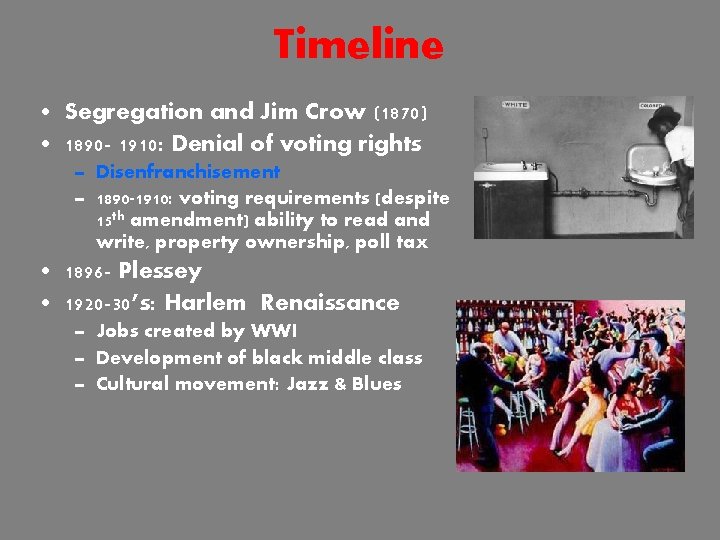
Timeline • Segregation and Jim Crow (1870) • 1890 - 1910: Denial of voting rights – Disenfranchisement – 1890 -1910: voting requirements (despite 15 th amendment) ability to read and write, property ownership, poll tax • 1896 - Plessey • 1920 -30’s: Harlem Renaissance – Jobs created by WWI – Development of black middle class – Cultural movement: Jazz & Blues
• 1909 -NAACP (national association for the advancement of colored people) W. E. B Du Bios • After WWII the NAACP led by Thurgood Marshal challenged Plessey -separate inherently unequal • 1960 sit-ins – white only sections of restaurants • 1961 - freedom riderstraveled in buses through the south • 1963 - March on Washington – MLK: I have a dream • 1954 - Brown v. Board • 1964 civil rights act • 1955 - Rosa Parks, Bus boycotts, Directed by MLK • 1965 24 th amendment • 1968 MLK assassinated
Need to Know • 1954: Supreme court overturn Plessey in Brown v. Board of education – segregation in schools based on race was unconstitutional ****Congress passed Civil Rights Acts of 1957, 60, 64 and 68 ***Voting Rights Acts of 1965, 70, 75, 82 • the Civil Rights Act of 1964 - no person may be denied access to or refused service in public facilities because of race, color, religion, or national origin • Civil Rights Act 1968 - forbids anyone to refuse to dell or rent a dwelling to any person on grounds of race, age, sex, color, or religion
Do I HAVE THE RIGHT • Go to icivics. org • Clink the play button • Click on the Bill of Rights edition of do I have the right game • PLAY
- Slides: 62