
Judging the approach speed of motorcycles and cars
- Slides: 1
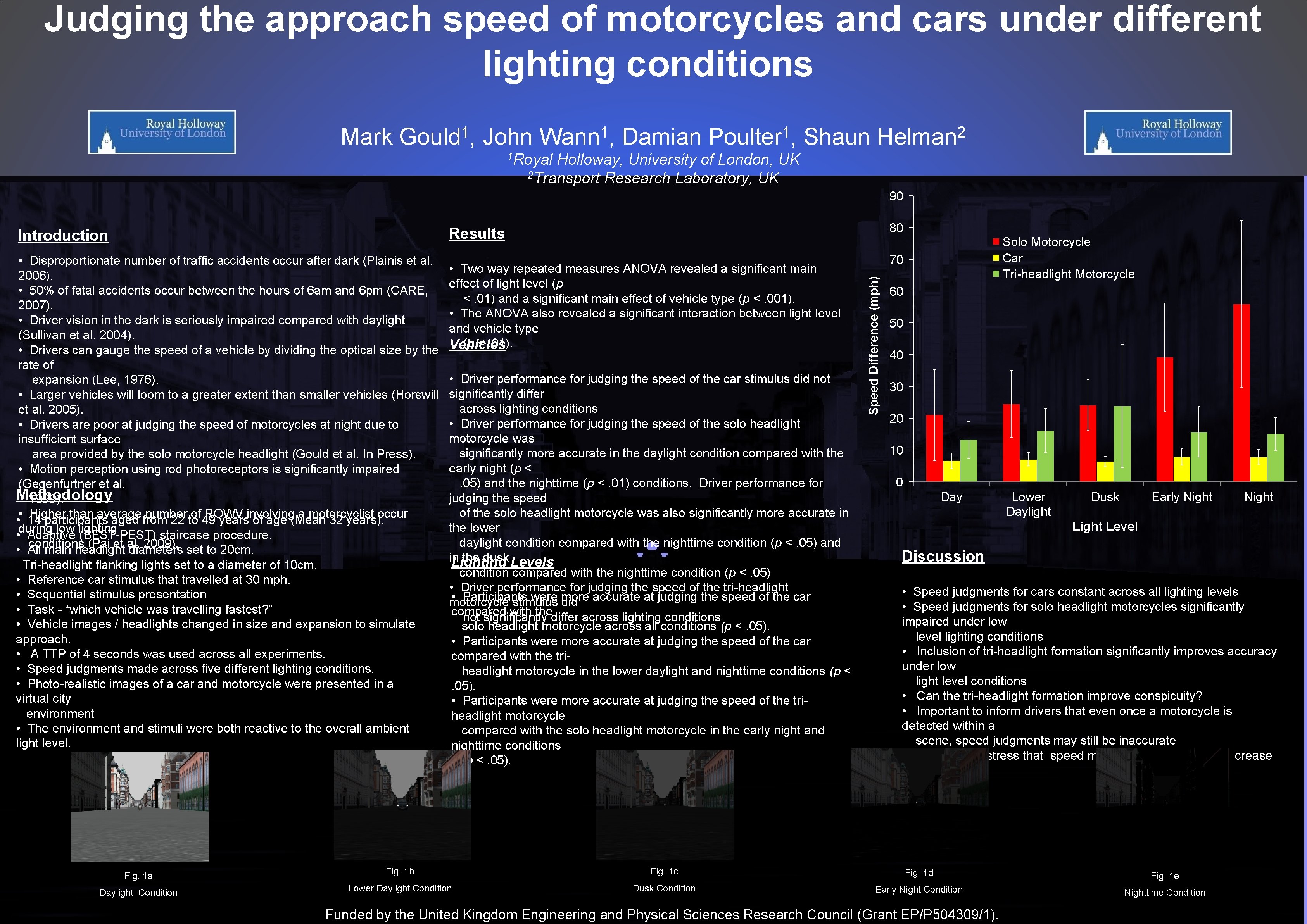
Judging the approach speed of motorcycles and cars under different lighting conditions Mark 1 Gould , John 1 Wann , Damian 1 Poulter , Shaun 2 Helman 1 Royal Holloway, University of London, UK 2 Transport Research Laboratory, UK 90 80 Results • Disproportionate number of traffic accidents occur after dark (Plainis et al. 2006). • 50% of fatal accidents occur between the hours of 6 am and 6 pm (CARE, 2007). • Driver vision in the dark is seriously impaired compared with daylight (Sullivan et al. 2004). • Drivers can gauge the speed of a vehicle by dividing the optical size by the rate of expansion (Lee, 1976). • Larger vehicles will loom to a greater extent than smaller vehicles (Horswill et al. 2005). • Drivers are poor at judging the speed of motorcycles at night due to insufficient surface area provided by the solo motorcycle headlight (Gould et al. In Press). • Motion perception using rod photoreceptors is significantly impaired (Gegenfurtner et al. Methodology 1999). • Higher than average number of ROWV involving a motorcyclist occur • 14 participants aged from 22 to 49 years of age (Mean 32 years). during low lighting • Adaptive (BEST-PEST) staircase procedure. conditions (Pai et al. 2009). • All main headlight diameters set to 20 cm. Tri-headlight flanking lights set to a diameter of 10 cm. • Reference car stimulus that travelled at 30 mph. • Sequential stimulus presentation • Task - “which vehicle was travelling fastest? ” • Vehicle images / headlights changed in size and expansion to simulate approach. • A TTP of 4 seconds was used across all experiments. • Speed judgments made across five different lighting conditions. • Photo-realistic images of a car and motorcycle were presented in a virtual city environment • The environment and stimuli were both reactive to the overall ambient light level. • Two way repeated measures ANOVA revealed a significant main effect of light level (p <. 01) and a significant main effect of vehicle type (p <. 001). • The ANOVA also revealed a significant interaction between light level and vehicle type (p <. 01). Vehicles • Driver performance for judging the speed of the car stimulus did not significantly differ across lighting conditions • Driver performance for judging the speed of the solo headlight motorcycle was significantly more accurate in the daylight condition compared with the early night (p <. 05) and the nighttime (p <. 01) conditions. Driver performance for judging the speed of the solo headlight motorcycle was also significantly more accurate in the lower daylight condition compared with the nighttime condition (p <. 05) and in the dusk Levels Lighting condition compared with the nighttime condition (p <. 05) • Driver performance for judging the speed of the tri-headlight • Participants were more accurate at judging the speed of the car motorcycle stimulus did compared with thediffer across lighting conditions not significantly solo headlight motorcycle across all conditions (p <. 05). • Participants were more accurate at judging the speed of the car compared with the triheadlight motorcycle in the lower daylight and nighttime conditions (p <. 05). • Participants were more accurate at judging the speed of the triheadlight motorcycle compared with the solo headlight motorcycle in the early night and nighttime conditions (p <. 05). Solo Motorcycle Car Tri-headlight Motorcycle 70 Speed Difference (mph) Introduction 60 50 40 30 20 10 0 Day Lower Daylight Dusk Early Night Light Level Discussion • Speed judgments for cars constant across all lighting levels • Speed judgments for solo headlight motorcycles significantly impaired under low level lighting conditions • Inclusion of tri-headlight formation significantly improves accuracy under low light level conditions • Can the tri-headlight formation improve conspicuity? • Important to inform drivers that even once a motorcycle is detected within a scene, speed judgments may still be inaccurate • Important to stress that speed misperception is likely to increase under low luminance Fig. 1 a Fig. 1 b Fig. 1 c Fig. 1 d Fig. 1 e Daylight Condition Lower Daylight Condition Dusk Condition Early Night Condition Nighttime Condition Funded by the United Kingdom Engineering and Physical Sciences Research Council (Grant EP/P 504309/1).