
Judaism Christianity Islam Abraham Ibrahim Sarai Sarah Hagar
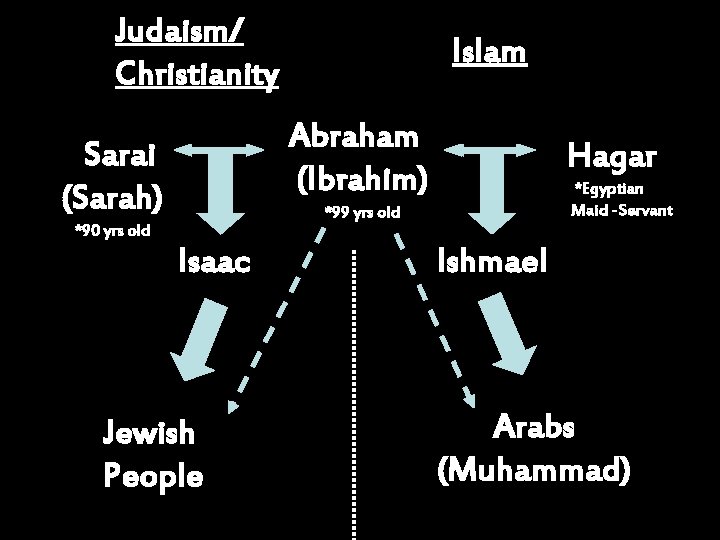
Judaism/ Christianity Islam Abraham (Ibrahim) Sarai (Sarah) Hagar *Egyptian Maid -Servant *99 yrs old *90 yrs old Isaac Jewish People Ishmael Arabs (Muhammad)
The Israeli-Palestinian Conflict: A Lesson in Perspective
One House, Two Stories: Dalia “Growing up, Dalia would frequently ask her parents and teachers: “What are these houses we are living in? ” “These are Arab houses, ” she was told. “What are these Arab houses that everyone talks about? ” she would reply. Dalia’s school was in an Arab house, and there she would learn Israel’s history. She learned about the creation of the state of Israel as a safe haven for the Jews. She studied the War of Independence as the story of the few against the many. The Arabs had invaded, Dalia would read, in order to destroy the new state and throw the Jews into the sea. Most nations confronted with such hostilities would have been paralyzed, but tiny Israel had withstood five Arab armies. Little David had defeated Goliath. As for the Arabs, Dalia’s textbooks would report that they ran away, deserting their lands and abandoning their homes, fleeing before the conquering Israeli army. The Arabs, one textbook of the day declared, “Preferred to leave” once the Jews had taken their towns. Dalia accepted the history she was taught. Still, she was confused. Why, she wondered, would anyone leave so willingly? ” --Excerpt from: The Lemon Tree by Sandy Tolan, page 115
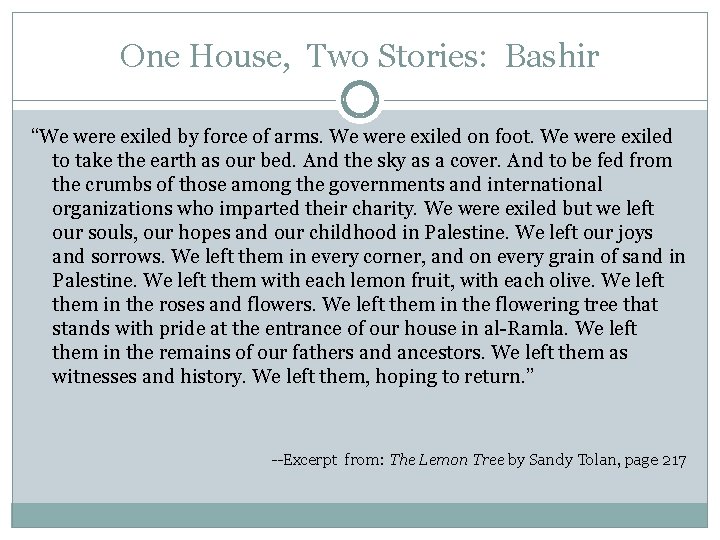
One House, Two Stories: Bashir “We were exiled by force of arms. We were exiled on foot. We were exiled to take the earth as our bed. And the sky as a cover. And to be fed from the crumbs of those among the governments and international organizations who imparted their charity. We were exiled but we left our souls, our hopes and our childhood in Palestine. We left our joys and sorrows. We left them in every corner, and on every grain of sand in Palestine. We left them with each lemon fruit, with each olive. We left them in the roses and flowers. We left them in the flowering tree that stands with pride at the entrance of our house in al-Ramla. We left them in the remains of our fathers and ancestors. We left them as witnesses and history. We left them, hoping to return. ” --Excerpt from: The Lemon Tree by Sandy Tolan, page 217
Discuss the differences between the two passages.
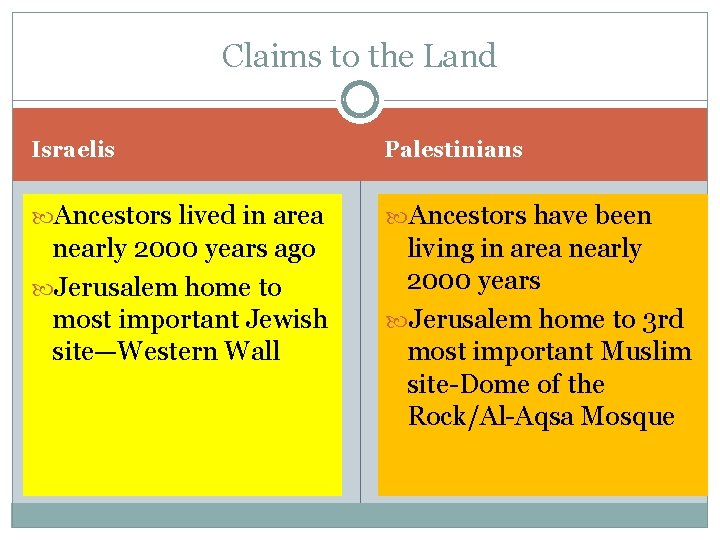
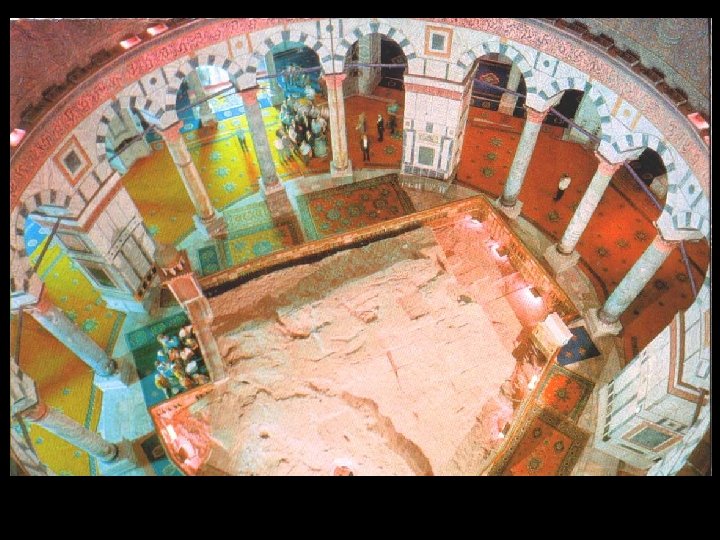
Claims to the Land Israelis Palestinians Ancestors lived in area Ancestors have been nearly 2000 years ago Jerusalem home to most important Jewish site—Western Wall living in area nearly 2000 years Jerusalem home to 3 rd most important Muslim site-Dome of the Rock/Al-Aqsa Mosque
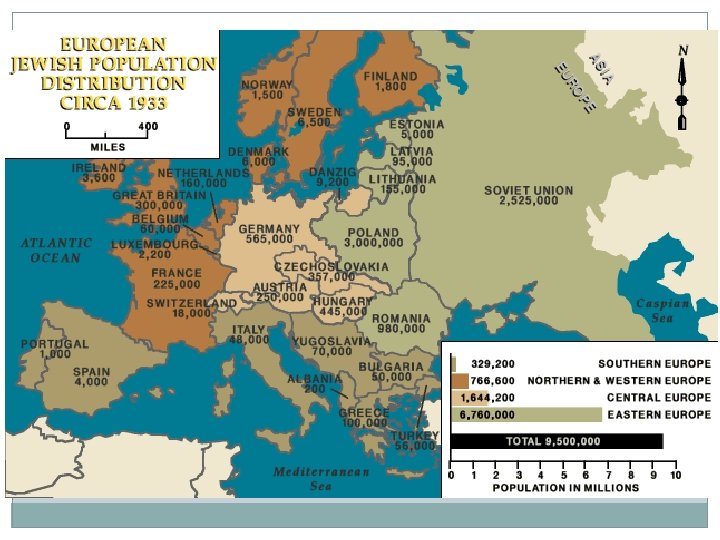
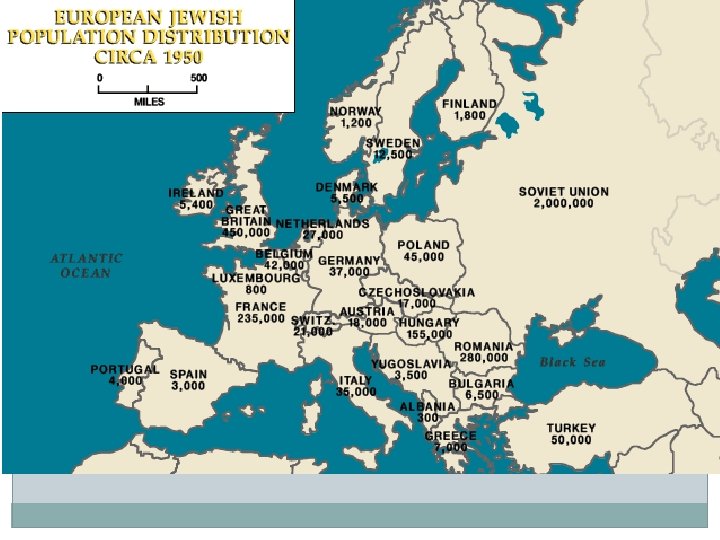
Historical Background Zionist Movement: Support for Jewish nationhood in the area of Palestine. Movement began late 1800 s. A result of two forces in Europe. Anti-Semitism (from Middle Ages) Nationalism Palestine (Pre-WWI): Area of Palestine under Ottoman Empire Palestine (After-WWI): Area of Palestine under control of British (British Mandate) until it became independent Balfour Declaration: 1917: Britain supports idea of a Jewish homeland w/ rights of non-Jews protected Many Jews began to immigrate to Palestine in the late 1800 s into the early 20 th C. Impact of WWII/Holocaust on the Zionist Movement?
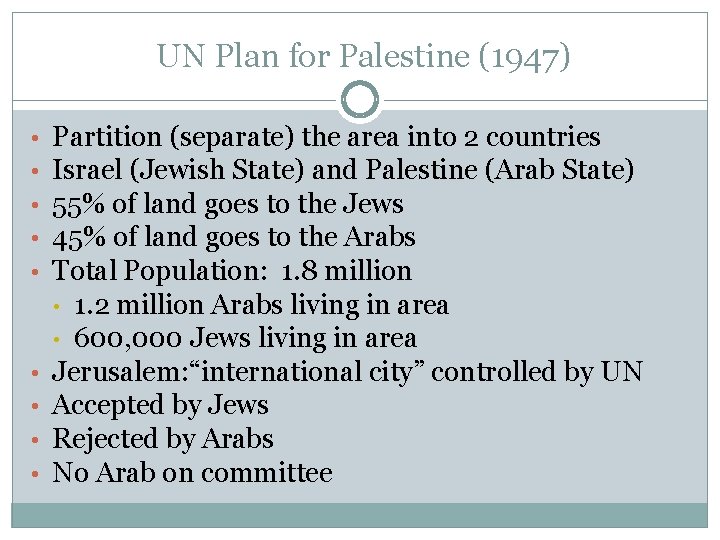
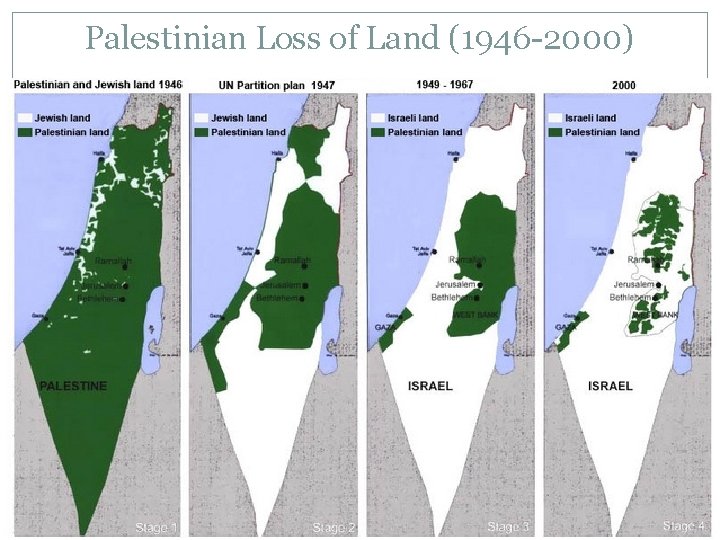
UN Plan for Palestine (1947) • • • Partition (separate) the area into 2 countries Israel (Jewish State) and Palestine (Arab State) 55% of land goes to the Jews 45% of land goes to the Arabs Total Population: 1. 8 million • 1. 2 million Arabs living in area • 600, 000 Jews living in area Jerusalem: “international city” controlled by UN Accepted by Jews Rejected by Arabs No Arab on committee
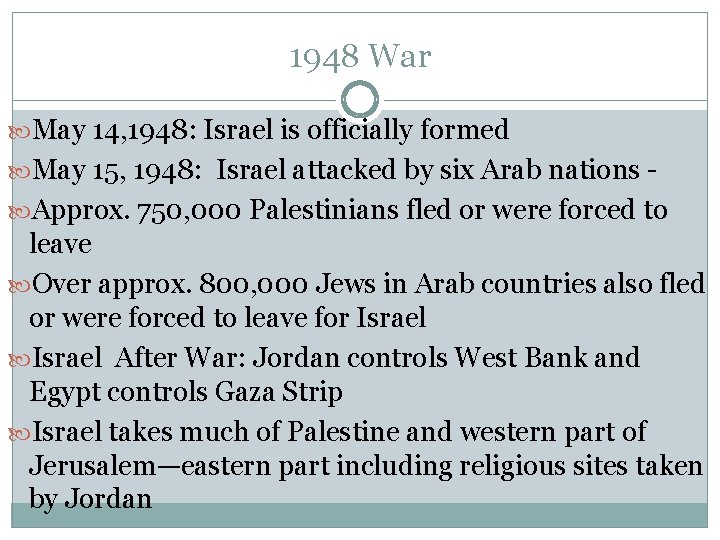
1948 War May 14, 1948: Israel is officially formed May 15, 1948: Israel attacked by six Arab nations Approx. 750, 000 Palestinians fled or were forced to leave Over approx. 800, 000 Jews in Arab countries also fled or were forced to leave for Israel After War: Jordan controls West Bank and Egypt controls Gaza Strip Israel takes much of Palestine and western part of Jerusalem—eastern part including religious sites taken by Jordan
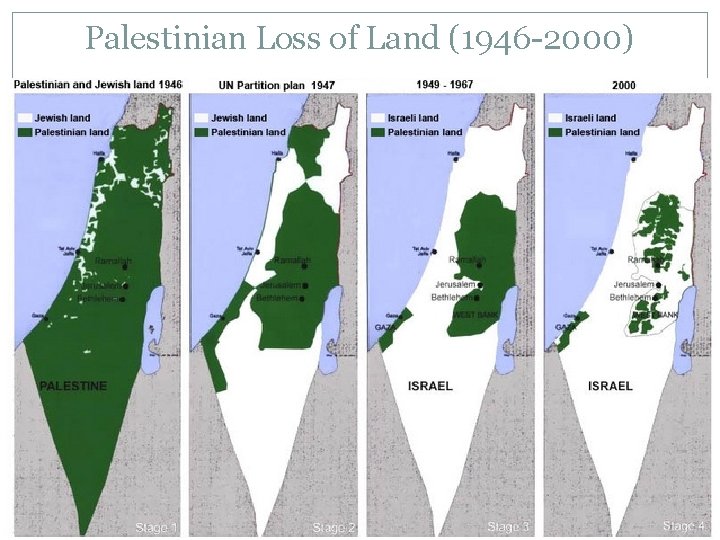
Palestinian Loss of Land (1946 -2000)
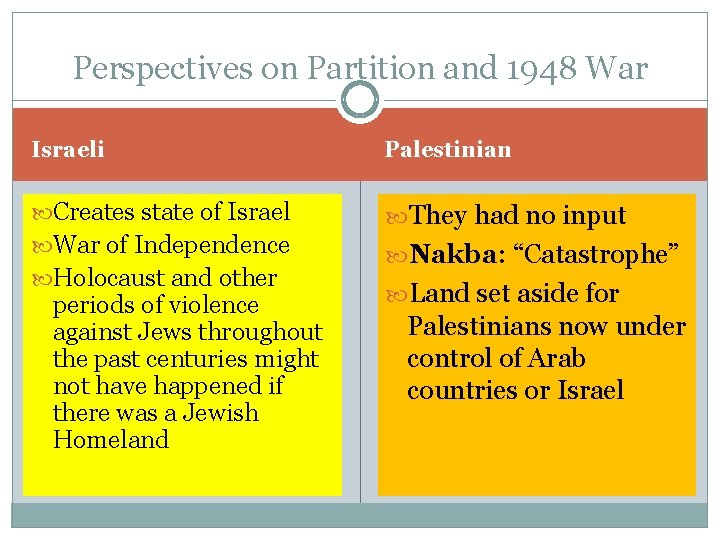
Perspectives on Partition and 1948 War Israeli Palestinian Creates state of Israel They had no input War of Independence Holocaust and other periods of violence against Jews throughout the past centuries might not have happened if there was a Jewish Homeland Nakba: “Catastrophe” Land set aside for Palestinians now under control of Arab countries or Israel
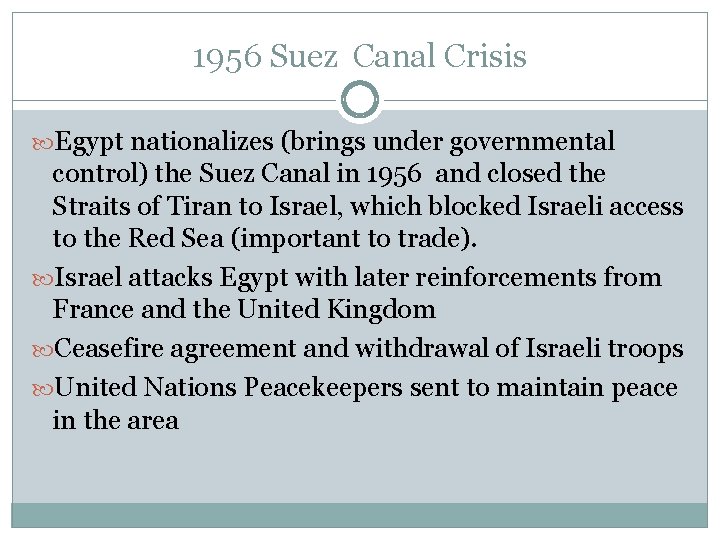
1956 Suez Canal Crisis Egypt nationalizes (brings under governmental control) the Suez Canal in 1956 and closed the Straits of Tiran to Israel, which blocked Israeli access to the Red Sea (important to trade). Israel attacks Egypt with later reinforcements from France and the United Kingdom Ceasefire agreement and withdrawal of Israeli troops United Nations Peacekeepers sent to maintain peace in the area
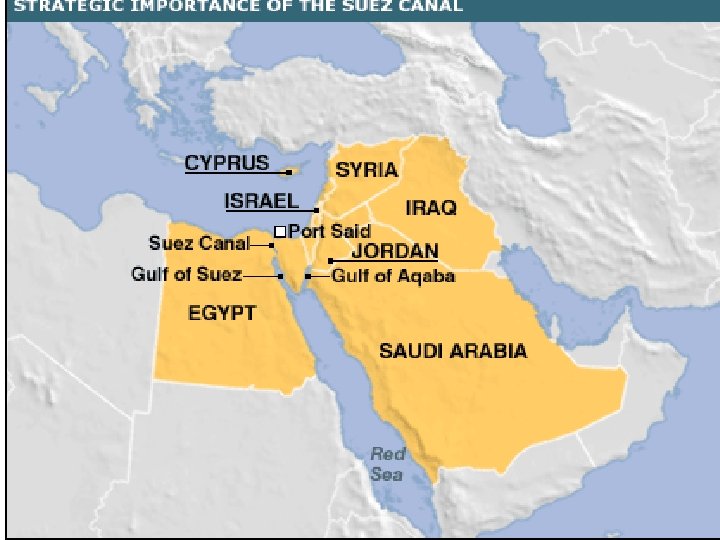
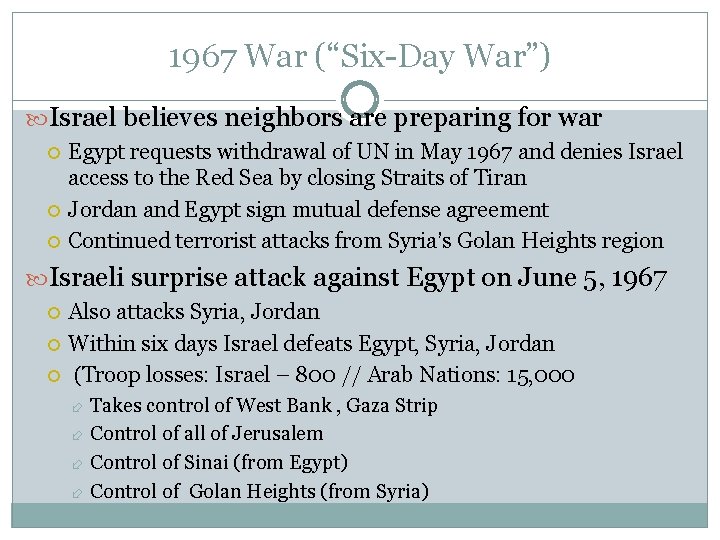
1967 War (“Six-Day War”) Israel believes neighbors are preparing for war Egypt requests withdrawal of UN in May 1967 and denies Israel access to the Red Sea by closing Straits of Tiran Jordan and Egypt sign mutual defense agreement Continued terrorist attacks from Syria’s Golan Heights region Israeli surprise attack against Egypt on June 5, 1967 Also attacks Syria, Jordan Within six days Israel defeats Egypt, Syria, Jordan (Troop losses: Israel – 800 // Arab Nations: 15, 000 Takes control of West Bank , Gaza Strip Control of all of Jerusalem Control of Sinai (from Egypt) Control of Golan Heights (from Syria)
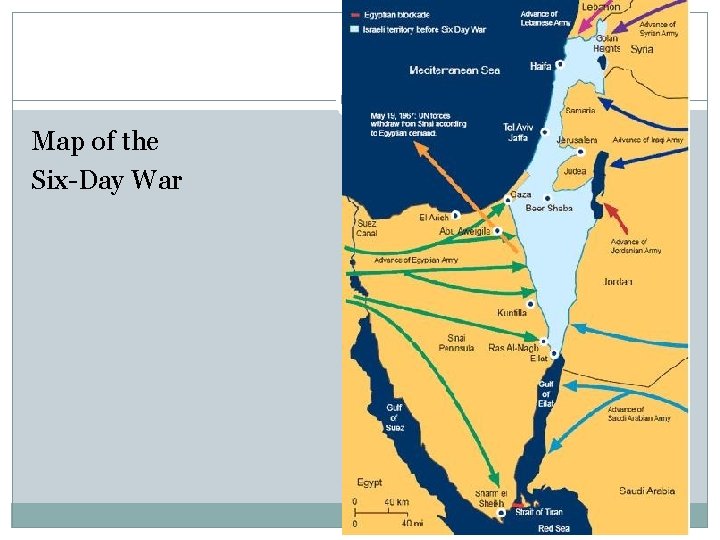
Map of the Six-Day War
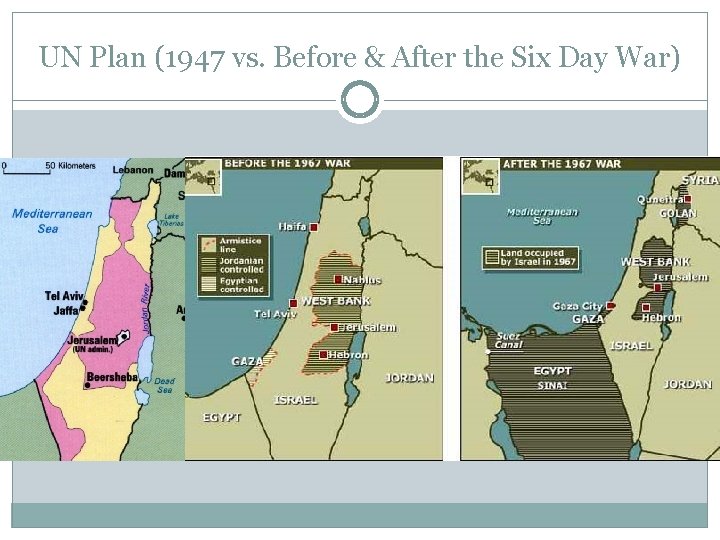
UN Plan (1947 vs. Before & After the Six Day War)
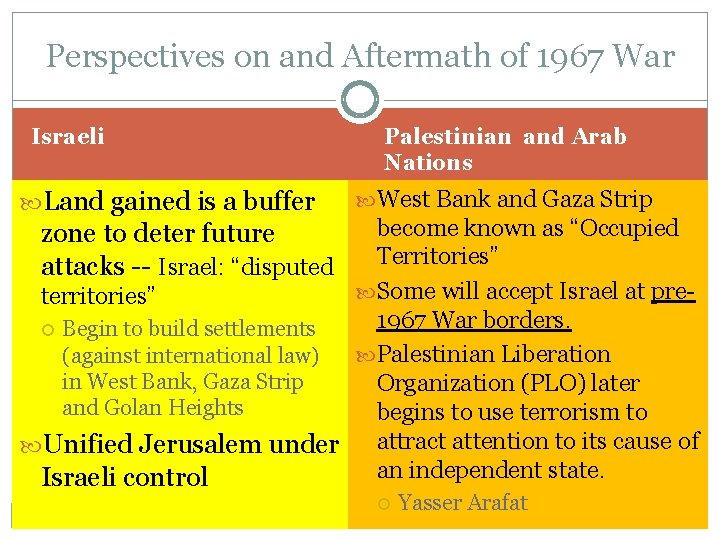
Perspectives on and Aftermath of 1967 War Israeli Land gained is a buffer Palestinian and Arab Nations West Bank and Gaza Strip become known as “Occupied Territories” Some will accept Israel at preterritories” 1967 War borders. Begin to build settlements Palestinian Liberation (against international law) in West Bank, Gaza Strip Organization (PLO) later and Golan Heights begins to use terrorism to attract attention to its cause of Unified Jerusalem under an independent state. Israeli control zone to deter future attacks -- Israel: “disputed Yasser Arafat
The Camp David Accords 1973 – Yom Kippur War – Syria/Egypt attack Israeli victory Egypt eventually engages Israel in peace talks 1977: Egypt (led by Anwar Sadat) engages Israel in peace efforts 1978: Camp David Accords U. S. President Carter invites Sadat and Israeli Prime Minister Begin to Camp David Egypt recognizes Israel as a country Israel gives Sinai peninsula back to Egypt First agreement between Israel and an Arab nation 1981 – Anwar Sadat assassinated
Perspectives on Camp David Accords Israeli Shows that the country is willing to trade land it has conquered for peace Palestinian and Arab Nations Egypt recognizes that Israel is a country and exists. Sadat assassinated in 1981 by Muslim extremists Jordan signs peace agreement with Israel in 1994.
The Intifada Palestinian uprising against Israeli occupation, living conditions, and to demand independence that begins in 1987. Includes Palestinian demonstrations, strikes, boycotts, rock throwing and gasoline bombs. Israeli military response Over approx. 400 Israelis Killed Over approx. 1500 Palestinians Killed
Peace Efforts Continued During the 1990 s several advances towards peace were made with several meetings taking place in places such as Egypt, Spain, the United States, and Norway. 1993 Oslo Accords: Palestinian Leader Yasser Arafat and Israel’s Prime Minister Yitzhak Rabin met to begin to work out a peace deal that included each side recognizing the right of the other to exist. Rabin assassinated by Jewish extremist in November of 1995
Second Intifada • By 2000, peace process has faded. • In 2000, Israeli political figure Ariel Sharon visits Temple Mount (Western Wall area and Al Aqsa Mosque area) in Jerusalem – seen as antagonistic by Palestinians • Palestinian violence erupts beginning the Second Intifada • Buses, discos, hotels, fast food restaurants, etc in Israel blown up by Palestinian suicide bombers • Israel responds militarily • From 2000 -June 2008 • Over 4, 500 Palestinians killed • Over 1, 000 Israelis killed
The Gaza Strip In 2005, Israel removed its settlements from the Gaza Strip and gave much political control of the area to the Palestinian government (with HUGE exceptions such as the border, airspace, coastline, imports/exports, movement) Gaza later comes under the control of Hamas, a group considered by Israel and other countries to be a terrorist organization – result of elections that were encouraged by the US. As of June 2008, Hamas and Israel had entered into a cease fire agreement. Ongoing violence: 2005 -2008 – 116/1, 509 Israelis killed/wounded – 1, 735/8, 308 Palestinians killed/wounded
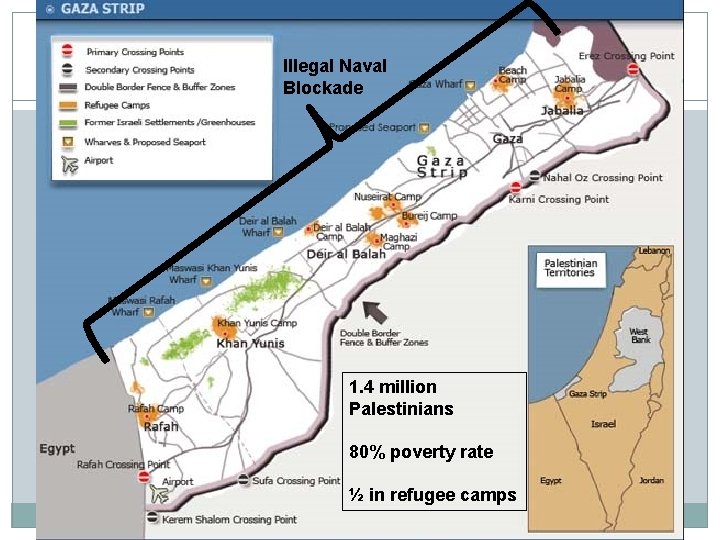
Illegal Naval Blockade 1. 4 million Palestinians 80% poverty rate ½ in refugee camps
2008 -2009 “War” in Gaza: “Operation Cast Lead” Homemade missiles launched from Gaza by Hamas militants in late-year 2008. Israel responds with aerial bombardment (cluster bombs, phosphorus bombs) and land invasion of civilian centers and a land invasion Death Tolls: Israeli Dead: 13 (3 civilians) Palestinian Dead: 1, 400 (900 civilians) US media calls the massacre a “war” Hamas operatives, Israel cited for war crimes/crimes against humanity – UN Human Rights Council condemns Israel for war crimes and crimes against humanity.
Current Issue : Two-State Solution The following issues remain…
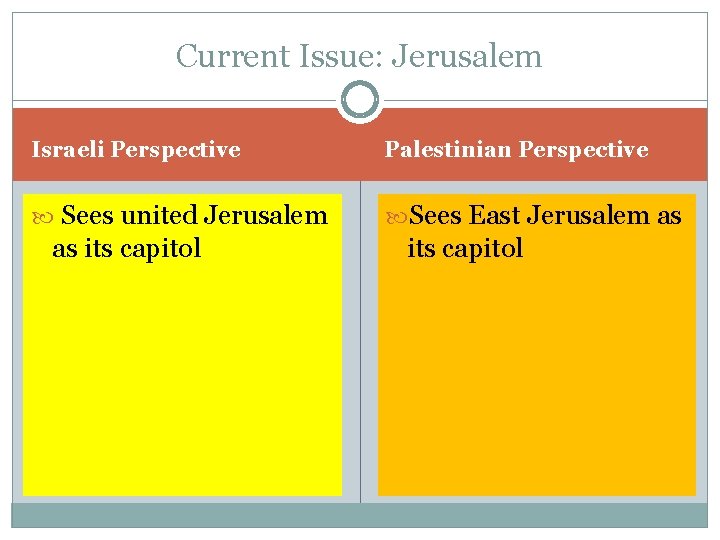
Current Issue: Jerusalem Israeli Perspective Palestinian Perspective Sees united Jerusalem Sees East Jerusalem as as its capitol
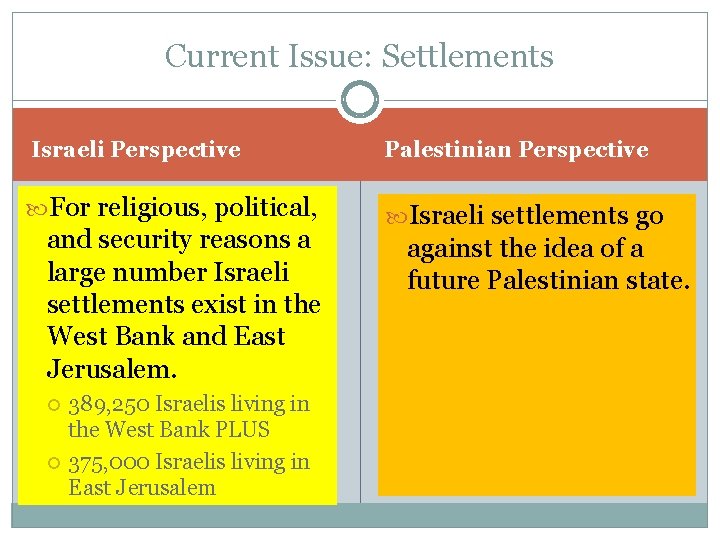
Current Issue: Settlements Israeli Perspective Palestinian Perspective For religious, political, Israeli settlements go and security reasons a large number Israeli settlements exist in the West Bank and East Jerusalem. 389, 250 Israelis living in the West Bank PLUS 375, 000 Israelis living in East Jerusalem against the idea of a future Palestinian state.
Palestinian Loss of Land (1946 -2000)
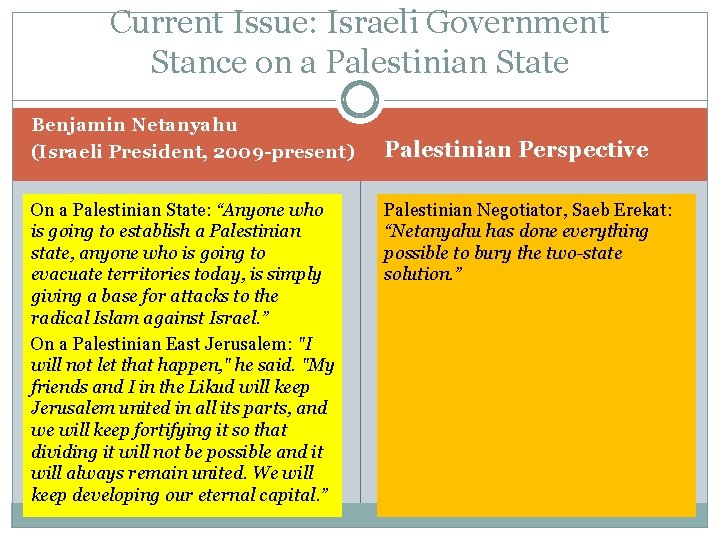
Current Issue: Israeli Government Stance on a Palestinian State Benjamin Netanyahu (Israeli President, 2009 -present) On a Palestinian State: “Anyone who is going to establish a Palestinian state, anyone who is going to evacuate territories today, is simply giving a base for attacks to the radical Islam against Israel. ” On a Palestinian East Jerusalem: "I will not let that happen, " he said. "My friends and I in the Likud will keep Jerusalem united in all its parts, and we will keep fortifying it so that dividing it will not be possible and it will always remain united. We will keep developing our eternal capital. ” Palestinian Perspective Palestinian Negotiator, Saeb Erekat: “Netanyahu has done everything possible to bury the two-state solution. ”
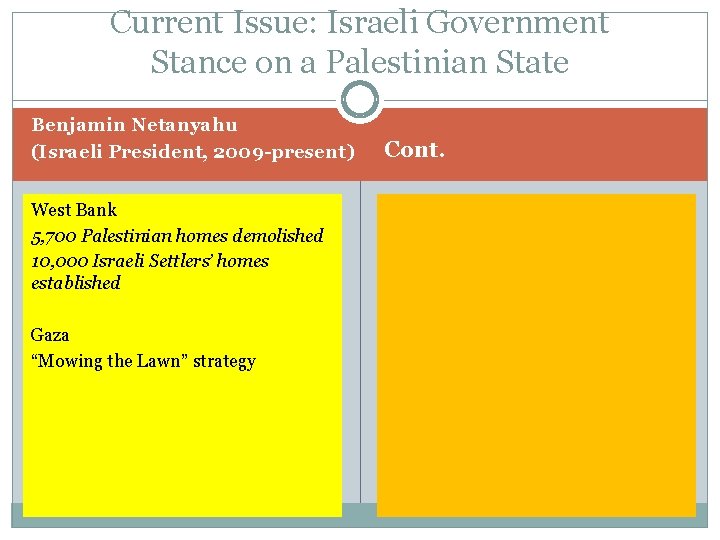
Current Issue: Israeli Government Stance on a Palestinian State Benjamin Netanyahu (Israeli President, 2009 -present) West Bank 5, 700 Palestinian homes demolished 10, 000 Israeli Settlers’ homes established Gaza “Mowing the Lawn” strategy Cont.
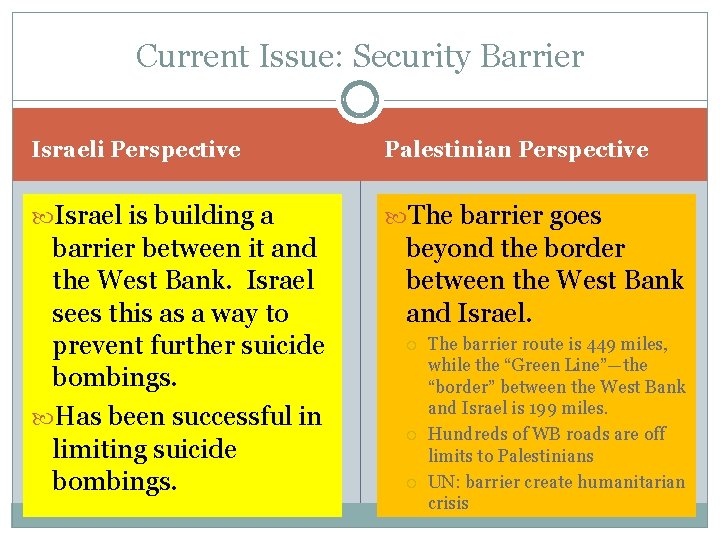
Current Issue: Security Barrier Israeli Perspective Palestinian Perspective Israel is building a The barrier goes barrier between it and the West Bank. Israel sees this as a way to prevent further suicide bombings. Has been successful in limiting suicide bombings. beyond the border between the West Bank and Israel. The barrier route is 449 miles, while the “Green Line”—the “border” between the West Bank and Israel is 199 miles. Hundreds of WB roads are off limits to Palestinians UN: barrier create humanitarian crisis
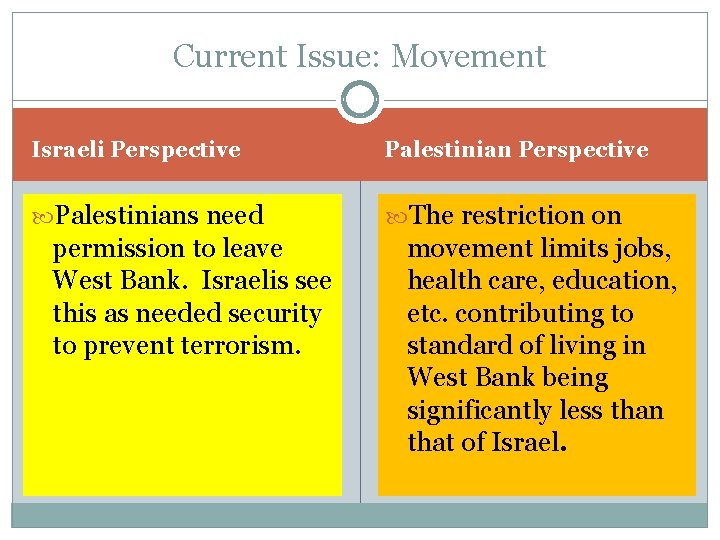
Current Issue: Movement Israeli Perspective Palestinian Perspective Palestinians need The restriction on permission to leave West Bank. Israelis see this as needed security to prevent terrorism. movement limits jobs, health care, education, etc. contributing to standard of living in West Bank being significantly less than that of Israel.
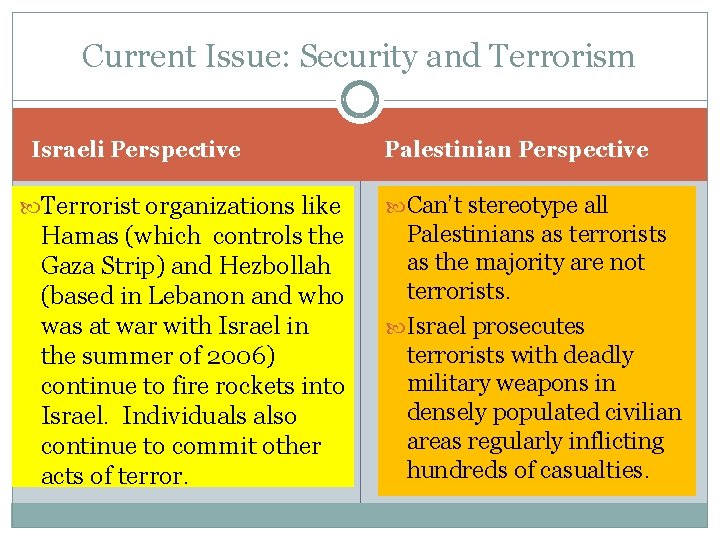
Current Issue: Security and Terrorism Israeli Perspective Terrorist organizations like Hamas (which controls the Gaza Strip) and Hezbollah (based in Lebanon and who was at war with Israel in the summer of 2006) continue to fire rockets into Israel. Individuals also continue to commit other acts of terror. Palestinian Perspective Can’t stereotype all Palestinians as terrorists as the majority are not terrorists. Israel prosecutes terrorists with deadly military weapons in densely populated civilian areas regularly inflicting hundreds of casualties.
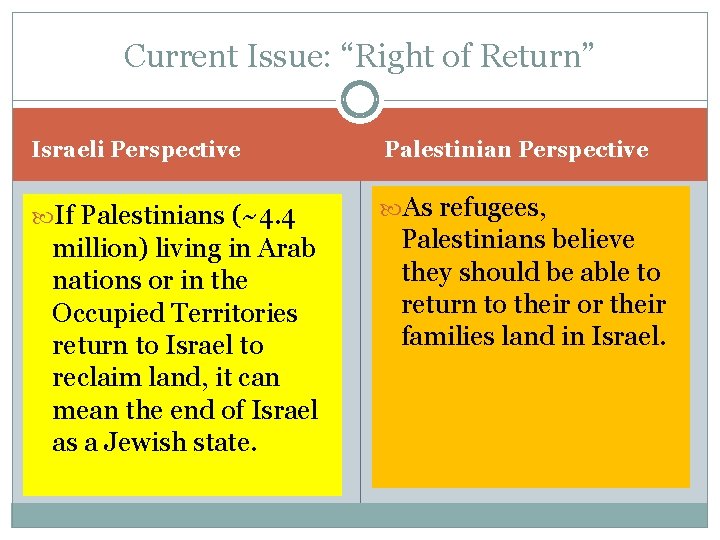
Current Issue: “Right of Return” Israeli Perspective Palestinian Perspective If Palestinians (~4. 4 As refugees, million) living in Arab nations or in the Occupied Territories return to Israel to reclaim land, it can mean the end of Israel as a Jewish state. Palestinians believe they should be able to return to their or their families land in Israel.

THE END…
- Slides: 39