
JTI at a glance The JT Group Our

- Slides: 16
JTI at a glance
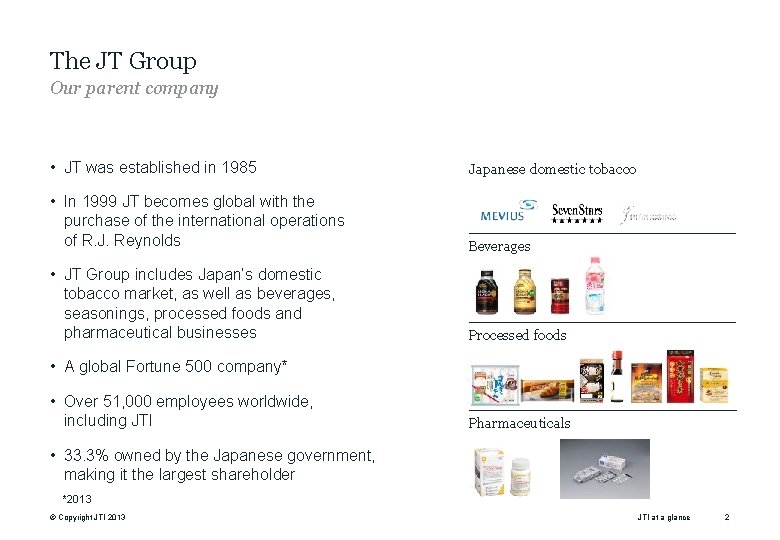
The JT Group Our parent company • JT was established in 1985 Japanese domestic tobacco • In 1999 JT becomes global with the purchase of the international operations of R. J. Reynolds Beverages • JT Group includes Japan’s domestic tobacco market, as well as beverages, seasonings, processed foods and pharmaceutical businesses Processed foods • A global Fortune 500 company* • Over 51, 000 employees worldwide, including JTI Pharmaceuticals • 33. 3% owned by the Japanese government, making it the largest shareholder *2013 © Copyright JTI 2013 JTI at a glance 2
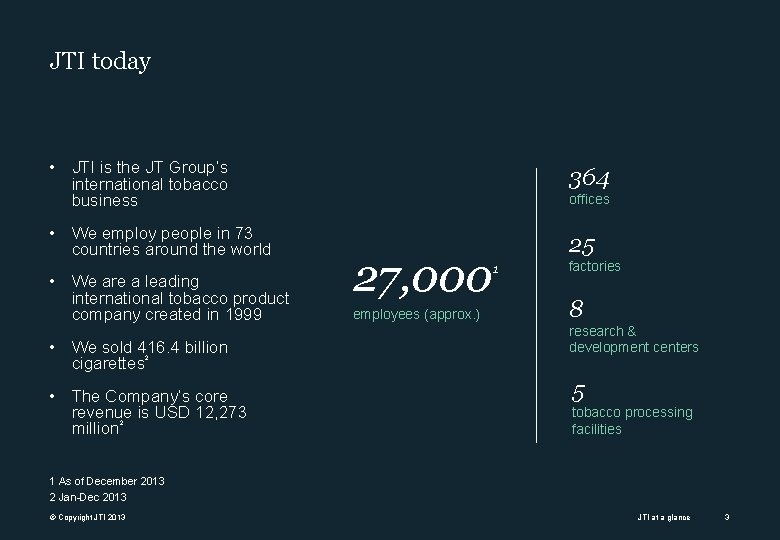
JTI today • JTI is the JT Group’s international tobacco business 364 • We employ people in 73 countries around the world 25 • We are a leading international tobacco product company created in 1999 • We sold 416. 4 billion cigarettes 2 • The Company’s core revenue is USD 12, 273 million 2 offices 27, 000 employees (approx. ) 1 factories 8 research & development centers 5 tobacco processing facilities 1 As of December 2013 2 Jan-Dec 2013 © Copyright JTI 2013 JTI at a glance 3
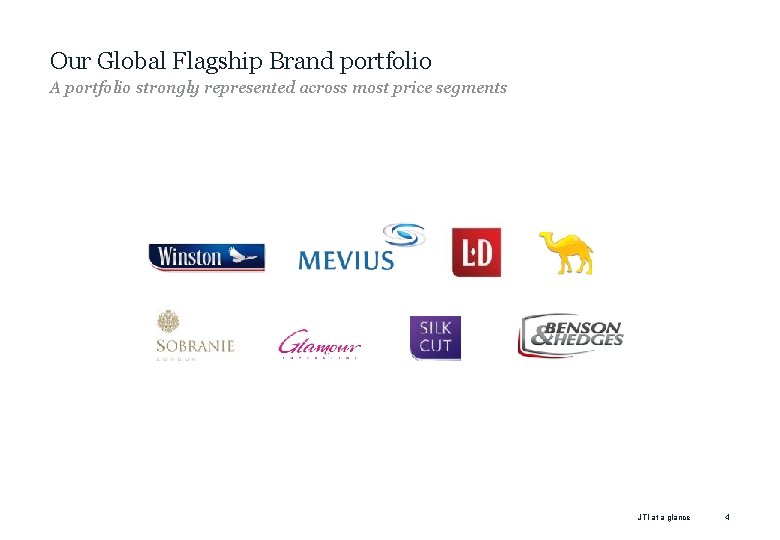
Our Global Flagship Brand portfolio A portfolio strongly represented across most price segments JTI at a glance 4
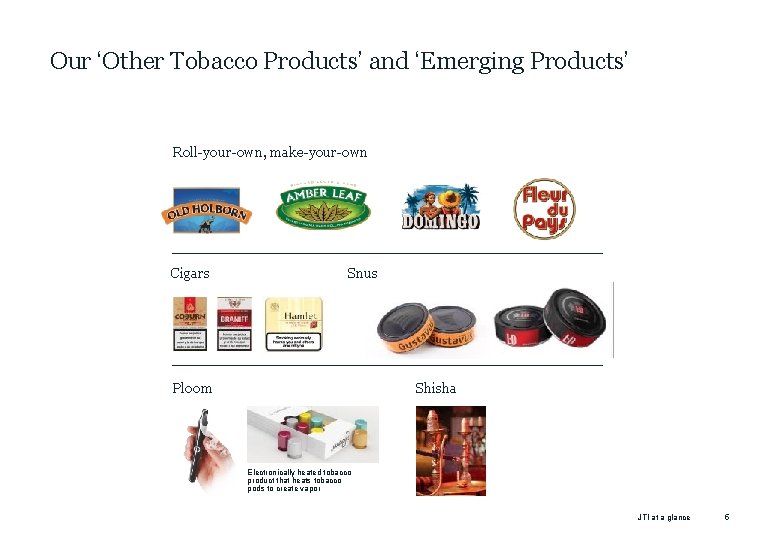
Our ‘Other Tobacco Products’ and ‘Emerging Products’ Roll-your-own, make-your-own Cigars Snus Ploom Shisha Electronically heated tobacco product that heats tobacco pods to create vapor JTI at a glance 5
JTI in Serbia Investment case
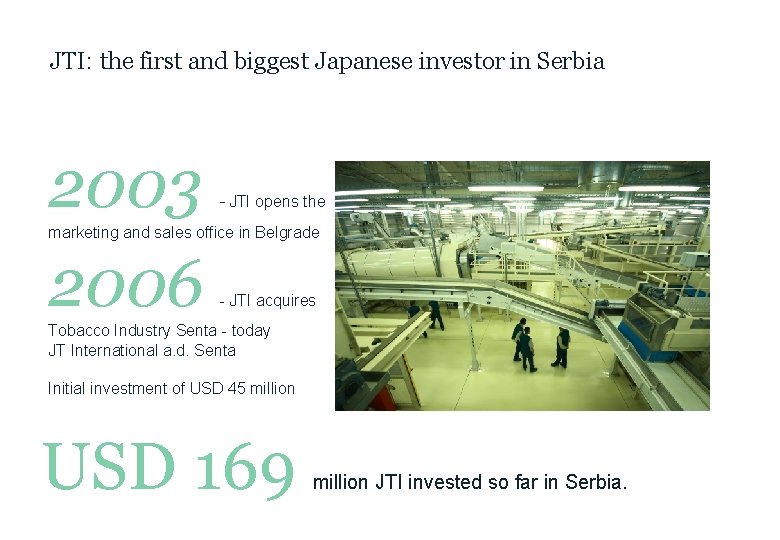
JTI: the first and biggest Japanese investor in Serbia 2003 2006 - JTI opens the marketing and sales office in Belgrade - JTI acquires Tobacco Industry Senta - today JT International a. d. Senta Initial investment of USD 45 million USD 169 million JTI invested so far in Serbia.
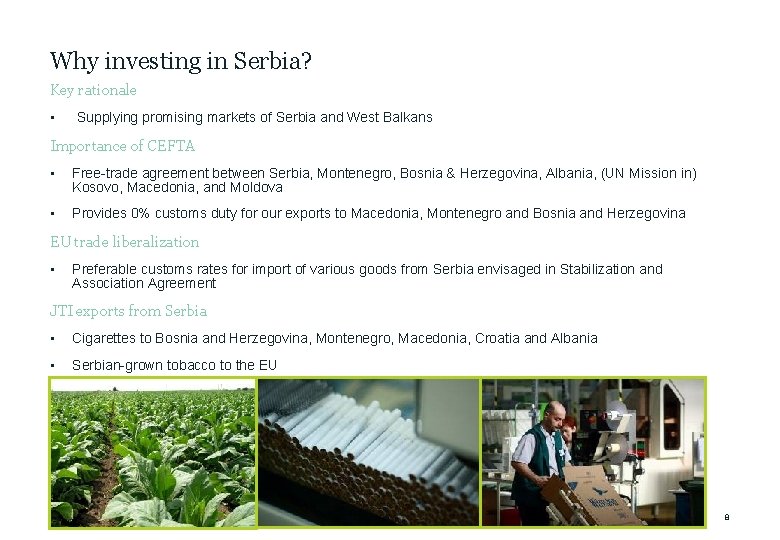
Why investing in Serbia? Key rationale • Supplying promising markets of Serbia and West Balkans Importance of CEFTA • Free-trade agreement between Serbia, Montenegro, Bosnia & Herzegovina, Albania, (UN Mission in) Kosovo, Macedonia, and Moldova • Provides 0% customs duty for our exports to Macedonia, Montenegro and Bosnia and Herzegovina EU trade liberalization • Preferable customs rates for import of various goods from Serbia envisaged in Stabilization and Association Agreement JTI exports from Serbia • Cigarettes to Bosnia and Herzegovina, Montenegro, Macedonia, Croatia and Albania • Serbian-grown tobacco to the EU • Total export of cigarettes and tobacco in 2013 worth USD 23, 4 million 8
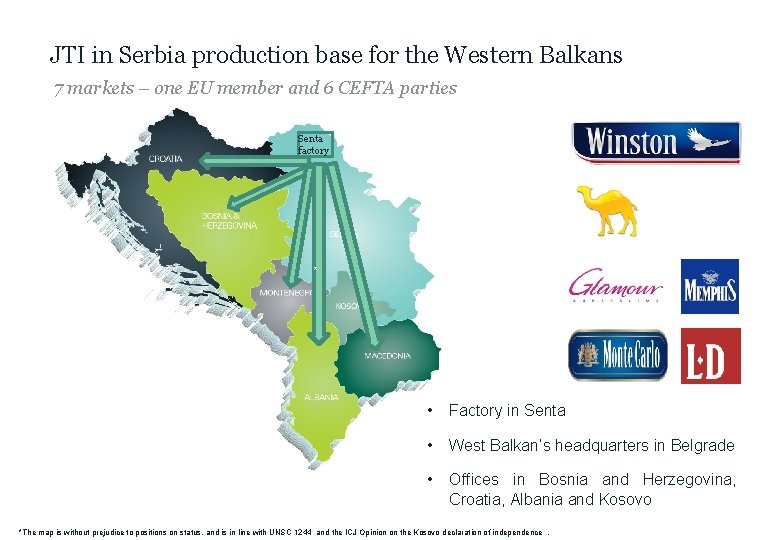
JTI in Serbia production base for the Western Balkans 7 markets – one EU member and 6 CEFTA parties Senta factory * • Factory in Senta • West Balkan’s headquarters in Belgrade • Offices in Bosnia and Herzegovina, Croatia, Albania and Kosovo *The map is without prejudice to positions on status, and is in line with UNSC 1244 and the ICJ Opinion on the Kosovo declaration of independence.
JTI: tax contributor in Serbia JTI is the 13. 6 th 6 largest taxpayer in the country billion dinars contributed to the state budget in 2013. 10
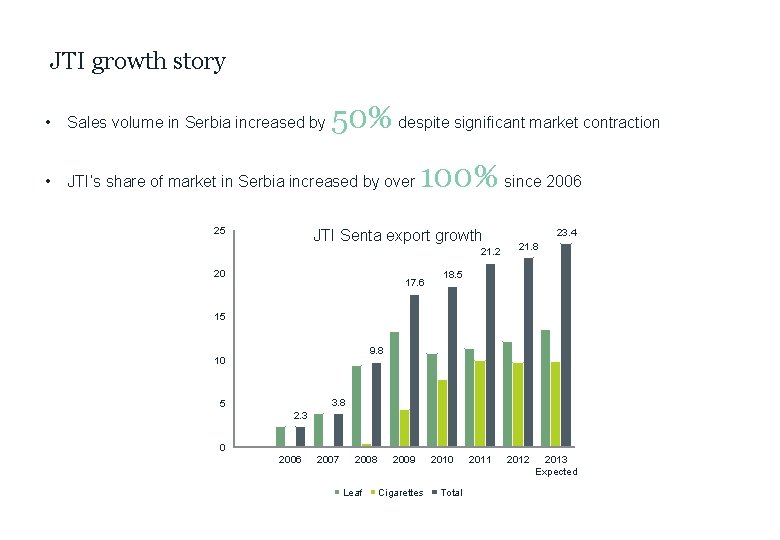
JTI growth story 50% despite significant market contraction • Sales volume in Serbia increased by • JTI’s share of market in Serbia increased by over 25 100% since 2006 JTI Senta export growth 21. 2 20 17. 6 23. 4 21. 8 18. 5 15 9. 8 10 3. 8 5 2. 3 0 2006 2007 2008 Leaf 2009 Cigarettes 2010 Total 2011 2012 2013 Expected
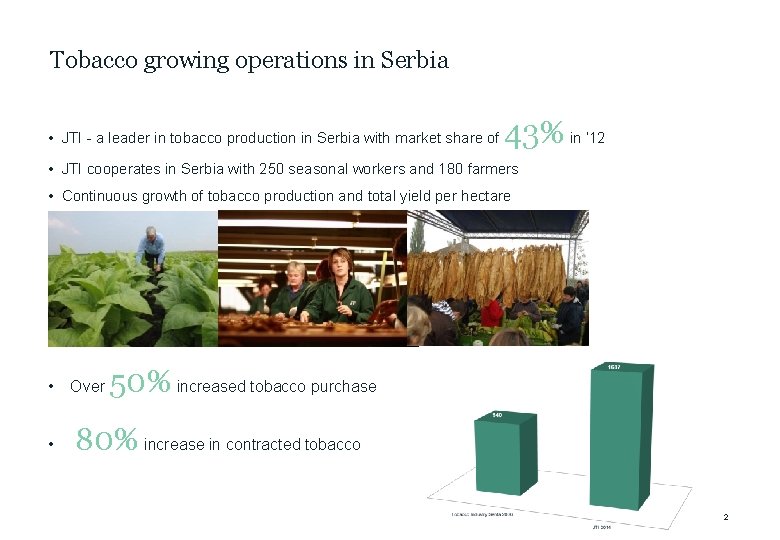
Tobacco growing operations in Serbia • JTI - a leader in tobacco production in Serbia with market share of 43% in ’ 12 • JTI cooperates in Serbia with 250 seasonal workers and 180 farmers • Continuous growth of tobacco production and total yield per hectare • Over • 50% increased tobacco purchase 80% increase in contracted tobacco 12
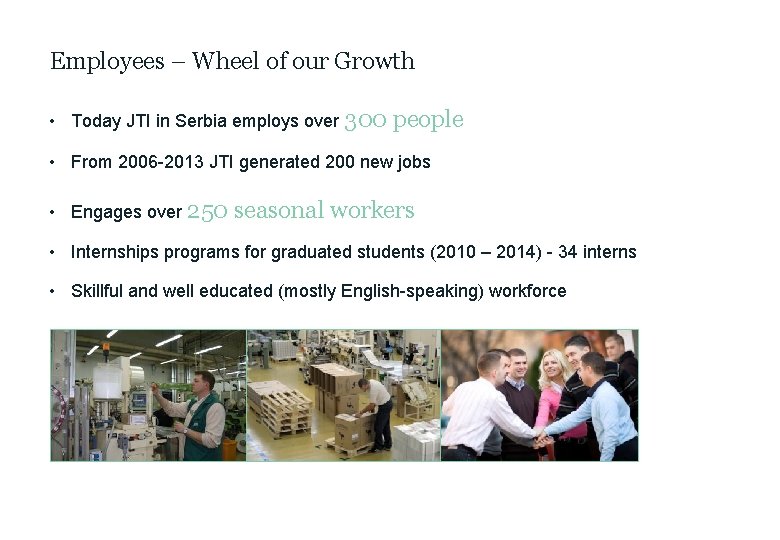
Employees – Wheel of our Growth • Today JTI in Serbia employs over 300 people • From 2006 -2013 JTI generated 200 new jobs • Engages over 250 seasonal workers • Internships programs for graduated students (2010 – 2014) - 34 interns • Skillful and well educated (mostly English-speaking) workforce
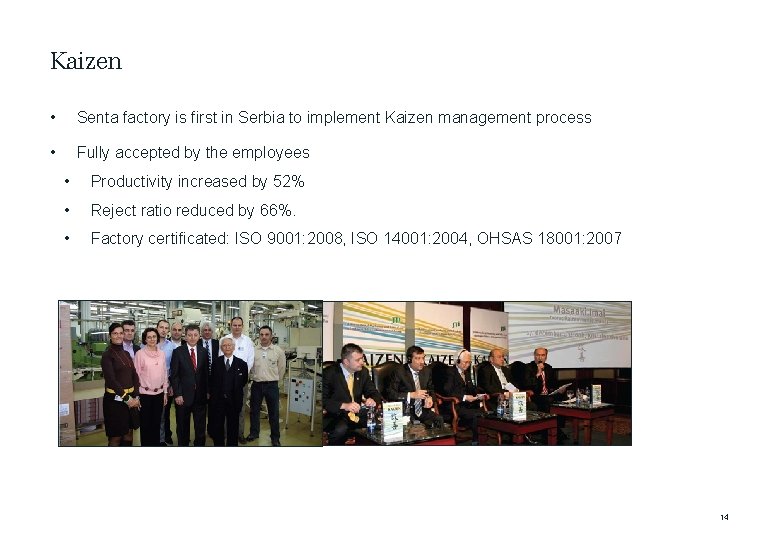
Kaizen • Senta factory is first in Serbia to implement Kaizen management process • Fully accepted by the employees • Productivity increased by 52% • Reject ratio reduced by 66%. • Factory certificated: ISO 9001: 2008, ISO 14001: 2004, OHSAS 18001: 2007 14
Business Environment in Serbia • Continuous dialog with the Government • Communication maintained on all key aspects of economic legislation development • Investor-friendly tax regime • Salary tax rate -10% and corporate profit tax rate – 15%, among the lowest in the Europe • National treatment of foreign investors • Serbia’s EU aspirations influencing regulatory environment that is heading towards alignment with EU • Predictable development of operating environment (e. g. excise calendar in tobacco industry) Conclusion • The investment in Serbia proved to be good platform for business expansion of JTI in Serbia and Adriatica region 15
Enterprising Open Challenging