
JSOCC Basic Course Slides Content Four Phase Lesson
JSOCC Basic Course Slides Content • Four Phase Lesson Plan Overview…. . 2 -10 • Classroom Management………………… 12 -23 • Ethics……………………… 25 -43 As of 11/12/2013 Unclassified 1
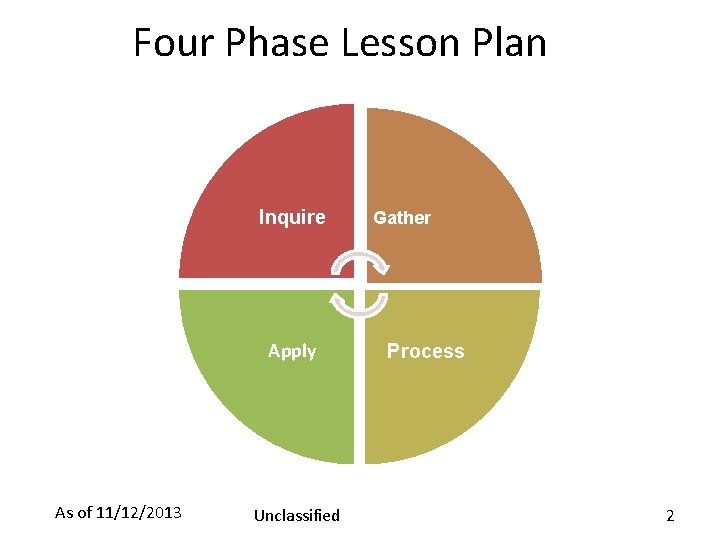
Four Phase Lesson Plan Inquire Apply As of 11/12/2013 Unclassified Gather Process 2
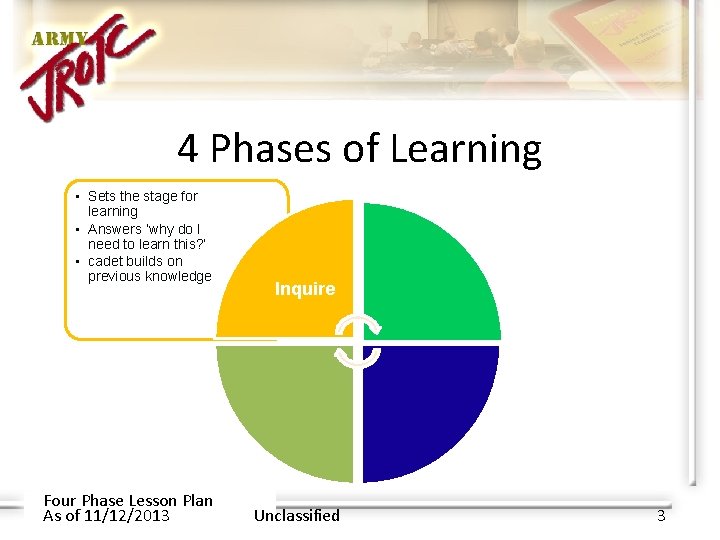
4 Phases of Learning • Sets the stage for learning • Answers ‘why do I need to learn this? ’ • cadet builds on previous knowledge Four Phase Lesson Plan As of 11/12/2013 Inquire Unclassified 3
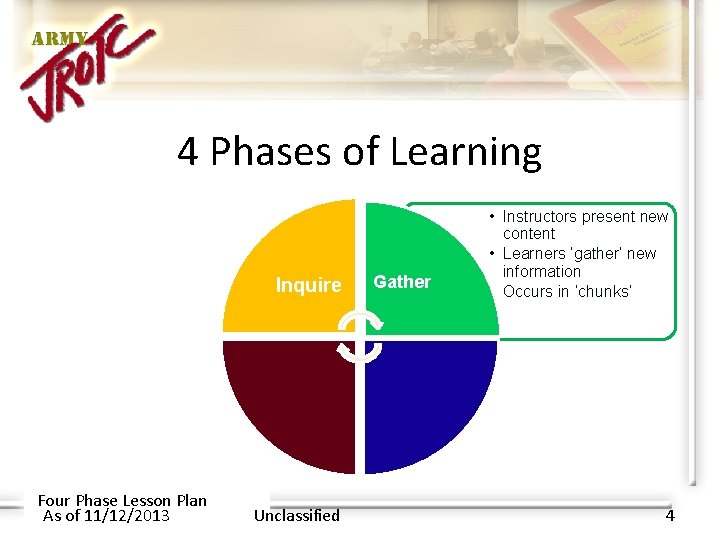
4 Phases of Learning Inquire Four Phase Lesson Plan As of 11/12/2013 Unclassified Gather • Instructors present new content • Learners ‘gather’ new information • Occurs in ‘chunks’ 4
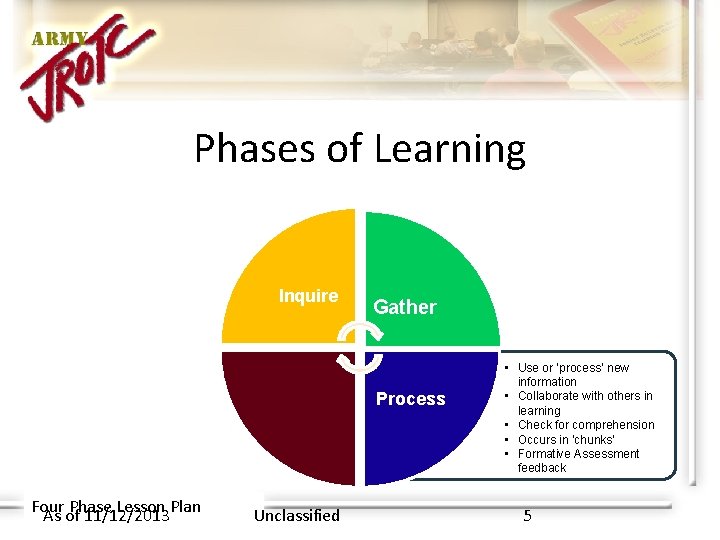
Phases of Learning Inquire Gather Process Four Phase Lesson Plan As of 11/12/2013 Unclassified • Use or ‘process’ new information • Collaborate with others in learning • Check for comprehension • Occurs in ‘chunks’ • Formative Assessment feedback 5

Phases of Learning • Apply the targeted skill or competency • Performance assessment task • Summative assessment Four Phase Lesson Plan As of 11/12/2013 Inquire Gather Apply Process Unclassified 6
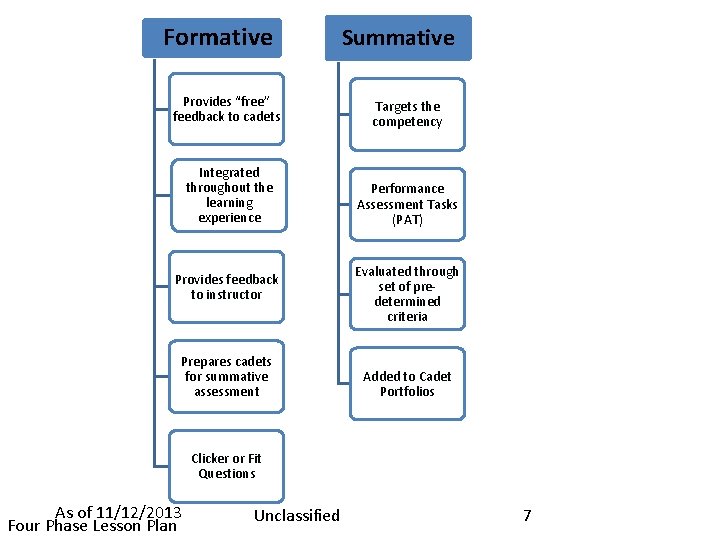
Formative Summative Provides “free” feedback to cadets Targets the competency Integrated throughout the learning experience Performance Assessment Tasks (PAT) Provides feedback to instructor Prepares cadets for summative assessment Evaluated through set of predetermined criteria Added to Cadet Portfolios Clicker or Fit Questions As of 11/12/2013 Four Phase Lesson Plan Unclassified 7
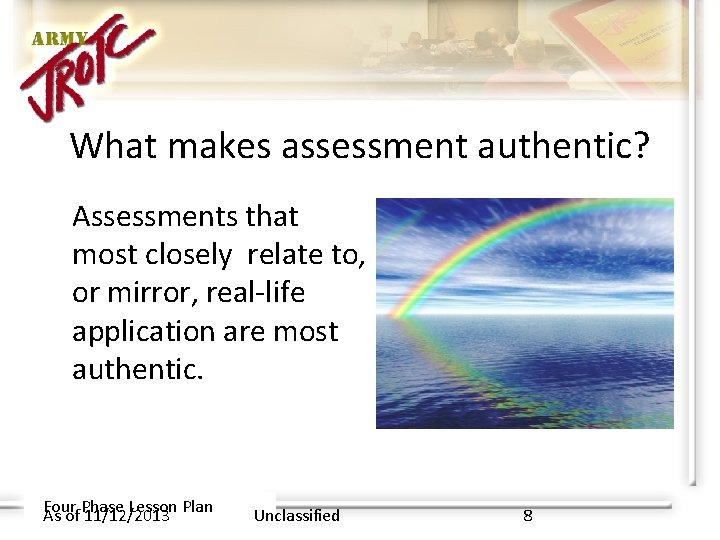
What makes assessment authentic? Assessments that most closely relate to, Gather or mirror, real-life application are most authentic. Four Lesson Plan As of Phase 11/12/2013 Unclassified 8
As of 11/12/2013 Unclassified 9
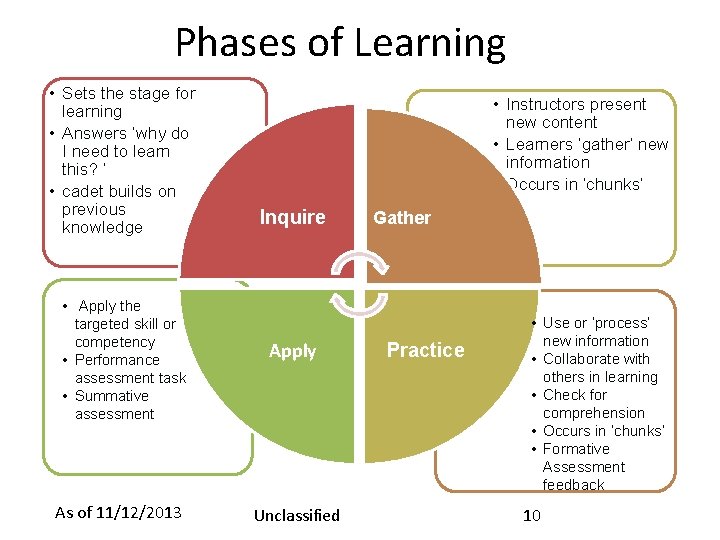
Phases of Learning • Sets the stage for learning • Answers ‘why do I need to learn this? ‘ • cadet builds on previous knowledge • Apply the targeted skill or competency • Performance assessment task • Summative assessment As of 11/12/2013 • Instructors present new content • Learners ‘gather’ new information • Occurs in ‘chunks’ Inquire Apply Unclassified Gather Practice • Use or ‘process’ new information • Collaborate with others in learning • Check for comprehension • Occurs in ‘chunks’ • Formative Assessment feedback 10
Transition Slide As of 11/12/2013 Unclassified 11
Classroom Management JSOCC Basic Course
OVERVIEW • • • Define Classroom Management & Discipline The Environment-Do you know yours? Stages of group formation Outline of a basic Classroom Management Plan Considerations for Establishing Classroom Standards • Conclusion As of 11/12/2013 Unclassified 13
Your Environment You need to know: • Your State, District, County, School Policies • Yourself as an educator • Your Students/family – Socio-economic background – Ethical background – Cultural practices /beliefs As of 11/12/2013 Unclassified 14
Why do they act that way? The stages of group formation Quote: “A group takes on the personality of its individual members, some of whom will have a more compelling impact on the group than others”… You must be the most compelling member!!! As of 11/12/2013 Unclassified 15
Four Stages of Group Formation • Forming-Build your foundation for classroom management -vital to your success -establish roles and procedures • Storming-Students will begin to test their limits -atmosphere will change/you will be frustrated -expectations must be explicit & strictly enforced As of 11/12/2013 Unclassified 16
Four Stages of Group Formation • Norming-Acceptance stage, Students are beginning to accept both conduct and content standards • Performance-Group becomes self-reliant, selfcontrolled and self-disciplined -getting to this phase is absolutely dependent upon your management abilities As of 11/12/2013 Unclassified 17
Classroom Management Plan • Establish Routines -beginning class -Classroom procedures for your room/area -instruction/lesson content/competencies/outcomes -ending class • There will be Interruptions!!!!! As of 11/12/2013 Unclassified 18
Interruptions - Rules Talking among students Conduct during interruptions or delays Passing out book Turning in work Handing back papers Tardy students Other disruptions As of 11/12/2013 Unclassified 19
Establishing Classroom Rules • Assertively, democratically, and competently managed • Precisely stated and defined, “respectful” • Posted and reviewed • Consequences must be clearly stated -negative and positive -implemented consistently, fairly, and calmly As of 11/12/2013 Unclassified 20
Establishing Classroom Rules • Choose effective consequences that are directed at changing behavior • May have alter consequences from class to class Do Not be afraid to alter consequences if the current ones are not working As of 11/12/2013 Unclassified 21
CONCLUSION • In spite of quality classroom management about 4% (2004) of students will require additional discipline measure s • “Without a planned and organized program of studies and an orderly way for people to conduct themselves, little teaching and learning will occur. ” As of 11/12/2013 Unclassified 22
References Pearson Education, Inc. (2004) Classroom Management, Custom Edition, taken from: Building Competence in Classroom Management and Discipline, Fourth Edition by Annette M. Iverson and Classroom Management for all Teachers: 12 Plans for Evidence-Based Practice, Second Edition by Ennio Cipani Tips: • www. pacificnet. net/~mandel/Classroom. Management. html Videos: • http: //ccss 1. watchknowlearn. org/Category. aspx? Category. ID=1357 • https: //www. teachingchannel. org/videos? landing_page=Classroom+Culture+Behavior+Landi ng+Page&gclid=CK 641 Yn. Cz. LQCFQVg. Mgod-WYAug • • Publications: http: //www. ascd. org/publications/books/104135/chapters/Classroom-Management-and. Organization. aspx As of 11/12/2013 Unclassified 23
Transition Slide As of 11/12/2013 Unclassified 24
Ethical Standards in The Classroom JSOCC Basic Course
OVERVIEW • Profile of a Good Teacher • Key Terms for developing an ethical framework • Practical Exercise-Apply Ethical Framework to avoid unethical practices • Guidelines • Strategies As of 11/12/2013 Unclassified 26
Profile of a Good Teacher • Provides holistic instruction (teach the total child) • Great Teacher • Well respected and stand out among their peers • Dedicates extra time to students As of 11/12/2013 Unclassified 27
Key Legal Terms and Definitions for developing an Ethical Framework As of 11/12/2013 Unclassified 28
Fiduciary Positions • By position there is an automatic imbalance of power. – Teachers – Doctors – Clergy – Lawyers – Therapists As of 11/12/2013 Unclassified 29
In Loco Parentis • In Place of the parents Captive Audience • Students are required to be there As of 11/12/2013 Unclassified 30
Safety & Welfare • The first priority of all educators is the safety and welfare of their students – Physical – Sexual – Emotional – Psychological – Intellectual As of 11/12/2013 Unclassified 31
Education as a Right of Property • 14 th Amendment states every person has a right to property • An Education is considered a property entitlement • Goss vs Lopez , 419 U. S. 565 -75 (1975) As of 11/12/2013 Unclassified 32
Student Freedom of Expression • Cannot be inconsistent with schools mission • School rules cannot infringe on students right to expression • Students is not permitted to cause disorder in the school • Should not violate someone else’s rights • REFER TO YOUR SCHOOLS STUDENT/TEACHER HANDBOOK As of 11/12/2013 Unclassified 33
Supervisory Liability • To avoid liability, teachers must be able to prove that they: – Provided proper supervision – Established rules – Attempted to anticipate danger – Gave warning of possible danger As of 11/12/2013 Unclassified 34
Teacher Lifestyle • Should not hinder teacher effectiveness Teacher Misconduct • Legal and ethical violations –may be criminal or non-criminal As of 11/12/2013 Unclassified 35
Teacher Sexual Misconduct • Verbal, visual, written, physical Teacher Freedom of Expression • Cannot conflict with school mission • Cannot endanger efficacy or safety • Relevant to curriculum As of 11/12/2013 Unclassified 36
Sexual Harassment • Criteria: – Sexual in nature, Unwanted and unwelcomed – Severe, persistent, or pervasive – Interfere with work or study • School Liability: – Must have knowledge of it – Deliberate indifference As of 11/12/2013 Unclassified 37
Duty to Report • You must report known or suspected abuse Due process • Protects the student and the teacher As of 11/12/2013 Unclassified 38
Student Punishment • Due process: – Documentation of Offense – Student given opportunity to accept or refuse accusation – Student and parents notified of the punishment REFER TO YOUR SCHOOL POLICY!!!!! As of 11/12/2013 Unclassified 39
Group Practical Exercise View The Good Teacher video segment • View possible outcomes (right and wrong decision) • Process each decision using your handout: - Decision (Based on two video outcomes) – Principles guiding decision –Which key terms are associated with your decision – Reasons-provide justification for right and wrong decision – Consequences -legal and non legal (give examples) – What did you learn during your group discussion • Facilitate a discuss with the class (8 min max) As of 11/12/2013 Unclassified 40
Ethical Guidelines (Staying off the Slippery Slope) • • • Remember the basis of your relationship. Set and maintain clearly defined boundaries. Balance the student’s needs and your responsibilities. Do not have “personal” conversations with students. Do not allow the students to fill a personal void in your life. As of 11/12/2013 Unclassified 41
Develop Strategies (“when” not “if”) • When a student says something inappropriate • When I become uncomfortable with a relationship • When I start to develop a close personal relationship with a student • When I start to relate to my students as equals • When I think/know I am getting too close As of 11/12/2013 Unclassified 42
Resources • Dr. Troy Hutchings-University of Phoenix • Teacher Liability http: //www 2. ed. gov/policy/elsec/leg/esea 02/pg 33. html • Student Freedom of Expression • http: //www. eric. ed. gov/ERICWeb. Portal/search/detailmini. jsp? _nfpb=true &_&ERICExt. Search_Search. Value_0=ED 154381&ERICExt. Search_Search. Typ e_0=no&accno=ED 154381 As of 11/12/2013 Unclassified 43
- Slides: 43