
JSOC Pipeline Processing Modules and data access Rasmus
- Slides: 30
JSOC Pipeline Processing: Modules and data access Rasmus Munk Larsen, Stanford University rmunk@quake. stanford. edu 650 -725 -5485 Rasmus Munk Larsen / Pipeline Processing 1
Overview • Overview – System architecture • SUMS – Architecture, tape robot GUI, API • DRMS data model – Data objects: series, records, keywords, links, segments… – Dataset naming and query syntax – Internal storage format • DRMS API – Functions – Code examples Rasmus Munk Larsen / Pipeline Processing 2
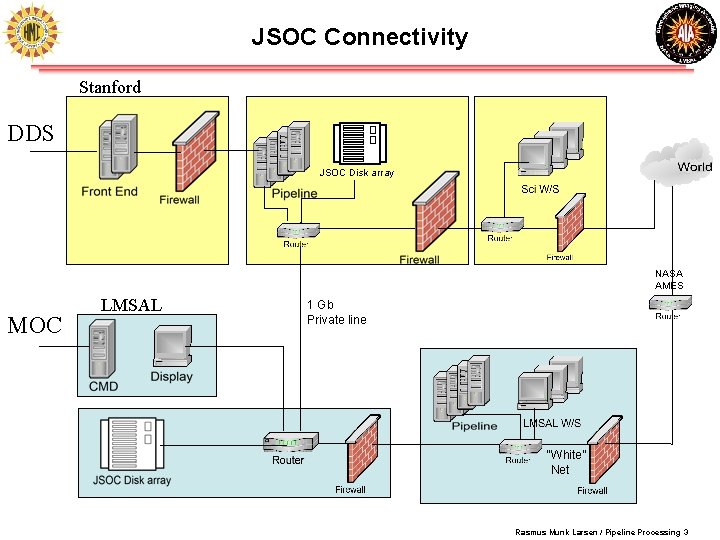
JSOC Connectivity Stanford DDS JSOC Disk array NASA AMES MOC LMSAL 1 Gb Private line “White” Net Rasmus Munk Larsen / Pipeline Processing 3
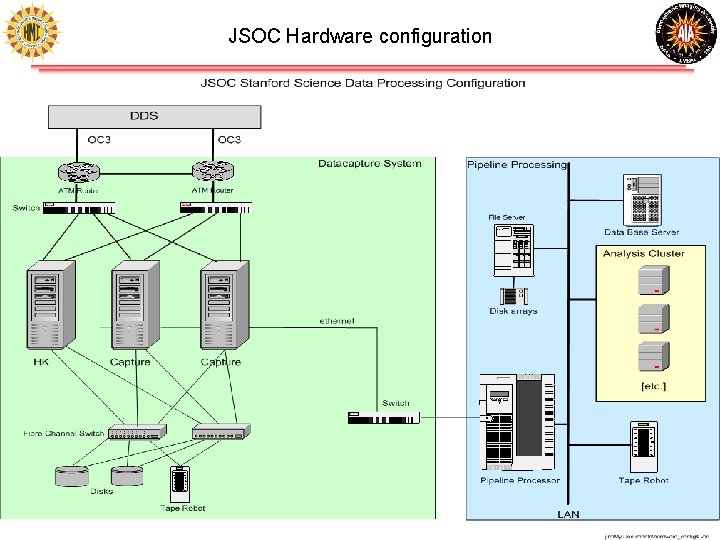
JSOC Hardware configuration Rasmus Munk Larsen / Pipeline Processing 4
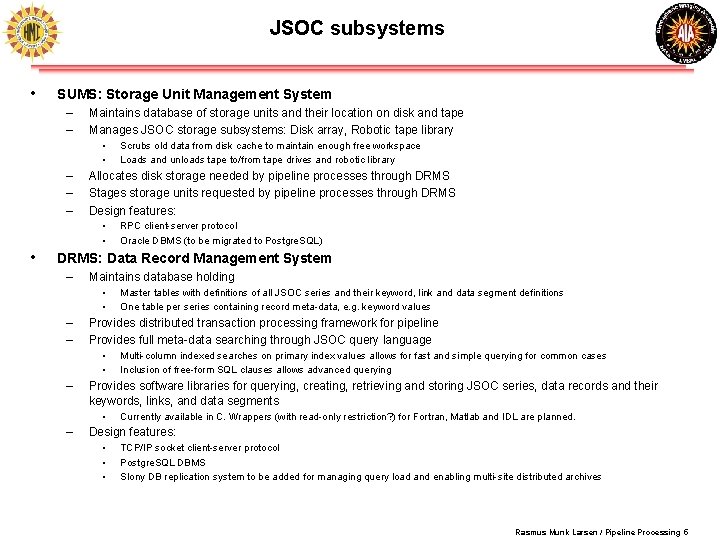
JSOC subsystems • SUMS: Storage Unit Management System – – Maintains database of storage units and their location on disk and tape Manages JSOC storage subsystems: Disk array, Robotic tape library • • – – – Allocates disk storage needed by pipeline processes through DRMS Stages storage units requested by pipeline processes through DRMS Design features: • • • Scrubs old data from disk cache to maintain enough free workspace Loads and unloads tape to/from tape drives and robotic library RPC client-server protocol Oracle DBMS (to be migrated to Postgre. SQL) DRMS: Data Record Management System – Maintains database holding • • – – Provides distributed transaction processing framework for pipeline Provides full meta-data searching through JSOC query language • • – Multi-column indexed searches on primary index values allows for fast and simple querying for common cases Inclusion of free-form SQL clauses allows advanced querying Provides software libraries for querying, creating, retrieving and storing JSOC series, data records and their keywords, links, and data segments • – Master tables with definitions of all JSOC series and their keyword, link and data segment definitions One table per series containing record meta-data, e. g. keyword values Currently available in C. Wrappers (with read-only restriction? ) for Fortran, Matlab and IDL are planned. Design features: • • • TCP/IP socket client-server protocol Postgre. SQL DBMS Slony DB replication system to be added for managing query load and enabling multi-site distributed archives Rasmus Munk Larsen / Pipeline Processing 5
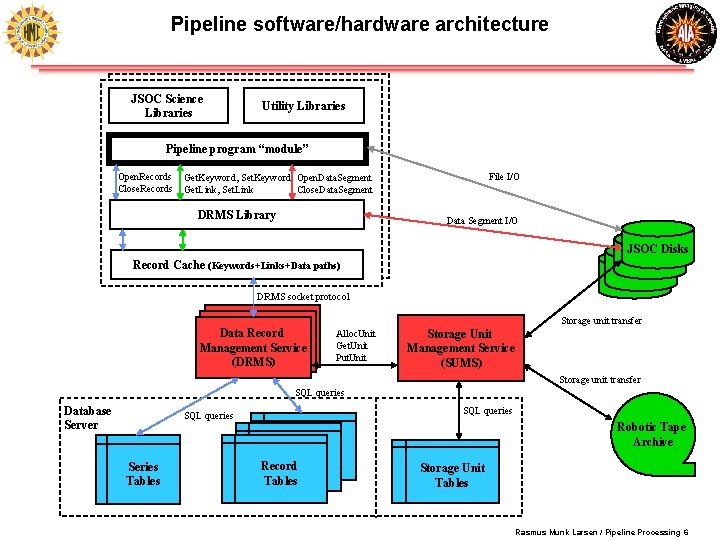
Pipeline software/hardware architecture JSOC Science Libraries Utility Libraries Pipeline program “module” Open. Records Close. Records File I/O Get. Keyword, Set. Keyword Open. Data. Segment Get. Link, Set. Link Close. Data. Segment DRMS Library Data Segment I/O JSOC Disks Record Cache (Keywords+Links+Data paths) DRMS socket protocol Data. Record Data Record Management. Service Management Service (DRMS) Storage unit transfer Alloc. Unit Get. Unit Put. Unit Storage Unit Management Service (SUMS) Storage unit transfer SQL queries Database Server SQL queries Series Tables Record Catalogs Tables Robotic Tape Archive Storage Unit Tables Rasmus Munk Larsen / Pipeline Processing 6
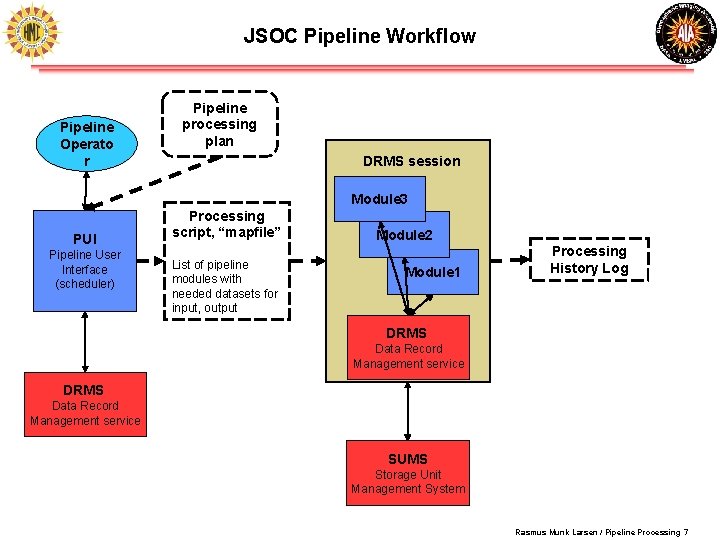
JSOC Pipeline Workflow Pipeline Operato r Pipeline processing plan DRMS session Module 3 PUI Pipeline User Interface (scheduler) Processing script, “mapfile” List of pipeline modules with needed datasets for input, output Module 2 Module 1 Processing History Log DRMS Data Record Management service SUMS Storage Unit Management System Rasmus Munk Larsen / Pipeline Processing 7
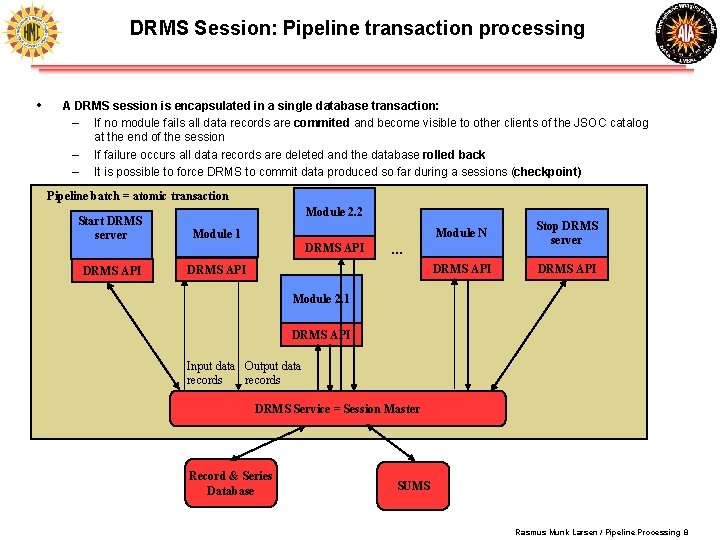
DRMS Session: Pipeline transaction processing • A DRMS session is encapsulated in a single database transaction: – If no module fails all data records are commited and become visible to other clients of the JSOC catalog at the end of the session – If failure occurs all data records are deleted and the database rolled back – It is possible to force DRMS to commit data produced so far during a sessions (checkpoint) Pipeline batch = atomic transaction Start DRMS server DRMS API Module 2. 2 Module 1 DRMS API Module N Stop DRMS server DRMS API … DRMS API Module 2. 1 DRMS API Input data Output data records DRMS Service = Session Master Record & Series Database SUMS Rasmus Munk Larsen / Pipeline Processing 8
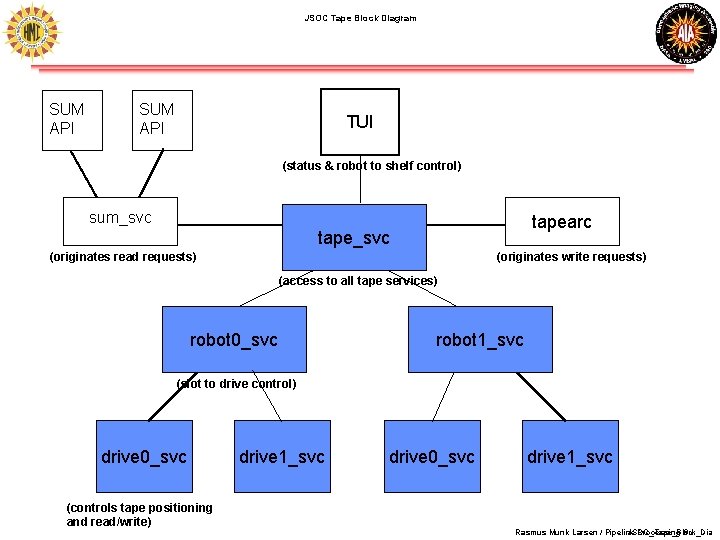
JSOC Tape Block Diagram SUM API TUI (status & robot to shelf control) sum_svc tapearc tape_svc (originates read requests) (originates write requests) (access to all tape services) robot 0_svc robot 1_svc (slot to drive control) drive 0_svc (controls tape positioning and read/write) drive 1_svc drive 0_svc drive 1_svc Rasmus Munk Larsen / Pipeline Processing 9 JSOC_Tape_Block_Dia
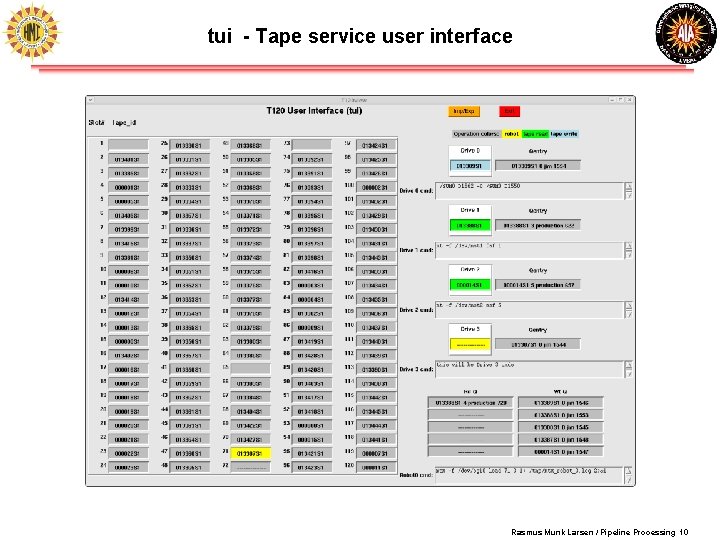
tui - Tape service user interface Rasmus Munk Larsen / Pipeline Processing 10
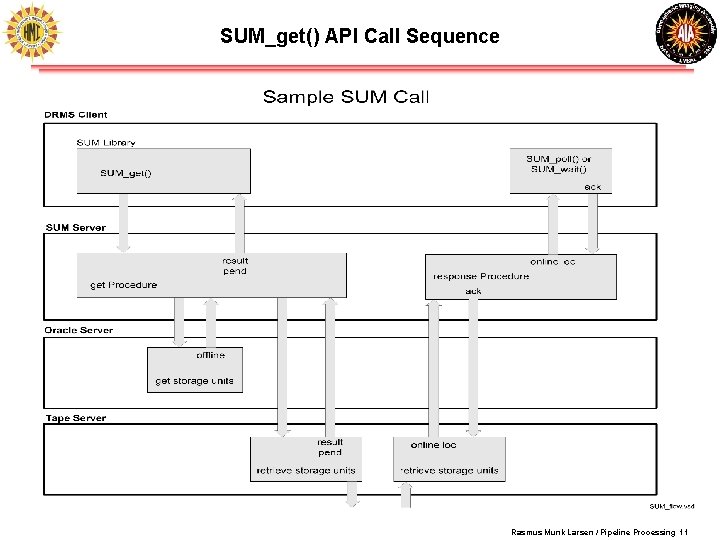
SUM_get() API Call Sequence Rasmus Munk Larsen / Pipeline Processing 11
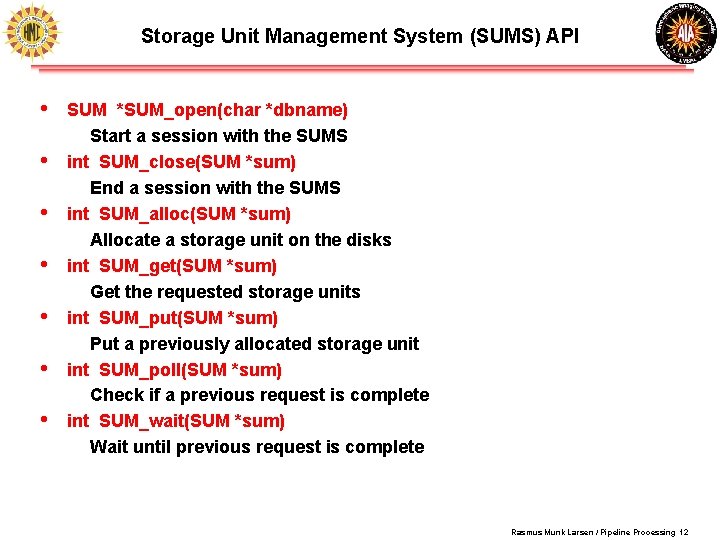
Storage Unit Management System (SUMS) API • • SUM *SUM_open(char *dbname) Start a session with the SUMS int SUM_close(SUM *sum) End a session with the SUMS int SUM_alloc(SUM *sum) Allocate a storage unit on the disks int SUM_get(SUM *sum) Get the requested storage units int SUM_put(SUM *sum) Put a previously allocated storage unit int SUM_poll(SUM *sum) Check if a previous request is complete int SUM_wait(SUM *sum) Wait until previous request is complete Rasmus Munk Larsen / Pipeline Processing 12
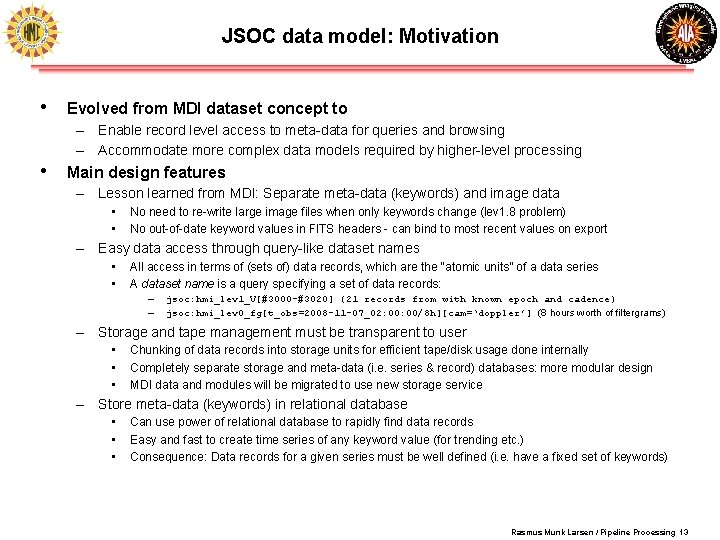
JSOC data model: Motivation • Evolved from MDI dataset concept to – Enable record level access to meta-data for queries and browsing – Accommodate more complex data models required by higher-level processing • Main design features – Lesson learned from MDI: Separate meta-data (keywords) and image data • • No need to re-write large image files when only keywords change (lev 1. 8 problem) No out-of-date keyword values in FITS headers - can bind to most recent values on export – Easy data access through query-like dataset names • • All access in terms of (sets of) data records, which are the “atomic units” of a data series A dataset name is a query specifying a set of data records: – – jsoc: hmi_lev 1_V[#3000 -#3020] (21 records from with known epoch and cadence) jsoc: hmi_lev 0_fg[t_obs=2008 -11 -07_02: 00/8 h][cam=‘doppler’] (8 hours worth of filtergrams) – Storage and tape management must be transparent to user • • • Chunking of data records into storage units for efficient tape/disk usage done internally Completely separate storage and meta-data (i. e. series & record) databases: more modular design MDI data and modules will be migrated to use new storage service – Store meta-data (keywords) in relational database • • • Can use power of relational database to rapidly find data records Easy and fast to create time series of any keyword value (for trending etc. ) Consequence: Data records for a given series must be well defined (i. e. have a fixed set of keywords) Rasmus Munk Larsen / Pipeline Processing 13
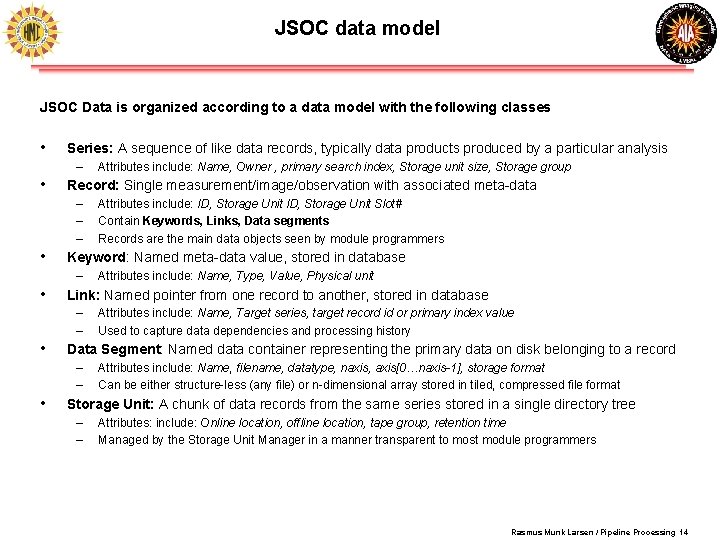
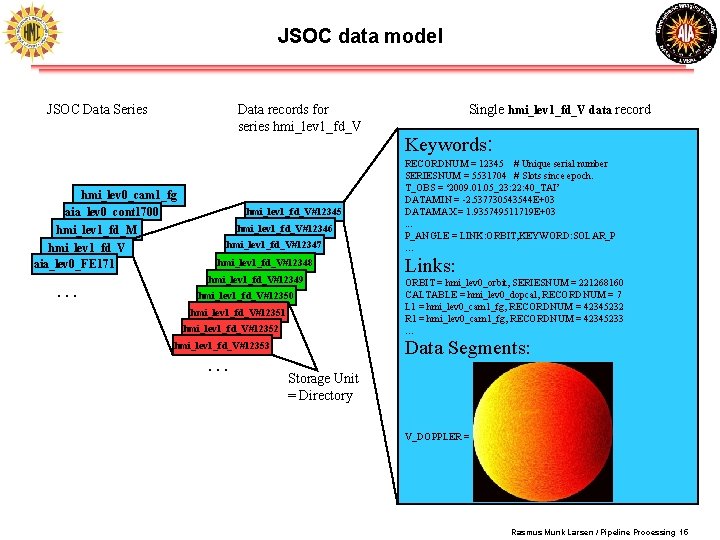
JSOC data model JSOC Data is organized according to a data model with the following classes • Series: A sequence of like data records, typically data products produced by a particular analysis – • Record: Single measurement/image/observation with associated meta-data – – – • Attributes include: Name, Target series, target record id or primary index value Used to capture data dependencies and processing history Data Segment: Named data container representing the primary data on disk belonging to a record – – • Attributes include: Name, Type, Value, Physical unit Link: Named pointer from one record to another, stored in database – – • Attributes include: ID, Storage Unit Slot# Contain Keywords, Links, Data segments Records are the main data objects seen by module programmers Keyword: Named meta-data value, stored in database – • Attributes include: Name, Owner , primary search index, Storage unit size, Storage group Attributes include: Name, filename, datatype, naxis, axis[0…naxis-1], storage format Can be either structure-less (any file) or n-dimensional array stored in tiled, compressed file format Storage Unit: A chunk of data records from the same series stored in a single directory tree – – Attributes: include: Online location, offline location, tape group, retention time Managed by the Storage Unit Manager in a manner transparent to most module programmers Rasmus Munk Larsen / Pipeline Processing 14
JSOC data model JSOC Data Series Data records for series hmi_lev 1_fd_V hmi_lev 0_cam 1_fg aia_lev 0_cont 1700 hmi_lev 1_fd_M hmi_lev 1_fd_V aia_lev 0_FE 171 … hmi_lev 1_fd_V#12345 hmi_lev 1_fd_V#12346 hmi_lev 1_fd_V#12347 hmi_lev 1_fd_V#12348 hmi_lev 1_fd_V#12349 hmi_lev 1_fd_V#12350 hmi_lev 1_fd_V#12351 hmi_lev 1_fd_V#12352 Keywords: RECORDNUM = 12345 # Unique serial number SERIESNUM = 5531704 # Slots since epoch. T_OBS = ‘ 2009. 01. 05_23: 22: 40_TAI’ DATAMIN = -2. 537730543544 E+03 DATAMAX = 1. 935749511719 E+03. . . P_ANGLE = LINK: ORBIT, KEYWORD: SOLAR_P … Links: ORBIT = hmi_lev 0_orbit, SERIESNUM = 221268160 CALTABLE = hmi_lev 0_dopcal, RECORDNUM = 7 L 1 = hmi_lev 0_cam 1_fg, RECORDNUM = 42345232 R 1 = hmi_lev 0_cam 1_fg, RECORDNUM = 42345233 … Data Segments: hmi_lev 1_fd_V#12353 … Single hmi_lev 1_fd_V data record Storage Unit = Directory V_DOPPLER = Rasmus Munk Larsen / Pipeline Processing 15
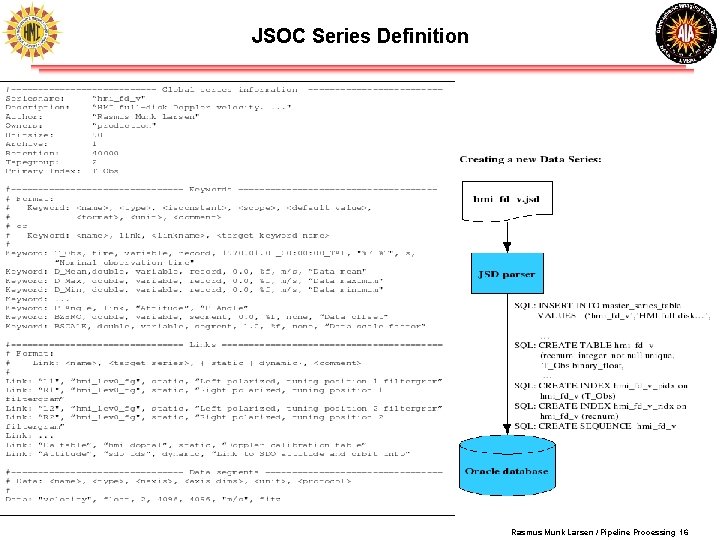
JSOC Series Definition Rasmus Munk Larsen / Pipeline Processing 16
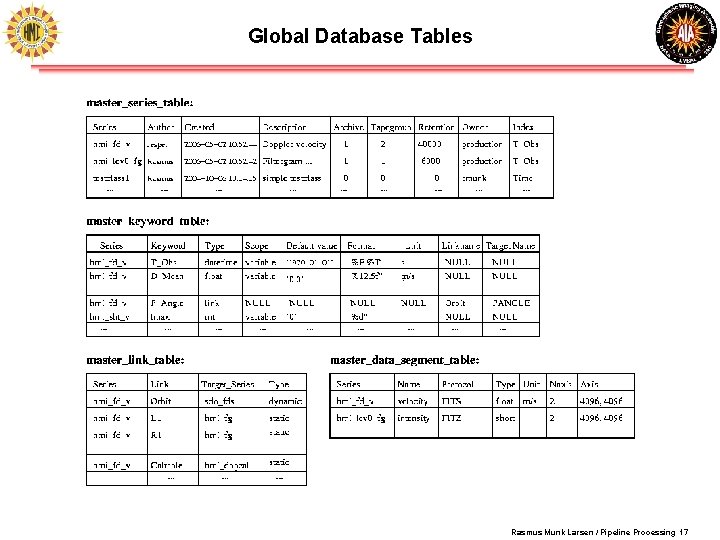
Global Database Tables Rasmus Munk Larsen / Pipeline Processing 17
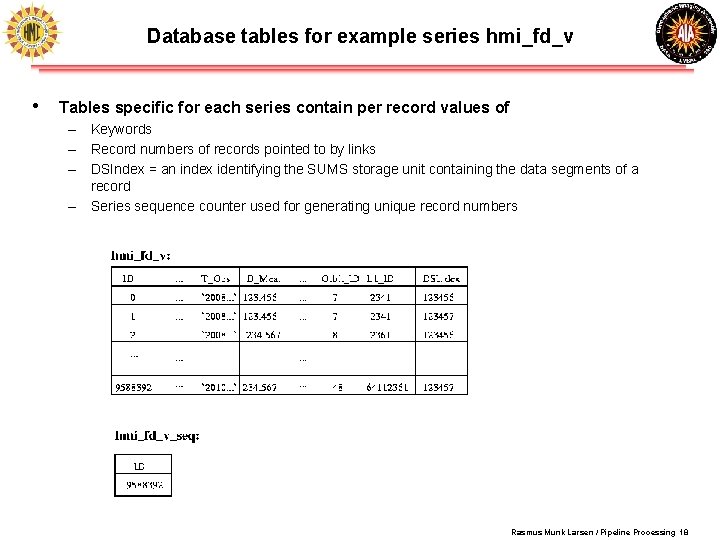
Database tables for example series hmi_fd_v • Tables specific for each series contain per record values of – Keywords – Record numbers of records pointed to by links – DSIndex = an index identifying the SUMS storage unit containing the data segments of a record – Series sequence counter used for generating unique record numbers Rasmus Munk Larsen / Pipeline Processing 18
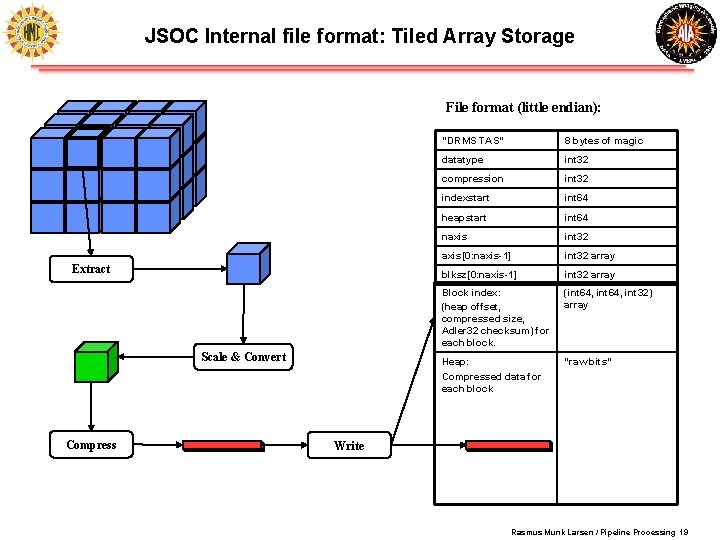
JSOC Internal file format: Tiled Array Storage File format (little endian): Extract Scale & Convert Compress “DRMS TAS” 8 bytes of magic datatype int 32 compression int 32 indexstart int 64 heapstart int 64 naxis int 32 axis[0: naxis-1] int 32 array blksz[0: naxis-1] int 32 array Block index: (heap offset, compressed size, Adler 32 checksum) for each block. (int 64, int 32) array Heap: Compressed data for each block “raw bits” Write Rasmus Munk Larsen / Pipeline Processing 19
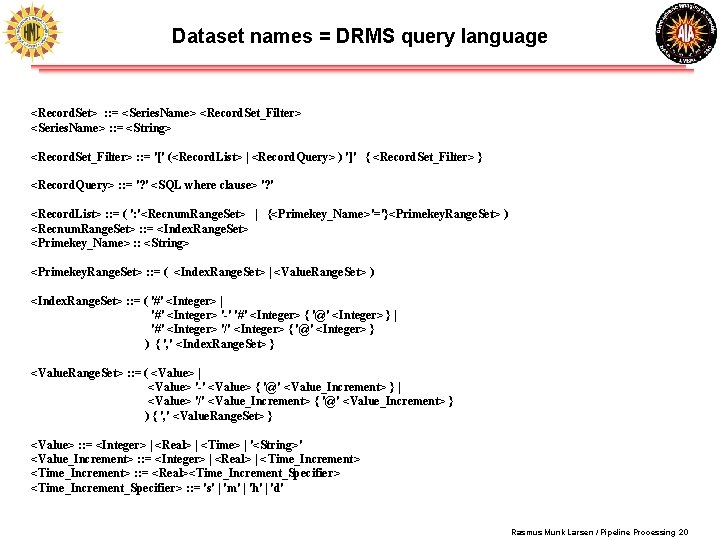
Dataset names = DRMS query language <Record. Set> : : = <Series. Name> <Record. Set_Filter> <Series. Name> : : = <String> <Record. Set_Filter> : : = '[' (<Record. List> | <Record. Query> ) ']' { <Record. Set_Filter> } <Record. Query> : : = '? ' <SQL where clause> '? ' <Record. List> : : = ( ': '<Recnum. Range. Set> | {<Primekey_Name>'='}<Primekey. Range. Set> ) <Recnum. Range. Set> : : = <Index. Range. Set> <Primekey_Name> : : <String> <Primekey. Range. Set> : : = ( <Index. Range. Set> | <Value. Range. Set> ) <Index. Range. Set> : : = ( '#' <Integer> | '#' <Integer> '-' '#' <Integer> { '@' <Integer> } | '#' <Integer> '/' <Integer> { '@' <Integer> } ) { ', ' <Index. Range. Set> } <Value. Range. Set> : : = ( <Value> | <Value> '-' <Value> { '@' <Value_Increment> } | <Value> '/' <Value_Increment> { '@' <Value_Increment> } ) { ', ' <Value. Range. Set> } <Value> : : = <Integer> | <Real> | <Time> | '<String>' <Value_Increment> : : = <Integer> | <Real> | <Time_Increment> : : = <Real><Time_Increment_Specifier> : : = 's' | 'm' | 'h' | 'd' Rasmus Munk Larsen / Pipeline Processing 20
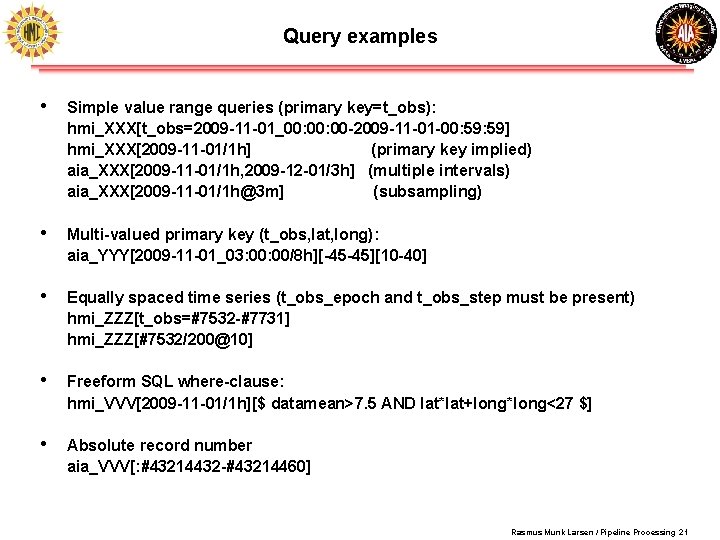
Query examples • Simple value range queries (primary key=t_obs): hmi_XXX[t_obs=2009 -11 -01_00: 00 -2009 -11 -01 -00: 59] hmi_XXX[2009 -11 -01/1 h] (primary key implied) aia_XXX[2009 -11 -01/1 h, 2009 -12 -01/3 h] (multiple intervals) aia_XXX[2009 -11 -01/1 h@3 m] (subsampling) • Multi-valued primary key (t_obs, lat, long): aia_YYY[2009 -11 -01_03: 00/8 h][-45 -45][10 -40] • Equally spaced time series (t_obs_epoch and t_obs_step must be present) hmi_ZZZ[t_obs=#7532 -#7731] hmi_ZZZ[#7532/200@10] • Freeform SQL where-clause: hmi_VVV[2009 -11 -01/1 h][$ datamean>7. 5 AND lat*lat+long*long<27 $] • Absolute record number aia_VVV[: #43214432 -#43214460] Rasmus Munk Larsen / Pipeline Processing 21
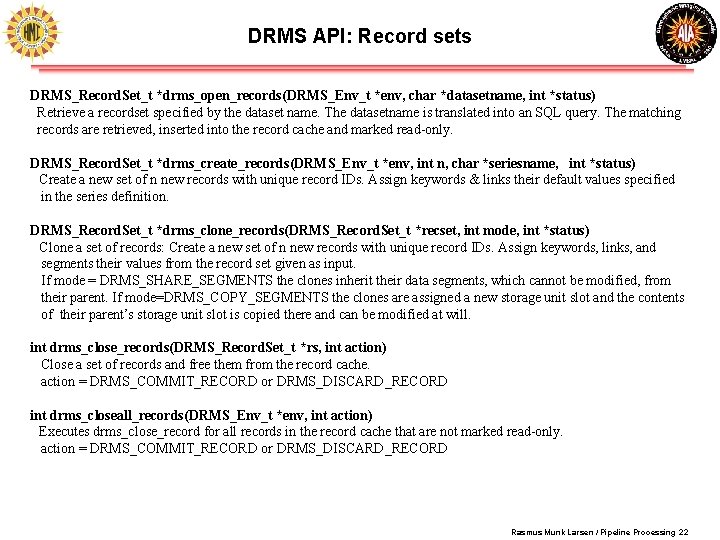
DRMS API: Record sets DRMS_Record. Set_t *drms_open_records(DRMS_Env_t *env, char *datasetname, int *status) Retrieve a recordset specified by the dataset name. The datasetname is translated into an SQL query. The matching records are retrieved, inserted into the record cache and marked read-only. DRMS_Record. Set_t *drms_create_records(DRMS_Env_t *env, int n, char *seriesname, int *status) Create a new set of n new records with unique record IDs. Assign keywords & links their default values specified in the series definition. DRMS_Record. Set_t *drms_clone_records(DRMS_Record. Set_t *recset, int mode, int *status) Clone a set of records: Create a new set of n new records with unique record IDs. Assign keywords, links, and segments their values from the record set given as input. If mode = DRMS_SHARE_SEGMENTS the clones inherit their data segments, which cannot be modified, from their parent. If mode=DRMS_COPY_SEGMENTS the clones are assigned a new storage unit slot and the contents of their parent’s storage unit slot is copied there and can be modified at will. int drms_close_records(DRMS_Record. Set_t *rs, int action) Close a set of records and free them from the record cache. action = DRMS_COMMIT_RECORD or DRMS_DISCARD_RECORD int drms_closeall_records(DRMS_Env_t *env, int action) Executes drms_close_record for all records in the record cache that are not marked read-only. action = DRMS_COMMIT_RECORD or DRMS_DISCARD_RECORD Rasmus Munk Larsen / Pipeline Processing 22
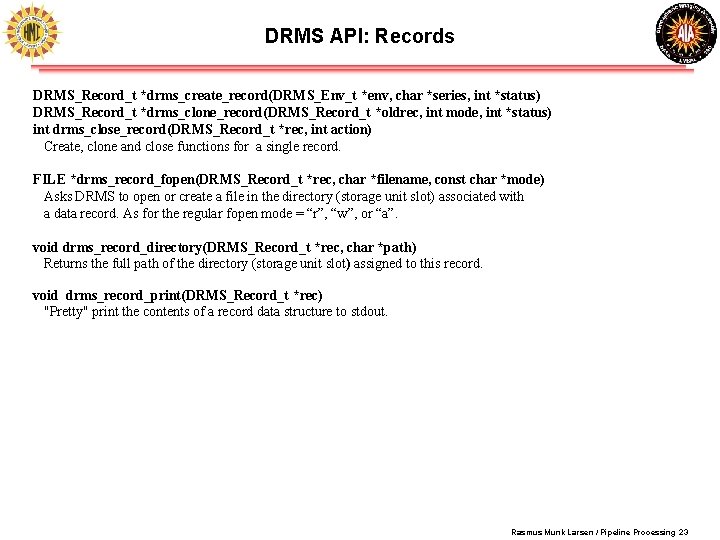
DRMS API: Records DRMS_Record_t *drms_create_record(DRMS_Env_t *env, char *series, int *status) DRMS_Record_t *drms_clone_record(DRMS_Record_t *oldrec, int mode, int *status) int drms_close_record(DRMS_Record_t *rec, int action) Create, clone and close functions for a single record. FILE *drms_record_fopen(DRMS_Record_t *rec, char *filename, const char *mode) Asks DRMS to open or create a file in the directory (storage unit slot) associated with a data record. As for the regular fopen mode = “r”, “w”, or “a”. void drms_record_directory(DRMS_Record_t *rec, char *path) Returns the full path of the directory (storage unit slot) assigned to this record. void drms_record_print(DRMS_Record_t *rec) "Pretty" print the contents of a record data structure to stdout. Rasmus Munk Larsen / Pipeline Processing 23
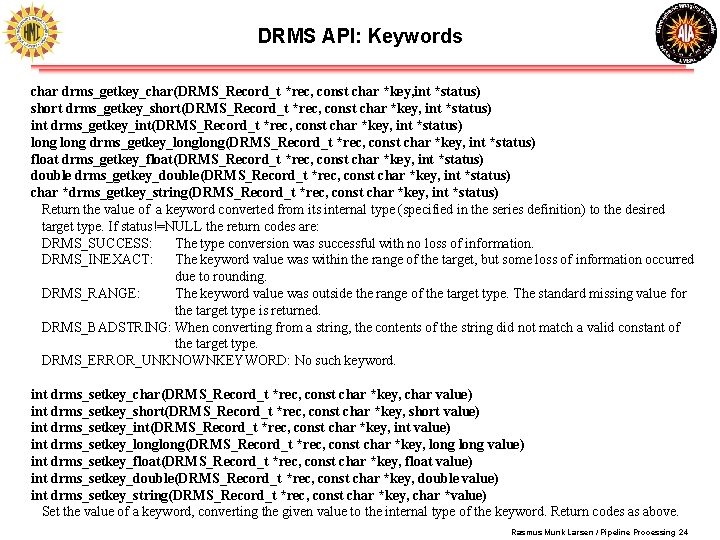
DRMS API: Keywords char drms_getkey_char(DRMS_Record_t *rec, const char *key, int *status) short drms_getkey_short(DRMS_Record_t *rec, const char *key, int *status) int drms_getkey_int(DRMS_Record_t *rec, const char *key, int *status) long drms_getkey_long(DRMS_Record_t *rec, const char *key, int *status) float drms_getkey_float(DRMS_Record_t *rec, const char *key, int *status) double drms_getkey_double(DRMS_Record_t *rec, const char *key, int *status) char *drms_getkey_string(DRMS_Record_t *rec, const char *key, int *status) Return the value of a keyword converted from its internal type (specified in the series definition) to the desired target type. If status!=NULL the return codes are: DRMS_SUCCESS: The type conversion was successful with no loss of information. DRMS_INEXACT: The keyword value was within the range of the target, but some loss of information occurred due to rounding. DRMS_RANGE: The keyword value was outside the range of the target type. The standard missing value for the target type is returned. DRMS_BADSTRING: When converting from a string, the contents of the string did not match a valid constant of the target type. DRMS_ERROR_UNKNOWNKEYWORD: No such keyword. int drms_setkey_char(DRMS_Record_t *rec, const char *key, char value) int drms_setkey_short(DRMS_Record_t *rec, const char *key, short value) int drms_setkey_int(DRMS_Record_t *rec, const char *key, int value) int drms_setkey_long(DRMS_Record_t *rec, const char *key, long value) int drms_setkey_float(DRMS_Record_t *rec, const char *key, float value) int drms_setkey_double(DRMS_Record_t *rec, const char *key, double value) int drms_setkey_string(DRMS_Record_t *rec, const char *key, char *value) Set the value of a keyword, converting the given value to the internal type of the keyword. Return codes as above. Rasmus Munk Larsen / Pipeline Processing 24
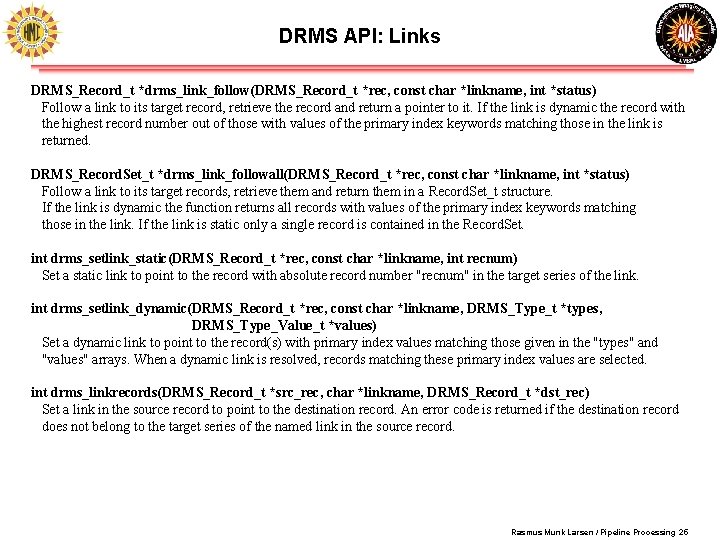
DRMS API: Links DRMS_Record_t *drms_link_follow(DRMS_Record_t *rec, const char *linkname, int *status) Follow a link to its target record, retrieve the record and return a pointer to it. If the link is dynamic the record with the highest record number out of those with values of the primary index keywords matching those in the link is returned. DRMS_Record. Set_t *drms_link_followall(DRMS_Record_t *rec, const char *linkname, int *status) Follow a link to its target records, retrieve them and return them in a Record. Set_t structure. If the link is dynamic the function returns all records with values of the primary index keywords matching those in the link. If the link is static only a single record is contained in the Record. Set. int drms_setlink_static(DRMS_Record_t *rec, const char *linkname, int recnum) Set a static link to point to the record with absolute record number "recnum" in the target series of the link. int drms_setlink_dynamic(DRMS_Record_t *rec, const char *linkname, DRMS_Type_t *types, DRMS_Type_Value_t *values) Set a dynamic link to point to the record(s) with primary index values matching those given in the "types" and "values" arrays. When a dynamic link is resolved, records matching these primary index values are selected. int drms_linkrecords(DRMS_Record_t *src_rec, char *linkname, DRMS_Record_t *dst_rec) Set a link in the source record to point to the destination record. An error code is returned if the destination record does not belong to the target series of the named link in the source record. Rasmus Munk Larsen / Pipeline Processing 25
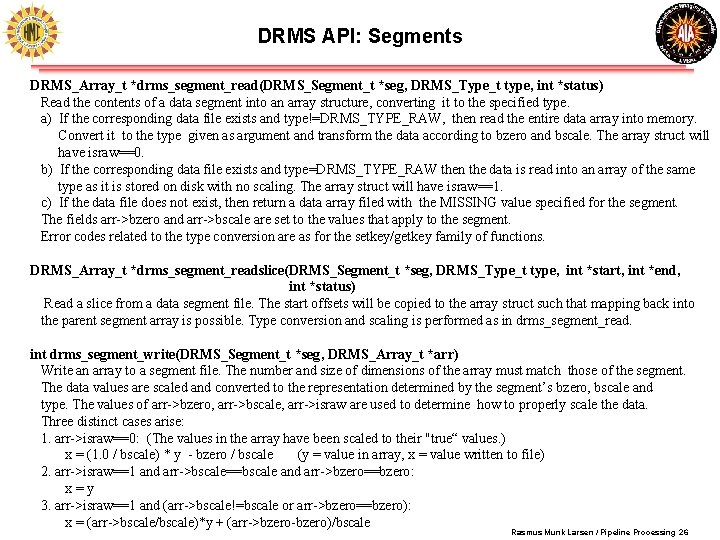
DRMS API: Segments DRMS_Array_t *drms_segment_read(DRMS_Segment_t *seg, DRMS_Type_t type, int *status) Read the contents of a data segment into an array structure, converting it to the specified type. a) If the corresponding data file exists and type!=DRMS_TYPE_RAW, then read the entire data array into memory. Convert it to the type given as argument and transform the data according to bzero and bscale. The array struct will have israw==0. b) If the corresponding data file exists and type=DRMS_TYPE_RAW then the data is read into an array of the same type as it is stored on disk with no scaling. The array struct will have israw==1. c) If the data file does not exist, then return a data array filed with the MISSING value specified for the segment. The fields arr->bzero and arr->bscale are set to the values that apply to the segment. Error codes related to the type conversion are as for the setkey/getkey family of functions. DRMS_Array_t *drms_segment_readslice(DRMS_Segment_t *seg, DRMS_Type_t type, int *start, int *end, int *status) Read a slice from a data segment file. The start offsets will be copied to the array struct such that mapping back into the parent segment array is possible. Type conversion and scaling is performed as in drms_segment_read. int drms_segment_write(DRMS_Segment_t *seg, DRMS_Array_t *arr) Write an array to a segment file. The number and size of dimensions of the array must match those of the segment. The data values are scaled and converted to the representation determined by the segment’s bzero, bscale and type. The values of arr->bzero, arr->bscale, arr->israw are used to determine how to properly scale the data. Three distinct cases arise: 1. arr->israw==0: (The values in the array have been scaled to their "true“ values. ) x = (1. 0 / bscale) * y - bzero / bscale (y = value in array, x = value written to file) 2. arr->israw==1 and arr->bscale==bscale and arr->bzero==bzero: x=y 3. arr->israw==1 and (arr->bscale!=bscale or arr->bzero==bzero): x = (arr->bscale/bscale)*y + (arr->bzero-bzero)/bscale Rasmus Munk Larsen / Pipeline Processing 26
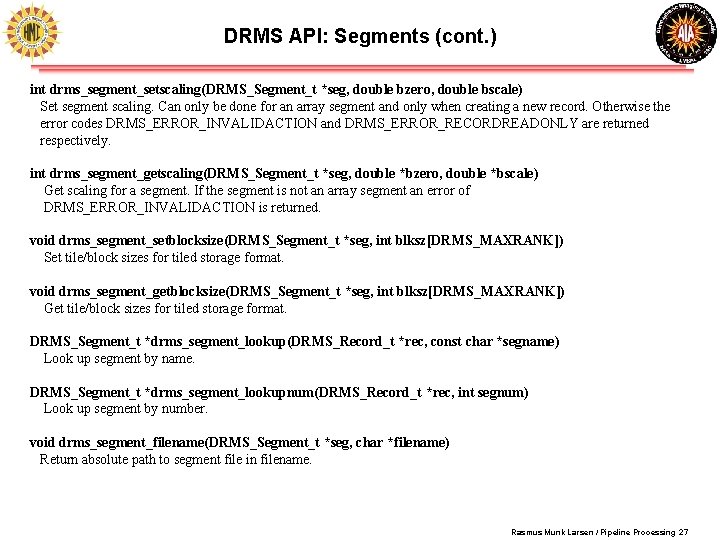
DRMS API: Segments (cont. ) int drms_segment_setscaling(DRMS_Segment_t *seg, double bzero, double bscale) Set segment scaling. Can only be done for an array segment and only when creating a new record. Otherwise the error codes DRMS_ERROR_INVALIDACTION and DRMS_ERROR_RECORDREADONLY are returned respectively. int drms_segment_getscaling(DRMS_Segment_t *seg, double *bzero, double *bscale) Get scaling for a segment. If the segment is not an array segment an error of DRMS_ERROR_INVALIDACTION is returned. void drms_segment_setblocksize(DRMS_Segment_t *seg, int blksz[DRMS_MAXRANK]) Set tile/block sizes for tiled storage format. void drms_segment_getblocksize(DRMS_Segment_t *seg, int blksz[DRMS_MAXRANK]) Get tile/block sizes for tiled storage format. DRMS_Segment_t *drms_segment_lookup(DRMS_Record_t *rec, const char *segname) Look up segment by name. DRMS_Segment_t *drms_segment_lookupnum(DRMS_Record_t *rec, int segnum) Look up segment by number. void drms_segment_filename(DRMS_Segment_t *seg, char *filename) Return absolute path to segment file in filename. Rasmus Munk Larsen / Pipeline Processing 27
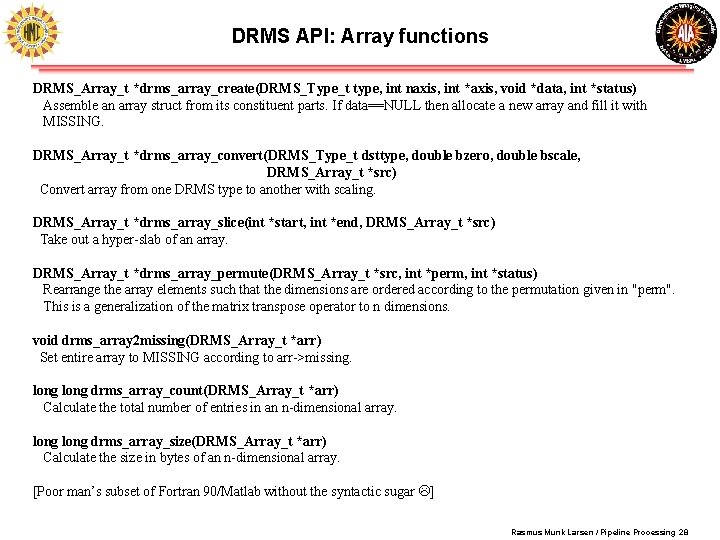
DRMS API: Array functions DRMS_Array_t *drms_array_create(DRMS_Type_t type, int naxis, int *axis, void *data, int *status) Assemble an array struct from its constituent parts. If data==NULL then allocate a new array and fill it with MISSING. DRMS_Array_t *drms_array_convert(DRMS_Type_t dsttype, double bzero, double bscale, DRMS_Array_t *src) Convert array from one DRMS type to another with scaling. DRMS_Array_t *drms_array_slice(int *start, int *end, DRMS_Array_t *src) Take out a hyper-slab of an array. DRMS_Array_t *drms_array_permute(DRMS_Array_t *src, int *perm, int *status) Rearrange the array elements such that the dimensions are ordered according to the permutation given in "perm". This is a generalization of the matrix transpose operator to n dimensions. void drms_array 2 missing(DRMS_Array_t *arr) Set entire array to MISSING according to arr->missing. long drms_array_count(DRMS_Array_t *arr) Calculate the total number of entries in an n-dimensional array. long drms_array_size(DRMS_Array_t *arr) Calculate the size in bytes of an n-dimensional array. [Poor man’s subset of Fortran 90/Matlab without the syntactic sugar ] Rasmus Munk Larsen / Pipeline Processing 28
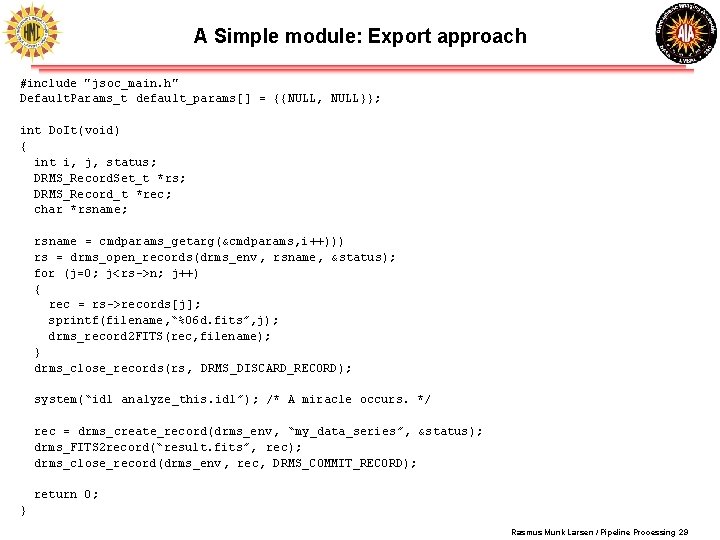
A Simple module: Export approach #include "jsoc_main. h" Default. Params_t default_params[] = {{NULL, NULL}}; int Do. It(void) { int i, j, status; DRMS_Record. Set_t *rs; DRMS_Record_t *rec; char *rsname; rsname = cmdparams_getarg(&cmdparams, i ++))) rs = drms_open_records(drms_env , rsname, &status); for (j=0; j<rs->n; j++) { rec = rs->records[j]; sprintf(filename, “%06 d. fits”, j); drms_record 2 FITS(rec, filename); } drms_close_records(rs, DRMS_DISCARD_RECORD); system(“idl analyze_this. idl”); /* A miracle occurs. */ rec = drms_create_record(drms_env , “my_data_series”, &status); drms_FITS 2 record(“result. fits”, rec); drms_close_record(drms_env , rec, DRMS_COMMIT_RECORD); return 0; } Rasmus Munk Larsen / Pipeline Processing 29
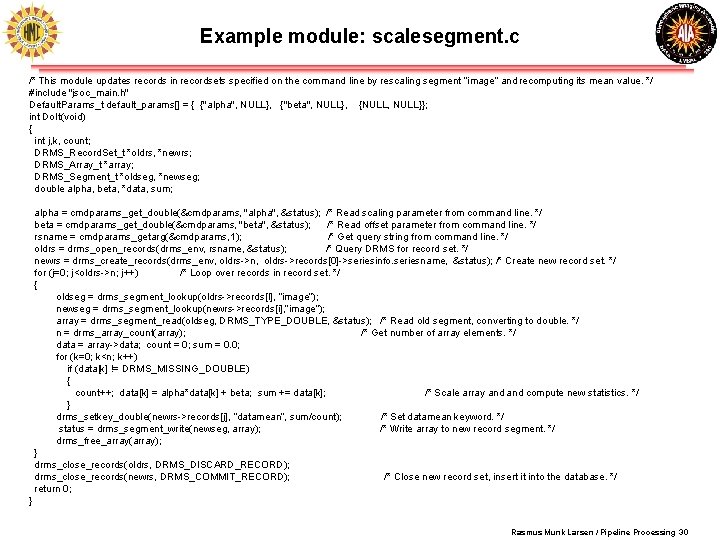
Example module: scalesegment. c /* This module updates records in recordsets specified on the command line by rescaling segment “image” and recomputing its mean value. */ #include "jsoc_main. h" Default. Params_t default_params[] = { {"alpha", NULL}, {"beta", NULL}, {NULL, NULL}}; int Do. It(void) { int j, k, count; DRMS_Record. Set_t *oldrs, *newrs; DRMS_Array_t *array; DRMS_Segment_t *oldseg, *newseg; double alpha, beta, *data, sum; alpha = cmdparams_get_double(&cmdparams, "alpha", &status); /* Read scaling parameter from command line. */ beta = cmdparams_get_double(&cmdparams, "beta", &status); /* Read offset parameter from command line. */ rsname = cmdparams_getarg(&cmdparams, 1); /* Get query string from command line. */ oldrs = drms_open_records(drms_env, rsname, &status); /* Query DRMS for record set. */ newrs = drms_create_records(drms_env, oldrs->n, oldrs->records[0]->seriesinfo. seriesname, &status); /* Create new record set. */ for (j=0; j<oldrs->n; j++) /* Loop over records in record set. */ { oldseg = drms_segment_lookup(oldrs->records[I], “image”); newseg = drms_segment_lookup(newrs->records[i], ”image”); array = drms_segment_read(oldseg, DRMS_TYPE_DOUBLE, &status); /* Read old segment, converting to double. */ n = drms_array_count(array); /* Get number of array elements. */ data = array->data; count = 0; sum = 0. 0; for (k=0; k<n; k++) if (data[k] != DRMS_MISSING_DOUBLE) { count++; data[k] = alpha*data[k] + beta; sum += data[k]; /* Scale array and compute new statistics. */ } drms_setkey_double(newrs->records[j], “datamean”, sum/count); /* Set datamean keyword. */ status = drms_segment_write(newseg, array); /* Write array to new record segment. */ drms_free_array(array); } drms_close_records(oldrs, DRMS_DISCARD_RECORD); drms_close_records(newrs, DRMS_COMMIT_RECORD); /* Close new record set, insert it into the database. */ return 0; } Rasmus Munk Larsen / Pipeline Processing 30