
JS 113 Trace evidence Hairs Fiber and Paint
JS 113: Trace evidence- Hairs, Fiber and Paint I. Announcements, Assignments and Acknowledgements II. Learning Objectives (Chapter 8) a. Hair 1. Describe cuticle, cortex and medulla and 3 growth phases 2. Explain distinction between human vs animal hair 3. List useful macro and microscopic hair features 4. Explain proper collection of hair evidence 5. Describe the role of DNA typing in hair comparisons b. Fibers 1. Classify fibers 2. Describe the structure of a polymer 3. List useful forensic properties of fiber 4. Explain proper collection of fiber evidence c. Paint 1. Describe the components of paint 2. Classify auto paints 3. List those examinations most useful forensic comparison of paint 4. Explain proper collection of paint evidence
AAA • Announcement – – • Dr. John Dehaan November seminar Change to schedule- Will cover Arson Nov 21 st – Next time Trace Evidence and Microscopy – Reread chapter 8 Assignments • • • Read : Houk M and B. Budowle. 2002. Comparison of Microscopic and mitochondrial DNA hair comparisons. JFS 47: 964 http: //aafs. micronexx. com/PDF/JOFS/JFS 2001398_475. pdf Read Linch CA et al. 2001 JFS 46: 844 http: //aafs. micronexx. com/PDF/JOFS/JFS 4640844. pdf Write a 500 word summary and 3 Q and 3 A for each for extra credit Acknowledgements – – Marty Blake- SFPD Jeremiah Garrido and Larry Turner: SCCCL
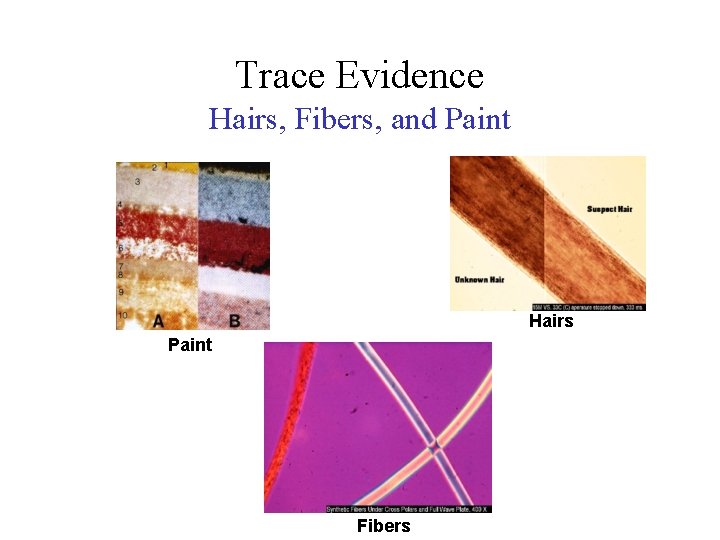
Trace Evidence Hairs, Fibers, and Paint Hairs Paint Fibers

Fundamental Rule • Locard's Exchange Principle (Edmond Locard/Frenchman 1877 -1966) states that whenever two objects come into contact, a transfer of material will occur. – Trace evidence that is transferred can be used to associate objects, individuals, or locations. • The integrity and significance of trace material as associative evidence relies on proper detection, collection, and preservation. Since each person entering the crime scene has the potential to contaminate

Nature of Physical Evidence Individual Characteristics Class Characteristics
Individual Characteristics Fingerprints Firearms/Toolmarks Shoeprints/Tiremarks Physical Matches Questioned Documents Biological Evidence (DNA)
Class Characteristics Trace (Paint, hair, fibers) Associated with a group rather than single source Note: Paint layer sequence and hair DNA typing may provide individual characteristics
Comparative Examinations • Evidence and references • Blood samples from are examined to determine Victim or Suspect if they have a common • Glass from a point of origin. entry of a burglary • Essential Materials for • Paint from a suspected hit comparative examinations: and run – reference samples • Shoes from a suspect – control samples • Written exemplars
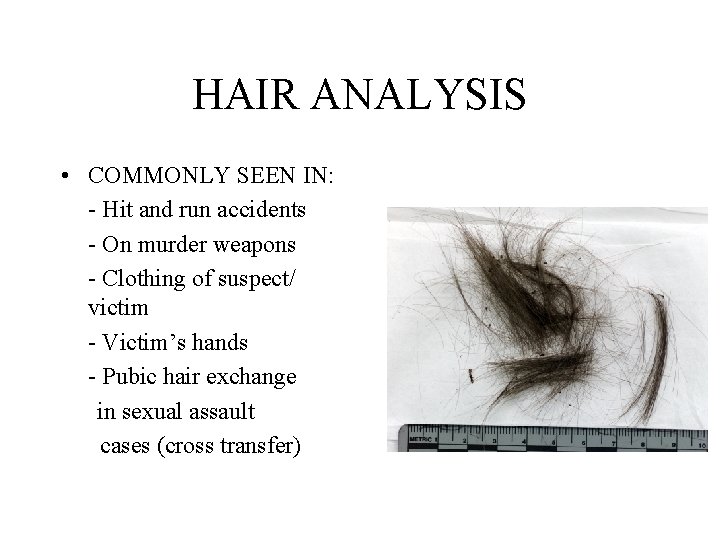
HAIR ANALYSIS • COMMONLY SEEN IN: - Hit and run accidents - On murder weapons - Clothing of suspect/ victim - Victim’s hands - Pubic hair exchange in sexual assault cases (cross transfer)
HAIR AS PHYSICAL EVIDENCE • Hair samples usually cannot be absolutely identified as belonging to a specific person • Reasons: - Scalp hairs from same individual can vary considerably - Different people show lots of similarities
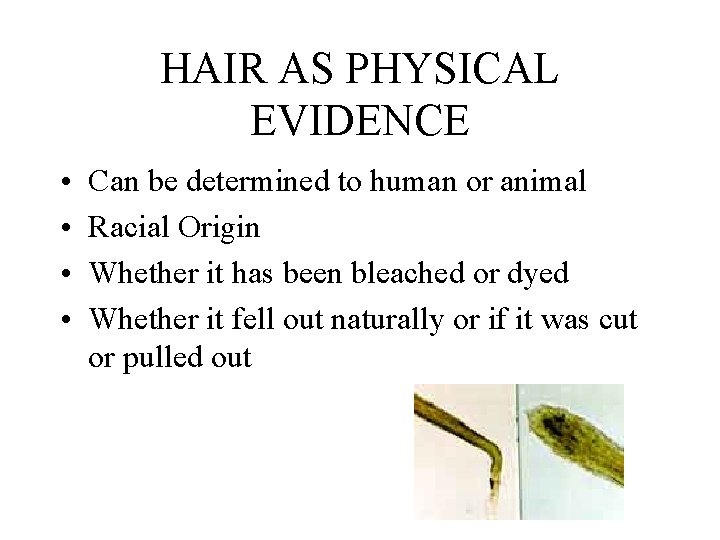
HAIR AS PHYSICAL EVIDENCE • • Can be determined to human or animal Racial Origin Whether it has been bleached or dyed Whether it fell out naturally or if it was cut or pulled out
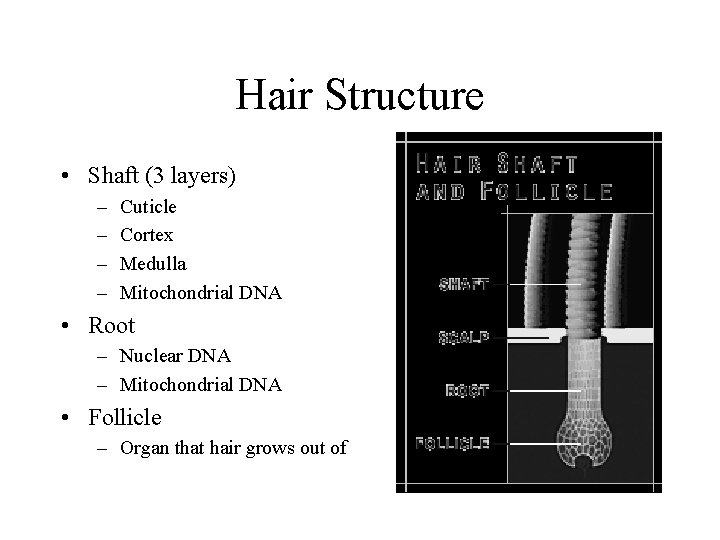
Hair Structure • Shaft (3 layers) – – Cuticle Cortex Medulla Mitochondrial DNA • Root – Nuclear DNA – Mitochondrial DNA • Follicle – Organ that hair grows out of
- Slides: 12