
JRCALC Clinical Practice Guidelines for use by UK
JRCALC Clinical Practice Guidelines for use by UK Ambulance Services

June 2004 • Evidence base – Best. Bets • Reformatting • User-friendly – A 4 – Pocket books

What’s changed • Consent chapter revised • Professional Standards - HPC • IV fluids – 250 ml boluses • NW Oxygen Guidelines • Obs. & Gynae • Mental Health – future risk table • Burns consensus guidance
What’s changed • ROLE – Start BLS whilst establish circumstances – May then stop if ROLE criteria fulfilled – Includes DNAR directives – Extended to Children – No need for doctor to confirm death
What’s changed • Morphine – Maximum dose 20 mg – Paediatric doses • Diazepam for Cocaine overdose • Atropine in children only for bradycardia from vagal stimulation • Aspirin GU/DU caution only
What’s changed • Thrombolytics – Pain lasting at least 15 mins – Onset less than 6 hours ago – Diastolic less than 110 mm. Hg – RBBB permitted (must also have ST elevation) – CPR not a contra-indication
What’s New • Sickle Cell crisis • Hyperventilation • Child Protection • Dealing with death of a child • CBRN • Ipratropium
Drug Codes • Department of Health • National Patient Safety Agency • Pre-Hospital • • Emergency Care Airport Codes Full name as well
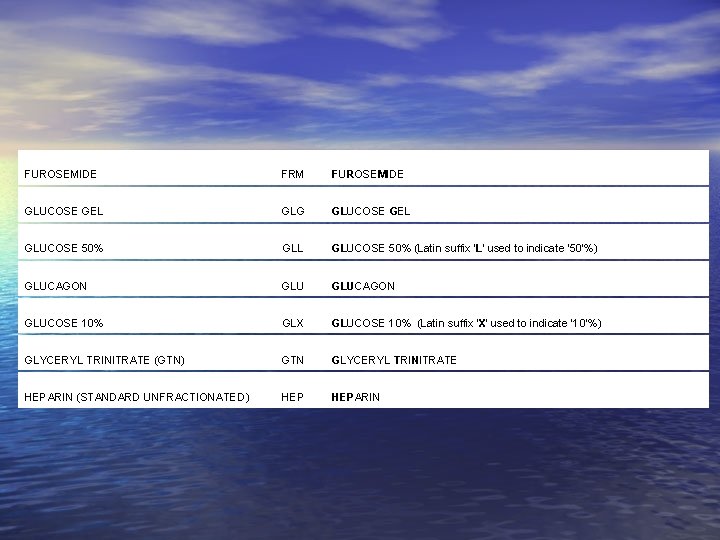
FUROSEMIDE FRM FUROSEMIDE GLUCOSE GEL GLG GLUCOSE GEL GLUCOSE 50% GLL GLUCOSE 50% (Latin suffix 'L' used to indicate '50'%) GLUCAGON GLUCOSE 10% GLX GLUCOSE 10% (Latin suffix 'X' used to indicate '10'%) GLYCERYL TRINITRATE (GTN) GTN GLYCERYL TRINITRATE HEPARIN (STANDARD UNFRACTIONATED) HEPARIN
The Future • 2006 • Evidence based review of all • • • guidelines Hyperlinks to Evidence All Guidelines Group may comment Secure Web-based development site

- Slides: 11