
JQI seminar July 8 2010 atomic calculations recent

- Slides: 66
JQI seminar July 8, 2010 atomic calculations: recent advances and modern applications marianna safronova
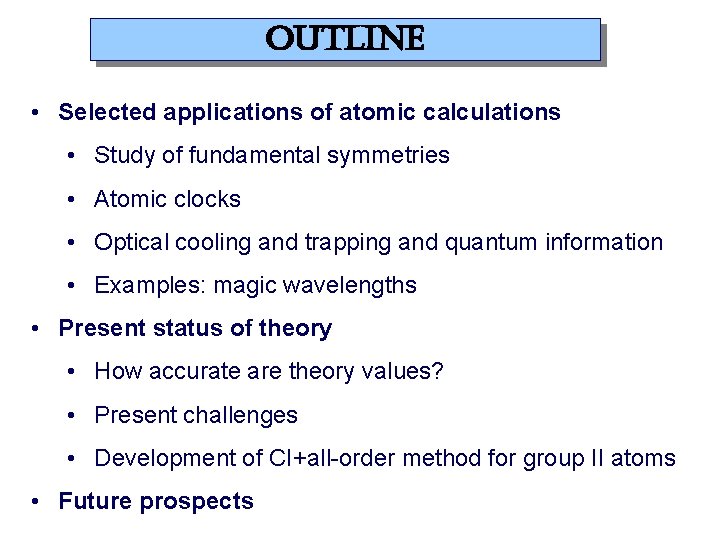
outline • Selected applications of atomic calculations • Study of fundamental symmetries • Atomic clocks • Optical cooling and trapping and quantum information • Examples: magic wavelengths • Present status of theory • How accurate are theory values? • Present challenges • Development of CI+all-order method for group II atoms • Future prospects
atomic calculations for study of fundamental symmetries
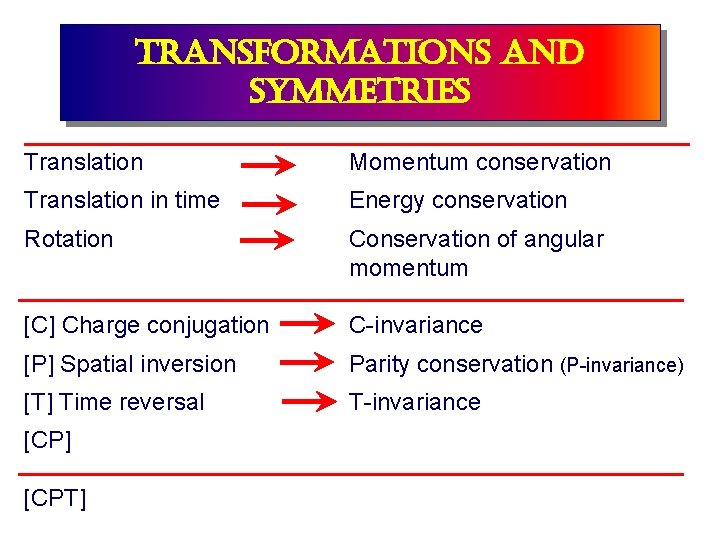
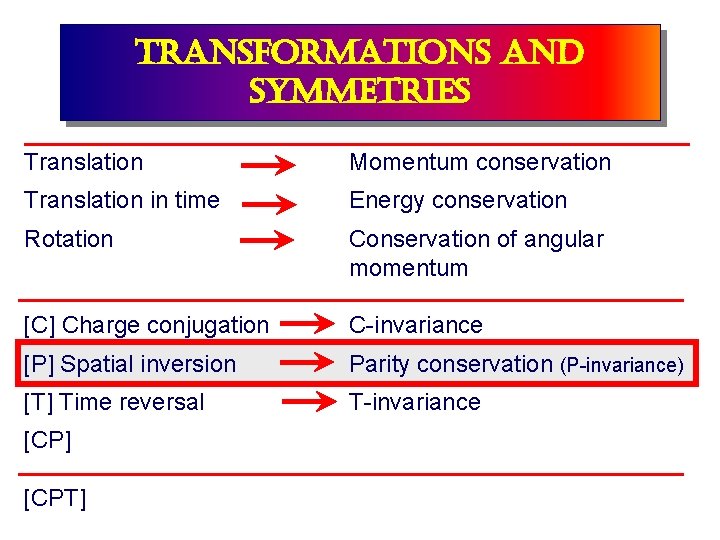
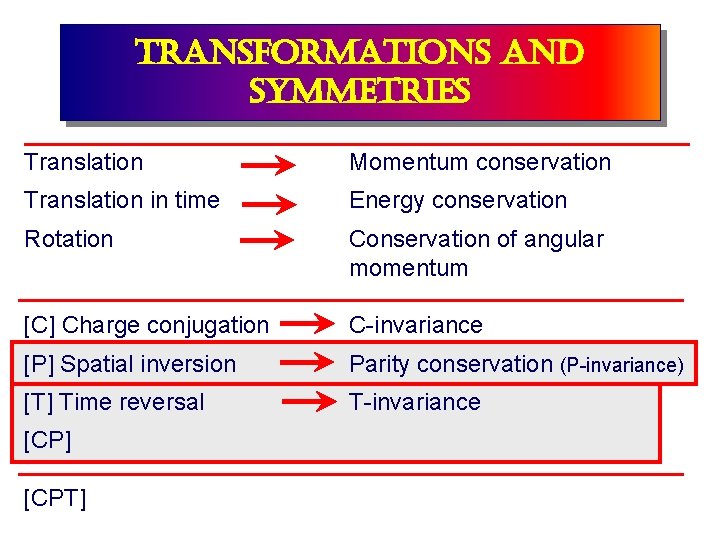
transformations and symmetries Translation Momentum conservation Translation in time Energy conservation Rotation Conservation of angular momentum [C] Charge conjugation C-invariance [P] Spatial inversion Parity conservation (P-invariance) [T] Time reversal T-invariance [CP] [CPT]
transformations and symmetries Translation Momentum conservation Translation in time Energy conservation Rotation Conservation of angular momentum [C] Charge conjugation C-invariance [P] Spatial inversion Parity conservation (P-invariance) [T] Time reversal T-invariance [CP] [CPT]
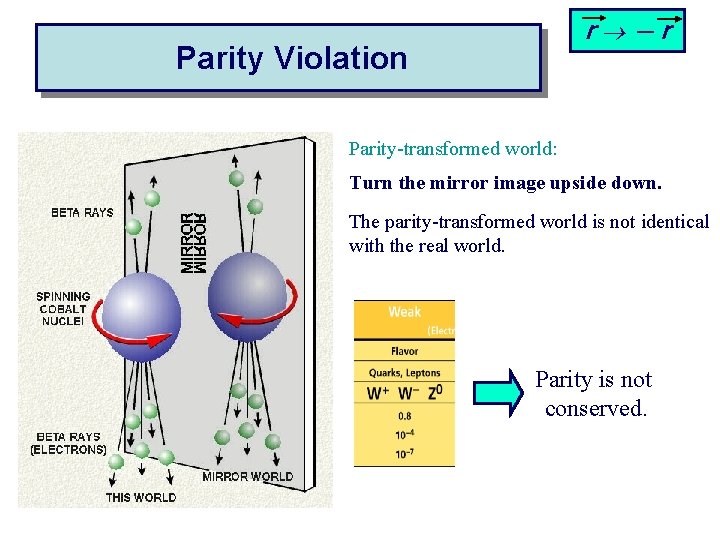
r ─r Parity Violation Parity-transformed world: Turn the mirror image upside down. The parity-transformed world is not identical with the real world. Parity is not conserved.
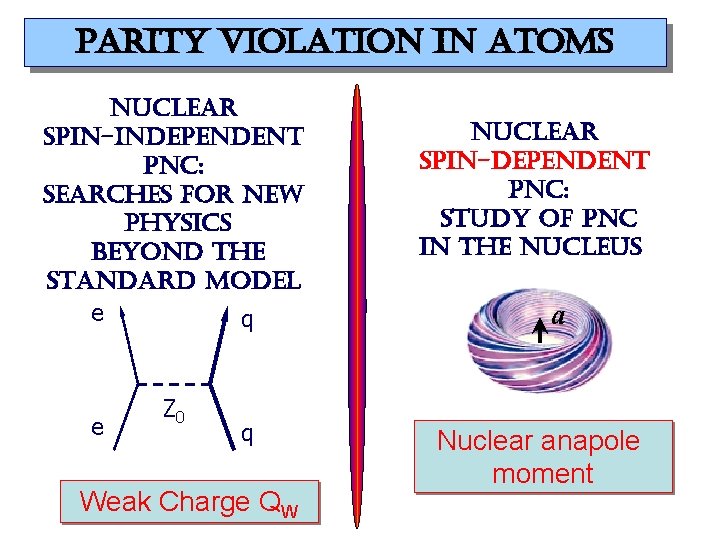
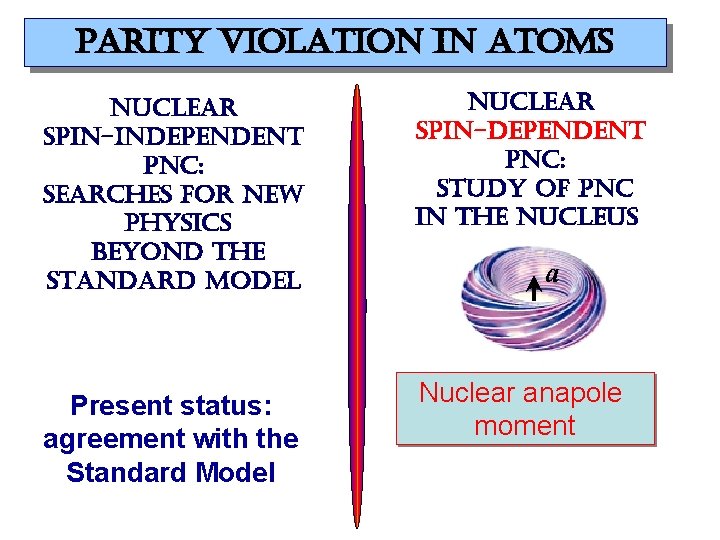
parity violation in atoms nuclear spin-independent pnc: searches for new physics beyond the standard model e q e Z 0 q Weak Charge QW nuclear spin-dependent pnc: study of pnc in the nucleus a Nuclear anapole moment
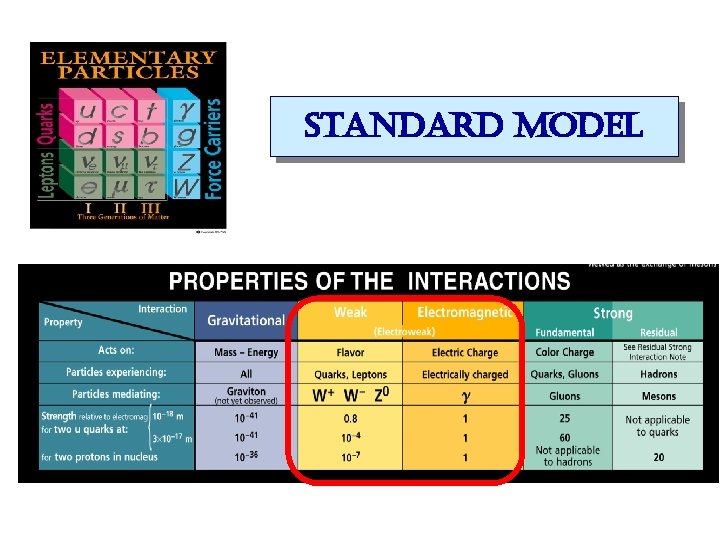
standard model
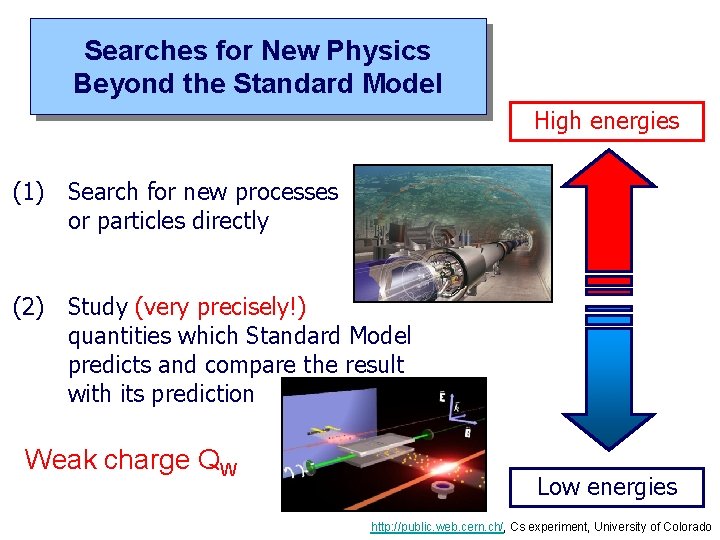
Searches for New Physics Beyond the Standard Model High energies (1) Search for new processes or particles directly (2) Study (very precisely!) quantities which Standard Model predicts and compare the result with its prediction Weak charge QW Low energies http: //public. web. cern. ch/, Cs experiment, University of Colorado
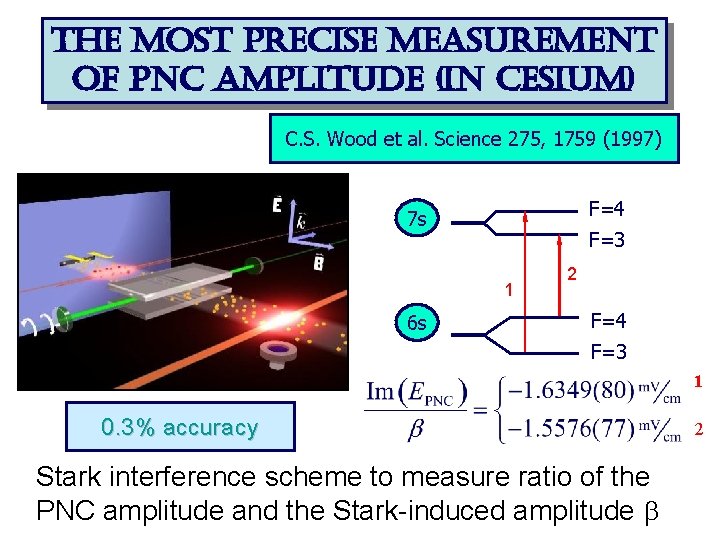
the most precise measurement of pnc amplitude (in cesium) C. S. Wood et al. Science 275, 1759 (1997) F=4 7 s F=3 1 6 s 2 F=4 F=3 1 0. 3% accuracy Stark interference scheme to measure ratio of the PNC amplitude and the Stark-induced amplitude b 2
parity violation in atoms nuclear spin-independent pnc: searches for new physics beyond the standard model Present status: agreement with the Standard Model nuclear spin-dependent pnc: study of pnc in the nucleus a Nuclear anapole moment
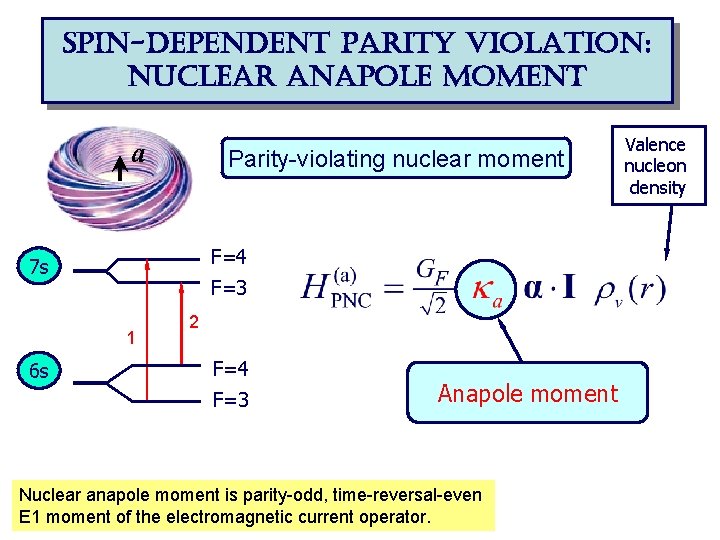
spin-dependent parity violation: nuclear anapole moment a Parity-violating nuclear moment F=4 7 s F=3 1 6 s 2 F=4 F=3 Anapole moment Nuclear anapole moment is parity-odd, time-reversal-even E 1 moment of the electromagnetic current operator. Valence nucleon density
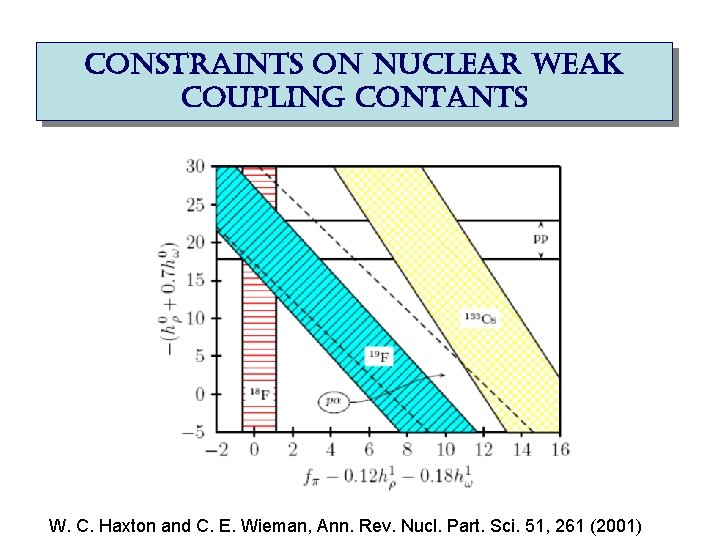
constraints on nuclear weak coupling contants W. C. Haxton and C. E. Wieman, Ann. Rev. Nucl. Part. Sci. 51, 261 (2001)
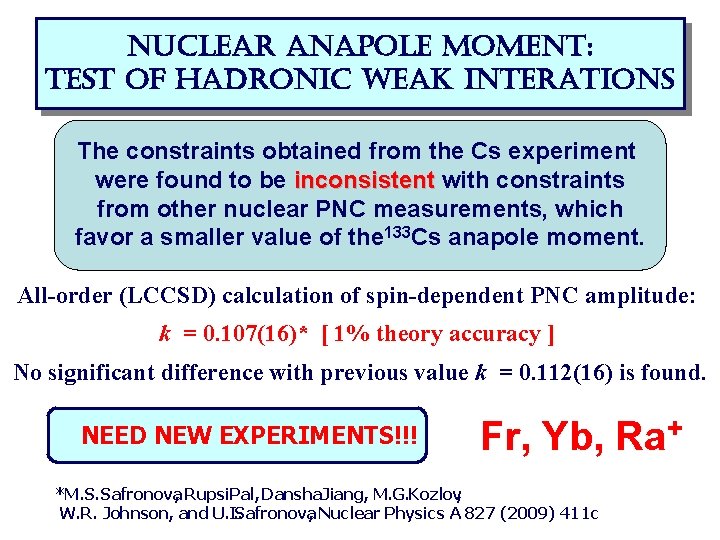
nuclear anapole moment: test of hadronic weak interations The constraints obtained from the Cs experiment were found to be inconsistent with constraints from other nuclear PNC measurements, which favor a smaller value of the 133 Cs anapole moment. All-order (LCCSD) calculation of spin-dependent PNC amplitude: k = 0. 107(16)* [ 1% theory accuracy ] No significant difference with previous value k = 0. 112(16) is found. NEED NEW EXPERIMENTS!!! Fr, Yb, Ra+ *M. S. Safronova, Rupsi. Pal, Dansha. Jiang, M. G. Kozlov, W. R. Johnson, and U. I. Safronova, Nuclear Physics A 827 (2009) 411 c
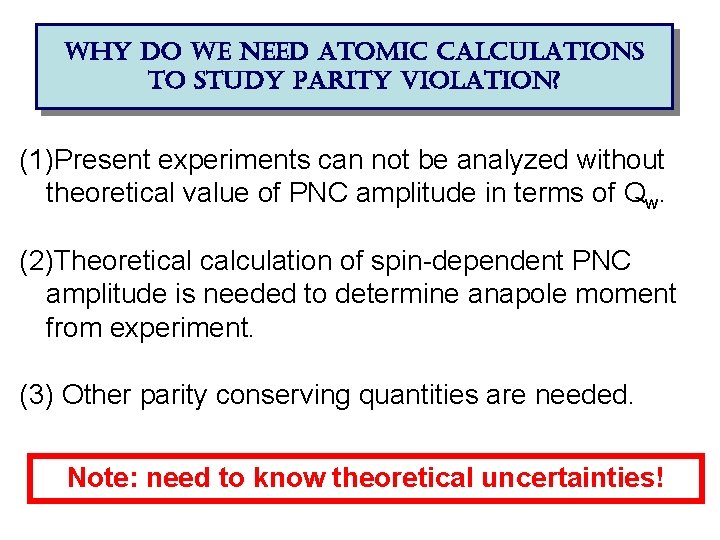
why do we need atomic calculations to study parity violation? (1)Present experiments can not be analyzed without theoretical value of PNC amplitude in terms of Qw. (2)Theoretical calculation of spin-dependent PNC amplitude is needed to determine anapole moment from experiment. (3) Other parity conserving quantities are needed. Note: need to know theoretical uncertainties!
transformations and symmetries Translation Momentum conservation Translation in time Energy conservation Rotation Conservation of angular momentum [C] Charge conjugation C-invariance [P] Spatial inversion Parity conservation (P-invariance) [T] Time reversal T-invariance [CP] [CPT]
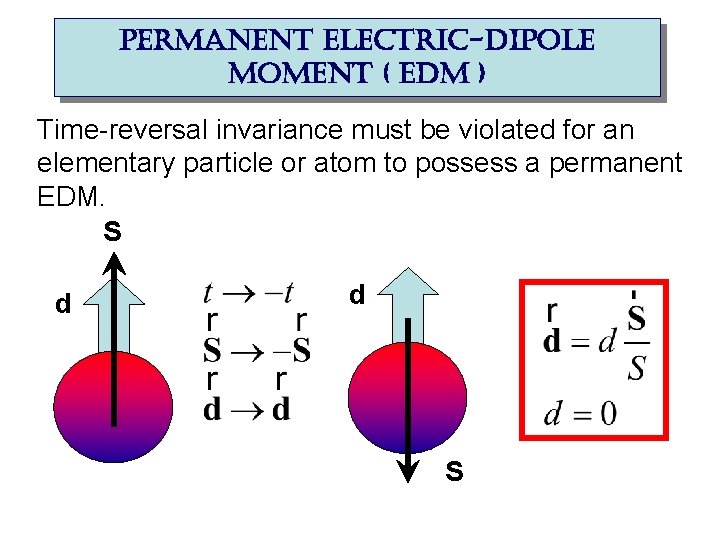
permanent electric-dipole moment ( edm ) Time-reversal invariance must be violated for an elementary particle or atom to possess a permanent EDM. S d d S
edm and new physics Many theories beyond the Standard Model predict EDM within or just beyond the present experimental capabilities. David De. Mille, Yale PANIC 2005
atomic calculations and search for edm EDM effects are enhanced in some heavy atoms and molecules. Theory is needed to calculate enhancement factors and search for new systems for EDM detection. Recent new limit on the EDM of 199 Hg | d(199 Hg) | < 3. 1 x 10 -29 e cm Phys. Rev. Lett. 102, 101601 (2009)
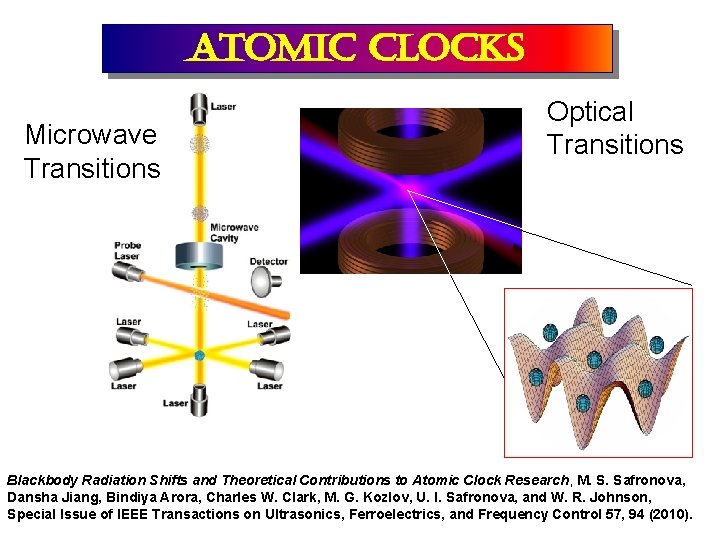
atomic clocks Microwave Transitions Optical Transitions Blackbody Radiation Shifts and Theoretical Contributions to Atomic Clock Research, M. S. Safronova, Dansha Jiang, Bindiya Arora, Charles W. Clark, M. G. Kozlov, U. I. Safronova, and W. R. Johnson, Special Issue of IEEE Transactions on Ultrasonics, Ferroelectrics, and Frequency Control 57, 94 (2010).
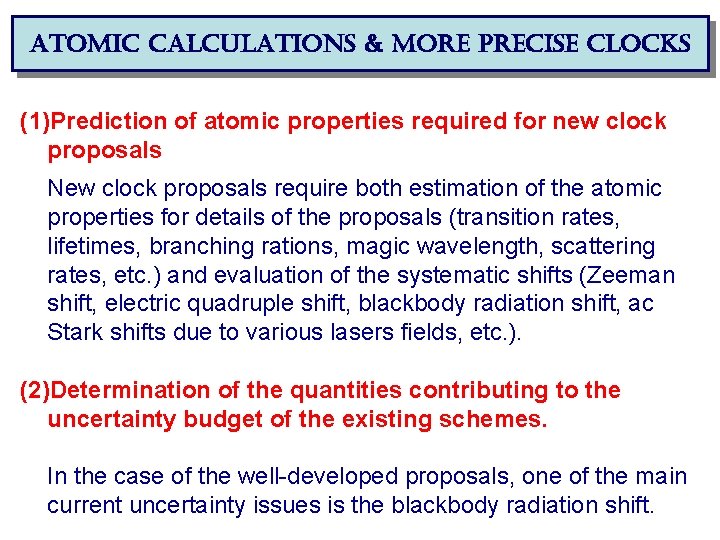
atomic calculations & more precise clocks (1)Prediction of atomic properties required for new clock proposals New clock proposals require both estimation of the atomic properties for details of the proposals (transition rates, lifetimes, branching rations, magic wavelength, scattering rates, etc. ) and evaluation of the systematic shifts (Zeeman shift, electric quadruple shift, blackbody radiation shift, ac Stark shifts due to various lasers fields, etc. ). (2)Determination of the quantities contributing to the uncertainty budget of the existing schemes. In the case of the well-developed proposals, one of the main current uncertainty issues is the blackbody radiation shift.
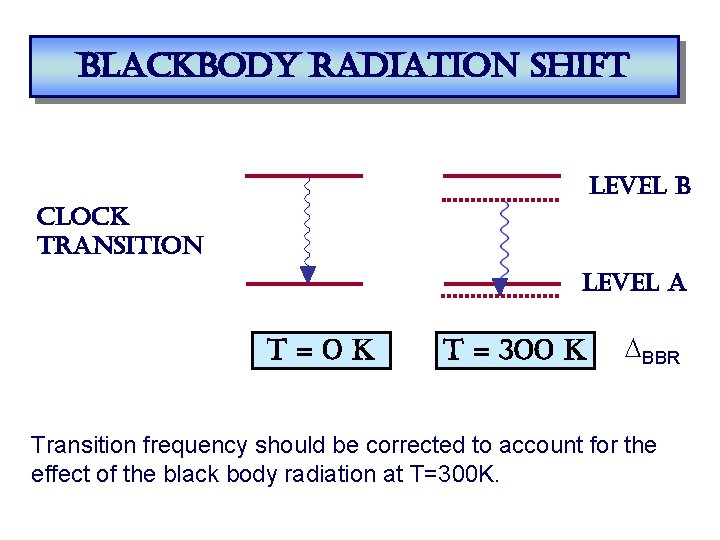
blackbody radiation shift level b clock transition level a t=0 k t = 300 k DBBR Transition frequency should be corrected to account for the effect of the black body radiation at T=300 K.
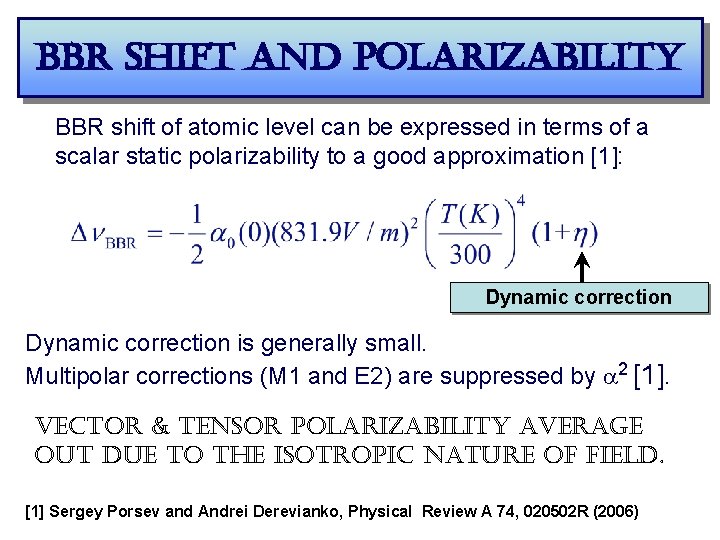
bbr shift and polarizability BBR shift of atomic level can be expressed in terms of a scalar static polarizability to a good approximation [1]: Dynamic correction is generally small. Multipolar corrections (M 1 and E 2) are suppressed by a 2 [1]. vector & tensor polarizability average out due to the isotropic nature of field. [1] Sergey Porsev and Andrei Derevianko, Physical Review A 74, 020502 R (2006)
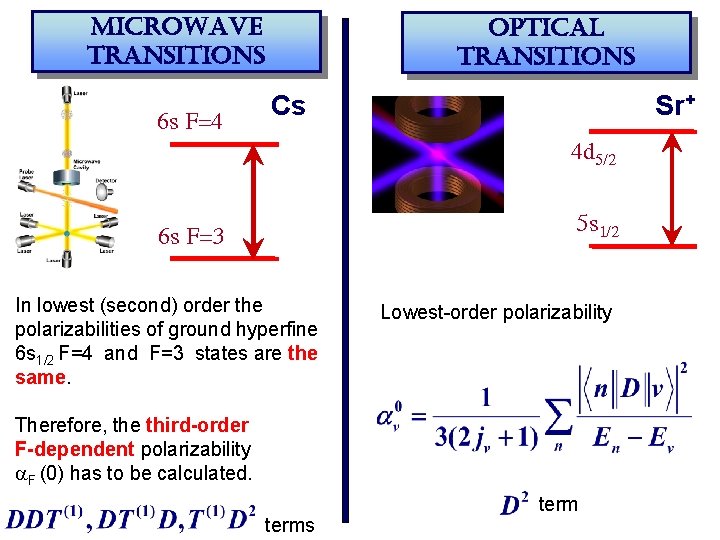
microwave transitions 6 s F=4 optical transitions Cs Sr+ 4 d 5/2 5 s 1/2 6 s F=3 In lowest (second) order the polarizabilities of ground hyperfine 6 s 1/2 F=4 and F=3 states are the same. Lowest-order polarizability Therefore, the third-order F-dependent polarizability a. F (0) has to be calculated. terms term
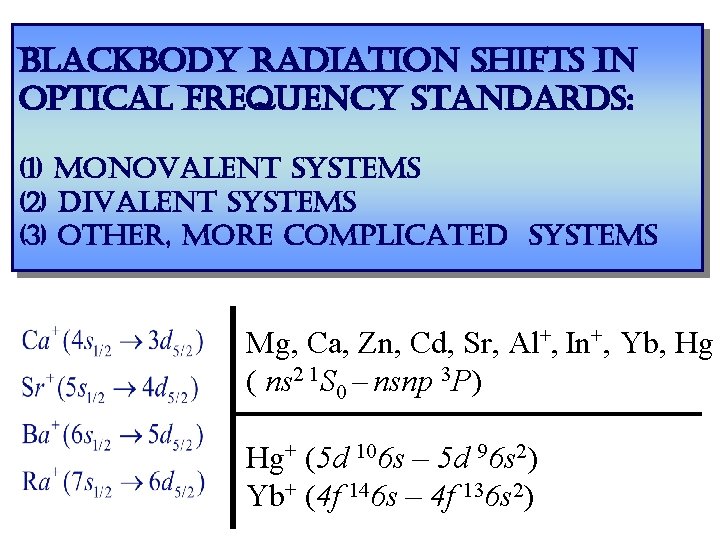
blackbody radiation shifts in optical frequency standards: (1) monovalent systems (2) divalent systems (3) other, more complicated systems Mg, Ca, Zn, Cd, Sr, Al+, In+, Yb, Hg ( ns 2 1 S 0 – nsnp 3 P) Hg+ (5 d 106 s – 5 d 96 s 2) Yb+ (4 f 146 s – 4 f 136 s 2)
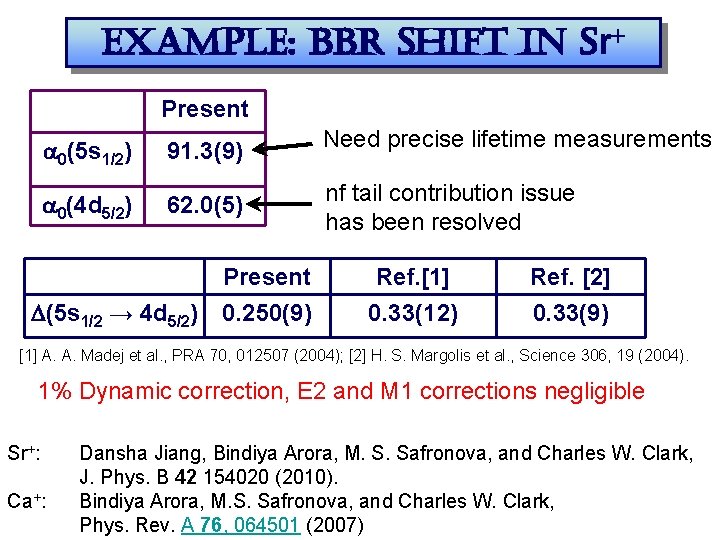
example: bbr shift in sr+ Present a 0(5 s 1/2) 91. 3(9) Need precise lifetime measurements a 0(4 d 5/2) 62. 0(5) nf tail contribution issue has been resolved D(5 s 1/2 → 4 d 5/2) Present 0. 250(9) Ref. [1] 0. 33(12) Ref. [2] 0. 33(9) [1] A. A. Madej et al. , PRA 70, 012507 (2004); [2] H. S. Margolis et al. , Science 306, 19 (2004). 1% Dynamic correction, E 2 and M 1 corrections negligible Sr+: Ca+: Dansha Jiang, Bindiya Arora, M. S. Safronova, and Charles W. Clark, J. Phys. B 42 154020 (2010). Bindiya Arora, M. S. Safronova, and Charles W. Clark, Phys. Rev. A 76, 064501 (2007)
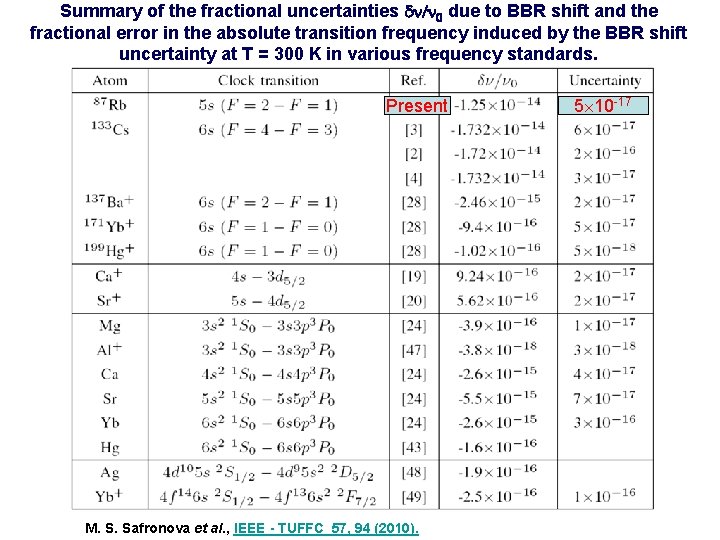
Summary of the fractional uncertainties dn/n 0 due to BBR shift and the fractional error in the absolute transition frequency induced by the BBR shift uncertainty at T = 300 K in various frequency standards. Present M. S. Safronova et al. , IEEE - TUFFC 57, 94 (2010). 5 10 -17
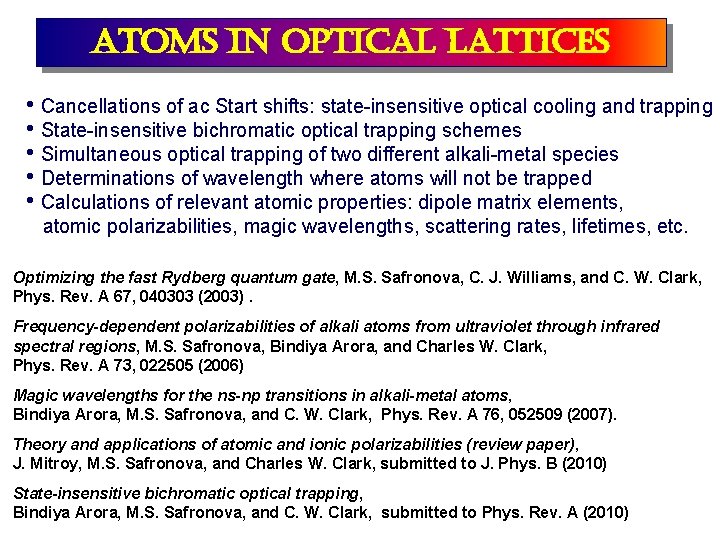
atoms in optical lattices • Cancellations of ac Start shifts: state-insensitive optical cooling and trapping • State-insensitive bichromatic optical trapping schemes • Simultaneous optical trapping of two different alkali-metal species • Determinations of wavelength where atoms will not be trapped • Calculations of relevant atomic properties: dipole matrix elements, atomic polarizabilities, magic wavelengths, scattering rates, lifetimes, etc. Optimizing the fast Rydberg quantum gate, M. S. Safronova, C. J. Williams, and C. W. Clark, Phys. Rev. A 67, 040303 (2003). Frequency-dependent polarizabilities of alkali atoms from ultraviolet through infrared spectral regions, M. S. Safronova, Bindiya Arora, and Charles W. Clark, Phys. Rev. A 73, 022505 (2006) Magic wavelengths for the ns-np transitions in alkali-metal atoms, Bindiya Arora, M. S. Safronova, and C. W. Clark, Phys. Rev. A 76, 052509 (2007). Theory and applications of atomic and ionic polarizabilities (review paper), J. Mitroy, M. S. Safronova, and Charles W. Clark, submitted to J. Phys. B (2010) State-insensitive bichromatic optical trapping, Bindiya Arora, M. S. Safronova, and C. W. Clark, submitted to Phys. Rev. A (2010)
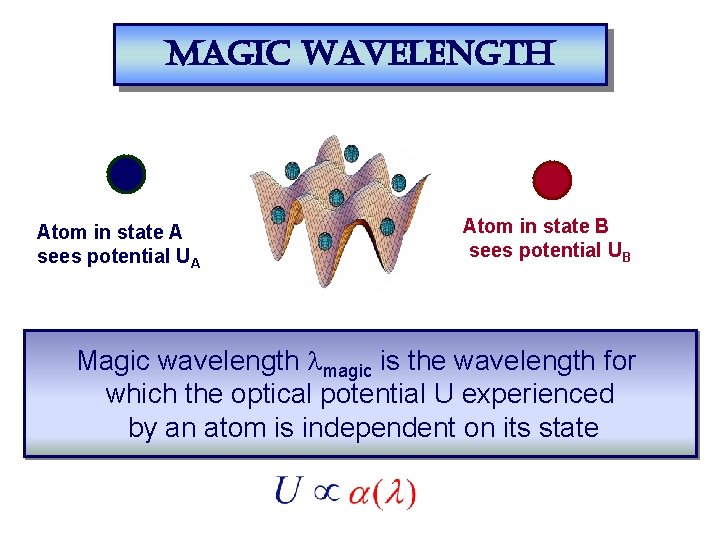
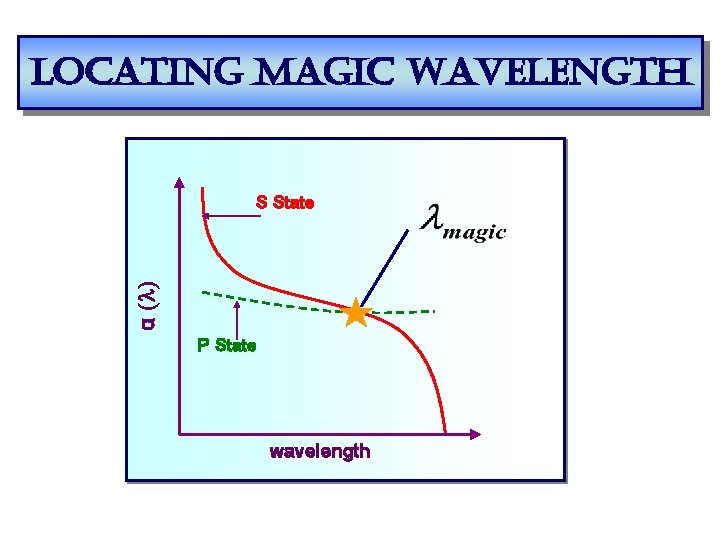
magic wavelength Atom in state A sees potential UA Atom in state B sees potential UB Magic wavelength lmagic is the wavelength for which the optical potential U experienced by an atom is independent on its state
locating magic wavelength α (l) S State P State wavelength
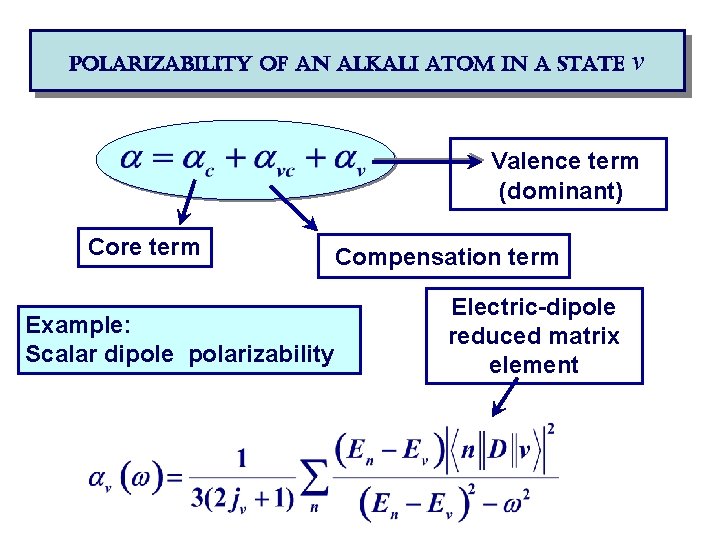
polarizability of an alkali atom in a state v Valence term (dominant) Core term Example: Scalar dipole polarizability Compensation term Electric-dipole reduced matrix element
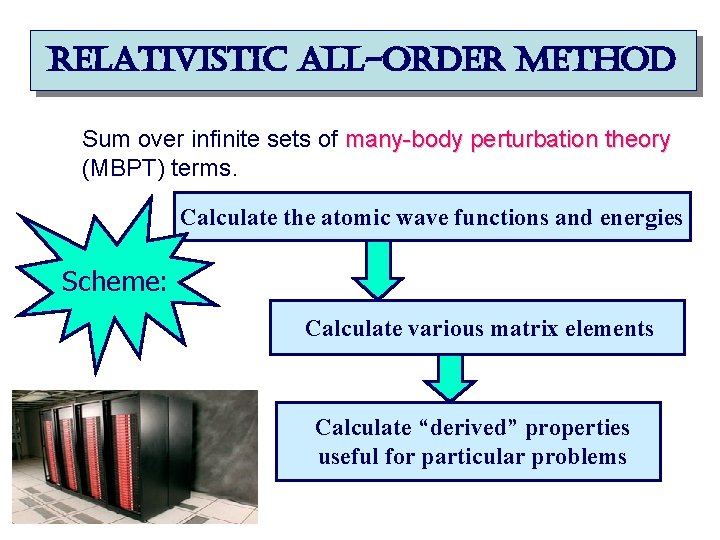
relativistic all-order method Sum over infinite sets of many-body perturbation theory (MBPT) terms. Calculate the atomic wave functions and energies Scheme: Calculate various matrix elements Calculate “derived” properties useful for particular problems
results for alkali-metal atoms: e 1 transition matrix elements in Experiment Na, K, Rb: U. Volz and H. Schmoranzer, Phys. Scr. T 65, 48 (1996), Theory Cs: R. J. Rafac et al. , Phys. Rev. A 60, 3648 (1999), Fr: J. E. Simsarian et al. , Phys. Rev. A 57, 2448 (1998) M. S. Safronova, W. R. Johnson, and A. Derevianko, Phys. Rev. A 60, 4476 (1999)
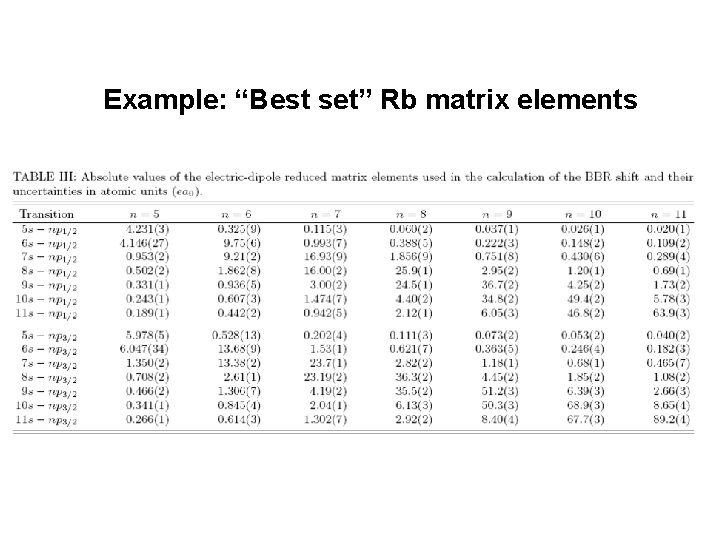
Example: “Best set” Rb matrix elements
Magic wavelengths for the 5 p 3/2 - 5 s transition of Rb.
ac Stark shifts for the transition from 5 p 3/2 F′=3 M′ sublevels to 5 s FM sublevels in Rb. The electric field intensity is taken to be 1 MW/cm 2.
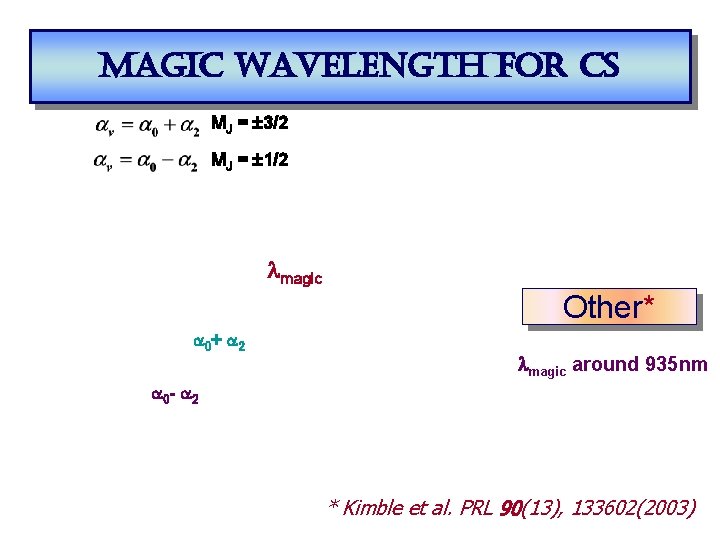
magic wavelength for cs MJ = ± 3/2 MJ = ± 1/2 lmagic Other* a 0+ a 2 lmagic around 935 nm a 0 - a 2 * Kimble et al. PRL 90(13), 133602(2003)
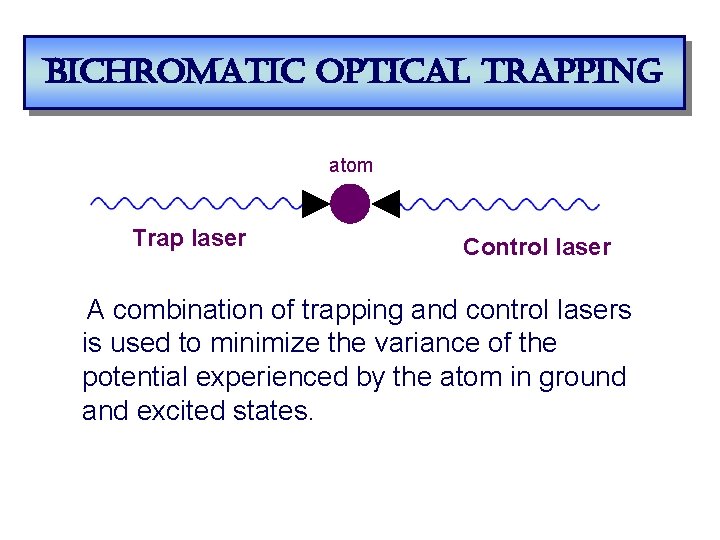
bichromatic optical trapping atom Trap laser Control laser A combination of trapping and control lasers is used to minimize the variance of the potential experienced by the atom in ground and excited states.
Surface plot for the 5 s and 5 p 3/2 |m| = 1/2 state polarizabilities as a function of laser wavelengths l 1 and l 2 for equal intensities of both lasers.
Magic wavelengths for the 5 s and 5 p 3/2 | m| = 1/2 states for l 1 =800 -810 nm and l 2=2 l 1 for various intensities of both lasers. The intensity ratio (e 1/e 2)2 ranges from 1 to 2.
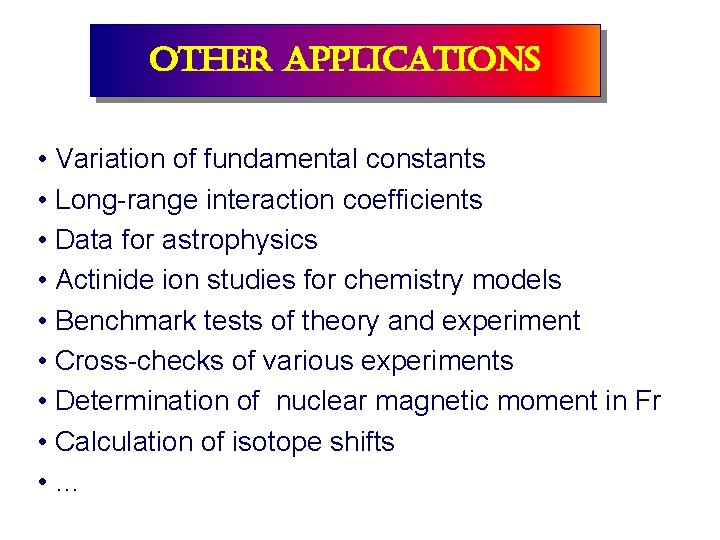
other applications • Variation of fundamental constants • Long-range interaction coefficients • Data for astrophysics • Actinide ion studies for chemistry models • Benchmark tests of theory and experiment • Cross-checks of various experiments • Determination of nuclear magnetic moment in Fr • Calculation of isotope shifts • …
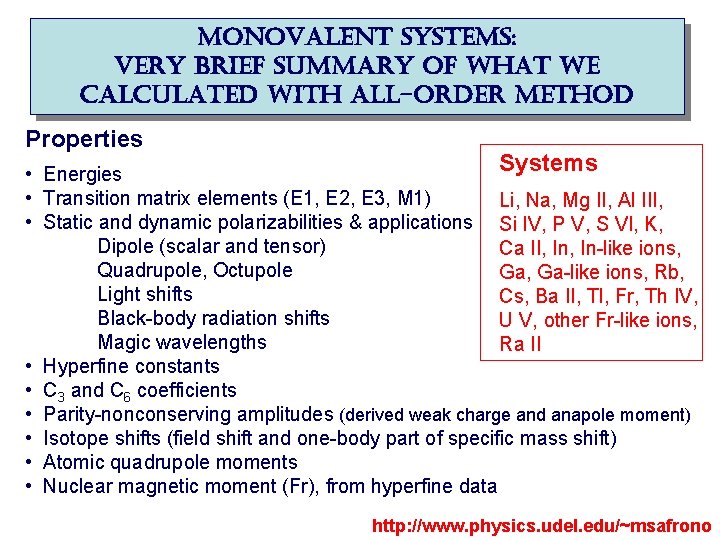
monovalent systems: very brief summary of what we calculated with all-order method Properties Systems • Energies • Transition matrix elements (E 1, E 2, E 3, M 1) Li, Na, Mg II, Al III, • Static and dynamic polarizabilities & applications Si IV, P V, S VI, K, Dipole (scalar and tensor) Ca II, In-like ions, Quadrupole, Octupole Ga, Ga-like ions, Rb, Light shifts Cs, Ba II, Tl, Fr, Th IV, Black-body radiation shifts U V, other Fr-like ions, Magic wavelengths Ra II • Hyperfine constants • C 3 and C 6 coefficients • Parity-nonconserving amplitudes (derived weak charge and anapole moment) • Isotope shifts (field shift and one-body part of specific mass shift) • Atomic quadrupole moments • Nuclear magnetic moment (Fr), from hyperfine data http: //www. physics. udel. edu/~msafrono
how to evaluate uncertainty of theoretical calculations?
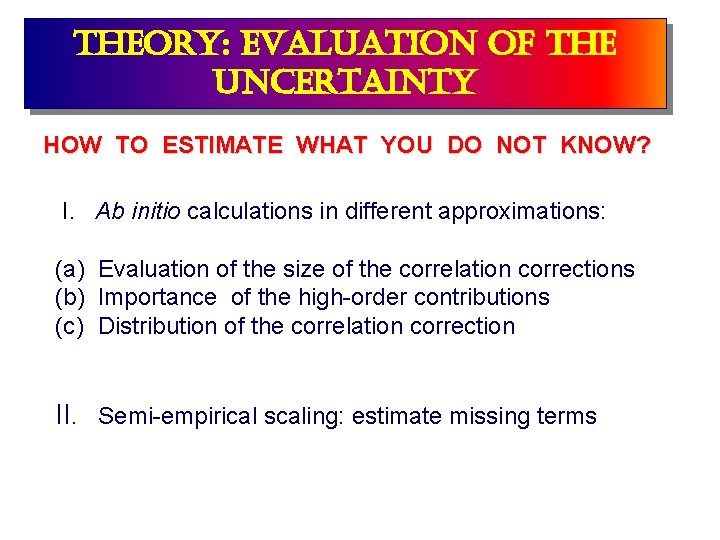
theory: evaluation of the uncertainty HOW TO ESTIMATE WHAT YOU DO NOT KNOW? I. Ab initio calculations in different approximations: (a) Evaluation of the size of the correlation corrections (b) Importance of the high-order contributions (c) Distribution of the correlation correction II. Semi-empirical scaling: estimate missing terms
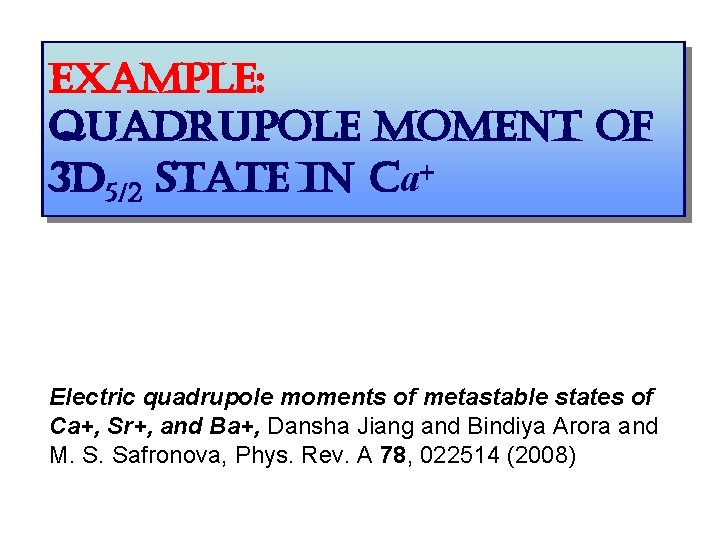
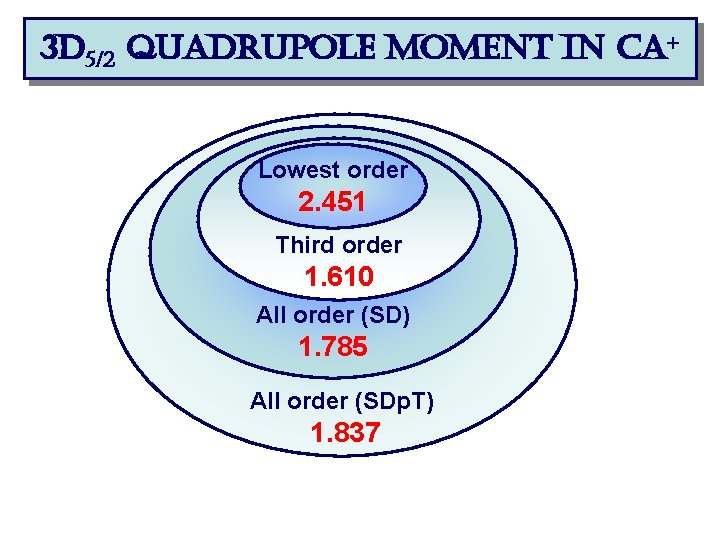
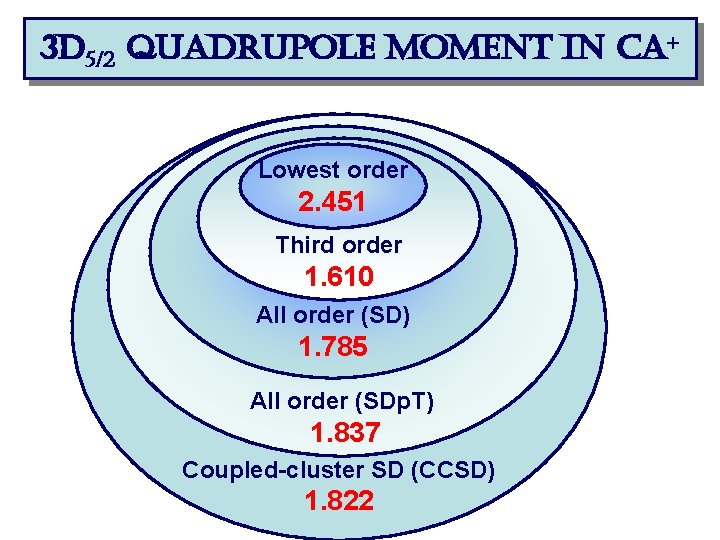
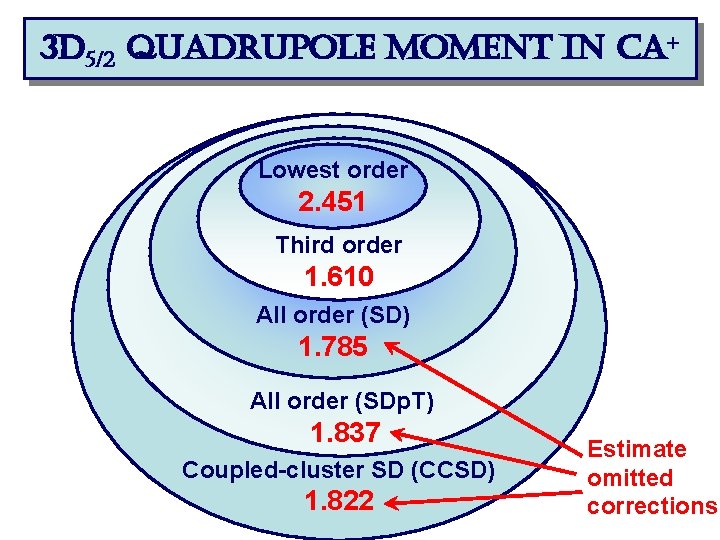
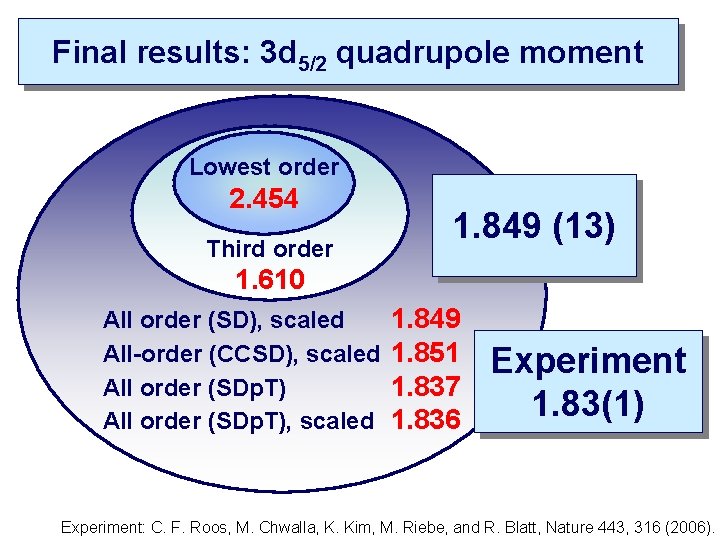
example: quadrupole moment of 3 d 5/2 state in ca+ Electric quadrupole moments of metastable states of Ca+, Sr+, and Ba+, Dansha Jiang and Bindiya Arora and M. S. Safronova, Phys. Rev. A 78, 022514 (2008)
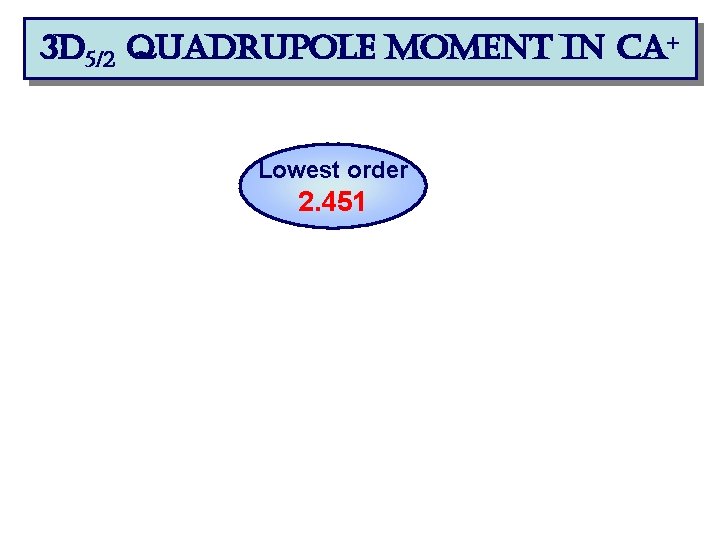
3 d 5/2 quadrupole moment in ca+ Lowest order 2. 451
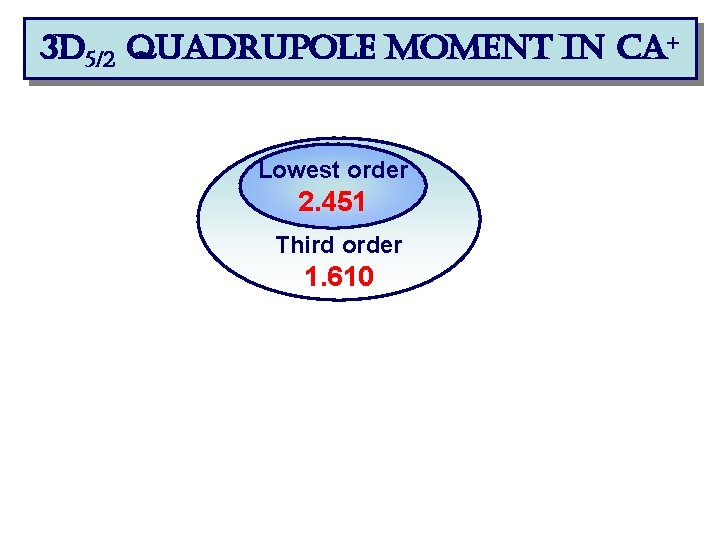
3 d 5/2 quadrupole moment in ca+ Lowest order 2. 451 Third order 1. 610
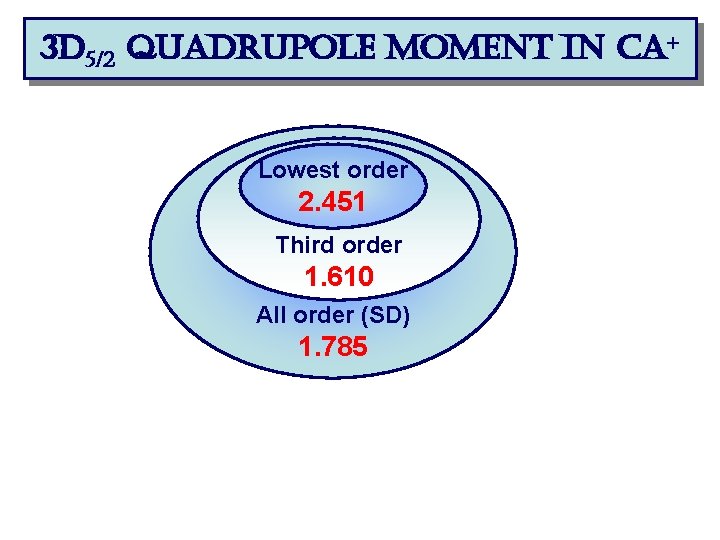
3 d 5/2 quadrupole moment in ca+ Lowest order 2. 451 Third order 1. 610 All order (SD) 1. 785
3 d 5/2 quadrupole moment in ca+ Lowest order 2. 451 Third order 1. 610 All order (SD) 1. 785 All order (SDp. T) 1. 837
3 d 5/2 quadrupole moment in ca+ Lowest order 2. 451 Third order 1. 610 All order (SD) 1. 785 All order (SDp. T) 1. 837 Coupled-cluster SD (CCSD) 1. 822
3 d 5/2 quadrupole moment in ca+ Lowest order 2. 451 Third order 1. 610 All order (SD) 1. 785 All order (SDp. T) 1. 837 Coupled-cluster SD (CCSD) 1. 822 Estimate omitted corrections
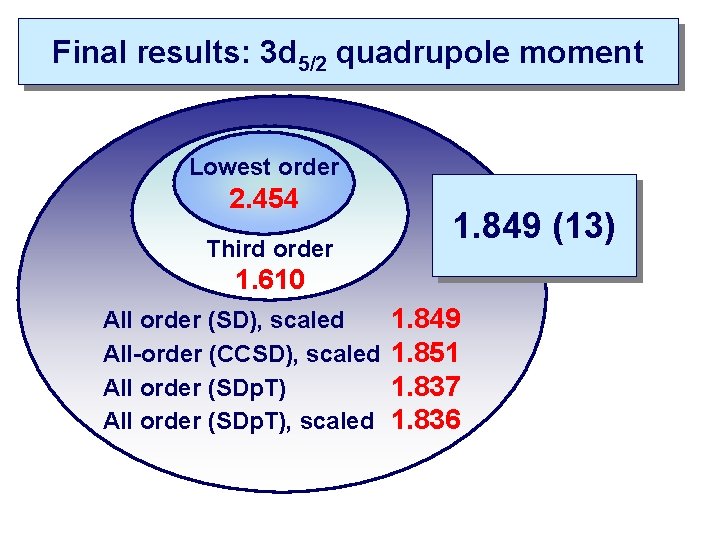
Final results: 3 d 5/2 quadrupole moment Lowest order 2. 454 Third order 1. 849 (13) 1. 610 All order (SD), scaled All-order (CCSD), scaled All order (SDp. T), scaled 1. 849 1. 851 1. 837 1. 836
Final results: 3 d 5/2 quadrupole moment Lowest order 2. 454 Third order 1. 849 (13) 1. 610 All order (SD), scaled All-order (CCSD), scaled All order (SDp. T), scaled 1. 849 1. 851 1. 837 1. 836 Experiment 1. 83(1) Experiment: C. F. Roos, M. Chwalla, K. Kim, M. Riebe, and R. Blatt, Nature 443, 316 (2006).
development of high-precision methods present status of theory and need for further development
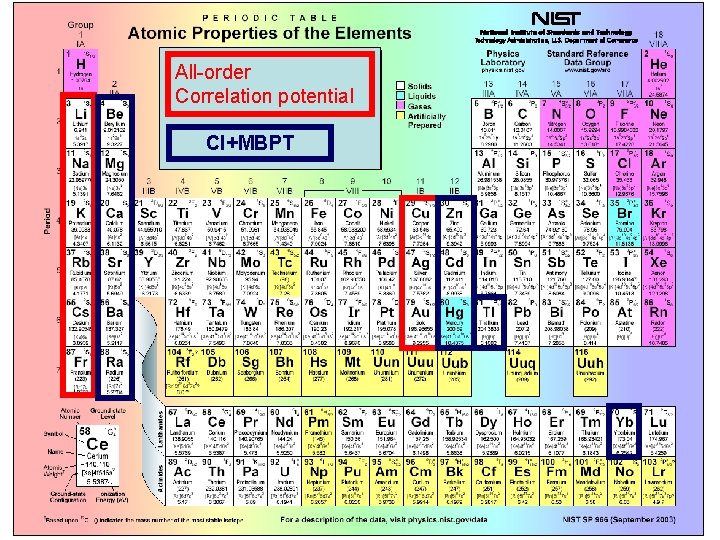
All-order Correlation potential CI+MBPT
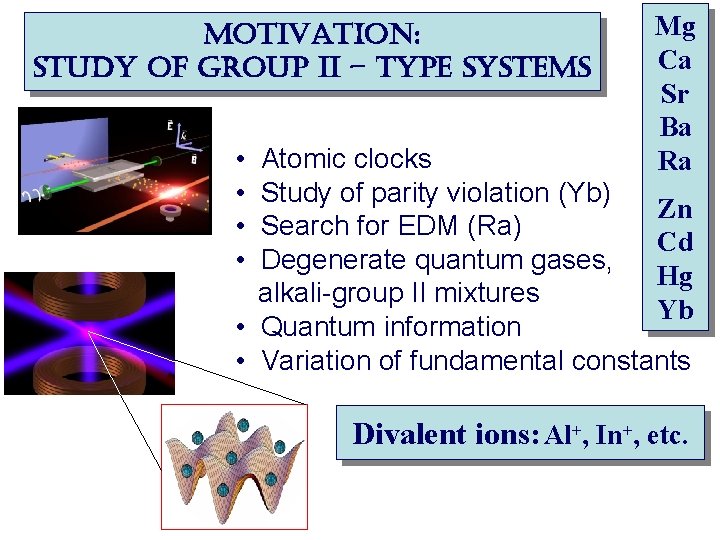
motivation: study of group ii – type systems • • Mg Ca Sr Ba Ra Atomic clocks Study of parity violation (Yb) Zn Search for EDM (Ra) Cd Degenerate quantum gases, Hg alkali-group II mixtures Yb • Quantum information • Variation of fundamental constants Divalent ions: Al+, In+, etc.
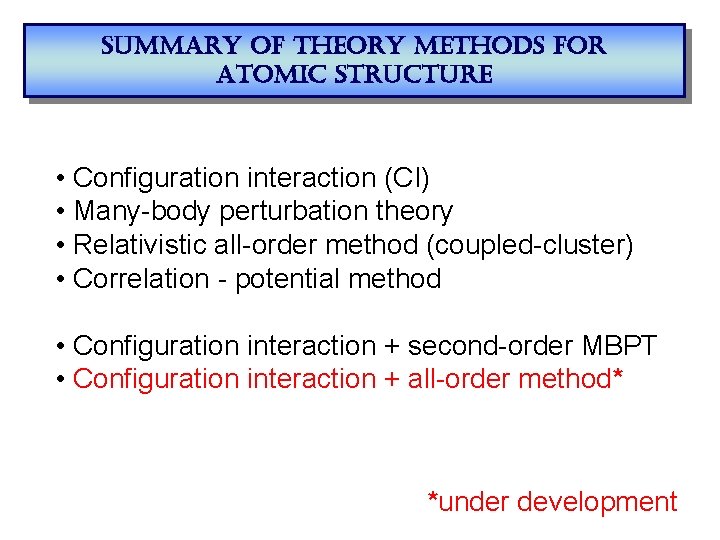
summary of theory methods for atomic structure • Configuration interaction (CI) • Many-body perturbation theory • Relativistic all-order method (coupled-cluster) • Correlation - potential method • Configuration interaction + second-order MBPT • Configuration interaction + all-order method* *under development
goal of the present project: calculate properties of group ii atoms with precision comparable to alkali-metal atoms
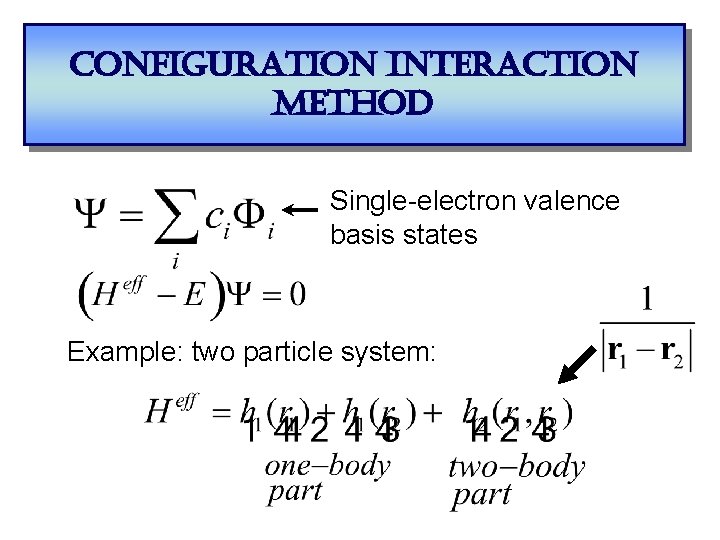
configuration interaction method Single-electron valence basis states Example: two particle system:
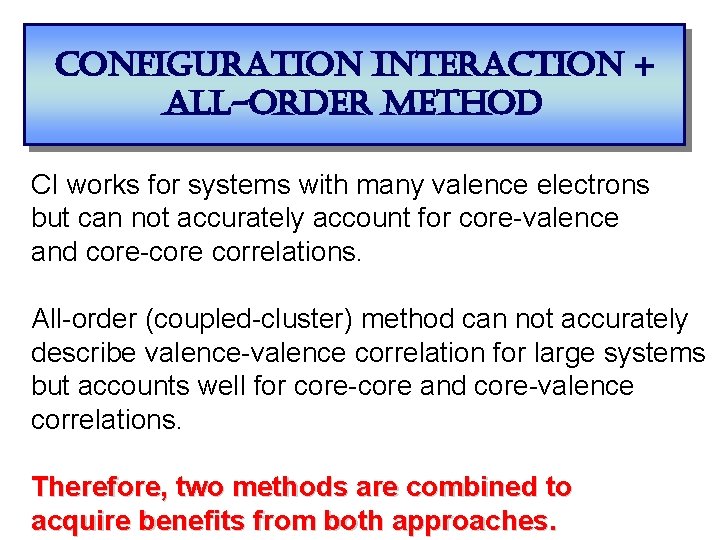
configuration interaction + all-order method CI works for systems with many valence electrons but can not accurately account for core-valence and core-core correlations. All-order (coupled-cluster) method can not accurately describe valence-valence correlation for large systems but accounts well for core-core and core-valence correlations. Therefore, two methods are combined to acquire benefits from both approaches.
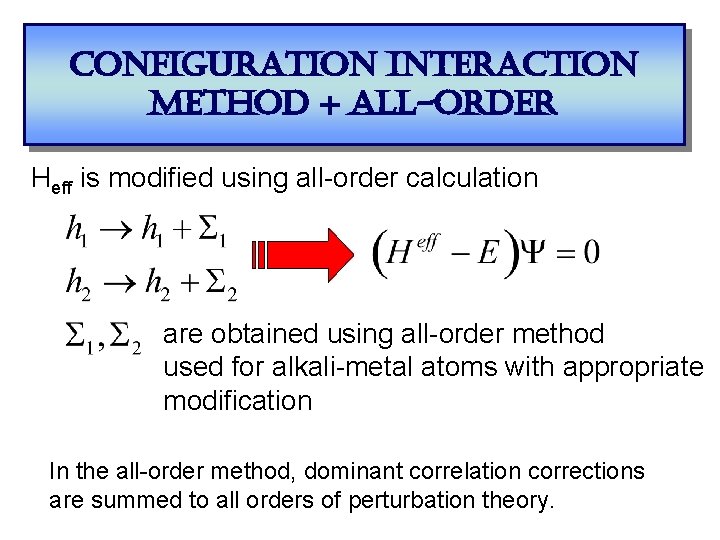
configuration interaction method + all-order Heff is modified using all-order calculation are obtained using all-order method used for alkali-metal atoms with appropriate modification In the all-order method, dominant correlation corrections are summed to all orders of perturbation theory.
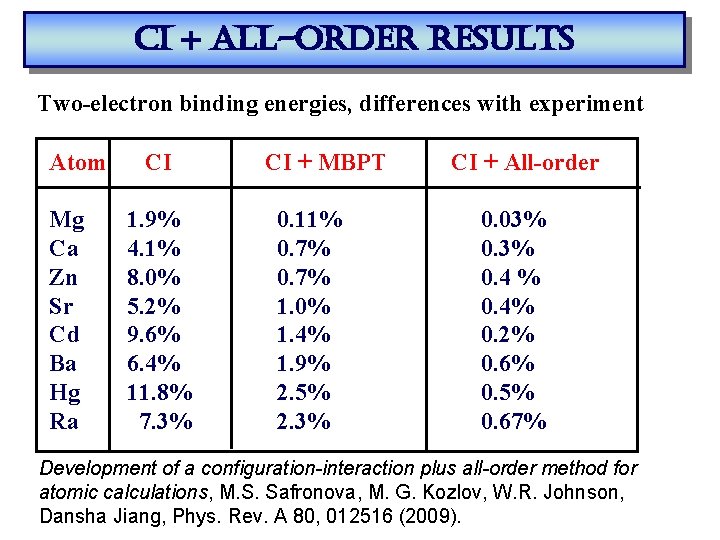
ci + all-order results Two-electron binding energies, differences with experiment Atom Mg Ca Zn Sr Cd Ba Hg Ra CI 1. 9% 4. 1% 8. 0% 5. 2% 9. 6% 6. 4% 11. 8% 7. 3% CI + MBPT 0. 11% 0. 7% 1. 0% 1. 4% 1. 9% 2. 5% 2. 3% CI + All-order 0. 03% 0. 4% 0. 2% 0. 6% 0. 5% 0. 67% Development of a configuration-interaction plus all-order method for atomic calculations, M. S. Safronova, M. G. Kozlov, W. R. Johnson, Dansha Jiang, Phys. Rev. A 80, 012516 (2009).
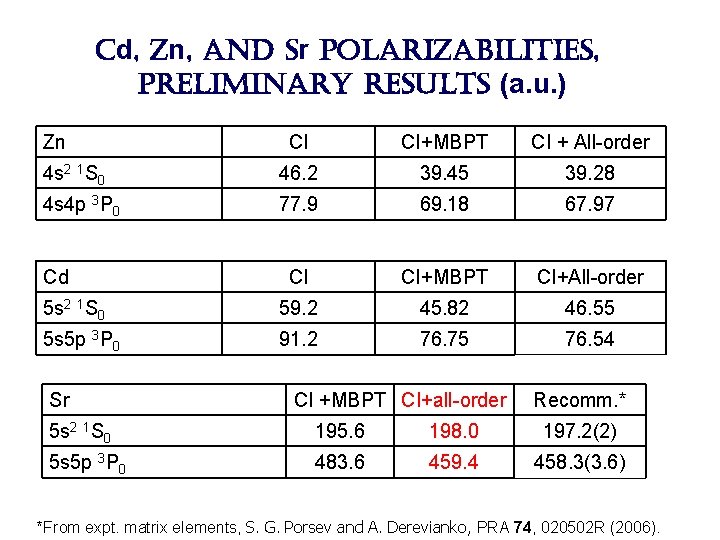
cd, zn, and sr polarizabilities, preliminary results (a. u. ) Zn CI CI+MBPT CI + All-order 4 s 2 1 S 0 46. 2 39. 45 39. 28 4 s 4 p 3 P 0 77. 9 69. 18 67. 97 CI CI+MBPT CI+All-order 5 s 2 1 S 0 59. 2 45. 82 46. 55 5 s 5 p 3 P 0 91. 2 76. 75 76. 54 Cd Sr CI +MBPT CI+all-order Recomm. * 5 s 2 1 S 0 195. 6 198. 0 197. 2(2) 5 s 5 p 3 P 0 483. 6 459. 4 458. 3(3. 6) *From expt. matrix elements, S. G. Porsev and A. Derevianko, PRA 74, 020502 R (2006).
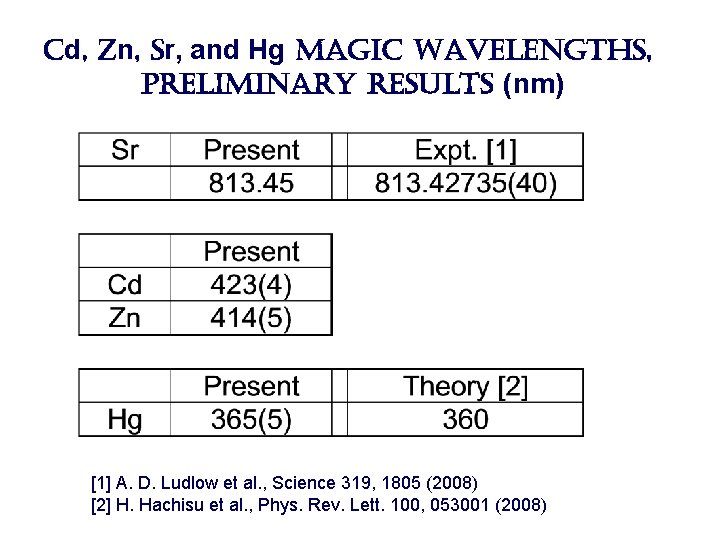
cd, zn, sr, and Hg magic wavelengths, preliminary results (nm) [1] A. D. Ludlow et al. , Science 319, 1805 (2008) [2] H. Hachisu et al. , Phys. Rev. Lett. 100, 053001 (2008)
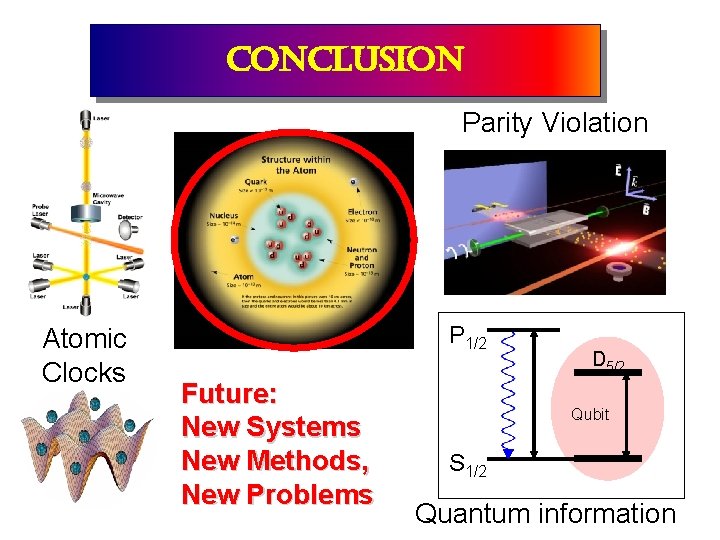
conclusion Parity Violation Atomic Clocks P 1/2 Future: New Systems New Methods, New Problems D 5/2 Qubit S 1/2 Quantum information