
JProf Dr Anne LauberRnsberg Dr Sven Hetmank Institute
JProf. Dr. Anne Lauber-Rönsberg / Dr. Sven Hetmank Institute of Intellectual Property, Competition and Media Law The Concept of Authorship and Inventorship Under Pressure: Does AI Shift Paradigms? GRUR meets Brussels 5 June 2018
Overview 1. Current Legal Framework: IP Protection for products generated by AI? 2. Arguments against and in favour of IP-Protection for AI generated output 3. Adjusting the current IP Law system – Options and Challenges 4. Authorship and Inventorship: Does AI Shift Paradigms? Authorship and Inventorship under Pressure – Does AI Shift Paradigms? Lauber-Rönsberg/Hetmank Brussels // 5 June 2018 Folie 2
Overview 1. Current Legal Framework: IP Protection for products generated by AI? 2. Arguments against and in favour of IP-Protection of AI generated output 3. Adjusting the current IP Law system – Options and Challenges 4. Authorship and Inventorship: Does AI Shift Paradigms? Authorship and Inventorship under Pressure – Does AI Shift Paradigms? Lauber-Rönsberg/Hetmank Brussels // 5 June 2018 Folie 3
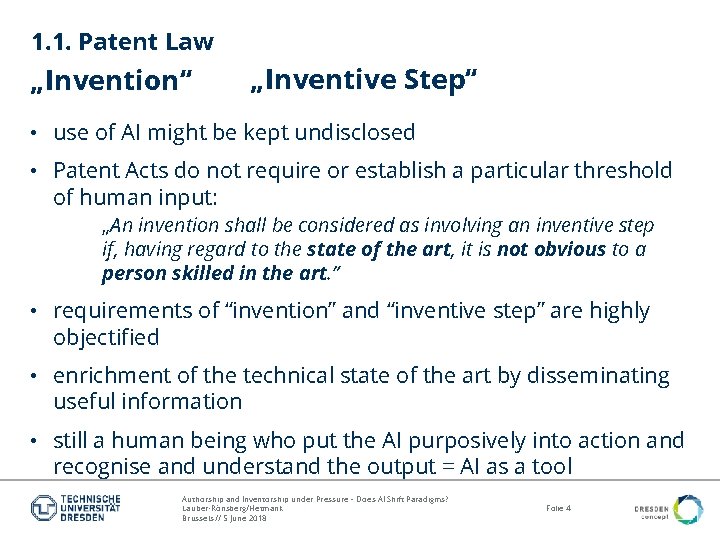
1. 1. Patent Law „Invention“ „Inventive Step“ • use of AI might be kept undisclosed • Patent Acts do not require or establish a particular threshold of human input: „An invention shall be considered as involving an inventive step if, having regard to the state of the art, it is not obvious to a person skilled in the art. ” • requirements of “invention” and “inventive step” are highly objectified • enrichment of the technical state of the art by disseminating useful information • still a human being who put the AI purposively into action and recognise and understand the output = AI as a tool Authorship and Inventorship under Pressure – Does AI Shift Paradigms? Lauber-Rönsberg/Hetmank Brussels // 5 June 2018 Folie 4
1. 1. Patent Law „Inventor“ • “The right to a European patent shall belong to the inventor. . . ” • depends on the precise intellectual input • however, reduced requirements if it would be otherwise not possible to identify an inventor at all • for example if two inventors found the invention by pure chance but without inventive intellectual input • allocation of the patent is separated from the requirement of inventive step • Patent offices do not verify the declaration of inventorship in the application Authorship and Inventorship under Pressure – Does AI Shift Paradigms? Lauber-Rönsberg/Hetmank Brussels // 5 June 2018 Folie 5
1. 2. Copyright Law EU Copyright Law: Acquis Article 2 Computer Programs Directive 2009/24: Authorship of computer programs 1. The author of a computer program shall be the natural person or group of natural persons who has created the program or, where the legislation of the Member State permits, the legal person designated as the rightholder by that legislation. See also Art. 4 Database Directive. Authorship and Inventorship under Pressure – Does AI Shift Paradigms? Lauber-Rönsberg/Hetmank Brussels // 5 June 2018 Folie 6
1. 2. Copyright Law EU Copyright Law: Acquis Art. 1 (3) Software Directive Art. 3 Database Directive Art. 6 Directive 2006/116: author's own intellectual creation Rec. 16 Directive 2006/116 : A photographic work within the meaning of the Berne Convention is to be considered original if it is the author's own intellectual creation reflecting his personality, no other criteria such as merit or purpose being taken into account. Authorship and Inventorship under Pressure – Does AI Shift Paradigms? Lauber-Rönsberg/Hetmank Brussels // 5 June 2018 Folie 7
1. 2. Copyright Law EU Copyright Law: Acquis Court of Justice, C-145/10, para 88 ff. – Painer/Standard: “(. . . ) an intellectual creation is an author’s own if it reflects the author’s personality. That is the case if the author was able to express his creative abilities in the production of the work by making free and creative choices (…) By making those various choices, the author of a portrait photograph can stamp the work created with his ‘personal touch’. ” Authorship and Inventorship under Pressure – Does AI Shift Paradigms? Lauber-Rönsberg/Hetmank Brussels // 5 June 2018 Folie 8
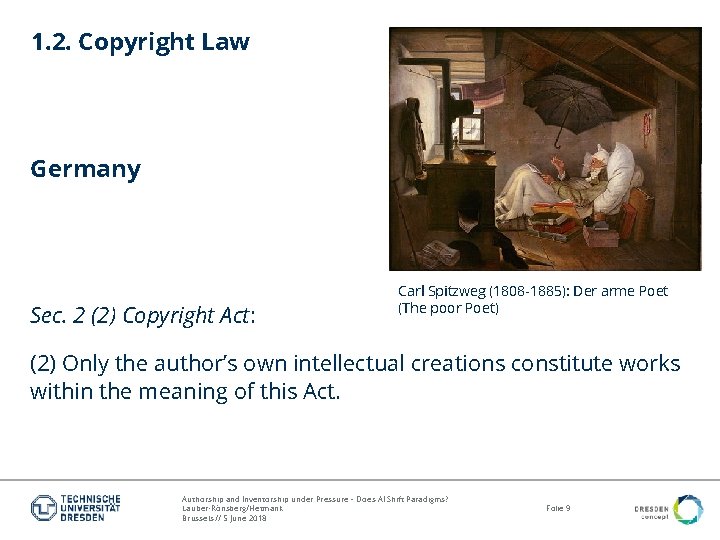
1. 2. Copyright Law Germany Sec. 2 (2) Copyright Act: Carl Spitzweg (1808 -1885): Der arme Poet (The poor Poet) (2) Only the author’s own intellectual creations constitute works within the meaning of this Act. Authorship and Inventorship under Pressure – Does AI Shift Paradigms? Lauber-Rönsberg/Hetmank Brussels // 5 June 2018 Folie 9
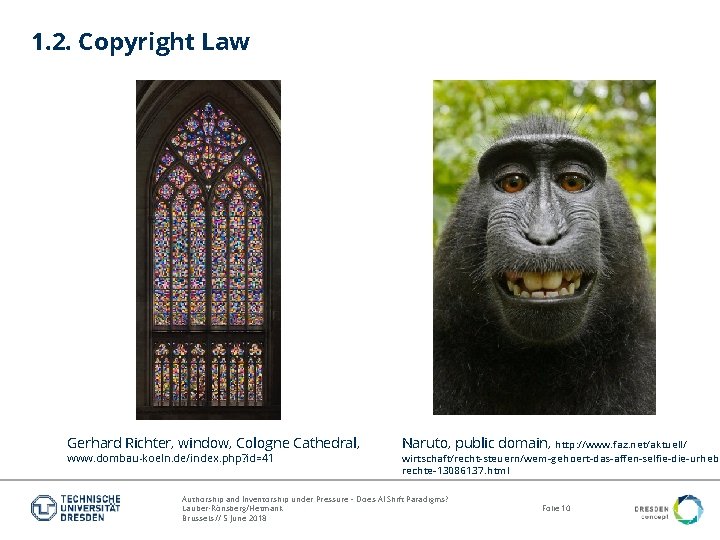
1. 2. Copyright Law Gerhard Richter, window, Cologne Cathedral, www. dombau-koeln. de/index. php? id=41 Naruto, public domain, http: //www. faz. net/aktuell/ wirtschaft/recht-steuern/wem-gehoert-das-affen-selfie-die-urhebe rechte-13086137. html Authorship and Inventorship under Pressure – Does AI Shift Paradigms? Lauber-Rönsberg/Hetmank Brussels // 5 June 2018 Folie 10
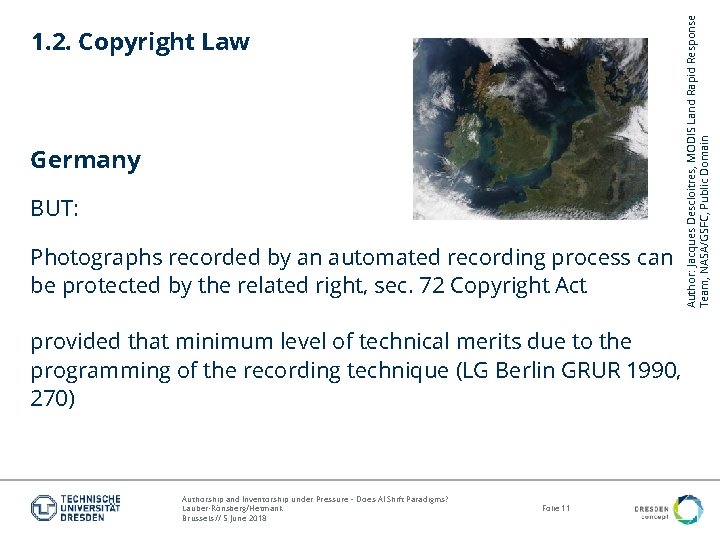
Germany BUT: Photographs recorded by an automated recording process can be protected by the related right, sec. 72 Copyright Act provided that minimum level of technical merits due to the programming of the recording technique (LG Berlin GRUR 1990, 270) Authorship and Inventorship under Pressure – Does AI Shift Paradigms? Lauber-Rönsberg/Hetmank Brussels // 5 June 2018 Folie 11 Author: Jacques Descloitres, MODIS Land Rapid Response Team, NASA/GSFC, Public Domain 1. 2. Copyright Law
1. 2. Copyright Law United Kingdom s. 9 CDPA 1988 Authorship of work. (3) In the case of a literary, dramatic, musical or artistic work which is computer-generated, the author shall be taken to be the person by whom the arrangements necessary for the creation of the work are undertaken. s. 178 CDPA 1988 Minor definitions “computer-generated”, in relation to a work, means that the work is generated by computer in circumstances such that there is no human author of the work; Authorship and Inventorship under Pressure – Does AI Shift Paradigms? Lauber-Rönsberg/Hetmank Brussels // 5 June 2018 Folie 12
1. 2. Copyright Law Status Quo: v “Works” created by AI without sufficient human involvement will be ineligible for copyright protection under EU acquis; v Disputed how substantial the human input needs to be in order to enjoy copyright protection v Lesser degree of human involvement needed with regard to related rights? Authorship and Inventorship under Pressure – Does AI Shift Paradigms? Lauber-Rönsberg/Hetmank Brussels // 5 June 2018 Folie 13
1. 3. Sui Generis Right (Database Directive 96/9) v Art. 7 (1) Database Directive - substantial investment in either the obtaining, verification or presentation of the contents - Maker of the database? v Art. 1 (2) Database Directive: collection of independent works, data or other materials arranged in a systematic or methodical way and individually accessible by electronic or other means Database Protection for: - Maps ✔ - Films? - Sound recordings? Authorship and Inventorship under Pressure – Does AI Shift Paradigms? Lauber-Rönsberg/Hetmank Brussels // 5 June 2018 Folie 14
Overview 1. Current Legal Framework: IP Protection for products generated by AI? 2. Arguments against and in favour of IP-Protection of AI generated output 3. Adjusting the current IP Law system – Options and Challenges 4. Authorship and Inventorship: Does AI Shift Paradigms? Authorship and Inventorship under Pressure – Does AI Shift Paradigms? Lauber-Rönsberg/Hetmank Brussels // 5 June 2018 Folie 15
2. Arguments against and in favour of IP-Protection of AI generated output On the one hand… • AI is not susceptible of incentives which are provided by IP Rights • IP Rights on AI generated outcome might foster market concentration and might stifle entry of new ventures into market • might have negative impacts on human incentives • other tools of stimulating investments might be sufficiant, for example „first–mover-advantage“ On the other hand… • IP Rights might be necessary to stimulate investments in AI • Patents might be necessary to incentivize disclosure and dissemination of those inventions as well as to disclose the use of AI Authorship and Inventorship under Pressure – Does AI Shift Paradigms? Lauber-Rönsberg/Hetmank Brussels // 5 June 2018 Folie 16
Overview 1. Current Legal Framework: IP Protection for products generated by AI? 2. Arguments against and in favour of IP-Protection of AI generated outcome 3. Adjusting the current IP Law system – Options and Challenges 4. Authorship and Inventorship: Does AI Shift Paradigms? Authorship and Inventorship under Pressure – Does AI Shift Paradigms? Lauber-Rönsberg/Hetmank Brussels // 5 June 2018 Folie 17
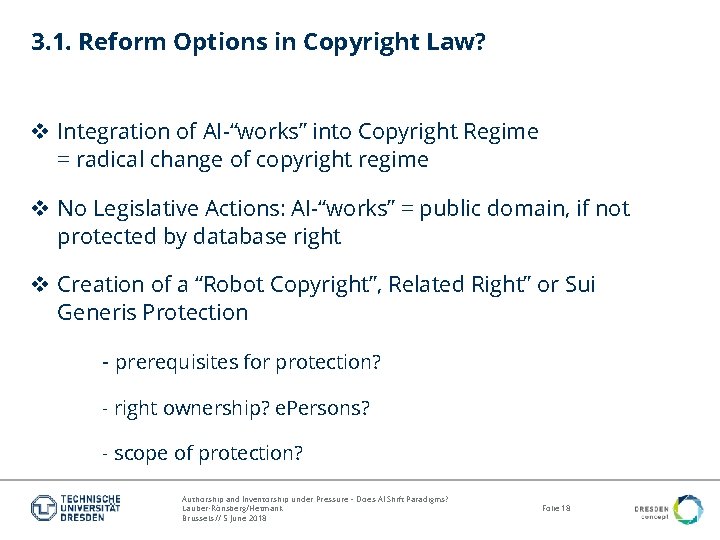
3. 1. Reform Options in Copyright Law? v Integration of AI-“works” into Copyright Regime = radical change of copyright regime v No Legislative Actions: AI-“works” = public domain, if not protected by database right v Creation of a “Robot Copyright”, Related Right” or Sui Generis Protection - prerequisites for protection? - right ownership? e. Persons? - scope of protection? Authorship and Inventorship under Pressure – Does AI Shift Paradigms? Lauber-Rönsberg/Hetmank Brussels // 5 June 2018 Folie 18
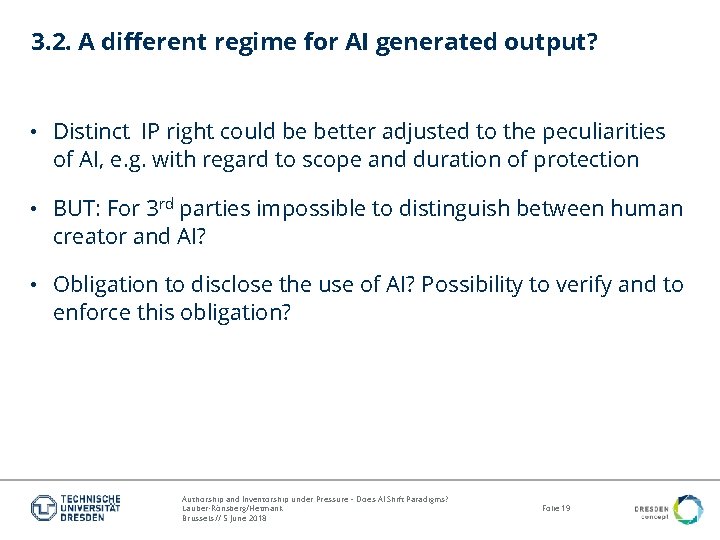
3. 2. A different regime for AI generated output? • Distinct IP right could be better adjusted to the peculiarities of AI, e. g. with regard to scope and duration of protection • BUT: For 3 rd parties impossible to distinguish between human creator and AI? • Obligation to disclose the use of AI? Possibility to verify and to enforce this obligation? Authorship and Inventorship under Pressure – Does AI Shift Paradigms? Lauber-Rönsberg/Hetmank Brussels // 5 June 2018 Folie 19
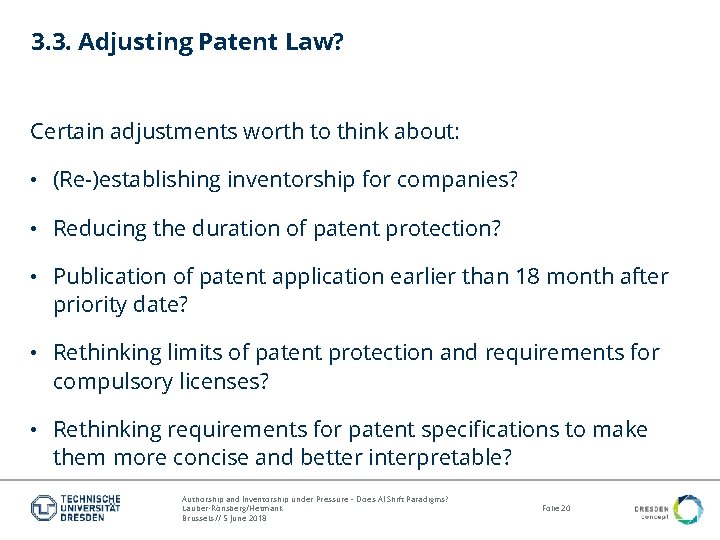
3. 3. Adjusting Patent Law? Certain adjustments worth to think about: • (Re-)establishing inventorship for companies? • Reducing the duration of patent protection? • Publication of patent application earlier than 18 month after priority date? • Rethinking limits of patent protection and requirements for compulsory licenses? • Rethinking requirements for patent specifications to make them more concise and better interpretable? Authorship and Inventorship under Pressure – Does AI Shift Paradigms? Lauber-Rönsberg/Hetmank Brussels // 5 June 2018 Folie 20
Overview 1. Current Legal Framework: IP Protection for products generated by AI? 2. Arguments against and in favour of IP-Protection of AI generated outcome 3. Adjusting the current IP Law system – Options and Challenges 4. Authorship and Inventorship: Does AI Shift Paradigms? Authorship and Inventorship under Pressure – Does AI Shift Paradigms? Lauber-Rönsberg/Hetmank Brussels // 5 June 2018 Folie 21
4. Authorship and Inventorship: Does AI Shift Paradigms? v From a practical point of view? Copyright Law: If AI becomes state of the art, - Considerable competition for human works, e. g. translations, jingles, graphic design, … Patent Law: If AI becomes state of the art, - The bar for inventiveness will be raised. - The state of the art will become more uncertain and less obvious. - Examiners might need knowledge of the capabilities of current AI. - AI might be kept secret to avoid non-inventiveness of their output. Authorship and Inventorship under Pressure – Does AI Shift Paradigms? Lauber-Rönsberg/Hetmank Brussels // 5 June 2018 Folie 22
4. Authorship and Inventorship: Does AI Shift Paradigms? v The Legal Concept of Inventorship? Patent Law: If Patent law to encompass AI-generated inventions, minimal human involvement needed: Identification of invention sufficient Authorship and Inventorship under Pressure – Does AI Shift Paradigms? Lauber-Rönsberg/Hetmank Brussels // 5 June 2018 Folie 23
4. Authorship and Inventorship: Does AI Shift Paradigms? v The Legal Concept of Authorship? Copyright Law: - If integration of IP protection for AI-works into current copyright regime: Shift of Paradigms, since adjustments necessary, e. g. term of protection - If separate or no IP Protection for AI Works, legal concept of authorship unaffected for now - But need for justifying copyright protection for human works grows, if AI-“work“s are perceived to be „better“ Authorship and Inventorship under Pressure – Does AI Shift Paradigms? Lauber-Rönsberg/Hetmank Brussels // 5 June 2018 Folie 24
- Slides: 24