
JOURNEY THROUGH THE AGES PART 3 Begins PALEOGENE

JOURNEY THROUGH THE AGES PART 3 Begins
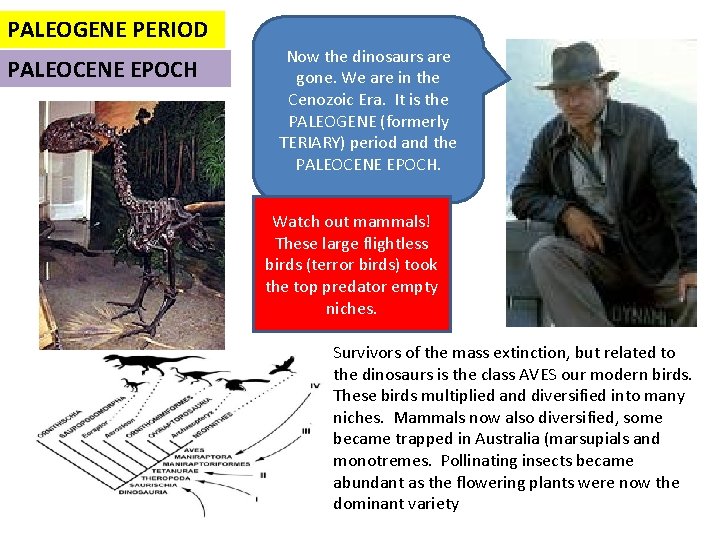
PALEOGENE PERIOD PALEOCENE EPOCH Now the dinosaurs are gone. We are in the Cenozoic Era. It is the PALEOGENE (formerly TERIARY) period and the PALEOCENE EPOCH. Watch out mammals! These large flightless birds (terror birds) took the top predator empty niches. Survivors of the mass extinction, but related to the dinosaurs is the class AVES our modern birds. These birds multiplied and diversified into many niches. Mammals now also diversified, some became trapped in Australia (marsupials and monotremes. Pollinating insects became abundant as the flowering plants were now the dominant variety

PALEOGENE PERIOD EOCENE EPOCH Approx 55 mya ey Monk raft Basilosaurus – mammal early whale Tell ya what, we didn’t swim across the Atlantic, but it was not as wide as today. Maybe we took a raft. Monkeys migrate across the Atlantic Ocean to South America dividing the group into OLD WORLD and NEW WORLD MONKEYS Dolphins and whales, what a success in the evolutionary world. Lots of diversity as the first modern mammals emerge. Early sirenians - manatees Sirens(sailor seductresses) date back to Greek mythology. They’re like an evil mermaid

PALEOGENE PERIOD EOCENE EPOCH OUR CONNECTION – Primates This ancestor is the primatomorphia

PALEOGENE PERIOD OLIGOCENE EPOCH Approx 34 mya Can you tell that the earth is becoming dryer? More grasslands, less tropical forest. It’s a transition time with fewer new species Origin of many primates -apes during this epoch. Horses and camels proliferate. In Greek Hippos mean horse. , meso mean middle. So middle horse. These early horses(Mesohippus) have three toes, not a hoof.

NEOGENE PERIOD Approx 23 mya MIOENE EPOCH Better watch out , the largest shark ever, Megalodon, existed during this epoch. Just look at the tooth, it measures 17 cm on this scale. It was 20 m long ( that’s 67 ft. )and weighed 114 tons. These teeth were Move over JAWS. thought to be the Further cooling teeth of DRAGONS resulted in the when found in rock formation of the formations Antarctic glaciers – Global cooling. My Oh MIOCENE!What a shark!

NEOGENE PERIOD MIOENE EPOCH OUR CONNECTION – Primates This ape ancestor is the Homoinoidea. It is the branch of apes that leads to the gorilla, chimps, This Terror bird lived in S America. I’m glad there is no land bridge yet to N America! Take a look at this bird. It’s the biggest flier that ever lived and it occurred in the Miocene. Argentavis magnificens, like the giant flying reptiles would not be capable of taking off without strong winds. It also probably was a glider. It also lived in S America. Must be some pretty big winds down there.

NEOGENE PERIOD PLIOCENE EPOCH I will move up to N. A. As a top predator Approx 5 mya The land bridge formed between N and S America connecting them and species moved The world cooled European crocs died and the Greenland Ice sheet formed. Overall global temperatures were still 2 -3 0 higher than today. The skull is no ordinary ape, it is the founder of the genus HOMO- It’s your first direct evolutionary relative, the Australopithecus of East Africa. 4 mya

NEOGENE PERIOD Pleiostocene epoch Woolly mammoths Sabre tooth cats DAWN OF THE HUMANS – LATE PLEISTOCENE Approx 2 mya-12, 000 years ago We are getting close to modern times now. This is the time of repeated ice ages, covering 30% of the globe. . We archaeologists call it the Palaeolithic. Take a look at the glaciations, Canada is under a glacier 100’s of meters thick. Global sea levels dropped as a result of all this ice. Makes you think the Greenhouse effect might not always be a bad thing. The retreat of the last ice age glaciers marks the end of this epoch 12, 000 years ago Neanderthals in Europe Homo sapiens leave Africa and migrate to Europe and Asia becoming dominant. All other members of the genus Homo disappear. Happens about 100, 000 ya

NEOGENE PERIOD Holocene epoch Approx 12, 000 years to present And so here we are, at the dawn of our beginnings. It’s been a long journey and if you look at it in perspective, it is just a split second on the clock of our planet Earth. It’s at this point that modern humans begin to master the land our skills in the use of tools begins to broaden our domains. It won’t be long before we build ships to sail to far away lands and civilizations become centers for culture and intellectual development. But there is another side to human nature. Why can we be so destructive? “What makes us fight amongst ourselves? How can the first species to dominate the planet on brains and not brawn, also be his own worst enemy? I’ll tell you Dr. Jones. Some people are better than the others and we will lead you and control you either politically or economically. You see there is no escape from our great game of control. We intend to spread this control over the globe, either by war or by your own personal finances. We will still win! Cro-Magnon man 30, 000 years ago
NEOGENE PERIOD Holocene epoch In this short time interval we learn to grow crops (green revolution) expanding our food supply and lead the way to population increases and more advancements. Setbacks occur as we war and lose the knowledge of the past(dark ages) but we continue on our path. What is in our future? Can we persist now that we dominate the planet and are learning the secrets of the universe around us? Or will people like these greedy inhumane Nazis destroy the beautiful world we could live in. That’s why the time capacitor is going the same place as the ark of the covenant. Sorry, Eddie That’s Okay Indy. I think it needs to go there too.
Journey through the Ages Ends ©KKproductions
P. S. Hydrogen sulphide has been implicated in some of the several mass extinctions that have occurred in the Earth's past. The Permian mass extinction (sometimes known as the "Great Dying") may have been caused by hydrogen sulphide. Organic residues from these extinction boundaries indicate that the oceans were anoxic (oxygen depleted) and had species of shallow plankton that metabolized H 2 S. The formation of H 2 S may have been initiated by massive volcanic eruptions, which emitted CO 2 and methane into the atmosphere which warmed the oceans, lowering their capacity to absorb oxygen which would otherwise oxidize H 2 S. The increased levels of hydrogen sulphide could have killed oxygen-generating plants as well as depleted the ozone layer causing further stress. Small H 2 S blooms have been detected in modern times in the Dead Sea The Dead Sea is both the lowest point in Eurasia at 418 metres below sea level and falling, and the deepest hypersaline body of water.
- Slides: 13