
Journey of Bills Journey How a bill becomes
Journey of Bill’s Journey: How a bill becomes a law.
Step 1 - Introduction (House of Representatives) Ideas for laws come from many sources: Citizens, President, Congressman, Interest Groups (Lobbyist) • Bill is introduced by a Representative - Bill is placed in the Hopper, assigned a number (ex. HR 151) & given its first reading. o o - Bill is then assigned to committee. Subcommittee (further in depth study of the issue) Hearings for & against
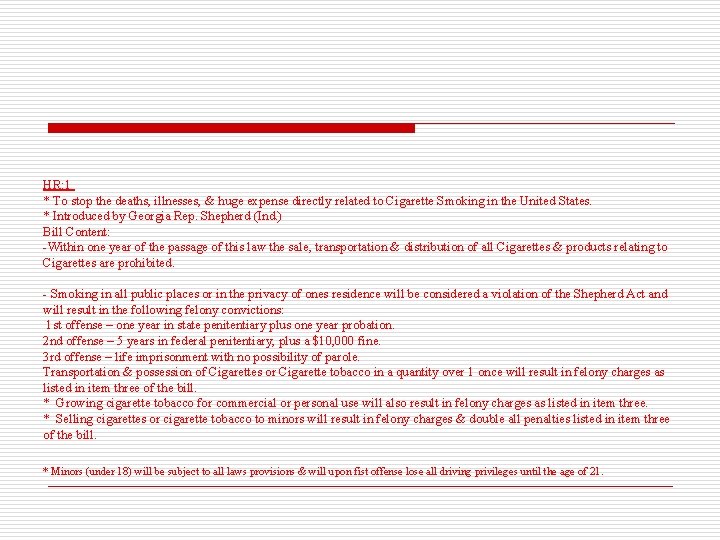
HR: 1 * To stop the deaths, illnesses, & huge expense directly related to Cigarette Smoking in the United States. * Introduced by Georgia Rep. Shepherd (Ind. ) Bill Content: -Within one year of the passage of this law the sale, transportation & distribution of all Cigarettes & products relating to Cigarettes are prohibited. - Smoking in all public places or in the privacy of ones residence will be considered a violation of the Shepherd Act and will result in the following felony convictions: 1 st offense – one year in state penitentiary plus one year probation. 2 nd offense – 5 years in federal penitentiary, plus a $10, 000 fine. 3 rd offense – life imprisonment with no possibility of parole. Transportation & possession of Cigarettes or Cigarette tobacco in a quantity over 1 once will result in felony charges as listed in item three of the bill. * Growing cigarette tobacco for commercial or personal use will also result in felony charges as listed in item three. * Selling cigarettes or cigarette tobacco to minors will result in felony charges & double all penalties listed in item three of the bill. * Minors (under 18) will be subject to all laws provisions & will upon fist offense lose all driving privileges until the age of 21.

Bill In Committee: 3 Options o Option 1 – Report Bill favorably -“do pass” recommendation (We like it, pass it) o Option 2 – Kill it by refusing to act on it (“pigeonhole”) or by majority vote (Bill dies). o Option 3 – Markup or Amend Bill from its original version & then report the new version bill.
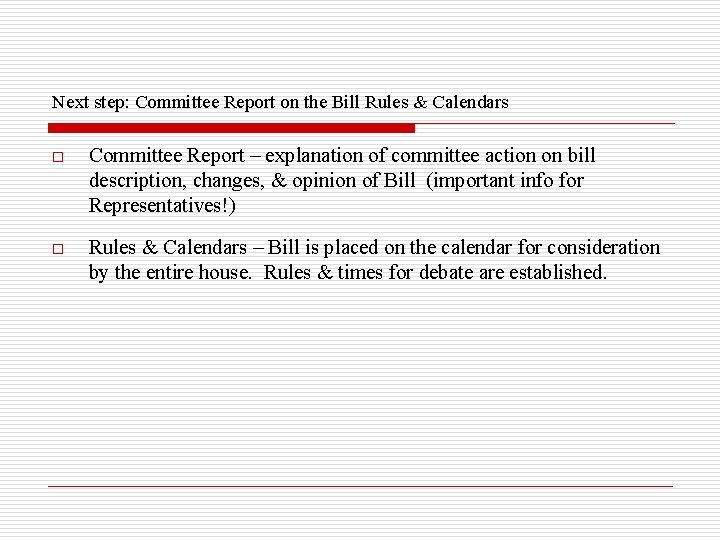
Next step: Committee Report on the Bill Rules & Calendars o Committee Report – explanation of committee action on bill description, changes, & opinion of Bill (important info for Representatives!) o Rules & Calendars – Bill is placed on the calendar for consideration by the entire house. Rules & times for debate are established.
Bill on the Floor of the House o o o Quorum must be present (majority-218) Debate & amendments – Reps may speak for or against Bill & add changes to bill. Voting – if passed with a majority, Bill is off to the Senate.
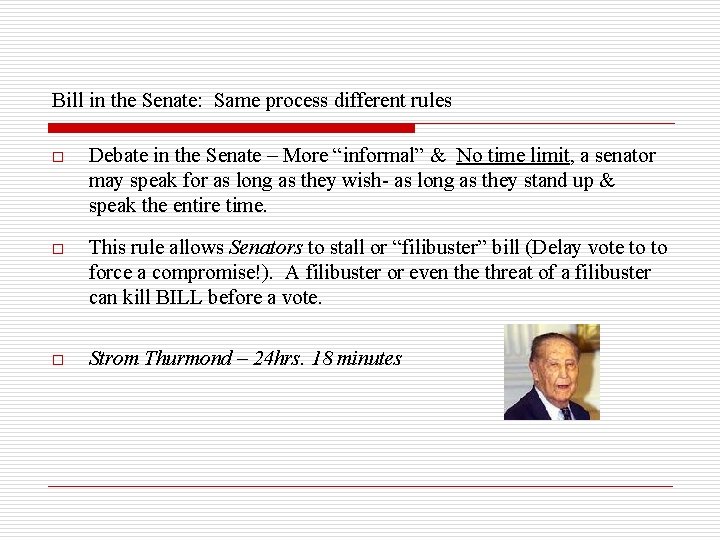
Bill in the Senate: Same process different rules o Debate in the Senate – More “informal” & No time limit, a senator may speak for as long as they wish- as long as they stand up & speak the entire time. o This rule allows Senators to stall or “filibuster” bill (Delay vote to to force a compromise!). A filibuster or even the threat of a filibuster can kill BILL before a vote. o Strom Thurmond – 24 hrs. 18 minutes
Senate: The Cloture Rule o To avoid a filibuster, a 3/5 th vote of the Senate (60 votes) can invoke the cloture rule which limits debate on a given bill. o If Cloture is passed, Bill is Debated & voted on. If Bill passes…….

Final Stages o Conference Committee – If Bill passes in both House & the Senate, both houses must meet in a joint committee (H & S members) to work out differences changing Bill. o Since bill was changed by the Conference Committee, BILL must go back to both House & Senate, where it is voted on again. • Bill must pass in identical form in both Senate & the House before it goes to the President.
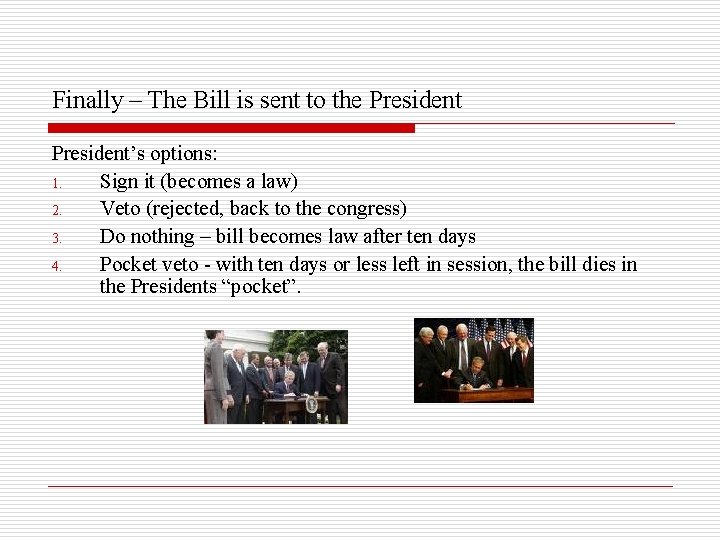
Finally – The Bill is sent to the President’s options: 1. Sign it (becomes a law) 2. Veto (rejected, back to the congress) 3. Do nothing – bill becomes law after ten days 4. Pocket veto - with ten days or less left in session, the bill dies in the Presidents “pocket”.
Veto Override o If the president vetoes a bill, the Congress may pass Bill anyway with a 2/3 rd vote in House (290) & Senate (67). o Bill is finally a LAW!
- Slides: 11