
Journal Entry 5118 How many paragraphs should your
- Slides: 18
Journal Entry 5/1/18 • How many paragraphs should your essay be? • What are the basic components of an essay?
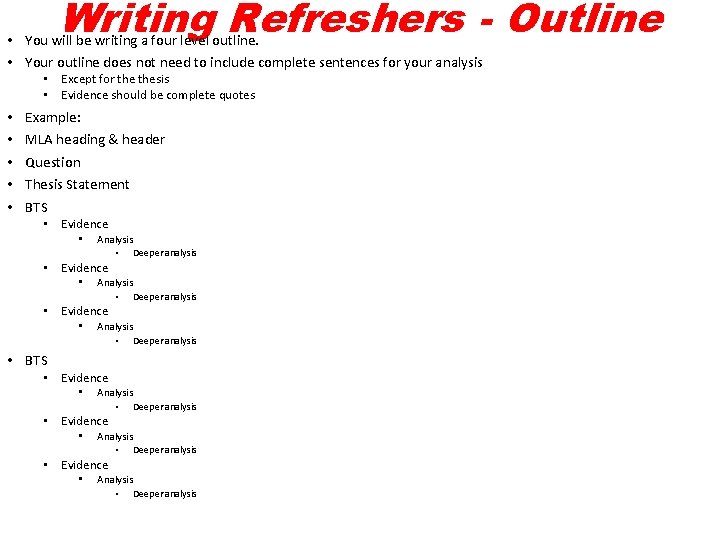
Writing Refreshers - Outline • You will be writing a four level outline. • Your outline does not need to include complete sentences for your analysis • Except for thesis • Evidence should be complete quotes • • • Example: MLA heading & header Question Thesis Statement BTS • Evidence • Analysis • Deeper analysis • BTS • Evidence • Analysis • Deeper analysis
Writing Refreshers - Introduction • What goes into an introduction in an essay? • Hook – quote that pertains to your essay or can be explained as part of your essay • Some contextual/background information • Enough for your reader to understand your thesis • Thesis – Should be the last sentence of the introduction. • If it isn’t your last sentence in your introduction you will be graded a zero for thesis.
Journal 10/23/18 • What should go in a conclusion?
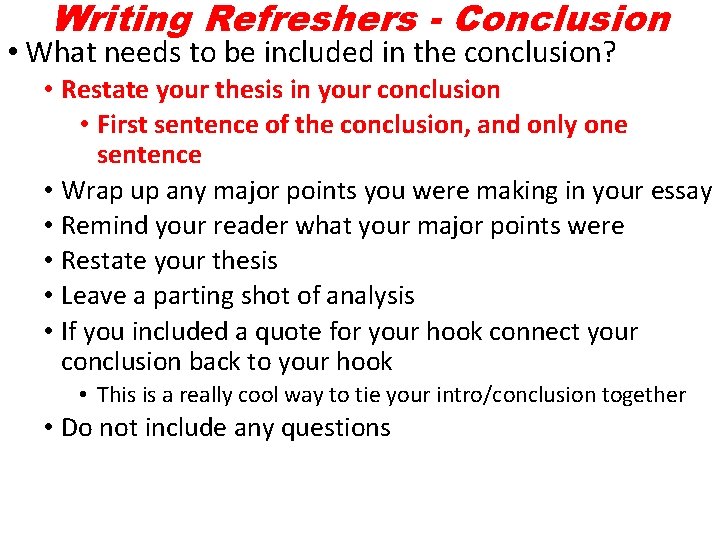
Writing Refreshers - Conclusion • What needs to be included in the conclusion? • Restate your thesis in your conclusion • First sentence of the conclusion, and only one sentence • Wrap up any major points you were making in your essay • Remind your reader what your major points were • Restate your thesis • Leave a parting shot of analysis • If you included a quote for your hook connect your conclusion back to your hook • This is a really cool way to tie your intro/conclusion together • Do not include any questions
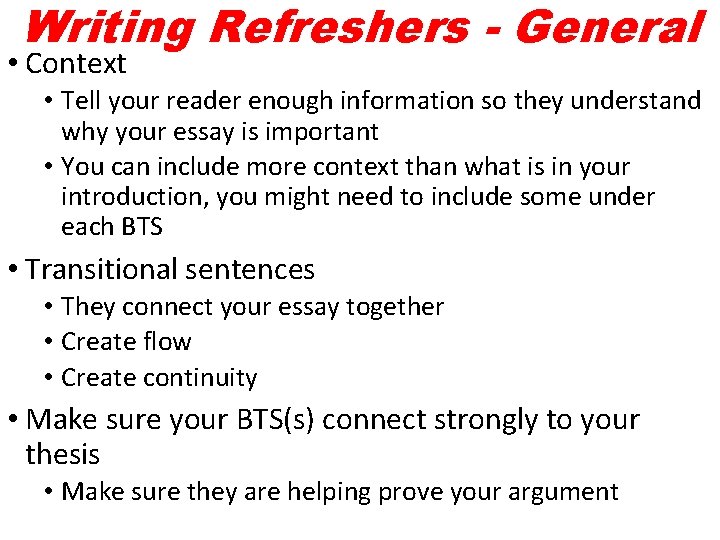
Writing Refreshers - General • Context • Tell your reader enough information so they understand why your essay is important • You can include more context than what is in your introduction, you might need to include some under each BTS • Transitional sentences • They connect your essay together • Create flow • Create continuity • Make sure your BTS(s) connect strongly to your thesis • Make sure they are helping prove your argument
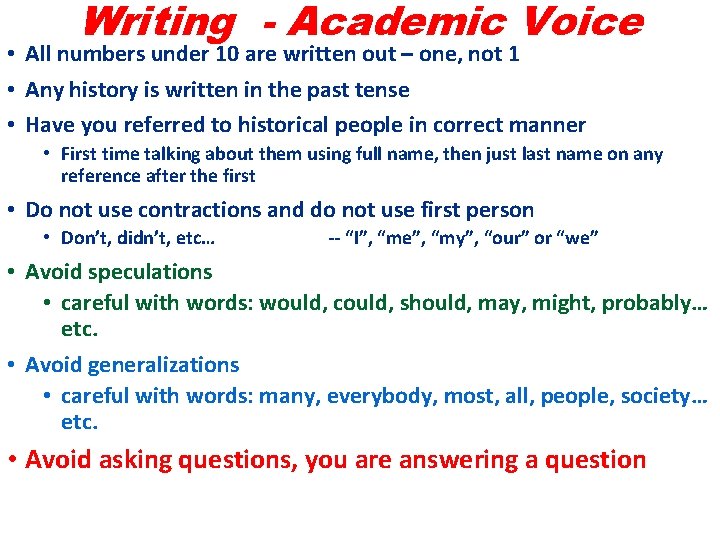
Writing - Academic Voice • All numbers under 10 are written out – one, not 1 • Any history is written in the past tense • Have you referred to historical people in correct manner • First time talking about them using full name, then just last name on any reference after the first • Do not use contractions and do not use first person • Don’t, didn’t, etc… -- “I”, “me”, “my”, “our” or “we” • Avoid speculations • careful with words: would, could, should, may, might, probably… etc. • Avoid generalizations • careful with words: many, everybody, most, all, people, society… etc. • Avoid asking questions, you are answering a question
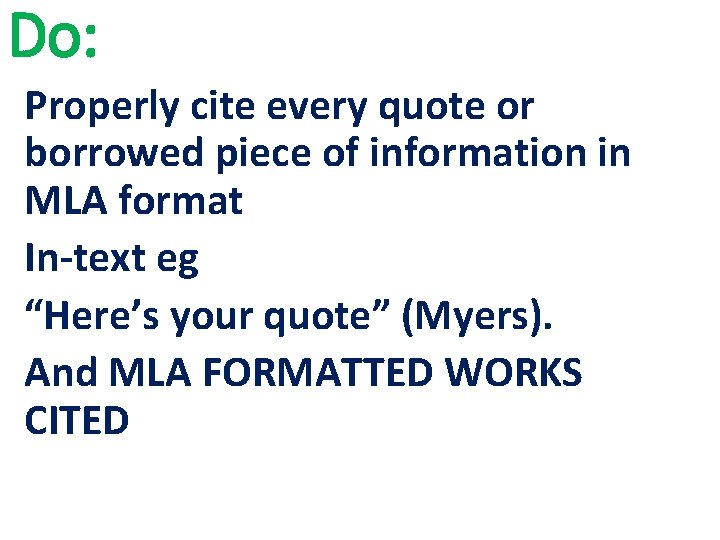
Do: Properly cite every quote or borrowed piece of information in MLA format In-text eg “Here’s your quote” (Myers). And MLA FORMATTED WORKS CITED
Don’t: Float quotes without context or connections
Do: Introduce quotes to fluidly provide readability for your reader
Do Not: Use contractions or non-academic language This includes first person statements. Do not say “I” in your paper.
Do: Use strong, organized academic language in you paper to effectively prove your thesis
Don’t: Leave evidence without analysis, or force your reader to make connections
Do: Provide direct, accurate analysis for your evidence to connect it back to the overall prompt
Don’t: Start your conclusion with: In conclusion All in all To sum it up
Do: Include a creative, restated thesis in your conclusion Summarize your overall argument End with a parting shot of analysis to drive your point home
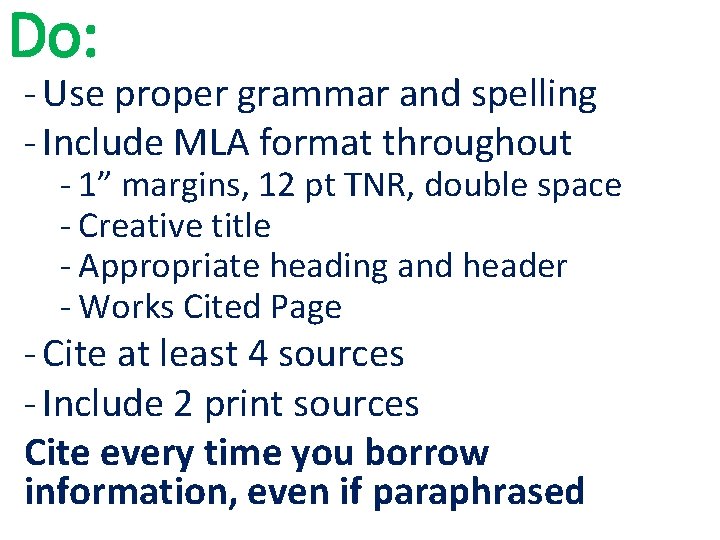
Do: - Use proper grammar and spelling - Include MLA format throughout - 1” margins, 12 pt TNR, double space - Creative title - Appropriate heading and header - Works Cited Page - Cite at least 4 sources - Include 2 print sources Cite every time you borrow information, even if paraphrased
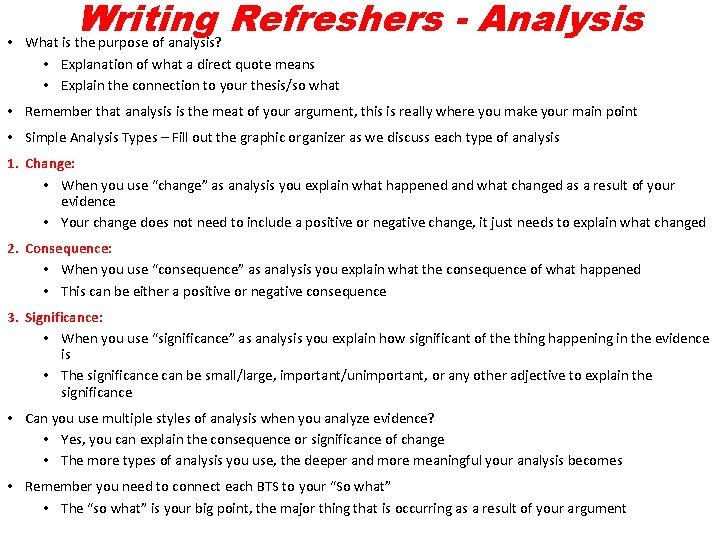
Writing Refreshers - Analysis • What is the purpose of analysis? • Explanation of what a direct quote means • Explain the connection to your thesis/so what • Remember that analysis is the meat of your argument, this is really where you make your main point • Simple Analysis Types – Fill out the graphic organizer as we discuss each type of analysis 1. Change: • When you use “change” as analysis you explain what happened and what changed as a result of your evidence • Your change does not need to include a positive or negative change, it just needs to explain what changed 2. Consequence: • When you use “consequence” as analysis you explain what the consequence of what happened • This can be either a positive or negative consequence 3. Significance: • When you use “significance” as analysis you explain how significant of the thing happening in the evidence is • The significance can be small/large, important/unimportant, or any other adjective to explain the significance • Can you use multiple styles of analysis when you analyze evidence? • Yes, you can explain the consequence or significance of change • The more types of analysis you use, the deeper and more meaningful your analysis becomes • Remember you need to connect each BTS to your “So what” • The “so what” is your big point, the major thing that is occurring as a result of your argument