
Journal Club Non invasive cardiac output monitoring JAMES

Journal Club- Non invasive cardiac output monitoring JAMES MASTERS ST 3
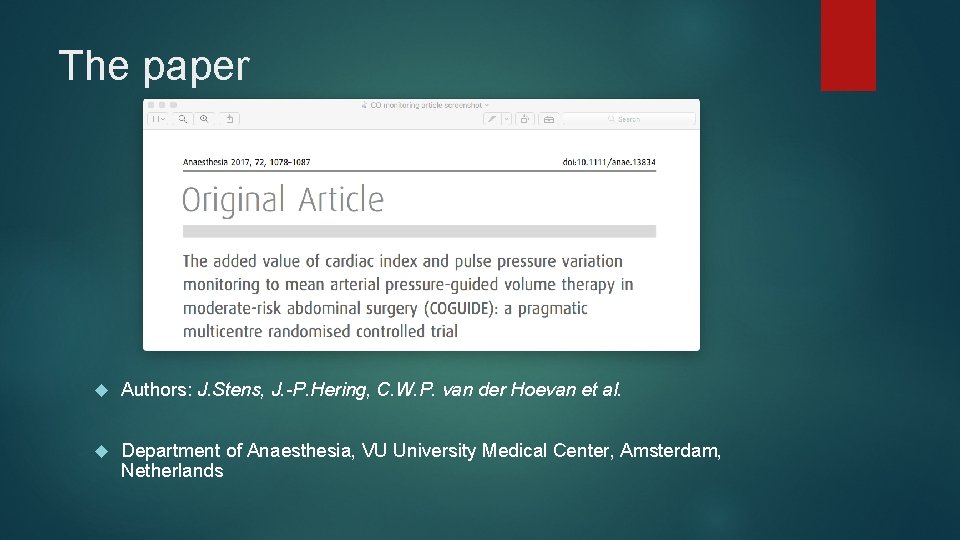
The paper Authors: J. Stens, J. -P. Hering, C. W. P. van der Hoevan et al. Department of Anaesthesia, VU University Medical Center, Amsterdam, Netherlands
Why this paper? Current Controversy regarding intra—op cardiac output (CO) monitoring NICE recommend Cardio. Q (oesophageal doppler) for high risk surgery (2) Is there something better and less invasive out there? Personal interest
Background Intra-op CO monitoring allows for goal directed therapy Improved outcomes BUT Most ACCURATE CO monitors highly invasive Most simple random number generators AND Does it make a difference anyway?
Background Interest in non-invasive arterial BP and CO measurement. Various devices available NEXFIN Non-Invasive finger cuff Measures blood flow in and out of finger- volume clamp method Generates Continuous NIBP recording Mathematic analysis of waveform gives PPV and CI

NEXFIN Monitor
Background Hypothesis: using NEXFIN device could guide fluid/inotropic therapy and reduce post op complications
Methods 4 tertiary hospitals in Netherlands Jan 2012 -Nov 2013 Patients undergoing ’moderate risk surgery’- Modified John Hopkins Surgical criteria grade 2 Patients randomised to one of two groups: MAP only group MAP plus pulse pressure variation/ cardiac index (PPV/CI) group
Methods PPV/ CI measured using NEXFIN device MAP measured by arterial line? Instruction to anaesthetists: MAP only group- MAP > 70 mm. HG MAP plus PPV/CI group - MAP > 70 mm. HG, PPV < 12% and CI > 2. 5 l/min
Results 244 randomised 175 Included in final analysis MAP only group = 94 patients MAP plus PPV/CI group = 81 patients Others excluded for: lack of nexfin availability, loss to follow up, high risk procedure
Results No significant difference in post op complications No significant difference in fluid administration (1756 mls vs 1857 mls) Patients in MAP plus PPV/CI group received more inotrope (78% vs 35%) Patients in MAP plus PPV/CI group received more vasopressor (64% vs 35%)

How good was the study? Solid design Multi-center RCT Tried to answer a reasonable question Small numbers Very broad surgical population Wide discrepancy in patient co-morbidities ? Conflict of interest- NEXFIN developed in Amsterdam
Discussion Theoretically great idea Ultimately, what we already knew Make no difference NEXFIN inaccurate- up to 30 mm. Hg (2) Probably applies to all CO except pulm. catheters Number chasing- MAP plus PPV/CI group received significantly more in way of dobutamine/noradrenaline MAP > 70 mm. Hg?
Impact on practice General rule avoid non-invasive CO monitoring If using CO monitoring, only as supplement to clinical judgement Treat patient not numbers

Questions? Many thanks

References 1. J stens. J. -P. Hering, C. W. P. van der hoeven et al. The added value of cardiac index and pulse pressure variation monitoring to mean arterial pressure guided volume therapy in moderate-risk abdominal surgery (COGUIDE): a pragmatic multicenter randomised controlled trial. Anaesthesia 2017, 72, 1078 -1087. 2. https: //www. nice. org. uk/guidance/mtg 3 3. A. Hohn J. M. Defosse S. Becker C. Steffen F. Wappler S. G. Sakka Non-invasive continuous arterial pressure monitoring with Nexfin® does not sufficiently replace invasive measurements in critically ill patients BJA: British Journal of Anaesthesia, Volume 111, Issue 2, 1 August 2013, Pages 178– 184, https: //doi. org/10. 1093/bja/aet 023
- Slides: 16