
JOURNAL CLUB Barbara Labban M D Complement System

JOURNAL CLUB Barbara Labban, M. D.


Complement System n - - Crucial component of the innate immune system. Host defense Clearance of immune complexes and dying cells Adjuvant role in immune response

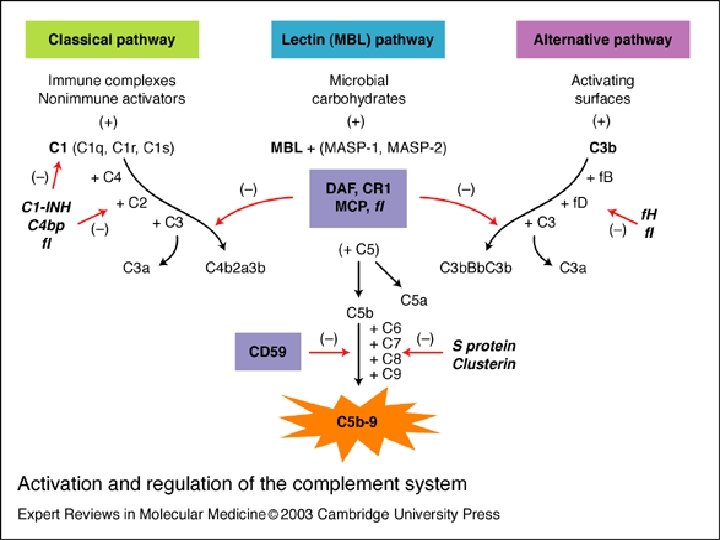
Classical Pathway Immune Complexes Non- Immune Complexes (-) C 1 -INH C 4 bp (-) C 4 f. I C 4 b C 1 Endotoxin C 3 f. D C 3 b Lectin Pathway C 2 C 3 b. Bb (C 3 Convertase) C 2 a C 4 b 2 a (C 3 Convertase) C 3 Alternative Pathway C 3 b C 4 b 2 a 3 b (C 5 Convertase) C 3 b. Bb 3 b (C 5 Convertase) C 5 b +C 6 +C 7 +C 8 +C 9 C 5 b-9 (MAC) Factor B Properdin C 3

Classical Pathway Activation Ab-Independent Ab-dependent Ag-Ig. M, Ag-Ig. G complexes + polyanions, protamine, DNA, RNA of apoptotic cells, G- Bacteria, CRP C 1 (-) + C 4 + C 2 C 1 -INH (-) + C 3 C 4 b 2 a 3 b
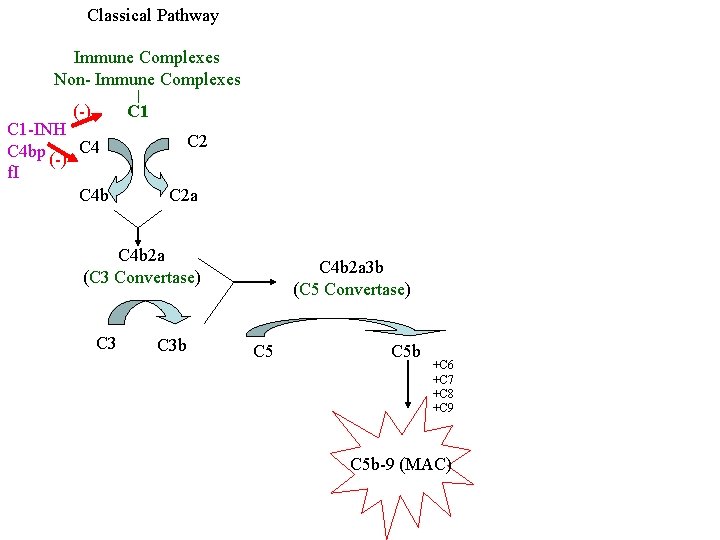
Classical Pathway Immune Complexes Non- Immune Complexes (-) C 1 -INH C 4 bp (-) C 4 f. I C 4 b C 1 C 2 a C 4 b 2 a (C 3 Convertase) C 3 b C 4 b 2 a 3 b (C 5 Convertase) C 5 b +C 6 +C 7 +C 8 +C 9 C 5 b-9 (MAC)
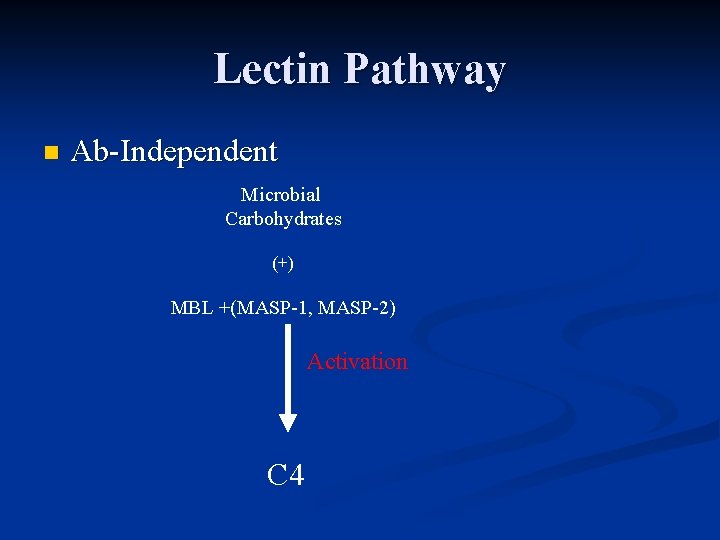
Lectin Pathway n Ab-Independent Microbial Carbohydrates (+) MBL +(MASP-1, MASP-2) Activation C 4
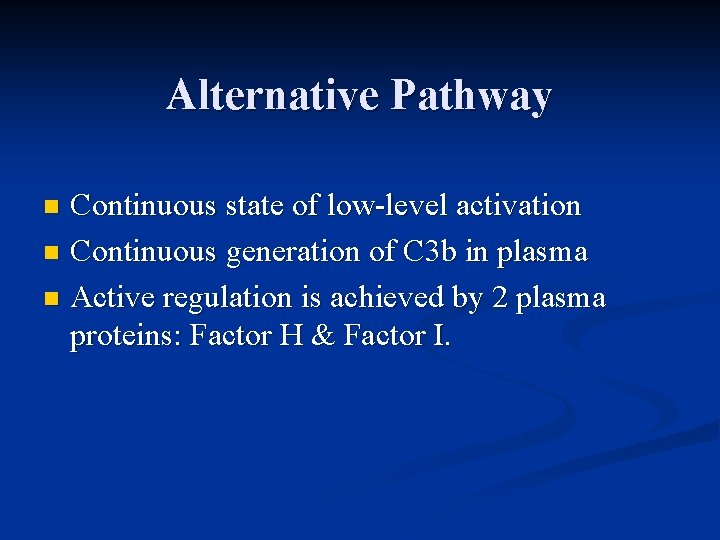
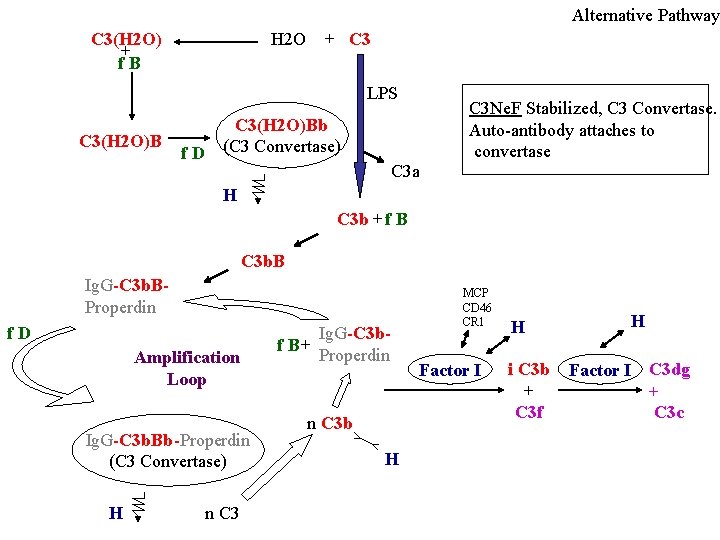
Alternative Pathway Continuous state of low-level activation n Continuous generation of C 3 b in plasma n Active regulation is achieved by 2 plasma proteins: Factor H & Factor I. n
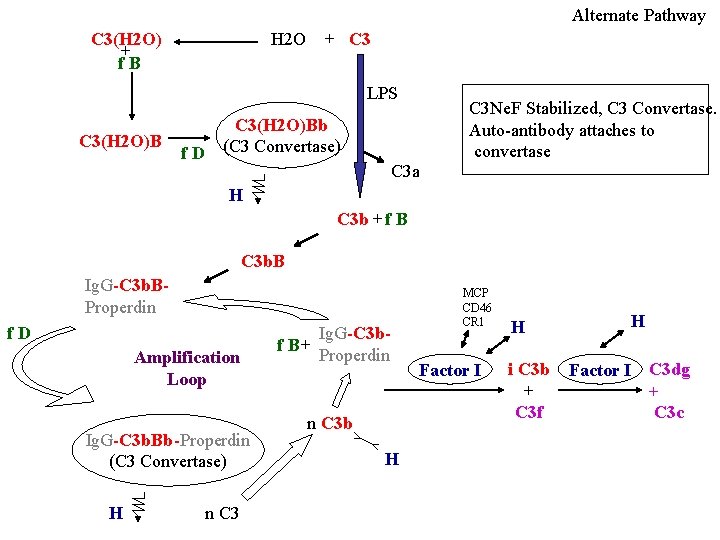
Alternate Pathway C 3(H 2 O) + f. B H 2 O + C 3 LPS C 3(H 2 O)B f. D C 3(H 2 O)Bb (C 3 Convertase) C 3 a C 3 Ne. F Stabilized, C 3 Convertase. Auto-antibody attaches to convertase H C 3 b + f B C 3 b. B Ig. G-C 3 b. BProperdin f. D Amplification Loop Ig. G-C 3 b. Bb-Properdin (C 3 Convertase) H n C 3 Ig. G-C 3 bf B+ Properdin n C 3 b H MCP CD 46 CR 1 Factor I H H i C 3 b + C 3 f Factor I C 3 dg + C 3 c
Factor H Single chain glycoprotein. Produced by the liver. n Composed of 20 Short Consensus Repeat (SCR) domains. n Each SCR composed of 60 amino-acids. n N-terminal SCR domains: Regulation of fluidphase C 3 activation. n C-terminal domains: Regulation of surface bound C 3 b (surface recognition function, depends on the chemical composition of the surface). n
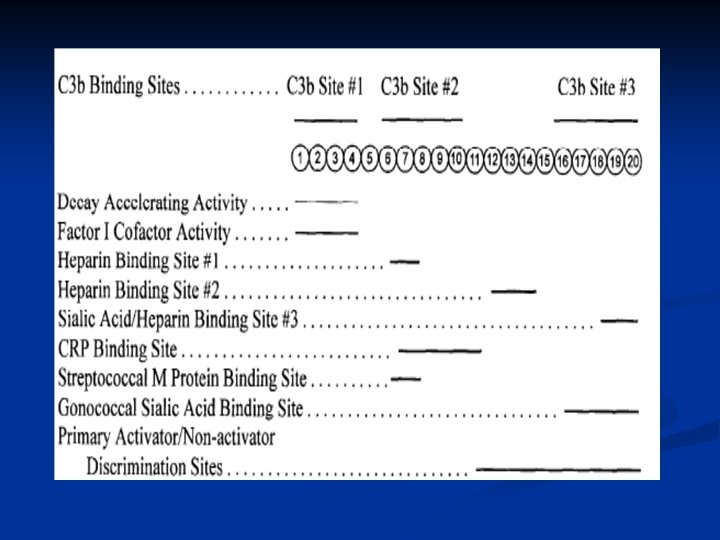
Factor H - Regulates the alternative Pathway : n Inhibits the formation of the C 3 Convertases of the alternative pathway by binding to C 3 b n Promotes dissociation of the C 3 Convertases (Decay acceleration activity) n Cofactor to Factor I- mediated proteolytic conversion of C 3 b to inactive C 3 b (i C 3 b). - Deficiency of Factor H Uncontrolled alternative pathway activation with secondary depletion of C 3, Factor B and properdin.
Factor H and Renal Disease Factor H gene mutation is associated with MPGN type II and atypical HUS. n Mutations located in the C terminal a. HUS. Rarely result in low complement or low Factor H plasma levels. n Mutations located in the N- terminal (complement regulatory domains) or complete factor H deficiency MPGN 2. n - Caprioli et al. The molecular basis of familial hemolytic uremic syndrome: mutation analysis of factor H gene reveals a hot spot in short consensus repeat 20. J Am Soc Nephrol 2001; 12: 297 -307 - Licht C. , et al. Deletion of Lys 224 in regulatory domain 4 of Factor H reveals a novel pathomechanism for dense deposit disease (MPGN II). Kidney Int. 2006; 70: 42– 50)
MPGN type II (Dense Deposit Disease) MPGN II: intramembranous electron-dense material along the GBM n Positive staining for C 3, C 5 & C 9. n Cleavage fragments of C 3 b such as C 3 c and C 3 dg are found in the plasma of patients with MPGN 2. n Complete Factor H deficiency in humans, pigs & mice results in uncontrolled Alternative pathway activation leading to MPGN 2. n Appel et al. Membranoproliferative Glomerulonephritis Type II (Dense Deposit Disease) An update. J Am Soc Nephrol 16: 1392 -1404, 2005. doi: 10. 1681
MPGN type II (Dense Deposit Disease) n Case Report: Patient with Autoantibody to factor H MPGN 2 Meri S. et al. Activation of the alternative pathway of complement by monoclonal lambda light chains in membranoproliferative glomerulonephritis. J. Exp. Med. 1992; 175: 939– 950) n Case Report: Mutation of factor H complement regulatory domains MPGN 2 Licht C. , et al. Deletion of Lys 224 in regulatory domain 4 of Factor H reveals a novel pathomechanism for dense deposit disease (MPGN II). Kidney Int. 2006; 70: 42– 50)
Hogasen et al studied 13 piglets affected by MPGN type II to investigate the cause of complement activation. n Plasma transfusion resulted in - increase in C 3 levels - increase in median and maximum survival ( 82 and 375 d vs 37 and 72 d) - MPGN was less proliferative compared to untreated pigs n Conclusion: The deficient regulatory protein was present in plasma. n Hogasen et al. Hereditary porcine membranoproliferative glomeulonephritis type II is caused by Factor H deficiency. The American Society for Clinical Investigation. Vol 95, March 1995, 1054 -1061
Fractionation of normal plasma, and administration of single proteins with monitoring of the C inhibitory activity in vivo n Conclusion: Inhibitory activity is confined to one single protein. - 150 k. Da - Cofactor to factor I in vitro - NH 2 -terminal amino acid sequence was homologous with human, murine and rabbit FH n Hogasen et al. Hereditary porcine membranoproliferative glomerulonephritis type II is caused by Factor H deficiency. The American Society for Clinical Investigation. Vol 95, March 1995, 1054 -1061
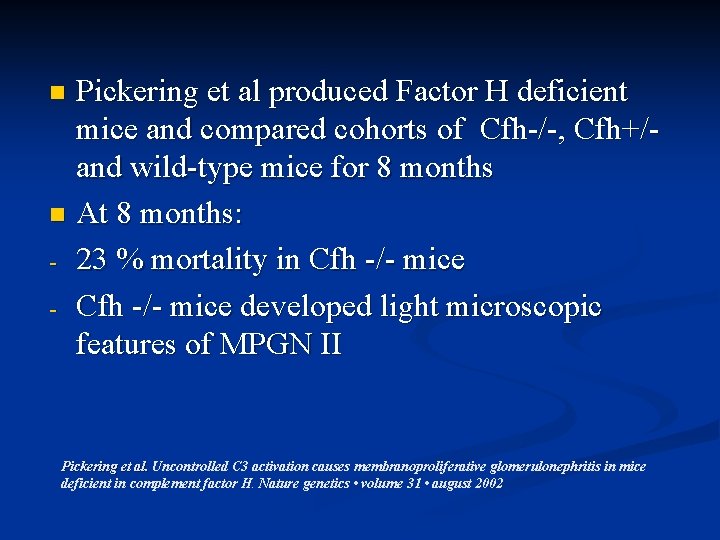
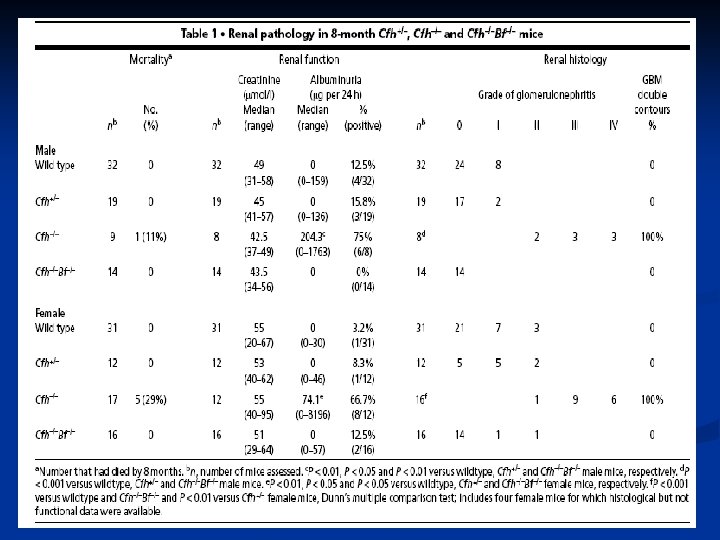
Pickering et al produced Factor H deficient mice and compared cohorts of Cfh-/-, Cfh+/and wild-type mice for 8 months n At 8 months: - 23 % mortality in Cfh -/- mice - Cfh -/- mice developed light microscopic features of MPGN II n Pickering et al. Uncontrolled C 3 activation causes membranoproliferative glomerulonephritis in mice deficient in complement factor H. Nature genetics • volume 31 • august 2002
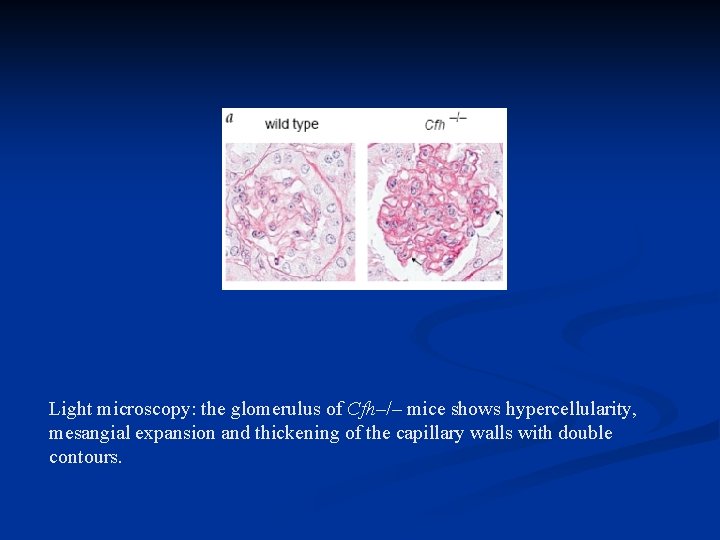
Light microscopy: the glomerulus of Cfh–/– mice shows hypercellularity, mesangial expansion and thickening of the capillary walls with double contours.
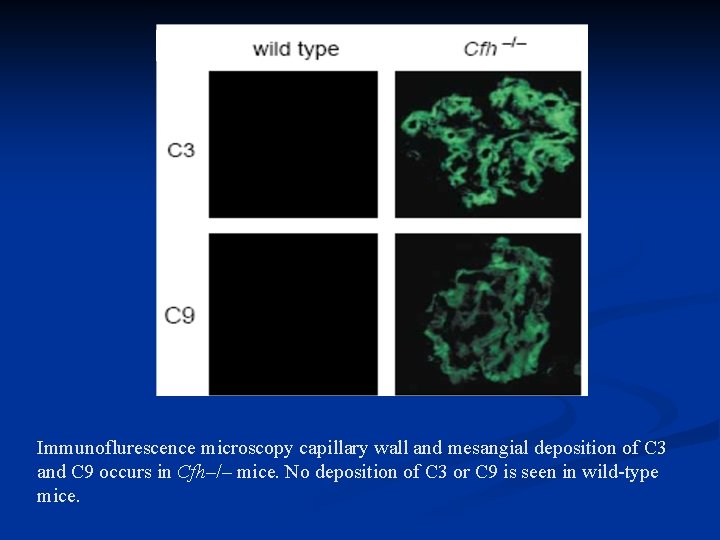
Immunoflurescence microscopy capillary wall and mesangial deposition of C 3 and C 9 occurs in Cfh–/– mice. No deposition of C 3 or C 9 is seen in wild-type mice.
Glomerular C 3 deposition preceded the appearance of GBM dense deposit which preceded the histological light microscopic appearance of MPGN. n MPGN II was totally dependent on C 3 activation. n Generation of mice deficient in factors H and factor B prevented C 3 activation and prevented the development of MPGN n
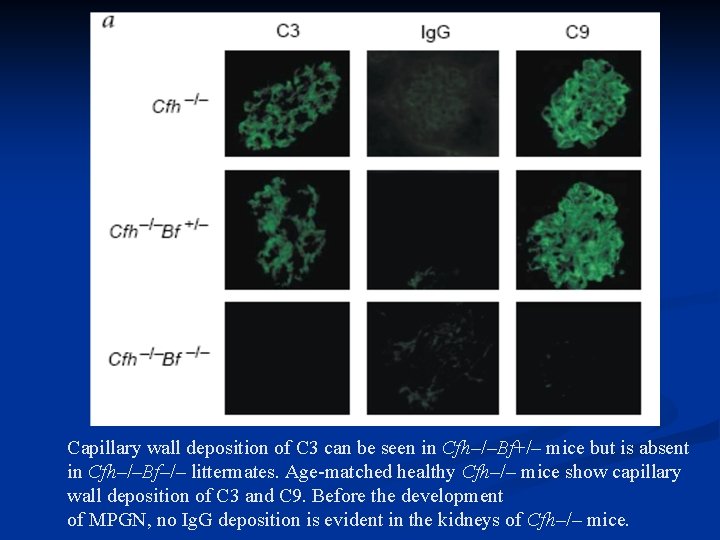
Capillary wall deposition of C 3 can be seen in Cfh–/–Bf+/– mice but is absent in Cfh–/–Bf–/– littermates. Age-matched healthy Cfh–/– mice show capillary wall deposition of C 3 and C 9. Before the development of MPGN, no Ig. G deposition is evident in the kidneys of Cfh–/– mice.
In another study, Pickering et al. prevented C 5 activation by crossing factor H- deficient mice with C 5 deficient animals. n No prevention in the development of the GBM deposits. n Reduction in glomerular cellularity, serum creatinine levels and mortality. n Pickering et al. Prevention of C 5 activation ameliorates spontaneous and experimental glomerulonephritis in factor H-deficient mice. Proc Natl Acad Sci U S A. 2006 June 20; 103(25): 9649– 9654.
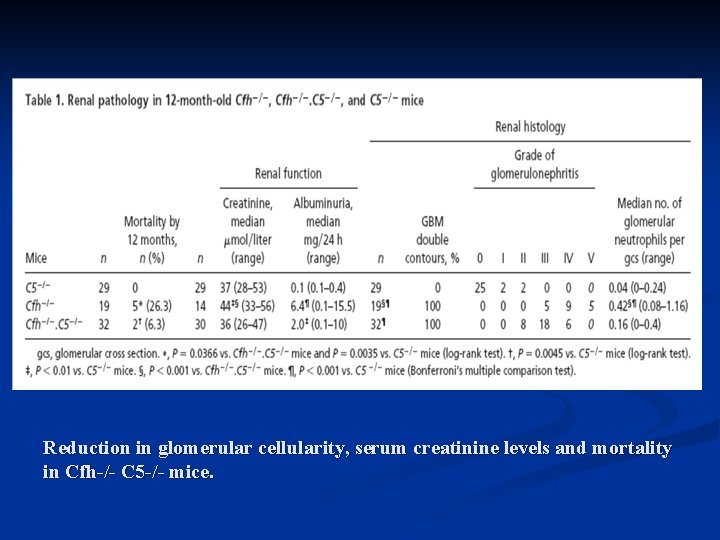
Reduction in glomerular cellularity, serum creatinine levels and mortality in Cfh-/- C 5 -/- mice.
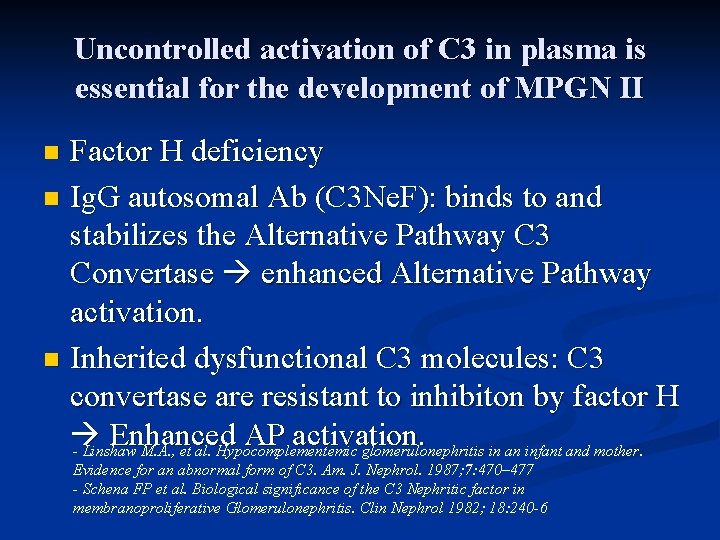
Uncontrolled activation of C 3 in plasma is essential for the development of MPGN II Factor H deficiency n Ig. G autosomal Ab (C 3 Ne. F): binds to and stabilizes the Alternative Pathway C 3 Convertase enhanced Alternative Pathway activation. n Inherited dysfunctional C 3 molecules: C 3 convertase are resistant to inhibiton by factor H Enhanced AP activation. - Linshaw M. A. , et al. Hypocomplementemic glomerulonephritis in an infant and mother. n Evidence for an abnormal form of C 3. Am. J. Nephrol. 1987; 7: 470– 477 - Schena FP et al. Biological significance of the C 3 Nephritic factor in membranoproliferative Glomerulonephritis. Clin Nephrol 1982; 18: 240 -6
Alternative Pathway C 3(H 2 O) + f. B H 2 O + C 3 LPS C 3(H 2 O)B f. D C 3(H 2 O)Bb (C 3 Convertase) C 3 a C 3 Ne. F Stabilized, C 3 Convertase. Auto-antibody attaches to convertase H C 3 b + f B C 3 b. B Ig. G-C 3 b. BProperdin f. D Amplification Loop Ig. G-C 3 b. Bb-Properdin (C 3 Convertase) H n C 3 Ig. G-C 3 bf B+ Properdin n C 3 b H MCP CD 46 CR 1 Factor I H H i C 3 b + C 3 f Factor I C 3 dg + C 3 c
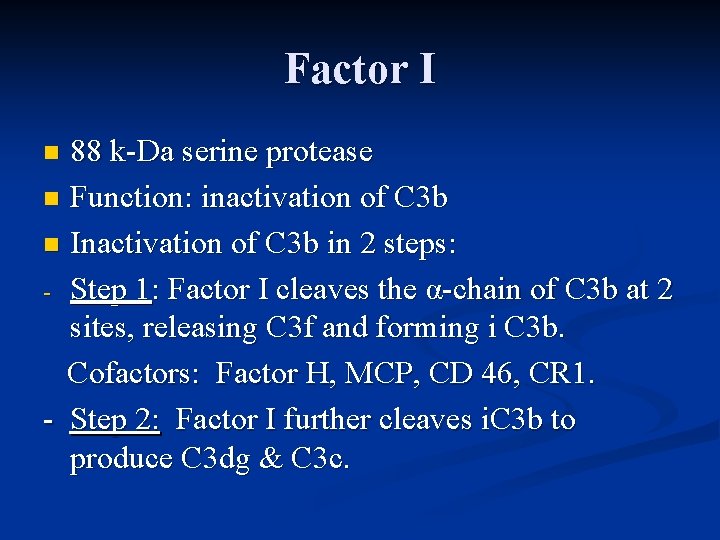
Factor I 88 k-Da serine protease n Function: inactivation of C 3 b n Inactivation of C 3 b in 2 steps: - Step 1: Factor I cleaves the α-chain of C 3 b at 2 sites, releasing C 3 f and forming i C 3 b. Cofactors: Factor H, MCP, CD 46, CR 1. - Step 2: Factor I further cleaves i. C 3 b to produce C 3 dg & C 3 c. n
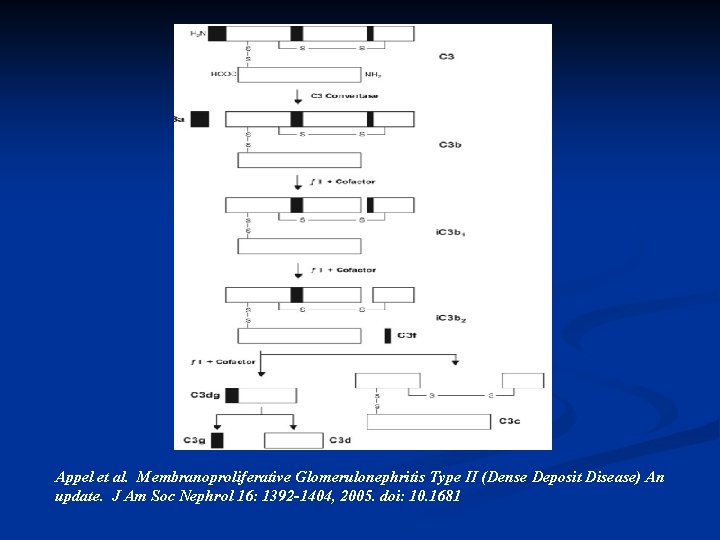
Appel et al. Membranoproliferative Glomerulonephritis Type II (Dense Deposit Disease) An update. J Am Soc Nephrol 16: 1392 -1404, 2005. doi: 10. 1681
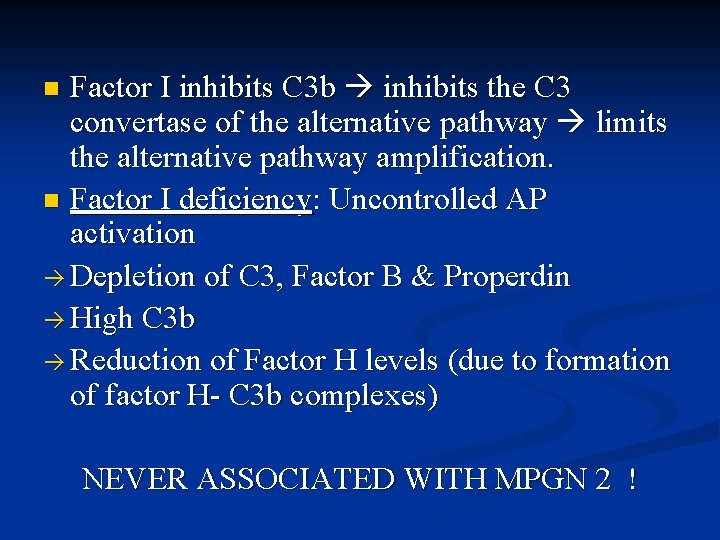
Factor I inhibits C 3 b inhibits the C 3 convertase of the alternative pathway limits the alternative pathway amplification. n Factor I deficiency: Uncontrolled AP activation Depletion of C 3, Factor B & Properdin High C 3 b Reduction of Factor H levels (due to formation of factor H- C 3 b complexes) n NEVER ASSOCIATED WITH MPGN 2 !
Study Purpose - MPGN 2 has never been reported in individuals with Factor I deficiency n To determine why uncontrolled C 3 activation in the context of factor I deficiency does not result in MPGN II.
n Cf i -/- mice were produced (disrupted the gene encoding factor I, by deleting exon 4 of the Cfi gene with a gene-targeting replacement vector).
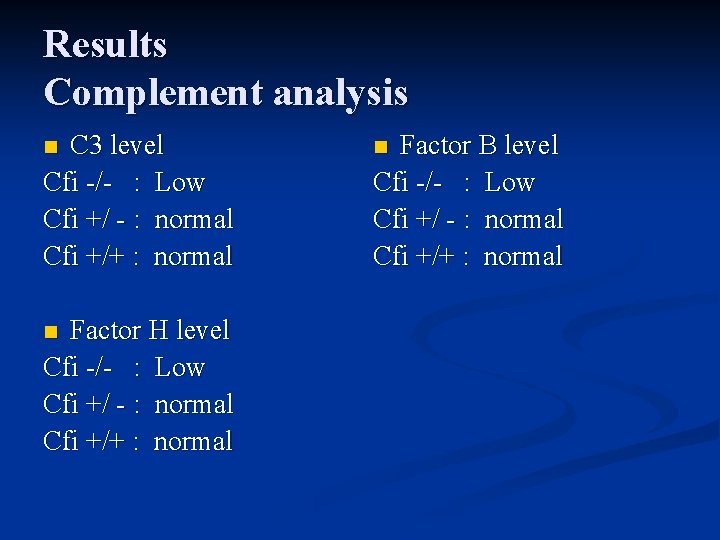
Results Complement analysis C 3 level Cfi -/- : Low Cfi +/ - : normal Cfi +/+ : normal n Factor H level Cfi -/- : Low Cfi +/ - : normal Cfi +/+ : normal n Factor B level Cfi -/- : Low Cfi +/ - : normal Cfi +/+ : normal n
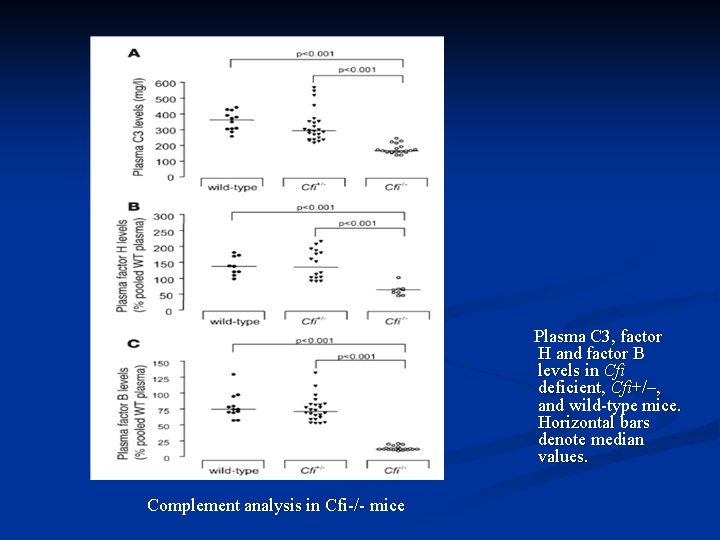
Plasma C 3, factor H and factor B levels in Cfi deficient, Cfi+/–, and wild-type mice. Horizontal bars denote median values. Complement analysis in Cfi-/- mice
Western blot to determine the nature of plasma C 3: C 3 α chain 115 k. Da C 3 b α’ chain 110 k. Da ß chain 55 -60 k. Da n Cfi -/- : HMW bands ( aggregates of C 3 b) present C 3 c not detectable n Cfi +/+: HMW bands ( aggregates of C 3 b) absent C 3 c Detectable
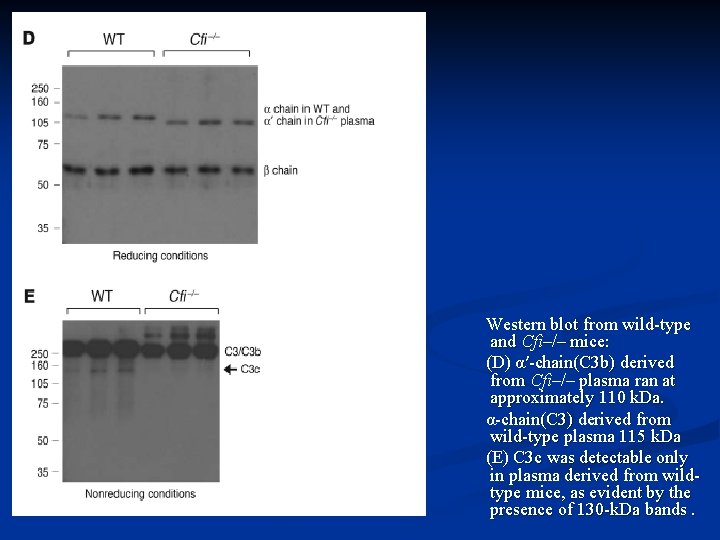
Western blot from wild-type and Cfi–/– mice: (D) α′-chain(C 3 b) derived from Cfi–/– plasma ran at approximately 110 k. Da. α-chain(C 3) derived from wild-type plasma 115 k. Da (E) C 3 c was detectable only in plasma derived from wildtype mice, as evident by the presence of 130 -k. Da bands.
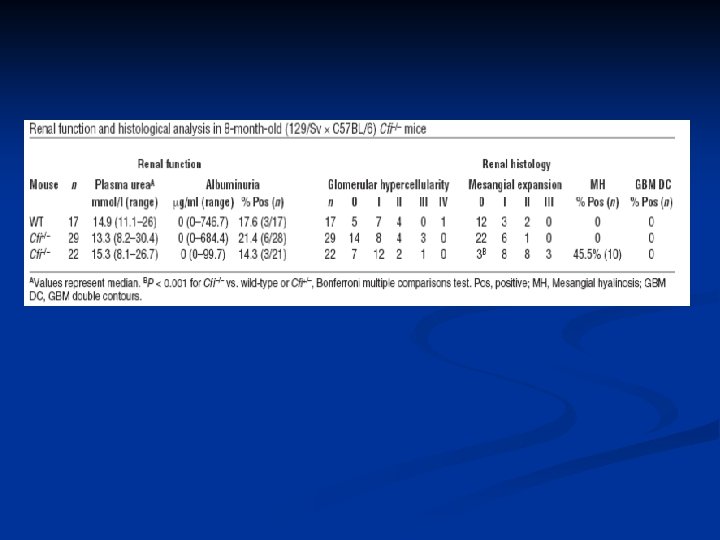
MPGN 2 development n n Monitored cohorts of wild type, Cfi+/- and Cfi-/- mice over an 8 month period at which time all were sacrificied and renal function and histology assessed. No difference in plasma urea levels or albuminuria No difference in glomerular hypercellularity. No capillary wall double contour. More mesangial expansion and deposition of nodular hyaline material.
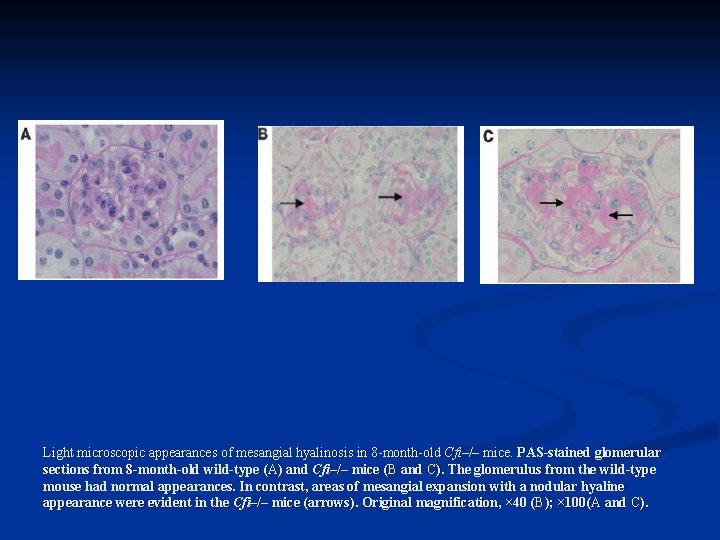
Light microscopic appearances of mesangial hyalinosis in 8 -month-old Cfi–/– mice. PAS-stained glomerular sections from 8 -month-old wild-type (A) and Cfi–/– mice (B and C). The glomerulus from the wild-type mouse had normal appearances. In contrast, areas of mesangial expansion with a nodular hyaline appearance were evident in the Cfi–/– mice (arrows). Original magnification, × 40 (B); × 100(A and C).
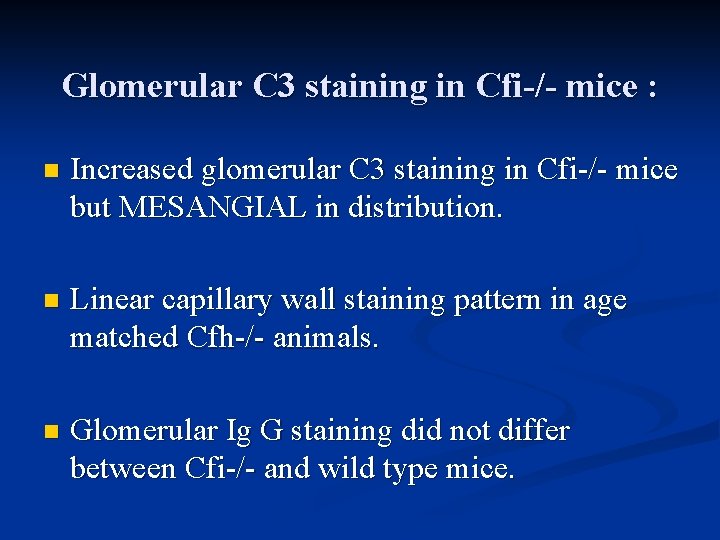
Glomerular C 3 staining in Cfi-/- mice : n Increased glomerular C 3 staining in Cfi-/- mice but MESANGIAL in distribution. n Linear capillary wall staining pattern in age matched Cfh-/- animals. n Glomerular Ig G staining did not differ between Cfi-/- and wild type mice.
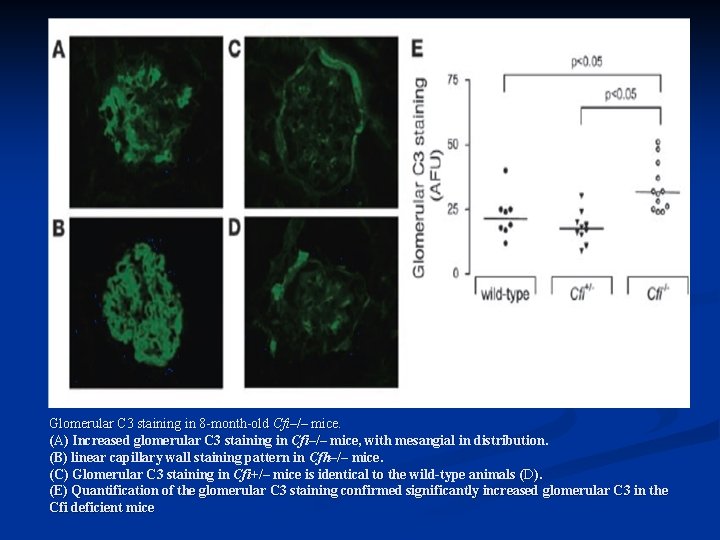
Glomerular C 3 staining in 8 -month-old Cfi–/– mice. (A) Increased glomerular C 3 staining in Cfi–/– mice, with mesangial in distribution. (B) linear capillary wall staining pattern in Cfh–/– mice. (C) Glomerular C 3 staining in Cfi+/– mice is identical to the wild-type animals (D). (E) Quantification of the glomerular C 3 staining confirmed significantly increased glomerular C 3 in the Cfi deficient mice
Cfi-/- mice developed increased mesangial C 3 staining but not deposition of C 3 along GBM n Factor I is an absolute requirement for GBM C 3 deposition and the development of MPGN II in Cfh-/- mice n Glomerular staining patterns in Cfi-/- mice with either heterozygous or homozygous factor H deficiency n
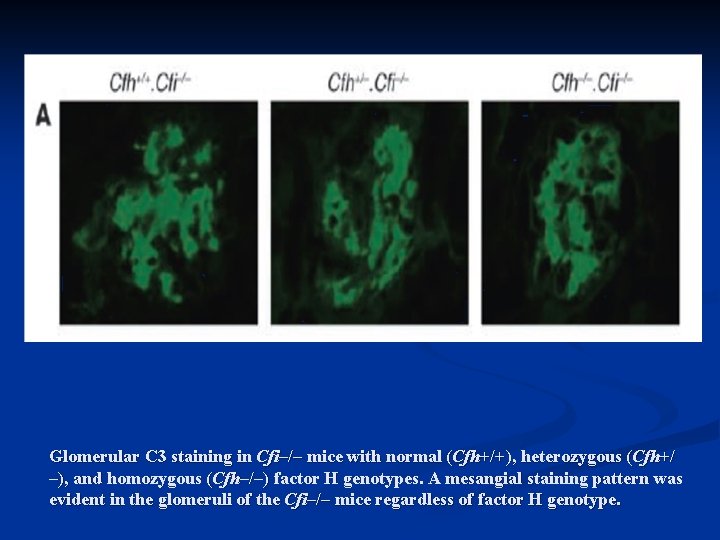
Glomerular C 3 staining in Cfi–/– mice with normal (Cfh+/+), heterozygous (Cfh+/ –), and homozygous (Cfh–/–) factor H genotypes. A mesangial staining pattern was evident in the glomeruli of the Cfi–/– mice regardless of factor H genotype.
Factor I deficiency prevented accumulation of C 3 along the GBM in Cfh-/- mice. n Light Microscopy: No evidence of MPGN 2 in 8 month old Cfh-/- Cfi-/- mice. n
Factor H deficient mice (cfh -/-) - Florid C 3 deposition along GBM/ MPGN 2 occurred n Factor I deficient mice (cfi -/-) Uncontrolled AP - Did not develop C 3 deposition /MPGN 2 n Factor H & Factor I deficient (cfh -/-, cfi -/-) Uncontrolled AP - Did not develop C 3 deposition/MPGN 2 n
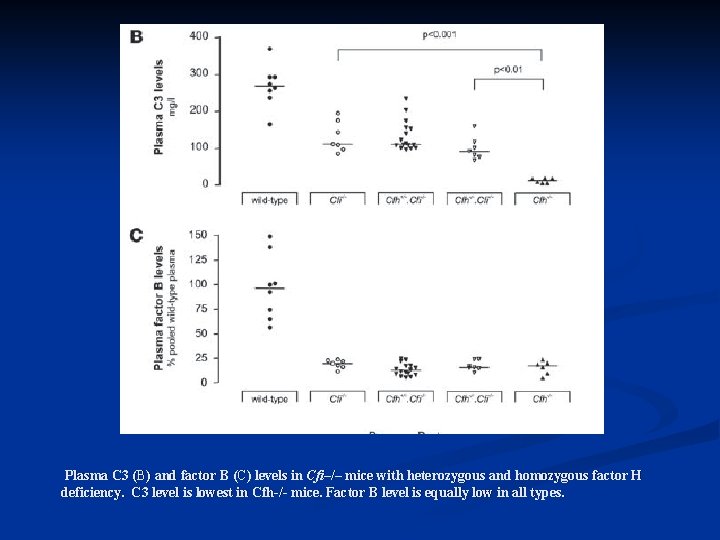
Plasma C 3 (B) and factor B (C) levels in Cfi–/– mice with heterozygous and homozygous factor H deficiency. C 3 level is lowest in Cfh-/- mice. Factor B level is equally low in all types.
Plasma analysis: (cfi -/-): C 3 b (cfh -/-) : C 3 b cleavage products (cfi -/- , cfh -/-): C 3 b n Addition of Factor I: (cfi-/-), (cfi-/-, cfh-/-) + Factor I C 3 b fragments in plasma. n Plasma analysis n
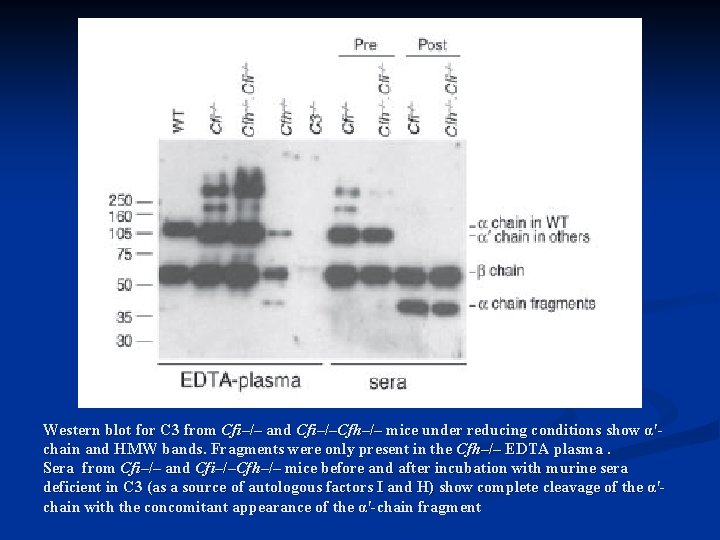
Western blot for C 3 from Cfi–/– and Cfi–/–Cfh–/– mice under reducing conditions show α′chain and HMW bands. Fragments were only present in the Cfh–/– EDTA plasma. Sera from Cfi–/– and Cfi–/–Cfh–/– mice before and after incubation with murine sera deficient in C 3 (as a source of autologous factors I and H) show complete cleavage of the α′chain with the concomitant appearance of the α′-chain fragment
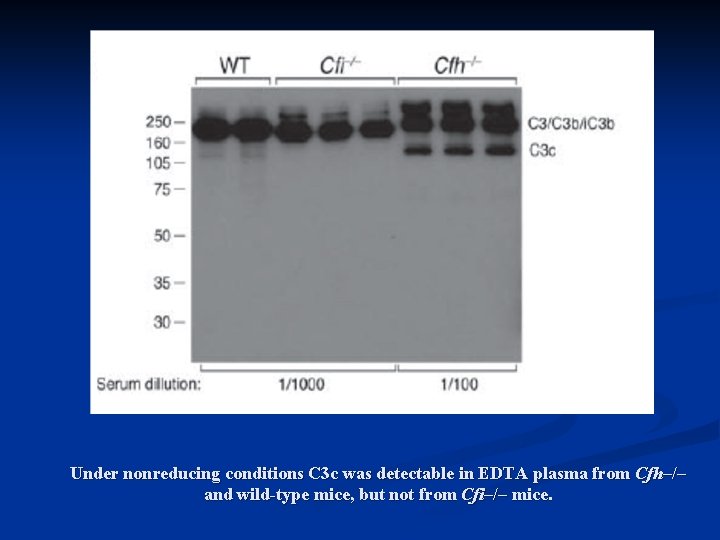
Under nonreducing conditions C 3 c was detectable in EDTA plasma from Cfh–/– and wild-type mice, but not from Cfi–/– mice.
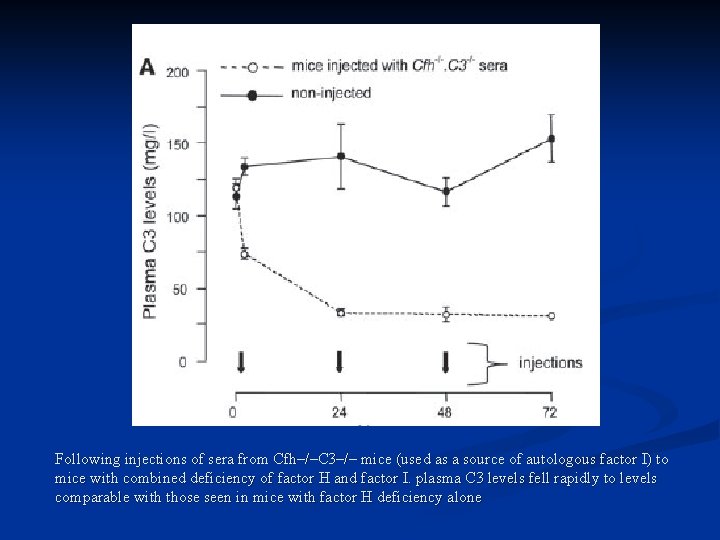
Following injections of sera from Cfh–/–C 3–/– mice (used as a source of autologous factor I) to mice with combined deficiency of factor H and factor I. plasma C 3 levels fell rapidly to levels comparable with those seen in mice with factor H deficiency alone
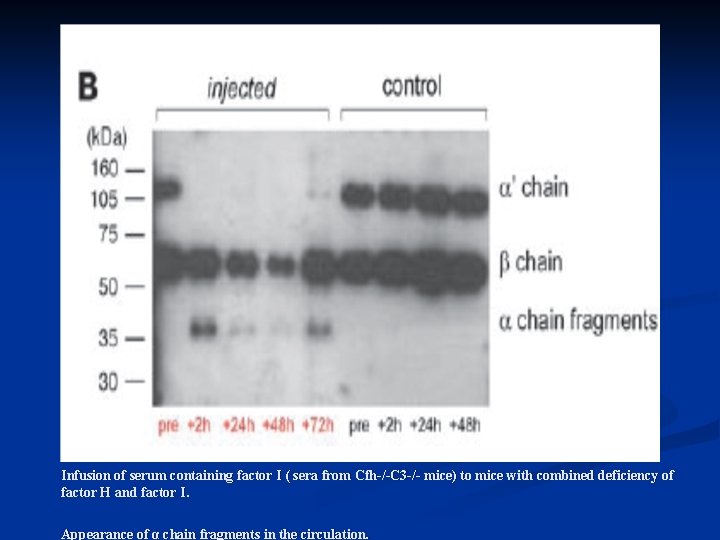
Infusion of serum containing factor I ( sera from Cfh-/-C 3 -/- mice) to mice with combined deficiency of factor H and factor I. Appearance of α chain fragments in the circulation.
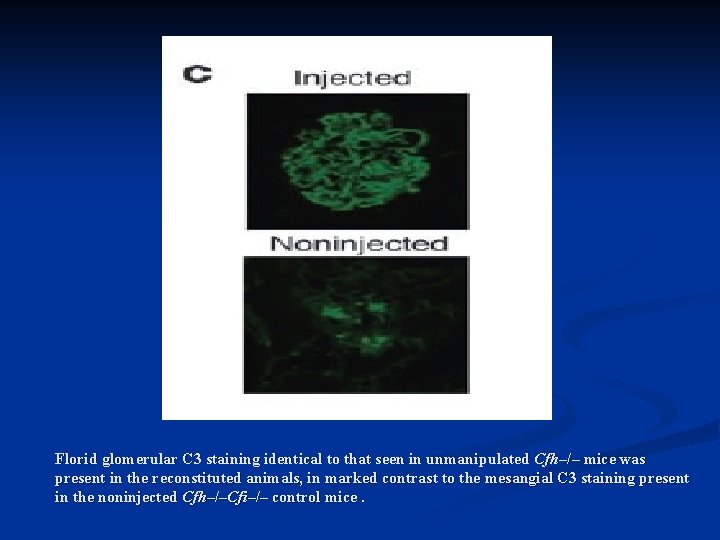
Florid glomerular C 3 staining identical to that seen in unmanipulated Cfh–/– mice was present in the reconstituted animals, in marked contrast to the mesangial C 3 staining present in the noninjected Cfh–/–Cfi–/– control mice.
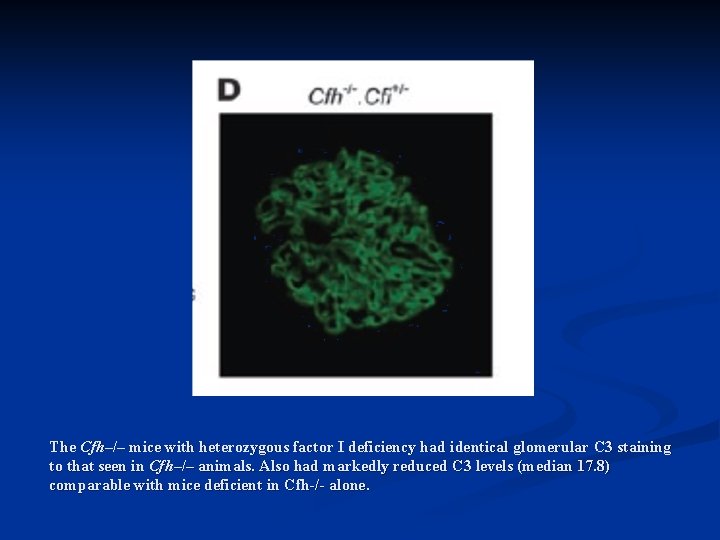
The Cfh–/– mice with heterozygous factor I deficiency had identical glomerular C 3 staining to that seen in Cfh–/– animals. Also had markedly reduced C 3 levels (median 17. 8) comparable with mice deficient in Cfh-/- alone.
Factor I is critically required for GBM C 3 deposition in Cfh-/- mice. n The C 3 deposited along the GBM in factor H deficient mice derives from the circulation: Examined glomerular staining 6 weeks post kidney transplant: - wild-type mice into Cfh-/- recipients - Cfh-/-, C 3 -/- mice into Cfh-/- recipients - Cfh-/- mice into Cfh-/- recipients - wild-type mice into wild-type recipients n
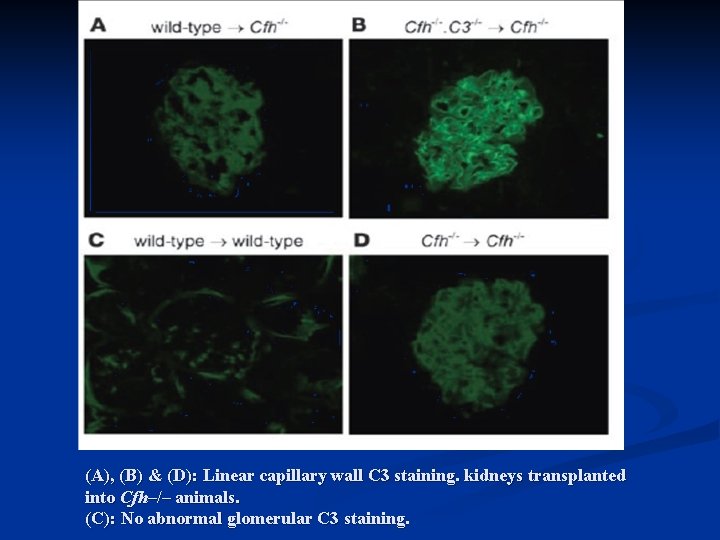
(A), (B) & (D): Linear capillary wall C 3 staining. kidneys transplanted into Cfh–/– animals. (C): No abnormal glomerular C 3 staining.
Conclusion In Cfi–/– mice, factor H is not responsible for the lack of GBM C 3 deposition. n Factor I is a critical requirement for GBM C 3 deposition and subsequent MPGN 2 in Cfh–/– mice. n During uncontrolled alternative pathway activation, it is the nature of the plasma C 3 activation product that determines whether GBM C 3 deposition develops. n
Conclusion n - - The important difference between factor I and factor H deficiency is the fate of plasma C 3 b: Factor I deficiency: No Cleavage products No MPGN Factor H deficiency: Cleavage products present MPGN develops Factor I–mediated cleavage of C 3 b to form i. C 3 b, C 3 c, and C 3 dg in Factor H deficiency occurs as a consequence of alternative factor I cofactors in the circulation (CR 1 on erythrocytes, plasma factor H–like protein 1 and plasma factor H–related protein 5).
Conclusion n n There remains no definitive therapy for MPGN 2. Prevention of C 5 activation ameliorated but did not prevent the development of MPGN 2 in Cfh–/– mice. GBM C 3 deposition secondary to alternative pathway dysregulation could be prevented, regardless of etiology, by strategies that either prevent proteolytic cleavage of C 3 b or sequester its metabolites in the circulation.
- Slides: 59