
Journal Ch 6 Polygon is a closed figure

- Slides: 18
Journal Ch 6
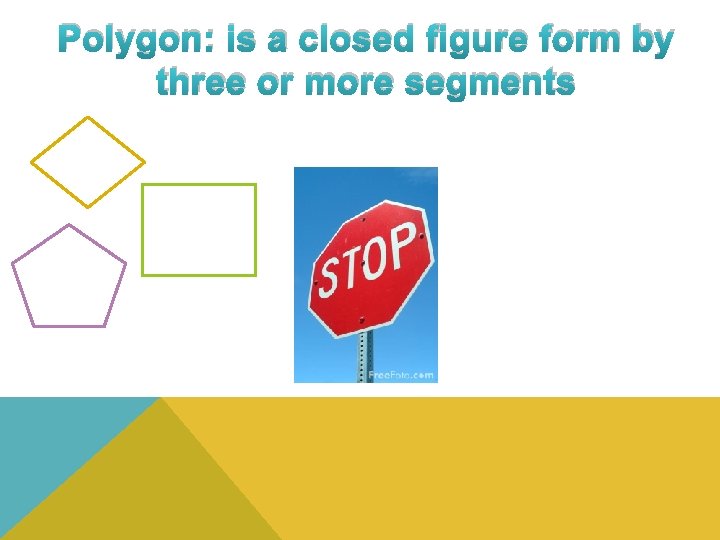
Polygon: is a closed figure form by three or more segments
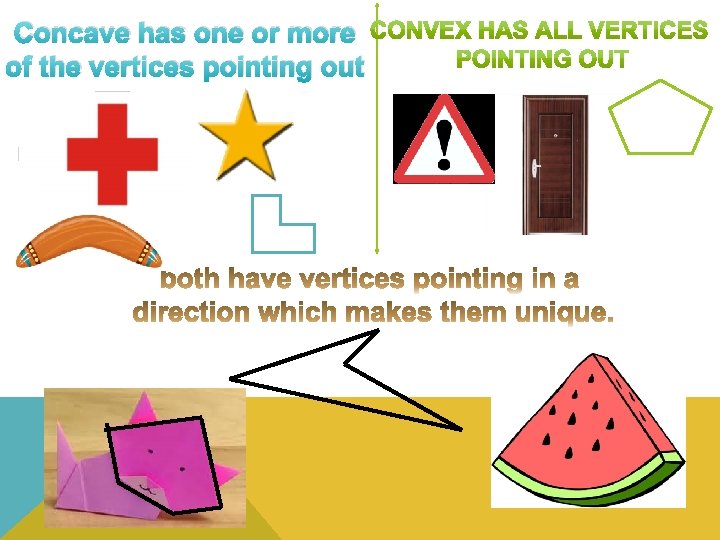
Concave has one or more of the vertices pointing out
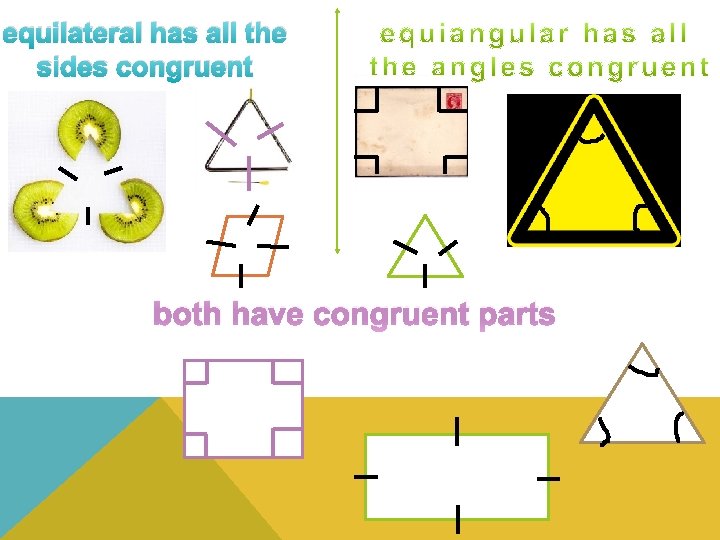
equilateral has all the sides congruent both have congruent parts
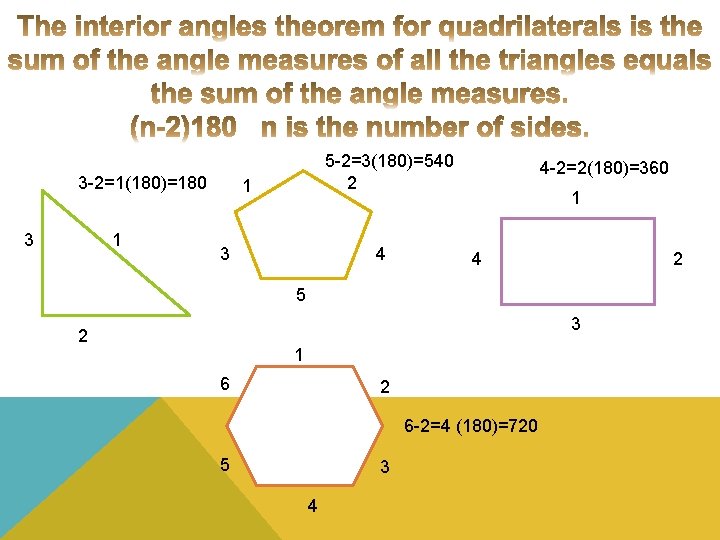
3 -2=1(180)=180 3 1 5 -2=3(180)=540 2 1 3 4 4 -2=2(180)=360 1 4 2 5 3 2 1 6 2 6 -2=4 (180)=720 5 3 4
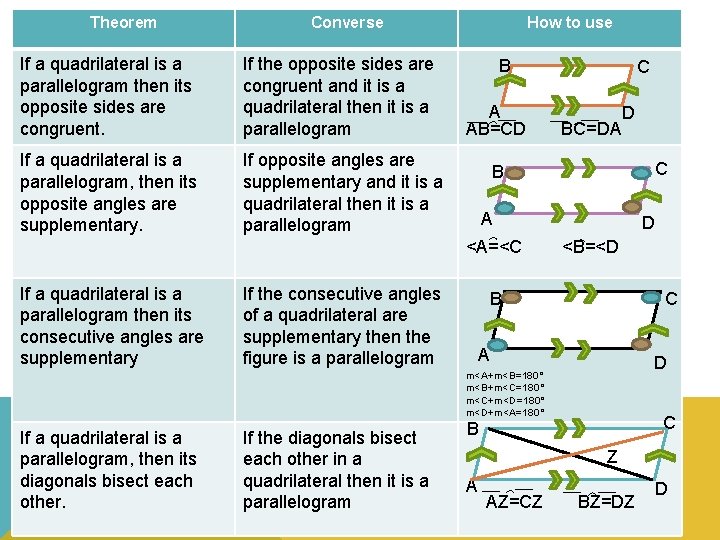
Theorem Converse If a quadrilateral is a parallelogram then its opposite sides are congruent. If the opposite sides are congruent and it is a quadrilateral then it is a parallelogram If a quadrilateral is a parallelogram, then its opposite angles are supplementary. If opposite angles are supplementary and it is a quadrilateral then it is a parallelogram How to use B A AB=CD If the consecutive angles of a quadrilateral are supplementary then the figure is a parallelogram BC=DA D C B A <A=<C If a quadrilateral is a parallelogram then its consecutive angles are supplementary C D <B=<D B C A D m<A+m<B=180° m<B+m<C=180° m<C+m<D=180° m<D+m<A=180° If a quadrilateral is a parallelogram, then its diagonals bisect each other. If the diagonals bisect each other in a quadrilateral then it is a parallelogram C B Z A AZ=CZ BZ=DZ D
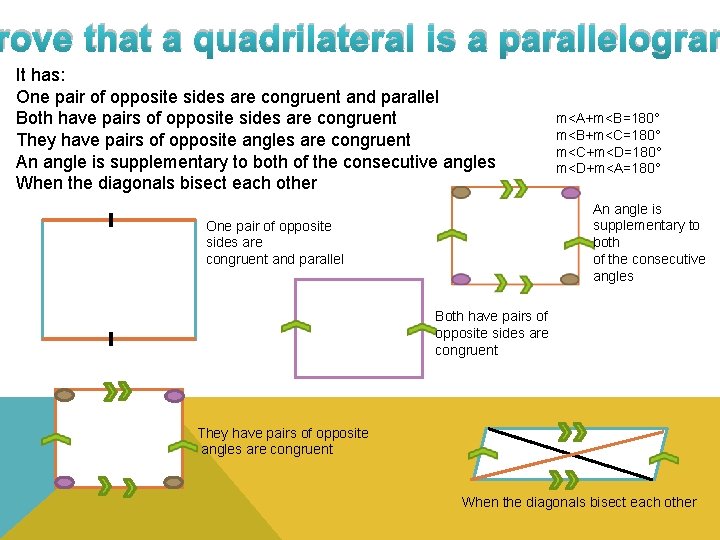
rove that a quadrilateral is a parallelogram It has: One pair of opposite sides are congruent and parallel Both have pairs of opposite sides are congruent They have pairs of opposite angles are congruent An angle is supplementary to both of the consecutive angles When the diagonals bisect each other m<A+m<B=180° m<B+m<C=180° m<C+m<D=180° m<D+m<A=180° An angle is supplementary to both of the consecutive angles One pair of opposite sides are congruent and parallel Both have pairs of opposite sides are congruent They have pairs of opposite angles are congruent When the diagonals bisect each other
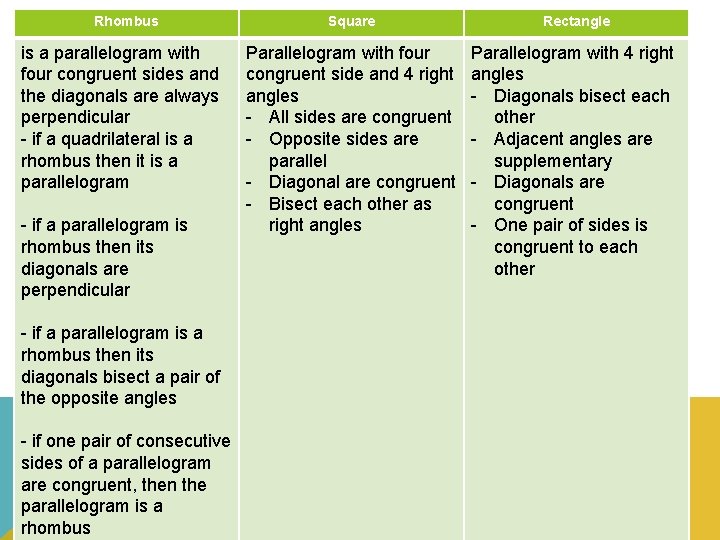
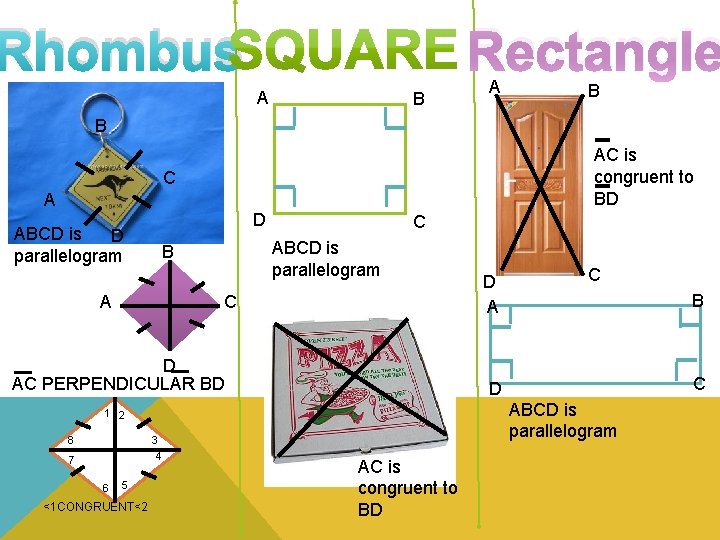
Rhombus is a parallelogram with four congruent sides and the diagonals are always perpendicular - if a quadrilateral is a rhombus then it is a parallelogram - if a parallelogram is rhombus then its diagonals are perpendicular - if a parallelogram is a rhombus then its diagonals bisect a pair of the opposite angles - if one pair of consecutive sides of a parallelogram are congruent, then the parallelogram is a rhombus Square Rectangle Parallelogram with four congruent side and 4 right angles - All sides are congruent - Opposite sides are parallel - Diagonal are congruent - Bisect each other as right angles Parallelogram with 4 right angles - Diagonals bisect each other - Adjacent angles are supplementary - Diagonals are congruent - One pair of sides is congruent to each other
Rhombus Rectangle A B B AC is congruent to BD C A ABCD is D parallelogram D ABCD is parallelogram B A C C D AC PERPENDICULAR BD 3 4 7 6 5 <1 CONGRUENT<2 C B C D ABCD is parallelogram 1 2 8 D A AC is congruent to BD
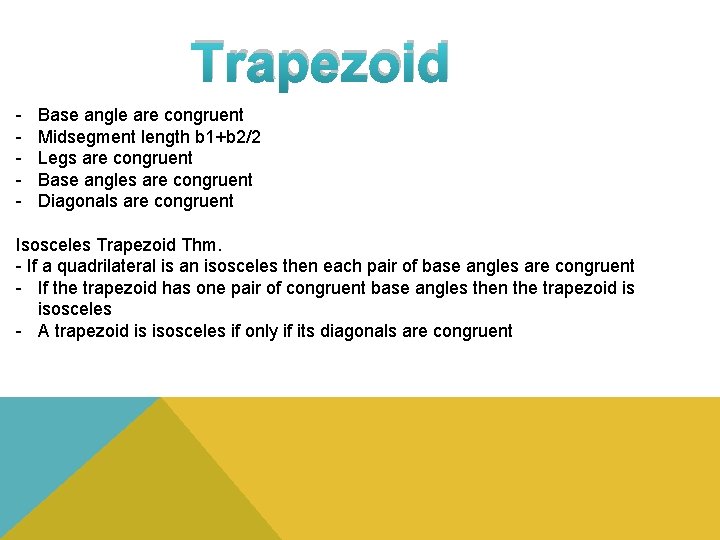
Trapezoid - Base angle are congruent Midsegment length b 1+b 2/2 Legs are congruent Base angles are congruent Diagonals are congruent Isosceles Trapezoid Thm. - If a quadrilateral is an isosceles then each pair of base angles are congruent - If the trapezoid has one pair of congruent base angles then the trapezoid is isosceles - A trapezoid is isosceles if only if its diagonals are congruent
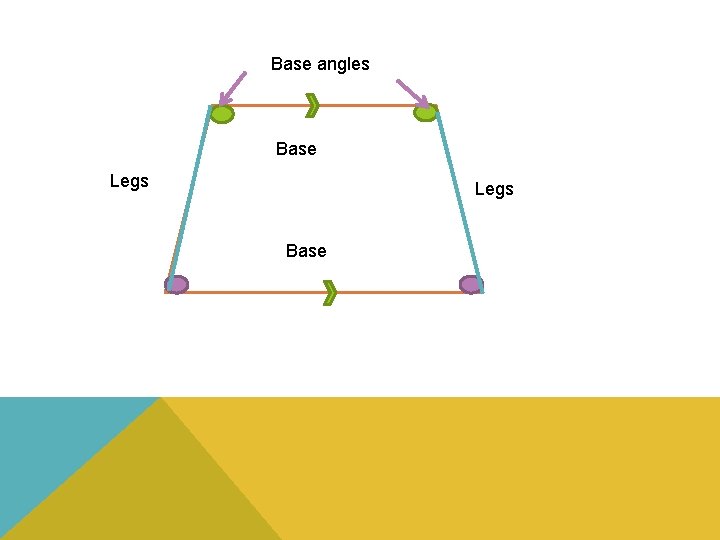
Base angles Base Legs Base
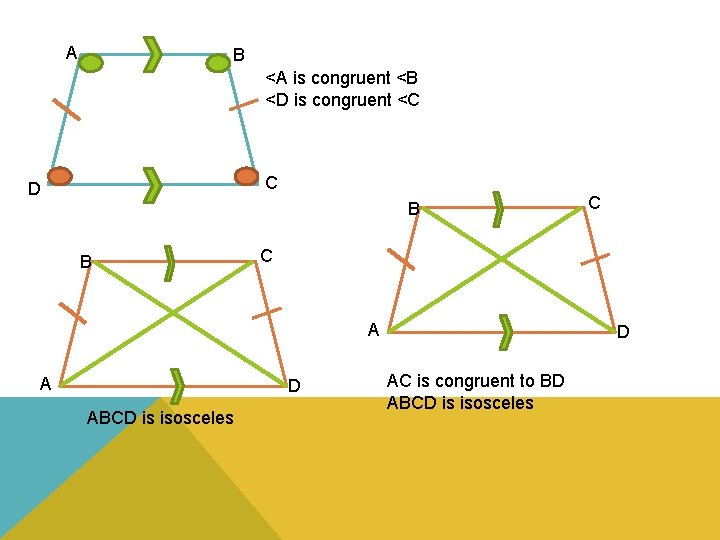
A B <A is congruent <B <D is congruent <C C D B B C A A D ABCD is isosceles C D AC is congruent to BD ABCD is isosceles
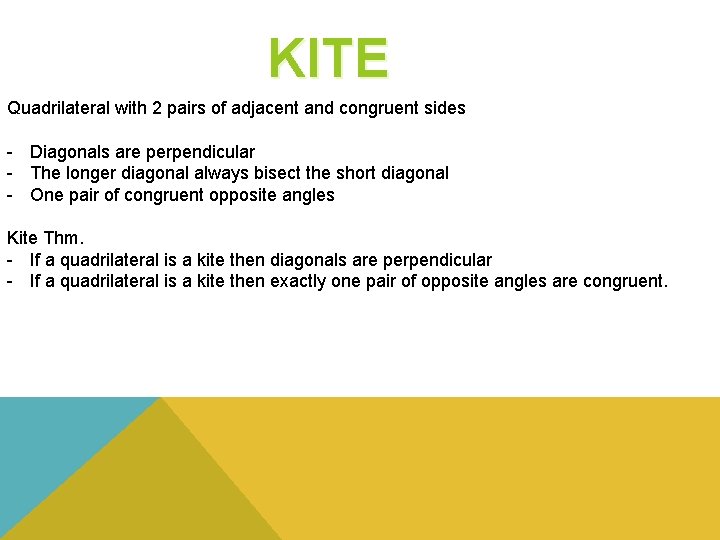
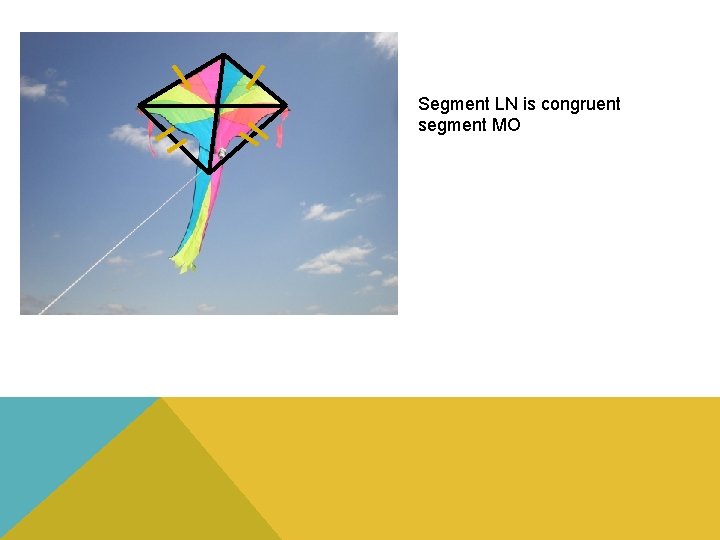
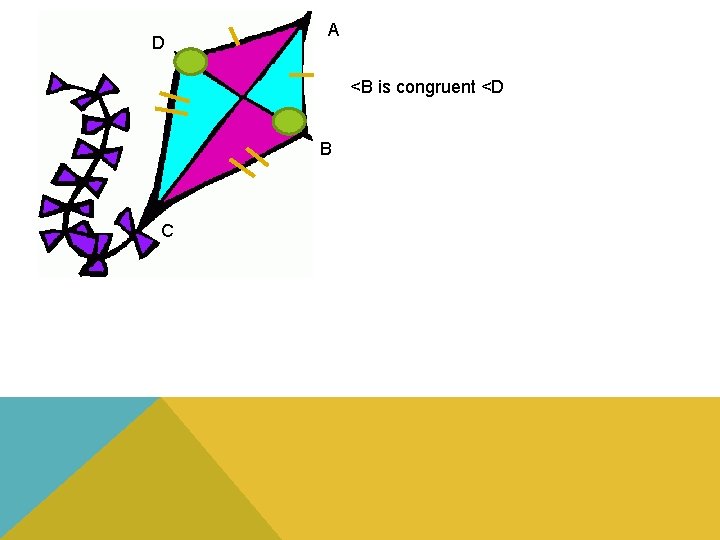
KITE Quadrilateral with 2 pairs of adjacent and congruent sides - Diagonals are perpendicular - The longer diagonal always bisect the short diagonal - One pair of congruent opposite angles Kite Thm. - If a quadrilateral is a kite then diagonals are perpendicular - If a quadrilateral is a kite then exactly one pair of opposite angles are congruent.
Segment LN is congruent segment MO
D A <B is congruent <D B C
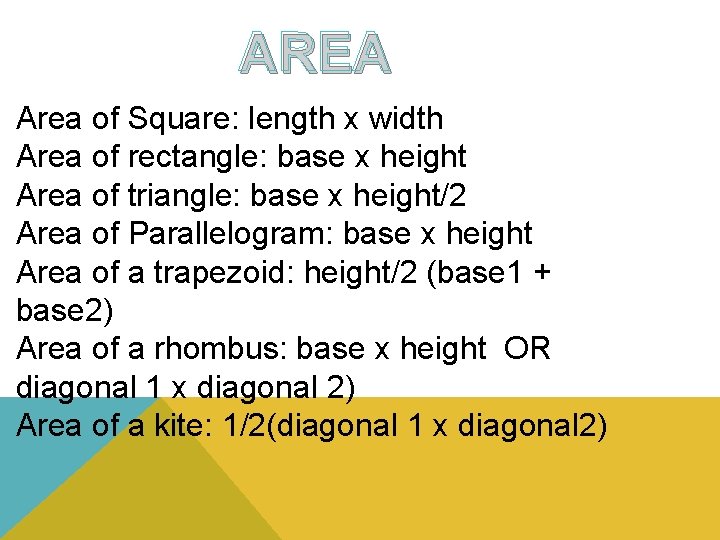
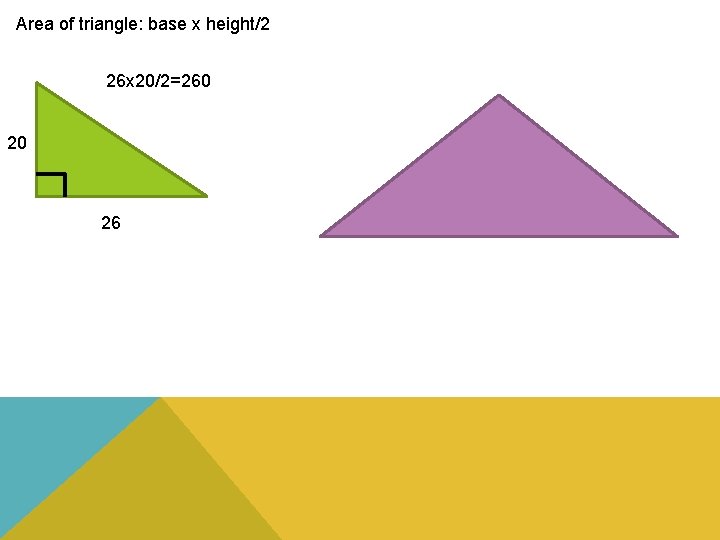
AREA Area of Square: length x width Area of rectangle: base x height Area of triangle: base x height/2 Area of Parallelogram: base x height Area of a trapezoid: height/2 (base 1 + base 2) Area of a rhombus: base x height OR diagonal 1 x diagonal 2) Area of a kite: 1/2(diagonal 1 x diagonal 2)
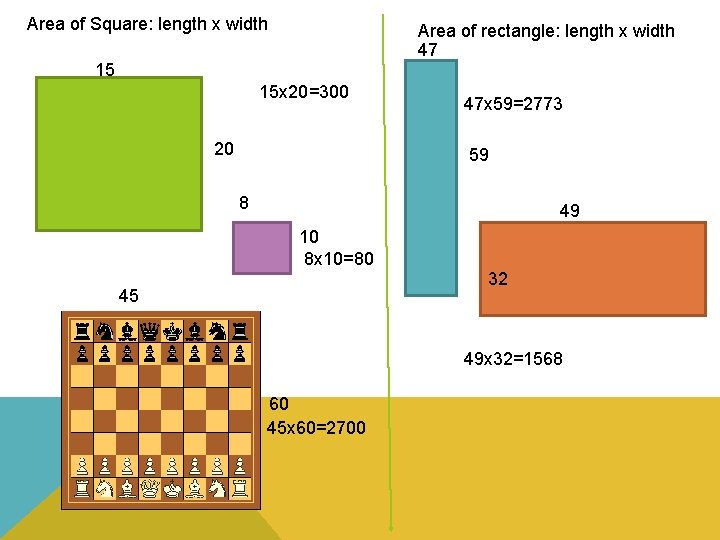
Area of Square: length x width Area of rectangle: length x width 47 15 15 x 20=300 20 47 x 59=2773 59 8 49 10 8 x 10=80 32 45 49 x 32=1568 60 45 x 60=2700
Area of triangle: base x height/2 26 x 20/2=260 20 26