
Journal 24 Due process fair application of the


- Slides: 25
Journal #24 • Due process – fair application of the law • Indict – to formally accuse someone (usually of a crime) • Double jeopardy – being tried in criminal court twice for the same crime • Eminent domain – the power to take personal property to benefit the public • Bail – money that defendants promise to pay the court if they do not appear in court at the proper time
The Bill of Rights and Citizenship 8. 2 and 8. 3
Bonus Questions • What are the 2 major parts of the Legislative Branch? • How many people serve in the House of Representatives? • How long is one term for a Senator? • What group is the most powerful part of the Judicial Branch?
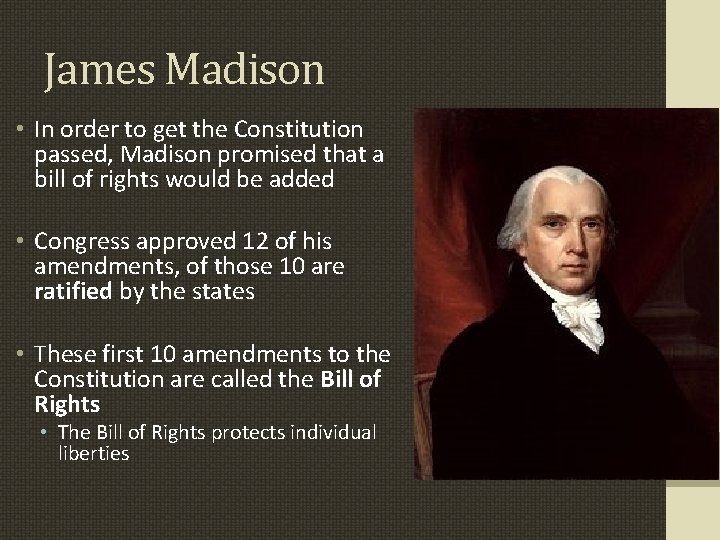
James Madison • In order to get the Constitution passed, Madison promised that a bill of rights would be added • Congress approved 12 of his amendments, of those 10 are ratified by the states • These first 10 amendments to the Constitution are called the Bill of Rights • The Bill of Rights protects individual liberties
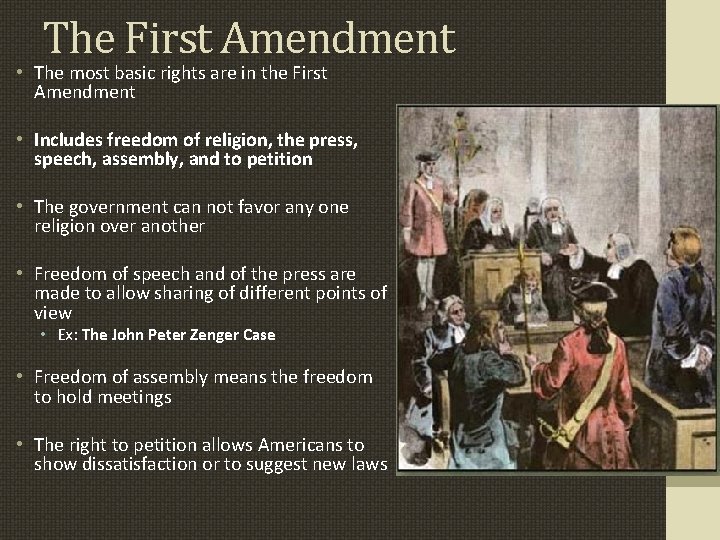
The First Amendment • The most basic rights are in the First Amendment • Includes freedom of religion, the press, speech, assembly, and to petition • The government can not favor any one religion over another • Freedom of speech and of the press are made to allow sharing of different points of view • Ex: The John Peter Zenger Case • Freedom of assembly means the freedom to hold meetings • The right to petition allows Americans to show dissatisfaction or to suggest new laws
The First Amendment • Freedom of speech does not mean that people can say anything they want, the 1 st Amendment does not protect • Slander – false statements that hurt someone else • Libel – intentionally publishing a lie that harms another person • Speech that endangers public safety
2 nd, 3 rd, and 4 th Amendments • These amendments are all related to colonial disputes with Britain before the Revolution • The 2 nd Amendment allows for state militias (National Guard today) and gives us the right to bear arms • The 3 rd Amendment prevents the military from forcing citizens to house soldiers • The 4 th Amendments protects us from “unreasonable searches and seizures” • Today authorities must get a search warrant in order to look through someone’s property
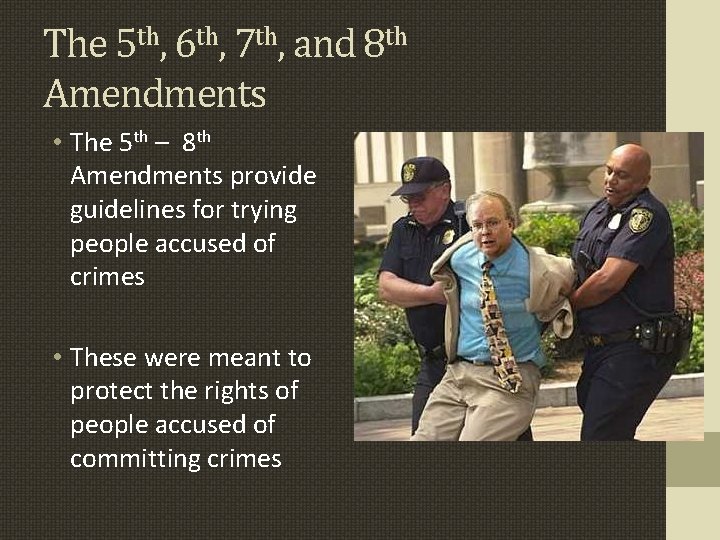
The 5 th, 6 th, 7 th, and 8 th Amendments • The 5 th – 8 th Amendments provide guidelines for trying people accused of crimes • These were meant to protect the rights of people accused of committing crimes
The 5 th Amendment • Says that the government cannot punish anyone for a crime without due process of law • Due process means that: • a jury first must decide if there is enough evidence to indict • People cannot be forced to testify in their own trial – “I plead the Fifth” • Anyone found not guilty in a criminal trial cannot face double jeopardy • The Fifth Amendment also protects property rights, stating that no one will have property taken without “due process of law” • Eminent domain is one exception to this rule
The 6 th Amendment • The Sixth Amendment protects the rights of people who are indicted for a crime • They have the right to: • • • A quick public trial by a jury Know the charges against him/her Hear and question the witness testifying against him/her A government provided attorney Refuse their Sixth Amendment rights (no attorney, no jury, plea bargain, etc. )
The 7 th Amendment • States that juries can decide civil cases • Sometimes an individual causes physical or financial harm to another person without committing a crime • These people are tried in civil court • They are usually about money or property
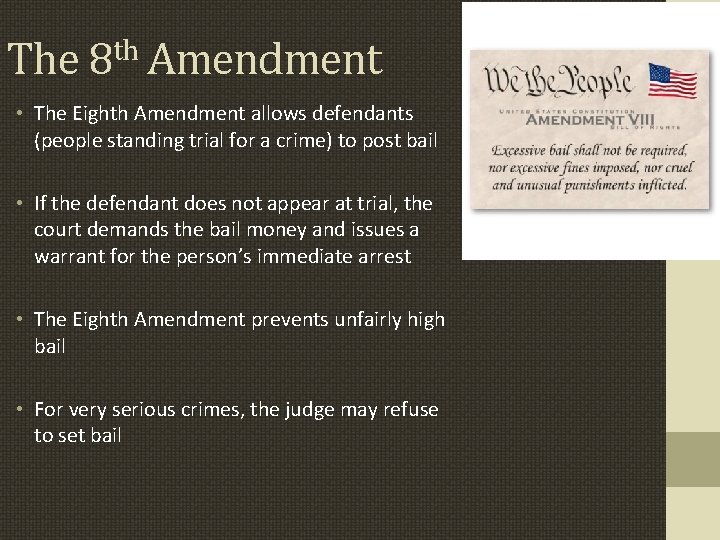
The 8 th Amendment • The Eighth Amendment allows defendants (people standing trial for a crime) to post bail • If the defendant does not appear at trial, the court demands the bail money and issues a warrant for the person’s immediate arrest • The Eighth Amendment prevents unfairly high bail • For very serious crimes, the judge may refuse to set bail
The 9 th and 10 th Amendments • The final two amendments in the Bill of Rights provide general protections for rights not addressed by the first 8 amendments • The 9 th and 10 th Amendments also reserve some governmental powers for states and people
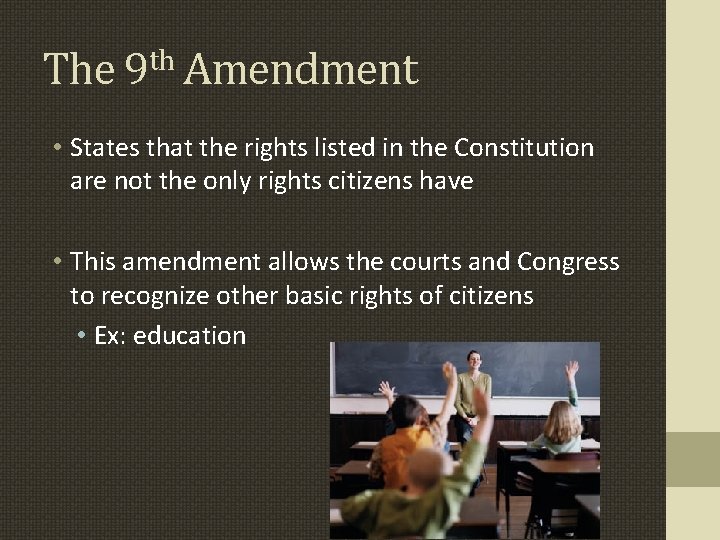
The 9 th Amendment • States that the rights listed in the Constitution are not the only rights citizens have • This amendment allows the courts and Congress to recognize other basic rights of citizens • Ex: education
The 10 th Amendment • Recognizes that states and people have additional powers beyond those mentioned in the Constitution • States have any powers that are not given to the national government or denied to the states • Bonus Question: What is this called?
8. 3 - The Rights and Responsibilities of Citizenship • “Let Liberty stretch forth her fair hand toward the people of the old world. Tell them to come and bid them welcome. ” • Patrick Henry
Becoming a U. S. Citizen • Citizenship can happen in several ways • Anyone born in the U. S. or a territory it controls is a citizen (ex: Puerto Rico) • A person can become a naturalized citizen if one of their parents is a citizen • They can also become naturalized by moving to the U. S. and completing a long process
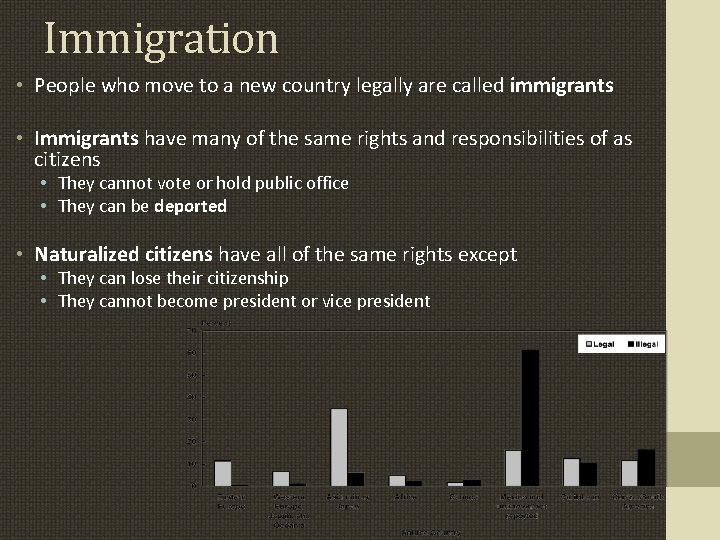
Immigration • People who move to a new country legally are called immigrants • Immigrants have many of the same rights and responsibilities of as citizens • They cannot vote or hold public office • They can be deported • Naturalized citizens have all of the same rights except • They can lose their citizenship • They cannot become president or vice president
Naturalization • Legal immigrants over 18 may apply for naturalization under the following conditions: • • They have lived in the U. S. for 5 years They can support themselves financially They must prove that they are law-abiding and of good moral character They must take a series of tests to show that they can read, write, and speak English and have a basic understanding of U. S. history and government • The U. S. Immigration and Naturalization Service (INS) oversees this process • When the process is completed the candidates appear before a naturalization court and take an oath of allegiance to the U. S.
Duties of Citizens • In order for a representative democracy to work, people must fulfill their civic duties • By electing leaders to make their laws • By trying to change laws that they disagree with • To know what the laws are
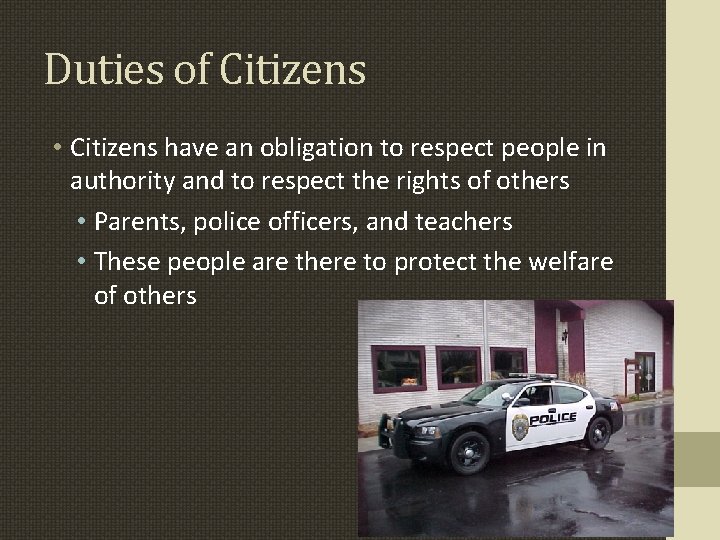
Duties of Citizens • Citizens have an obligation to respect people in authority and to respect the rights of others • Parents, police officers, and teachers • These people are there to protect the welfare of others
Duties of Citizens • Good citizenship includes paying taxes • The government relies on taxes to pay for public roads, police and fire departments and schools • Without taxes, the government would not be able to provide these services • Property taxes, sales taxes, income taxes, and tariffs • April 15 th is income tax day, all Americans who earned money the previous year have to have their taxes paid
Duties of Citizens • Citizens have the duty to protect and defend the nation from harm • If a war breaks out, citizens should help the war effort • Sometimes the federal government has issued a draft • All men must register for the draft at age 18 • The U. S. has had a volunteer military since 1973
Duties of Citizens • Anybody can be called to serve on a jury • Jury duty involves listening to a court case and reaching a verdict on it • This helps fulfill people’s 6 th Amendment rights • Americans also have a duty to testify in court if needed
Ways to Get Involved • PACs – Political Action Committees – they support certain candidates in elections • Interest groups – gun control vs. gun safety education • Community service – Neighborhood Watch, the American Red Cross, Habitat for Humanity