
Journal 21 Constitution a set of basic principles
Journal #21 � Constitution – a set of basic principles and laws that state the powers and duties of the government � Republicanism – a system where citizens elect representatives who are responsible to the people � Limited Government – a government where all leaders have to obey laws and no one has total power � Suffrage – voting rights � Ratification – official approval
Quotes of the Day � “Every man must decide whether he will walk in the light of creative altruism or in the darkness of destructive selfishness. ” � “Life's most persistent and urgent question is, 'What are you doing for others? ” � “Love is the only force capable of transforming an enemy into friend. ” � “Never succumb to the temptation of bitterness. ” � Martin Luther King Jr.
Unit 5: A New American Nation Chapters 7 -9
Bonus Questions � During what years was the American Revolution fought? � Name an important leader of the American Revolution besides George Washington � What was the final major battle of the American Revolution? � What was the final peace agreement of the American Revolution?
In This Unit We Will Learn About � The Articles of Confederation � Problems with the new nation after the Revolution � The Constitution � Citizenship and the new government (the 3 branches of government) � The Bill of Rights
Ideas About Government � After the colonies declared independence in 1776, they needed to form governments � They � The used many political ideas from other people Romans – republicanism and balance of power � English Law – The Magna Carta and the English Bill of Rights both limited the King/Queen’s power � The Enlightenment, especially philosopher John Locke – natural rights � American political traditions – the town hall meeting and the Virginia House of Burgesses
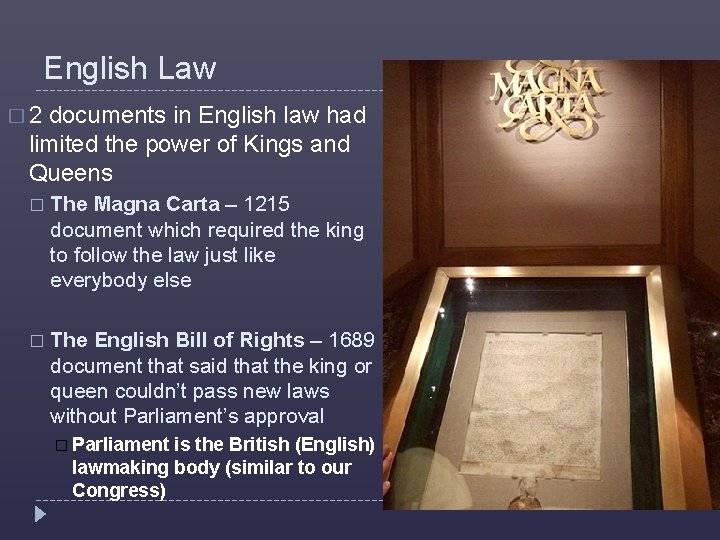
English Law � 2 documents in English law had limited the power of Kings and Queens � The Magna Carta – 1215 document which required the king to follow the law just like everybody else � The English Bill of Rights – 1689 document that said that the king or queen couldn’t pass new laws without Parliament’s approval � Parliament is the British (English) lawmaking body (similar to our Congress)
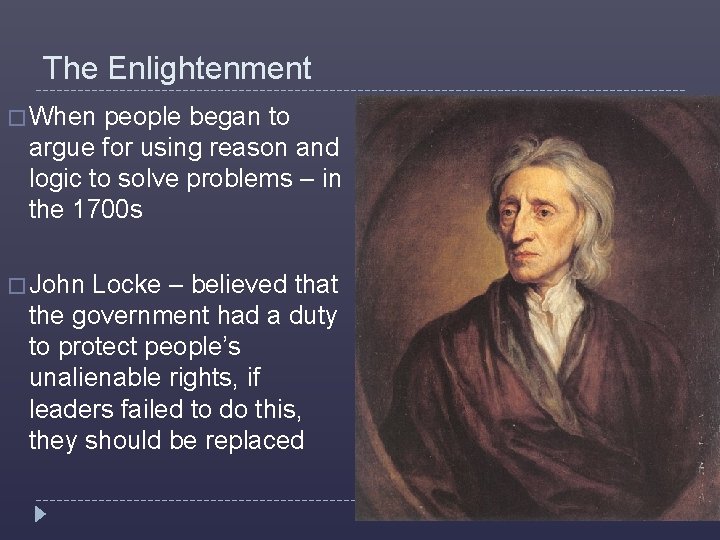
The Enlightenment � When people began to argue for using reason and logic to solve problems – in the 1700 s � John Locke – believed that the government had a duty to protect people’s unalienable rights, if leaders failed to do this, they should be replaced
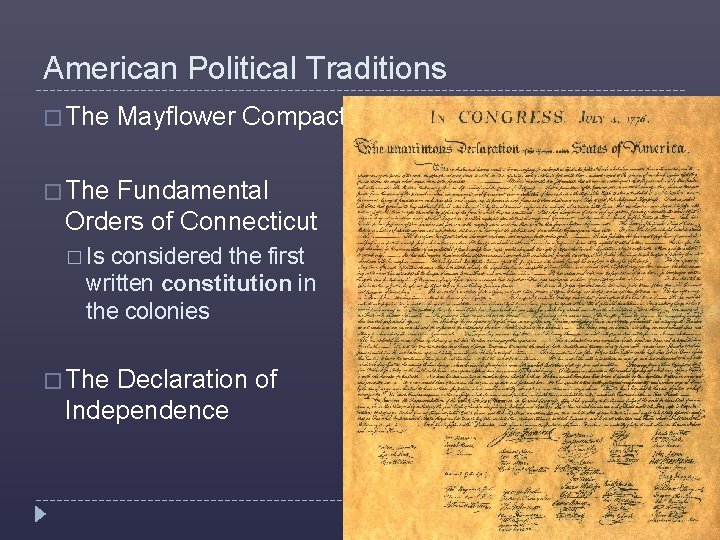
American Political Traditions � The Mayflower Compact � The Fundamental Orders of Connecticut � Is considered the first written constitution in the colonies � The Declaration of Independence
State Constitutions � During the Revolution, nearly every colony wrote a new state constitution � These constitutions showed a belief in republicanism, limited government, and suffrage for more people � White men gained more voting rights
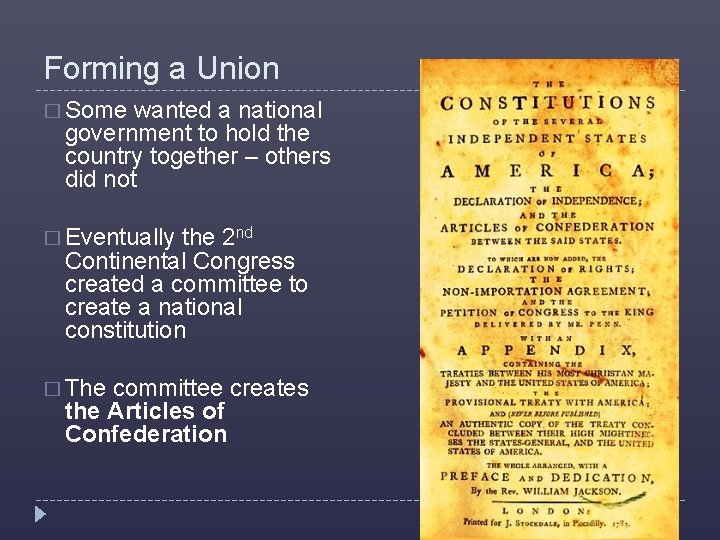
Forming a Union � Some wanted a national government to hold the country together – others did not � Eventually the 2 nd Continental Congress created a committee to create a national constitution � The committee creates the Articles of Confederation

The Articles of Confederation �A new Confederation Congress would become the national government � The Articles of Confederation did not have a president or court system � The Confederation Congress had very limited powers It could make coins and borrow money � It could make treaties � It could settle conflicts between the states � It could ask for money and troops � � The Articles of Confederation were ratified in March of 1781
The Northwest Territory � Under the Articles of Confederation, the national government controlled newly claimed “western” land � The Confederation Congress decides to sell the land to the public � The Land Ordinance of 1785 set up a system for dividing the public territory It divided the land into townships of 36 square miles � Each township was divided into 36 lots of 640 acres each � One of the lots was for a school, 4 went to Revolutionary War veterans and the rest were for sale to the public � Importance: this is the basis for the Public Land Survey System which is still used today to identify land parcels for undeveloped land �
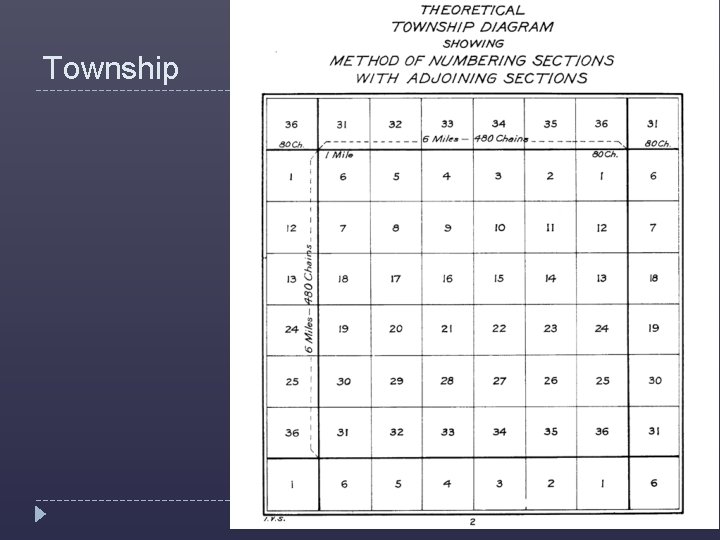
Township
The Northwest Ordinance of 1787 � Created the Northwest Territory which is the land that now includes Illinois, Indiana, Michigan, Ohio, and Wisconsin � The � It Northwest Ordinance had other important provisions created a system for bringing new states into the Union � It required that public education be provided in the region � Stated that “there shall be neither slavery nor involuntary servitude in the territory. ” – based on a proposal by Thomas Jefferson
Problems in the New Nation 7. 2
Weaknesses of the Confederation Congress and the Articles of Confederation 1. Problems with other countries – they did not respect our weak central government 2. Problems with trade – the government couldn’t regulate it 3. Economic problems in the U. S. – related to interstate (between state) trade and inflation – led to a depression
Problems with Other Countries � The story of Thomas Amis on the Mississippi River in 1786 � The Confederation Congress couldn’t protect citizens because it could not force states to provide soldiers � Britain � The was slow to turn over their forts in the U. S. Spanish closed the lower Mississippi to U. S. shipping � People began to criticize the weak Confederation Congress
Problems with Trade � After the Revolution the British refused to trade with the U. S. � The British also forced Americans to pay high taxes, called tariffs, in order to sell their goods in Britain � At the same time, British goods flowed freely into the U. S. � The Confederation Congress could not fix the problem because it didn’t have the power to pass its own tariffs
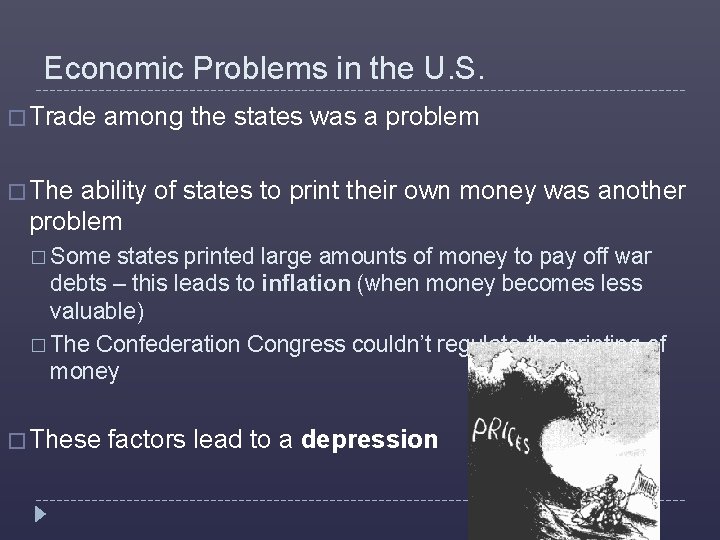
Economic Problems in the U. S. � Trade among the states was a problem � The ability of states to print their own money was another problem � Some states printed large amounts of money to pay off war debts – this leads to inflation (when money becomes less valuable) � The Confederation Congress couldn’t regulate the printing of money � These factors lead to a depression
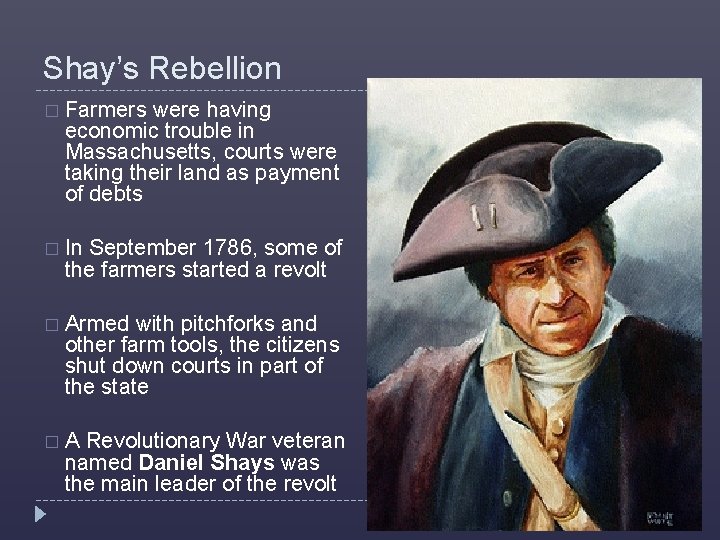
Shay’s Rebellion � Farmers were having economic trouble in Massachusetts, courts were taking their land as payment of debts � In September 1786, some of the farmers started a revolt � Armed with pitchforks and other farm tools, the citizens shut down courts in part of the state �A Revolutionary War veteran named Daniel Shays was the main leader of the revolt
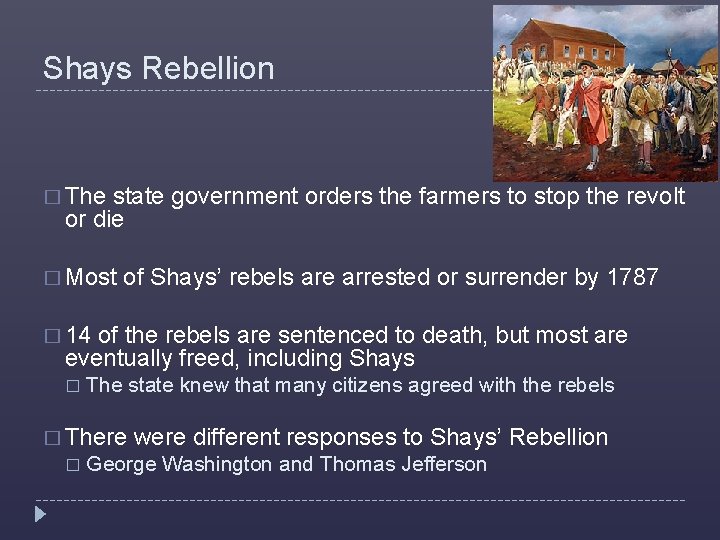
Shays Rebellion � The state government orders the farmers to stop the revolt or die � Most of Shays’ rebels are arrested or surrender by 1787 � 14 of the rebels are sentenced to death, but most are eventually freed, including Shays � The state knew that many citizens agreed with the rebels � There � were different responses to Shays’ Rebellion George Washington and Thomas Jefferson
The Significance of Shays Rebellion � Shays Rebellion showed the weakness of the Confederation government and led some Americans to admit that the Articles of Confederation were not working � Massachusetts asked the national government to help but Congress could not do much � Many Americans began to call for a stronger national government
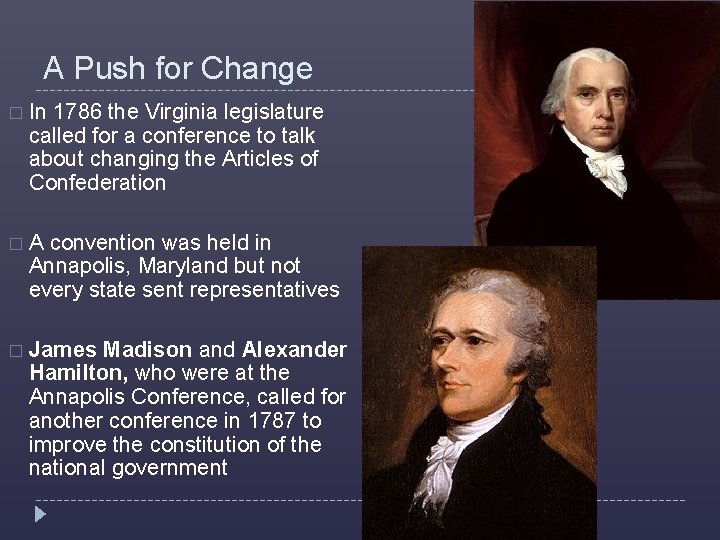
A Push for Change � In 1786 the Virginia legislature called for a conference to talk about changing the Articles of Confederation �A convention was held in Annapolis, Maryland but not every state sent representatives � James Madison and Alexander Hamilton, who were at the Annapolis Conference, called for another conference in 1787 to improve the constitution of the national government
- Slides: 24