
Joshua Sunshine Privacy for Ubiquitous Computing Looking Forward

Joshua Sunshine Privacy for Ubiquitous Computing
Looking Forward �Defining Ubiquitous Computing �Unique Privacy Problems �Examples �Exercise 1: Privacy Solution �Privacy Tradeoffs �Professional Solutions �Exercise 2: User Study �Conclusion
Ubiquitous Computing Definitions �Everywhere (duh!) �Invisible �Mobile �Interoperable �Context Aware �Personal �Multi-Agent
Privacy Problems �More data collected, more data to be used inappropriately (Everywhere) �User forget they are revealing private information (Invisible) �Hard to configure data sharing (Invisible, Everywhere)
Privacy Problems 2 �New class of data -- contextual information (Context Aware) Stalkers (location) Advertisers (location, activity) �Hard To Identify Invasions (Multi-Agent) �Hard to Recover (Multi-Agent)
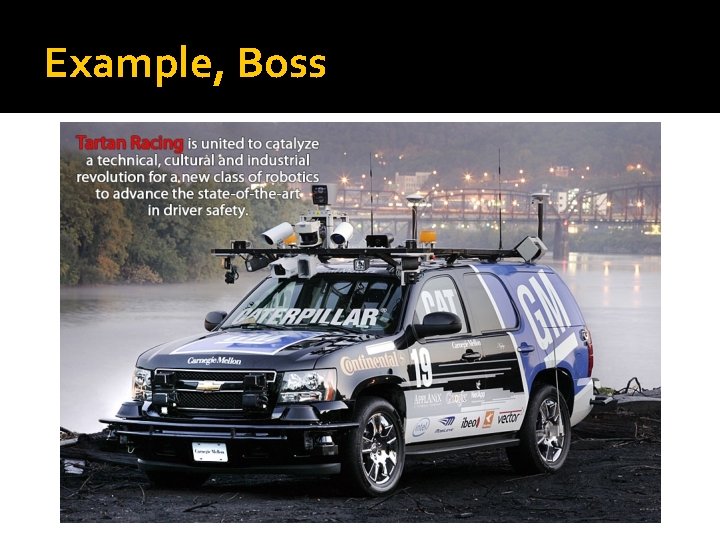
Example, Boss
Example, Mobile Phones �Problem: Interruptions �Caller doesn’t know receiver’s context �Solution: Reveal Context Location Activity Company Conversation
Example, Bus Tracking �Problem: When will the next bus arrive? �Tool: Cell phones �Solution: Aggregate information from riders phones Send alerts to people waiting for a bus
Exercise 1: Privacy Solution �Break up into two groups �Make a list of privacy problems �Come up with a solution that avoids or minimizes these problems � 10 minutes
Professional Privacy Problems, Bus Tracking �Identity violation Identity of individual is determined Happens when identifier is sent in a report to the server �Tracking violation Movement of individual tracked over time Happens when identify one report as belonging to a person who sent an earlier report
Professional Solution, Bus Tracking �Hitchhiking �Anonymous data collection �Location is Computed on the Client �Only the Client Device is Trusted �Report Approval �Restriction of Reports to Specific Locations
User Study, Mobile Phones �Context Types: Location, Activity, Company, Conversation �Relationship Types: Significant other, family member, friend, colleague, boss, and unknown �Representative Sample of 20, regular routine �Participants “called” at regular intervals by individual with one of the relationship types �Asked to share context
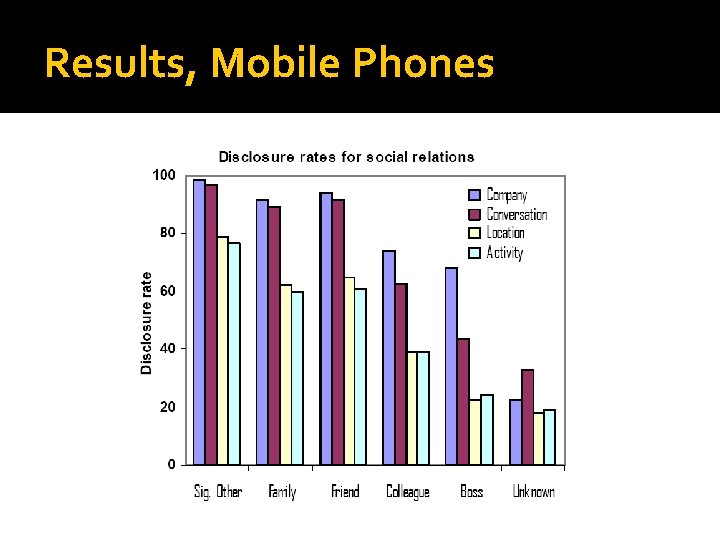
Results, Mobile Phones
Criticism, Mobile Phones �Bad: Value is not real Participants were not receiving real phone calls based on their answers Goal: Avoid interruptions Questionnaire is an interruption �Good: Context is more than location Ideas for Configuration in Real Setting
Privacy Tradeoffs �Value of Sharing vs. Privacy of Not Sharing �Control vs. Trust �Prevention vs. Detection �Configurability vs. Invisibility �Fidelity vs. Confidentiality �Fine vs. Coarse Grained Filtering
Exercise 2: User Study �Same groups �Create a user study for the Professional Bus Tracking System �Try to determine if the solution uses the correct trade offs �Focus on usability of privacy, not on overall usability � 20 minutes
Bibliography http: //www. tartanracing. org/ Khalil, A. and Connelly, K. 2006. Context-aware telephony: privacy preferences and sharing patterns. In Proceedings of the 2006 20 th Anniversary Conference on Computer Supported Cooperative Work (Banff, Alberta, Canada, November 04 08, 2006). CSCW '06. ACM, New York, NY, 469 -478. � Tang, K. P. , Keyani, P. , Fogarty, J. , and Hong, J. I. 2006. Putting people in their place: an anonymous and privacy-sensitive approach to collecting sensed data in location-based applications. In Proceedings of the SIGCHI Conference on Human Factors in Computing Systems (Montreal, Quebec, Canada, April 22 - 27, 2006). R. Grinter, T. Rodden, P. Aoki, E. Cutrell, R. Jeffries, and G. Olson, Eds. CHI '06. ACM, New York, NY, 93 -102. � Hong, J. I. , J. Ng, and J. A. Landay. Privacy Risk Models for Designing Privacy. Sensitive Ubiquitous Computing Systems. In Proceedings of Designing Interactive Systems (DIS 2004). Boston, MA. pp. 91 -100 2004. � �
- Slides: 17