
Joseph W Grier Academy Title I Annual Parent

- Slides: 24
Joseph W. Grier Academy Title I Annual Parent Information Meeting September 28, 2020 12: 00 – 1: 30 Welcome - B. Wilson Meeting Overview – B. Wilson Annual Notice to Parents - B. Wilson Learning Compact - J. Taylor Closing Remarks - B. Wilson
Welcome to the Title I Annual Meeting for Parents & Families 2020 -2021 Joseph W. Grier Academy Mrs. Wilson, Principal
Why are we here? • The Elementary and Secondary Education Act (ESSA) requires that each Title I School hold an Annual Meeting for Title I parents for the purpose of… – Informing you of your school’s participation in Title I – Explaining the requirements of Title I – Explaining your rights as parents to be involved
Meeting Overview • • • What it means to be a Title I school 1% Set-Aside for parent and family engagement The CMS Parent and Family Engagement Policy SIP (School Improvement Plan) School-Parent Compact How to request the qualifications of my child’s teacher(s) How will I be notified if my child is taught by a teacher who is not Highly Qualified How the Annual Evaluation of the CMS Parent and Family Engagement Policy is conducted How can I be involved in all I am learning about
What does it mean to be a Title I School? • Being a Title I school means receiving federal funding (Title I dollars) to supplement the school’s existing programs. These dollars are used for… – Identifying students experiencing academic difficulties and providing timely assistance to help students meet the State’s challenging content standards. – Purchasing supplemental staff/programs/materials/supplies – Conducting parental Involvement meetings/trainings/activities – Recruiting/Hiring/Retaining Highly Qualified Teachers • Being a Title I school also means encouraging parental involvement and advocating for parents’ rights
How is our school using this funding? • • • Student Agendas Staffing to support reduced class sizes & support services to students and families Family events Professional development and resource for teacher training Student resources to supplement academic and social/emotional needs.
What is the 1% set-aside and how are parents involved? • Any LEA with a Title I Allocation exceeding $500, 000 is required by law to set aside 1% of the Title I allocation for parent and family engagement • Of that 1%, 5% may be reserved at the LEA level for system-wide initiatives related to parental involvement. The remaining 95% must be allocated to all Title I schools in the LEA. Each Title I school receives its portion of the 95% to implement school-level parental involvement • Title I parents have the right to make decisions regarding how this money is spent
Parent and Family Engagement Allocation • • Student agendas Family Handbook (printing/binding)
What is the CMS Parent and Family Engagement Policy? • This plan addresses how the LEA will implement the family engagement requirements of the Elementary and Secondary Education Act. It includes… – The LEA’s expectations for parents – How the LEA will involve parents in decision-making – How the LEA will work to build the schools’ and parents’ capacities in the implementation of effective parent and family engagement activities to improve student academic achievement • Title I parents and families have the right to be involved in the development of this plan
What is the SIP? • The SIP is your School Improvement Plan and includes: – A School Self-Evaluation Form and Summary of Data – Goals and Strategies to Address Academic Needs of Students – Professional Development Needs – Coordination of Resources and Comprehensive Budget – The School’s Parent and Family Engagement Plan • Title I parents have a right to be involved in the development of this plan
What’s included in the School’s Parent and Family Engagement Plan? • This plan addresses how the school will implement the parent and family engagement requirements of the Elementary and Secondary Education Act (ESEA). Components include… – How parents can be involved in decision-making and activities – How parent and family engagement funds are being used – How information and training will be provided to parents – How the school will build capacity in parents and staff for strong parent and family engagement • Title I parents have the right to be involved in the development of the school’s Parent and Family Engagement Plan
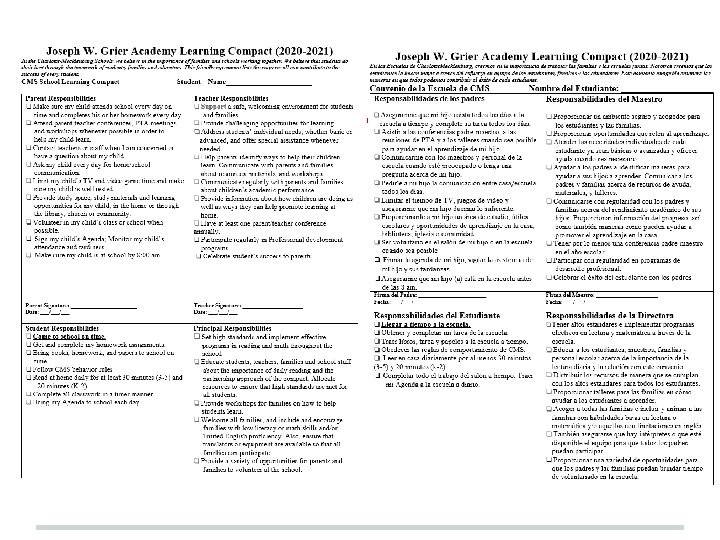
What is the School Compact? • The compact is a commitment from the school, the parent, and the student, to share in the responsibility for improved academic achievement • Title I parents and families have the right to be involved in the development of the School Compact
Who are the parent leaders at my school? Name • • V. Stinson J. Wiltshire SLT Chair SLT Representative
How can I volunteer to assist my student with school needs? • • Join the School Improvement Team/School Leadership Team Volunteer to contact other parents regarding important school information • Ex. – 100% Compact completion ○ Talk to your neighbors and let them know what is going on at your child’s school. • Contact our office at 980 -343 -5671 to volunteer.
How do I request the qualifications of my child’s teachers? • Title I parents and families have the right to request the qualifications of their child’s teachers • How are you notified of this right and what is the process for making a request? (Explain Procedure – Right To Know Letter and request should be completed within 30 days of parent request)
How will I be notified if my child is taught by a teacher who is not Highly-Qualified? • Our school’s present status of Highly Qualified Teachers • Notification to parents and families regarding teachers not meeting ESEA’s requirements for Highly-Qualified • How parents and families are notified and/or may request information on status
Federal Programs Complaint Procedures NCDPI Website Link to the Complaint Resolution Procedures: http: //www. ncpublicschools. org/nclb/federal/complaint COMPLAINT RESOLUTION PROCEDURES: As required by the Elementary and Secondary Act of 1965 as amended by the Every Student Succeeds Act of 2015. Section 9304(a)(3)(C) of the Elementary and Secondary Act of 1965 as amended by the Every Student Succeeds Act of 2015 (P. L. 107 -110) requires: states adopt written procedures for the receipt and resolution of complaints alleging violations of law in the administration of the programs in P. L. 107 -110. North Carolina State Board of Education policy #EEO-E-001 outlines the procedures to be followed in resolving complaints alleging violations of requirements of the Elementary and Secondary Act of 1965 as amended by the Every Student Succeeds Act of 2015. The State Board’s complaint resolution policy can be viewed by going to the NCSBE Policy Manual Table of Contents at http: //sbepolicy. dpi. state. nc. us. Click on “EEO Series” to access the Effective and Efficient Operations policies. Click on “EEO-E” to access the federal programs policies. Click on policy “EEO-E-001” to view the State Board’s policy on resolution of complaints for federal programs. To learn more about the Elementary and Secondary Act of 1965 as amended by the Every Student Succeeds Act of 2015 go to the North Carolina Department of Public Instruction’s website at: http: //www. ncpublicschools. org/nclb or the U. S. Department of Education’s website at: http: //www. ed. gov/index. jhtml.
AMOs (Annual Measurable Objectives) *New under ESEA Flexibility Waiver • • • The ESEA waiver specified AMO targets will be used for reporting. These targets are: (1) based on 2010 -11 data (2) identified for each federally reported subgroup Per the flexibility waiver, the AMO targets were set with the goal of reducing the percentage of non-proficient students by one-half within six years Annual Measurable Objectives (AMO) will replace Annual Yearly Progress (AYP) targets and eliminate school improvement designations for Title I schools The change from AYP targets to Annual Measurement Objectives (AMO) acknowledges that subgroups have different starting points and thus need different targets. Overall, there are 13 specific areas of flexibility included in the waiver. All schools are measured according to AMO
AMO measures the progress of student groups Definition of AMOs • Annual Measurable Objectives (AMOs) is defined as a series of performance targets that states, school districts, and specific subgroups within schools, must achieve each year to meet the requirements of ESEA. In each public school and Local Education Agency(LEA) in North Carolina, the 11 student subgroups are: • School as a whole (all students) • American Indian • Asian • Black • Hispanic • Two or More Races • White • Economically Disadvantaged Students (Based on Child Nutrition data files submitted in accordance with a Memorandum of Agreement) • Limited English Proficient (LEP) • Students with Disabilities (SWD) • AIG- Academic Intelligence- Gifted
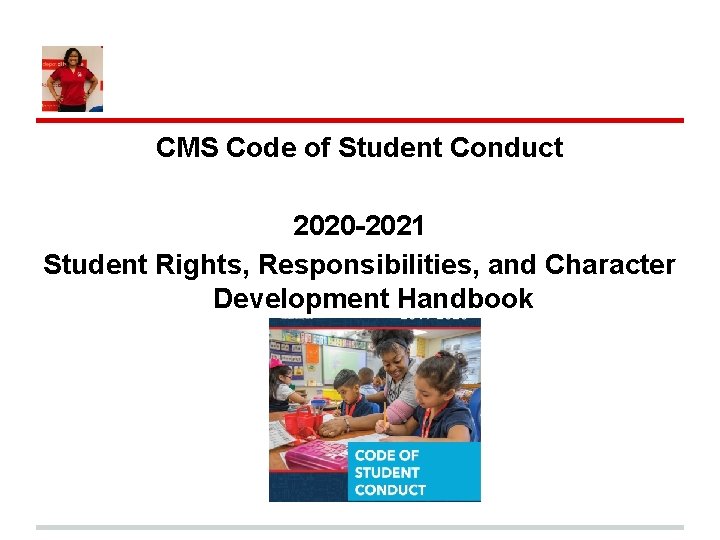
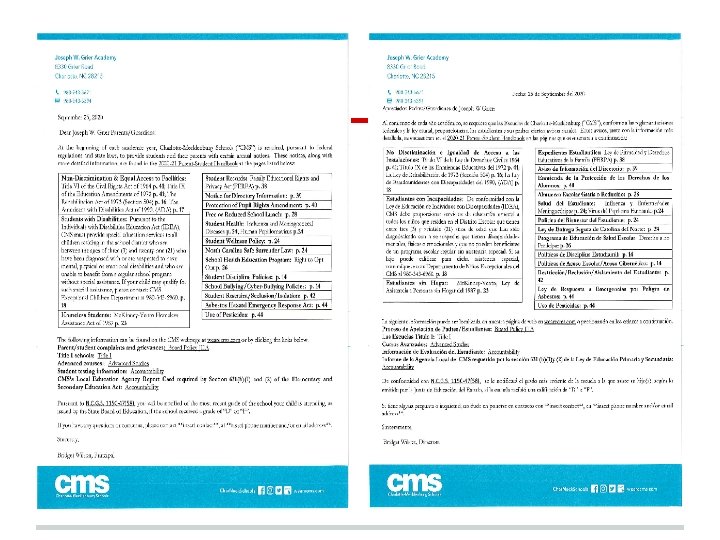
CMS Code of Student Conduct 2020 -2021 Student Rights, Responsibilities, and Character Development Handbook
• Questions? Please e-mail me at bridget. Wilson@cms. k 12. nc. us or Jacqueline. taylor@cms. k 12. nc. us Thank you for your partnership! Principal Wilson
Learning Compact ● Please click the link below to complete the students Learning Compact indicating you and your child have reviewed the document. ● https: //docs. google. com/forms/d/e/1 FAIp. QLSf. Uu. Epm 8 c. E 4 ho 8 YHFkk. B_ZGL_CS 2 q. Nu. VJ 9 q. IF 3 Tx. Wa. RZs. Tnw/viewform? usp=sf_link