
Joseph Campbells use of Jungian Archetypes and the
Joseph Campbell’s use of Jungian Archetypes and the Formation of the Western Literary Canon Updated, Fall 2018
The Narrative Formula � In EVERY story of the Western Literary Canon, there are 7 archetypal figures represented. � *Western = Europe, North & South America � *Literary = Quality novels and poetry � *Canon = Collection � *Archetypal = An original symbol or person that (or who) is instantly recognizable and may be copied or patterned. E. g. = Mother ? Father ? Old Wise Man The 7 Literary Archetypes: 1. Hero 2. Mentor 3. Threshold Guardian(s) 4. Herald 5. Shape-Shifter 6. Trickster 7. Shadow
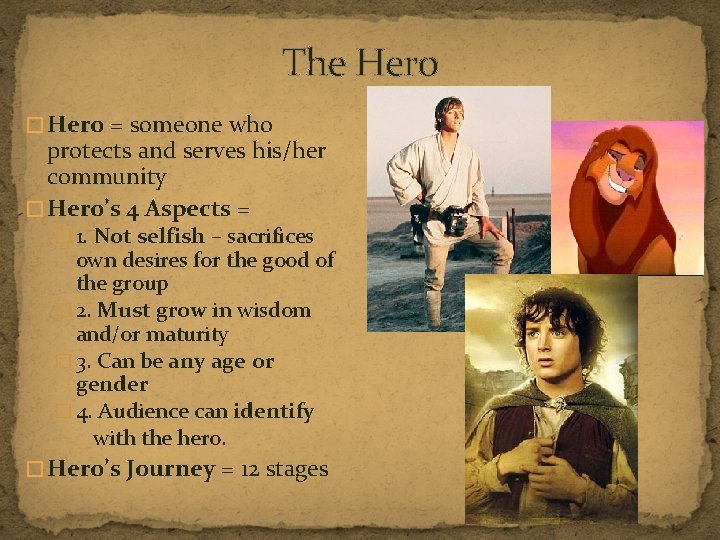
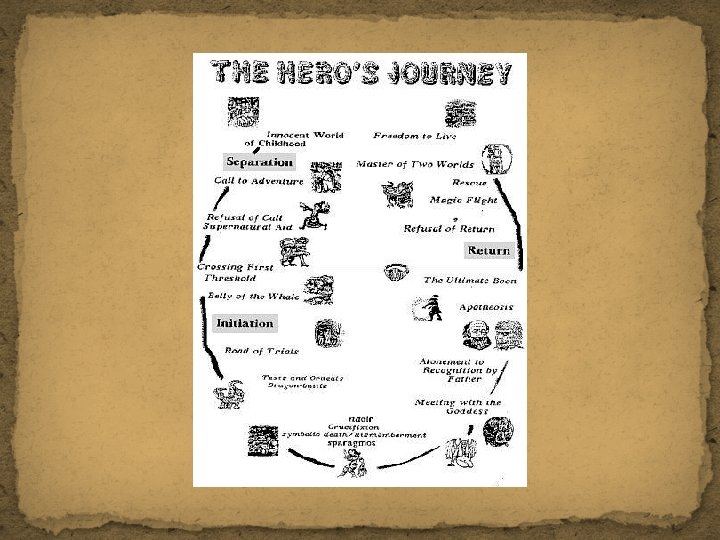
The Hero � Hero = someone who protects and serves his/her community � Hero’s 4 Aspects = � 1. Not selfish – sacrifices own desires for the good of the group � 2. Must grow in wisdom and/or maturity � 3. Can be any age or gender � 4. Audience can identify with the hero. � Hero’s Journey = 12 stages
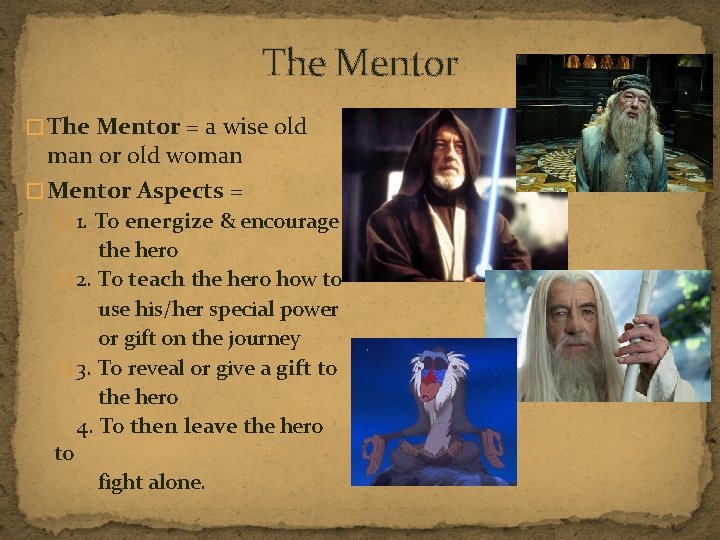
The Mentor � The Mentor = a wise old man or old woman � Mentor Aspects = � 1. To energize & encourage the hero � 2. To teach the hero how to use his/her special power or gift on the journey � 3. To reveal or give a gift to the hero 4. To then leave the hero to fight alone.
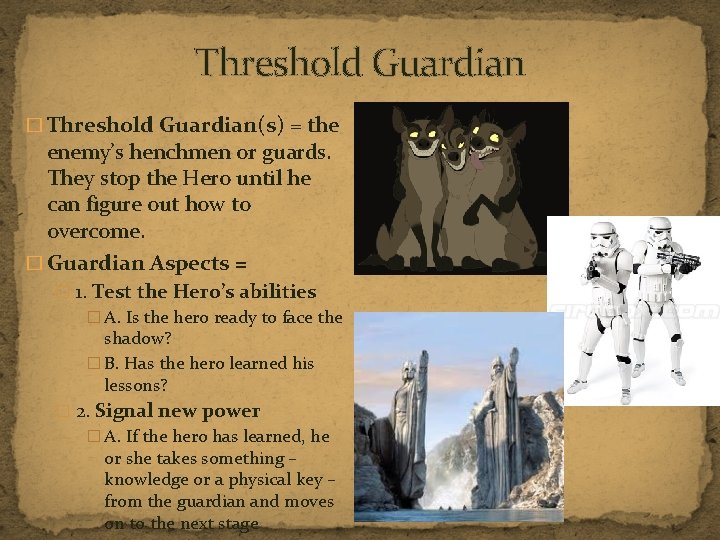
Threshold Guardian � Threshold Guardian(s) = the enemy’s henchmen or guards. They stop the Hero until he can figure out how to overcome. � Guardian Aspects = � 1. Test the Hero’s abilities � A. Is the hero ready to face the shadow? � B. Has the hero learned his lessons? � 2. Signal new power � A. If the hero has learned, he or she takes something – knowledge or a physical key – from the guardian and moves on to the next stage
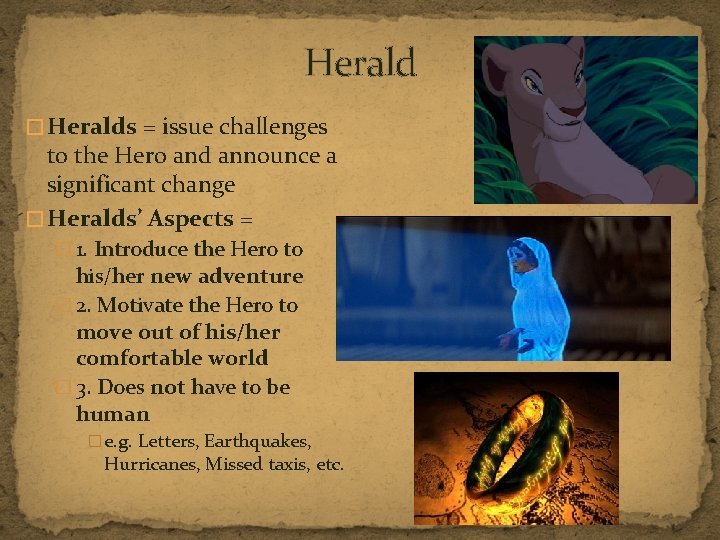
Herald � Heralds = issue challenges to the Hero and announce a significant change � Heralds’ Aspects = � 1. Introduce the Hero to his/her new adventure � 2. Motivate the Hero to move out of his/her comfortable world � 3. Does not have to be human � e. g. Letters, Earthquakes, Hurricanes, Missed taxis, etc.
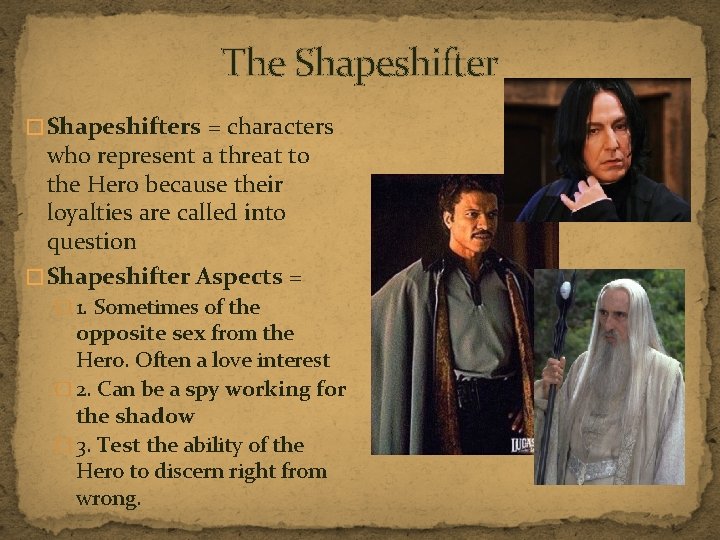
The Shapeshifter � Shapeshifters = characters who represent a threat to the Hero because their loyalties are called into question � Shapeshifter Aspects = � 1. Sometimes of the opposite sex from the Hero. Often a love interest � 2. Can be a spy working for the shadow � 3. Test the ability of the Hero to discern right from wrong.
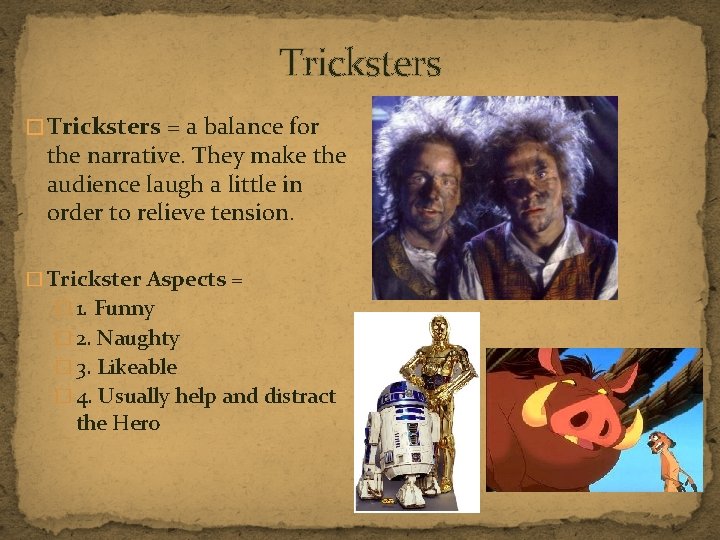
Tricksters � Tricksters = a balance for the narrative. They make the audience laugh a little in order to relieve tension. � Trickster Aspects = � 1. Funny � 2. Naughty � 3. Likeable � 4. Usually help and distract the Hero
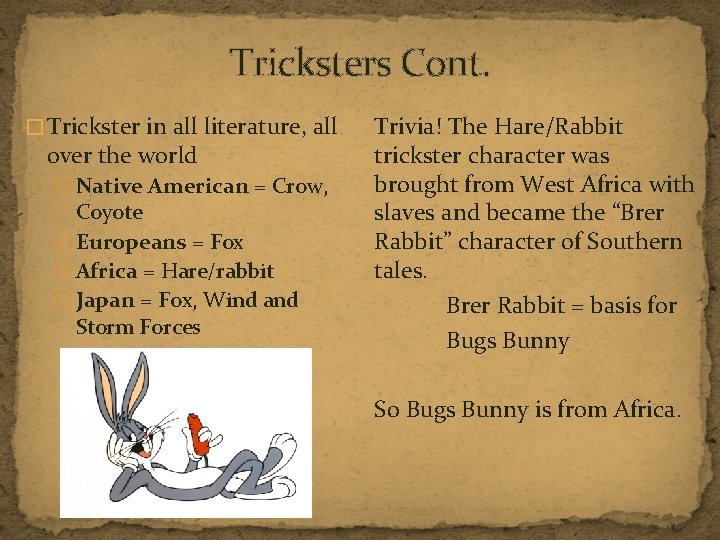
Tricksters Cont. � Trickster in all literature, all over the world � Native American = Crow, Coyote � Europeans = Fox � Africa = Hare/rabbit � Japan = Fox, Wind and Storm Forces Trivia! The Hare/Rabbit trickster character was brought from West Africa with slaves and became the “Brer Rabbit” character of Southern tales. Brer Rabbit = basis for Bugs Bunny So Bugs Bunny is from Africa.
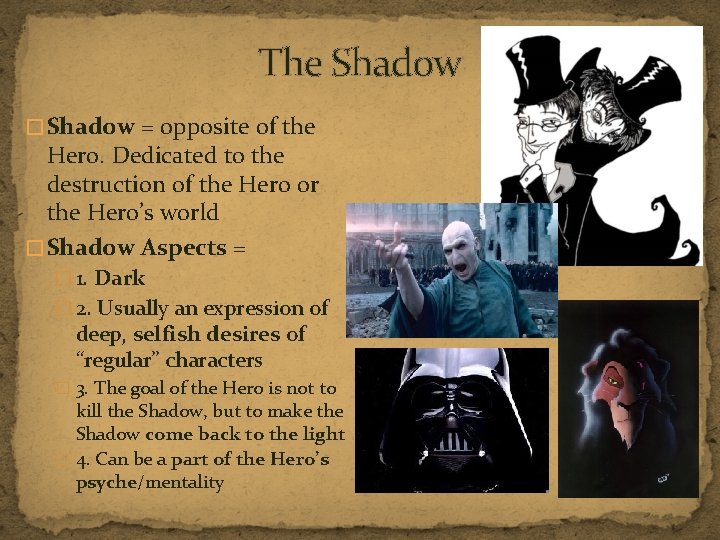
The Shadow � Shadow = opposite of the Hero. Dedicated to the destruction of the Hero or the Hero’s world � Shadow Aspects = � 1. Dark � 2. Usually an expression of deep, selfish desires of “regular” characters � 3. The goal of the Hero is not to kill the Shadow, but to make the Shadow come back to the light � 4. Can be a part of the Hero’s psyche/mentality
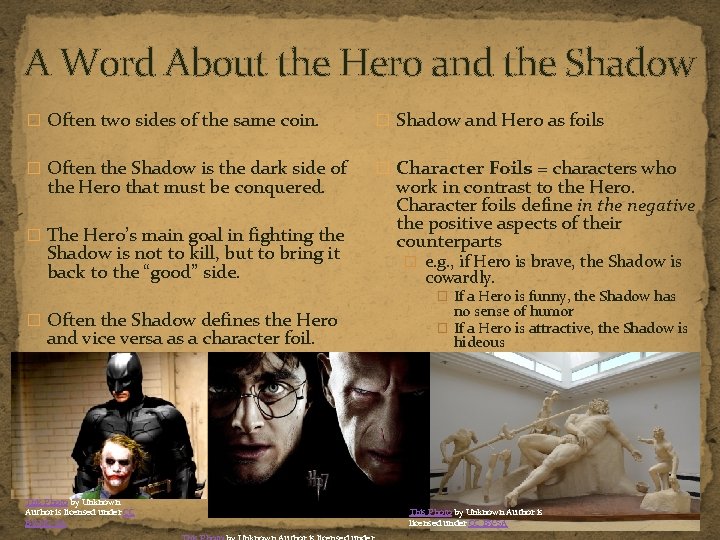
A Word About the Hero and the Shadow � Often two sides of the same coin. � Shadow and Hero as foils � Often the Shadow is the dark side of � Character Foils = characters who the Hero that must be conquered. � The Hero’s main goal in fighting the Shadow is not to kill, but to bring it back to the “good” side. work in contrast to the Hero. Character foils define in the negative the positive aspects of their counterparts � e. g. , if Hero is brave, the Shadow is cowardly. � If a Hero is funny, the Shadow has � Often the Shadow defines the Hero and vice versa as a character foil. This Photo by Unknown Author is licensed under CC BY-NC-SA no sense of humor � If a Hero is attractive, the Shadow is hideous This Photo by Unknown Author is licensed under CC BY-SA
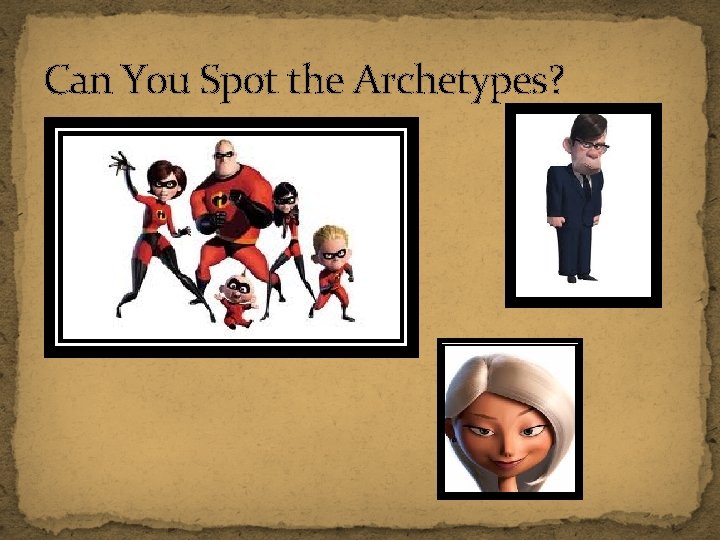
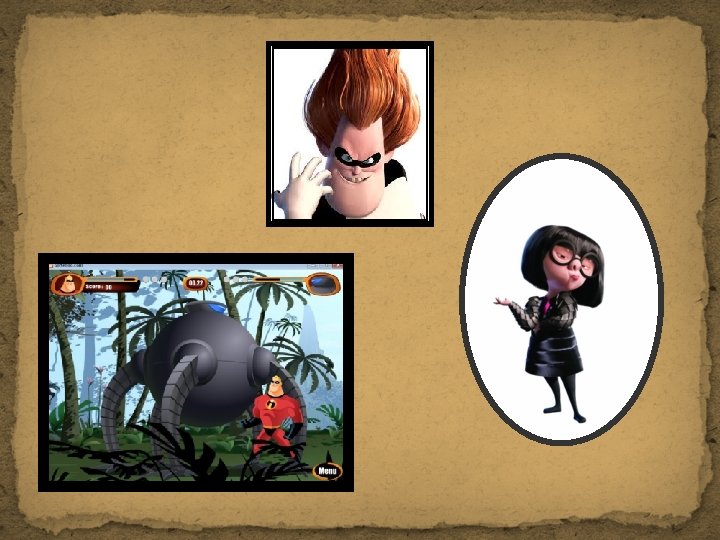
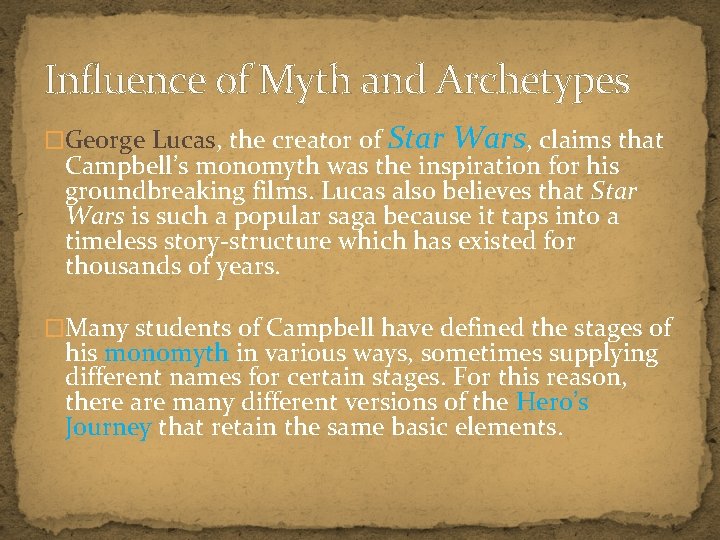
Can You Spot the Archetypes?
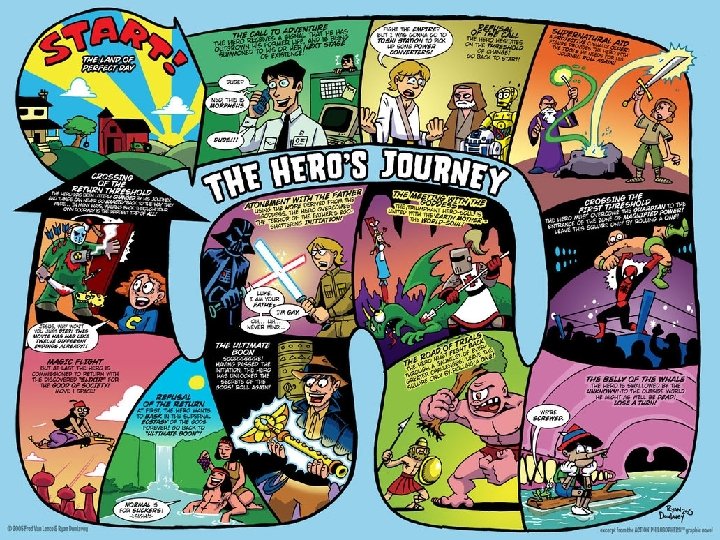
Influence of Myth and Archetypes �George Lucas, the creator of Star Wars, claims that Campbell’s monomyth was the inspiration for his groundbreaking films. Lucas also believes that Star Wars is such a popular saga because it taps into a timeless story-structure which has existed for thousands of years. �Many students of Campbell have defined the stages of his monomyth in various ways, sometimes supplying different names for certain stages. For this reason, there are many different versions of the Hero’s Journey that retain the same basic elements.
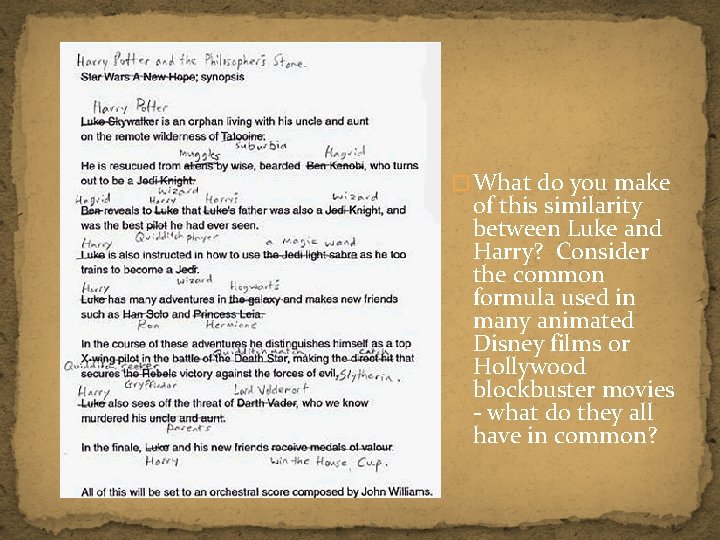
� What do you make of this similarity between Luke and Harry? Consider the common formula used in many animated Disney films or Hollywood blockbuster movies - what do they all have in common?
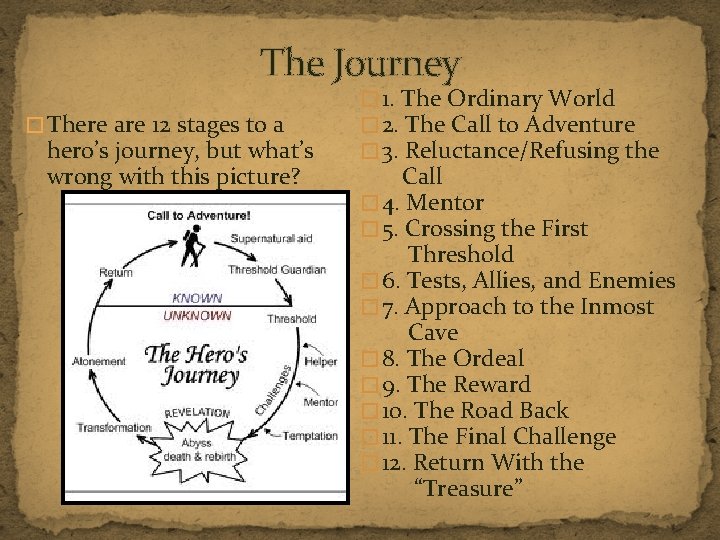
The Journey � There are 12 stages to a hero’s journey, but what’s wrong with this picture? � 1. The Ordinary World � 2. The Call to Adventure � 3. Reluctance/Refusing the Call � 4. Mentor � 5. Crossing the First Threshold � 6. Tests, Allies, and Enemies � 7. Approach to the Inmost Cave � 8. The Ordeal � 9. The Reward � 10. The Road Back � 11. The Final Challenge � 12. Return With the “Treasure”
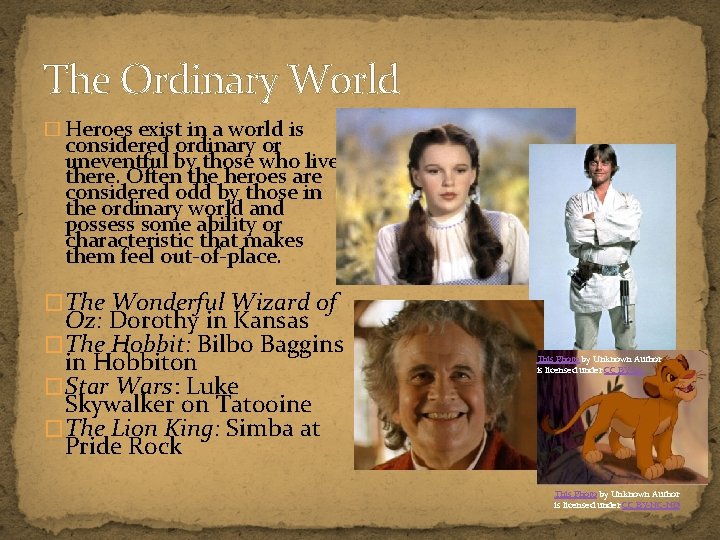
The Ordinary World � Heroes exist in a world is considered ordinary or uneventful by those who live there. Often the heroes are considered odd by those in the ordinary world and possess some ability or characteristic that makes them feel out-of-place. �The Wonderful Wizard of Oz: Dorothy in Kansas �The Hobbit: Bilbo Baggins in Hobbiton �Star Wars: Luke Skywalker on Tatooine �The Lion King: Simba at Pride Rock This Photo by Unknown Author is licensed under CC BY-SA This Photo by Unknown Author is licensed under CC BY-NC-ND
The Call to Adventure � For heroes to begin their journeys, they must be called away from the ordinary world. Fantastic quests don’t happen in everyday life. Heroes must be removed from their typical environment. Most heroes show a reluctance to leave their home, their friends, and their life to journey on a quest. But in the end they accept their destiny. � Usually there is a discovery, some event, or some danger that starts them on the heroic path. Heroes find a mystic object or discover their world is in danger. In some cases, heroes happen upon their quest by accident. Campbell puts it like this, “A blunder—the merest chance—reveals an unsuspected world. ”
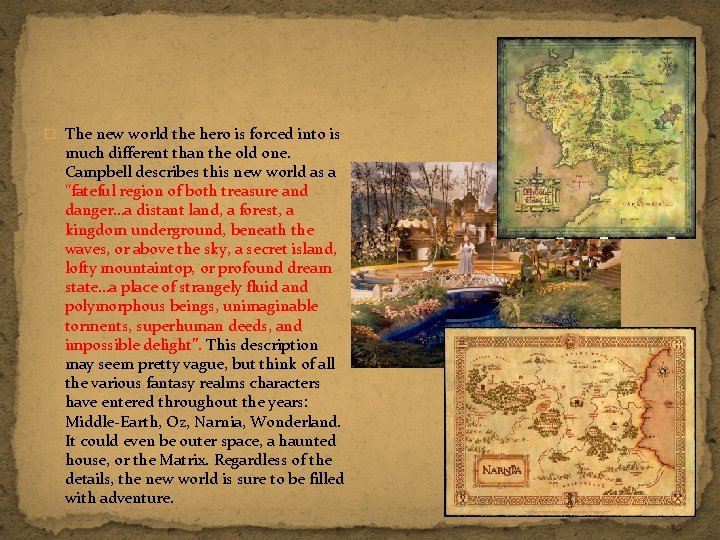
� The new world the hero is forced into is much different than the old one. Campbell describes this new world as a “fateful region of both treasure and danger…a distant land, a forest, a kingdom underground, beneath the waves, or above the sky, a secret island, lofty mountaintop, or profound dream state…a place of strangely fluid and polymorphous beings, unimaginable torments, superhuman deeds, and impossible delight”. This description may seem pretty vague, but think of all the various fantasy realms characters have entered throughout the years: Middle-Earth, Oz, Narnia, Wonderland. It could even be outer space, a haunted house, or the Matrix. Regardless of the details, the new world is sure to be filled with adventure.
Refusal of the Call �During the Call to Adventure heroes are given a task or quest which only they can complete. They are faced with a choice: accept the quest or deny it. Their choice might seem like a no-brainer. If they don’t accept the quest, there won’t be much of a story—or will there? Actually, there are stories where heroes don’t accept their destinies. When this happens, the stage is set for disaster. There’s a reason why the powers-that-be have chosen a particular hero. A refusal of the quest only brings trouble.
Refusal Means Trouble � King Minos, the monarch of Crete who antagonizes the Greek hero Theseus, does not do what the gods ask of him. Poseidon, Lord of the Seas, sends him a beautiful white bull. The god’s only order is that Minos must sacrifice the creature back to him. After seeing the magnificent beast, Minos decides he just can’t bring himself to do what the god asks and keeps the bull as a personal trophy. � Enraged, Poseidon vows revenge and causes Minos’ wife to burn with lust for her husband’s prized beast. The rest of this story is taboo and results in the birth of the Minotaur, a creature half-bull, half-human, a curse to his father King Minos.
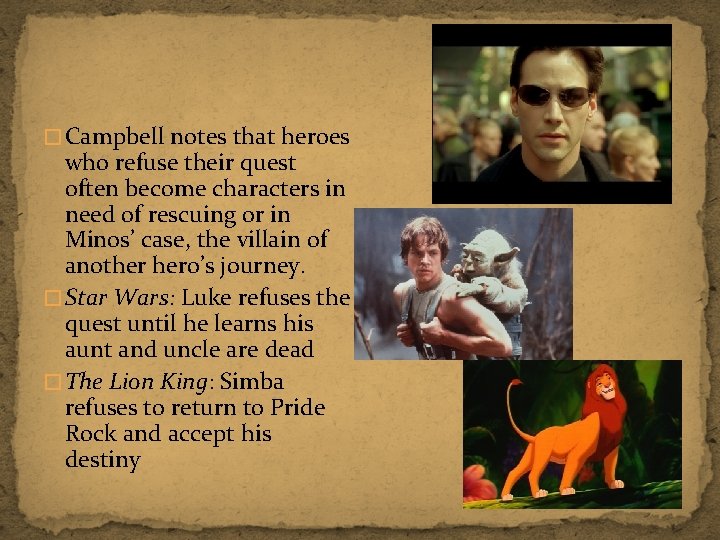
� Campbell notes that heroes who refuse their quest often become characters in need of rescuing or in Minos’ case, the villain of another hero’s journey. � Star Wars: Luke refuses the quest until he learns his aunt and uncle are dead � The Lion King: Simba refuses to return to Pride Rock and accept his destiny
The Journey Begins… � ACCEPTING THE CALL: Once the adventure is accepted, the heroes advance into the next stage of their journey. � ENTERING THE UNKNOWN : As they embark on their journey, the heroes enter a world they have never experienced before. Very often it is filled with supernatural creatures, breathtaking sights, and the constant threat of death. Unlike the heroes’ home, this outside world has its own rules, and they quickly learns to respect these rules as their endurance, strength, and mettle are tested time and time again. After all, it is not the end of the journey which teaches, but the journey itself. � The Wizard of Oz: Dorothy must learn the rules of Oz � The Matrix: Neo must come to grips with the realities and unrealities of the Matrix � Lord of the Rings: Frodo has to navigate the world outside the Shire
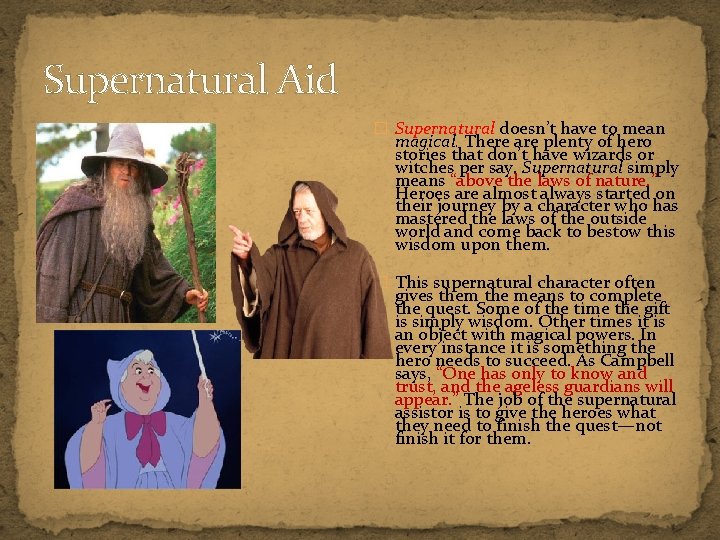
Supernatural Aid � Supernatural doesn’t have to mean magical. There are plenty of hero stories that don’t have wizards or witches per say. Supernatural simply means “above the laws of nature. ” Heroes are almost always started on their journey by a character who has mastered the laws of the outside world and come back to bestow this wisdom upon them. � This supernatural character often gives them the means to complete the quest. Some of the time the gift is simply wisdom. Other times it is an object with magical powers. In every instance it is something the hero needs to succeed. As Campbell says, “One has only to know and trust, and the ageless guardians will appear. ” The job of the supernatural assistor is to give the heroes what they need to finish the quest—not finish it for them.
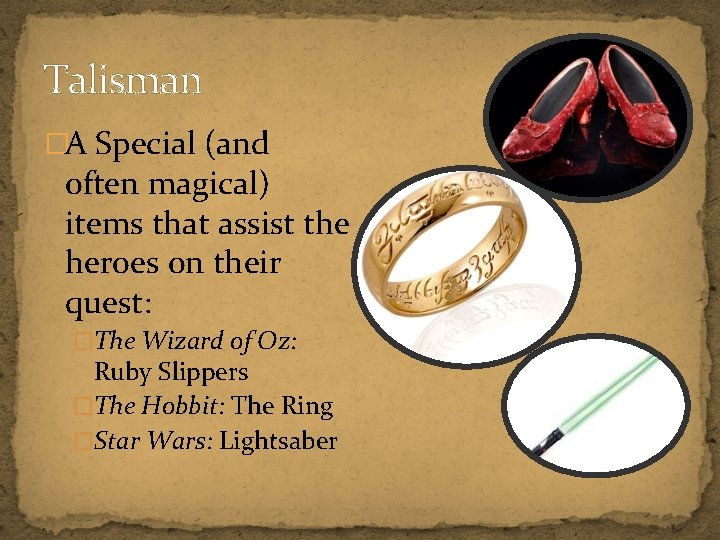
Talisman �A Special (and often magical) items that assist the heroes on their quest: �The Wizard of Oz: Ruby Slippers �The Hobbit: The Ring �Star Wars: Lightsaber
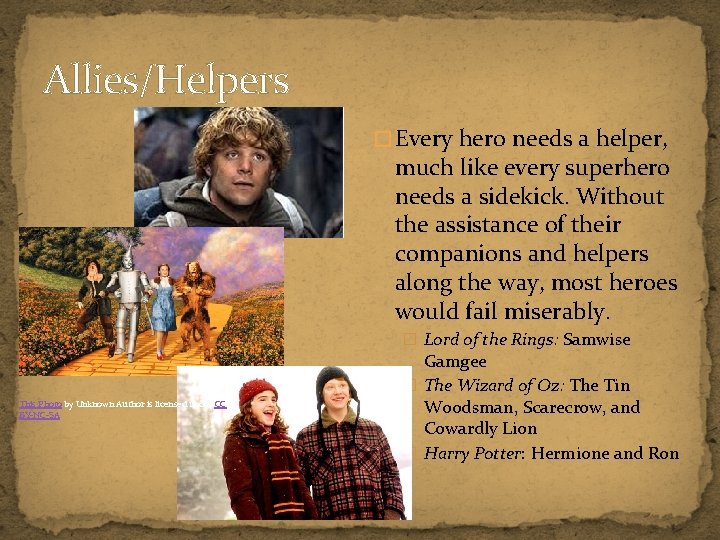
Allies/Helpers � Every hero needs a helper, much like every superhero needs a sidekick. Without the assistance of their companions and helpers along the way, most heroes would fail miserably. � Lord of the Rings: Samwise This Photo by Unknown Author is licensed under CC BY-NC-SA Gamgee � The Wizard of Oz: The Tin Woodsman, Scarecrow, and Cowardly Lion � Harry Potter: Hermione and Ron
Tests and the Supreme Ordeal � The heroes progress through a series of tests, a set of obstacles that make them stronger, preparing them for their final showdown. At long last they reach the Supreme Ordeal, the obstacle they have journeyed so far to overcome. � All the heroes’ training and toil comes into play now. The journey has hardened them, and it’s time for them to show their prowess. Once this obstacle is overcome, the tension will be relieved. The worst is passed, and the quest, while not officially over, has succeeded. � Star Wars: Blowing up the Death Star � Lord of the Rings: Mount Doom � The Wizard of Oz: Defeating the Wicked Witch
Reward and the Journey Home � Typically, there is a reward �The Hobbit: The Battle of Five Armies �The Lord of the Rings: Return to Hobbiton �The Odyssey: Return to Ithaca given to heroes for passing the Supreme Ordeal. It could be a kingdom. It could be the hand of a beautiful princess. It could be the Holy Grail. Whatever it is, it is a reward for the heroes’ endurance and strength. � After the heroes complete the Supreme Ordeal and have the reward firmly in hand, all that is left is for them to return home. Just because the majority of the adventure has passed doesn’t mean that the return journey will be smooth sailing. There are still lesser homebound obstacles to overcome.
Master of Two Worlds/Restoring � Success on the hero’s quest is life-changing, for them and often for many others. By achieving victory, they have changed or preserved their original world. Often they return with “the exilir, ” an object or personal ability that allows them to save their world. � The heroes have also grown in spirit and strength. They have proved themselves worthy for marriage, kingship, or queenship. Their mastery of the outside world qualifies them to be giants in their own. �Lord of the Rings: Frodo saves the Shire �The Wizard of Oz: Dorothy rids Oz of the Wicked Witch �Odyssey rids Ithaca of the suitors
The Hero’s Journey in the Movies �https: //www. youtube. com/watch? v=3 RRWm. Li. YTZk
What Would YOUR Hero’s Journey Look Like? � Gather a group of no more than 3 students � Outline a hero’s journey involving all character types and steps � Can be a book, movie, graphic novel, anime, or video game narrative � Must provide examples for all archetypes and stepsexplain as though your reader has never seen or heard of your example before
- Slides: 33