
Jonathan Welburn Justin Grana Karen Schwindt Cyber Deterrence
Jonathan Welburn • Justin Grana • Karen Schwindt Cyber Deterrence or: How We Learned to Stop Worrying and Love The Signal Office of the Secretary of Defense by the RAND National Security Research Division presented to the SMA General Speaker Series Prepared for the 1
The current state of cyberspace Nation-state and non-state actors continue to target the U. S. through cyber means Targeting is no longer contained to cyberspace and threatens key institutions and critical infrastructure Cyber security best practices have yet to halt increased aggression U. S. actions in cyberspace have not deterred cyber attacks There is a lack of supporting policies, authorities 2
The need for deterrence Deterrence – a policy aiming to dissuade adversaries from attack under the threat of consequence – should be employed when defense is not sufficient A cyber deterrence framework should be developed to deter attacks that enhanced security protocols can not The need for cyber deterrence has drawn key attention “The supreme art of war is to subdue the enemy without fighting. “ Sun Tzu, The Art of War 3
Calls for cyber deterrence SASC comments on FY 19 NDAA, Sec 1621: “The committee has also placed a strong emphasis on the need for developing a comprehensive cyber deterrence strategy. Unfortunately, the committee believes the responses to those requests have been insufficient hitherto and incommensurate with the threat we face in the cyber domain. ” 4
Calls for cyber deterrence NDAA Sec 1636: “It shall be the policy of the United States, with respect to matters pertaining to cyberspace, cybersecurity and cyber warfare, that the United States should employ all instruments of national power, including the use of offensive cyber capabilities, to deter if possible, and respond to when necessary, all cyber attacks or other malicious cyber activities of foreign powers that target United States interests…” Sec 1636 (b)-(e) call for a need to determine – Response options – Denial options – Cost-imposition options – Multi-prong response options 5
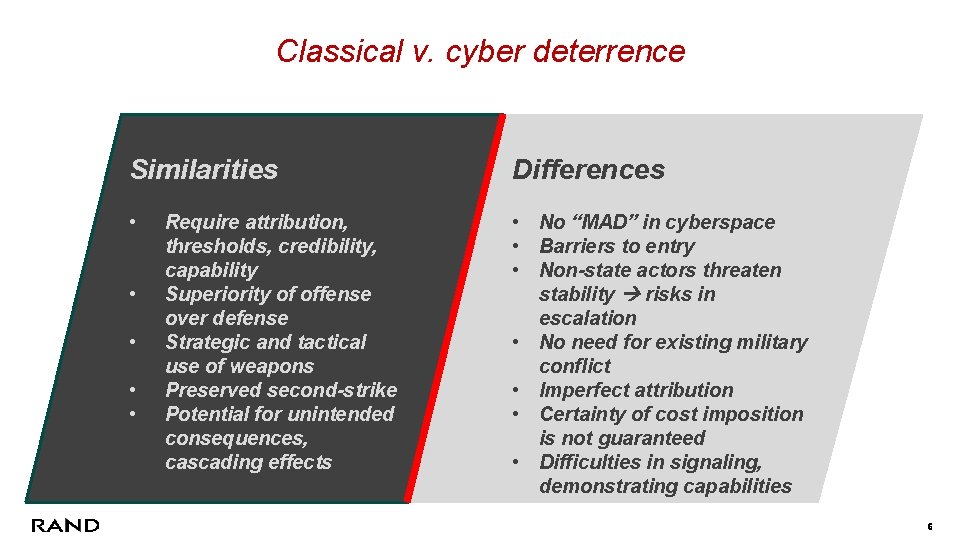
Classical v. cyber deterrence Similarities Differences • • No “MAD” in cyberspace • Barriers to entry • Non-state actors threaten stability risks in escalation • No need for existing military conflict • Imperfect attribution • Certainty of cost imposition is not guaranteed • Difficulties in signaling, demonstrating capabilities • • Require attribution, thresholds, credibility, capability Superiority of offense over defense Strategic and tactical use of weapons Preserved second-strike Potential for unintended consequences, cascading effects 6
The ambiguities of cyber deterrence stand in stark contrast with the clarities of nuclear deterrence. attribution signaling 7
Imperfect attribution does not prevent at least some degree of deterrence by punishment in cyberspace. Deterrence by denial likely will be the anchor of a cyber deterrence strategy. 8
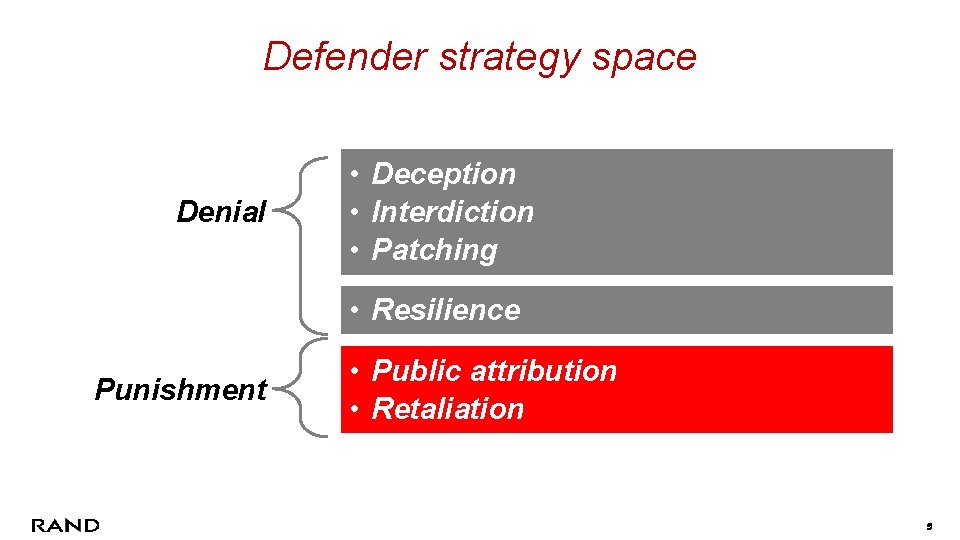
Defender strategy space Denial • Deception • Interdiction • Patching • Resilience Punishment • Public attribution • Retaliation 9
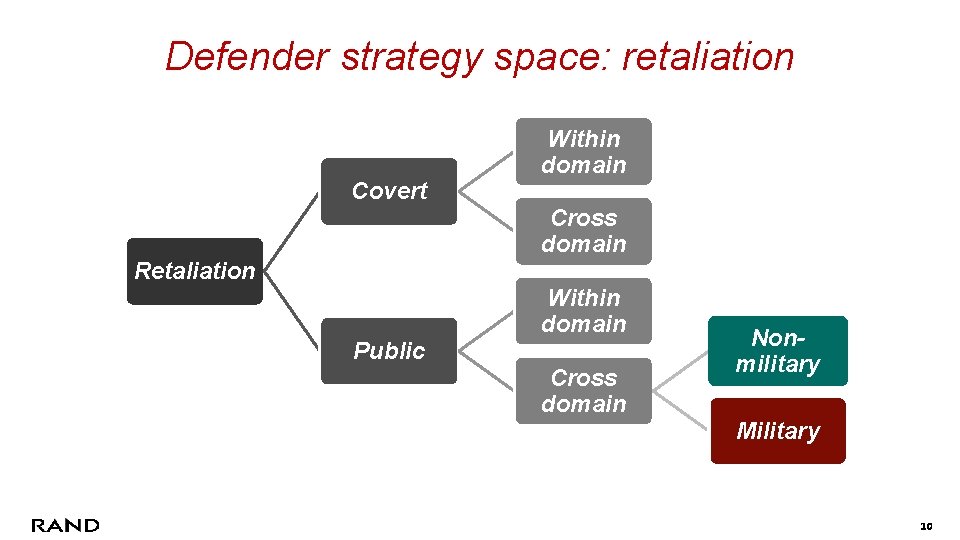
Defender strategy space: retaliation Within domain Covert Cross domain Retaliation Within domain Public Cross domain Nonmilitary Military 10
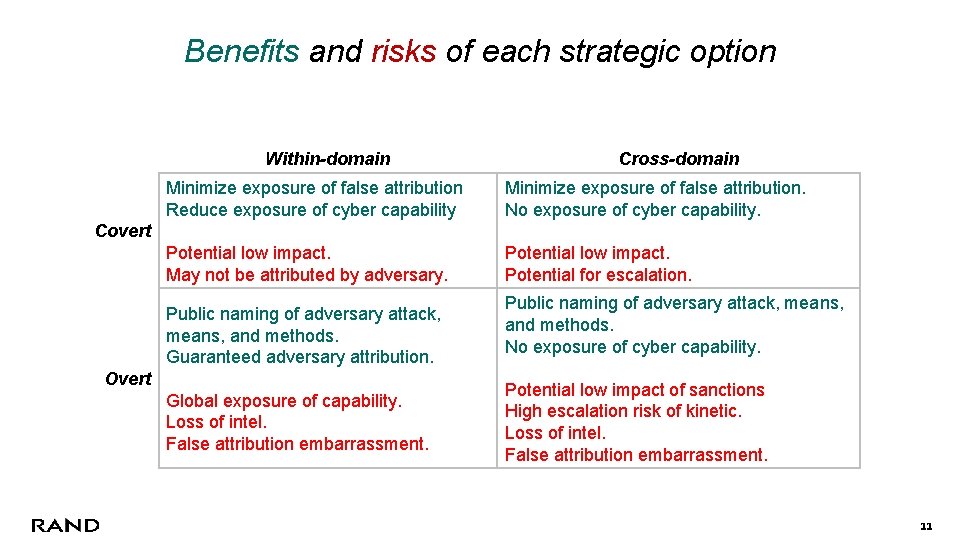
Benefits and risks of each strategic option Within-domain Cross-domain Minimize exposure of false attribution Reduce exposure of cyber capability Minimize exposure of false attribution. No exposure of cyber capability. Potential low impact. May not be attributed by adversary. Potential low impact. Potential for escalation. Covert Public naming of adversary attack, means, and methods. Guaranteed adversary attribution. Overt Global exposure of capability. Loss of intel. False attribution embarrassment. Public naming of adversary attack, means, and methods. No exposure of cyber capability. Potential low impact of sanctions High escalation risk of kinetic. Loss of intel. False attribution embarrassment. 11
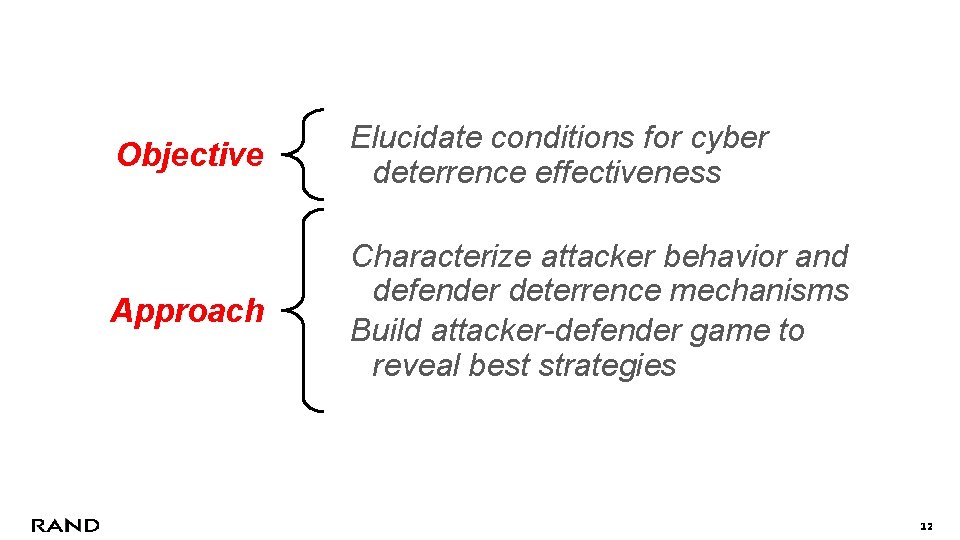
Objective Elucidate conditions for cyber deterrence effectiveness Approach Characterize attacker behavior and defender deterrence mechanisms Build attacker-defender game to reveal best strategies 12
A note on current literature Baliga, Sandeep, Ethan Bueno de Mesquita, and Alexander Wolitzky. 2019. Deterrence with Imperfect Attribution. " Working Paper. • One defender, many attackers. • Attackers don't know defender's retaliatory capability. • One attacker is selected at random and chooses whether or not to • attack. • Defender does not observe attacker's decision but a signal that is • correlated with the attacker's signal. • Defender chooses whether or not to retaliate against a specific actor. 13
A note on current literature Baliga, Sandeep, Ethan Bueno de Mesquita, and Alexander Wolitzky. 2019. Deterrence with Imperfect Attribution. " Working Paper. Result: In some cases, being able to detect more attacks without improving attribution can degrade deterrence. Question: “Would the ability to signal cyber-capability lead to coordination on a peaceful equilibrium, or to perverse incentives leading to conflict? ” 14
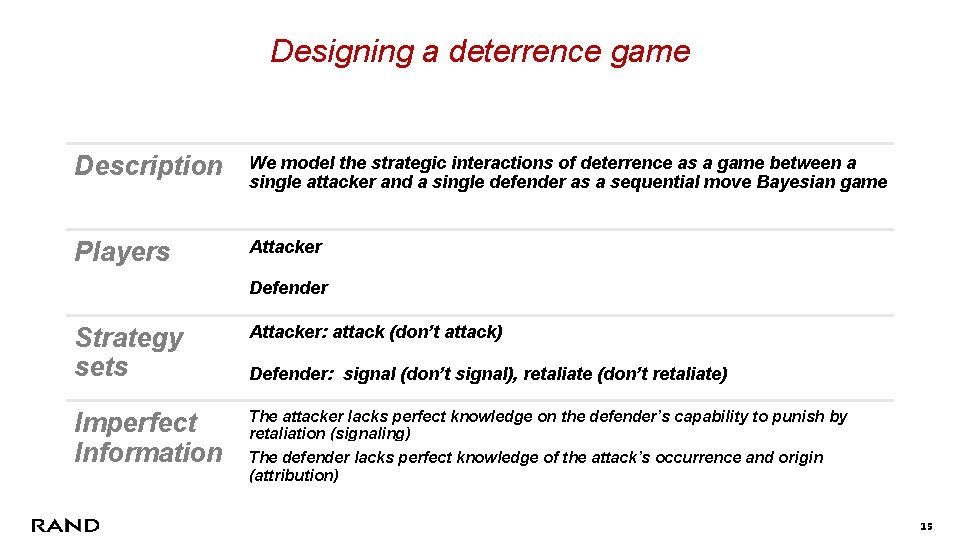
Designing a deterrence game Description We model the strategic interactions of deterrence as a game between a single attacker and a single defender as a sequential move Bayesian game Players Attacker Defender Strategy sets Attacker: attack (don’t attack) Imperfect Information The attacker lacks perfect knowledge on the defender’s capability to punish by retaliation (signaling) Defender: signal (don’t signal), retaliate (don’t retaliate) The defender lacks perfect knowledge of the attack’s occurrence and origin (attribution) 15
Attacker’s incentives The attacker receives a reward if it attacks If the attacker attacks and is retaliated against, it receives a punishment If the attacker doesn’t attack and is retaliated against, it still receives a punishment In general, the attacker wants to attack as often as possible without being retaliated against 16
Defender’s incentives The defender incurs a cost every time the attacker chooses to attack The defender accrues a reward if it successfully retaliates The defender incurs a cost if it incorrectly retaliates In general, the defender wants to limit the number of attacks, minimize the false alarm rate and retaliate against the attacker when it attacks 17
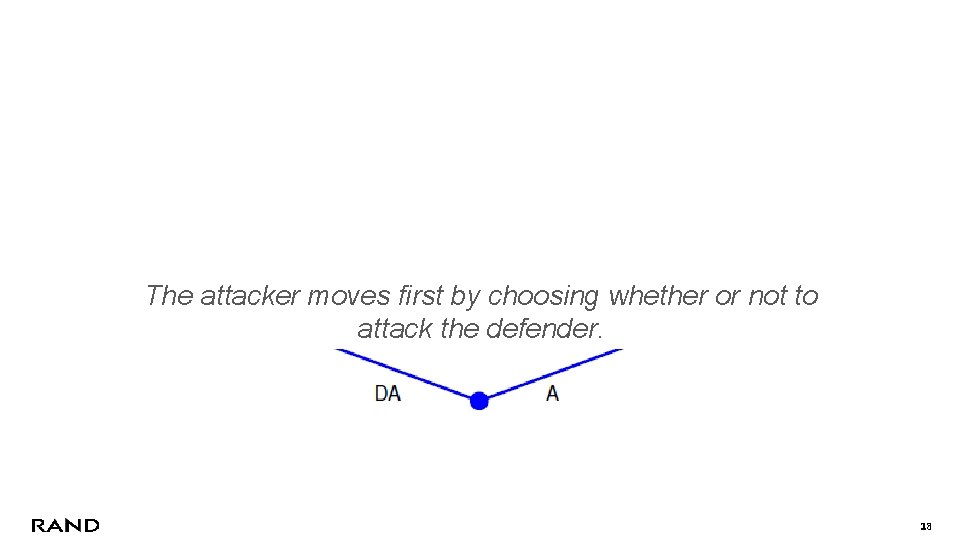
The attacker moves first by choosing whether or not to attack the defender. 18
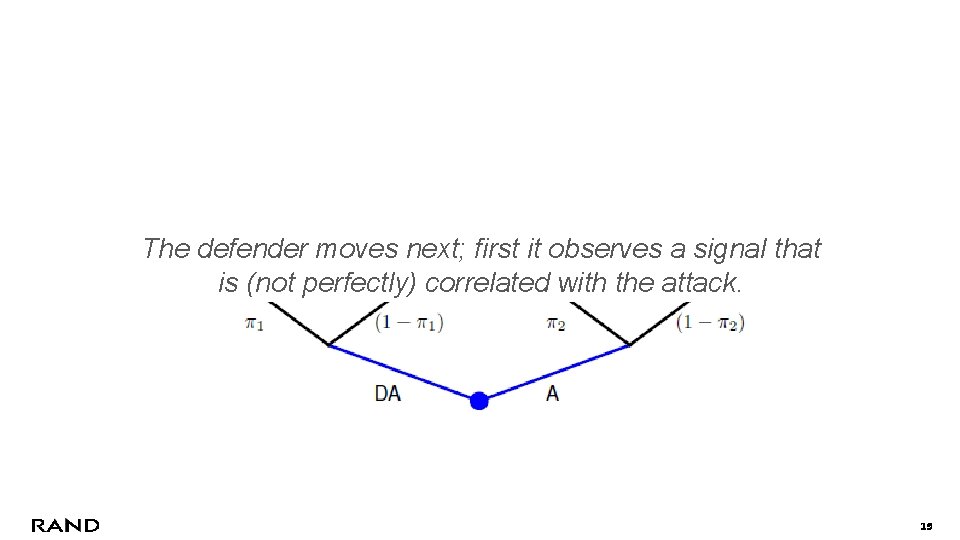
The defender moves next; first it observes a signal that is (not perfectly) correlated with the attack. 19
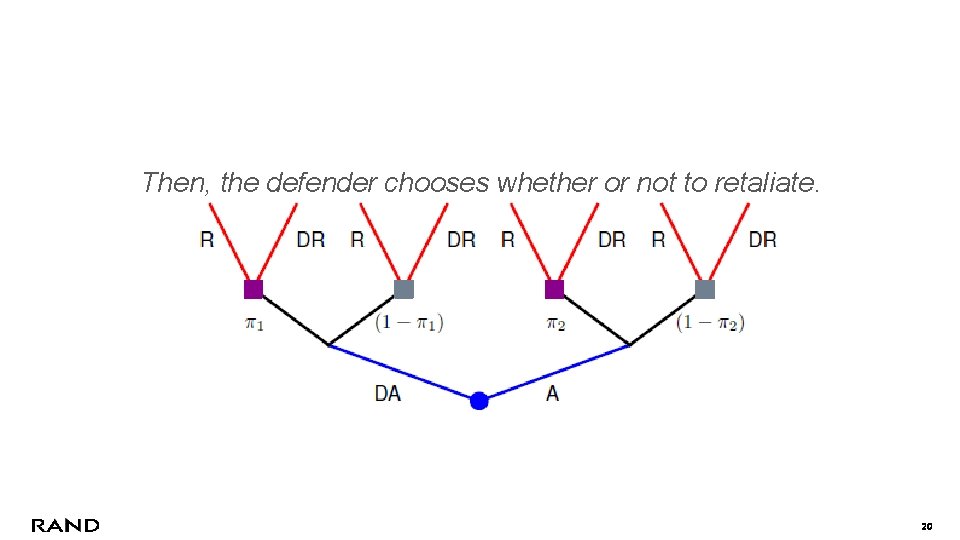
Then, the defender chooses whether or not to retaliate. 20
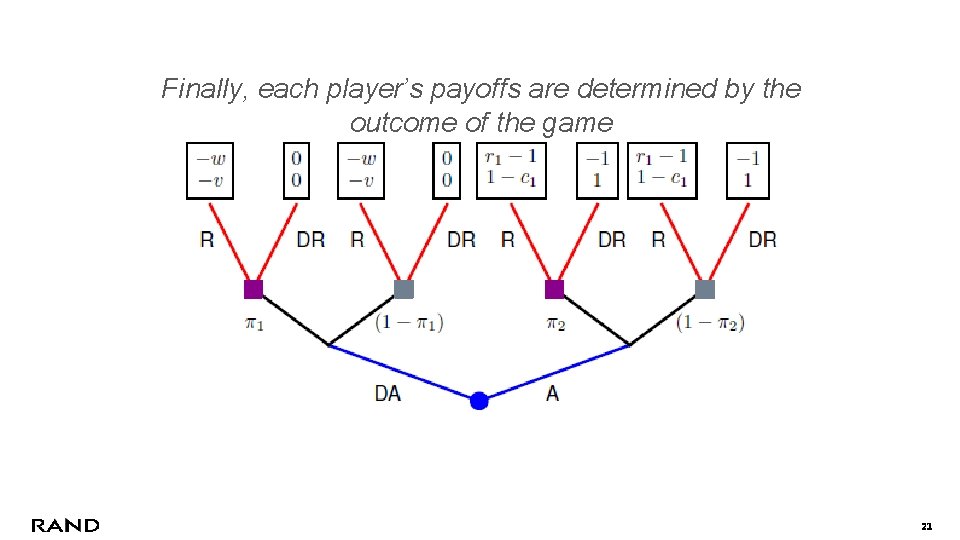
Finally, each player’s payoffs are determined by the outcome of the game 21
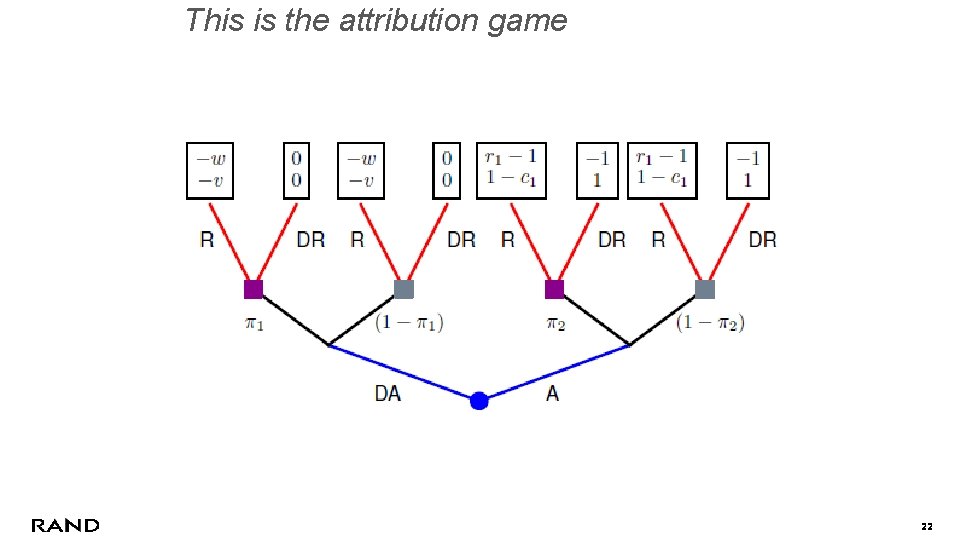
This is the attribution game with signaling 22
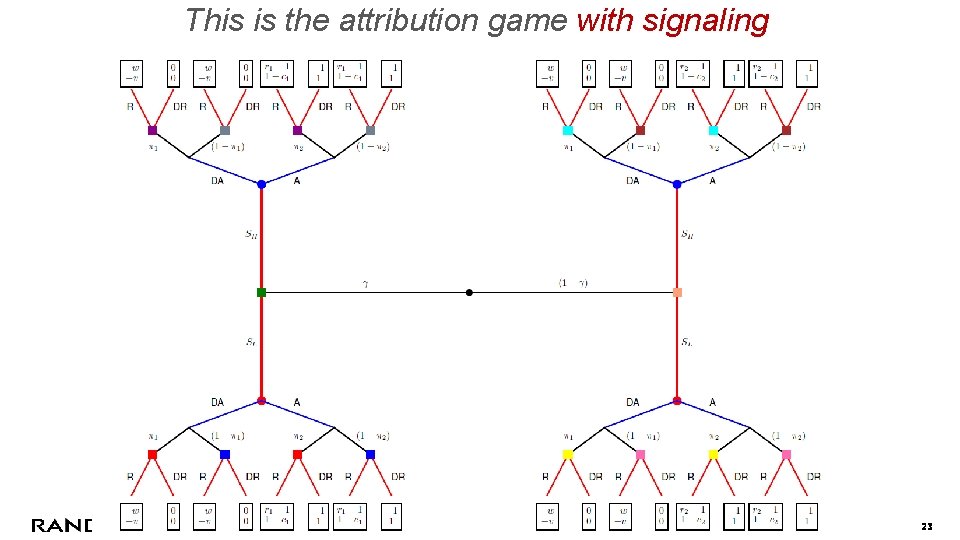
This is the attribution game with signaling 23
24
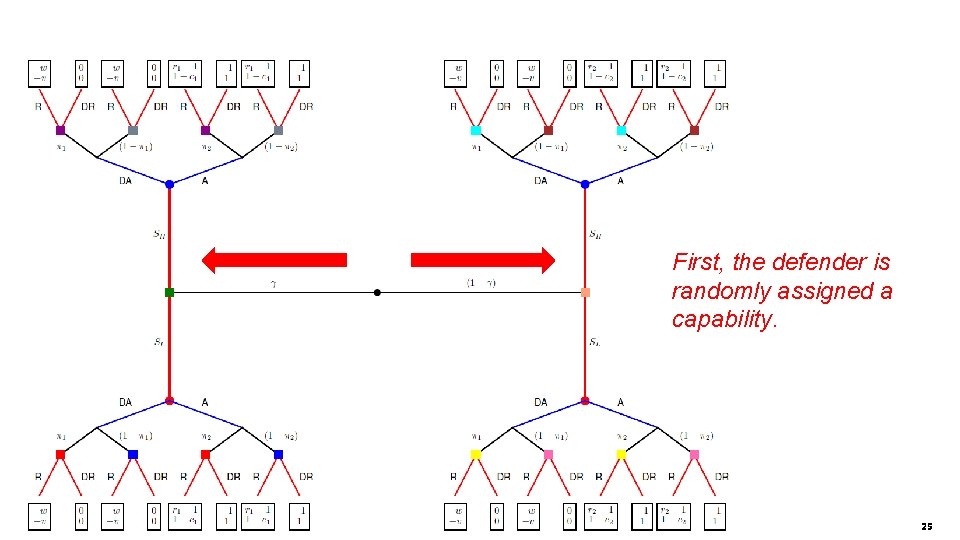
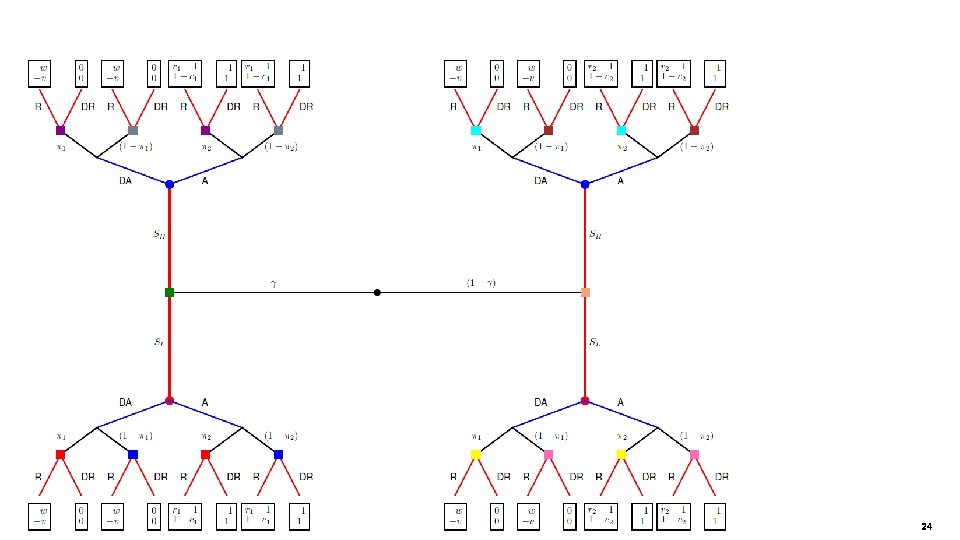
First, the defender is randomly assigned a capability. 25
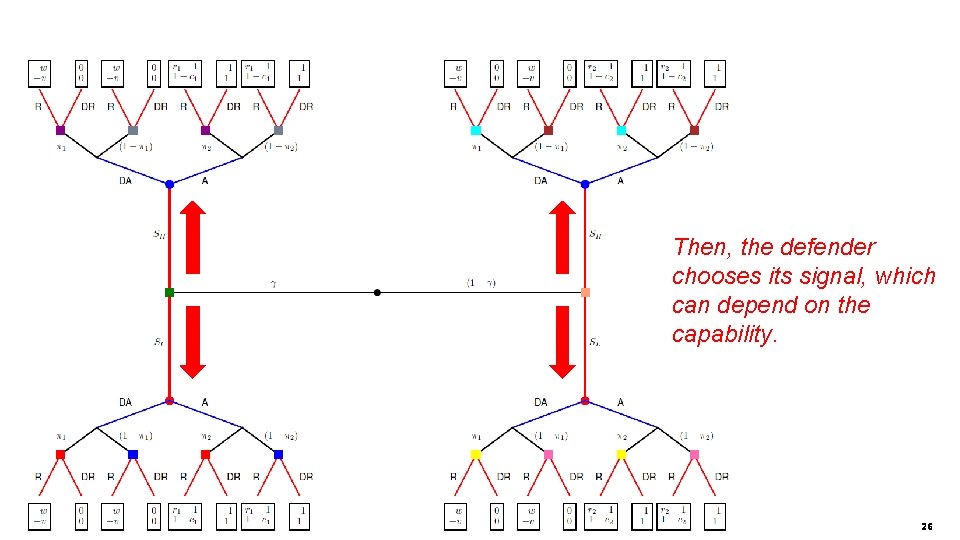
Then, the defender chooses its signal, which can depend on the capability. 26
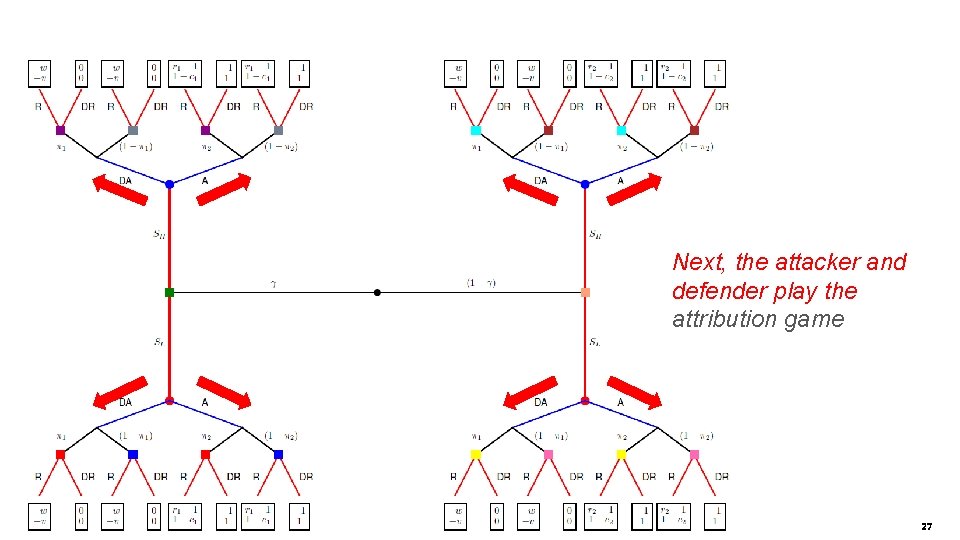
Next, the attacker and defender play the attribution game 27
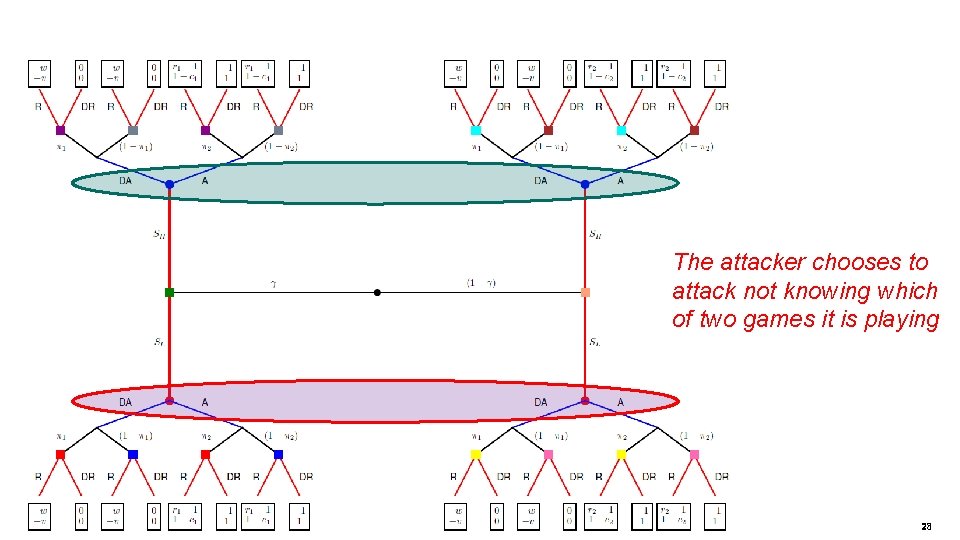
The attacker chooses to attack not knowing which of two games it is playing 28
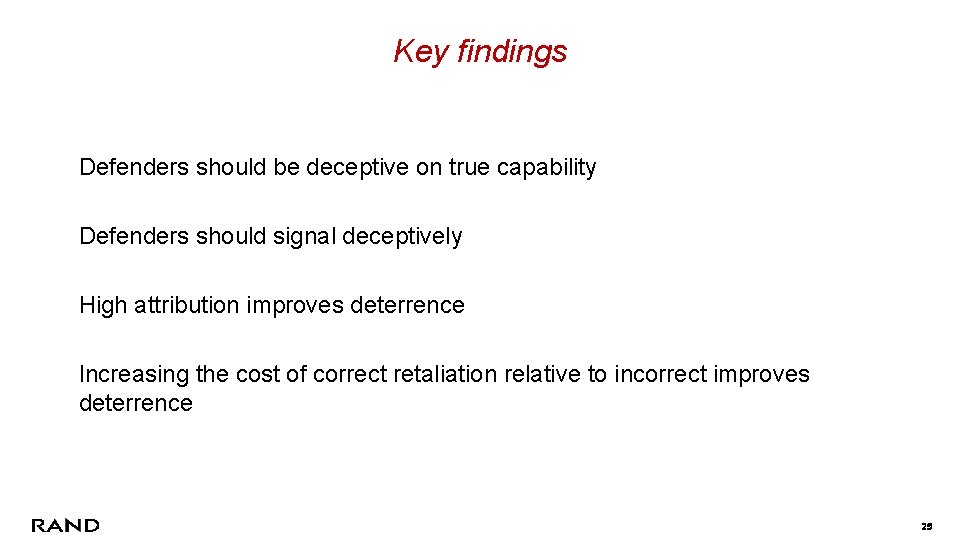
Key findings Defenders should be deceptive on true capability Defenders should signal deceptively High attribution improves deterrence Increasing the cost of correct retaliation relative to incorrect improves deterrence 29
“Appear weak when you are strong and strong when you are weak” Sun Tzu 30
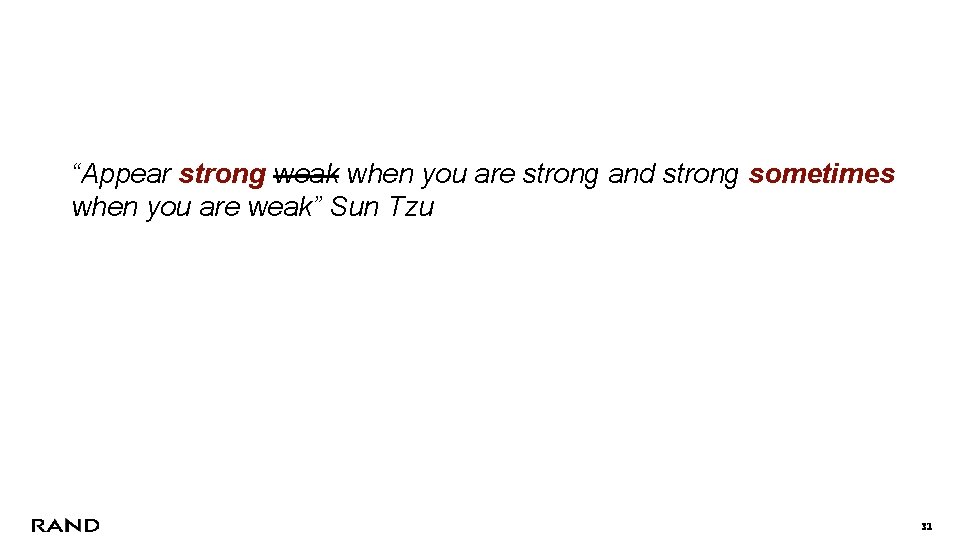
“Appear strong weak when you are strong and strong sometimes when you are weak” Sun Tzu 31
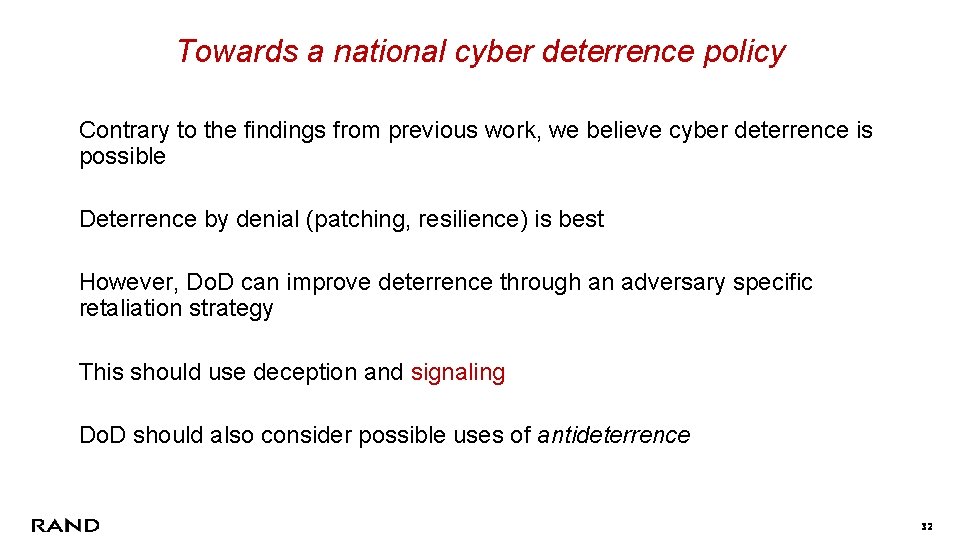
Towards a national cyber deterrence policy Contrary to the findings from previous work, we believe cyber deterrence is possible Deterrence by denial (patching, resilience) is best However, Do. D can improve deterrence through an adversary specific retaliation strategy This should use deception and signaling Do. D should also consider possible uses of antideterrence 32

jwelburn@rand. org https: //www. rand. org/pubs/working_papers/WR 1294. html 33
- Slides: 33