
Jonathan Edwards Sinners in the Hands of an


- Slides: 32
Jonathan Edwards “Sinners in the Hands of an Angry God”
For Edwards, science, reason, and observation of the universe confirmed for him the existence of God. A brilliant thinker and speaker, Edwards entered Yale at 13 and became a minister 12 years later. His passionate, yet frightening, sermons helped to bring about The Great Awakening, a time when many who attended church were not “saved” or could testify to an emotional encounter with God and His grace. “Unregenerate” Christians were those who attended church and accepted church teachings but had not been “born again” by God’s grace.
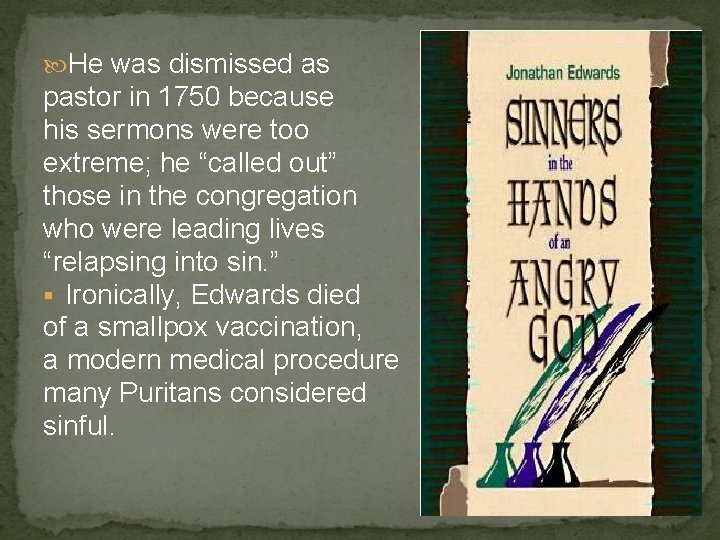
He was dismissed as pastor in 1750 because his sermons were too extreme; he “called out” those in the congregation who were leading lives “relapsing into sin. ” § Ironically, Edwards died of a smallpox vaccination, a modern medical procedure many Puritans considered sinful.
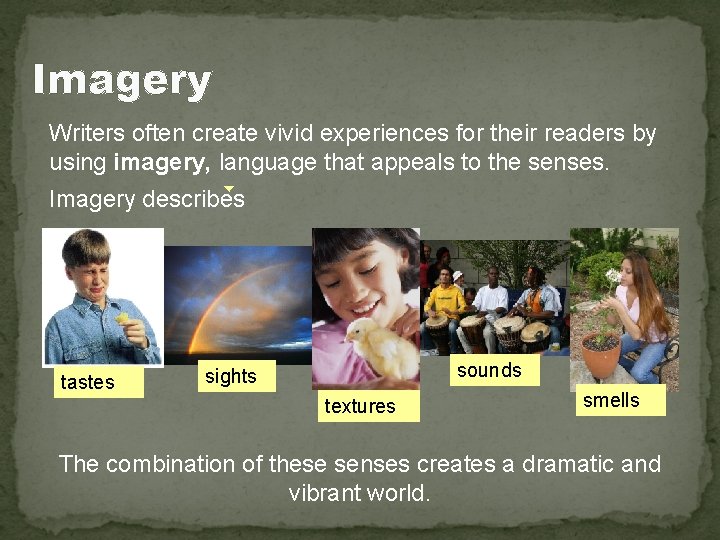
Imagery Writers often create vivid experiences for their readers by using imagery, language that appeals to the senses. Imagery describes tastes sounds sights textures smells The combination of these senses creates a dramatic and vibrant world.
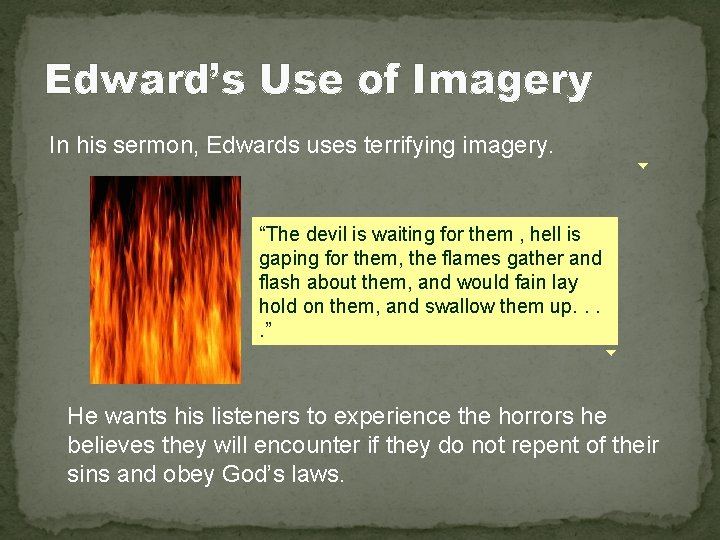
Edward’s Use of Imagery In his sermon, Edwards uses terrifying imagery. “The devil is waiting for them , hell is gaping for them, the flames gather and flash about them, and would fain lay hold on them, and swallow them up. . ” He wants his listeners to experience the horrors he believes they will encounter if they do not repent of their sins and obey God’s laws.
Figurative Language in “Sinners in the Hands of an Angry God”
“The devil is waiting for them, hell is gaping for them, the flames gather and flash about them…” (79). Imagery
“The devil is waiting for them, hell is gaping for them, the flames gather and flash about them, and would fain lay hold on them and swallow them up…” (79). Personificati on
“…the fire pent up in their own hearts is struggling to break out…” (79). Personificati on
“The bow of God’s wrath is bent, and the arrow made ready on the string, and justice bends the arrow of your heart, and strains the bow…” (109). Metaphor
“The God that holds you over the pit of Hell, much as one holds a spider, or some loathsome insect over the fire, …” (81). Simile
“…you are ten thousand times more abominable in his eyes, than the most hateful venomous serpent is in ours” (81). Simile
“…it is a great furnace of wrath, a wide and bottomless pit, full of the fire of wrath…” (81). metaphor
“…if God should let you go, you would immediately sink and swiftly descend and plunge into a bottomless gulf…” (80). Imagery
“The wrath of God is like great waters that are damned for the present…” (80). Simile
“…if your strength were ten thousand times greater than it is, yea, ten thousand times greater that the strength of the stoutest, sturdiest devil in hell, it would be nothing to withstand or endure it” (80). Simile
“That world of misery, that lake of burning brimstone, is extended abroad under you” (80). Imagery/ metaphor
“Your wickedness makes you as it were heavy as lead” (80). Simile
“…your own care and prudence, …would have no more influence to uphold you and keep you out of Hell, than a spider’s web would have to stop a fallen rock” (80). Simile
“You have offended Him infinitely more than ever a stubborn rebel did his prince…” (81). Simile
“…his wrath towards you burns like fire; ” (81). Simile
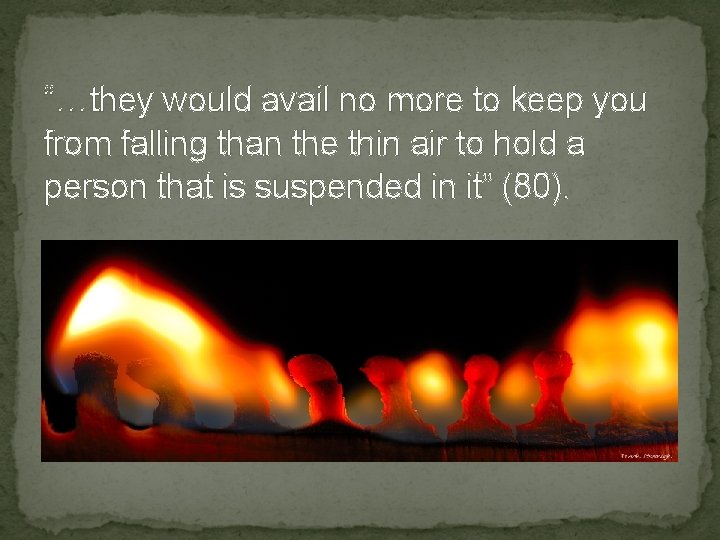
“…they would avail no more to keep you from falling than the thin air to hold a person that is suspended in it” (80). Simile
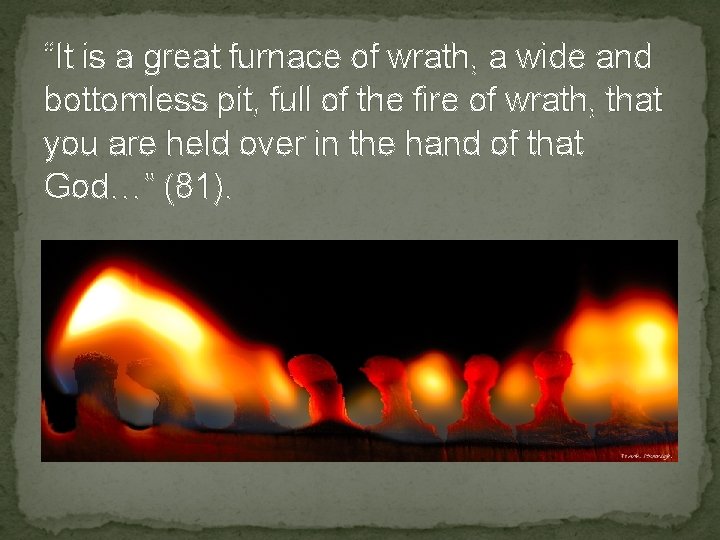
“It is a great furnace of wrath, a wide and bottomless pit, full of the fire of wrath, that you are held over in the hand of that God…” (81). metaphor
Repetition In addition to imagery, Edwards also uses repetition to emphasize his points. As you read, record images and words that Edwards uses repeatedly, such as wrath and descriptions of “the pit of hell. ” “. . . are actually suffering the fierceness of His wrath in hell. . ” “. . . held in the hand of God, over the pit of hell; they have deserved the fiery pit, and are already sentenced to it. . ” Consider how repetition might affect a listener and how it contributes to Edwards’s purpose.
Identifying Author’s Purpose • The author’s purpose is the reason that he or she is writing. • Authors may write to inform, to persuade, or to entertain. • Sometimes they state their purpose directly. • Other times, readers determine an author’s purpose by paying close attention to the details and images in the selection. • As you read, think about how and why Edwards uses certain images, and monitor your reactions to them. • Consider what reactions Edwards might want to elicit from his readers.
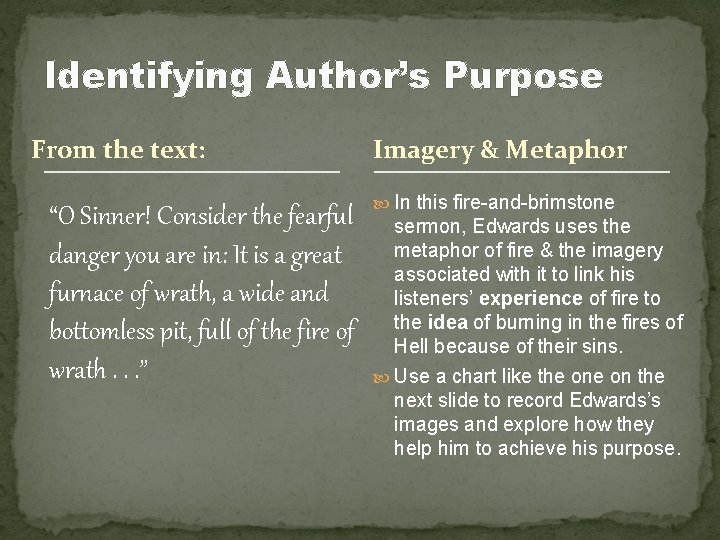
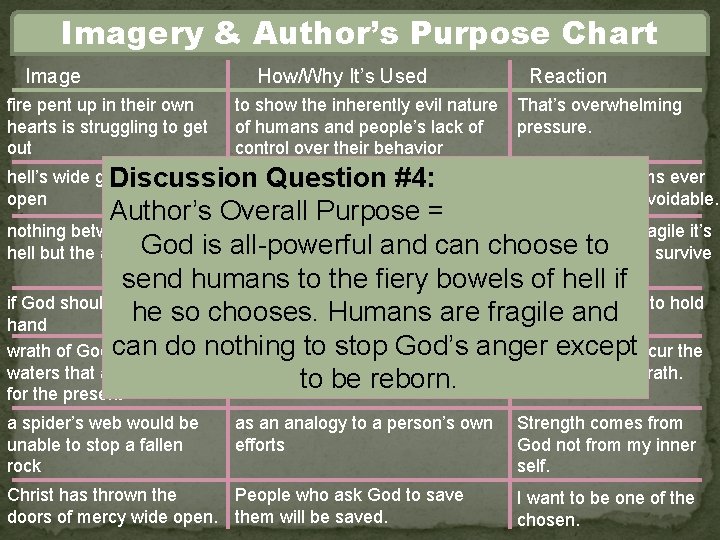
Identifying Author’s Purpose From the text: “O Sinner! Consider the fearful danger you are in: It is a great furnace of wrath, a wide and bottomless pit, full of the fire of wrath. . . ” Imagery & Metaphor In this fire-and-brimstone sermon, Edwards uses the metaphor of fire & the imagery associated with it to link his listeners’ experience of fire to the idea of burning in the fires of Hell because of their sins. Use a chart like the on the next slide to record Edwards’s images and explore how they help him to achieve his purpose.
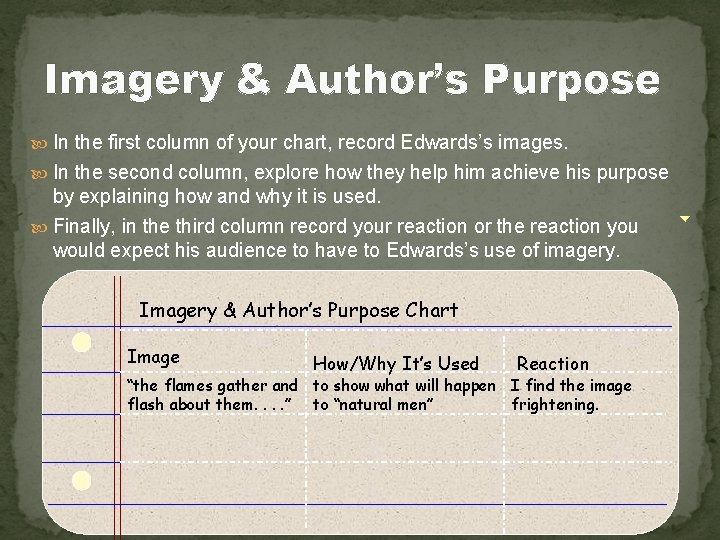
Imagery & Author’s Purpose In the first column of your chart, record Edwards’s images. In the second column, explore how they help him achieve his purpose by explaining how and why it is used. Finally, in the third column record your reaction or the reaction you would expect his audience to have to Edwards’s use of imagery. Imagery & Author’s Purpose Chart Image How/Why It’s Used Reaction “the flames gather and to show what will happen I find the image flash about them. . ” to “natural men” frightening.
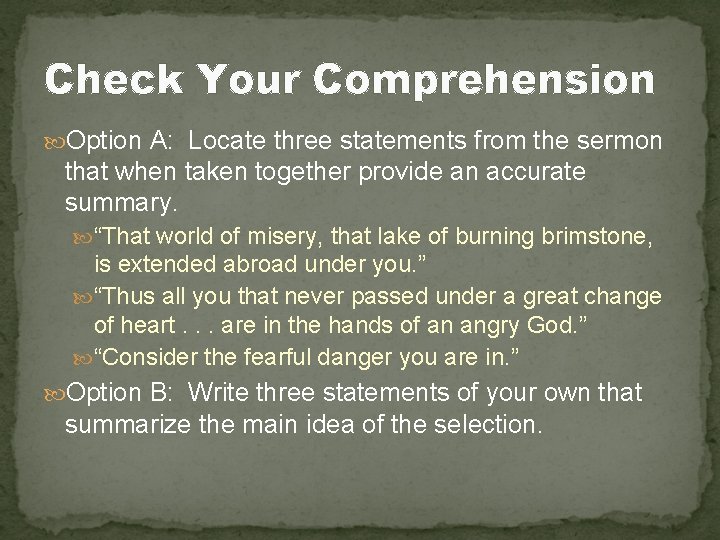
Check Your Comprehension Option A: Locate three statements from the sermon that when taken together provide an accurate summary. “That world of misery, that lake of burning brimstone, is extended abroad under you. ” “Thus all you that never passed under a great change of heart. . . are in the hands of an angry God. ” “Consider the fearful danger you are in. ” Option B: Write three statements of your own that summarize the main idea of the selection.
Introductory Journal Exercise • Edwards’s convictions put him at odds with society. • Would you risk being an outsider for your beliefs? • Why or why not? • What beliefs of yours do you consider most important? • Do you think it is necessary to persuade others to share those beliefs? • Why or why not?
Imagery & Author’s Purpose Chart Image fire pent up in their own hearts is struggling to get out How/Why It’s Used to show the inherently evil nature of humans and people’s lack of control over their behavior Reaction That’s overwhelming pressure. hell’s wide gaping mouth instill. Question fear Discussion open Temptation seems ever #4: present and unavoidable. Author’s Overall Purpose = nothing between you and to show need for God’s Mortals are so fragile it’s and can choose hell but the air God is all-powerful intervention and how ephemeral a wonderto people survive the natural all. hell if send humans to world the isfiery bowelsatof if God should withdraw His God, not our own efforts, support I must trust God to hold he so chooses. Humans are fragile and hand us me up. to stop God’s except wrath of God can is like do greatnothing to show God’s restraint and anger I don’t want to incur the waters that are dammed power force of God’s wrath. to be reborn. for the present a spider’s web would be unable to stop a fallen rock as an analogy to a person’s own efforts Christ has thrown the People who ask God to save doors of mercy wide open. them will be saved. Strength comes from God not from my inner self. I want to be one of the chosen.
Closure Journal Exercise • Edwards’s beliefs motivate him to try to change the lives of others. • Do you think this desire is common among people with strong beliefs? Why or why not? • Edwards’s use of repeated words and images helps convey his message by arousing fear in his listeners. • Do you see his approach as effective? Explain why or why not, giving examples from the text. • How would you try to convince someone to change his or her behavior? What words and images would you use make your plea dramatic?