
Jonas Christ Supervision Lorenzo Bortot Update on the
Jonas Christ Supervision: Lorenzo Bortot Update on the Application of Spectral Element Methods on Quench Simulation
Outline • • • Numerical context of quench simulation Spectral Element Method in a nutshell Proof of concept Implementation notes Outlook 22/08/2019 Update on the application of spectral element methods on quench simulation 3
Problem • Quench propagation: Multi-Physics (here: reduce to thermal problem) • Magnet geometry: Multi-Scale, 3 D (here: reduce to 1 D cable simplification) Ø Best way to reach fast and accurate simulation? 22/08/2019 Update on the application of spectral element methods on quench simulation 4
Problem Approach A: Find reasonable simplifications or models, e. g. for Comsol Approach B: Optimize numerical procedure which is internally used by solving programs Ø Best way to reach fast and accurate simulation? Ongoing research for finding numerical procedure best suitable for quench propagation in magnets* My contribution: Implement solver for 1 D thermal problem using a nonstandard numerical solution procedure - SEM * 22/08/2019 Update on the application of spectral element methods on quench simulation 5
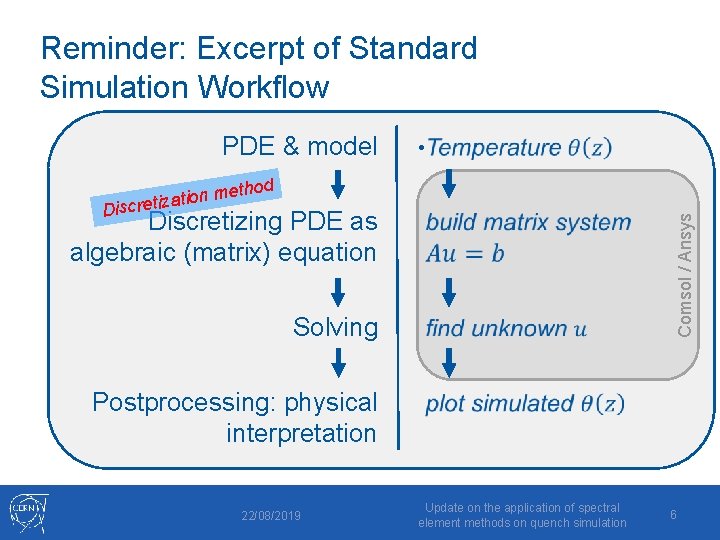
Reminder: Excerpt of Standard Simulation Workflow PDE & model • ethod on m i t a z i t e r isc D Comsol / Ansys Discretizing PDE as algebraic (matrix) equation Solving Postprocessing: physical interpretation 22/08/2019 Update on the application of spectral element methods on quench simulation 6
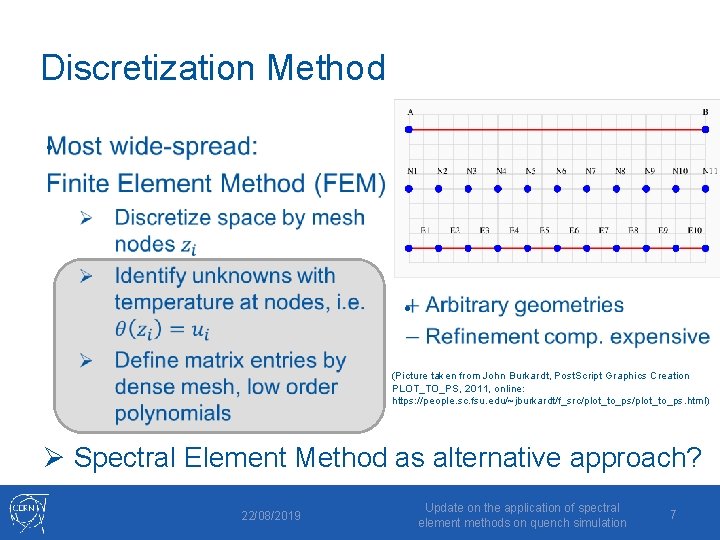
Discretization Method • • (Picture taken from John Burkardt, Post. Script Graphics Creation PLOT_TO_PS, 2011, online: https: //people. sc. fsu. edu/~jburkardt/f_src/plot_to_ps. html) Ø Spectral Element Method as alternative approach? 22/08/2019 Update on the application of spectral element methods on quench simulation 7
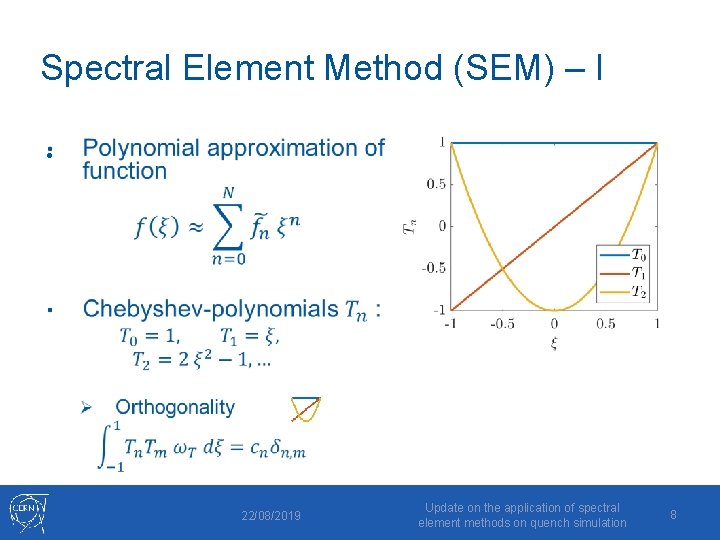
Spectral Element Method (SEM) – I • 22/08/2019 Update on the application of spectral element methods on quench simulation 8
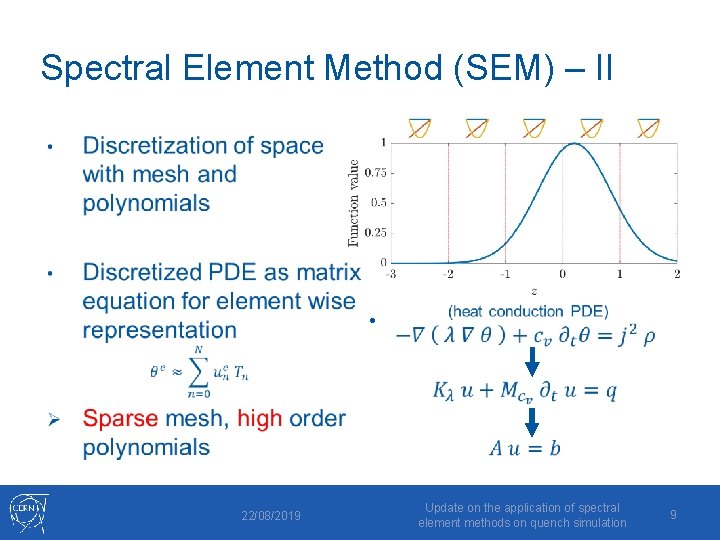
Spectral Element Method (SEM) – II • 22/08/2019 Update on the application of spectral element methods on quench simulation 9
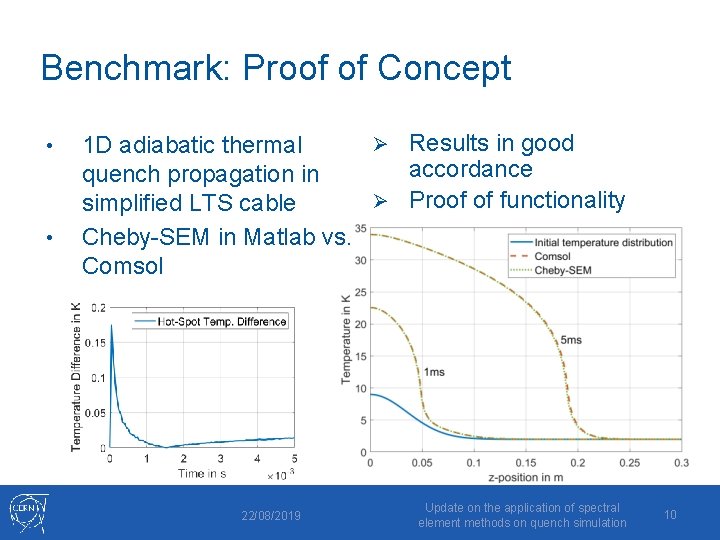
Benchmark: Proof of Concept • • Ø Results in good 1 D adiabatic thermal accordance quench propagation in Ø Proof of functionality simplified LTS cable Cheby-SEM in Matlab vs. Comsol 22/08/2019 Update on the application of spectral element methods on quench simulation 10
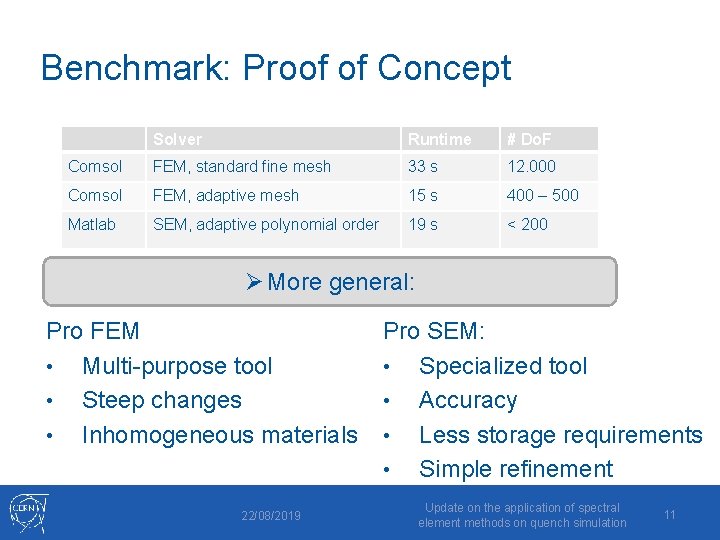
Benchmark: Proof of Concept Solver Runtime # Do. F Comsol FEM, standard fine mesh 33 s 12. 000 Comsol FEM, adaptive mesh 15 s 400 – 500 Matlab SEM, adaptive polynomial order 19 s < 200 Ø More general: Pro FEM • Multi-purpose tool • Steep changes • Inhomogeneous materials 22/08/2019 Pro SEM: • Specialized tool • Accuracy • Less storage requirements • Simple refinement Update on the application of spectral element methods on quench simulation 11
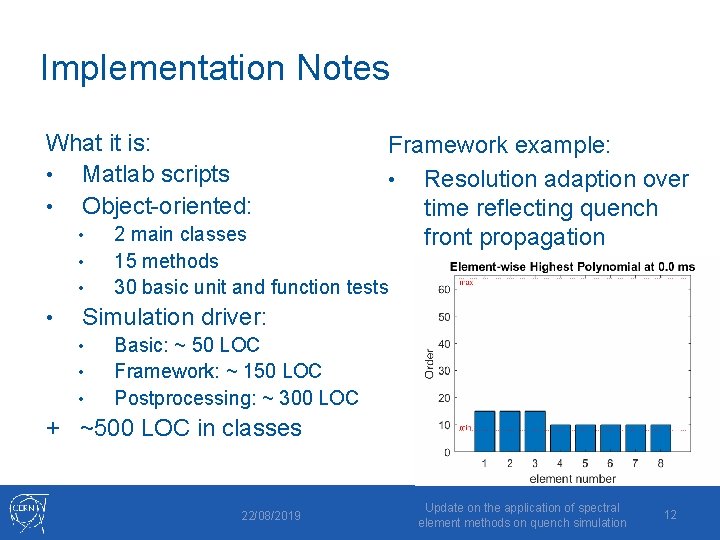
Implementation Notes What it is: • Matlab scripts • Object-oriented: • • Framework example: • Resolution adaption over time reflecting quench front propagation 2 main classes 15 methods 30 basic unit and function tests Simulation driver: • • • Basic: ~ 50 LOC Framework: ~ 150 LOC Postprocessing: ~ 300 LOC + ~500 LOC in classes 22/08/2019 Update on the application of spectral element methods on quench simulation 12
Summary • • Cheby-SEM and necessary framework has been implemented in Matlab Implementation has been validated for an academic example against FEM 22/08/2019 • Clear advantages of SEM compared to FEM for quench propagation are shown: 1. Simple refinement Ø Obtain desired accuracy 2. Less storage Ø Cheaper application to larger geometries 3. Local resolution Ø Easy adaption to quench front Update on the application of spectral element methods on quench simulation 13
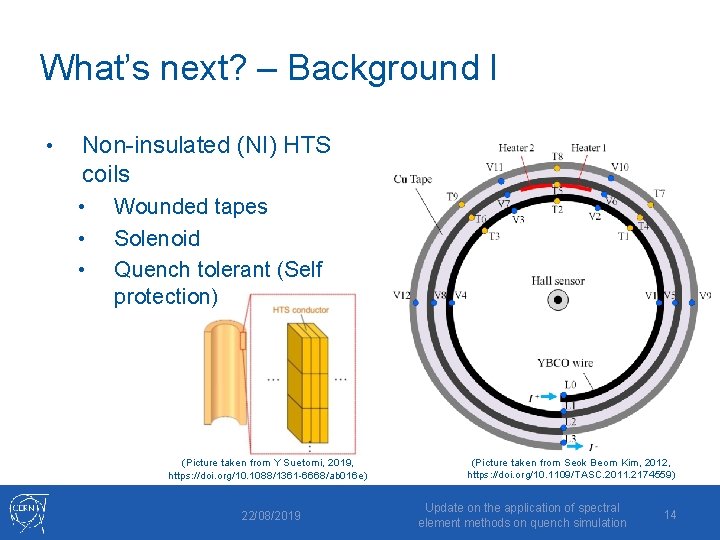
What’s next? – Background I • Non-insulated (NI) HTS coils • • • Wounded tapes Solenoid Quench tolerant (Self protection) (Picture taken from Y Suetomi, 2019, https: //doi. org/10. 1088/1361 -6668/ab 016 e) 22/08/2019 (Picture taken from Seok Beom Kim, 2012, https: //doi. org/10. 1109/TASC. 2011. 2174559) Update on the application of spectral element methods on quench simulation 14
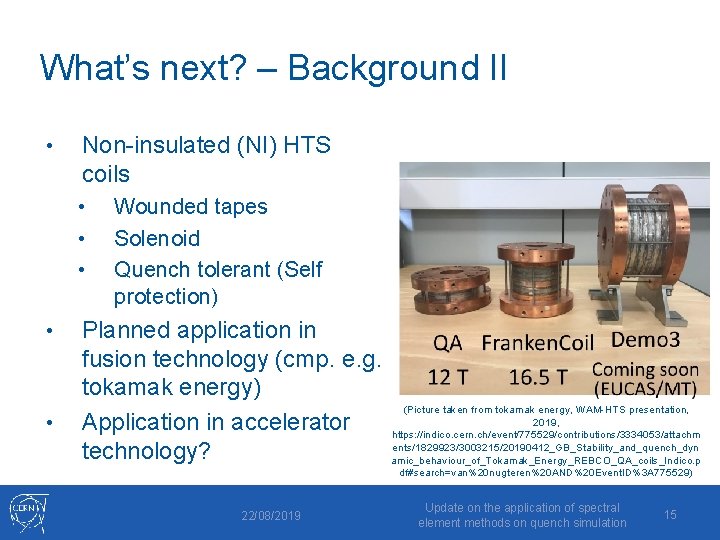
What’s next? – Background II • Non-insulated (NI) HTS coils • • • Wounded tapes Solenoid Quench tolerant (Self protection) Planned application in fusion technology (cmp. e. g. tokamak energy) Application in accelerator technology? 22/08/2019 (Picture taken from tokamak energy, WAM-HTS presentation, 2019, https: //indico. cern. ch/event/775529/contributions/3334053/attachm ents/1829923/3003215/20190412_GB_Stability_and_quench_dyn amic_behaviour_of_Tokamak_Energy_REBCO_QA_coils_Indico. p df#search=van%20 nugteren%20 AND%20 Event. ID%3 A 775529) Update on the application of spectral element methods on quench simulation 15
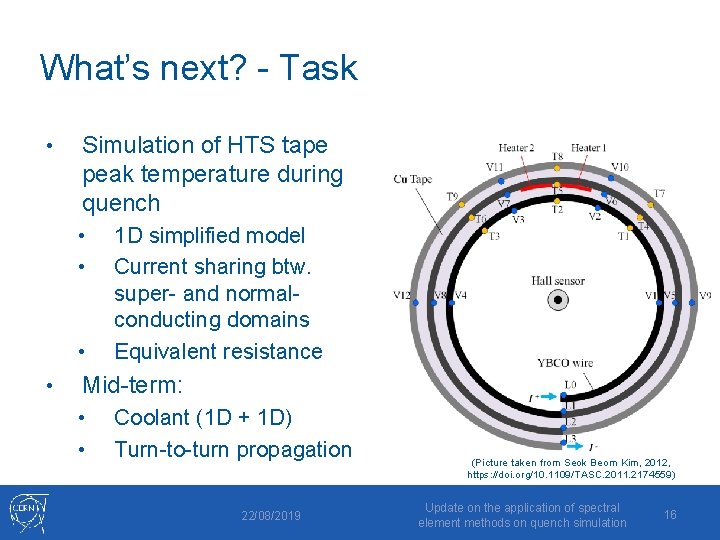
What’s next? - Task • Simulation of HTS tape peak temperature during quench • • 1 D simplified model Current sharing btw. super- and normalconducting domains Equivalent resistance Mid-term: • • Coolant (1 D + 1 D) Turn-to-turn propagation 22/08/2019 (Picture taken from Seok Beom Kim, 2012, https: //doi. org/10. 1109/TASC. 2011. 2174559) Update on the application of spectral element methods on quench simulation 16
Outlook: Numerical Aspects • • Coupling with magnetic problem? Advance to 3 D simulation? • Treatment of timedomain: solutions for multi-rate problem? Only excerpt - focused on ongoing work in Darmstadt 22/08/2019 Update on the application of spectral element methods on quench simulation 17
- Slides: 18