
Joints of the lower limb Hip joint e
Joints of the lower limb

Hip joint e: yp T 1 - Synovial ball-and-socket joint 2 -Articular surfaces: a- head of femur b- lunate surface of acetabulum Which is deepened by the fibrocartilaginous labrum acetabulare 3 -Nerve Supply: Femoral nerve Obturator nerve Sciatic nerve ferred e r r e b m Reme pain
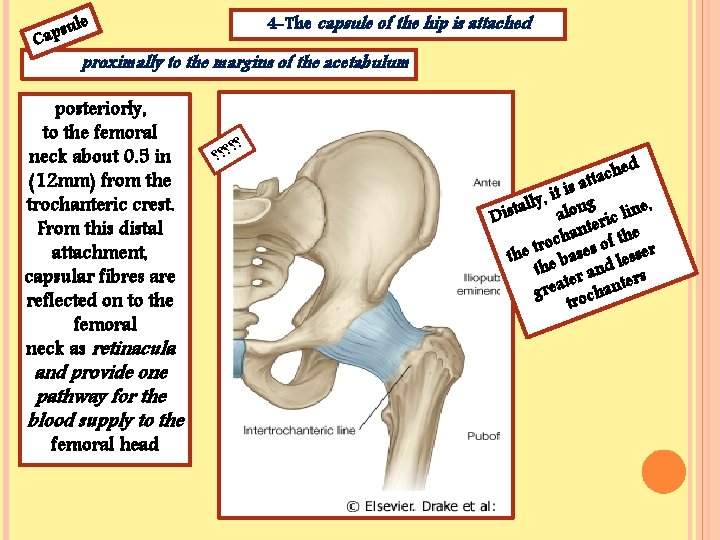
su Cap le 4 -The capsule of the hip is attached proximally to the margins of the acetabulum posteriorly, to the femoral neck about 0. 5 in (12 mm) from the trochanteric crest. From this distal attachment, capsular fibres are reflected on to the femoral neck as retinacula and provide one pathway for the blood supply to the femoral head ؟؟؟ ed h c a att s i t y, i ng l , l a t alo ric line Dis nte the a h roc ses of t e ser a th s e b l the r and rs te te grea rochan t
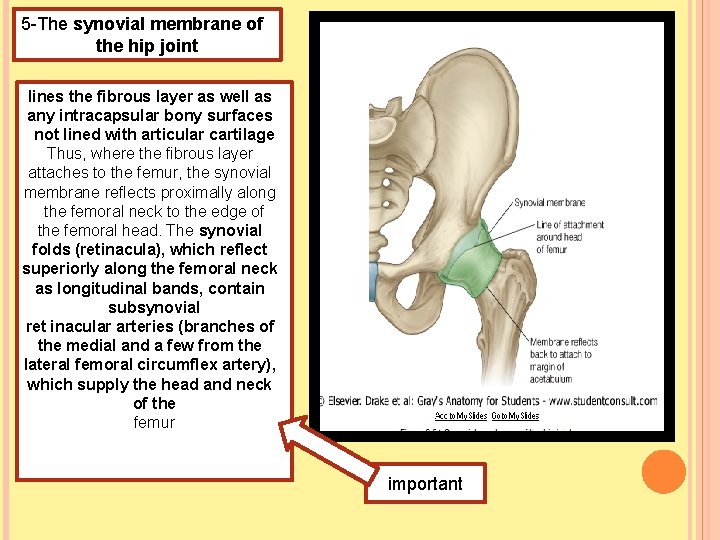
5 -The synovial membrane of the hip joint lines the fibrous layer as well as any intracapsular bony surfaces not lined with articular cartilage Thus, where the fibrous layer attaches to the femur, the synovial membrane reflects proximally along the femoral neck to the edge of the femoral head. The synovial folds (retinacula), which reflect superiorly along the femoral neck as longitudinal bands, contain subsynovial ret inacular arteries (branches of the medial and a few from the lateral femoral circumflex artery), which supply the head and neck of the femur important
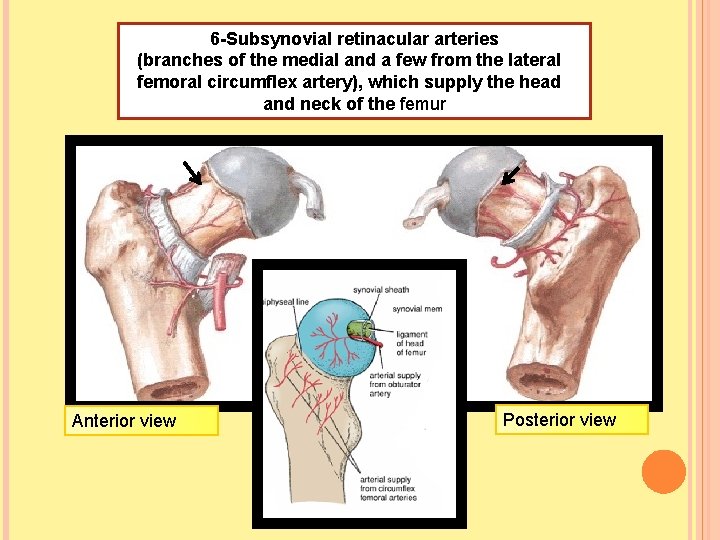
6 -Subsynovial retinacular arteries (branches of the medial and a few from the lateral femoral circumflex artery), which supply the head and neck of the femur Anterior view Posterior view

Blood supply of the head of the femur -Acetabular (foveolar) br. of post division of obturator a. (patent in approx. 30% )
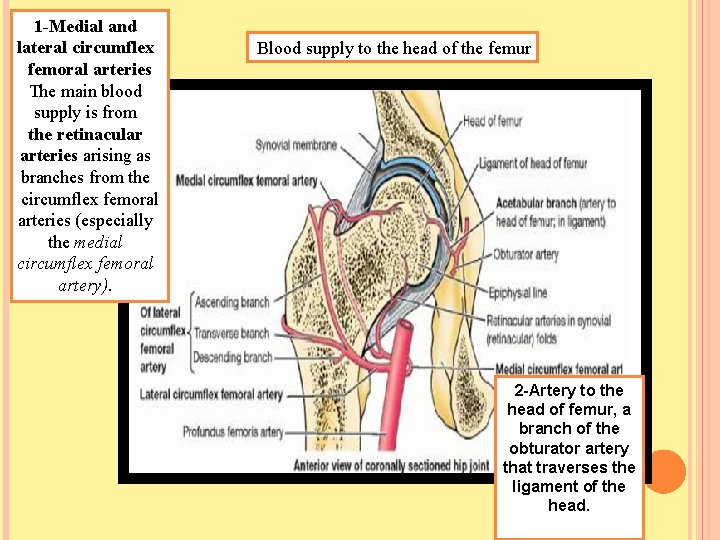
1 -Medial and lateral circumflex femoral arteries The main blood supply is from the retinacular arteries arising as branches from the circumflex femoral arteries (especially the medial circumflex femoral artery). Blood supply to the head of the femur 2 -Artery to the head of femur, a branch of the obturator artery that traverses the ligament of the head.
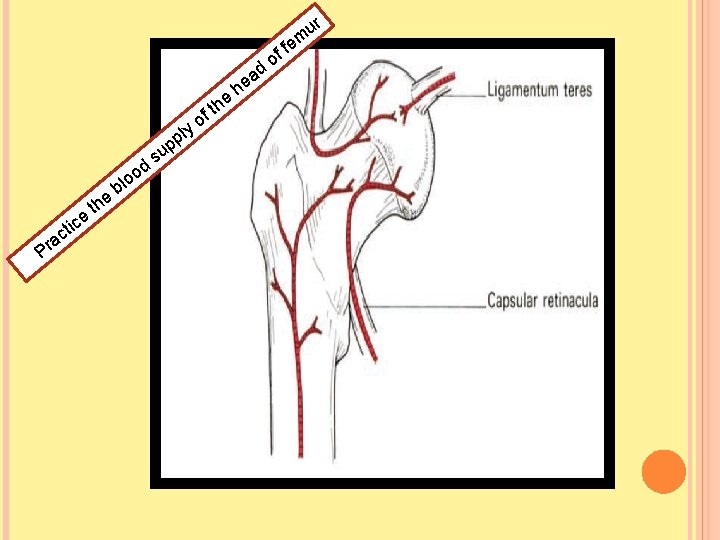
d e p a Pr c cti e e th o o l b d su ply o h ft a he of f ur em
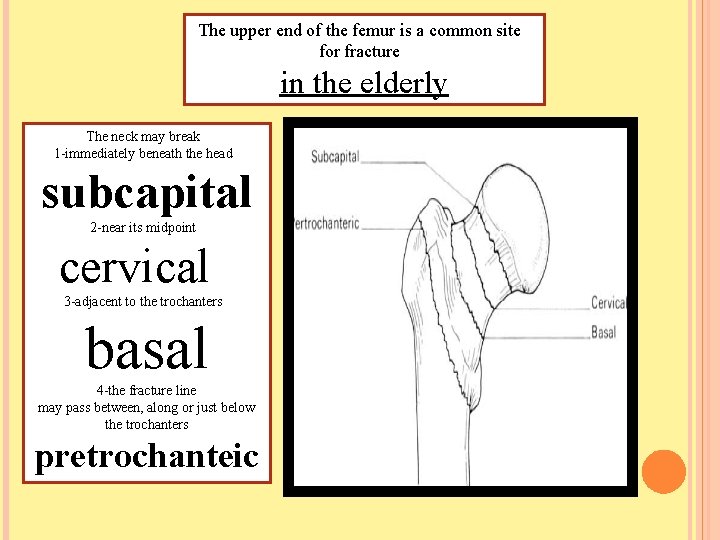
The upper end of the femur is a common site for fracture in the elderly The neck may break 1 -immediately beneath the head subcapital 2 -near its midpoint cervical 3 -adjacent to the trochanters basal 4 -the fracture line may pass between, along or just below the trochanters pretrochanteic
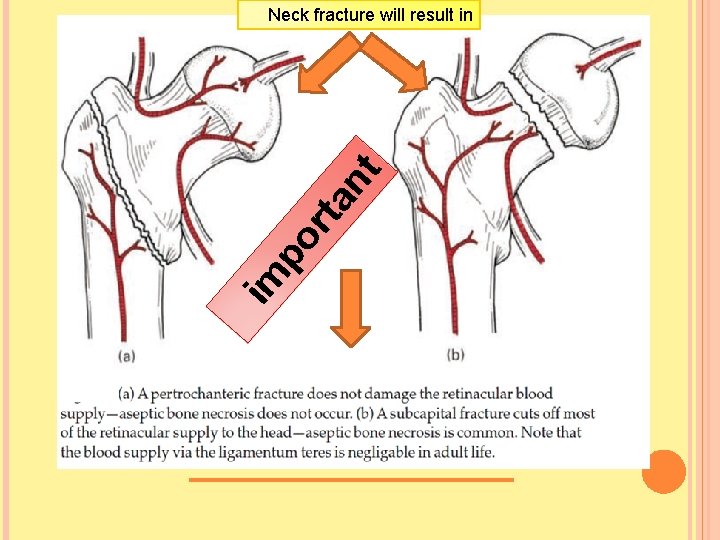
im po rta nt Neck fracture will result in
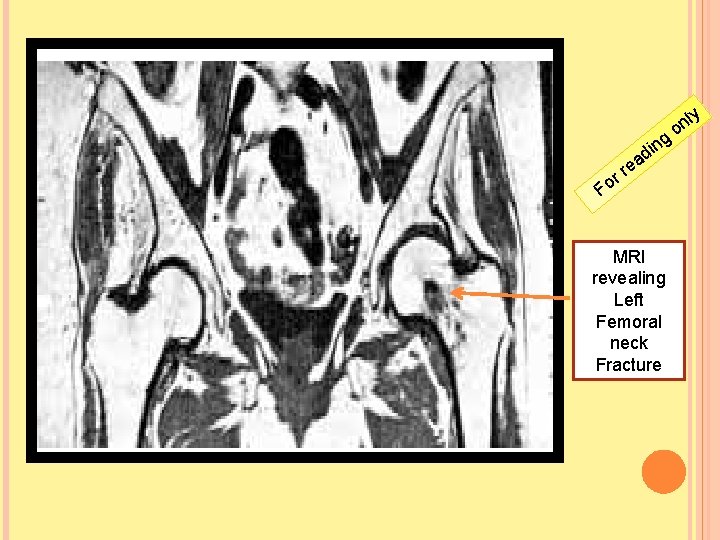
g n i d a e rr Fo MRI revealing Left Femoral neck Fracture ly n o
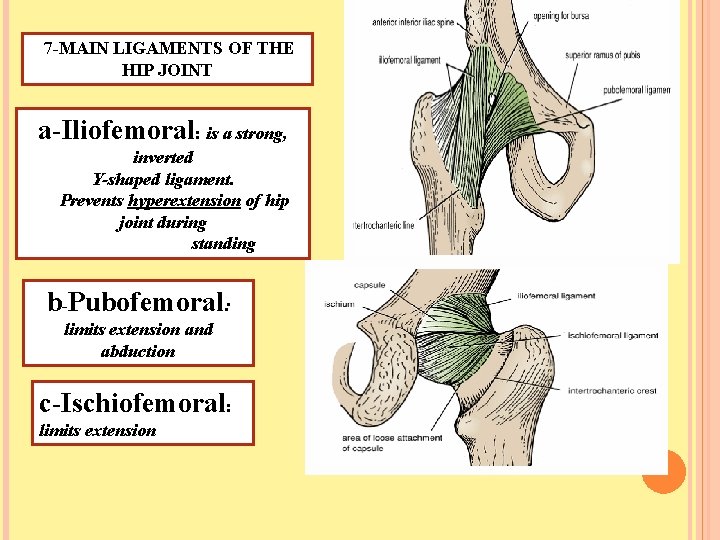
7 -MAIN LIGAMENTS OF THE HIP JOINT a-Iliofemoral: is a strong, inverted Y-shaped ligament. Prevents hyperextension of hip joint during standing b-Pubofemoral: limits extension and abduction c-Ischiofemoral: limits extension
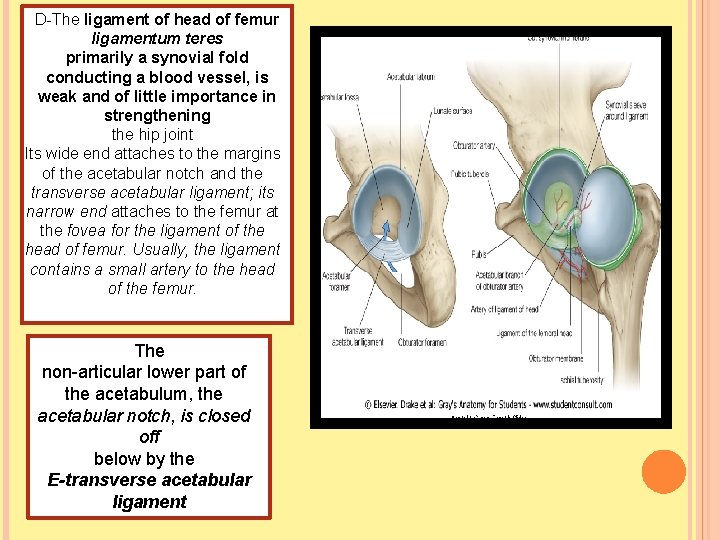
D-The ligament of head of femur ligamentum teres primarily a synovial fold conducting a blood vessel, is weak and of little importance in strengthening the hip joint Its wide end attaches to the margins of the acetabular notch and the transverse acetabular ligament; its narrow end attaches to the femur at the fovea for the ligament of the head of femur. Usually, the ligament contains a small artery to the head of the femur. The non-articular lower part of the acetabulum, the acetabular notch, is closed off below by the E-transverse acetabular ligament
8 -Movements ØFlexion is performed by the iliopsoas, rectus femoris, and sartorius ØExtension is performed by the gluteus maximus and the hamstring muscles. ØAbduction is performed by the gluteus medius and minimus, assisted by the sartorius, tensor fasciae latae, and piriformis. ØAdduction is performed by the adductor longus and brevis and the adductor fibers of the adductor magnus. These muscles are assisted by the pectineus and the gracilis. ØLateral rotation is performed by the short lateral rotator muscles and assisted by the gluteus maximus. ØMedial rotation is performed by the anterior fibers of the gluteus medius and gluteus minimus and the tensor fasciae latae. mited by li is n io x le F ing muscle r t s m a h e h t nsion is group. Exte limited entous m a g li e h t y b of the thickening duction, capsule; ab ctor by the addu uscles; m f o p u o r g by the adduction, cle and tensor mus ductor b a e h t f o fascia d muscles; an the rotation, by sular fibrous cap
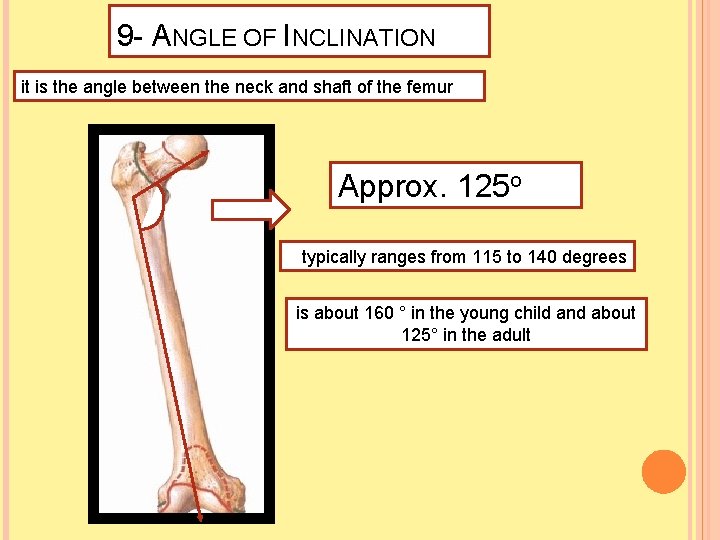
9 - ANGLE OF INCLINATION it is the angle between the neck and shaft of the femur Approx. 125 o typically ranges from 115 to 140 degrees is about 160 ° in the young child and about 125° in the adult
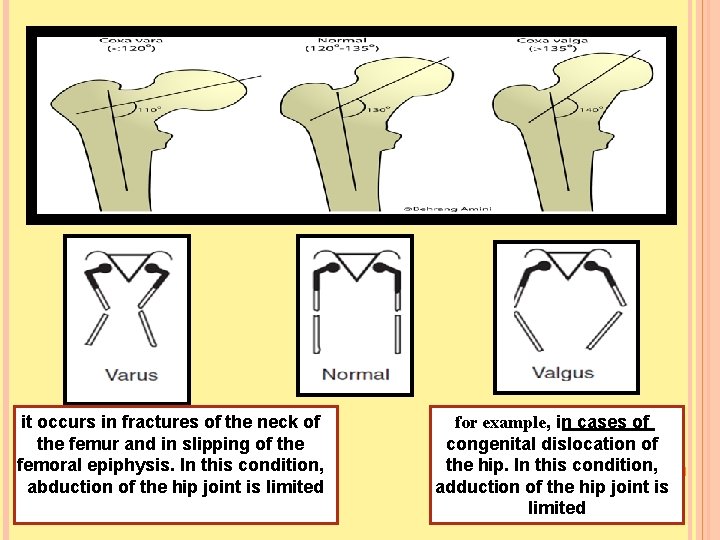
it occurs in fractures of the neck of the femur and in slipping of the femoral epiphysis. In this condition, abduction of the hip joint is limited for example, in cases of congenital dislocation of the hip. In this condition, adduction of the hip joint is limited
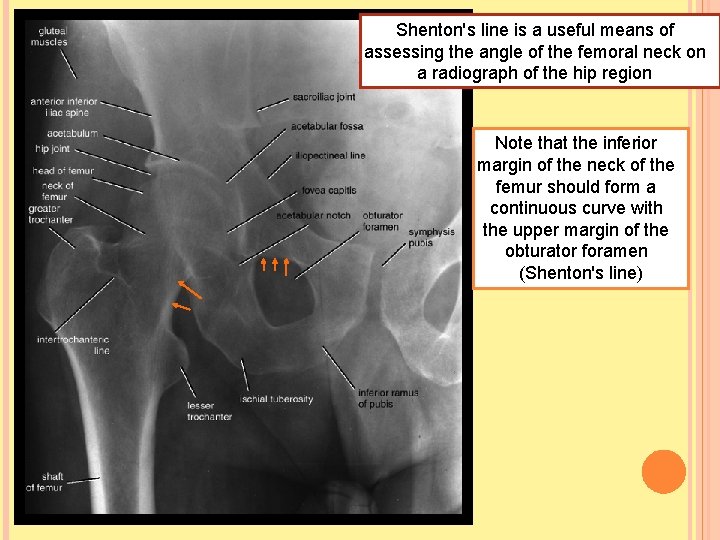
Shenton's line is a useful means of assessing the angle of the femoral neck on a radiograph of the hip region Note that the inferior margin of the neck of the femur should form a continuous curve with the upper margin of the obturator foramen (Shenton's line)
10 -There is a pattern of hip injuries; In children may sustain greenstick fractures of the femoral neck schoolboys may displace the epiphysis of the femoral head in adult life the hip dislocates in old age fracture of the neck of the femur again becomes the usual lesion
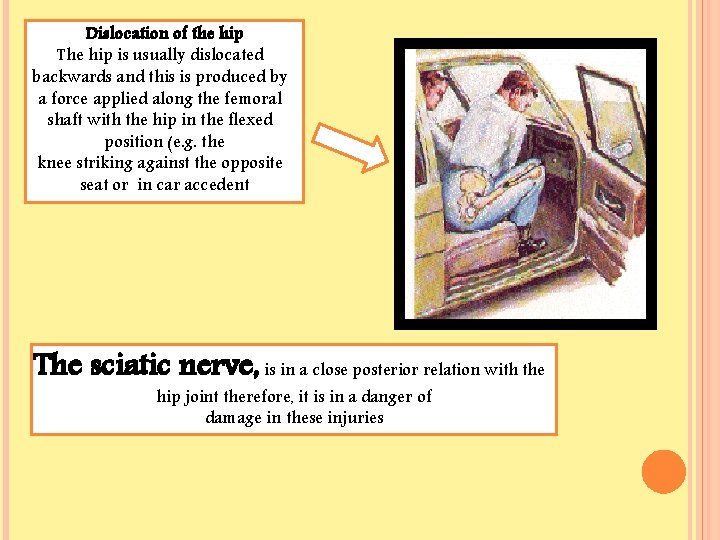
Dislocation of the hip The hip is usually dislocated backwards and this is produced by a force applied along the femoral shaft with the hip in the flexed position (e. g. the knee striking against the opposite seat or in car accedent The sciatic nerve, is in a close posterior relation with the hip joint therefore, it is in a danger of damage in these injuries
- Slides: 19