
Joints and their classifications what are joints A



- Slides: 15
Joints and their classifications
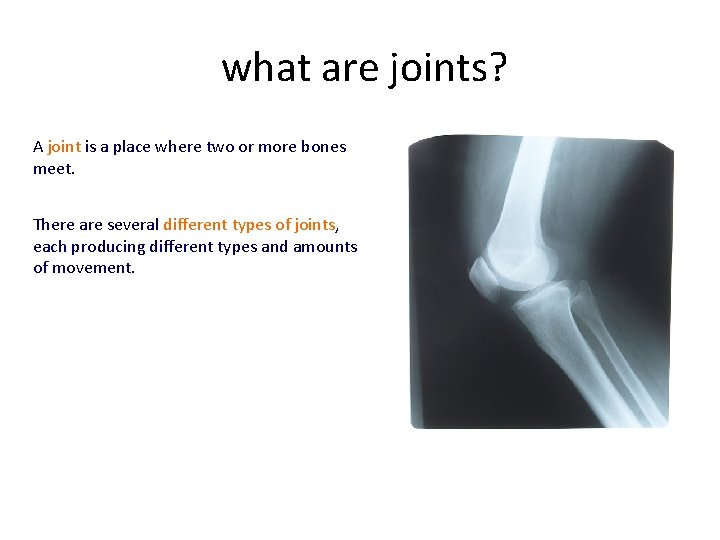
what are joints? A joint is a place where two or more bones meet. There are several different types of joints, each producing different types and amounts of movement.
Joint Classification • The structural classification of joints – Fibrous joints (bones held together by dense collagen fibers) – Cartilaginous joints (bones held together by cartilage) – Synovial joints (bones held together by ligaments) • The functional classification of joints – Synarthrosis (an immovable joint) – Amphiarthrosis (a slightly movable joint) – Diarthrosis (a freely movable joint)
Different types of joint There are 3 different types of joint: 1. Immovable (or fixed) joints 2. Slightly movable joints 3. Movable (or synovial) joints
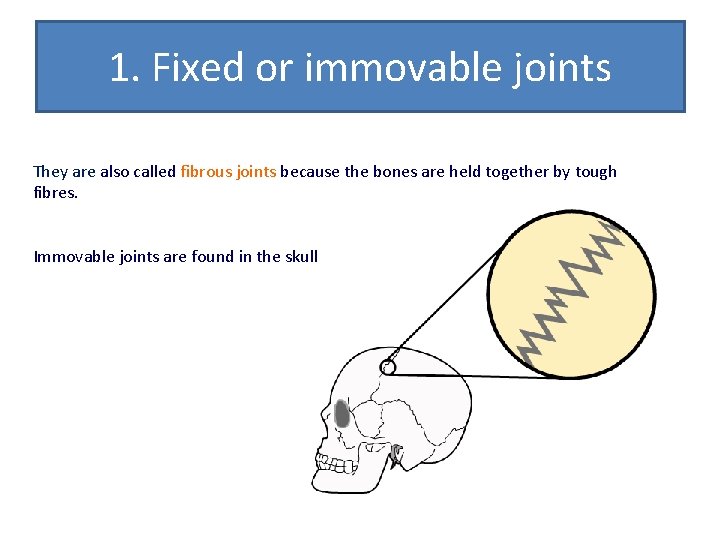
1. Fixed or immovable joints They are also called fibrous joints because the bones are held together by tough fibres. Immovable joints are found in the skull
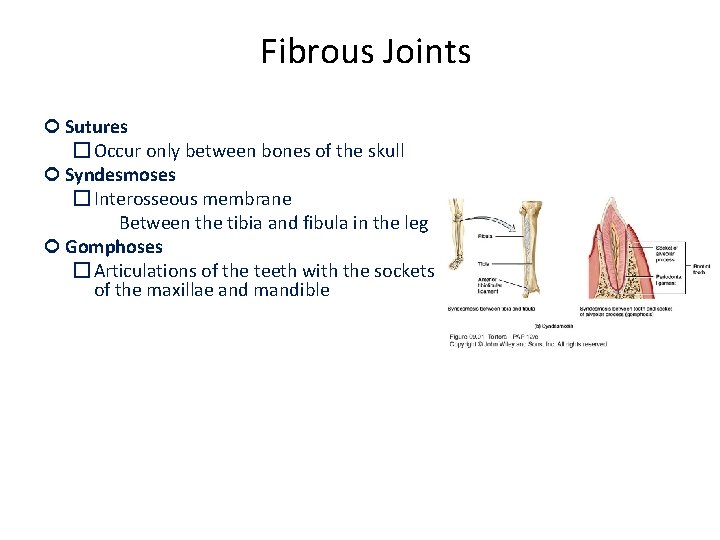
Fibrous Joints Sutures � Occur only between bones of the skull Syndesmoses � Interosseous membrane Between the tibia and fibula in the leg Gomphoses � Articulations of the teeth with the sockets of the maxillae and mandible
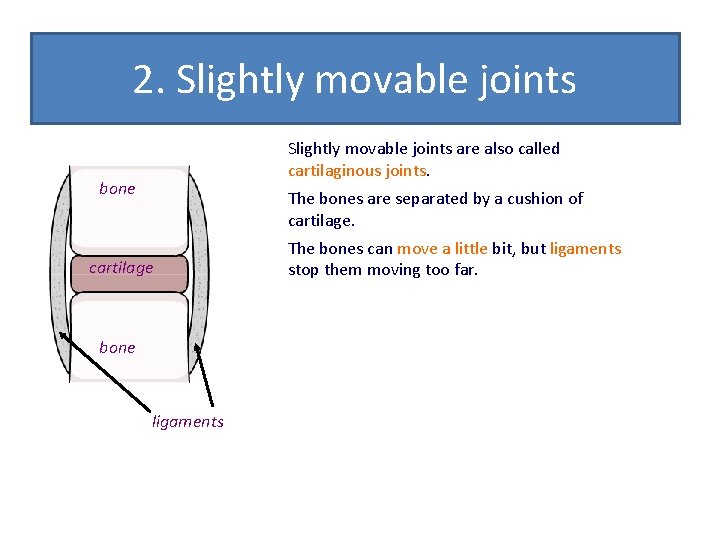
2. Slightly movable joints are also called cartilaginous joints. bone The bones are separated by a cushion of cartilage bone ligaments The bones can move a little bit, but ligaments stop them moving too far.
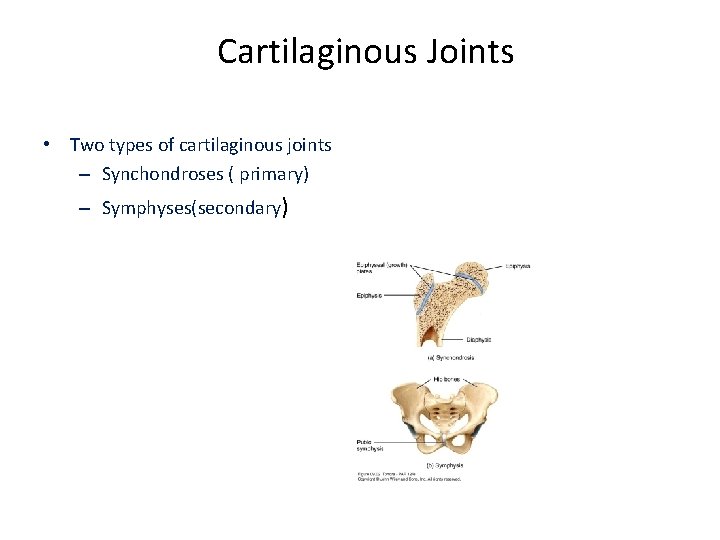
Cartilaginous Joints • Two types of cartilaginous joints – Synchondroses ( primary) – Symphyses(secondary)
Cartilaginous Joints • Synchondroses – Connecting tissue is hyaline cartilage – Epiphyseal (growth) plate • Symphyses – Slightly movable joint – Ends of the articulating bones are covered with hyaline cartilage, but a disc of fibrocartilage connects the bones
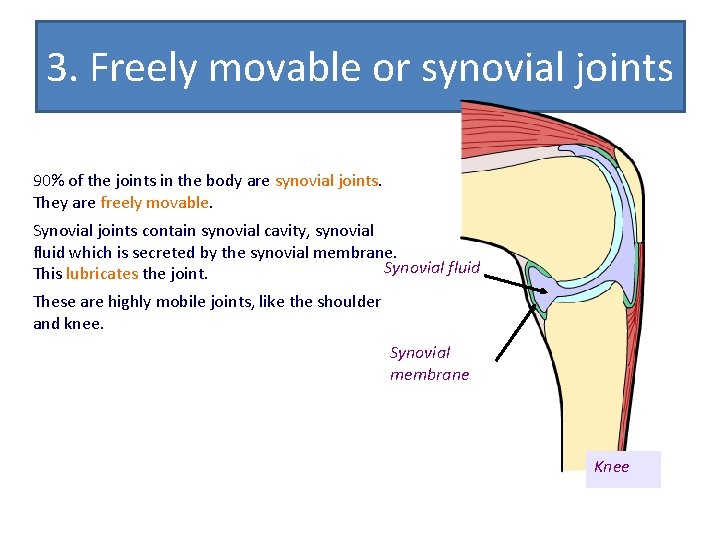
3. Freely movable or synovial joints 90% of the joints in the body are synovial joints. They are freely movable. Synovial joints contain synovial cavity, synovial fluid which is secreted by the synovial membrane. Synovial fluid This lubricates the joint. These are highly mobile joints, like the shoulder and knee. Synovial membrane Knee
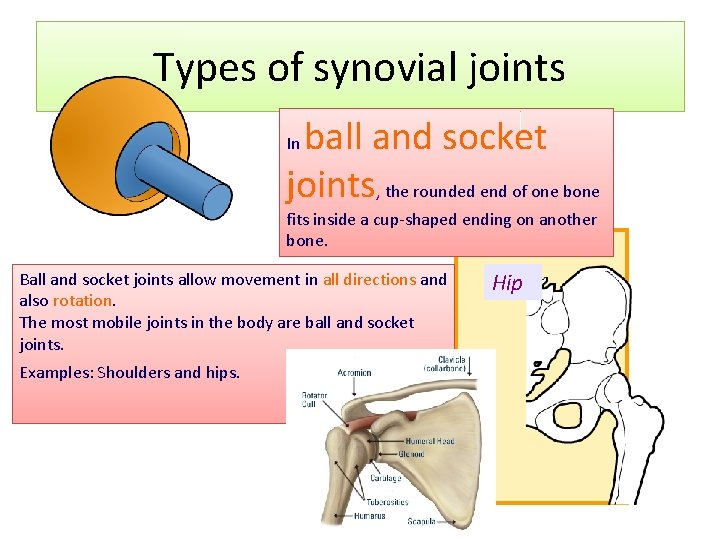
Types of synovial joints ball and socket joints, the rounded end of one bone In fits inside a cup-shaped ending on another bone. Ball and socket joints allow movement in all directions and also rotation. The most mobile joints in the body are ball and socket joints. Examples: Shoulders and hips. Hip
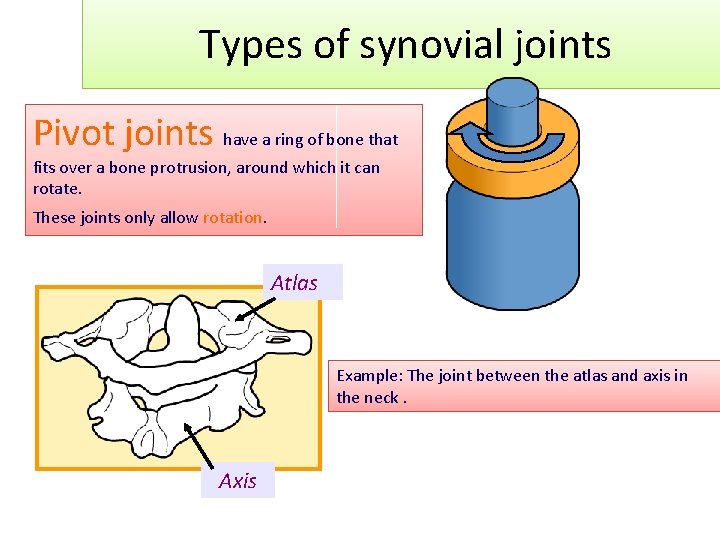
Types of synovial joints Pivot joints have a ring of bone that fits over a bone protrusion, around which it can rotate. These joints only allow rotation. Atlas Example: The joint between the atlas and axis in the neck. Axis
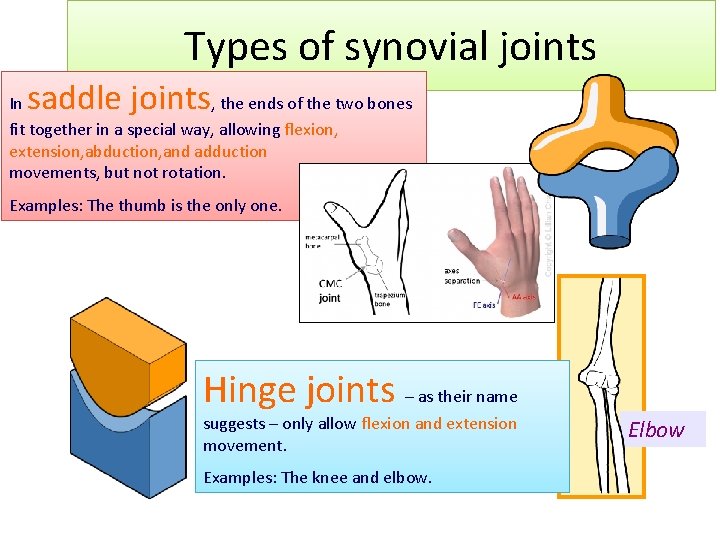
Types of synovial joints saddle joints In , the ends of the two bones fit together in a special way, allowing flexion, extension, abduction, and adduction movements, but not rotation. Examples: The thumb is the only one. Hinge joints – as their name suggests – only allow flexion and extension movement. Examples: The knee and elbow. Elbow
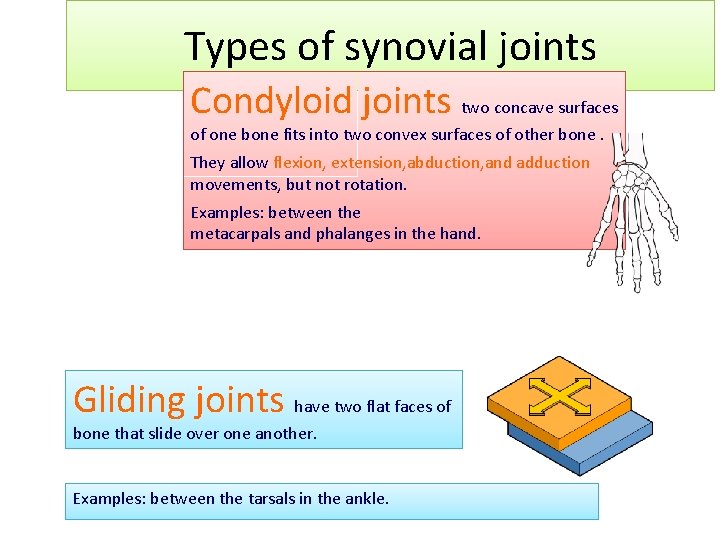
Types of synovial joints Condyloid joints two concave surfaces of one bone fits into two convex surfaces of other bone. They allow flexion, extension, abduction, and adduction movements, but not rotation. Examples: between the metacarpals and phalanges in the hand. Gliding joints have two flat faces of bone that slide over one another. Examples: between the tarsals in the ankle.