
JOINTS a k a articulations Functional junctions between

JOINTS

a. k. a. articulations • • • Functional junctions between bones Bind parts of the skeletal system Make bone growth possible Permit parts of the skeleton to change shape during childbirth Enable the body to move in response to skeletal muscle contractions Immovable, slightly movable, or freely movable
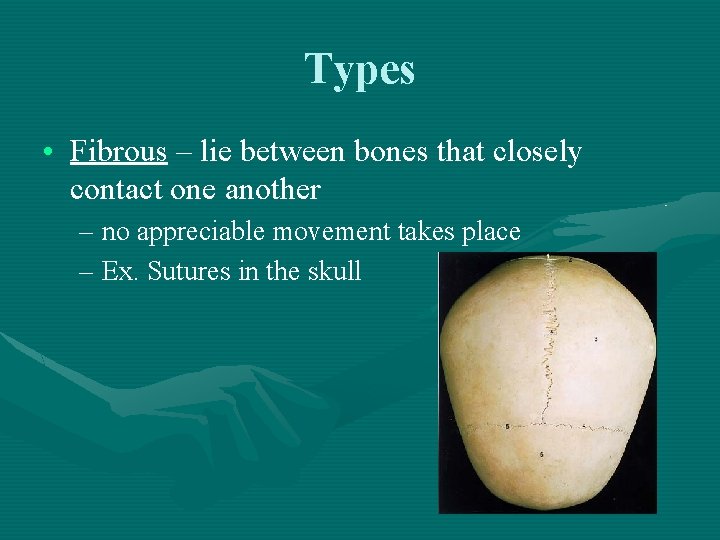
Types • Fibrous – lie between bones that closely contact one another – no appreciable movement takes place – Ex. Sutures in the skull
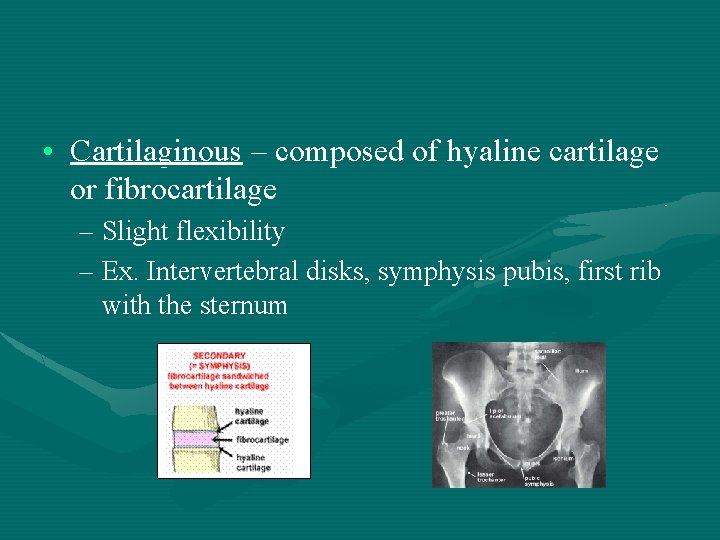
• Cartilaginous – composed of hyaline cartilage or fibrocartilage – Slight flexibility – Ex. Intervertebral disks, symphysis pubis, first rib with the sternum
• Synovial – allow free movement – Articular ends are covered with hyaline cartilage and a surrounding capsule of dense connective tissue holds them together – Synovial membraneous lining secretes synovial fluid which lubricates joints – Have shock-absorbing pads called menisci – Have fluid-filled sacs called bursae
Type of Synovial Joints • Ball-and-socket – shoulder and hip • Condyloid – joints between metacarpals and phalanges (oval-shaped condyle of one bone fits into an elliptical cavity of another bone) • Gliding – wrist and ankle (nearly flat or slightly curved) • Hinge – elbow and phalanges • Pivot – proximal ends of the radius and ulna • Saddle – carpal and metacarpal (both concave and convex surfaces)
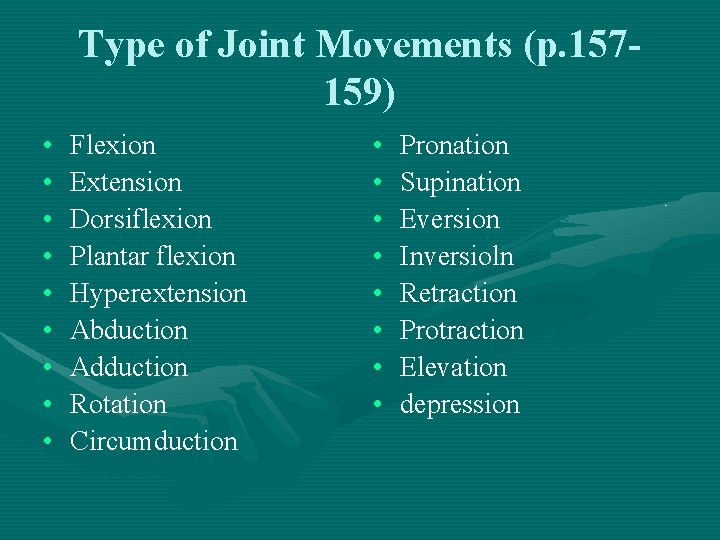
Type of Joint Movements (p. 157159) • • • Flexion Extension Dorsiflexion Plantar flexion Hyperextension Abduction Adduction Rotation Circumduction • • Pronation Supination Eversion Inversioln Retraction Protraction Elevation depression
- Slides: 7