
Joint Water Commission Greenhouse Gas Inventory Kristel Fesler
- Slides: 33
Joint Water Commission Greenhouse Gas Inventory Kristel Fesler City of Hillsboro, Water Resources Technician The Oregon Water Conference Oregon State University May 25, 2011
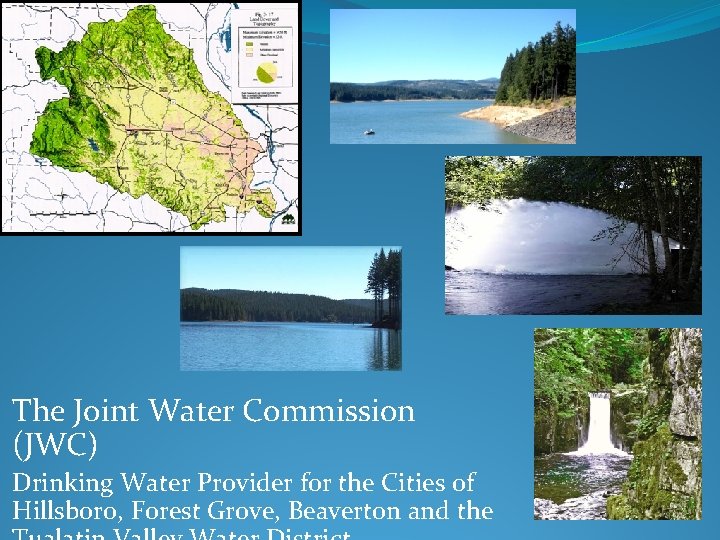
The Joint Water Commission (JWC) Drinking Water Provider for the Cities of Hillsboro, Forest Grove, Beaverton and the
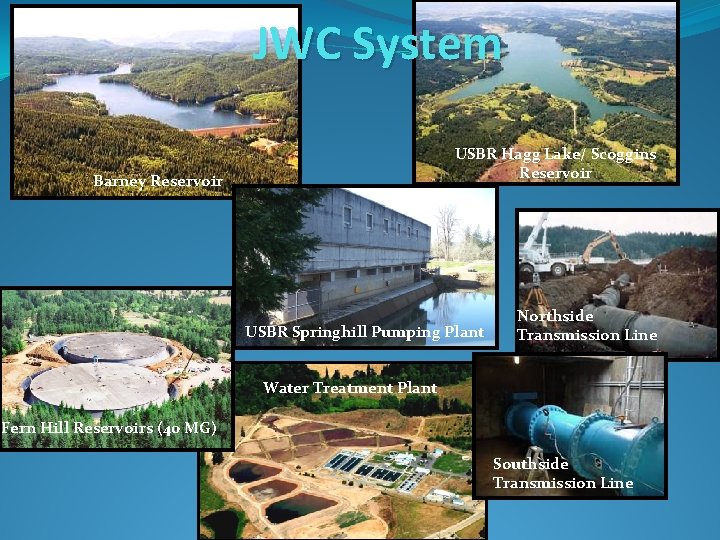
JWC System USBR Hagg Lake/ Scoggins Reservoir Barney Reservoir USBR Springhill Pumping Plant Northside Transmission Line Water Treatment Plant Fern Hill Reservoirs (40 MG) Southside Transmission Line
Why Complete a GHG Inventory? �Track JWC Trends Over Time �Information Required for Member Agencies Inventories �Mandatory Reporting in Oregon by Emissions Level �Gain a Better Understanding of Legislative and Emissions Assumptions that Impact JWC 4
Good Company’s Operation Climate Collaborative Network �Good Company is a sustainability consulting firm that provides analysis, strategy and implementation services to help clients meet their triple bottom line �JWC began GHG Inventory Process in March 2010, Completed in August 2010 �Good Company gave 7 webinars to teach the process and methods �Calculated and Classified GHG emissions for 2007 -2009 5
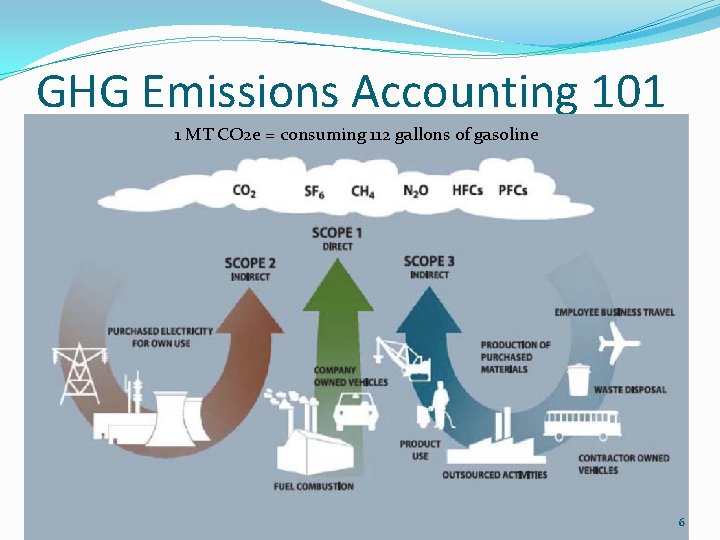
GHG Emissions Accounting 101 1 MT CO 2 e = consuming 112 gallons of gasoline 6
Emission Calculations �Use emission factors to translate activities and purchases into equivalent carbon dioxide emissions �Collect data on JWC’s purchases and activities �Emissions factors available from widely available, high consensus public information �EPA (e. GRID, WARM), Carnegie Mellon University, Portland General Electric, Bureau of Labor Statistics, and more �Input data into Good Company Carbon Calculator 7
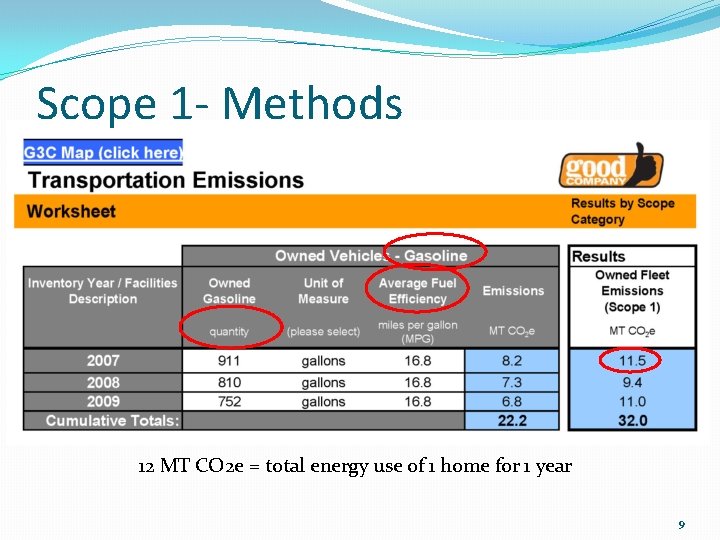
Scope 1 - Methods �Includes direct emissions from �Vehicles �Onsite Fuel Combustion (i. e. generators) �Refrigerants �Easiest to calculate and JWC’s smallest category �Only 11 Fleet Vehicles � 1 generator �Minimal AC usage 8
Scope 1 - Methods 12 MT CO 2 e = total energy use of 1 home for 1 year 9
Scope 2 - Methods �Indirect emissions from Purchased Electricity �Easy to calculate and very large emission value �Only 1 electric provider- PGE �JWC has 5 accounts �JWC uses 23 million k. Wh of electricity per year 10
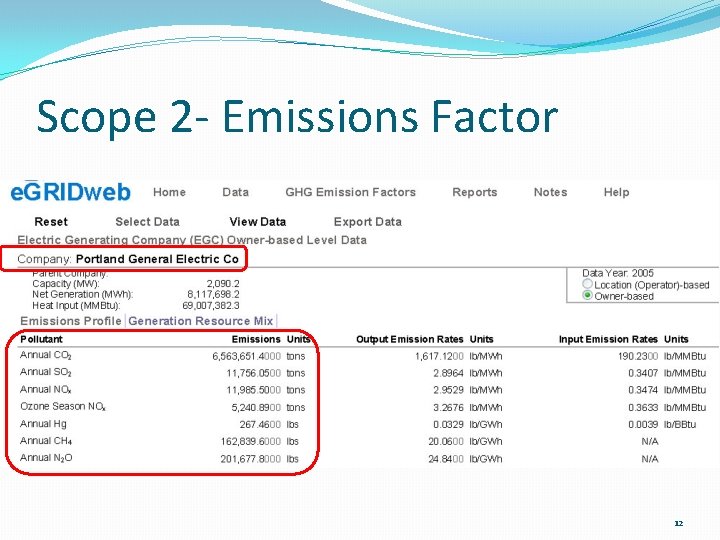
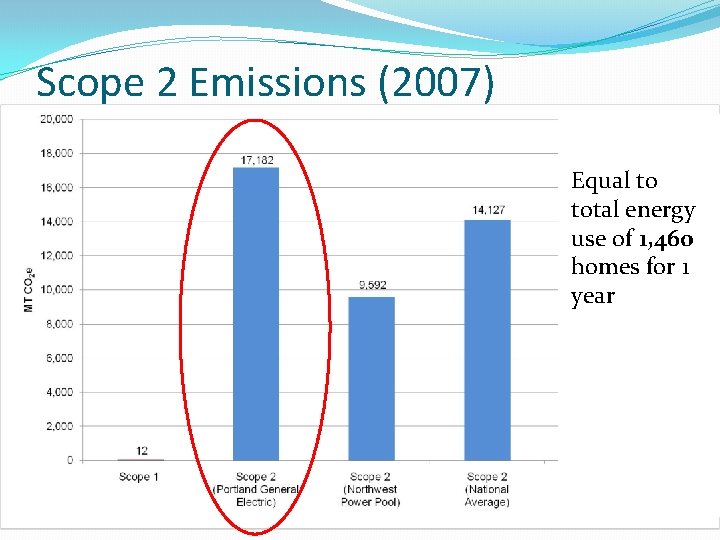
Scope 2 - Emissions Factor �Electricity is traded on the minute-byminute basis from large geographic areas making it difficult to determine the ‘correct’ emissions factor. �Available emissions factors �Portland General Electric �Northwest Power Pool (7 western states) �National Average 11
Scope 2 - Emissions Factor 12
Scope 2 Emissions (2007) Equal to total energy use of 1, 460 homes for 1 year 13
Scope 3 �Indirect emission source �Often not required or completed during emissions analysis �Important to give sense of scale of total operations 14
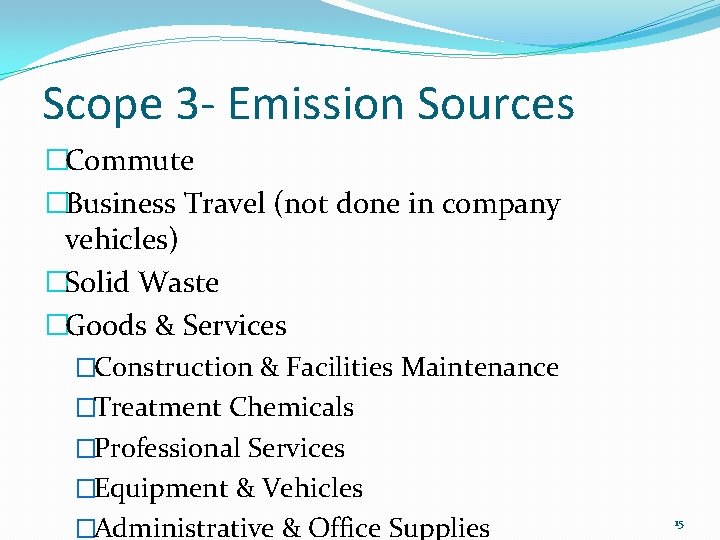
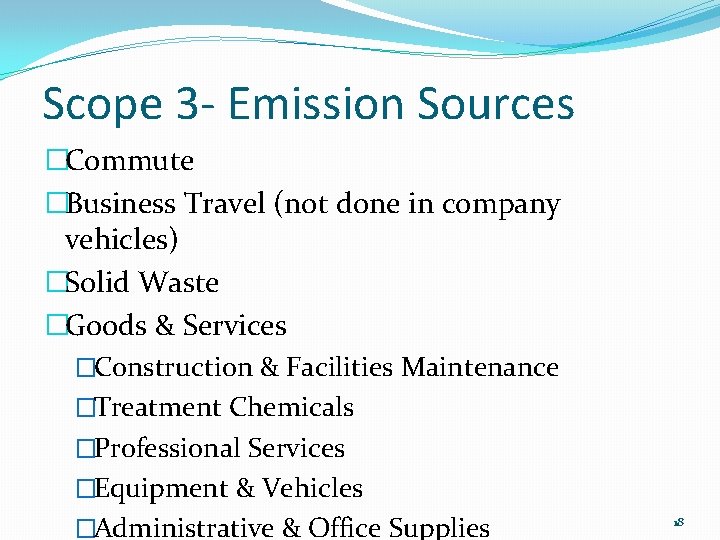
Scope 3 - Emission Sources �Commute �Business Travel (not done in company vehicles) �Solid Waste �Goods & Services �Construction & Facilities Maintenance �Treatment Chemicals �Professional Services �Equipment & Vehicles �Administrative & Office Supplies 15
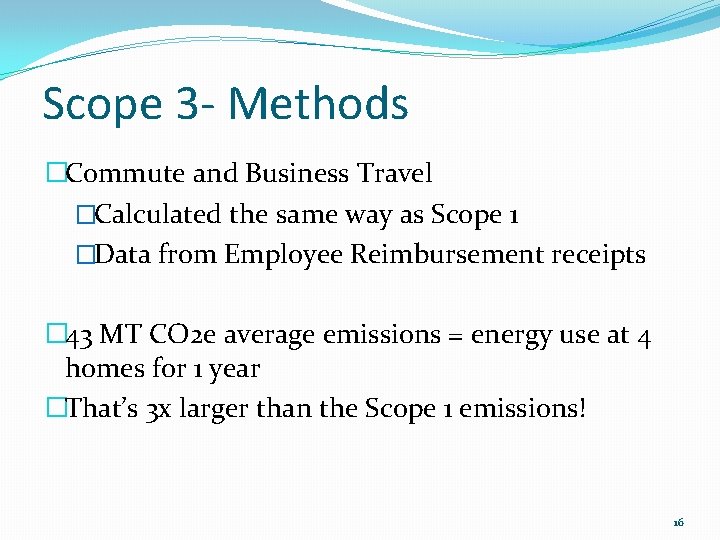
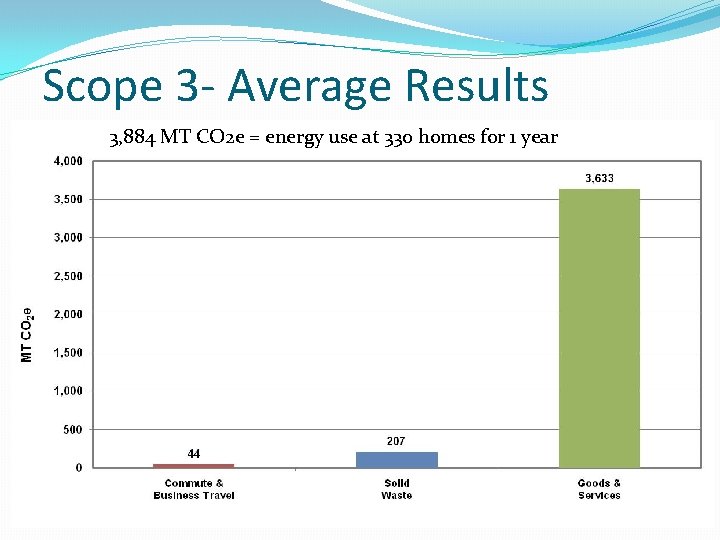
Scope 3 - Methods �Commute and Business Travel �Calculated the same way as Scope 1 �Data from Employee Reimbursement receipts � 43 MT CO 2 e average emissions = energy use at 4 homes for 1 year �That’s 3 x larger than the Scope 1 emissions! 16
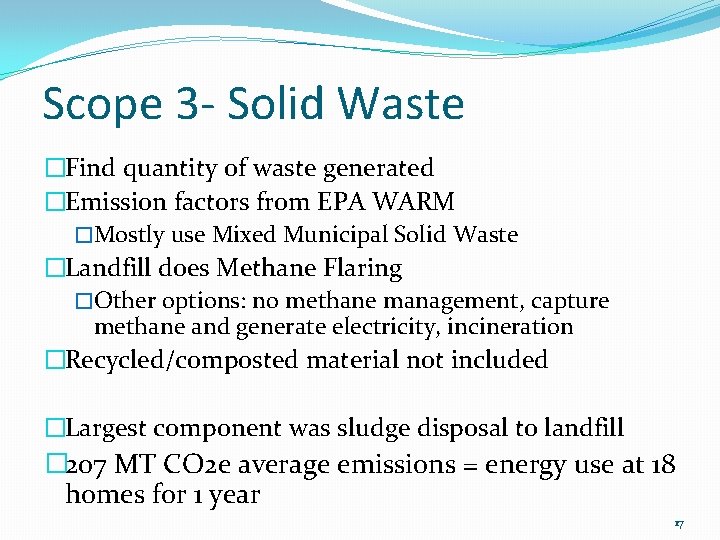
Scope 3 - Solid Waste �Find quantity of waste generated �Emission factors from EPA WARM �Mostly use Mixed Municipal Solid Waste �Landfill does Methane Flaring �Other options: no methane management, capture methane and generate electricity, incineration �Recycled/composted material not included �Largest component was sludge disposal to landfill � 207 MT CO 2 e average emissions = energy use at 18 homes for 1 year 17
Scope 3 - Emission Sources �Commute �Business Travel (not done in company vehicles) �Solid Waste �Goods & Services �Construction & Facilities Maintenance �Treatment Chemicals �Professional Services �Equipment & Vehicles �Administrative & Office Supplies 18
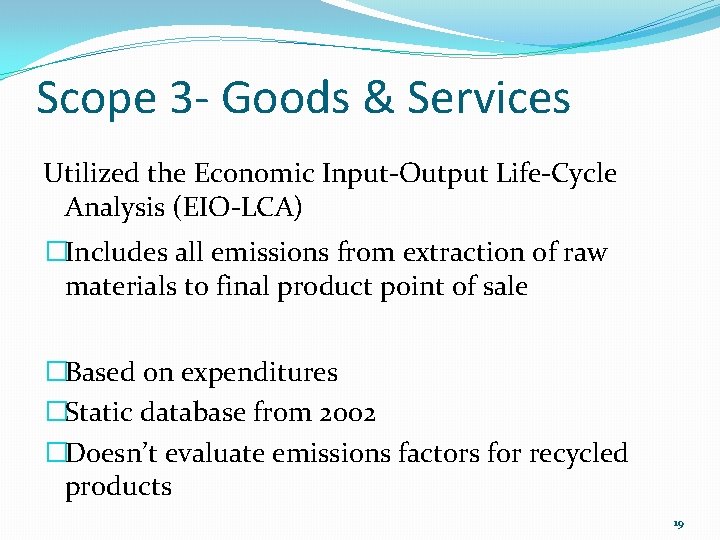
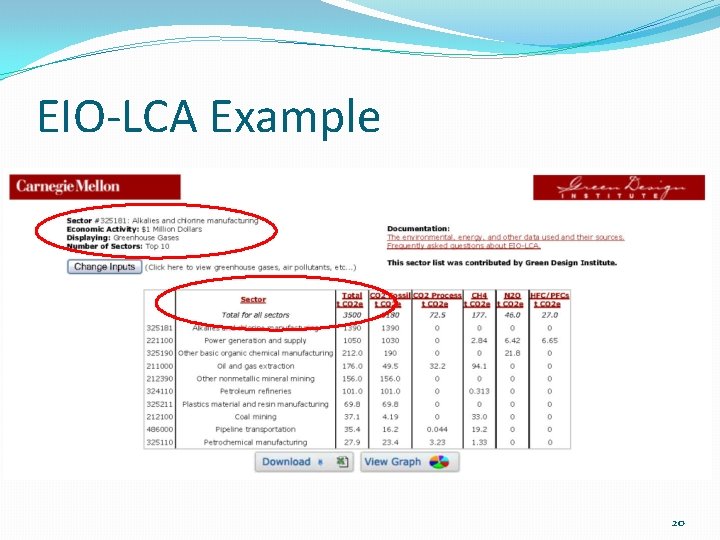
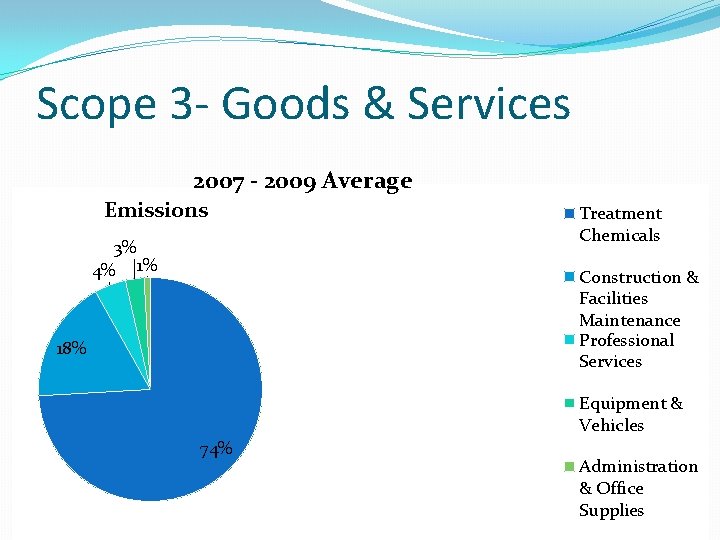
Scope 3 - Goods & Services Utilized the Economic Input-Output Life-Cycle Analysis (EIO-LCA) �Includes all emissions from extraction of raw materials to final product point of sale �Based on expenditures �Static database from 2002 �Doesn’t evaluate emissions factors for recycled products 19
EIO-LCA Example 20
Scope 3 - Goods & Services 2007 - 2009 Average Expenditures Emissions 3% 4% 1% 2% 7% 26% 18% 31% 74% Treatment Chemicals Construction & Facilities Maintenance Professional Services Equipment & Vehicles 34% Administration & Office Supplies 21
Scope 3 - Average Results 3, 884 MT CO 2 e = energy use at 330 homes for 1 year 22
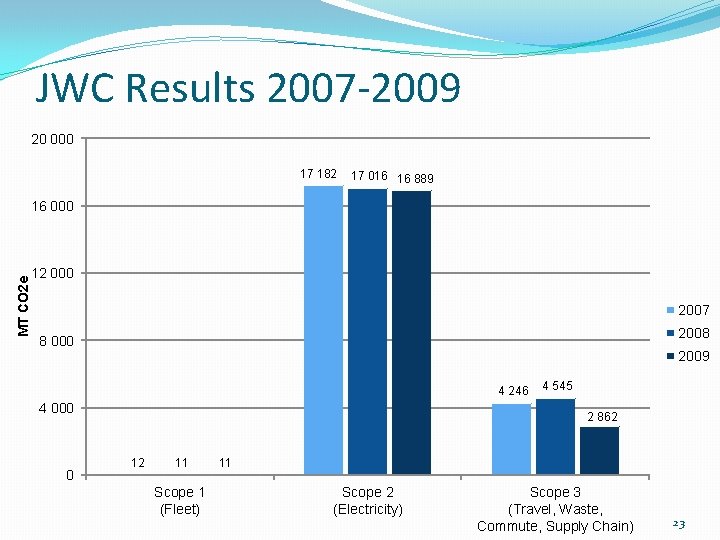
JWC Results 2007 -2009 20 000 17 182 17 016 16 889 MT CO 2 e 16 000 12 000 2007 2008 8 000 2009 4 246 4 000 0 4 545 2 862 12 11 Scope 1 (Fleet) 11 Scope 2 (Electricity) Scope 3 (Travel, Waste, Commute, Supply Chain) 23
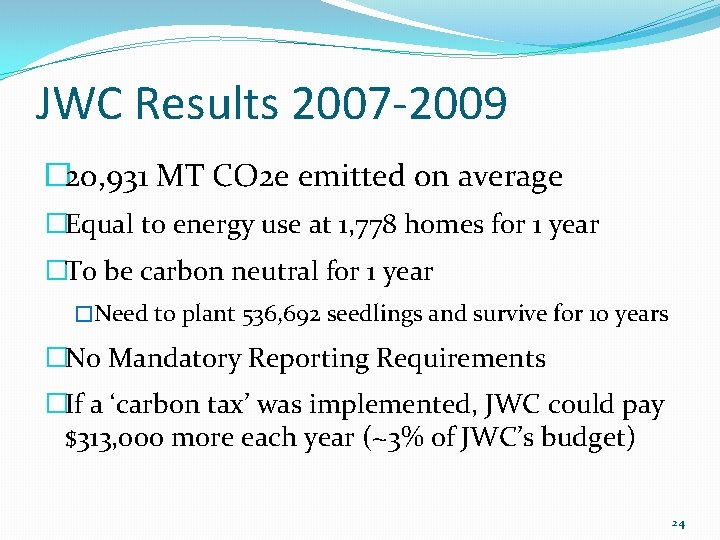
JWC Results 2007 -2009 � 20, 931 MT CO 2 e emitted on average �Equal to energy use at 1, 778 homes for 1 year �To be carbon neutral for 1 year �Need to plant 536, 692 seedlings and survive for 10 years �No Mandatory Reporting Requirements �If a ‘carbon tax’ was implemented, JWC could pay $313, 000 more each year (~3% of JWC’s budget) 24
Are the JWC results common? �Not many WTPs have completed a carbon footprint �Low vehicle emissions (Scope 1) compared to most Public Works agencies. �Very high electricity use �High Scope 3 for the dollars spent 25
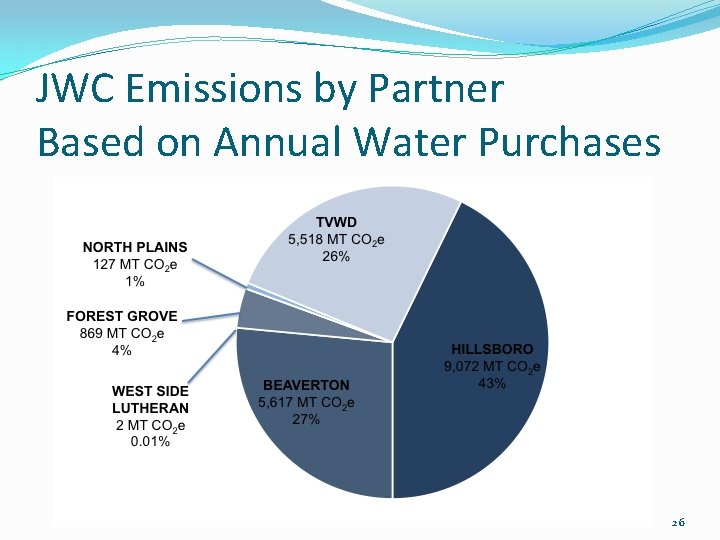
JWC Emissions by Partner Based on Annual Water Purchases 26
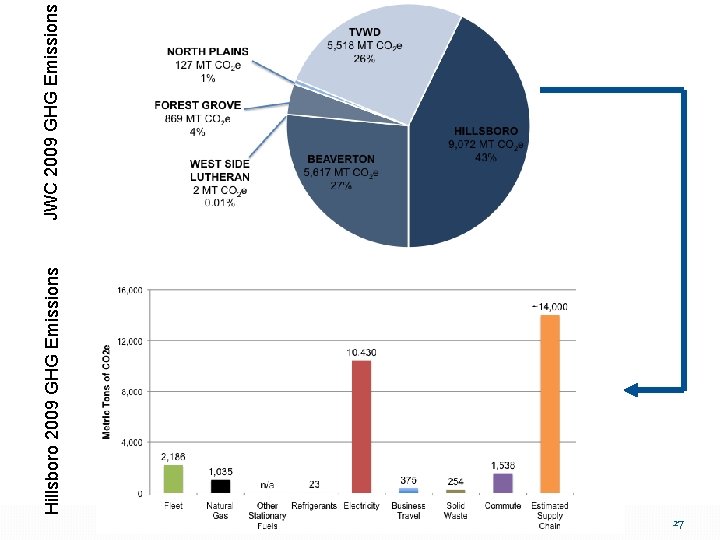
Hillsboro 2009 GHG Emissions k 27 JWC 2009 GHG Emissions
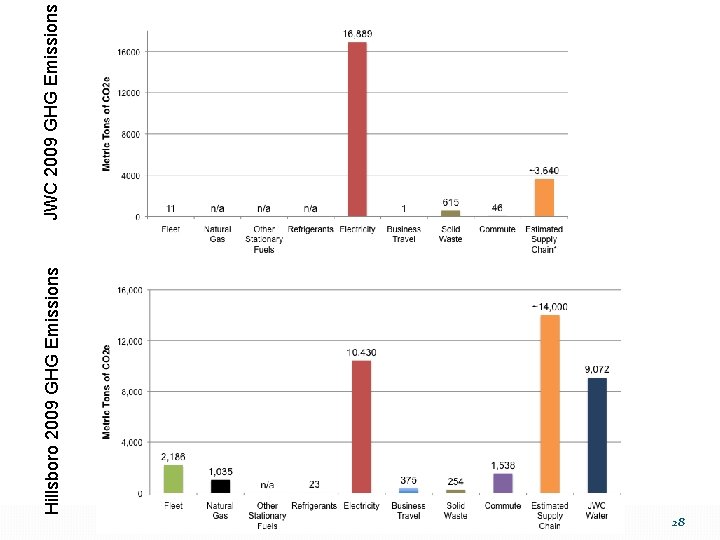
Hillsboro 2009 GHG Emissions k 28 JWC 2009 GHG Emissions
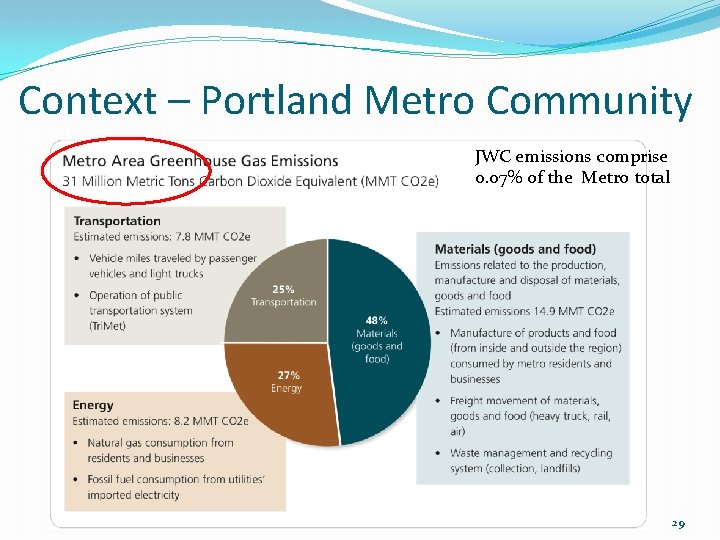
Context – Portland Metro Community JWC emissions comprise 0. 07% of the Metro total 29
Climate Action Opportunities �Investigate Energy Savings and Grants: �Solar Array at JWC WTP �Micro-Hydroelectric Generation �Efficiency in Energy and Chemical use �Operating a WTP for Energy Efficiency is not the most efficient for Pump Life or Treatment Processes. 30
Climate Change Risks �Increase frequency and intensity of turbidity events �Higher temperatures lead to increased algal blooms �Higher temperatures lead to increased demands �Leading to increased chemical and energy usage and sludge production �Higher temperature water more likely to form the contaminant DBP �May lead to changes in operations or chemicals �Biggest Potential Climate Change Impact to JWC – Water Availability 31
Acknowledgements �Josh Skov (Principal) and Kelly Hoell (Associate) from Good Company �Brian Lovelin (Hillsboro – Water Department Staff) �Several Hillsboro and JWC Staff, and JWC’s Vendors �Need More Info? �Kristel Fesler at Kristel. F@ci. hillsboro. or. us 32
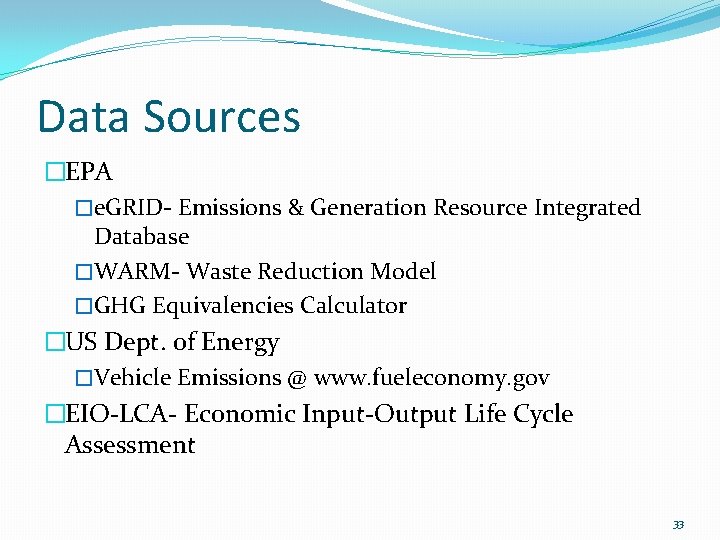
Data Sources �EPA �e. GRID- Emissions & Generation Resource Integrated Database �WARM- Waste Reduction Model �GHG Equivalencies Calculator �US Dept. of Energy �Vehicle Emissions @ www. fueleconomy. gov �EIO-LCA- Economic Input-Output Life Cycle Assessment 33