
Joint Transport and Communication Model for Vehicular Adhoc
- Slides: 11
Joint Transport and Communication Model for Vehicular Ad-hoc Networks Supervisors: Prof. Kin K. Leung and Prof. John W. Polak Ivan Ho
Background Mobile Ad hoc NETwork (MANET): A collection of wireless nodes communicating with each other in the absence of any infrastructure Vehicular Ad hoc NETwork (VANET): A subclass of MANET, which would perform crucial functions in road safety, detection of traffic accidents and reduction of traffic congestions. However, driver behaviour, mobility constraints and high speeds create unique characteristics in VANET.
Background Joint Transport and Communication Model: to adequately capture spatial and temporal details and accuracy of vehicle propagation, link condition, node connectivity and network protocol operations Key Question: How different characteristics of mobility affect the performance of wireless communication protocols?
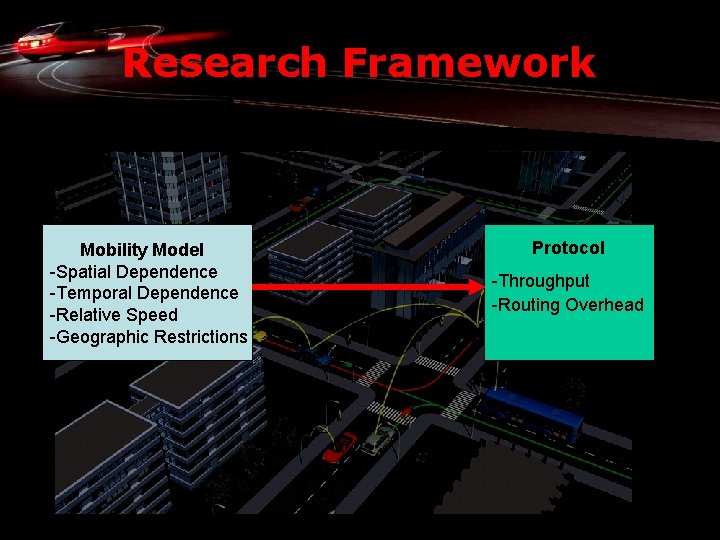
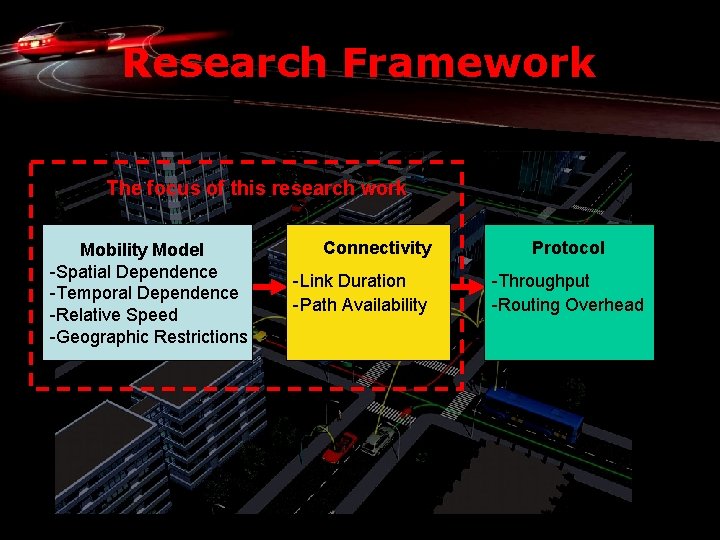
Research Framework Mobility Model -Spatial Dependence -Temporal Dependence -Relative Speed -Geographic Restrictions Protocol -Throughput -Routing Overhead
Research Framework The focus of this research work Mobility Model -Spatial Dependence -Temporal Dependence -Relative Speed -Geographic Restrictions Connectivity -Link Duration -Path Availability Protocol -Throughput -Routing Overhead
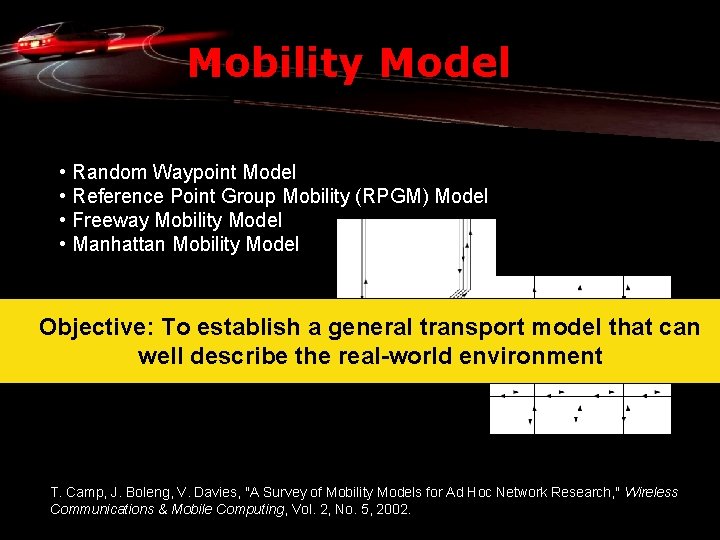
Mobility Model • Random Waypoint Model • Reference Point Group Mobility (RPGM) Model • Freeway Mobility Model • Manhattan Mobility Model Objective: These models To establish are insufficient a general transport to capturemodel the major that can characteristics well describe of thereal-worldtransport environment systems! T. Camp, J. Boleng, V. Davies, "A Survey of Mobility Models for Ad Hoc Network Research, " Wireless Communications & Mobile Computing, Vol. 2, No. 5, 2002.
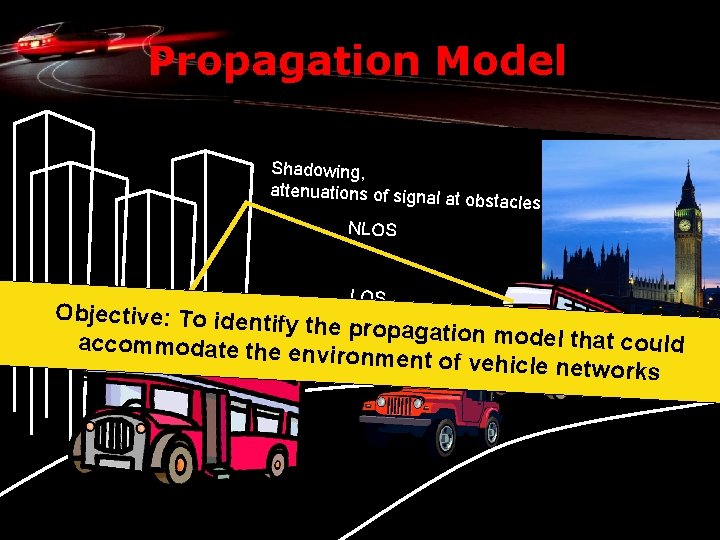
Propagation Model Shadowing, attenuations of signal at o bstacles NLOS Objective: To identify the propagation mod el that could accommodate the en NLOS vironment of vehicle networks
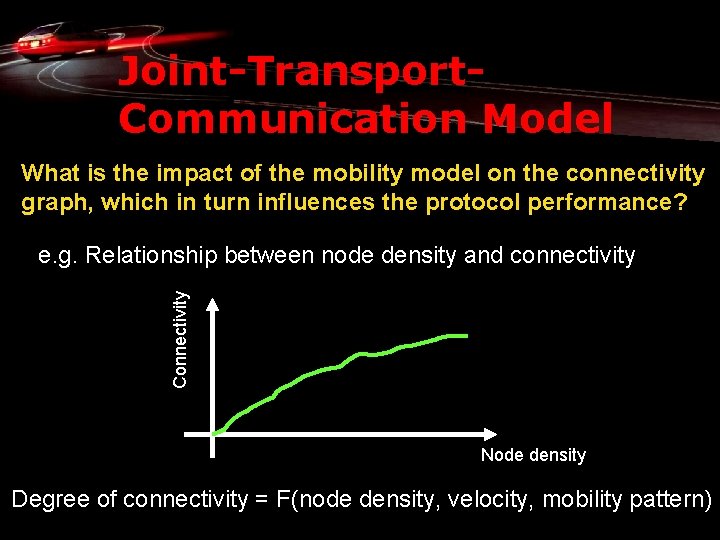
Joint-Transport. Communication Model What is the impact of the mobility model on the connectivity graph, which in turn influences the protocol performance? Connectivity e. g. Relationship between node density and connectivity Node density Degree of connectivity = F(node density, velocity, mobility pattern)
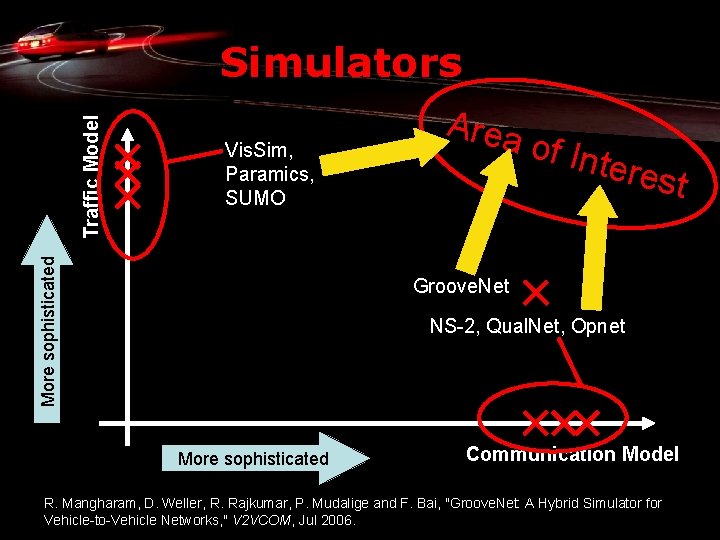
Vis. Sim, Paramics, SUMO More sophisticated Traffic Model Simulators Area o f Inte rest Groove. Net NS-2, Qual. Net, Opnet More sophisticated Communication Model R. Mangharam, D. Weller, R. Rajkumar, P. Mudalige and F. Bai, "Groove. Net: A Hybrid Simulator for Vehicle-to-Vehicle Networks, " V 2 VCOM, Jul 2006.
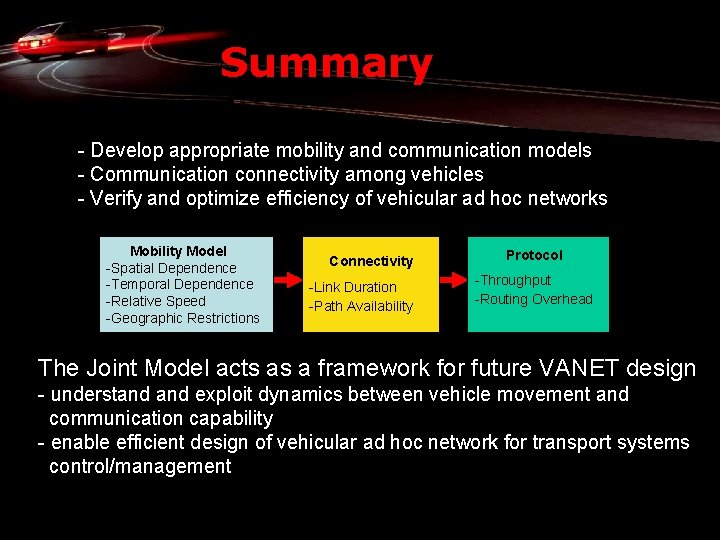
Summary - Develop appropriate mobility and communication models - Communication connectivity among vehicles - Verify and optimize efficiency of vehicular ad hoc networks Mobility Model -Spatial Dependence -Temporal Dependence -Relative Speed -Geographic Restrictions Connectivity -Link Duration -Path Availability Protocol -Throughput -Routing Overhead The Joint Model acts as a framework for future VANET design - understand exploit dynamics between vehicle movement and communication capability - enable efficient design of vehicular ad hoc network for transport systems control/management
Q&A