
Joint Scheduling of Overlapping Phases in the Map

- Slides: 33
Joint Scheduling of Overlapping Phases in the Map. Reduce Framework Jie Wu Collaborators: Huanyang Zheng and Yang Chen Center for Networked Computing Temple University
Road Map 1. Introduction 2. Model and Formulation 3. General Greedy Solutions 4. Experiment 5. Conclusion
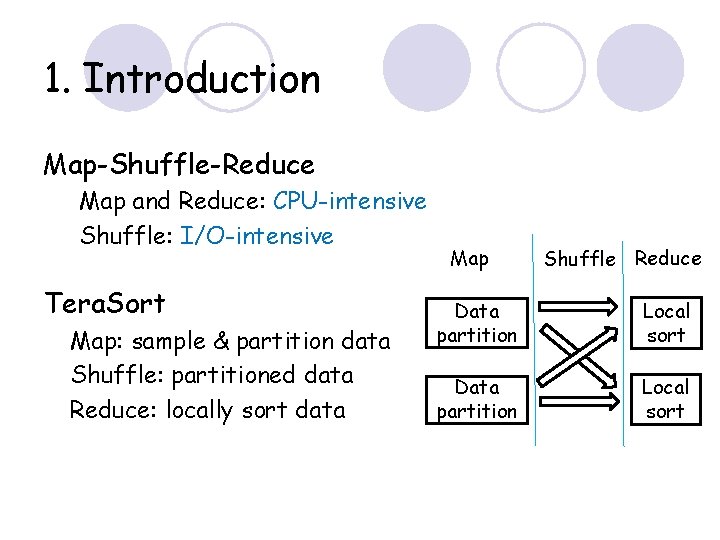
1. Introduction Map-Shuffle-Reduce Map and Reduce: CPU-intensive Shuffle: I/O-intensive Tera. Sort Map: sample & partition data Shuffle: partitioned data Reduce: locally sort data Map Shuffle Reduce Data partition Local sort
Map-Shuffle-Reduce Multiple jobs Tera. Sort, Word. Count, etc. Reduce is not significant (Zaharia, OSDI 2008) 7% of jobs are reduce-heavy Centralized scheduler Determines a sequential order for jobs on the map and shuffle pipelines
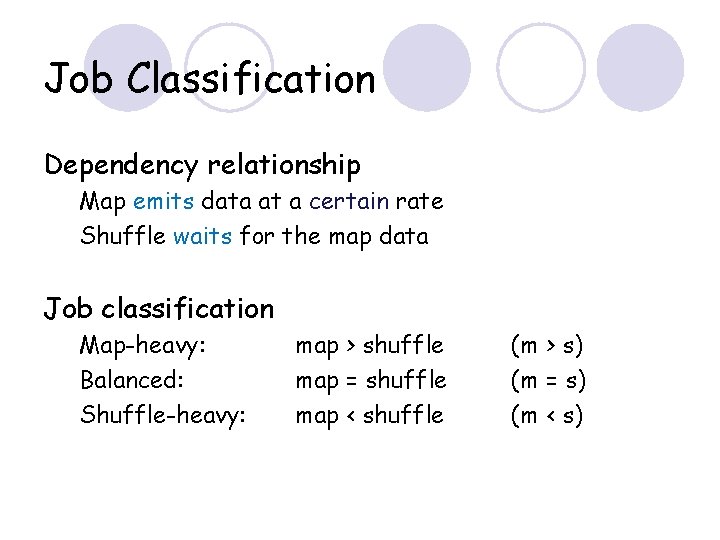
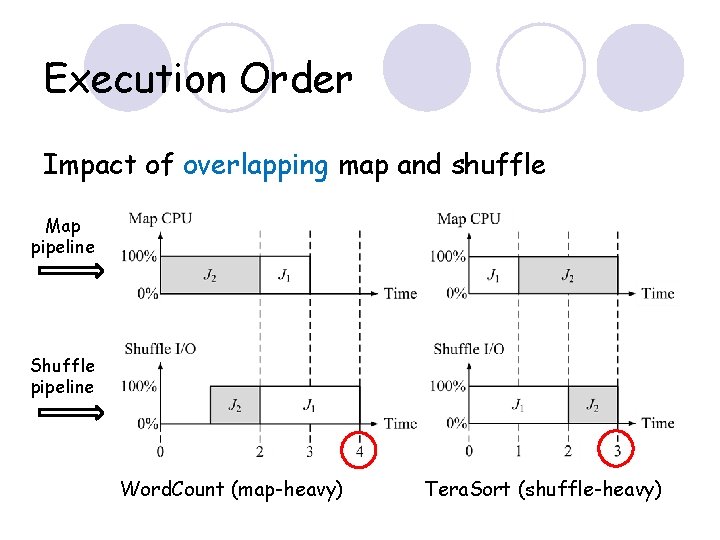
Job Classification Dependency relationship Map emits data at a certain rate Shuffle waits for the map data Job classification Map-heavy: Balanced: Shuffle-heavy: map > shuffle map = shuffle map < shuffle (m > s) (m = s) (m < s)
Execution Order Impact of overlapping map and shuffle Map pipeline Shuffle pipeline Word. Count (map-heavy) Tera. Sort (shuffle-heavy)
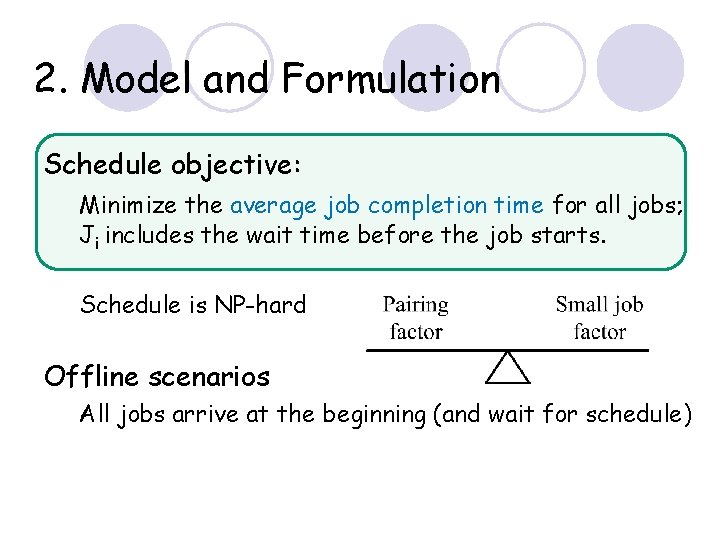
2. Model and Formulation Schedule objective: Minimize the average job completion time for all jobs; Ji includes the wait time before the job starts. Schedule is NP-hard Offline scenarios All jobs arrive at the beginning (and wait for schedule)
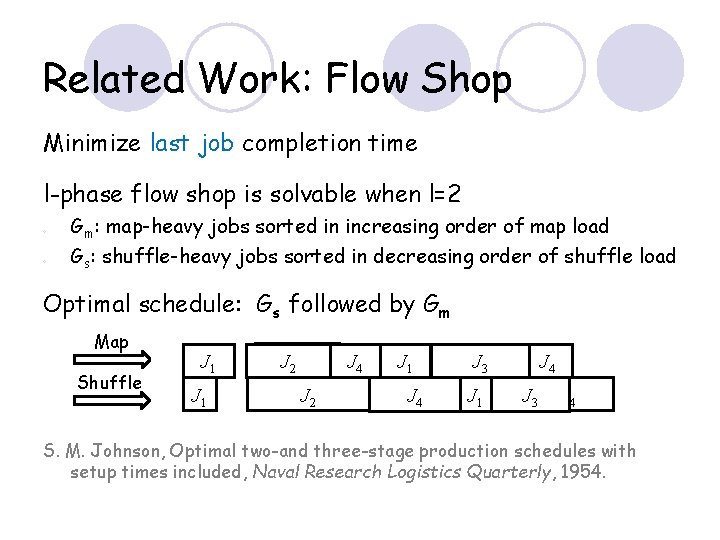
Related Work: Flow Shop Minimize last job completion time l-phase flow shop is solvable when l=2 ○ ○ Gm: map-heavy jobs sorted in increasing order of map load Gs: shuffle-heavy jobs sorted in decreasing order of shuffle load Optimal schedule: Gs followed by Gm Map Shuffle J 1 JJ 2 2 J 4 J 1 J 3 J 4 J 3 J 1 J 4 J 3 J 4 S. M. Johnson, Optimal two-and three-stage production schedules with setup times included, Naval Research Logistics Quarterly, 1954.
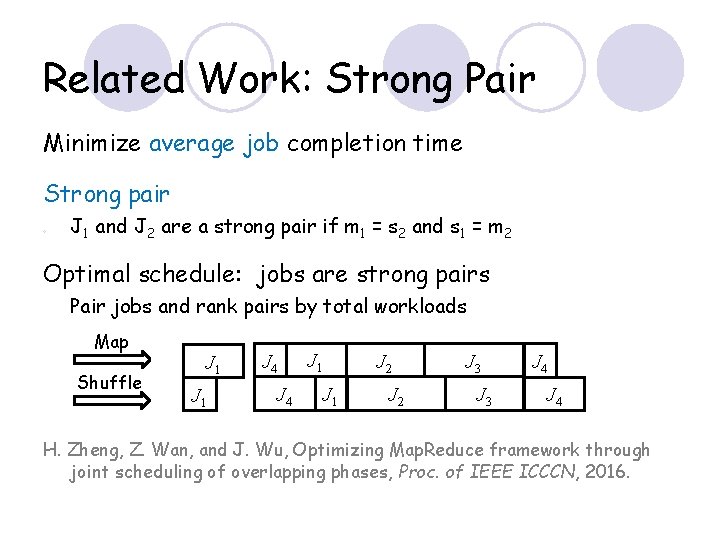
Related Work: Strong Pair Minimize average job completion time Strong pair ○ J 1 and J 2 are a strong pair if m 1 = s 2 and s 1 = m 2 Optimal schedule: jobs are strong pairs Pair jobs and rank pairs by total workloads Map Shuffle J 1 J 4 JJ 21 J 2 J 1 J 2 J 3 J 3 J 4 H. Zheng, Z. Wan, and J. Wu, Optimizing Map. Reduce framework through joint scheduling of overlapping phases, Proc. of IEEE ICCCN, 2016.
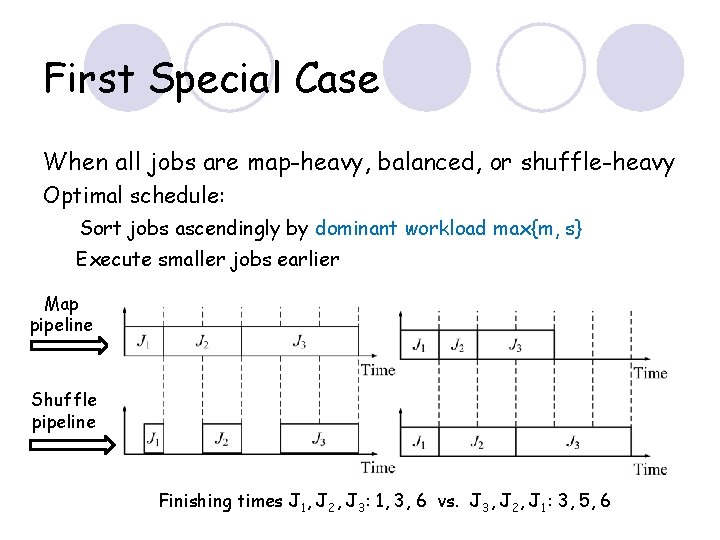
First Special Case When all jobs are map-heavy, balanced, or shuffle-heavy Optimal schedule: Sort jobs ascendingly by dominant workload max{m, s} Execute smaller jobs earlier Map pipeline Shuffle pipeline Finishing times J 1, J 2, J 3: 1, 3, 6 vs. J 3, J 2, J 1: 3, 5, 6
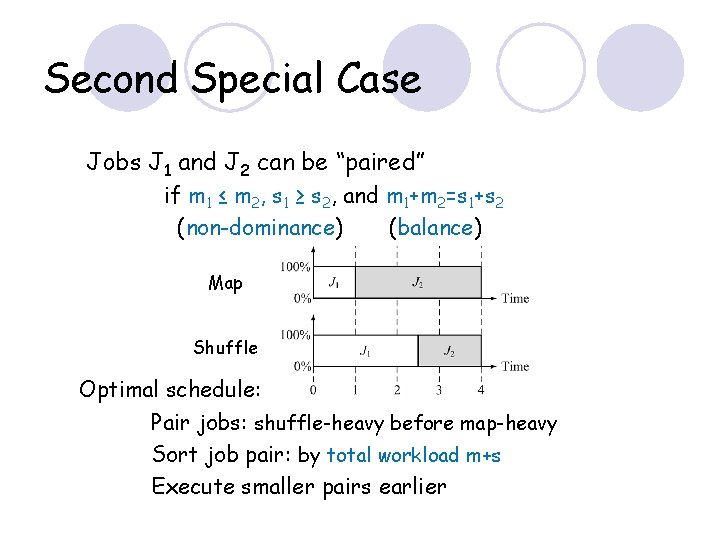
Second Special Case Jobs J 1 and J 2 can be “paired” if m 1 ≤ m 2, s 1 ≥ s 2, and m 1+m 2=s 1+s 2 (non-dominance) (balance) Map Shuffle Optimal schedule: Pair jobs: shuffle-heavy before map-heavy Sort job pair: by total workload m+s Execute smaller pairs earlier
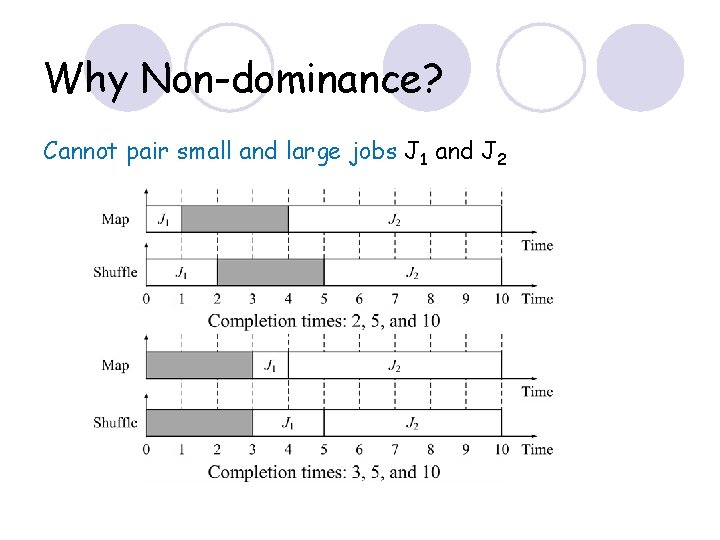
Why Non-dominance? Cannot pair small and large jobs J 1 and J 2
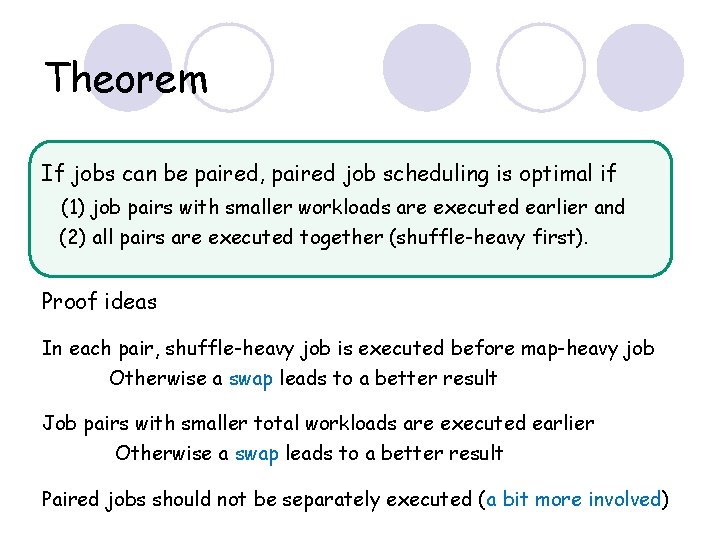
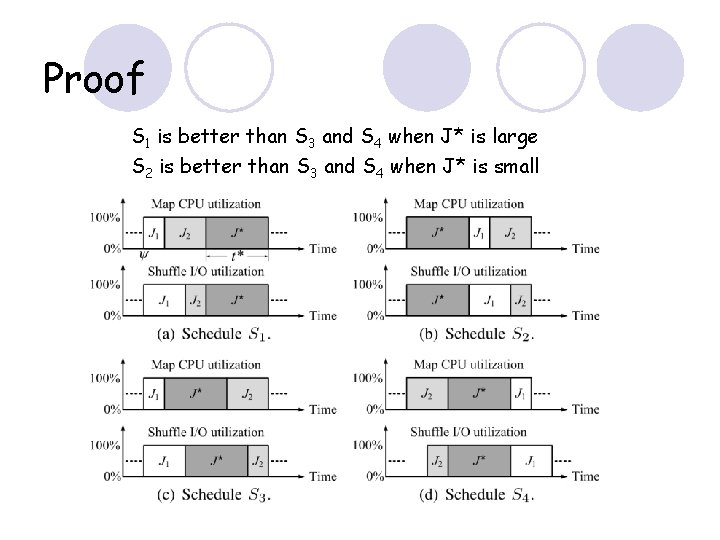
Theorem If jobs can be paired, paired job scheduling is optimal if (1) job pairs with smaller workloads are executed earlier and (2) all pairs are executed together (shuffle-heavy first). Proof ideas In each pair, shuffle-heavy job is executed before map-heavy job Otherwise a swap leads to a better result Job pairs with smaller total workloads are executed earlier Otherwise a swap leads to a better result Paired jobs should not be separately executed (a bit more involved)
Proof S 1 is better than S 3 and S 4 when J* is large S 2 is better than S 3 and S 4 when J* is small
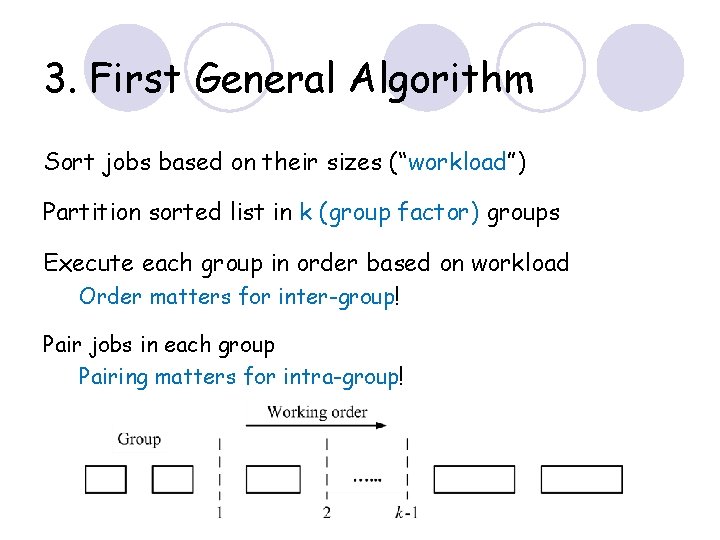
3. First General Algorithm Sort jobs based on their sizes (“workload”) Partition sorted list in k (group factor) groups Execute each group in order based on workload Order matters for inter-group! Pair jobs in each group Pairing matters for intra-group!
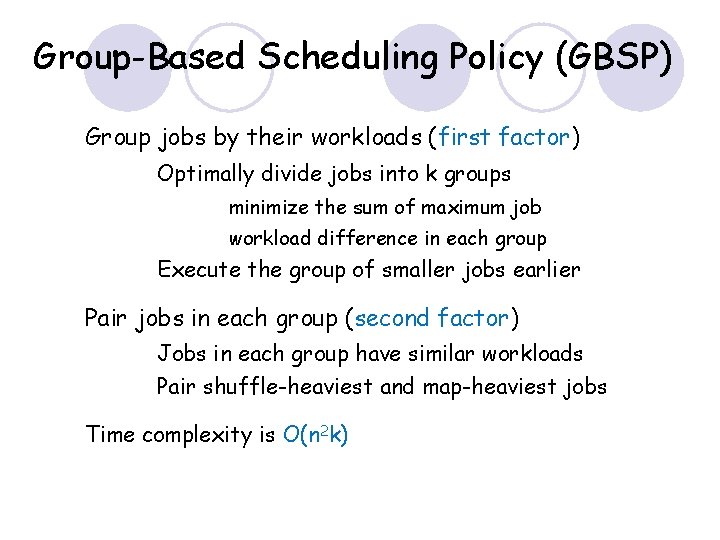
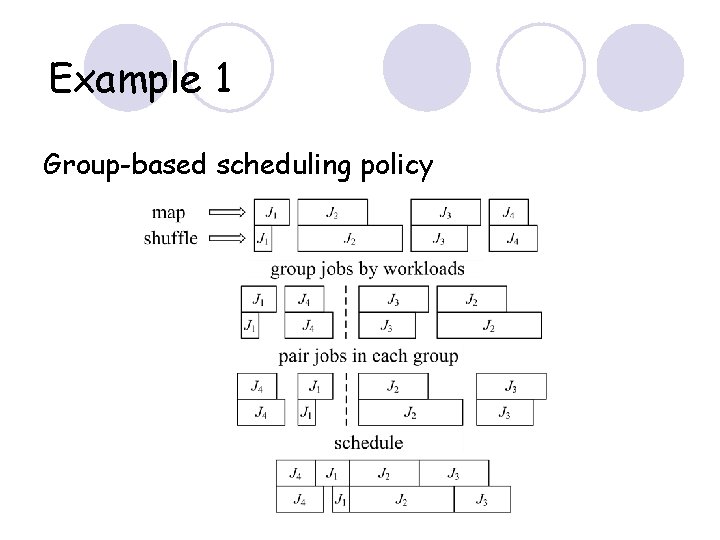
Group-Based Scheduling Policy (GBSP) Group jobs by their workloads (first factor) Optimally divide jobs into k groups minimize the sum of maximum job workload difference in each group Execute the group of smaller jobs earlier Pair jobs in each group (second factor) Jobs in each group have similar workloads Pair shuffle-heaviest and map-heaviest jobs Time complexity is O(n 2 k)
Example 1 Group-based scheduling policy
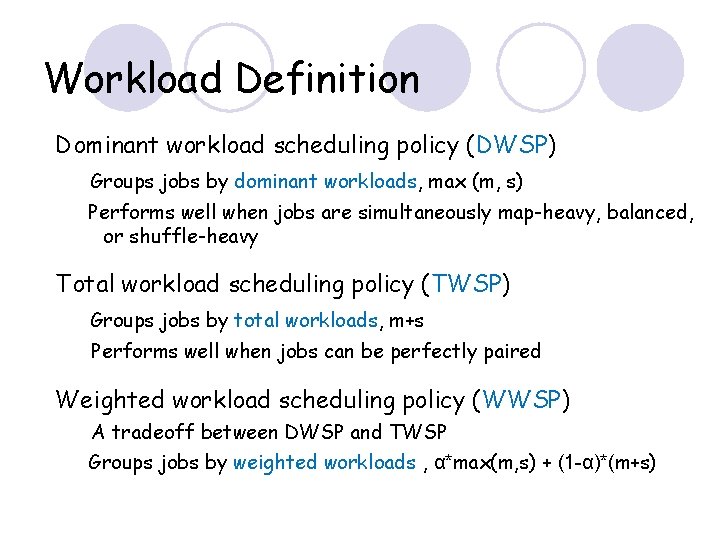
Workload Definition Dominant workload scheduling policy (DWSP) Groups jobs by dominant workloads, max (m, s) Performs well when jobs are simultaneously map-heavy, balanced, or shuffle-heavy Total workload scheduling policy (TWSP) Groups jobs by total workloads, m+s Performs well when jobs can be perfectly paired Weighted workload scheduling policy (WWSP) A tradeoff between DWSP and TWSP Groups jobs by weighted workloads , α*max(m, s) + (1 -α)*(m+s)
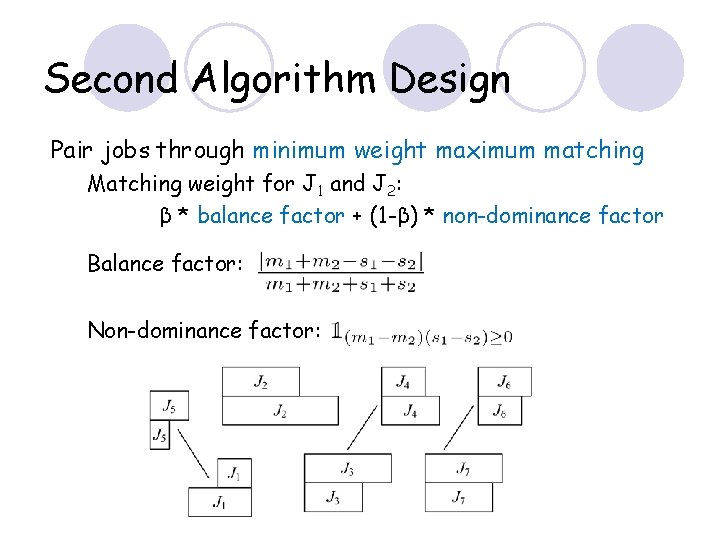
Second Algorithm Design Pair jobs through minimum weight maximum matching Matching weight for J 1 and J 2: β * balance factor + (1 -β) * non-dominance factor Balance factor: Non-dominance factor:
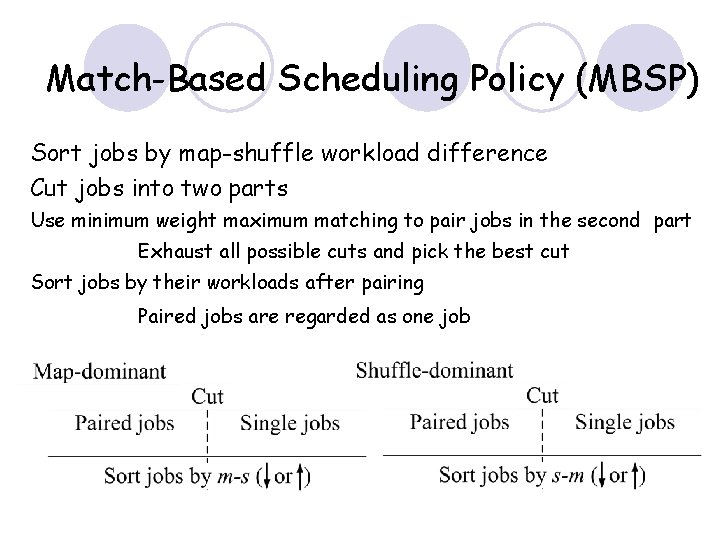
Match-Based Scheduling Policy (MBSP) Sort jobs by map-shuffle workload difference Cut jobs into two parts Use minimum weight maximum matching to pair jobs in the second part Exhaust all possible cuts and pick the best cut Sort jobs by their workloads after pairing Paired jobs are regarded as one job
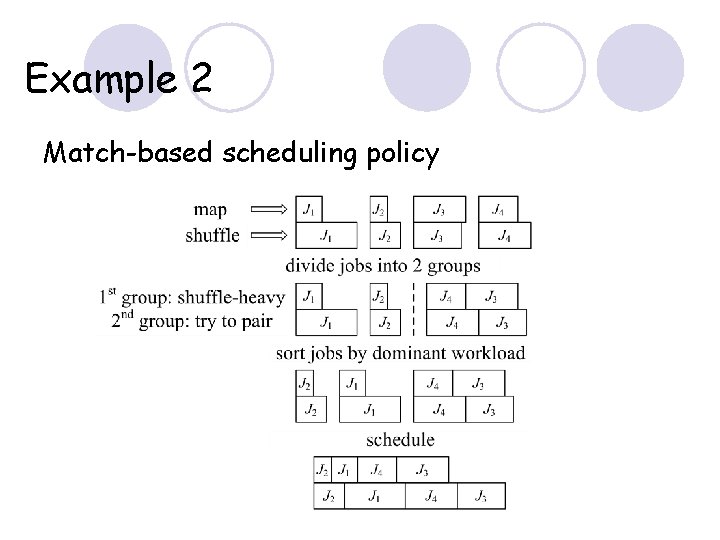
Example 2 Match-based scheduling policy
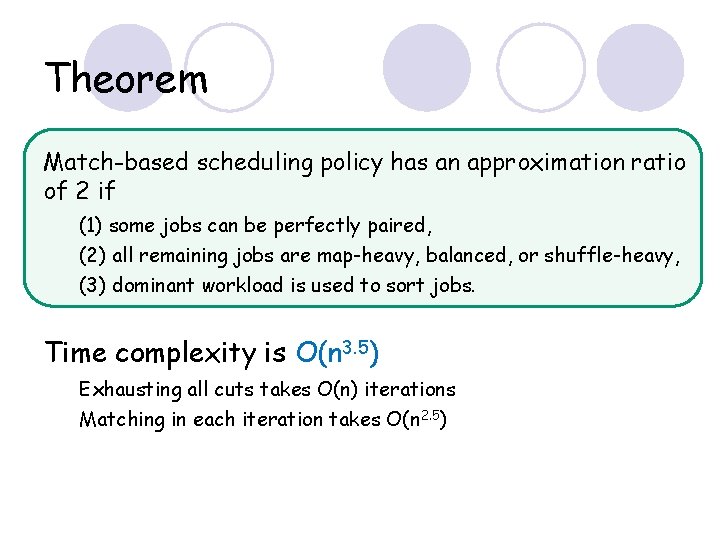
Theorem Match-based scheduling policy has an approximation ratio of 2 if (1) some jobs can be perfectly paired, (2) all remaining jobs are map-heavy, balanced, or shuffle-heavy, (3) dominant workload is used to sort jobs. Time complexity is O(n 3. 5) Exhausting all cuts takes O(n) iterations Matching in each iteration takes O(n 2. 5)
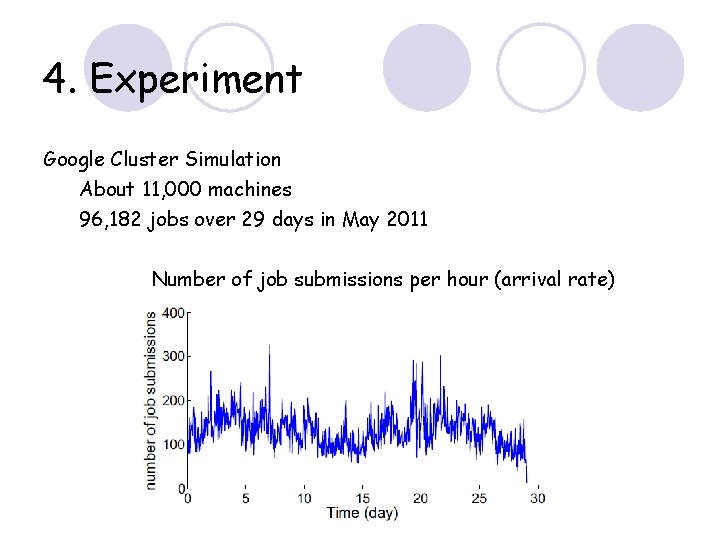
4. Experiment Google Cluster Simulation About 11, 000 machines 96, 182 jobs over 29 days in May 2011 Number of job submissions per hour (arrival rate)
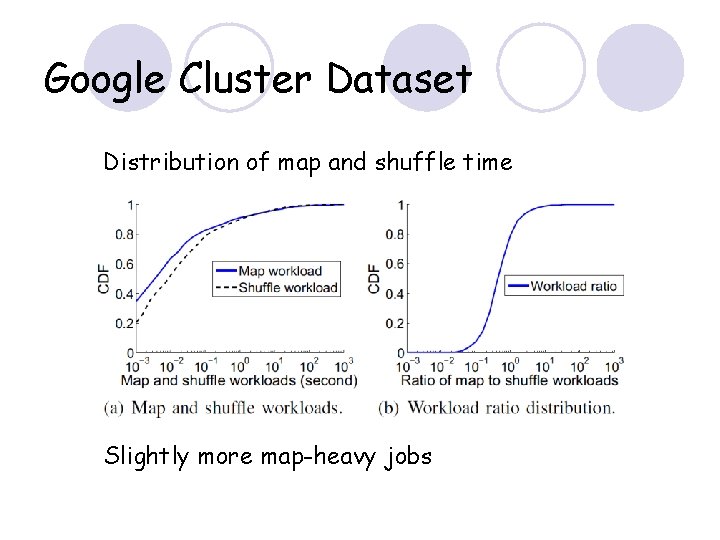
Google Cluster Dataset Distribution of map and shuffle time Slightly more map-heavy jobs
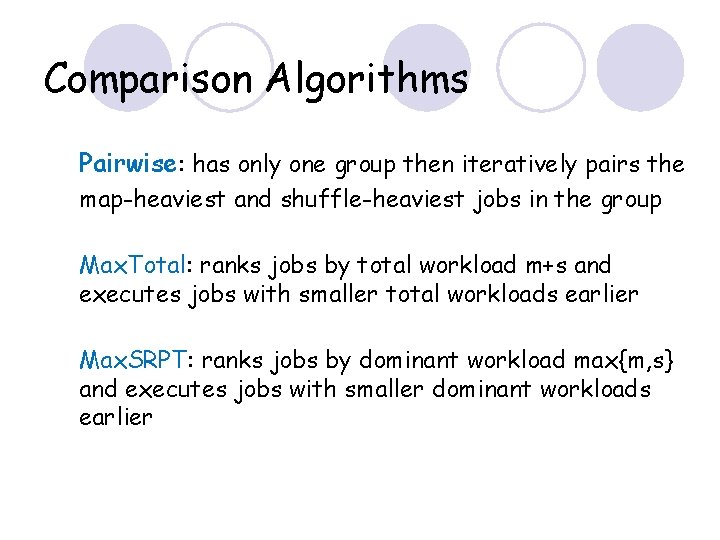
Comparison Algorithms Pairwise: has only one group then iteratively pairs the map-heaviest and shuffle-heaviest jobs in the group Max. Total: ranks jobs by total workload m+s and executes jobs with smaller total workloads earlier Max. SRPT: ranks jobs by dominant workload max{m, s} and executes jobs with smaller dominant workloads earlier
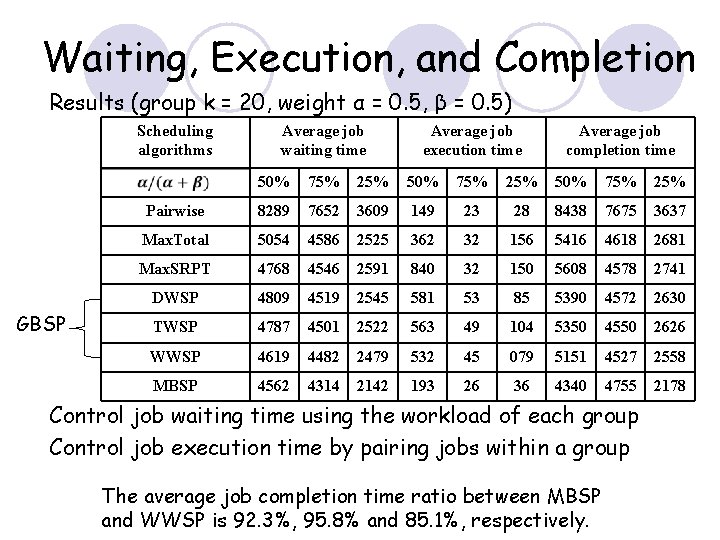
Waiting, Execution, and Completion Results (group k = 20, weight α = 0. 5, β = 0. 5) Scheduling algorithms GBSP Average job waiting time Average job execution time Average job completion time 50% 75% 25% Pairwise 8289 7652 3609 149 23 28 8438 7675 3637 Max. Total 5054 4586 2525 362 32 156 5416 4618 2681 Max. SRPT 4768 4546 2591 840 32 150 5608 4578 2741 DWSP 4809 4519 2545 581 53 85 5390 4572 2630 TWSP 4787 4501 2522 563 49 104 5350 4550 2626 WWSP 4619 4482 2479 532 45 079 5151 4527 2558 MBSP 4562 4314 2142 193 26 36 4340 4755 2178 Control job waiting time using the workload of each group Control job execution time by pairing jobs within a group The average job completion time ratio between MBSP and WWSP is 92. 3%, 95. 8% and 85. 1%, respectively.
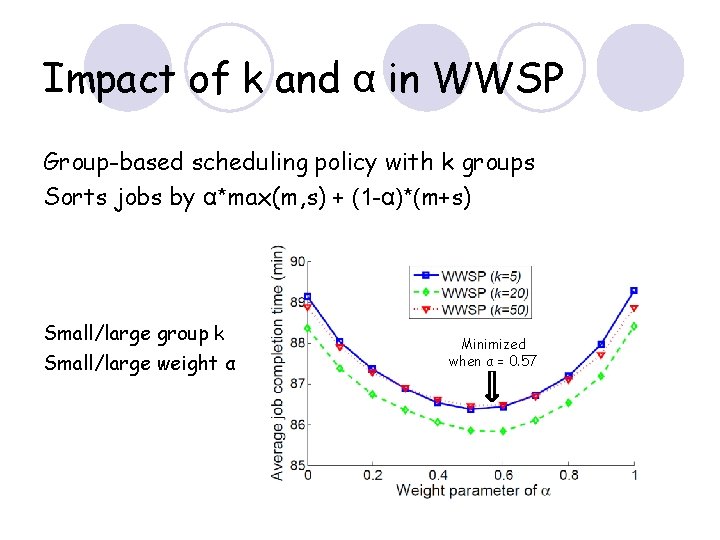
Impact of k and α in WWSP Group-based scheduling policy with k groups Sorts jobs by α*max(m, s) + (1 -α)*(m+s) Small/large group k Small/large weight α Minimized when α = 0. 57
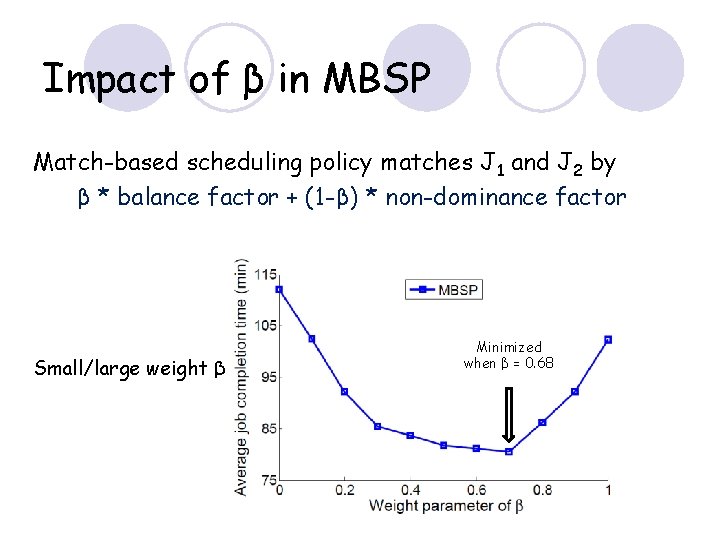
Impact of β in MBSP Match-based scheduling policy matches J 1 and J 2 by β * balance factor + (1 -β) * non-dominance factor Small/large weight β Minimized when β = 0. 68
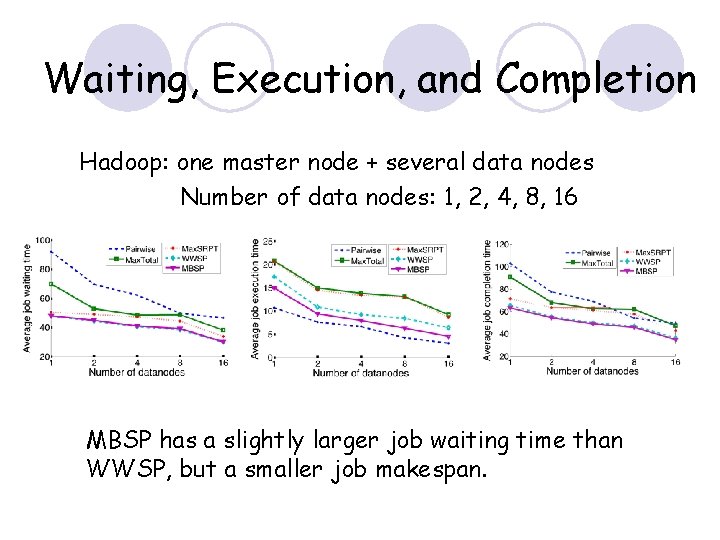
Hadoop Testbed on Amazon EC 2 Testbed Ubuntu Server 14. 04 LTS (HVM) Single core CPU and 8 G SSD memory Jobs: Word. Count jobs and Tera. Sort jobs 6 Word. Count uses books of different sizes 2 MB, 4 MB, 6 MB, 8 MB, 10 MB, 12 MB 6 Tera. Sort uses instances of different sizes 1 KB, 100 KB, 1 MB, 100 MB
Waiting, Execution, and Completion Hadoop: one master node + several data nodes Number of data nodes: 1, 2, 4, 8, 16 MBSP has a slightly larger job waiting time than WWSP, but a smaller job makespan.
Performance Comparison Pairwise has the smallest average execution time, but a large job wait time since workloads are ignored. Max. Total and Max. SPRT do not balance the trade-off between job sizes and job pairs. DWSP, TWSP, WWSP, and MBSP jointly consider job sizes and job pairs.
5. Conclusion Map and Shuffle phases can overlap CPU and I/O resource Objective: minimize average job completion time Group-based and match-based schedules Job workloads (dominant factor) Job pairs (avoid I/O underutilization) Optimality under certain scenarios
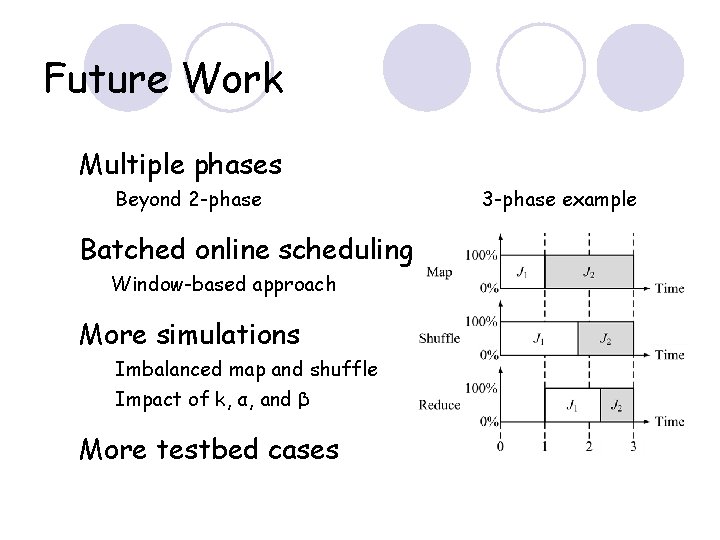
Future Work Multiple phases Beyond 2 -phase Batched online scheduling Window-based approach More simulations Imbalanced map and shuffle Impact of k, α, and β More testbed cases 3 -phase example