
Joint Requirements Oversight Council JROC Joint Capabilities Integration
Joint Requirements Oversight Council (JROC) Joint Capabilities Integration and Development System (JCIDS) & Insensitive Munitions (IM) Waiver Process Col Rob “Gimp” Martinez, USMC Joint Staff J 8 April 14, 2004 1
Agenda I. Joint Staff J 8 Organization II. Joint Capabilities Integration and Development System (JCIDS) - CJCSI 3170. 01 D and CJCSM 3170. 01 A III. What is IM? IV. Why IM? V. Summary – Way Ahead 2
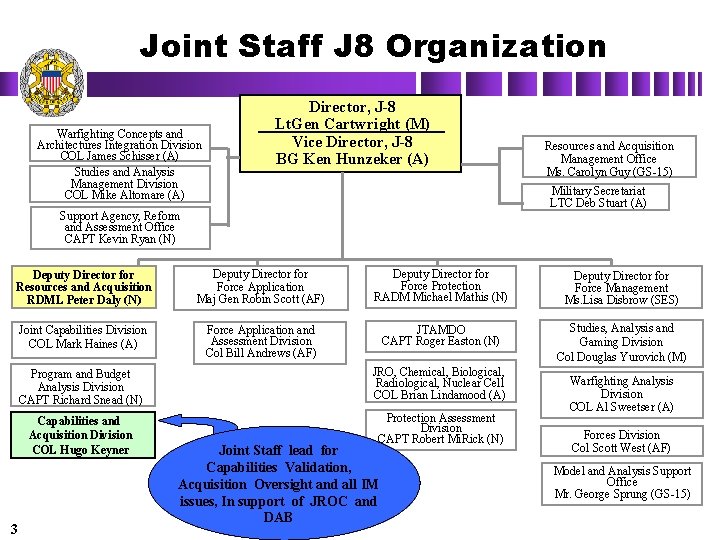
Joint Staff J 8 Organization Warfighting Concepts and Architectures Integration Division COL James Schisser (A) Studies and Analysis Management Division COL Mike Altomare (A) Director, J-8 Lt. Gen Cartwright (M) Vice Director, J-8 BG Ken Hunzeker (A) Resources and Acquisition Management Office Ms. Carolyn Guy (GS-15) Military Secretariat LTC Deb Stuart (A) Support Agency, Reform and Assessment Office CAPT Kevin Ryan (N) Deputy Director for Resources and Acquisition RDML Peter Daly (N) Deputy Director for Force Application Maj Gen Robin Scott (AF) Deputy Director for Force Protection RADM Michael Mathis (N) Deputy Director for Force Management Ms. Lisa Disbrow (SES) Joint Capabilities Division COL Mark Haines (A) Force Application and Assessment Division Col Bill Andrews (AF) JTAMDO CAPT Roger Easton (N) Studies, Analysis and Gaming Division Col Douglas Yurovich (M) 3 Program and Budget Analysis Division CAPT Richard Snead (N) JRO, Chemical, Biological, Radiological, Nuclear Cell COL Brian Lindamood (A) Capabilities and Acquisition Division COL Hugo Keyner Protection Assessment Division CAPT Robert Mi. Rick (N) Joint Staff lead for Capabilities Validation, Acquisition Oversight and all IM issues, In support of JROC and DAB Warfighting Analysis Division COL Al Sweetser (A) Forces Division Col Scott West (AF) Model and Analysis Support Office Mr. George Sprung (GS-15)
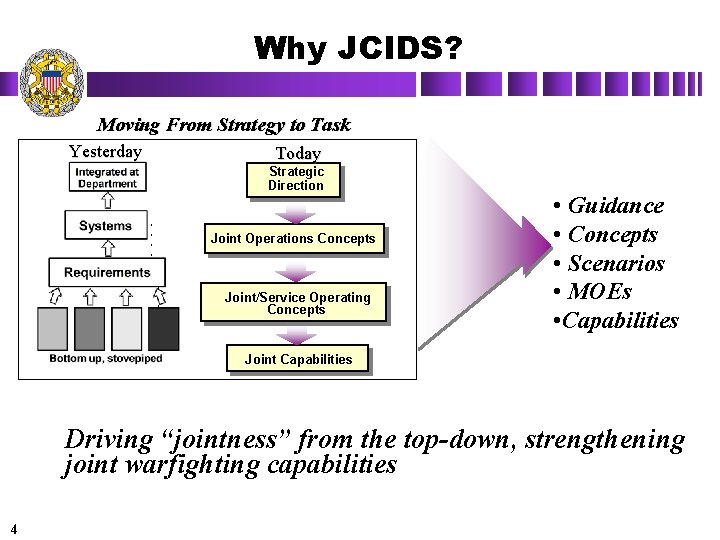
Why JCIDS? Moving From Strategy to Task Yesterday Today Strategic Direction Joint Operations Concepts Joint/Service Operating Concepts • Guidance • Concepts • Scenarios • MOEs • Capabilities Joint Capabilities Driving “jointness” from the top-down, strengthening joint warfighting capabilities 4
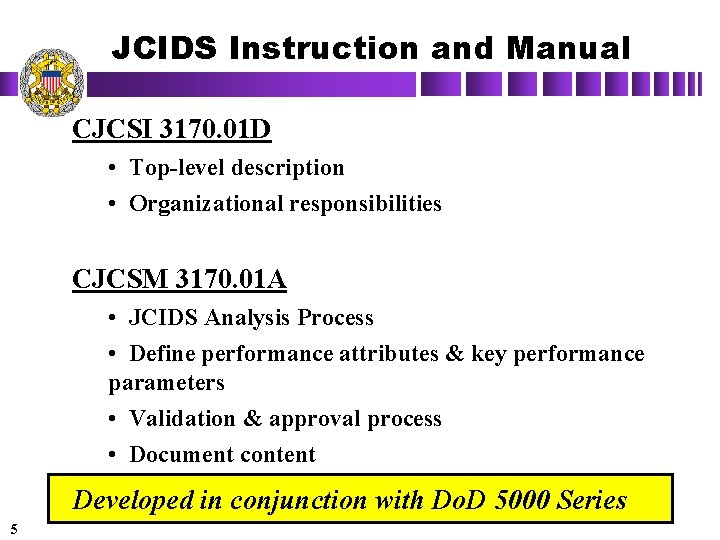
JCIDS Instruction and Manual CJCSI 3170. 01 D • Top-level description • Organizational responsibilities CJCSM 3170. 01 A • JCIDS Analysis Process • Define performance attributes & key performance parameters • Validation & approval process • Document content Developed in conjunction with Do. D 5000 Series 5
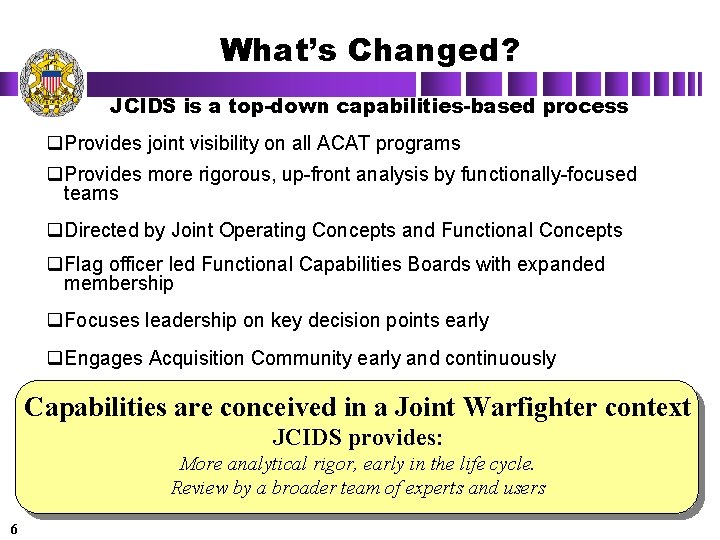
What’s Changed? JCIDS is a top-down capabilities-based process q. Provides joint visibility on all ACAT programs q. Provides more rigorous, up-front analysis by functionally-focused teams q. Directed by Joint Operating Concepts and Functional Concepts q. Flag officer led Functional Capabilities Boards with expanded membership q. Focuses leadership on key decision points early q. Engages Acquisition Community early and continuously Capabilities are conceived in a Joint Warfighter context JCIDS provides: More analytical rigor, early in the life cycle. Review by a broader team of experts and users 6
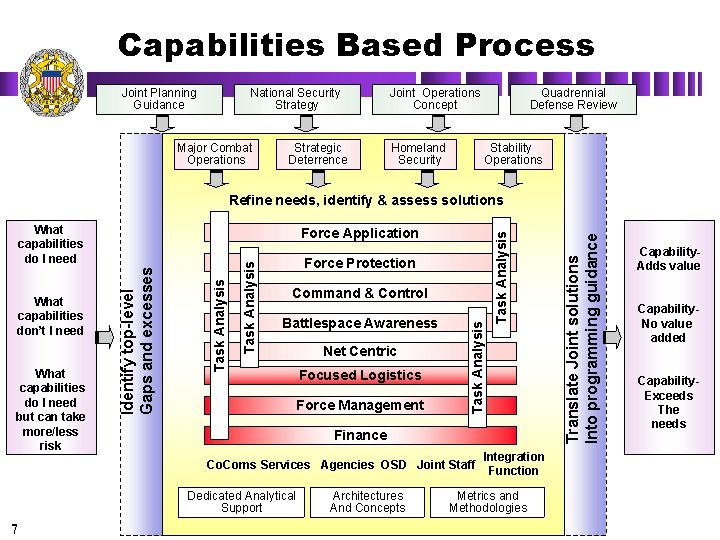
Capabilities Based Process Joint Planning Guidance National Security Strategy Major Combat Operations Strategic Deterrence Joint Operations Concept Homeland Security Quadrennial Defense Review Stability Operations Force Protection Command & Control Battlespace Awareness Net Centric Focused Logistics Force Management Task Analysis What capabilities do I need but can take more/less risk Identify top-level Gaps and excesses What capabilities don’t I need Force Application Finance Co. Coms Services Agencies OSD Joint Staff Dedicated Analytical Support 7 Architectures And Concepts Integration Function Metrics and Methodologies Translate Joint solutions Into programming guidance What capabilities do I need Task Analysis Refine needs, identify & assess solutions Capability. Adds value Capability. No value added Capability. Exceeds The needs
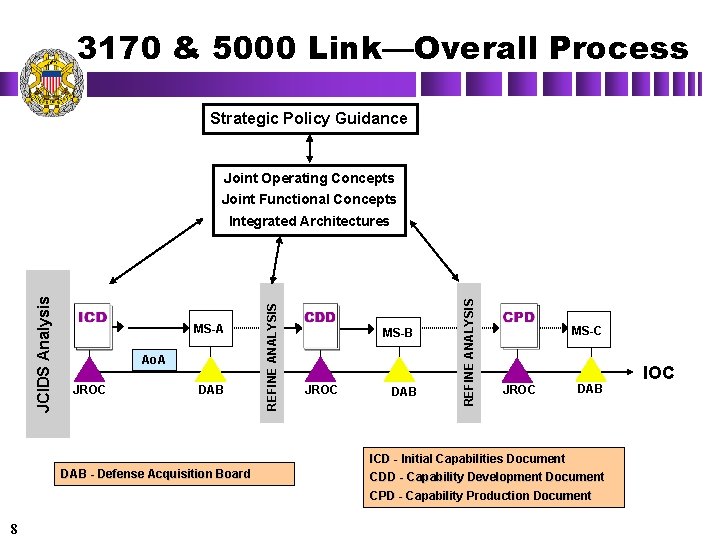
3170 & 5000 Link—Overall Process Strategic Policy Guidance Joint Operating Concepts Joint Functional Concepts Ao. A JROC DAB MS-B JROC DAB REFINE ANALYSIS MS-A REFINE ANALYSIS JCIDS Analysis Integrated Architectures MS-C JROC DAB ICD - Initial Capabilities Document DAB - Defense Acquisition Board CDD - Capability Development Document CPD - Capability Production Document 8 IOC
What is the definition of IM? Munitions which reliably fulfill their performance, readiness and operational requirements on demand, but which minimize the probability of inadvertent initiation and severity of subsequent collateral damage to weapon platforms, logistic systems and personnel when subjected to unplanned stimuli. 9
Why IM? Congressional Law q USC, Title 10, Chapter 14, December 2001: “§ 2389. Ensuring safety regarding insensitive munitions. ” ''The Secretary of Defense shall ensure, to the extent practicable, that insensitive munitions under development or procurement are safe throughout development and fielding when subject to unplanned stimuli. ” Department of Defense Policy q Do. DD 5000. 1, May 12, 2003: E 1. 23. Safety. “… All systems containing energetics shall comply with insensitive munitions criteria. ” Joint Chiefs Policy q Chairman, Joint Chiefs of Staff Manual CJCSM 3170. 01, June 23, 2003: “Insensitive Munitions Waiver Requests. Insensitive munitions waiver requests require approval by the JROC. Insensitive munitions waiver requests shall include a Component or agency approved insensitive munitions plan of action and milestones to identify how future purchases of the same system or future system variants will achieve incremental and full compliance. Waiver requests will be submitted to J-4 for review, then forwarded to the JROC Secretariat in conjunction with JCIDS staffing for JROC consideration. ” 10 IT’S THE RIGHT THING TO DO FOR THE WARFIGHTER AND NONCOMBATANTS
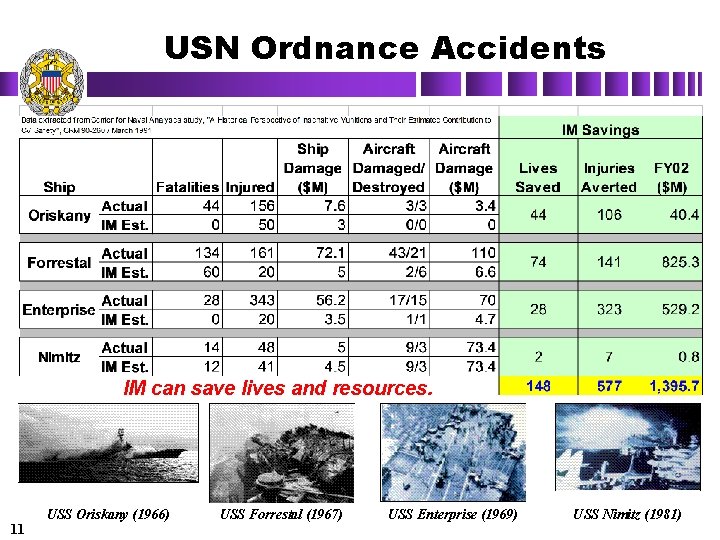
USN Ordnance Accidents IM can save lives and resources. 11 USS Oriskany (1966) USS Forrestal (1967) USS Enterprise (1969) USS Nimitz (1981)
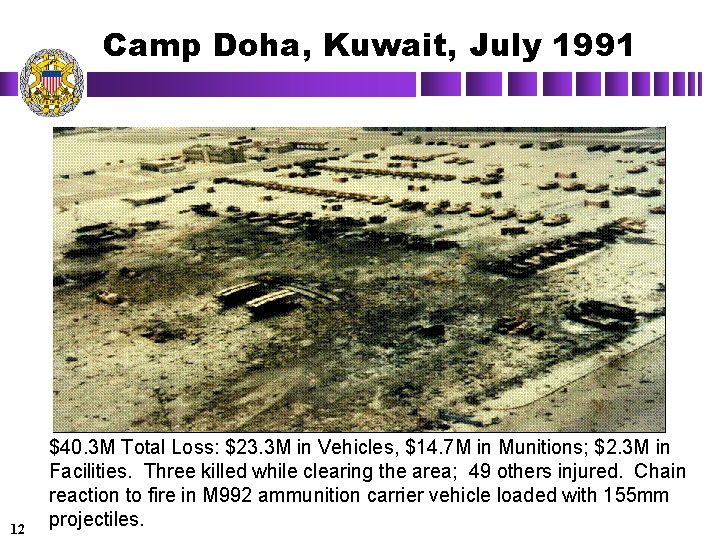
Camp Doha, Kuwait, July 1991 12 $40. 3 M Total Loss: $23. 3 M in Vehicles, $14. 7 M in Munitions; $2. 3 M in Facilities. Three killed while clearing the area; 49 others injured. Chain reaction to fire in M 992 ammunition carrier vehicle loaded with 155 mm projectiles.
Increased JS Emphasis on IM q ICW the new JCIDS process, emphasis on IM has shifted. q JROC IM Waiver approval process. q Joint Staff working in concert with OSD on all IM issues. DDRA, DDFP, DJ 8 and VCJCS all engaged on IM issues, working with corresponding levels within OSD. q JROC desires new munitions be “borne” IM compliant, e. g. , SDB, JCM, JASSM, etc. q For existing munitions, JROC desires to see some level of IM compliance and emphasis on IM technology insertion…common sense approach for scarce resources. q JROC concerned with lack of Do. D and Service wide IM S&T efforts. 13
JROC desire for IM S&T q. JROC Memo 150 -03 of 28 July 03 (PAC-3) stated: Ø “The JROC…deferred a decision. . . on a waiver request for the PAC-3. The JROC is concerned with the lack of PAC-3 IM compliance on current production missiles and nominal improvements on planned subsequent production variants…. the JROC is requesting the DAB re-examine possible IM technology insertions for PAC-3. ” Ø “The JROC also requests USD(AT&L) assistance in overseeing DOD -wide science and technology efforts to improve IM. A focused DODwide IM technology effort will ensure long-term compliance and safety. ” Through the IM waiver process, the JROC has clearly seen the lack of technologies available to meet IM challenges. Program Managers consistently cite technology unavailability as the key reason a waiver is needed. 14
DOD IM Roadmap Approach q Service S&T Executives need to fund core technology S&T (6. 1 and 6. 2) efforts focused on new energetic materials (explosives and propellants) and manufacturing processes, case and package technology, and modeling and simulations. q Work would be completed by all three Military Departments and would provide the critically needed technology building blocks to address these deficiencies. q DOD IM Roadmap also identified the need to demonstrate current and future technology in munition-like hardware and configuration. This is an important process in order to validate the application of IM technology to particular types of munitions. q The 6. 3 effort would fund priority efforts across the Military Departments to complete this work. 15
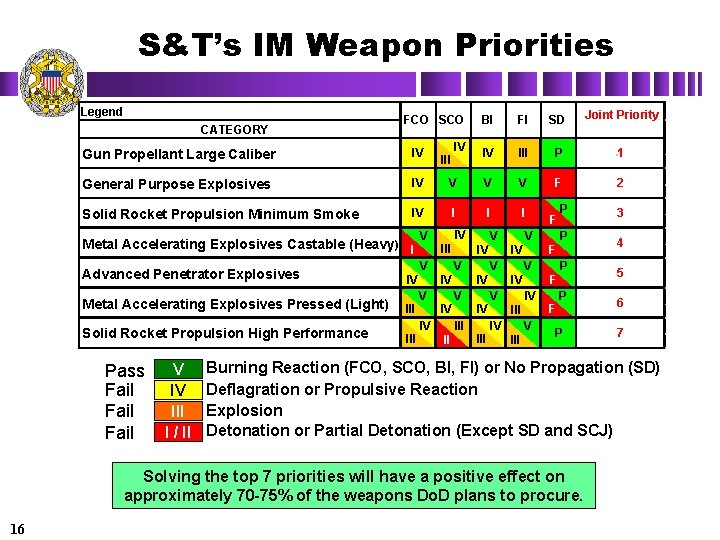
S&T’s IM Weapon Priorities Legend CATEGORY FCO SCO IV BI FI SD Joint Priority IV III P 1 F 2 Gun Propellant Large Caliber IV General Purpose Explosives IV V Solid Rocket Propulsion Minimum Smoke IV I I I Metal Accelerating Explosives Castable (Heavy) I Advanced Penetrator Explosives IV III Solid Rocket Propulsion High Performance III V IV III I / II III V IV V Metal Accelerating Explosives Pressed (Light) Pass Fail V III IV V IV IV IV III II V IV V V III P P F IV IV III F P F P 4 5 6 7 Burning Reaction (FCO, SCO, BI, FI) or No Propagation (SD) Deflagration or Propulsive Reaction Explosion Detonation or Partial Detonation (Except SD and SCJ) Solving the top 7 priorities will have a positive effect on approximately 70 -75% of the weapons Do. D plans to procure. 16 3
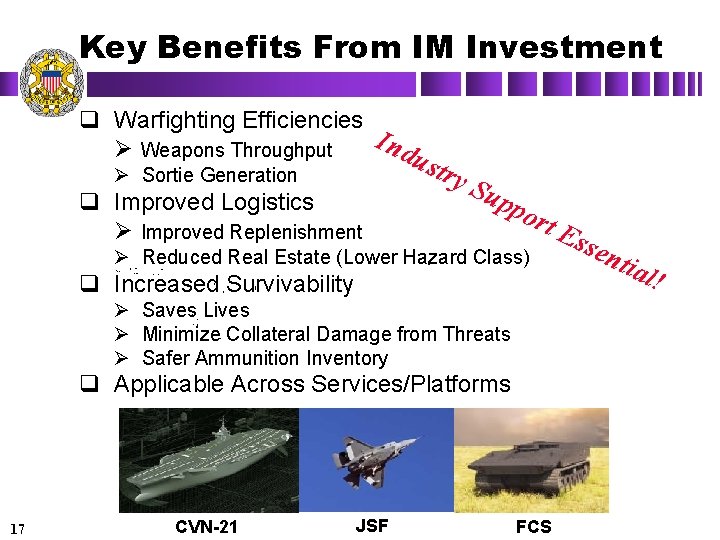
Key Benefits From IM Investment q Warfighting Efficiencies Ind Ø Weapons Throughput ust ry S Ø Sortie Generation upp q Improved Logistics ort Ø Improved Replenishment Es Ø Reduced Real Estate (Lower Hazard Class) q Increased Survivability Ø Saves Lives Ø Minimize Collateral Damage from Threats Ø Safer Ammunition Inventory q Applicable Across Services/Platforms 17 CVN-21 JSF FCS sen tial !
Summary-Way Ahead q JCIDS process driving “jointness” from the top down, with oversight of all ACAT programs and earlier buy-in by all players. q 3170 & 5000 closely aligned ensuring evolutionary acquisition. q IM addresses the Joint and International warfighting needs. It’s also the law! q IM is the right thing to do for warfighters and noncombatants. IM saves lives and material. q JROC is looking for consistent improvements with a long term plan for achieving incremental and full IM compliance per Do. DD 5000. 1 and CJCSI 3170. 01 D. Bottom Line: Services and industry need to make the necessary funding investments for the development of IM technology. 18
Questions? 19
Back-up 20
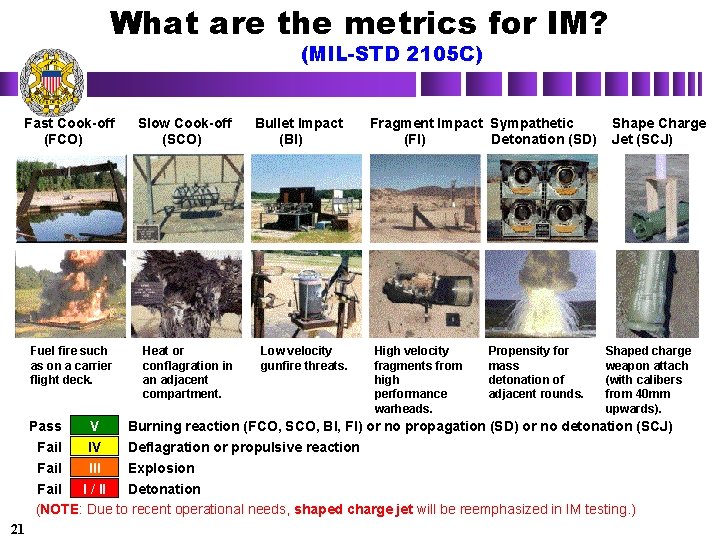
What are the metrics for IM? (MIL-STD 2105 C) Fast Cook-off (FCO) Slow Cook-off (SCO) Fuel fire such as on a carrier flight deck. Heat or conflagration in an adjacent compartment. Pass V Bullet Impact (BI) Low velocity gunfire threats. Fragment Impact Sympathetic (FI) Detonation (SD) High velocity fragments from high performance warheads. Propensity for mass detonation of adjacent rounds. Shape Charge Jet (SCJ) Shaped charge weapon attach (with calibers from 40 mm upwards). Burning reaction (FCO, SCO, BI, FI) or no propagation (SD) or no detonation (SCJ) Fail Deflagration or propulsive reaction IV Fail Explosion III Fail Detonation I / II (NOTE: Due to recent operational needs, shaped charge jet will be reemphasized in IM testing. ) 21
Additional Information • Revised Chairman’s Instruction and companion Manual were signed 24 Jun 03 • CJCSI 3170. 01 C and CJCSM 3170. 01 are posted on the DTIC web site: http: //www. dtic. mil/cjcs_directives • Resident and Distance learning available through the Defense Acquisition University http: //www. dau. mil • Update to Instruction and Manual signed 23 Mar 04 22
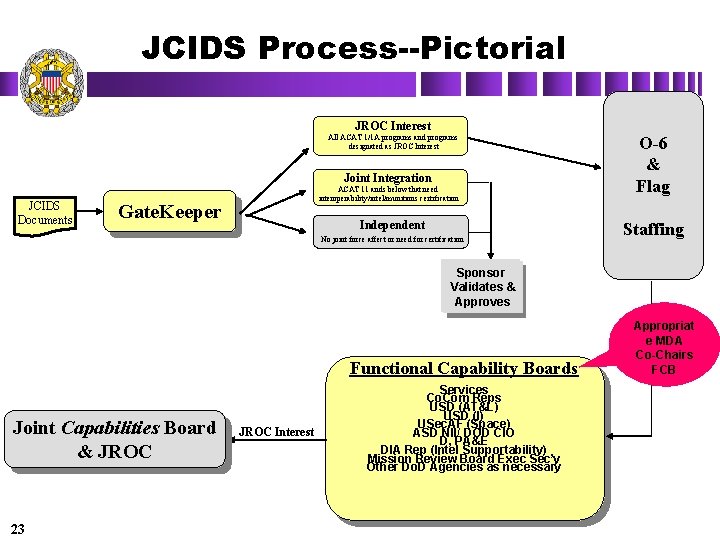
JCIDS Process--Pictorial JROC Interest All ACAT 1/1 A programs and programs designated as JROC Interest Joint Integration JCIDS Documents ACAT 11 ands below that need interoperability/intel/munitions certification Gate. Keeper Independent No joint force affect or need for certification O-6 & Flag Staffing Sponsor Validates & Approves Functional Capability Boards Joint Capabilities Board & JROC 23 JROC Interest Services Co. Com Reps USD (AT&L) USD (I) USec. AF (Space) ASD NII/ DOD CIO D, PA&E DIA Rep (Intel Supportability) Mission Review Board Exec Sec’y Other Do. D Agencies as necessary Appropriat e MDA Co-Chairs FCB
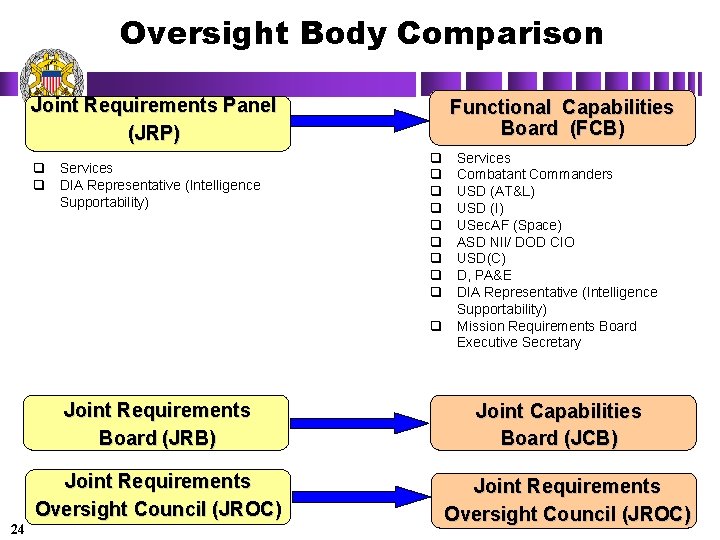
Oversight Body Comparison Joint Requirements Panel (JRP) q Services q DIA Representative (Intelligence Supportability) Functional Capabilities Board (FCB) q q q q q Joint Requirements Board (JRB) Joint Requirements Oversight Council (JROC) 24 Services Combatant Commanders USD (AT&L) USD (I) USec. AF (Space) ASD NII/ DOD CIO USD(C) D, PA&E DIA Representative (Intelligence Supportability) Mission Requirements Board Executive Secretary Joint Capabilities Board (JCB) Joint Requirements Oversight Council (JROC)
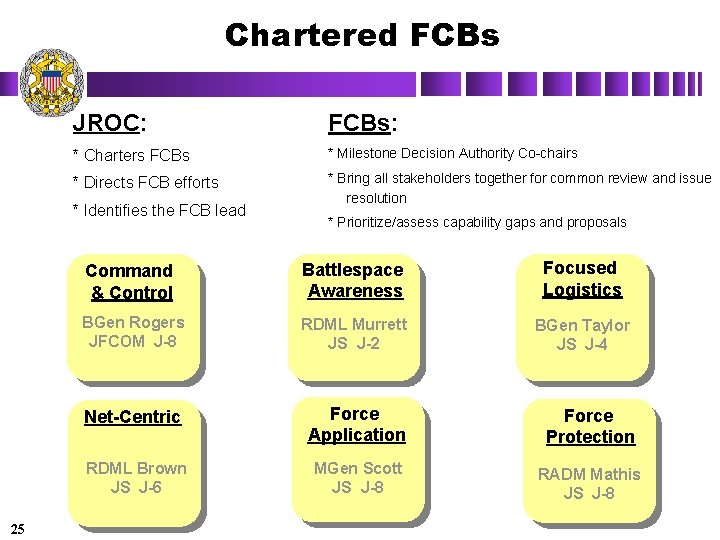
Chartered FCBs JROC: FCBs: * Charters FCBs * Milestone Decision Authority Co-chairs * Directs FCB efforts * Bring all stakeholders together for common review and issue resolution * Identifies the FCB lead 25 * Prioritize/assess capability gaps and proposals Command & Control Battlespace Awareness Focused Logistics BGen Rogers JFCOM J-8 RDML Murrett JS J-2 BGen Taylor JS J-4 Net-Centric Force Application Force Protection RDML Brown JS J-6 MGen Scott JS J-8 RADM Mathis JS J-8
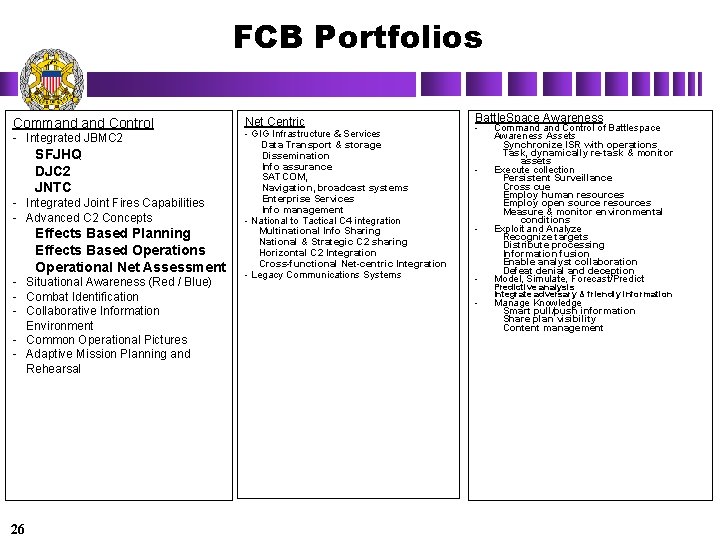
FCB Portfolios Command Control - Integrated JBMC 2 SFJHQ DJC 2 JNTC - Integrated Joint Fires Capabilities - Advanced C 2 Concepts Effects Based Planning Effects Based Operations Operational Net Assessment - Situational Awareness (Red / Blue) - Combat Identification - Collaborative Information Environment - Common Operational Pictures - Adaptive Mission Planning and Rehearsal 26 Net Centric - GIG Infrastructure & Services Data Transport & storage Dissemination Info assurance SATCOM, Navigation, broadcast systems Enterprise Services Info management - National to Tactical C 4 integration Multinational Info Sharing National & Strategic C 2 sharing Horizontal C 2 Integration Cross-functional Net-centric Integration - Legacy Communications Systems Battle. Space Awareness - - Command Control of Battlespace Awareness Assets Synchronize ISR with operations Task, dynamically re-task & monitor assets Execute collection Persistent Surveillance Cross cue Employ human resources Employ open source resources Measure & monitor environmental conditions Exploit and Analyze Recognize targets Distribute processing Information fusion Enable analyst collaboration Defeat denial and deception Model, Simulate, Forecast/Predictive analysis Integrate adversary & friendly information Manage Knowledge Smart pull/push information Share plan visibility Content management
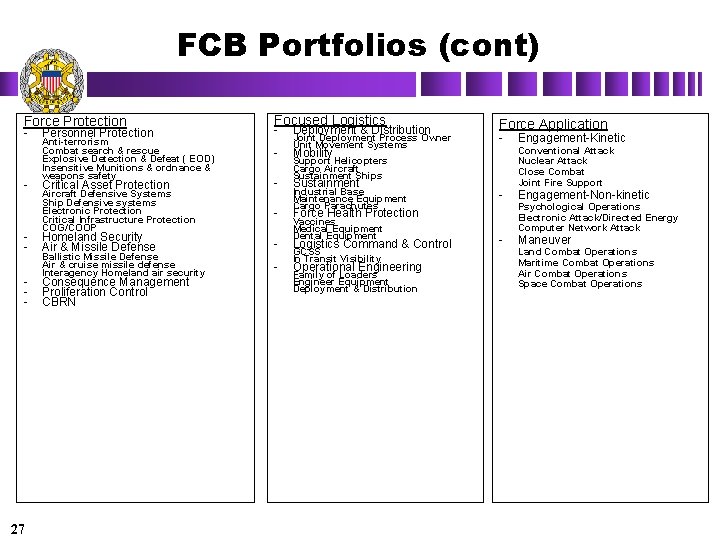
FCB Portfolios (cont) Force Protection - - - 27 Personnel Protection Anti-terrorism Combat search & rescue Explosive Detection & Defeat ( EOD) Insensitive Munitions & ordnance & weapons safety Critical Asset Protection Aircraft Defensive Systems Ship Defensive systems Electronic Protection Critical Infrastructure Protection COG/COOP Homeland Security Air & Missile Defense Ballistic Missile Defense Air & cruise missile defense Interagency Homeland air security Consequence Management Proliferation Control CBRN Focused Logistics - Deployment & Distribution - Mobility - Joint Deployment Process Owner Unit Movement Systems Force Application - Engagement-Kinetic - Engagement-Non-kinetic Support Helicopters Cargo Aircraft Sustainment Ships Sustainment Industrial Base Maintenance Equipment Cargo Parachutes Force Health Protection Vaccines Medical Equipment Dental Equipment Logistics Command & Control GCSS In Transit Visibility Operational Engineering Family of Loaders Engineer Equipment Deployment & Distribution - Conventional Attack Nuclear Attack Close Combat Joint Fire Support Psychological Operations Electronic Attack/Directed Energy Computer Network Attack Maneuver Land Combat Operations Maritime Combat Operations Air Combat Operations Space Combat Operations
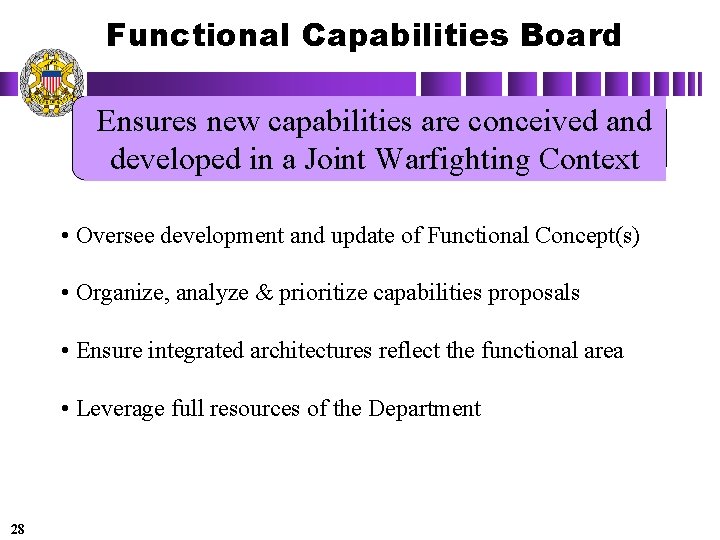
Functional Capabilities Board Ensures new capabilities are conceived and developed in a Joint Warfighting Context • Oversee development and update of Functional Concept(s) • Organize, analyze & prioritize capabilities proposals • Ensure integrated architectures reflect the functional area • Leverage full resources of the Department 28
FCB Working Groups Working Arm of the Functional Capabilities Boards q Coordinate and assist sponsors during JCIDS analysis and document development q Analyze capabilities documents to ensure sponsor is considering joint warfighting aspects q Review assigned functional area to identify capability shortfalls q Develop/maintain prioritized lists of capability shortfalls and current JCIDS proposals across the functional area q Provide the warfighting context and recommendation to the FCB/JCB/ JROC on validation and/or approval of JCIDS documents 29
Initial Capabilities Document (ICD) Purpose of the ICD: q Describes capability gaps as determined by the functional analysis q Summarizes the DOTMLPF analysis Ø Describes why such changes are inadequate q Documents the evaluation of possible materiel approaches Ø Describes how the recommended approach(es) best provide the desired capability When is an ICD required? q All new programs when a MNS is greater that 2 years old q Programs proceeding directly to Milestone B or C 30
Initial Capabilities Document (ICD) (cont’d) Who writes an ICD? q The sponsor Ø In coordination with • Other DOD components • Agencies • JWCA teams • CRD leads • Integrated architecture leads • PA&E Is there a repository? q All approved ICDs will be posted to KM/DS for future reference 31
CDD and CPD q. Capability Development Document (CDD) Ø Identifies operational performance attributes of proposed system Ø System specific, applies to single increment (in an evolutionary program) Ø Results from Technology Development & supports Milestone B Ø Updated or rewritten for subsequent increments q. Capability Production Document (CPD) Ø Identifies production attributes for a single increment of a program Ø Prepared during System Development and Demonstration Ø Rewritten for each increment in a evolutionary program 32
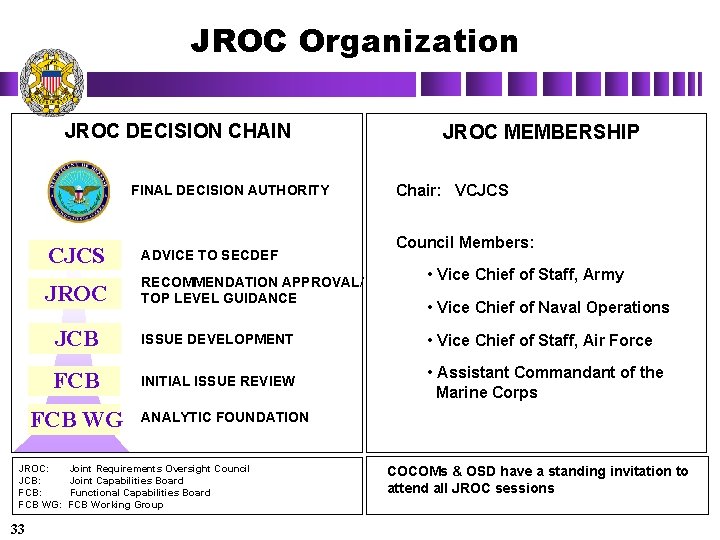
JROC Organization JROC DECISION CHAIN FINAL DECISION AUTHORITY CJCS JROC RECOMMENDATION APPROVAL/ TOP LEVEL GUIDANCE Chair: VCJCS Council Members: • Vice Chief of Staff, Army • Vice Chief of Naval Operations JCB ISSUE DEVELOPMENT • Vice Chief of Staff, Air Force FCB INITIAL ISSUE REVIEW • Assistant Commandant of the Marine Corps FCB WG JROC: JCB: FCB WG: 33 ADVICE TO SECDEF JROC MEMBERSHIP ANALYTIC FOUNDATION Joint Requirements Oversight Council Joint Capabilities Board Functional Capabilities Board FCB Working Group COCOMs & OSD have a standing invitation to attend all JROC sessions
- Slides: 33