
Joint Layout Estimation and Global MultiView Registration for

Joint Layout Estimation and Global Multi-View Registration for Indoor Reconstruction

Introduction ● ● low-cost consumer depth camera > image-based approaches in 3 D reconstruction applications a new approach for accurate indoor reconstruction to resolved the scene layout estimate problem and global registration problem using detasets created by low-cost consumer depth camera.
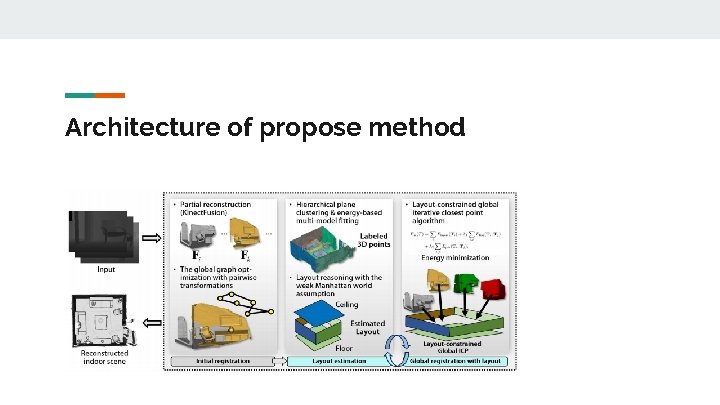
Architecture of propose method
Initial Registration ● ● To construct a scene fragment for every n frames (e. g. 50 )with Kinect. Fusion. we find pairwise transformations for all pairs of the consecutive fragments and align all the fragments in the world coordinate system based on sequential multiplication of the pairwise transformations Loop closure detection Pose graph optimization
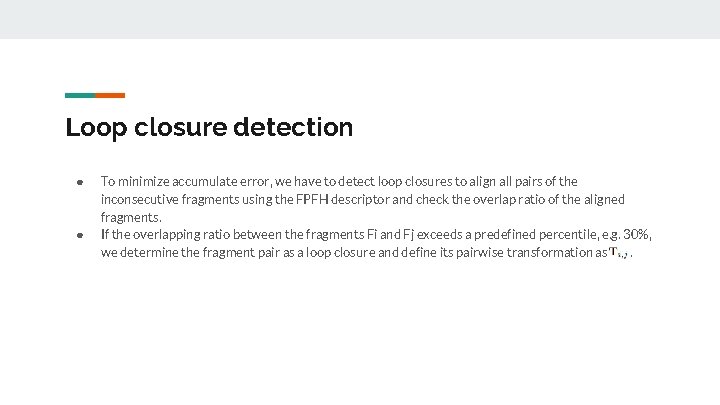
Loop closure detection ● ● To minimize accumulate error, we have to detect loop closures to align all pairs of the inconsecutive fragments using the FPFH descriptor and check the overlap ratio of the aligned fragments. If the overlapping ratio between the fragments Fi and Fj exceeds a predefined percentile, e. g. 30%, we determine the fragment pair as a loop closure and define its pairwise transformation as Ti, j.
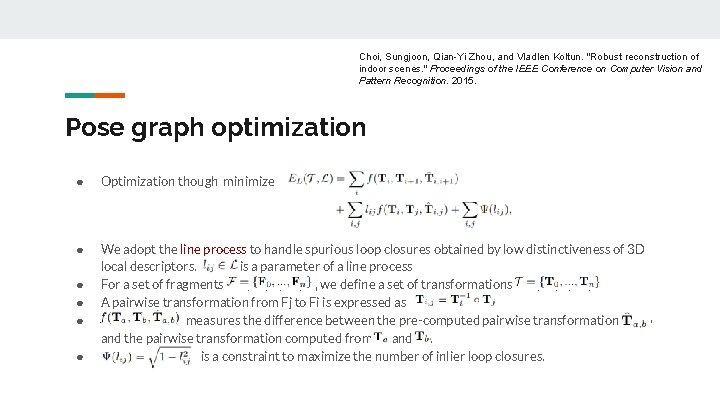
Choi, Sungjoon, Qian-Yi Zhou, and Vladlen Koltun. "Robust reconstruction of indoor scenes. " Proceedings of the IEEE Conference on Computer Vision and Pattern Recognition. 2015. Pose graph optimization ● Optimization though minimize ● We adopt the line process to handle spurious loop closures obtained by low distinctiveness of 3 D local descriptors. is a parameter of a line process For a set of fragments F = {F 0, . . . , Fn} , we define a set of transformations T = {T 0, . . . , Tn} A pairwise transformation from Fj to Fi is expressed as f(Ta, Tb, Tˆ a, b) measures the difference between the pre-computed pairwise transformation Tˆ a, b and the pairwise transformation computed from Ta and Tb. is a constraint to maximize the number of inlier loop closures. ● ●
Layout Estimation ● ● To estimate the scene layout, which consists of a set of planes such as a ceiling, a floor, and walls, we find the dominant planes Pdominant in the scene and then determine layout planes Playout from Pdominant. To extract a set of dominant planes, we compute and cluster plane parameters from supervoxels of each fragment and merge similar plane parameters in the world coordinate system. Dominant plane extraction Layout plane estimate
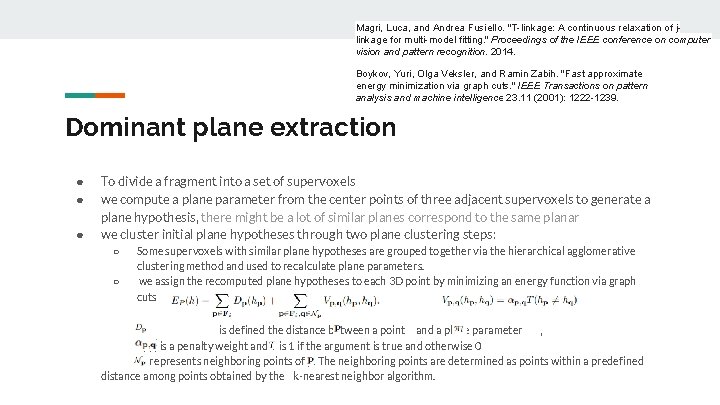
Magri, Luca, and Andrea Fusiello. "T-linkage: A continuous relaxation of jlinkage for multi-model fitting. " Proceedings of the IEEE conference on computer vision and pattern recognition. 2014. Boykov, Yuri, Olga Veksler, and Ramin Zabih. "Fast approximate energy minimization via graph cuts. " IEEE Transactions on pattern analysis and machine intelligence 23. 11 (2001): 1222 -1239. Dominant plane extraction ● ● ● To divide a fragment into a set of supervoxels we compute a plane parameter from the center points of three adjacent supervoxels to generate a plane hypothesis, there might be a lot of similar planes correspond to the same planar we cluster initial plane hypotheses through two plane clustering steps: ○ ○ Some supervoxels with similar plane hypotheses are grouped together via the hierarchical agglomerative clustering method and used to recalculate plane parameters. we assign the recomputed plane hypotheses to each 3 D point by minimizing an energy function via graph cuts is defined the distance between a point and a plane parameter , αp, q is a penalty weight and T is 1 if the argument is true and otherwise 0 represents neighboring points of p. The neighboring points are determined as points within a predefined distance among points obtained by the k-nearest neighbor algorithm.
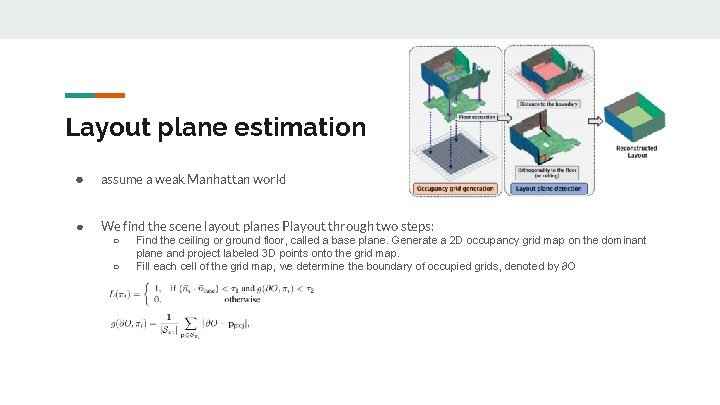
Layout plane estimation ● assume a weak Manhattan world ● We find the scene layout planes Playout through two steps: ○ ○ Find the ceiling or ground floor, called a base plane. Generate a 2 D occupancy grid map on the dominant plane and project labeled 3 D points onto the grid map. Fill each cell of the grid map, we determine the boundary of occupied grids, denoted by ∂O
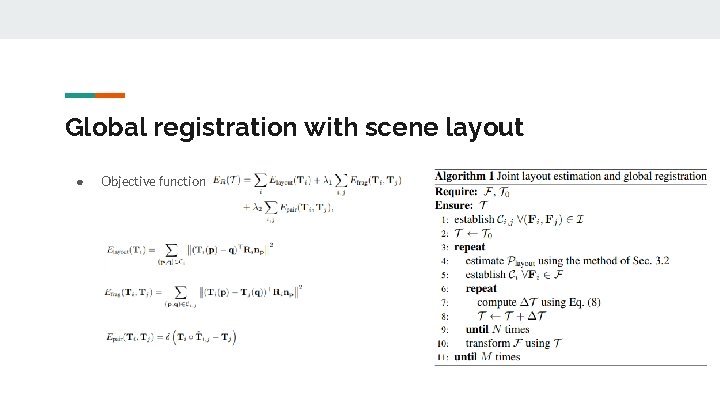
Global registration with scene layout ● Objective function
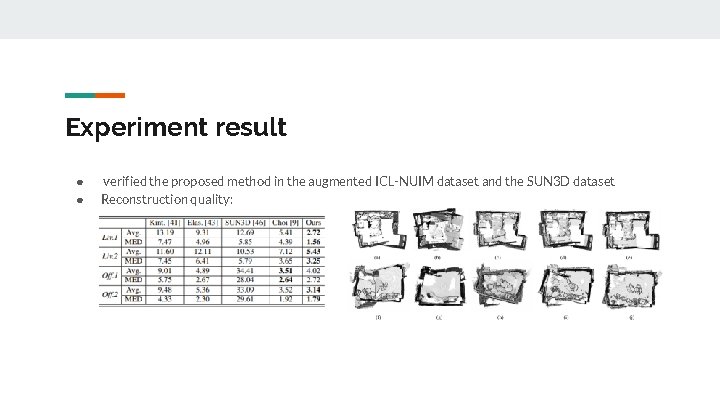
Experiment result ● ● verified the proposed method in the augmented ICL-NUIM dataset and the SUN 3 D dataset Reconstruction quality:
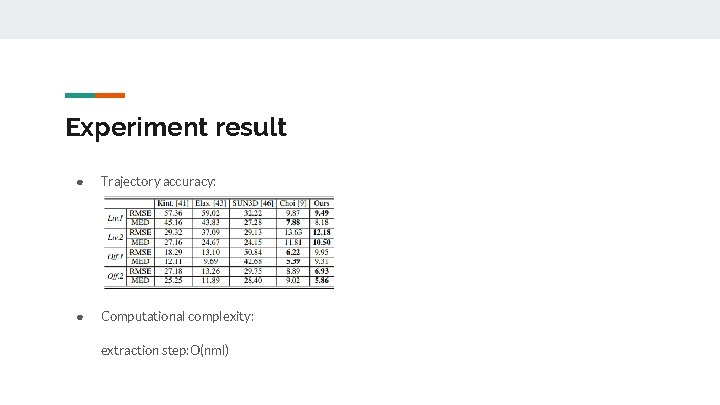
Experiment result ● Trajectory accuracy: ● Computational complexity: extraction step: O(nml)
Conclusion ● Author proposed an indoor 3 D reconstruction algorithm ○ ○ ● It through hierarchical clustering and energy-based multi-model fitting to find a minimum set of planes It exploit the scene layout information to obtain globally consistent reconstruction results It is more reliable, robust, and accurate.
- Slides: 13