
Joint IEEESA and ITU Workshop on Ethernet Time
- Slides: 18
Joint IEEE-SA and ITU Workshop on Ethernet Time Sync Network Limits: Status, Challenges Stefano Ruffini, Ericsson Q 13/15 AR Geneva, Switzerland, 13 July 2013
Contents Introduction on G. 8271 and G. 8271. 1 Definition of Time sync Network Limits Challenges for an operator Next Steps Geneva, Switzerland, 13 July 2013 2
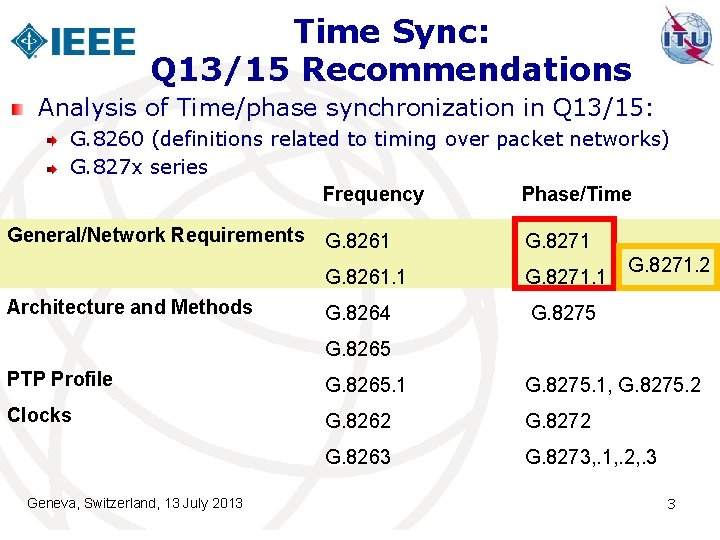
Time Sync: Q 13/15 Recommendations Analysis of Time/phase synchronization in Q 13/15: G. 8260 (definitions related to timing over packet networks) G. 827 x series Phase/Time Frequency General/Network Requirements Architecture and Methods G. 8261 G. 8271 G. 8261. 1 G. 8271. 1 G. 8264 G. 8275 G. 8271. 2 G. 8265 PTP Profile G. 8265. 1 G. 8275. 1, G. 8275. 2 Clocks G. 8262 G. 8272 G. 8263 G. 8273, . 1, . 2, . 3 Geneva, Switzerland, 13 July 2013 3
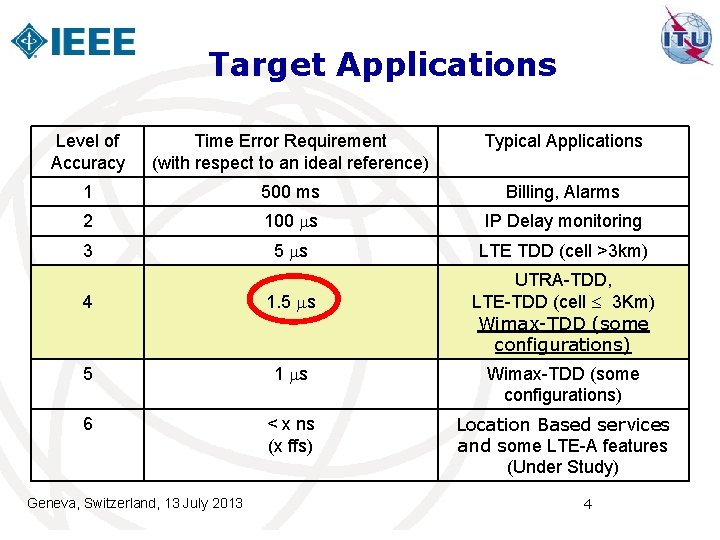
Target Applications Level of Accuracy Time Error Requirement (with respect to an ideal reference) Typical Applications 1 500 ms Billing, Alarms 2 100 ms IP Delay monitoring 3 5 ms LTE TDD (cell >3 km) UTRA-TDD, LTE-TDD (cell 3 Km) Wimax-TDD (some configurations) 4 1. 5 ms 5 1 ms Wimax-TDD (some configurations) 6 < x ns (x ffs) Location Based services and some LTE-A features (Under Study) Geneva, Switzerland, 13 July 2013 4
Time sync Network Limits Aspects to be addressed when defining the Network Limits Reference network (HRM) for the simulations Metrics Network Limits Components (Constant and Dynamic Time Error) Failure conditions Network Rearrangements Time Sync Holdover Geneva, Switzerland, 2 13 July 2013 5
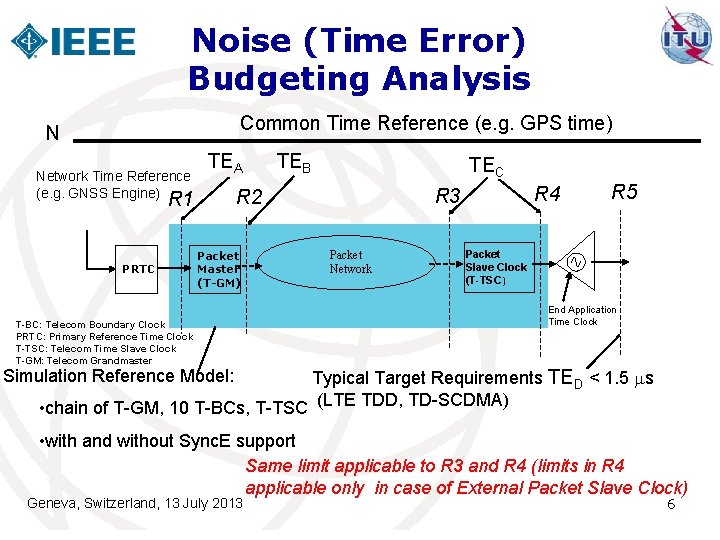
Noise (Time Error) Budgeting Analysis Common Time Reference (e. g. GPS time) N Network Time Reference (e. g. GNSS Engine) TEA TEC Packet Master (T-GM) T-BC: Telecom Boundary Clock PRTC: Primary Reference Time Clock T-TSC: Telecom Time Slave Clock T-GM: Telecom Grandmaster R 4 R 3 R 2 R 1 PRTC TEB Packet Network R 5 Packet Slave Clock (T-TSC) End Application Time Clock Simulation Reference Model: Typical Target Requirements TED < 1. 5 ms • chain of T-GM, 10 T-BCs, T-TSC (LTE TDD, TD-SCDMA) • with and without Sync. E support Same limit applicable to R 3 and R 4 (limits in R 4 applicable only in case of External Packet Slave Clock) Geneva, Switzerland, 13 July 2013 6
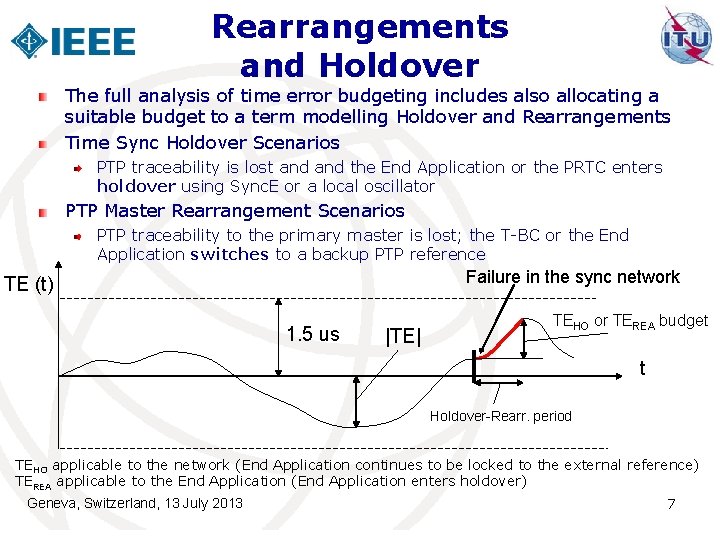
Rearrangements and Holdover The full analysis of time error budgeting includes also allocating a suitable budget to a term modelling Holdover and Rearrangements Time Sync Holdover Scenarios PTP traceability is lost and the End Application or the PRTC enters holdover using Sync. E or a local oscillator PTP Master Rearrangement Scenarios PTP traceability to the primary master is lost; the T-BC or the End Application switches to a backup PTP reference Failure in the sync network TE (t) 1. 5 us |TE| TEHO or TEREA budget t Holdover-Rearr. period TEHO applicable to the network (End Application continues to be locked to the external reference) TEREA applicable to the End Application (End Application enters holdover) Geneva, Switzerland, 13 July 2013 7
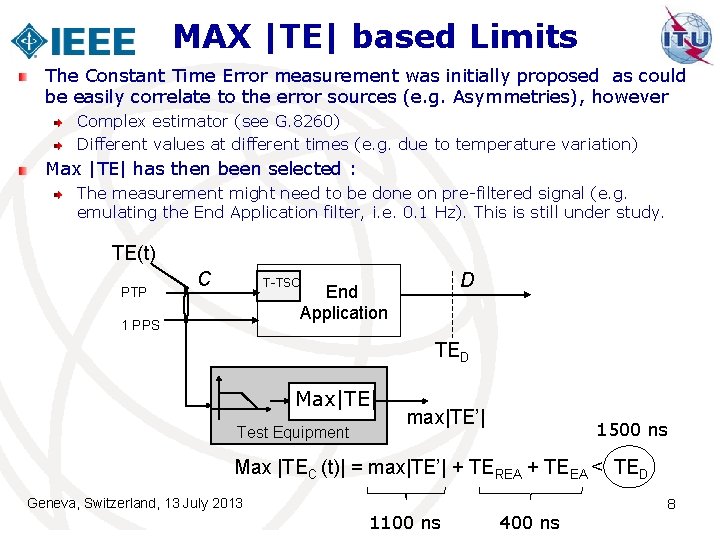
MAX |TE| based Limits The Constant Time Error measurement was initially proposed as could be easily correlate to the error sources (e. g. Asymmetries), however Complex estimator (see G. 8260) Different values at different times (e. g. due to temperature variation) Max |TE| has then been selected : The measurement might need to be done on pre-filtered signal (e. g. emulating the End Application filter, i. e. 0. 1 Hz). This is still under study. TE(t) PTP C T-TSC 1 PPS D End Application TED Max|TE| Test Equipment max|TE’| 1500 ns Max |TEC (t)| = max|TE’| + TEREA + TEEA < TED Geneva, Switzerland, 13 July 2013 1100 ns 400 ns 8
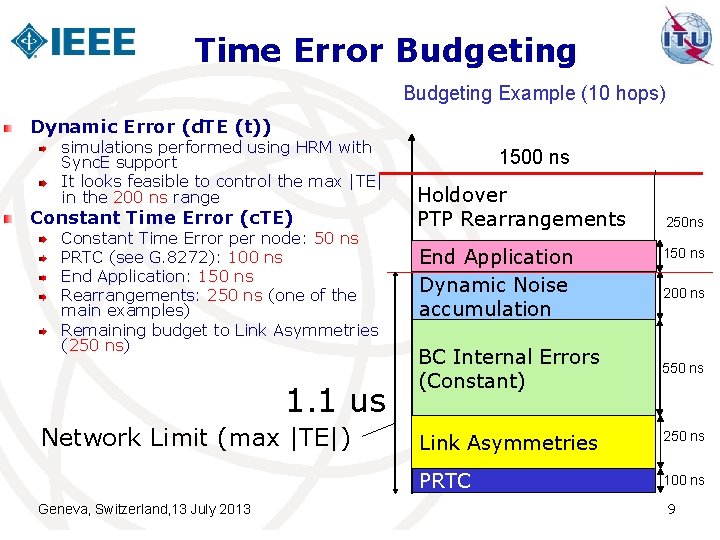
Time Error Budgeting Example (10 hops) Dynamic Error (d. TE (t)) simulations performed using HRM with Sync. E support It looks feasible to control the max |TE| in the 200 ns range Constant Time Error (c. TE) Constant Time Error per node: 50 ns PRTC (see G. 8272): 100 ns End Application: 150 ns Rearrangements: 250 ns (one of the main examples) Remaining budget to Link Asymmetries (250 ns) 1. 1 us Network Limit (max |TE|) Geneva, Switzerland, 13 July 2013 1500 ns Holdover PTP Rearrangements End Application Dynamic Noise accumulation 250 ns 150 ns 200 ns BC Internal Errors (Constant) 550 ns Link Asymmetries 250 ns PRTC 100 ns 9
Stability Requirements Additional requirement on stability of the timing signal is needed and is under study Applicable to the dynamic component (d(t)) In terms of MTIE and TDEV Possible Jitter requirements Important for End Application Tolerance Geneva, Switzerland, 13 July 2013 10
Challenges for an operator Distribution of accurate time synchronization creates new challenges for an operator Operation of the network Handling of asymmetries (at set up and during operation) Planning of proper Redundancy (e. g. Time sync Holdover is only available for limited periods (minutes instead of days). Exceeding the limits can cause service degradation New testing procedures Network performance and Node performance requires new methods and test equipment Some aspect still under definition (e. g. G. 8273. x) Geneva, Switzerland, 2 13 July 2013 11
Sources of Asymmetries Different Fiber Lengths in the forward and reverse direction Main problem: DCF (Dispersion Compensated Fiber) Different Wavelengths used on the forward and reverse direction Asymmetries added by specific access and transport technologies GPON VDSL 2 Microwave OTN Additional sources of asymmetries in case of partial support : Different load in the forward and reverse direction Use of interfaces with different speed Different paths in Packet networks (mainly relevant in case of partial support) Traffic Engineering rules in order to define always the same path for the forward and reverse directions Geneva, Switzerland, 13 July 2013 12
Next Steps Work is not completed Dynamic components in terms of MTIE and TDEV; Jitter? Testing methods (G. 8273 provides initial information) Partial Timing support Geneva, Switzerland, 13 July 2013 13
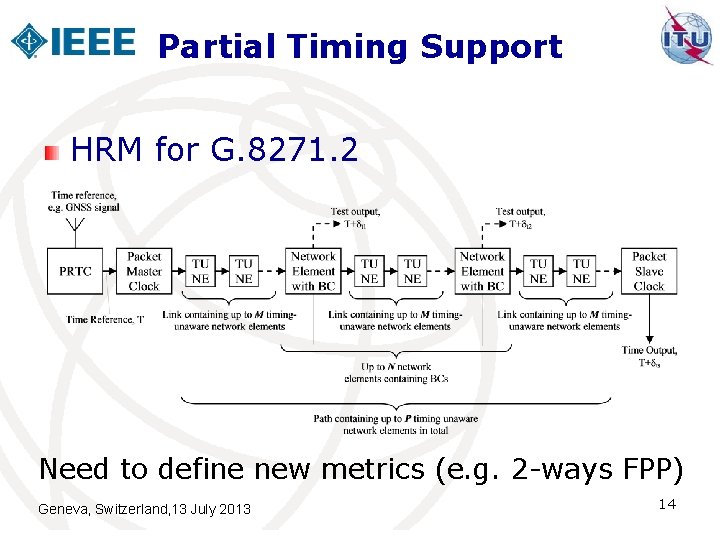
Partial Timing Support HRM for G. 8271. 2 Need to define new metrics (e. g. 2 -ways FPP) Geneva, Switzerland, 13 July 2013 14
Summary G. 8271. 1 consented this week: Max |TE| Time sync limits are available The delivery of accurate time sync presents some challenges for an operator Asymmetry calibration Handling of failures in the network Still some important topics need to be completed Stability requirements Partial timing support (G. 8271. 2) Geneva, Switzerland, 13 July 2013 15
Back Up Geneva, Switzerland, 13 July 2013
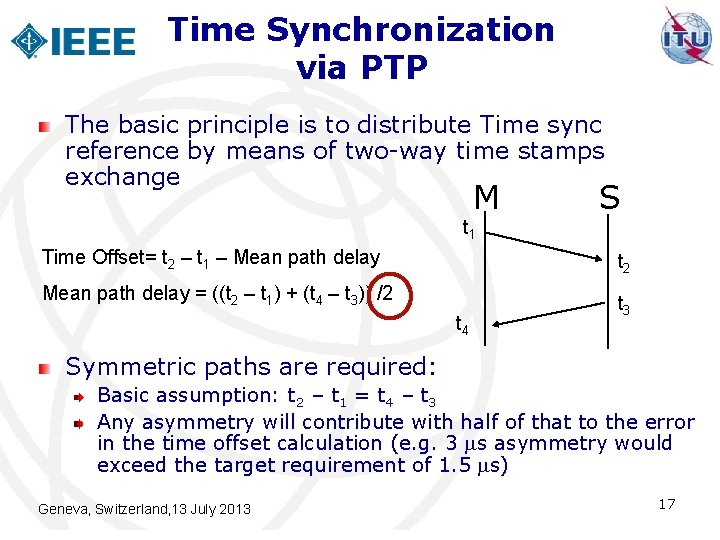
Time Synchronization via PTP The basic principle is to distribute Time sync reference by means of two-way time stamps exchange M t 1 S Time Offset= t 2 – t 1 – Mean path delay t 2 Mean path delay = ((t 2 – t 1) + (t 4 – t 3)) /2 t 3 t 4 Symmetric paths are required: Basic assumption: t 2 – t 1 = t 4 – t 3 Any asymmetry will contribute with half of that to the error in the time offset calculation (e. g. 3 ms asymmetry would exceed the target requirement of 1. 5 ms) Geneva, Switzerland, 13 July 2013 17
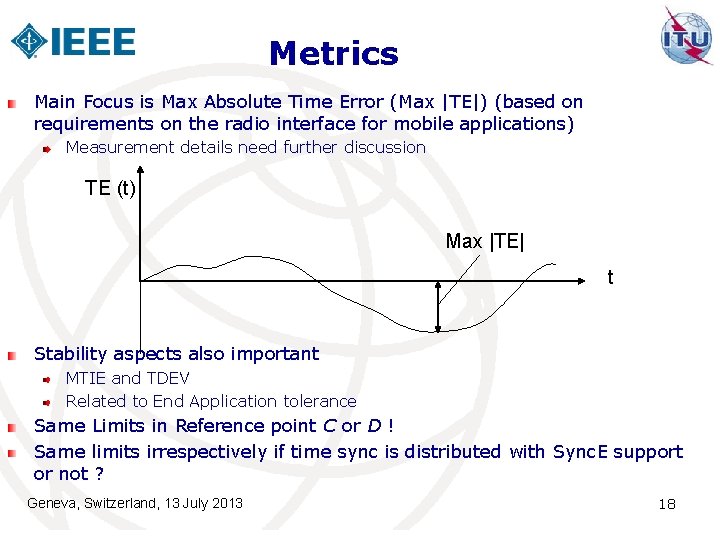
Metrics Main Focus is Max Absolute Time Error (Max |TE|) (based on requirements on the radio interface for mobile applications) Measurement details need further discussion TE (t) Max |TE| t Stability aspects also important MTIE and TDEV Related to End Application tolerance Same Limits in Reference point C or D ! Same limits irrespectively if time sync is distributed with Sync. E support or not ? Geneva, Switzerland, 13 July 2013 18