
Joint Hospital Surgical Grand Round Breast Reconstruction after
Joint Hospital Surgical Grand Round Breast Reconstruction after Surgery for Breast Cancer Steven Law Pamela Youde Nethersole Eastern Hospital
Breast Cancer • The most common cancer in females in Hong Kong • Incidence 2945/year (24% of all cancers) • Mortality 555/year • Life time risk before age of 75: 1 in 19 Hong Kong Cancer Registry 2009
Management of Breast Cancer • Multidisciplinary approach – Surgery – Chemotherapy – Radiation therapy – Hormonal therapy • Surgery remains the mainstay of treatment for cure
Surgery for Breast Cancer • Breast-conservation treatment in early breast cancer • Mastectomy • Important factor for patients in choice of treatment – Cosmetic concern vs fear of recurrence Molenaar et al. Br J Cancer 2004; 90: 2123 -30

Consequence of Mastectomy • Functional deficits – Inability to breast-feed • Psychosocial effects – Anxiety – Depression – Loss of feminity – Negative effects on body images and sexual function
Breast Reconstruction • Goal of reconstruction is to restore a breast mound and to maintain the quality of life without affecting the prognosis or detection of recurrence of cancer Elder EE et al. Breast 2005; 14: 201 -8
Clinical Evidence for Reconstruction • Support for breast reconstruction has been derived from cohort studies: reduce anxiety, depression, improve quality of life • Benefits of reconstruction are dependant on individual circumstances and patients’ preference Harcourt DM et al. Plast Reconstr Surg 2003; 111: 1060 -8 Nano MT et al. ANZ J Surg 2005; 75: 940 -7 Roth RS et al. Plast Reconstr Surg 2005; 116: 993 -1002 • Limitations of these studies – Patients who elect for reconstruction differ significantly from those who do not – Different expectation
Breast Reconstruction • Restoration of breast mound – Implant – Autologous tissue • Reconstruction of nipple-areolar complex – When both reconstruction of breast mound administration of adjuvant therapy complete • Surgery may be performed on the contralateral breast to maximize symmetry – Breast reduction, augmentation
Breast Reconstruction • Restoration of breast mound – Implant – Autologous tissue • Reconstruction of nipple-areolar complex – When both reconstruction of breast mound administration of adjuvant therapy complete • Surgery may be performed on the contralateral breast to maximize symmetry – Breast reduction, augmentation
Implants • Surgical options – Immediate reconstruction with a standard or adjustable implant – Two stage reconstruction with a tissue expander followed by an permanent implant – Combination of implant and autologous tissue
Reconstruction with Implants • Materials: saline or silicone gel • Can be anatomically shaped (tear drop) or round • No association with cancer, immunologic or neurologic disorders Evans et al. Plastic Reconstr Surg 1995; 96: 1111 -8 Deapen et al. Plastic Reconstr Surg 2000; 105: 535 -40 • Potential association in case of rupture: connective tissue disease, fibromyalgia Gaubitz et al. Rheumatology 2002; 41: 129 -35 • Cumulative incidence of rupture at 10 years has been reported up to 38% in some studies Brown et al. J Rheumatol 2001; 28: 996 -1003
Single-stage Implant Reconstruction • Only suitable for small, non-ptotic breast with adequate amount of good quality skin and muscle • Disadvantage: – aesthetic outcome usually not as good as two stage reconstruction – Revisionary procedure is required in many instance
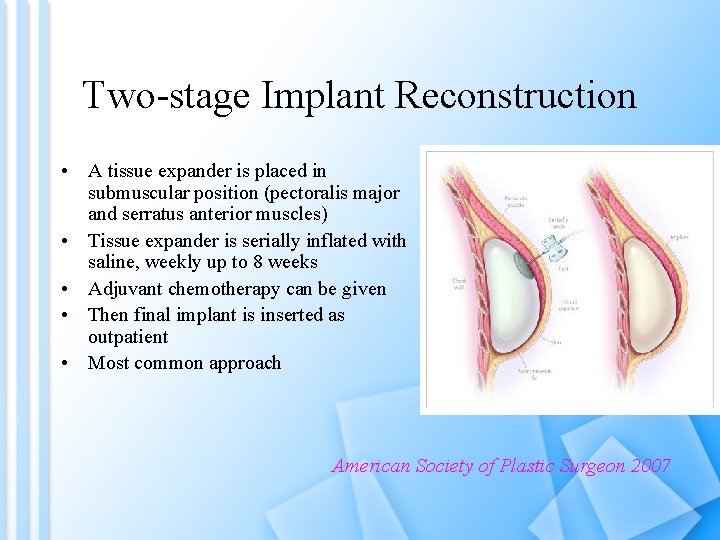
Two-stage Implant Reconstruction • A tissue expander is placed in submuscular position (pectoralis major and serratus anterior muscles) • Tissue expander is serially inflated with saline, weekly up to 8 weeks • Adjuvant chemotherapy can be given • Then final implant is inserted as outpatient • Most common approach American Society of Plastic Surgeon 2007
Combination of Implant and Autologous Tissue • In patient with the skin-muscle envelope not adequate for expansion • Autologous tissue (most commonly latissimus myocutaneous flap) is used for adequate coverage • Contributing factors: – large skin resection at time of mastectomy – multiple scars – radiation injury resulting in non-expansile pocket • Increased morbidity compared with implant alone
Autologous Tissue-based Reconstruction • Donor sites: abdomen, back, buttock, thigh • Skin, fat and muscle transferred as – pedicled flap with it own blood supply – a free flap requiring microvascular anastomosis at the recipient site
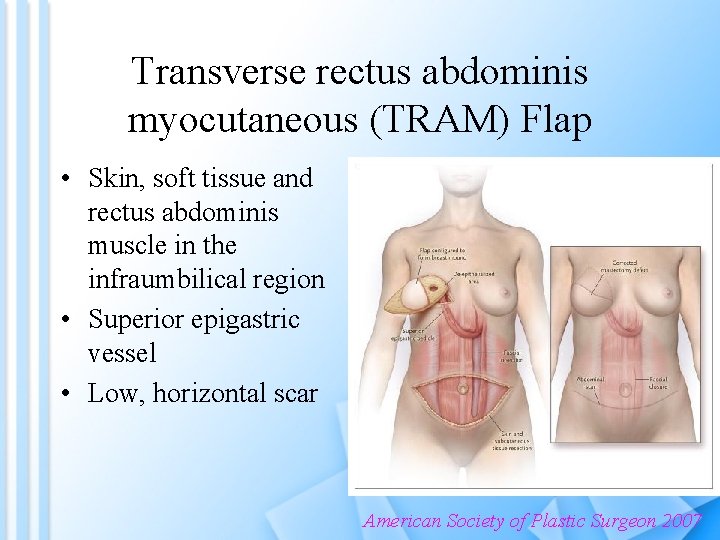
Transverse rectus abdominis myocutaneous (TRAM) Flap • Skin, soft tissue and rectus abdominis muscle in the infraumbilical region • Superior epigastric vessel • Low, horizontal scar American Society of Plastic Surgeon 2007
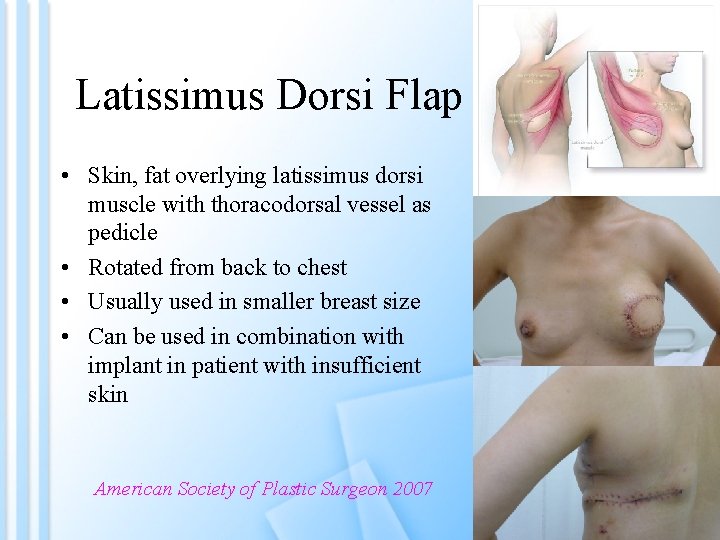
Latissimus Dorsi Flap • Skin, fat overlying latissimus dorsi muscle with thoracodorsal vessel as pedicle • Rotated from back to chest • Usually used in smaller breast size • Can be used in combination with implant in patient with insufficient skin American Society of Plastic Surgeon 2007
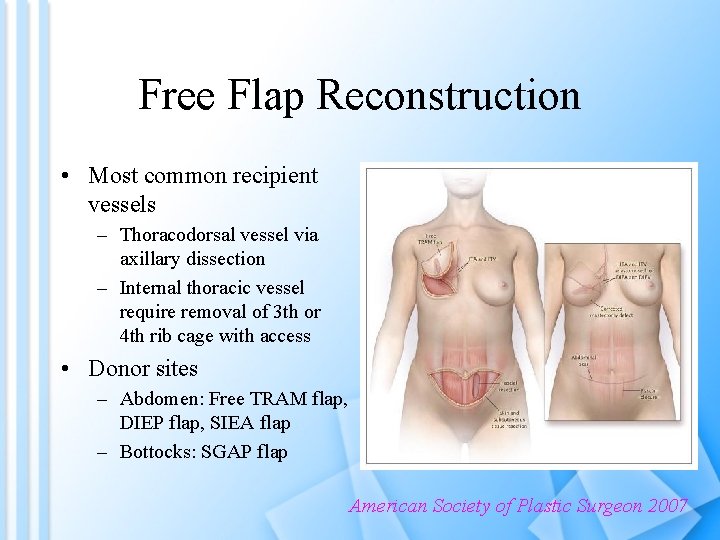
Free Flap Reconstruction • Most common recipient vessels – Thoracodorsal vessel via axillary dissection – Internal thoracic vessel require removal of 3 th or 4 th rib cage with access • Donor sites – Abdomen: Free TRAM flap, DIEP flap, SIEA flap – Bottocks: SGAP flap American Society of Plastic Surgeon 2007
Oncological Safety of Reconstruction • No difference in the incidence of locoregional recurrence up to 8 years post op in breast cancer patients who undergo reconstruction compared with those patients who do not Mc Carthy et al. Plast Reconstr Surg 2008; 121: 381 -8 • Immediate breast reconstruction is oncologically safe for stage 1 and 2 breast cancer patient up to 15 years European Journal of Surgical Oncology. 33(10): 1142 -5, 2007 Dec • Prosthetic breast reconstruction does not hinder detection of locoregional cancer recurrence Huang et al. Plast Reconstr Surg 2006; 118: 1079 -88
Complications: Implant • Early complication – Skin flap necrosis, Infection (1 -24%) • Late complication – Capsular contracture (Baker grade II to IV, incidence 14 -40%) – leak or rupture – rippling • Risk increased with history of irradiation or postoperative radiotherapy Ascherman et al. Plastic & Reconstructive Surgery. 117(2): 359 -65, 2006 Feb Cordeiro et al. Platic Reconstr Surg 2006; 118: 825 -31
Complications: Autologous Tissue • Risk of fat necrosis, flap loss (0. 5 -5% in literature) • Donor site scar, abdominal weakness or hernia • High risk patients – – old age Obesity Smoker diabetes Blondeel N et al. Br J Plast Surg 1997; 50: 322 -30 Nahabedian et al. Ann Plast Surg 2005; 54: 124 -9
Complications: Implant vs Autologous Tissue • No difference in complication rates between tissue expander/implant and autologous tissue reconstruction • No difference in complication rates between specific types of autologous tissue used Alderman et al. Plast Reconstr Surg 109: 2265, 2002
Timing for Reconstruction • Immediate reconstruction has the potential benefits of – – Fewer operation Decreased cost Less psychological impairment No impairment on survival, recurrence and monitoring by mammogram Holley et al. Am. Surg 61: 60, 1995 Noone et al Plast Reconstr Surg 93: 96, 1994 • Disadvantage of immediate reconstruction – Higher complication rates (49 -60% vs 31 -37% in delayed group) Alderman et al. Plast Reconstr Surg 109: 2265, 2002
Literature Review: Immediate vs Delayed Reconstruction • Latest review in Cochrane found only one RCT in the literature addressing effect of the timing of reconstruction on patient’s outcomes – Immediate reconstruction reduce psychiatric morbidity at 3 months postoperatively (Dean et al. Lancet 1983; 1(8322): 459– 62) Immediate versus delayed reconstruction following surgery for breast cancer. Cochrane Review 2011
Immediate vs Delayed Reconstruction • Immediate reconstructions had significantly higher morbidity rate compared with delayed procedures – Higher morbidity in implant patients who received radiotherapy Alderman Plastic & Reconstructive Surgery. 109(7): 2265 -74, 2002 Jun. • Delayed reconstruction decrease ischemic complications in pedicle TRAM flap Atisha et al. Annals of Plastic Surgery. 63(4): 383 -8, 2009 Oct. • Reason for higher morbidity in immediate reconstruction – Contamination of the surgical field during mastectomy – Marginal mastectomy skin flap viability – Increased inflammation in local tissue after mastectomy
Immediate vs Delayed Reconstruction • No difference in breast pain between immediate vs delayed reconstruction at 2 years Roth et al. Annals of Plastic Surgery. 58(4): 371 -6, 2007 Apr. • No statistical difference in complication rate between immediate vs delayed reconstruction using DIEP and SIEA flaps Cheng et al. Plastic & Reconstructive Surgery. 117(7): 2139 -42
Immediate vs Delayed Reconstruction • No statistical difference in risk of depression or anxiety between immediate vs delayed reconstruction Fernandez-Delgado et al Annals of Oncology. 19(8): 1430 -4, 2008 Aug Harcourt et al Plastic & Reconstructive Surgery. 111(3): 1060 -8, 2003 Mar. • No difference in psychological impact between immediate vs delayed reconstruction at 1 year Wilkins et al Plastic & Reconstructive Surgery. 106(5): 1014 -25, 2000
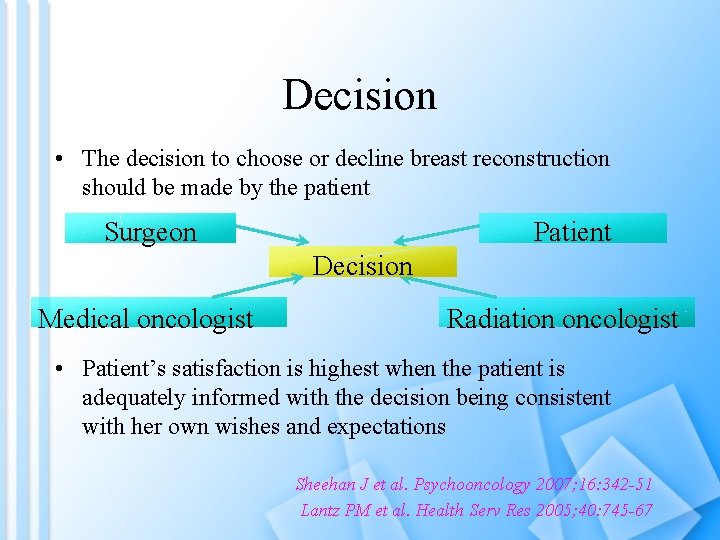
Decision • The decision to choose or decline breast reconstruction should be made by the patient Surgeon Patient Decision Medical oncologist Radiation oncologist • Patient’s satisfaction is highest when the patient is adequately informed with the decision being consistent with her own wishes and expectations Sheehan J et al. Psychooncology 2007; 16: 342 -51 Lantz PM et al. Health Serv Res 2005; 40: 745 -67
Patient satisfaction • Women with pedicle TRAM flaps, free TRAM flaps, and expander/implants had similar levels of general satisfaction in the long-term Alderman et al. Michigan result outcome study. Journal of the American College of Surgeons. 204(1): 7 -12, 2007 Jan.
Conclusion • Immediate implant reconstruction is associated with significant morbidity, especially in patient who received radiotherapy • No difference in outcome between different types of autologous reconstruction • Currently no strong evidence in the literature in addressing the effect of timing for reconstruction • Preoperative multidisciplinary counseling is important, addressing patient expectation and enhancing postoperative satisfaction

Thank You
- Slides: 31