
Joint Distribution of two or More Random Variables
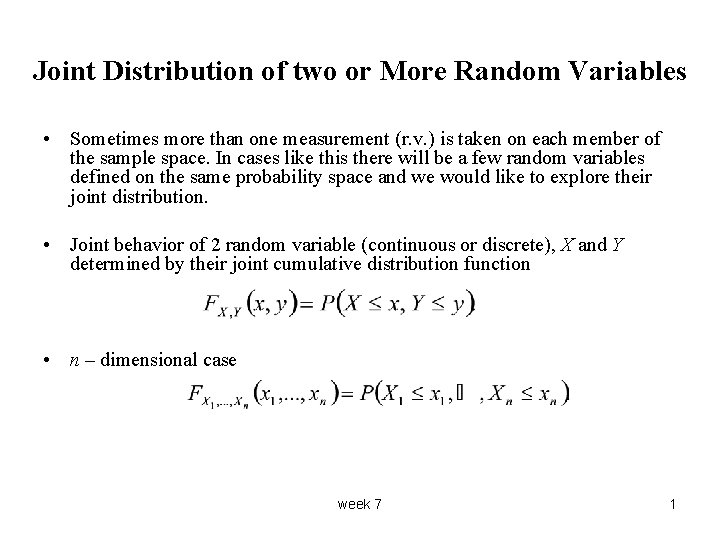
Joint Distribution of two or More Random Variables • Sometimes more than one measurement (r. v. ) is taken on each member of the sample space. In cases like this there will be a few random variables defined on the same probability space and we would like to explore their joint distribution. • Joint behavior of 2 random variable (continuous or discrete), X and Y determined by their joint cumulative distribution function • n – dimensional case week 7 1
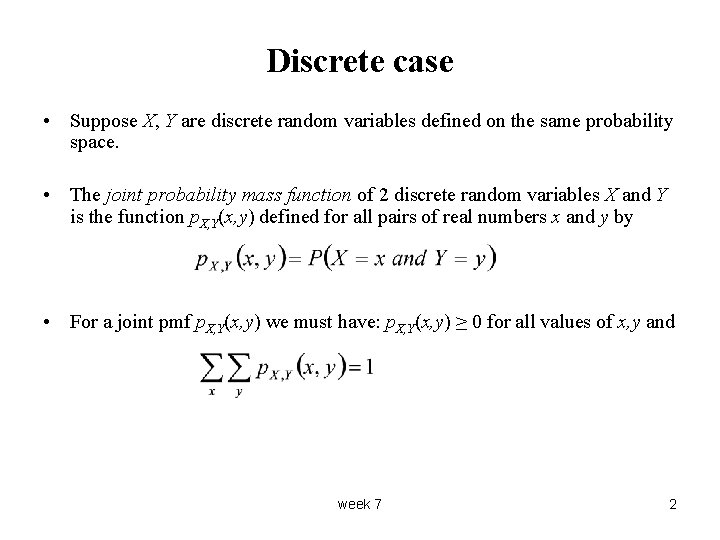
Discrete case • Suppose X, Y are discrete random variables defined on the same probability space. • The joint probability mass function of 2 discrete random variables X and Y is the function p. X, Y(x, y) defined for all pairs of real numbers x and y by • For a joint pmf p. X, Y(x, y) we must have: p. X, Y(x, y) ≥ 0 for all values of x, y and week 7 2
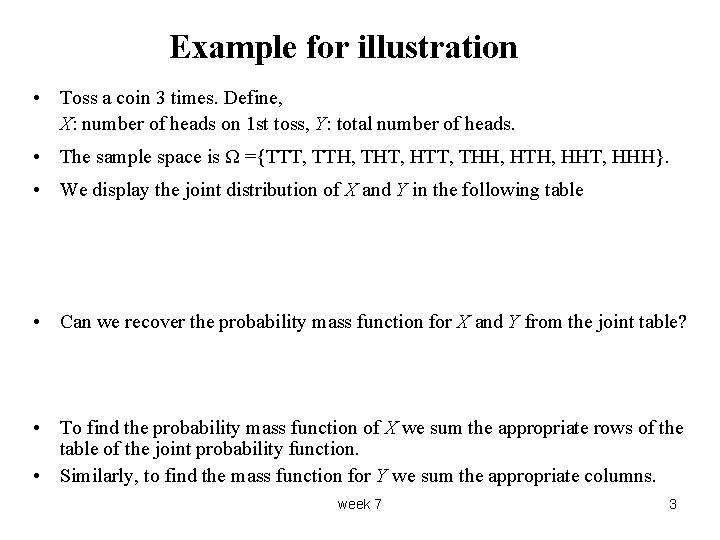
Example for illustration • Toss a coin 3 times. Define, X: number of heads on 1 st toss, Y: total number of heads. • The sample space is Ω ={TTT, TTH, THT, HTT, THH, HTH, HHT, HHH}. • We display the joint distribution of X and Y in the following table • Can we recover the probability mass function for X and Y from the joint table? • To find the probability mass function of X we sum the appropriate rows of the table of the joint probability function. • Similarly, to find the mass function for Y we sum the appropriate columns. week 7 3
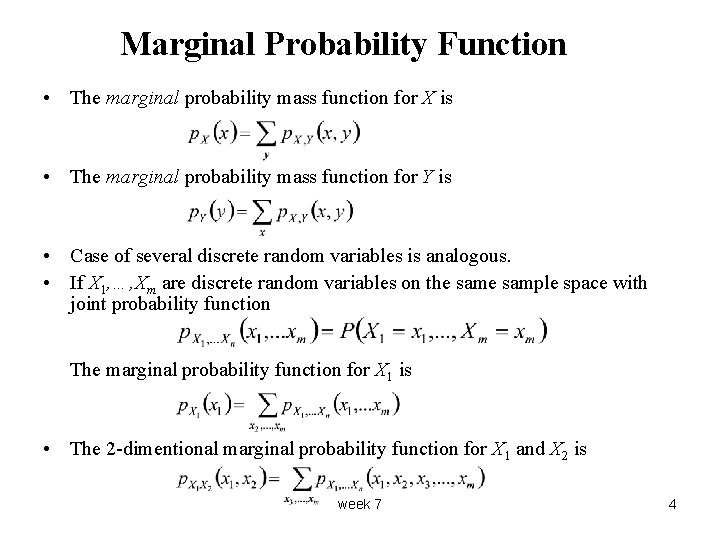
Marginal Probability Function • The marginal probability mass function for X is • The marginal probability mass function for Y is • Case of several discrete random variables is analogous. • If X 1, …, Xm are discrete random variables on the sample space with joint probability function The marginal probability function for X 1 is • The 2 -dimentional marginal probability function for X 1 and X 2 is week 7 4
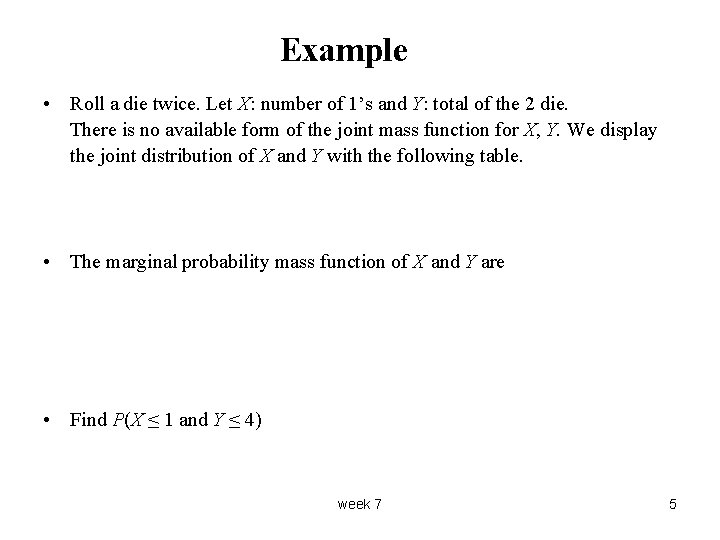
Example • Roll a die twice. Let X: number of 1’s and Y: total of the 2 die. There is no available form of the joint mass function for X, Y. We display the joint distribution of X and Y with the following table. • The marginal probability mass function of X and Y are • Find P(X ≤ 1 and Y ≤ 4) week 7 5
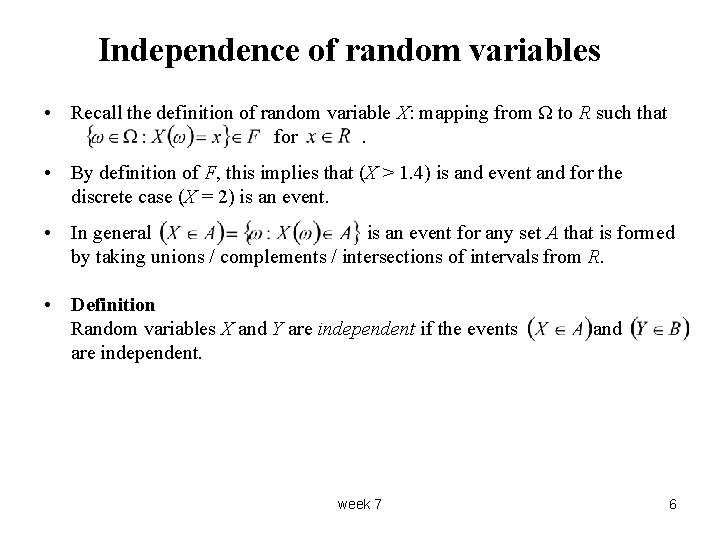
Independence of random variables • Recall the definition of random variable X: mapping from Ω to R such that for. • By definition of F, this implies that (X > 1. 4) is and event and for the discrete case (X = 2) is an event. • In general is an event for any set A that is formed by taking unions / complements / intersections of intervals from R. • Definition Random variables X and Y are independent if the events are independent. week 7 and 6
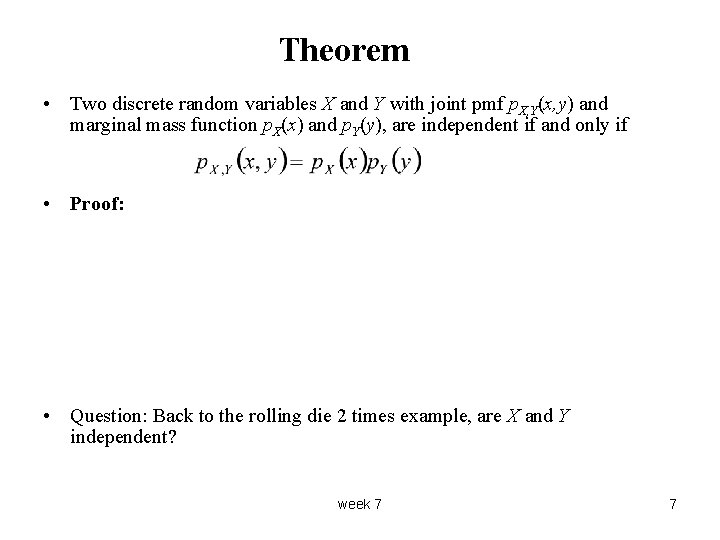
Theorem • Two discrete random variables X and Y with joint pmf p. X, Y(x, y) and marginal mass function p. X(x) and p. Y(y), are independent if and only if • Proof: • Question: Back to the rolling die 2 times example, are X and Y independent? week 7 7

Conditional Probability on a joint discrete distribution • Given the joint pmf of X and Y, we want to find and • Back to the example on slide 5, • These 11 probabilities give the conditional pmf of Y given X = 1. week 7 8
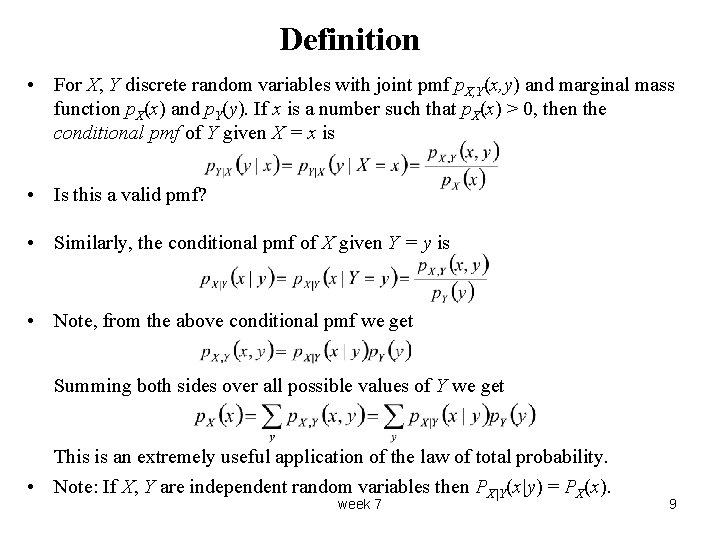
Definition • For X, Y discrete random variables with joint pmf p. X, Y(x, y) and marginal mass function p. X(x) and p. Y(y). If x is a number such that p. X(x) > 0, then the conditional pmf of Y given X = x is • Is this a valid pmf? • Similarly, the conditional pmf of X given Y = y is • Note, from the above conditional pmf we get Summing both sides over all possible values of Y we get This is an extremely useful application of the law of total probability. • Note: If X, Y are independent random variables then PX|Y(x|y) = PX(x). week 7 9
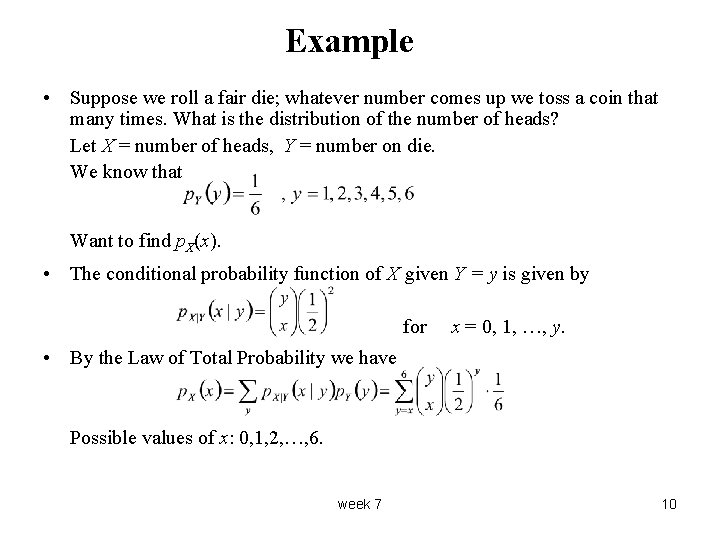
Example • Suppose we roll a fair die; whatever number comes up we toss a coin that many times. What is the distribution of the number of heads? Let X = number of heads, Y = number on die. We know that Want to find p. X(x). • The conditional probability function of X given Y = y is given by for x = 0, 1, …, y. • By the Law of Total Probability we have Possible values of x: 0, 1, 2, …, 6. week 7 10
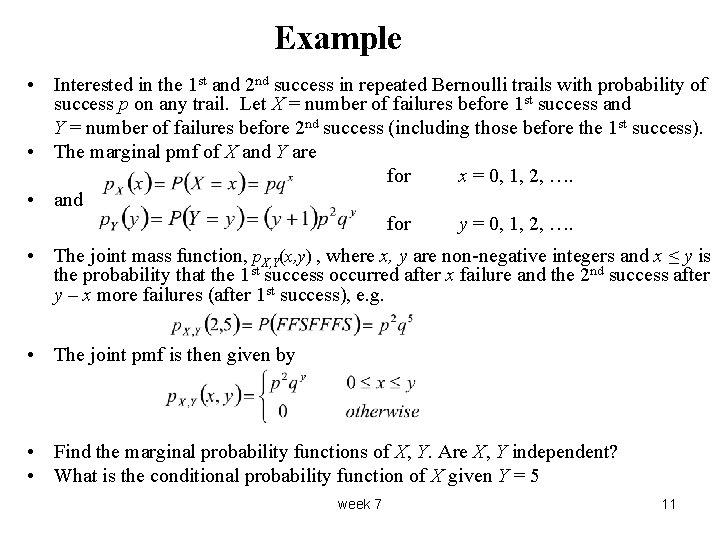
Example • Interested in the 1 st and 2 nd success in repeated Bernoulli trails with probability of success p on any trail. Let X = number of failures before 1 st success and Y = number of failures before 2 nd success (including those before the 1 st success). • The marginal pmf of X and Y are for x = 0, 1, 2, …. • and for y = 0, 1, 2, …. • The joint mass function, p. X, Y(x, y) , where x, y are non-negative integers and x ≤ y is the probability that the 1 st success occurred after x failure and the 2 nd success after y – x more failures (after 1 st success), e. g. • The joint pmf is then given by • Find the marginal probability functions of X, Y. Are X, Y independent? • What is the conditional probability function of X given Y = 5 week 7 11
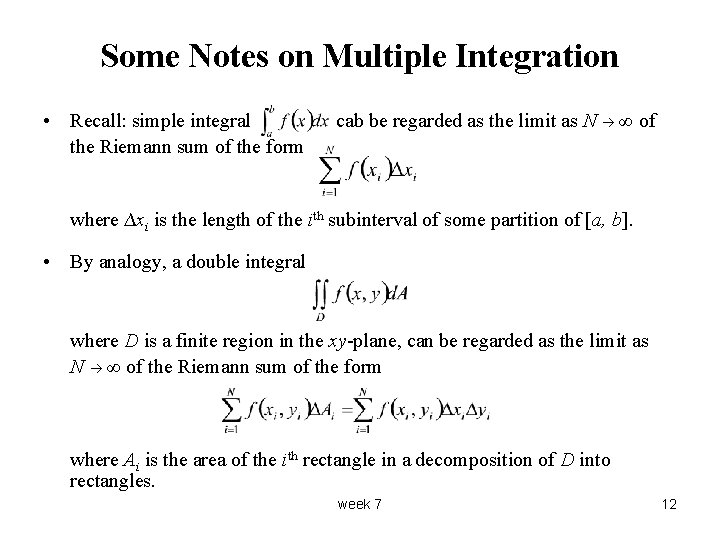
Some Notes on Multiple Integration • Recall: simple integral the Riemann sum of the form cab be regarded as the limit as N ∞ of where ∆xi is the length of the ith subinterval of some partition of [a, b]. • By analogy, a double integral where D is a finite region in the xy-plane, can be regarded as the limit as N ∞ of the Riemann sum of the form where Ai is the area of the ith rectangle in a decomposition of D into rectangles. week 7 12
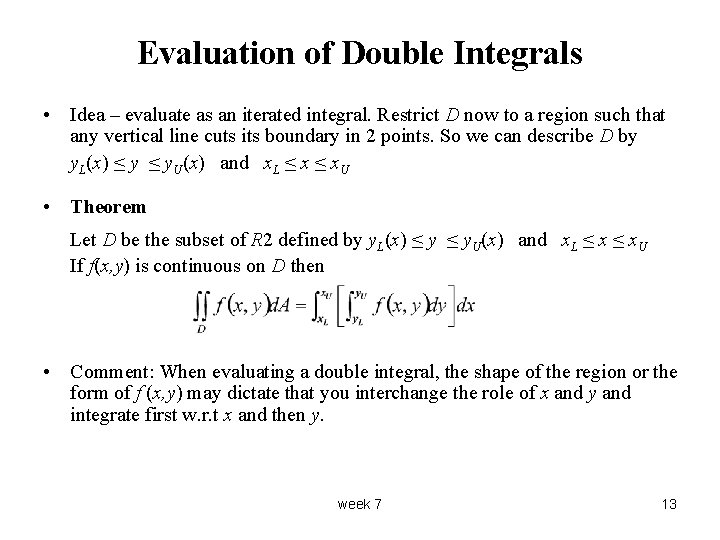
Evaluation of Double Integrals • Idea – evaluate as an iterated integral. Restrict D now to a region such that any vertical line cuts its boundary in 2 points. So we can describe D by y. L(x) ≤ y. U(x) and x. L ≤ x. U • Theorem Let D be the subset of R 2 defined by y. L(x) ≤ y. U(x) and x. L ≤ x. U If f(x, y) is continuous on D then • Comment: When evaluating a double integral, the shape of the region or the form of f (x, y) may dictate that you interchange the role of x and y and integrate first w. r. t x and then y. week 7 13
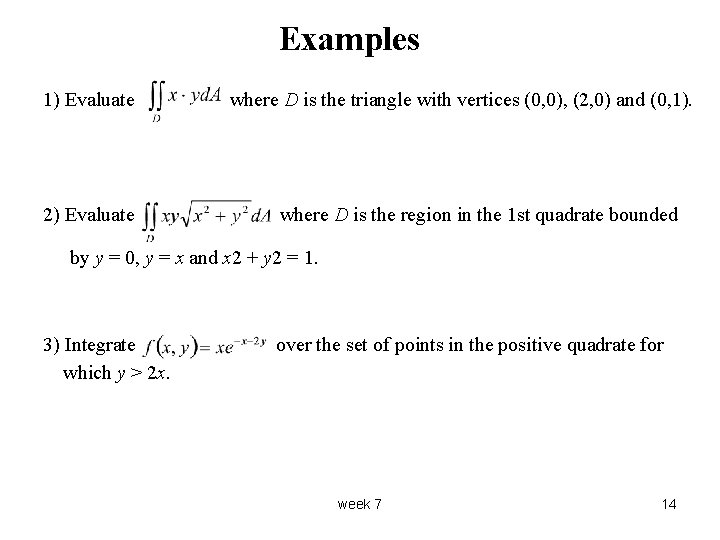
Examples 1) Evaluate 2) Evaluate where D is the triangle with vertices (0, 0), (2, 0) and (0, 1). where D is the region in the 1 st quadrate bounded by y = 0, y = x and x 2 + y 2 = 1. 3) Integrate which y > 2 x. over the set of points in the positive quadrate for week 7 14
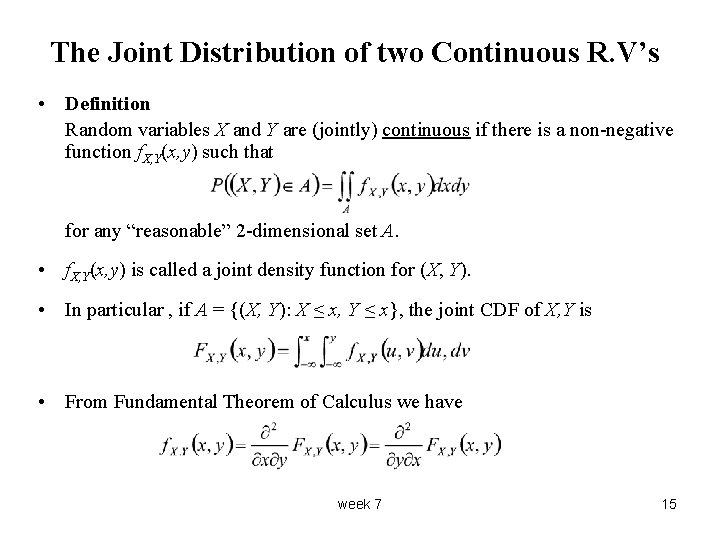
The Joint Distribution of two Continuous R. V’s • Definition Random variables X and Y are (jointly) continuous if there is a non-negative function f. X, Y(x, y) such that for any “reasonable” 2 -dimensional set A. • f. X, Y(x, y) is called a joint density function for (X, Y). • In particular , if A = {(X, Y): X ≤ x, Y ≤ x}, the joint CDF of X, Y is • From Fundamental Theorem of Calculus we have week 7 15
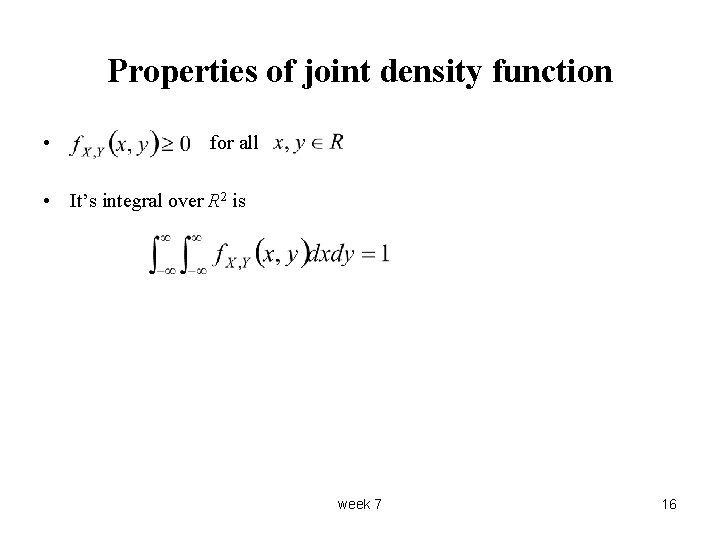
Properties of joint density function • for all • It’s integral over R 2 is week 7 16
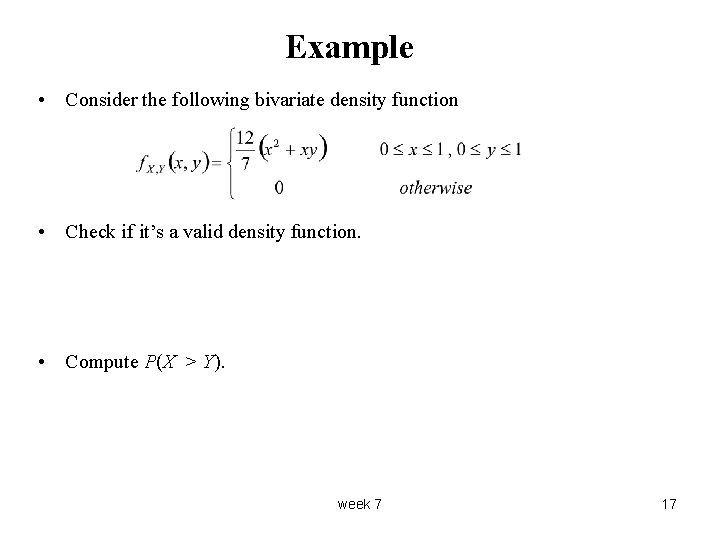
Example • Consider the following bivariate density function • Check if it’s a valid density function. • Compute P(X > Y). week 7 17
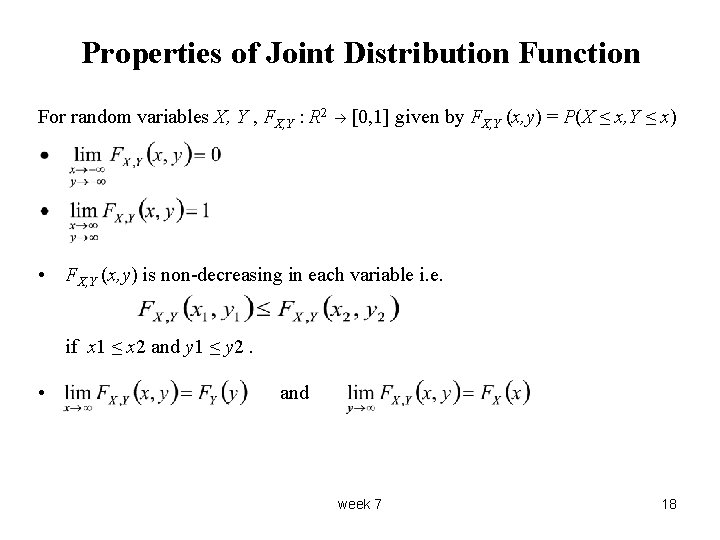
Properties of Joint Distribution Function For random variables X, Y , FX, Y : R 2 [0, 1] given by FX, Y (x, y) = P(X ≤ x, Y ≤ x) • FX, Y (x, y) is non-decreasing in each variable i. e. if x 1 ≤ x 2 and y 1 ≤ y 2. • and week 7 18
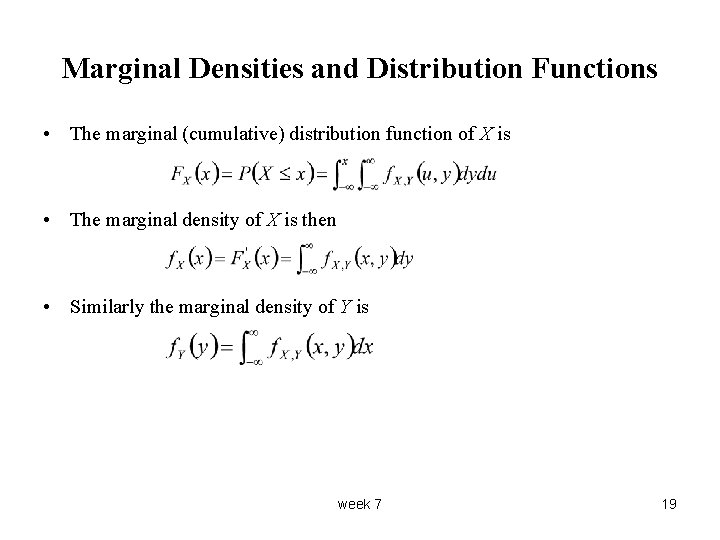
Marginal Densities and Distribution Functions • The marginal (cumulative) distribution function of X is • The marginal density of X is then • Similarly the marginal density of Y is week 7 19
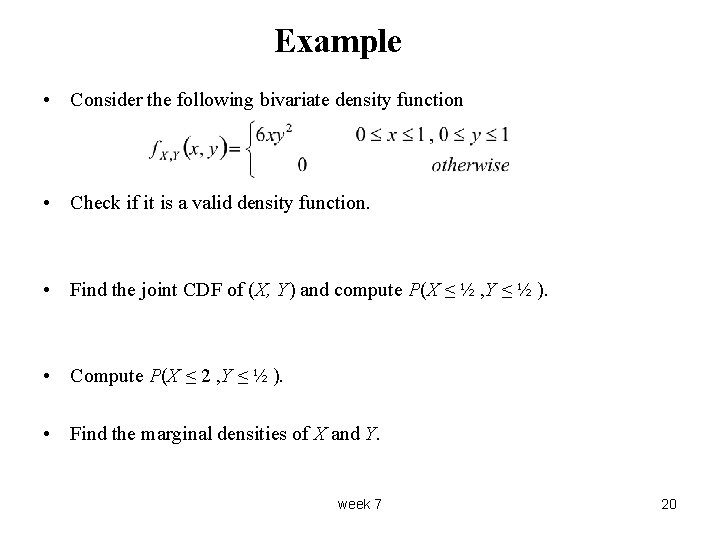
Example • Consider the following bivariate density function • Check if it is a valid density function. • Find the joint CDF of (X, Y) and compute P(X ≤ ½ , Y ≤ ½ ). • Compute P(X ≤ 2 , Y ≤ ½ ). • Find the marginal densities of X and Y. week 7 20
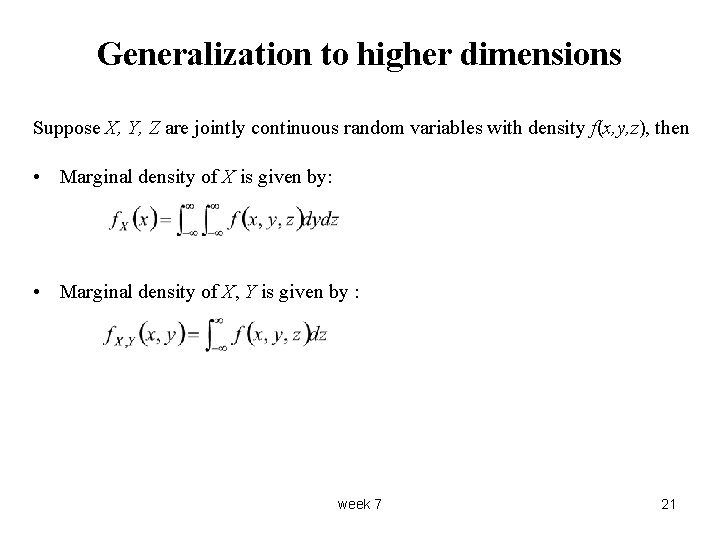
Generalization to higher dimensions Suppose X, Y, Z are jointly continuous random variables with density f(x, y, z), then • Marginal density of X is given by: • Marginal density of X, Y is given by : week 7 21
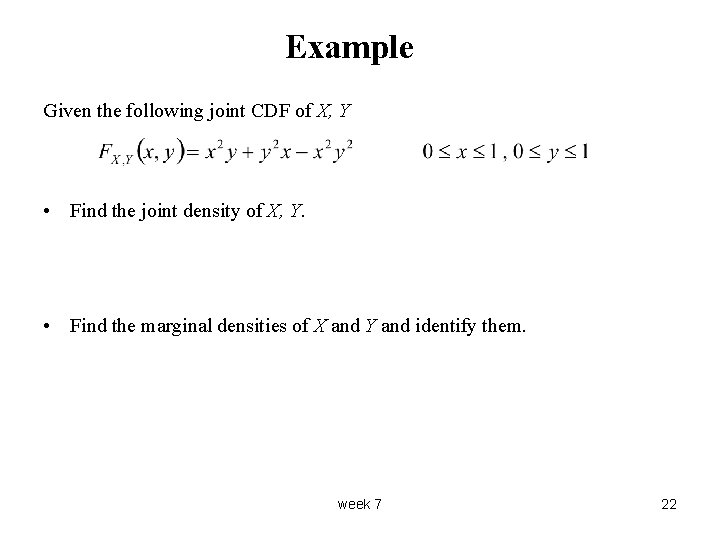
Example Given the following joint CDF of X, Y • Find the joint density of X, Y. • Find the marginal densities of X and Y and identify them. week 7 22
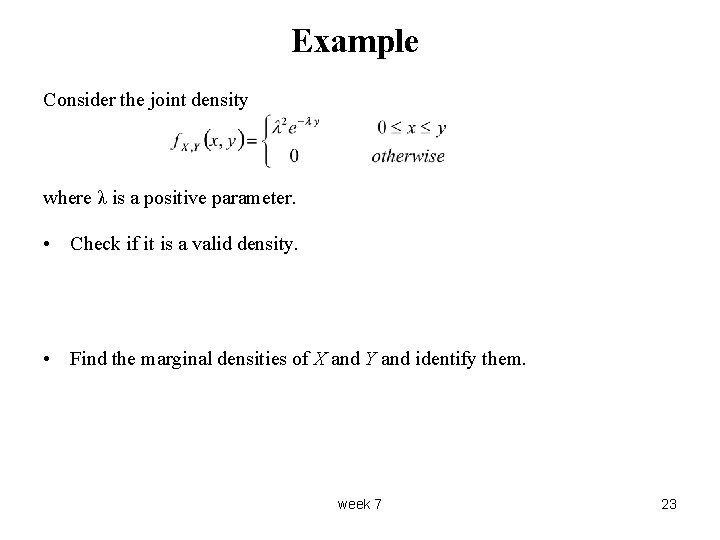
Example Consider the joint density where λ is a positive parameter. • Check if it is a valid density. • Find the marginal densities of X and Y and identify them. week 7 23
- Slides: 23