
Joint Distribution Functions Independence of Random Variables Covariance
Joint Distribution Functions, Independence of Random Variables, Covariance, and Correlation ECE 313 Probability with Engineering Applications Lecture 19 Ravi K. Iyer Dept. of Electrical and Computer Engineering University of Illinois at Urbana Champaign Iyer - Lecture 19 ECE 313 – Spring 2017

Today’s Topics and Announcements • Joint Distribution Functions • Announcements: – Group activity in the class, next Week, . – Final project will be released Today • Concepts: Hypothesis testing, Joint distributions, Independence, Covariance and correlation • Project schedules on Compass and Piazza Iyer - Lecture 19 ECE 313 – Spring 2017
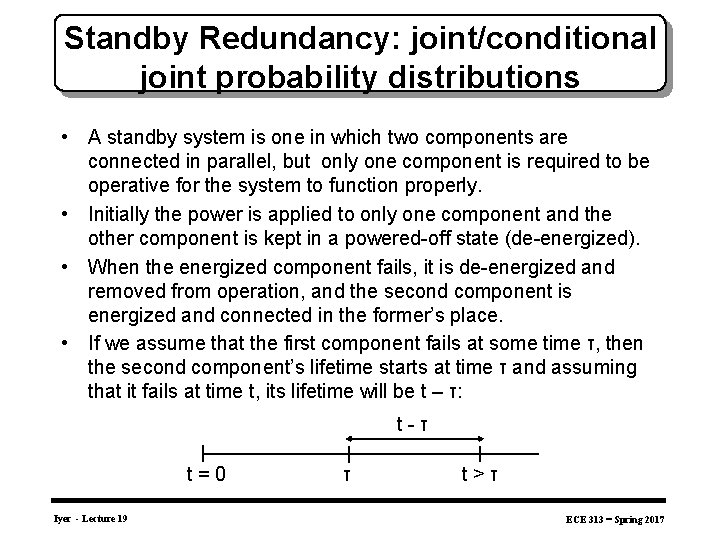
Standby Redundancy: joint/conditional joint probability distributions • A standby system is one in which two components are connected in parallel, but only one component is required to be operative for the system to function properly. • Initially the power is applied to only one component and the other component is kept in a powered-off state (de-energized). • When the energized component fails, it is de-energized and removed from operation, and the second component is energized and connected in the former’s place. • If we assume that the first component fails at some time τ, then the second component’s lifetime starts at time τ and assuming that it fails at time t, its lifetime will be t – τ: t-τ t=0 Iyer - Lecture 19 τ t>τ ECE 313 – Spring 2017
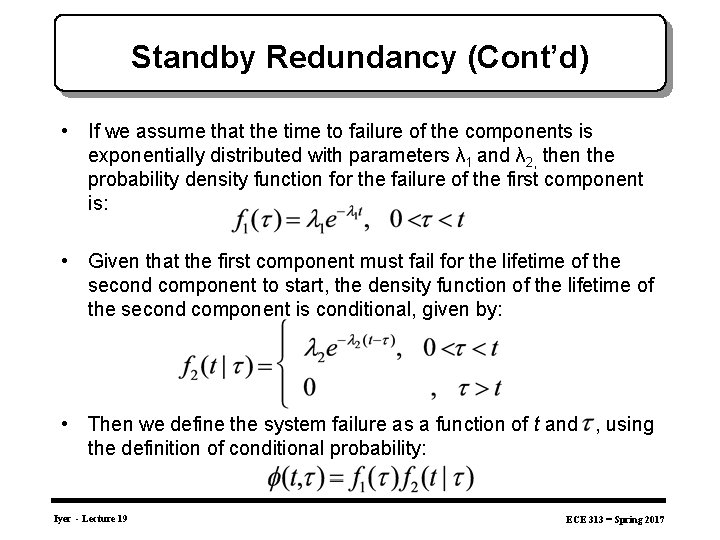
Standby Redundancy (Cont’d) • If we assume that the time to failure of the components is exponentially distributed with parameters λ 1 and λ 2, then the probability density function for the failure of the first component is: • Given that the first component must fail for the lifetime of the second component to start, the density function of the lifetime of the second component is conditional, given by: • Then we define the system failure as a function of t and , using the definition of conditional probability: Iyer - Lecture 19 ECE 313 – Spring 2017
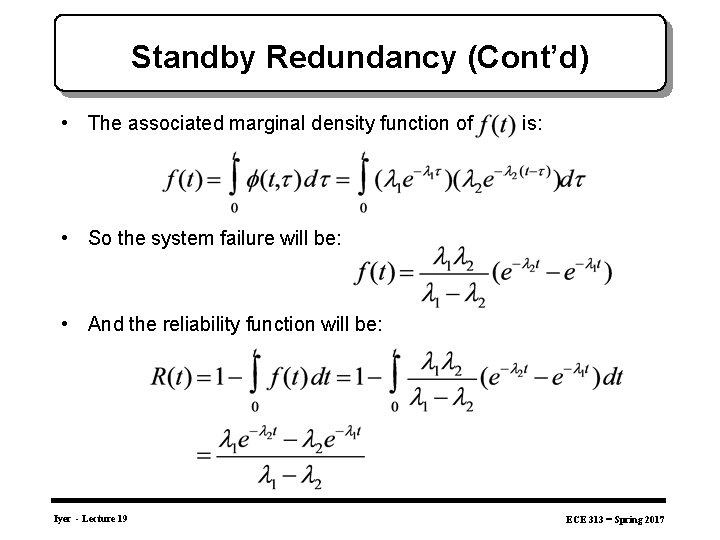
Standby Redundancy (Cont’d) • The associated marginal density function of is: • So the system failure will be: • And the reliability function will be: Iyer - Lecture 19 ECE 313 – Spring 2017
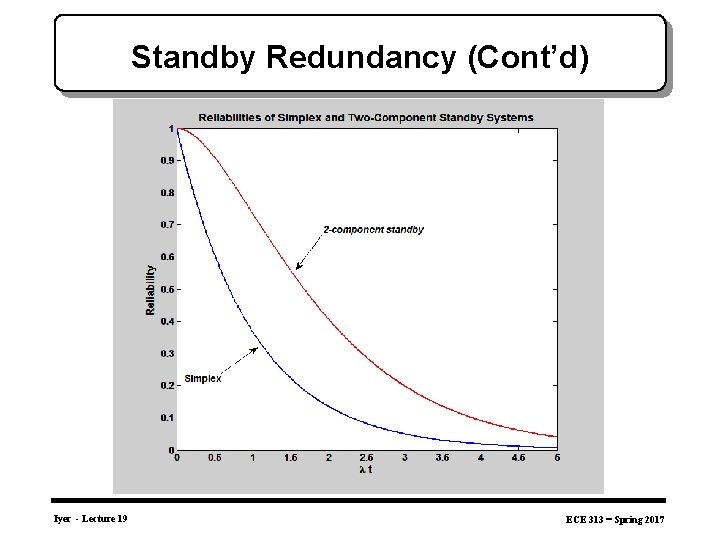
Standby Redundancy (Cont’d) Iyer - Lecture 19 ECE 313 – Spring 2017
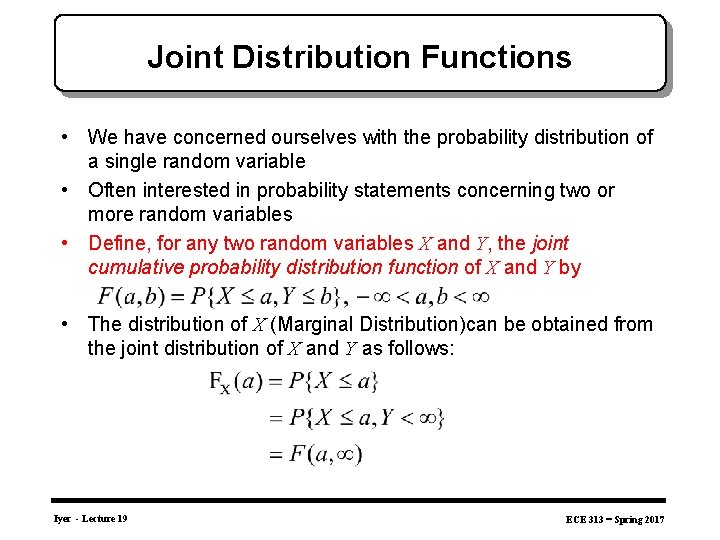
Joint Distribution Functions • We have concerned ourselves with the probability distribution of a single random variable • Often interested in probability statements concerning two or more random variables • Define, for any two random variables X and Y, the joint cumulative probability distribution function of X and Y by • The distribution of X (Marginal Distribution)can be obtained from the joint distribution of X and Y as follows: Iyer - Lecture 19 ECE 313 – Spring 2017
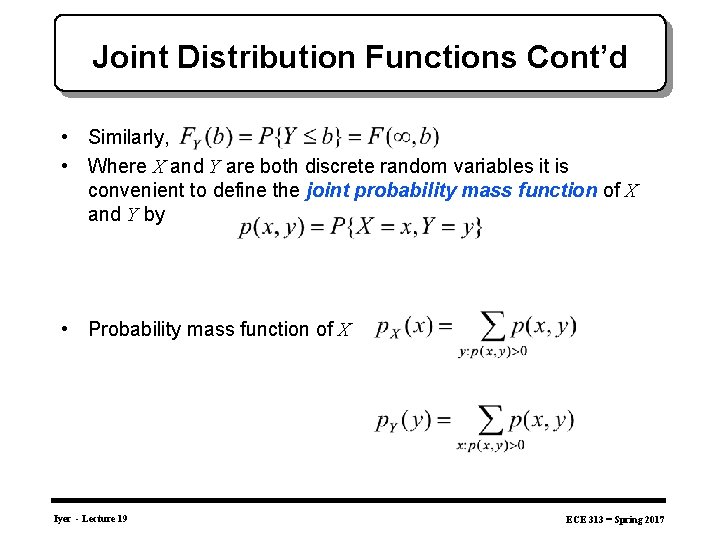
Joint Distribution Functions Cont’d • Similarly, • Where X and Y are both discrete random variables it is convenient to define the joint probability mass function of X and Y by • Probability mass function of X Iyer - Lecture 19 ECE 313 – Spring 2017
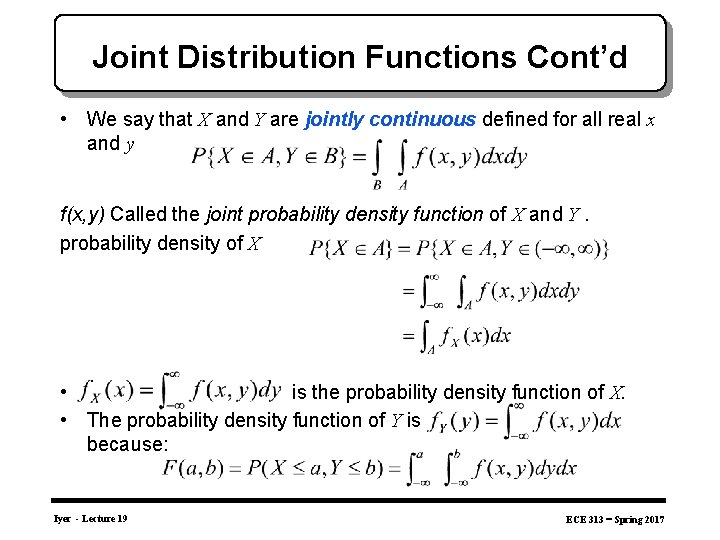
Joint Distribution Functions Cont’d • We say that X and Y are jointly continuous defined for all real x and y f(x, y) Called the joint probability density function of X and Y. probability density of X • is the probability density function of X. • The probability density function of Y is because: Iyer - Lecture 19 ECE 313 – Spring 2017
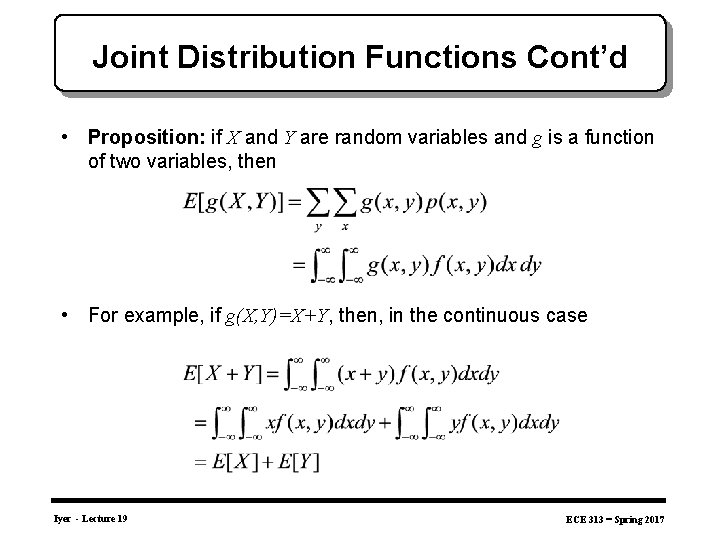
Joint Distribution Functions Cont’d • Proposition: if X and Y are random variables and g is a function of two variables, then • For example, if g(X, Y)=X+Y, then, in the continuous case Iyer - Lecture 19 ECE 313 – Spring 2017
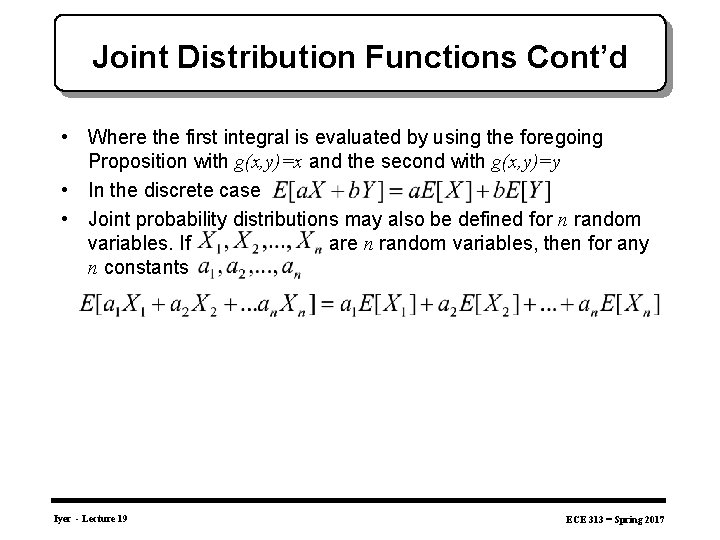
Joint Distribution Functions Cont’d • Where the first integral is evaluated by using the foregoing Proposition with g(x, y)=x and the second with g(x, y)=y • In the discrete case • Joint probability distributions may also be defined for n random variables. If are n random variables, then for any n constants Iyer - Lecture 19 ECE 313 – Spring 2017
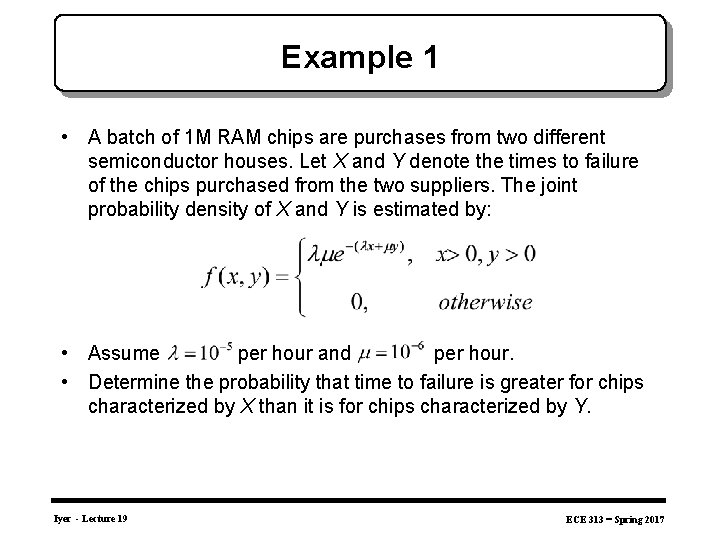
Example 1 • A batch of 1 M RAM chips are purchases from two different semiconductor houses. Let X and Y denote the times to failure of the chips purchased from the two suppliers. The joint probability density of X and Y is estimated by: • Assume per hour and per hour. • Determine the probability that time to failure is greater for chips characterized by X than it is for chips characterized by Y. Iyer - Lecture 19 ECE 313 – Spring 2017
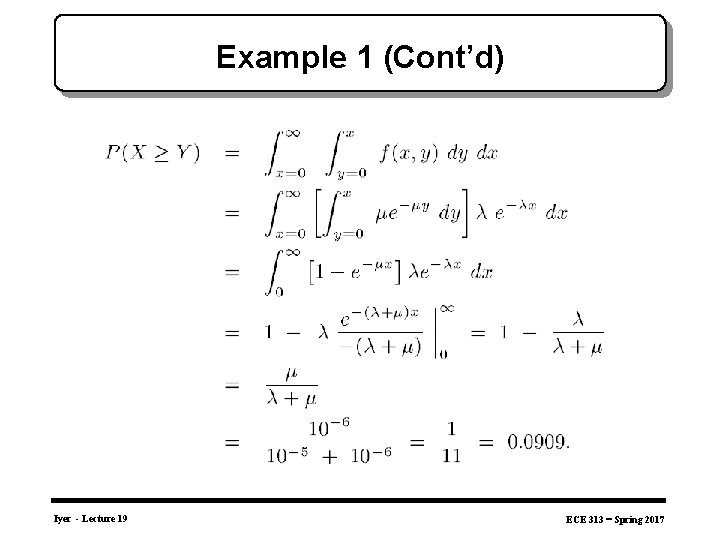
Example 1 (Cont’d) Iyer - Lecture 19 ECE 313 – Spring 2017
- Slides: 13