
Joint Command Control and Consultation Information Exchange Data


- Slides: 44
Joint Command, Control, and Consultation Information Exchange Data Model (JC 3 IEDM)
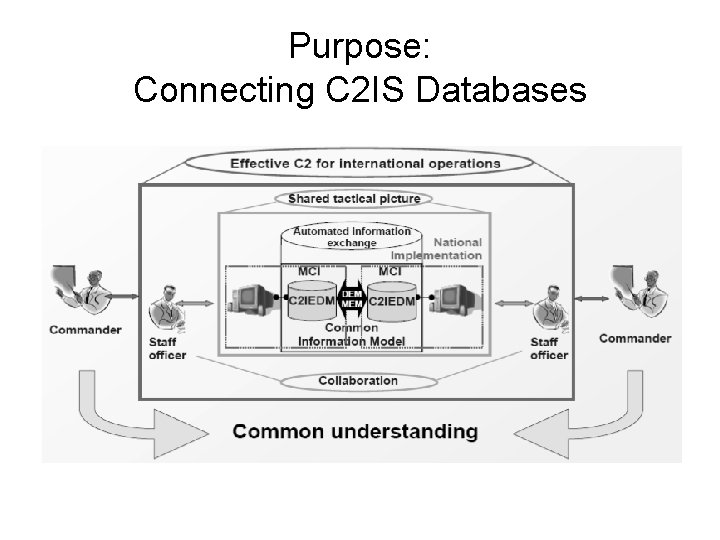
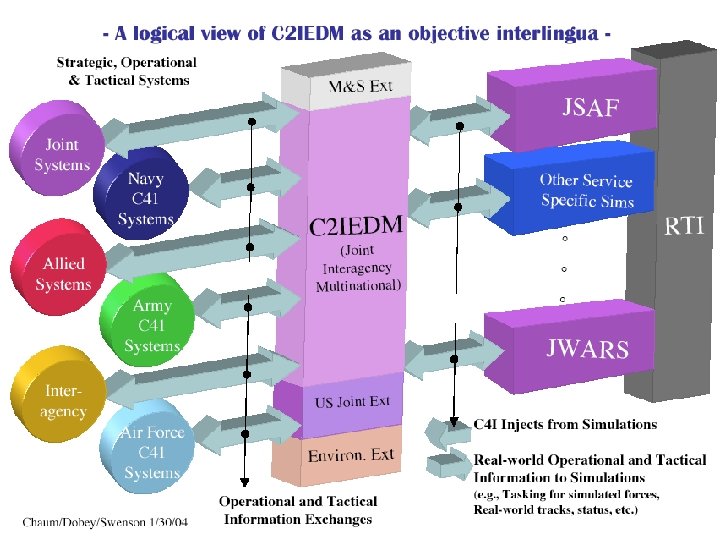
What is the JC 3 IEDM? • Joint Command, Control, and Consultation Information Exchange Data Model • Common specification for C 2 data to be exchanged • Expected to be compliant with NATO Level 5 System Interconnection – Automated Exchange of Data – User Imposed Constraints – Connecting C 2 IS databases
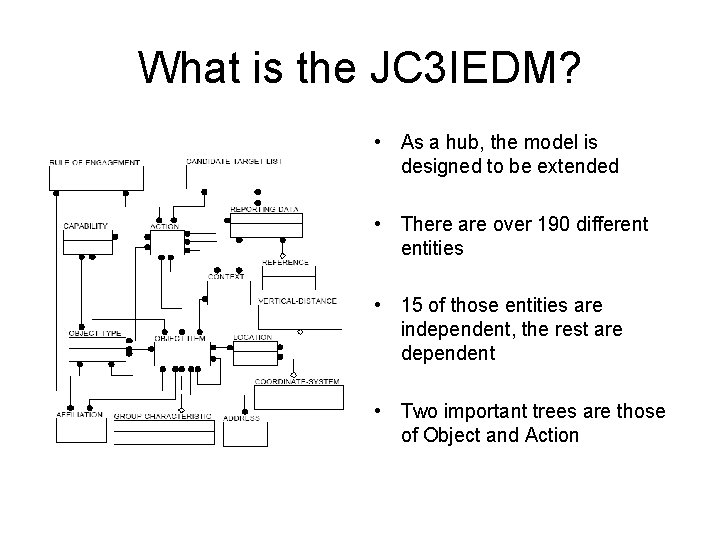
What is the JC 3 IEDM? • As a hub, the model is designed to be extended • There are over 190 different entities • 15 of those entities are independent, the rest are dependent • Two important trees are those of Object and Action
Purpose: Describing the Battle Space
Purpose: Connecting C 2 IS Databases
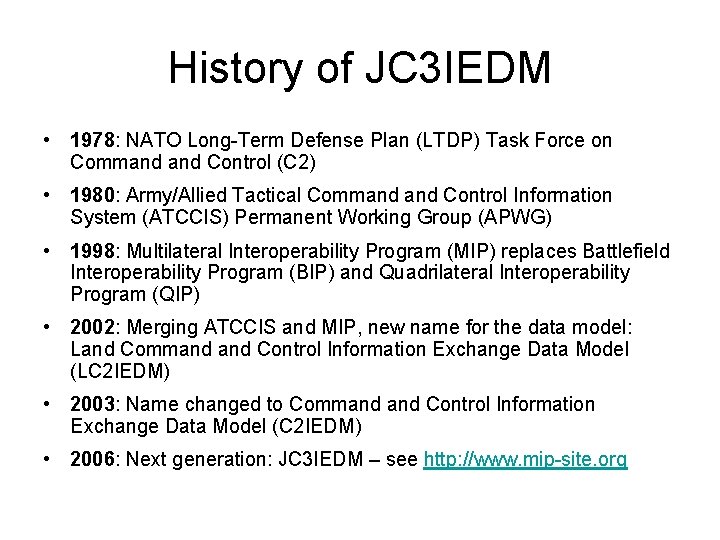
History of JC 3 IEDM • 1978: NATO Long-Term Defense Plan (LTDP) Task Force on Command Control (C 2) • 1980: Army/Allied Tactical Command Control Information System (ATCCIS) Permanent Working Group (APWG) • 1998: Multilateral Interoperability Program (MIP) replaces Battlefield Interoperability Program (BIP) and Quadrilateral Interoperability Program (QIP) • 2002: Merging ATCCIS and MIP, new name for the data model: Land Command Control Information Exchange Data Model (LC 2 IEDM) • 2003: Name changed to Command Control Information Exchange Data Model (C 2 IEDM) • 2006: Next generation: JC 3 IEDM – see http: //www. mip-site. org
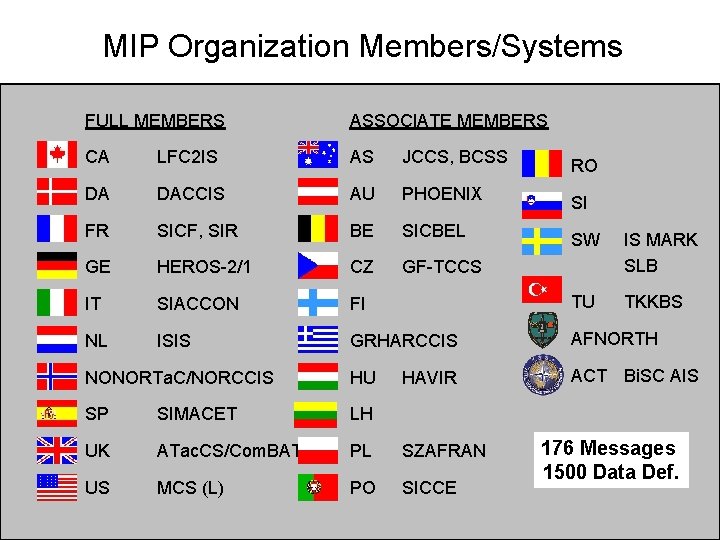
MIP Organization Members/Systems FULL MEMBERS ASSOCIATE MEMBERS CA LFC 2 IS AS JCCS, BCSS RO DA DACCIS AU PHOENIX SI FR SICF, SIR BE SICBEL SW GE HEROS-2/1 CZ GF-TCCS IS MARK SLB IT SIACCON FI TU TKKBS NL ISIS GRHARCCIS AFNORTH NONORTa. C/NORCCIS HU ACT Bi. SC AIS SP SIMACET LH UK ATac. CS/Com. BAT PL SZAFRAN US MCS (L) PO SICCE HAVIR 176 Messages 1500 Data Def.
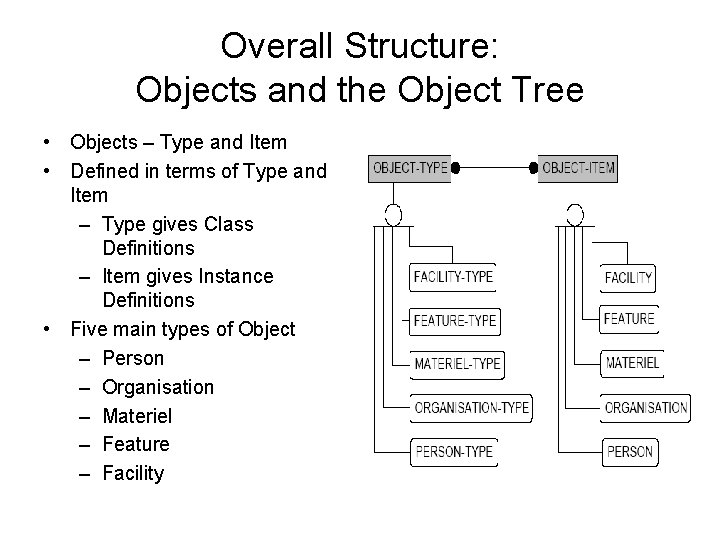
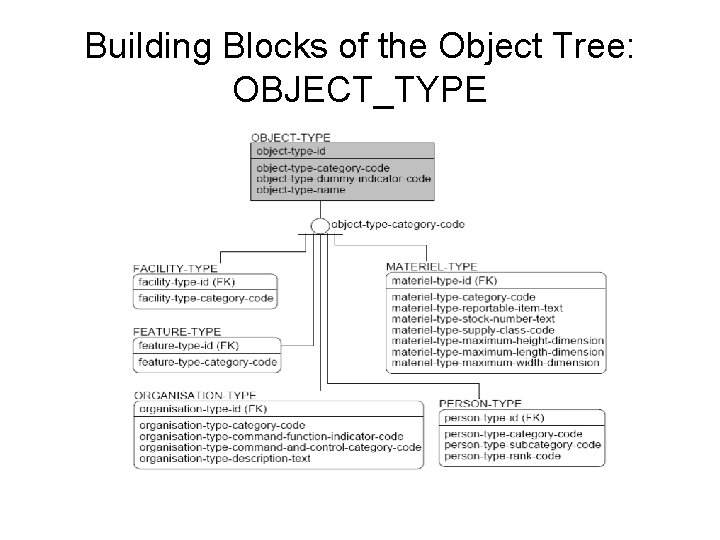
Overall Structure: Objects and the Object Tree • Objects – Type and Item • Defined in terms of Type and Item – Type gives Class Definitions – Item gives Instance Definitions • Five main types of Object – Person – Organisation – Materiel – Feature – Facility
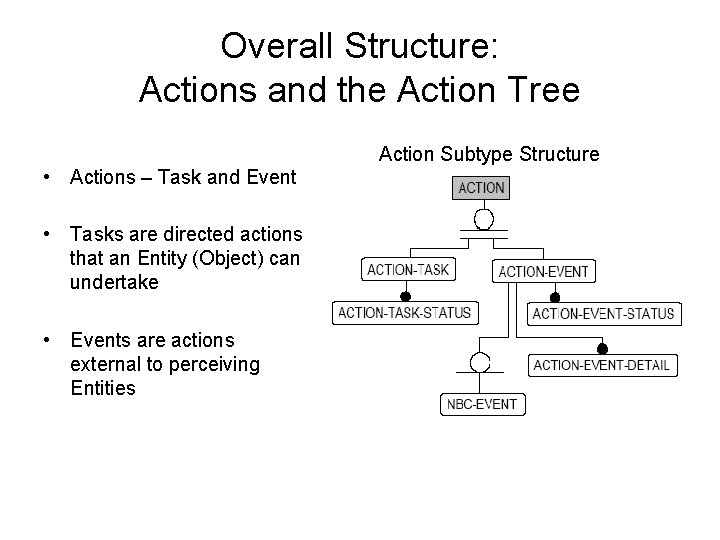
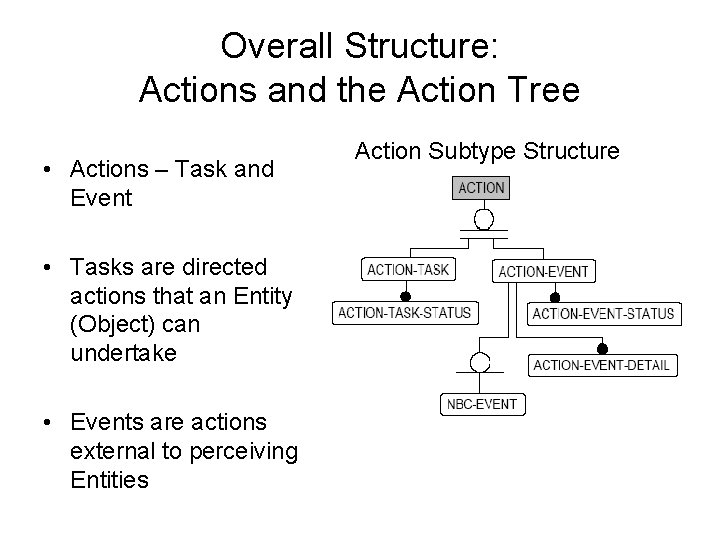
Overall Structure: Actions and the Action Tree • Actions – Task and Event • Tasks are directed actions that an Entity (Object) can undertake • Events are actions external to perceiving Entities Action Subtype Structure
XML Representations • XML Schemas available: – Physical model – Logical model – Object-oriented model • Institute for Defense Analysis (IDA) developing ontology description in Web Ontology Language (OWL)
Questions? Point of Contact Curtis Blais MOVES Institute Naval Postgraduate School 831 -656 -3215 clblais@nps. edu
Backups
The Object Tree People, Places, Things And their Properties
Building Blocks of the Object Tree: OBJECT_TYPE
Building Blocks of the Object Tree: OBJECT_TYPE
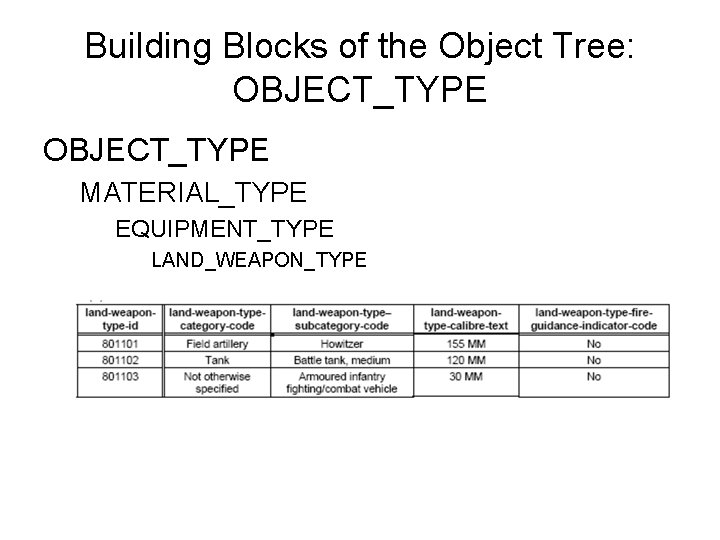
Building Blocks of the Object Tree: OBJECT_TYPE MATERIAL_TYPE EQUIPMENT_TYPE LAND_WEAPON_TYPE
Building Blocks of the Object Tree: OBJECT_ITEM
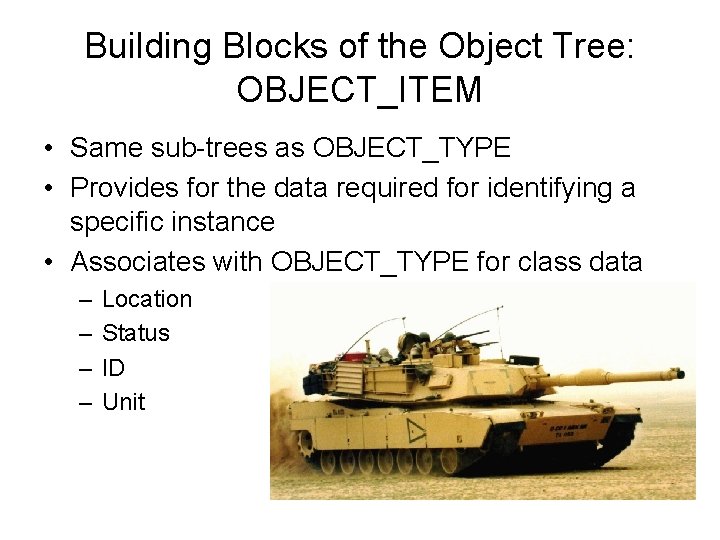
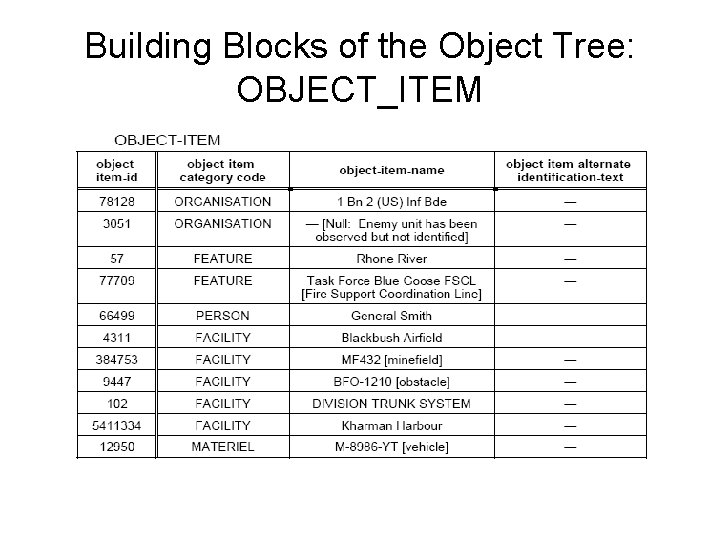
Building Blocks of the Object Tree: OBJECT_ITEM • Same sub-trees as OBJECT_TYPE • Provides for the data required for identifying a specific instance • Associates with OBJECT_TYPE for class data – – Location Status ID Unit
Building Blocks of the Object Tree: OBJECT_ITEM
Supporting Structure for the Object Tree • Actual Objects? Not necessarily – Networks are a type of FACILITY – Control Features are a type of FEATURE – Visibility as a type of FEATURE • Multiple Instances of an Item are linked to a Type through the HOLDING association • TO&E is shown through the ORGANISATION_MATERIAL_ASSOCIATION
Objects in Motion STATUS, CAPABILITY, and ACTION • All OBJECT_ITEMS have the capability to have their status reported on – Under Orders; Damaged; Loaded etc • All OBJECT_ITEM associations have the capability to have their status reported on – Embarkation/Disembarkation; Join a Unit/Convoy • Locations (point and relative) can be associated with OBJECT_ITEMs
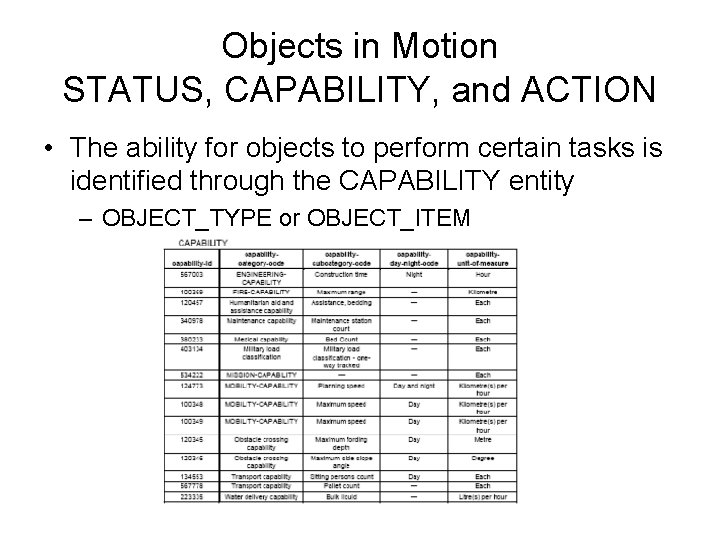
Objects in Motion STATUS, CAPABILITY, and ACTION • The ability for objects to perform certain tasks is identified through the CAPABILITY entity – OBJECT_TYPE or OBJECT_ITEM
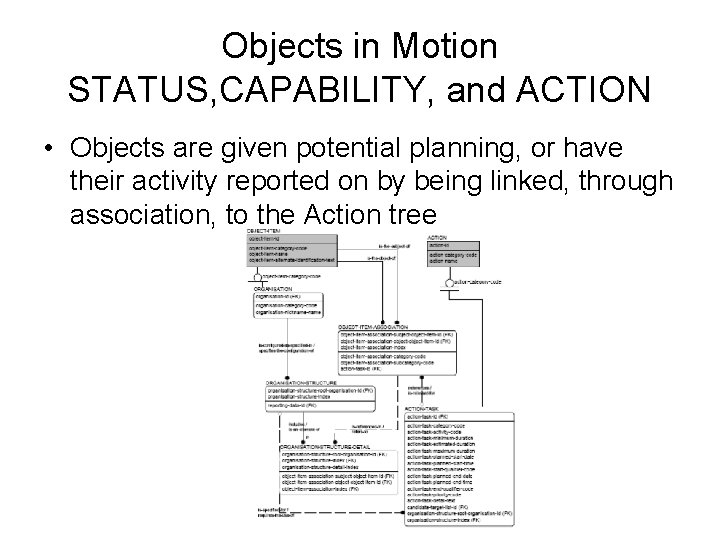
Objects in Motion STATUS, CAPABILITY, and ACTION • Objects are given potential planning, or have their activity reported on by being linked, through association, to the Action tree
The Action Tree Move, Shoot, Look, Communicate
ACTION • Represents activity in the model: something carries out an activity to affect something at some time • Includes mechanisms for specifying: – Items or classes as resources and objectives for activity – Recording effects of activity – Classifying activities as planned tasks or unplanned events – Keeping status of activities – Relating activities to each other functionally and temporally
Overall Structure: Actions and the Action Tree • Actions – Task and Event • Tasks are directed actions that an Entity (Object) can undertake • Events are actions external to perceiving Entities Action Subtype Structure
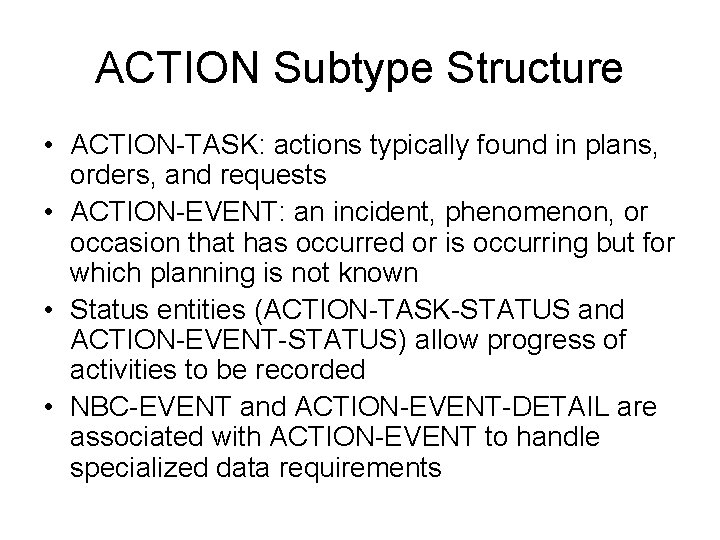
ACTION Subtype Structure • ACTION-TASK: actions typically found in plans, orders, and requests • ACTION-EVENT: an incident, phenomenon, or occasion that has occurred or is occurring but for which planning is not known • Status entities (ACTION-TASK-STATUS and ACTION-EVENT-STATUS) allow progress of activities to be recorded • NBC-EVENT and ACTION-EVENT-DETAIL are associated with ACTION-EVENT to handle specialized data requirements
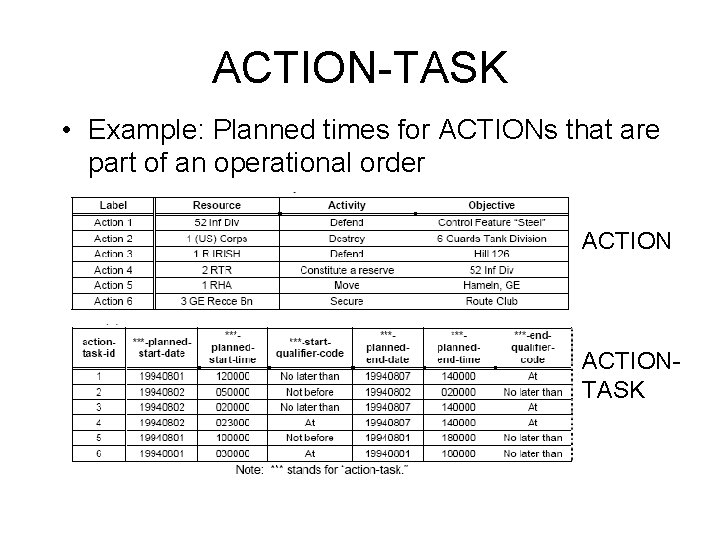
ACTION-TASK • Example: Planned times for ACTIONs that are part of an operational order ACTIONTASK
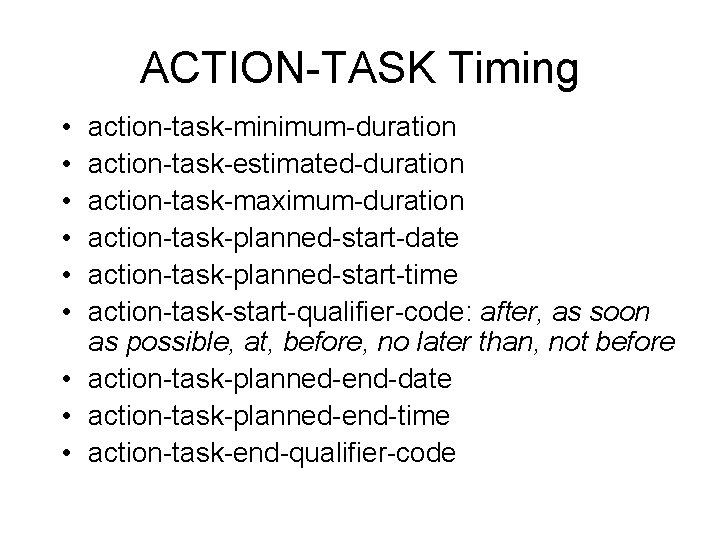
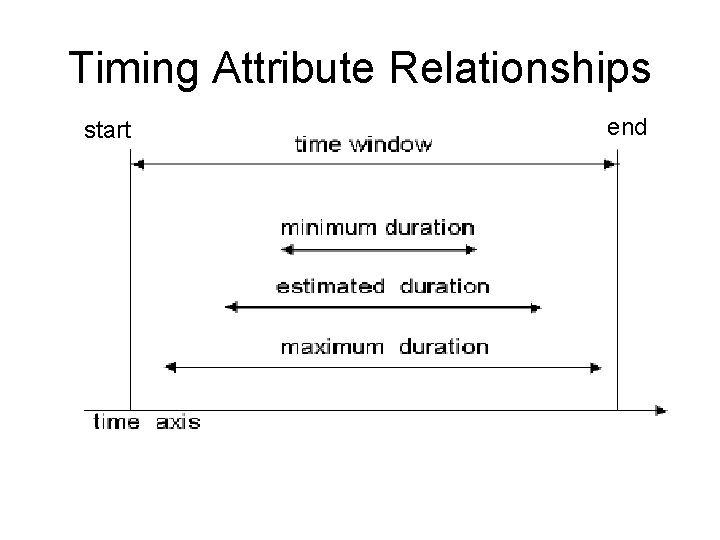
ACTION-TASK Timing • • • action-task-minimum-duration action-task-estimated-duration action-task-maximum-duration action-task-planned-start-date action-task-planned-start-time action-task-start-qualifier-code: after, as soon as possible, at, before, no later than, not before • action-task-planned-end-date • action-task-planned-end-time • action-task-end-qualifier-code
Timing Attribute Relationships start end
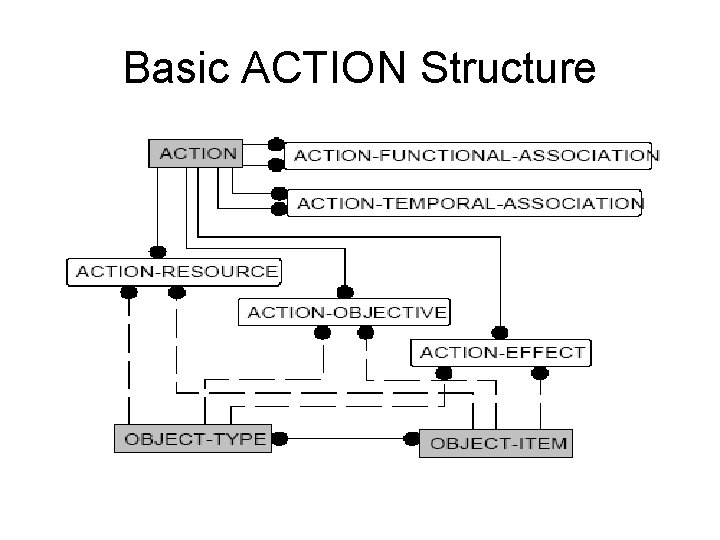
Basic ACTION Structure
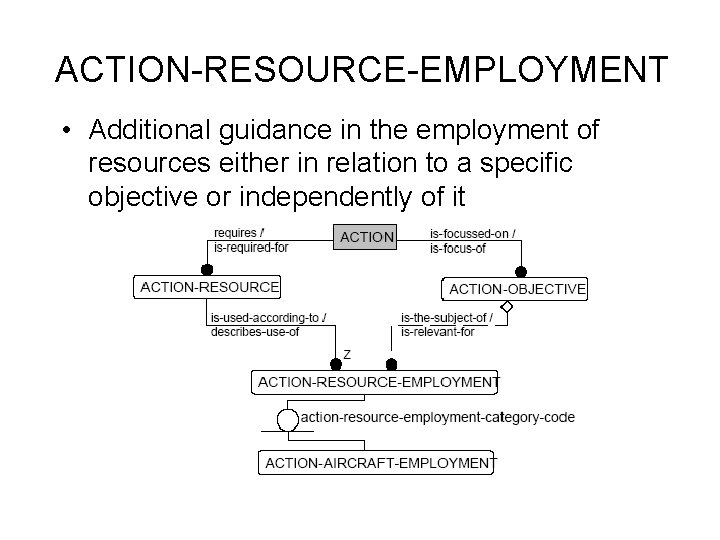
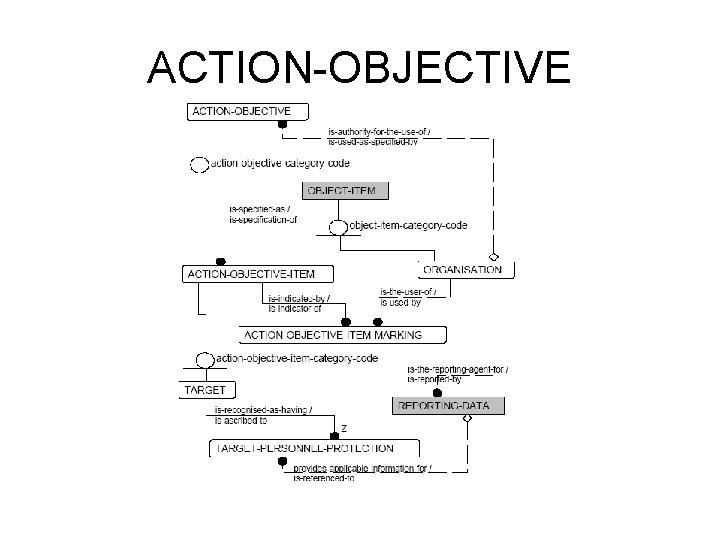
Role of Objects • ACTION-RESOURCE: OBJECT-ITEM or OBJECTTYPE that is required, requested, allocated, or otherwise used or planned to be used in conducting a specific ACTION • ACTION-OBJECTIVE: OBJECT-ITEM or OBJECTTYPE that is the focus of a specific ACTION – E. g. , helicopters transporting troops to a landing zone • ACTION-EFFECT: perceived effectiveness of a specific ACTION against a specific item or its type – A quantity if the objective is an OBJECT-TYPE – A fraction if the objective is an OBJECT-ITEM – Can include unintended effects (e. g. , collateral damage)
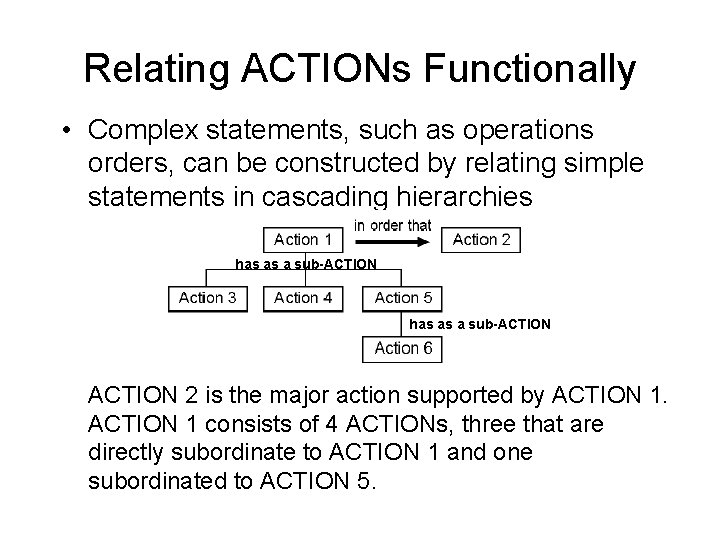
Relating ACTIONs Functionally • ACTION-FUNCTIONAL-ASSOCIATION – One ACTION being dependent on, supporting, or derived from another ACTION • • • Has a provisional sub-ACTION Has as a sub-ACTION In order that In response to Is a modification of Is a prerequisite for Is a template for Is an alternative to Uses as a reference
Relating ACTIONs Functionally • Complex statements, such as operations orders, can be constructed by relating simple statements in cascading hierarchies has as a sub-ACTION 2 is the major action supported by ACTION 1 consists of 4 ACTIONs, three that are directly subordinate to ACTION 1 and one subordinated to ACTION 5.
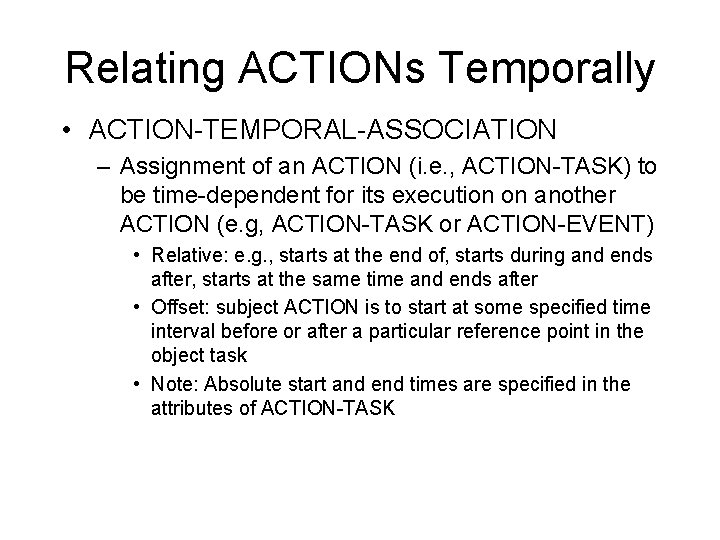
Relating ACTIONs Temporally • ACTION-TEMPORAL-ASSOCIATION – Assignment of an ACTION (i. e. , ACTION-TASK) to be time-dependent for its execution on another ACTION (e. g, ACTION-TASK or ACTION-EVENT) • Relative: e. g. , starts at the end of, starts during and ends after, starts at the same time and ends after • Offset: subject ACTION is to start at some specified time interval before or after a particular reference point in the object task • Note: Absolute start and end times are specified in the attributes of ACTION-TASK
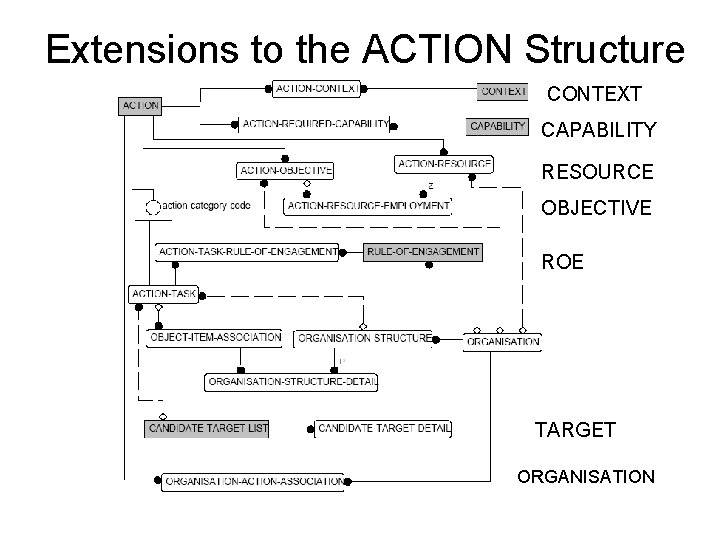
Extensions to the ACTION Structure CONTEXT CAPABILITY RESOURCE OBJECTIVE ROE TARGET ORGANISATION
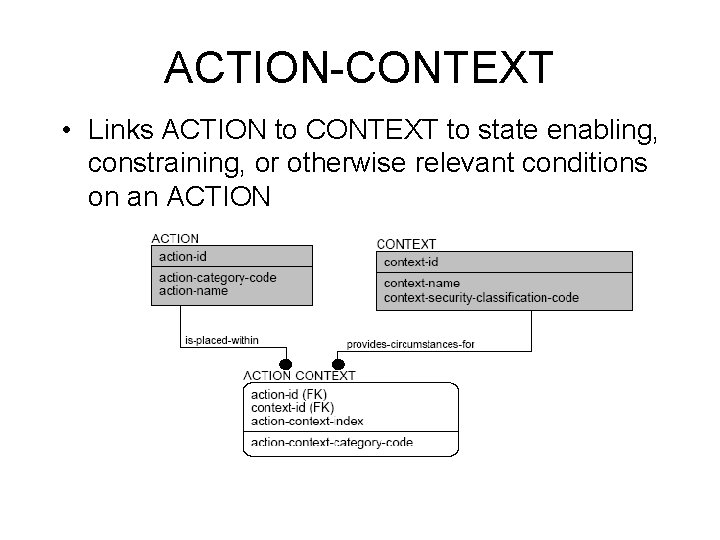
ACTION-CONTEXT • Links ACTION to CONTEXT to state enabling, constraining, or otherwise relevant conditions on an ACTION
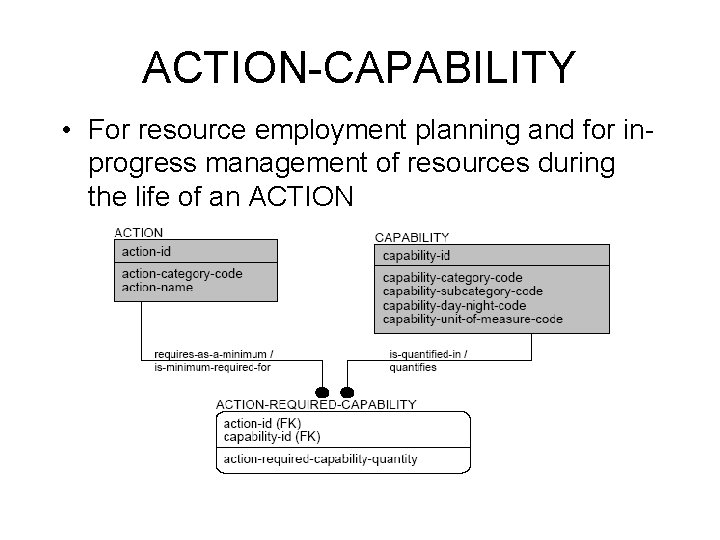
ACTION-CAPABILITY • For resource employment planning and for inprogress management of resources during the life of an ACTION
ACTION-RESOURCE-EMPLOYMENT • Additional guidance in the employment of resources either in relation to a specific objective or independently of it
ACTION-OBJECTIVE
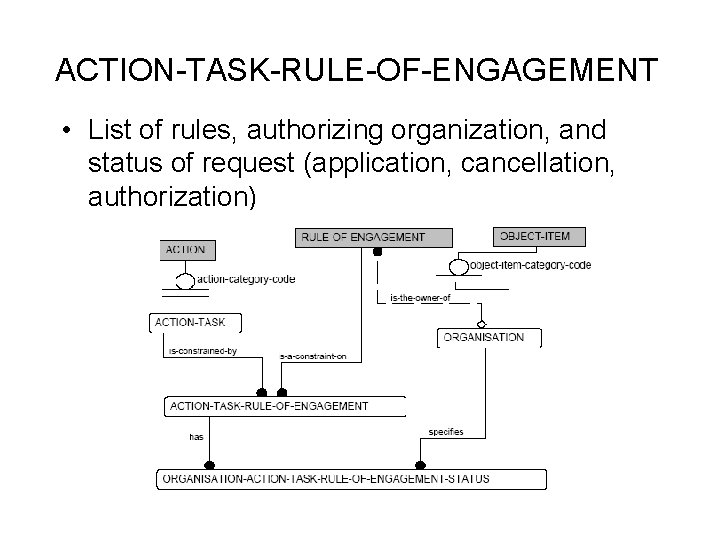
ACTION-TASK-RULE-OF-ENGAGEMENT • List of rules, authorizing organization, and status of request (application, cancellation, authorization)
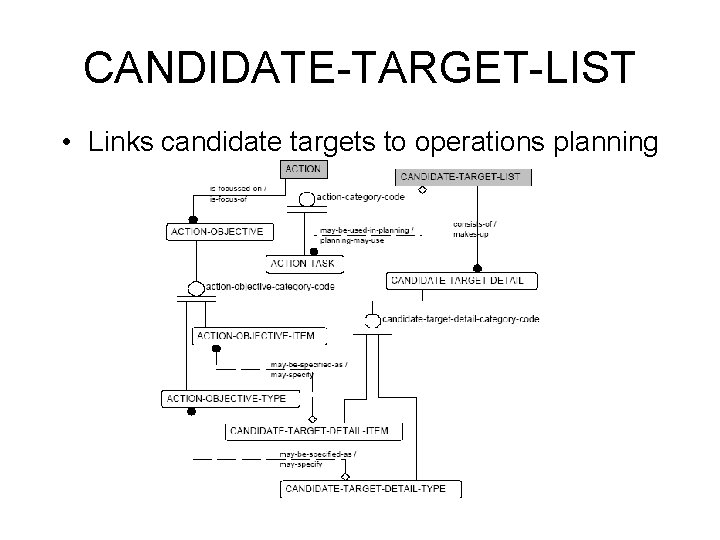
CANDIDATE-TARGET-LIST • Links candidate targets to operations planning
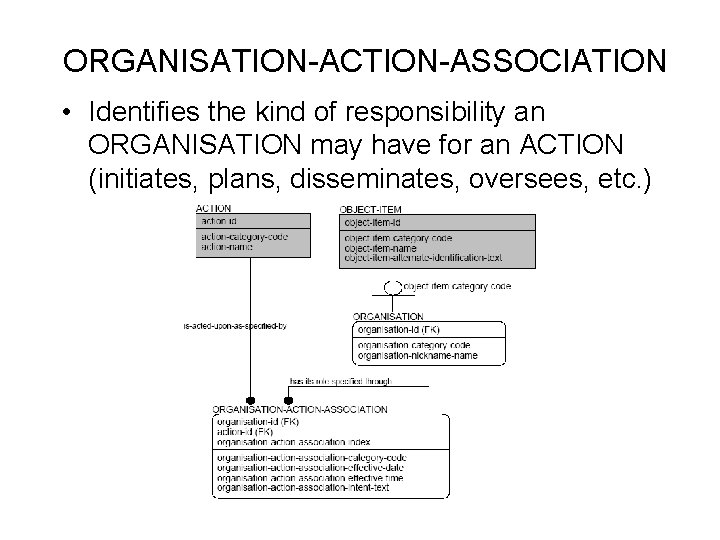
ORGANISATION-ACTION-ASSOCIATION • Identifies the kind of responsibility an ORGANISATION may have for an ACTION (initiates, plans, disseminates, oversees, etc. )