
Joint Base LewisMc Chord JBLM Joint Base Safety
Joint Base Lewis-Mc. Chord (JBLM) Joint Base Safety and Occupational Health (SOH) Program
Bottom Line Up Front § We are forward-focused, built on risk management doctrine, aligned with Do. D and service component guidance § We involve, engage and support leaders § We are intensely customer-focused § We steer by standards, using disciplined processes to manage mishap risks § We emphasize program links among Joint Base Safety, Occupational Health, Industrial Hygiene, Fire, Environmental
JBSO Mission Advise, audit and assist commanders and managers in executing their Safety and Occupational Health Program, in order to protect mission, prevent injury, prevent damage, comply with the law, and limit liability.
JBSO Vision: CLEAR § § § Customers first Lead by example Expect to be Green and “T” Anticipate Ready to respond
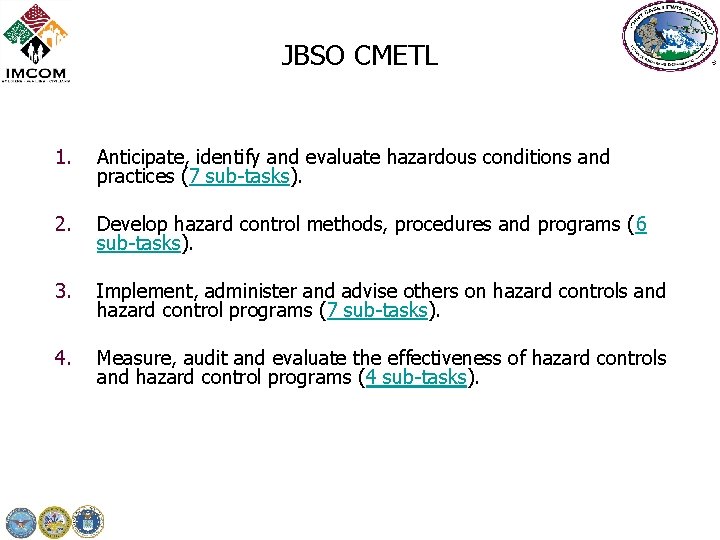
JBSO CMETL 1. Anticipate, identify and evaluate hazardous conditions and practices (7 sub-tasks). 2. Develop hazard control methods, procedures and programs (6 sub-tasks). 3. Implement, administer and advise others on hazard controls and hazard control programs (7 sub-tasks). 4. Measure, audit and evaluate the effectiveness of hazard controls and hazard control programs (4 sub-tasks).
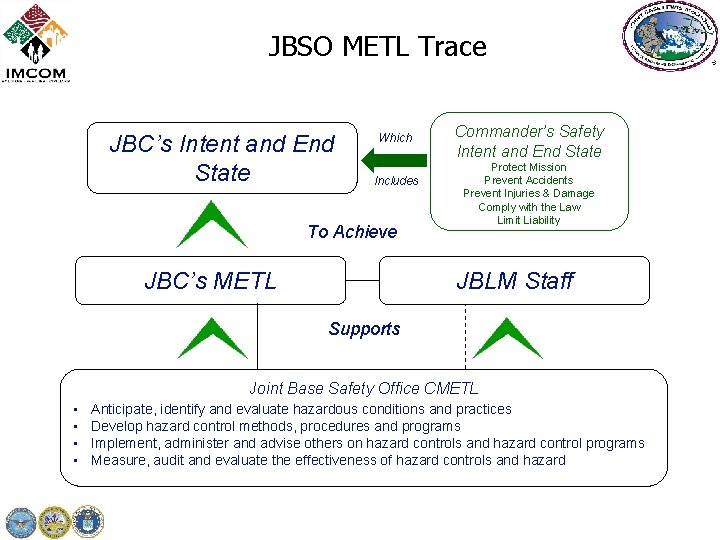
JBSO METL Trace JBC’s Intent and End State Which Includes To Achieve JBC’s METL Commander’s Safety Intent and End State Protect Mission Prevent Accidents Prevent Injuries & Damage Comply with the Law Limit Liability JBLM Staff Supports Joint Base Safety Office CMETL • • Anticipate, identify and evaluate hazardous conditions and practices Develop hazard control methods, procedures and programs Implement, administer and advise others on hazard controls and hazard control programs Measure, audit and evaluate the effectiveness of hazard controls and hazard
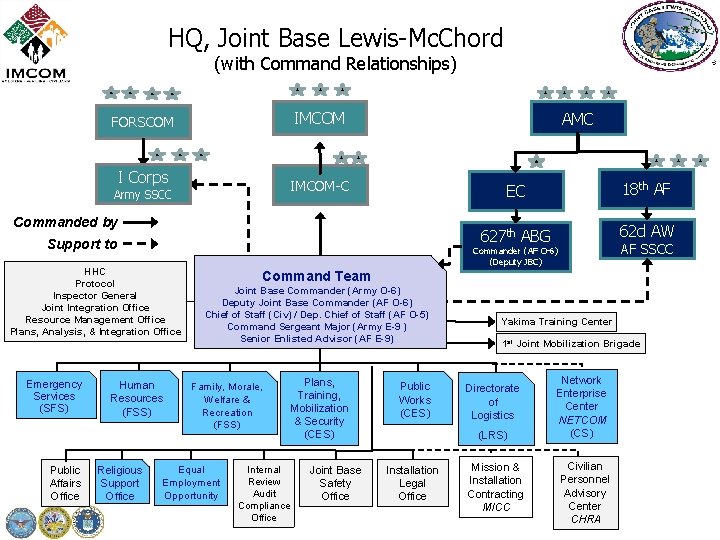
HQ, Joint Base Lewis-Mc. Chord (with Command Relationships) FORSCOM IMCOM I Corps IMCOM-C Army SSCC AMC Commanded by Support to HHC Protocol Inspector General Joint Integration Office Resource Management Office Plans, Analysis, & Integration Office Emergency Services (SFS) Public Affairs Office Human Resources (FSS) Religious Support Office EC 18 th AF 627 th ABG 62 d AW AF SSCC Commander (AF O-6) (Deputy JBC) Command Team Joint Base Commander (Army O-6) Deputy Joint Base Commander (AF O-6) Chief of Staff (Civ) / Dep. Chief of Staff (AF O-5) Command Sergeant Major (Army E-9 ) Senior Enlisted Advisor (AF E-9) Family, Morale, Welfare & Recreation (FSS) Equal Employment Opportunity Internal Review Audit Compliance Office Plans, Training, Mobilization & Security (CES) Joint Base Safety Office Public Works (CES) Yakima Training Center 1 st Joint Mobilization Brigade Directorate of Logistics (LRS) Installation Legal Office Mission & Installation Contracting MICC Network Enterprise Center NETCOM (CS) Civilian Personnel Advisory Center CHRA
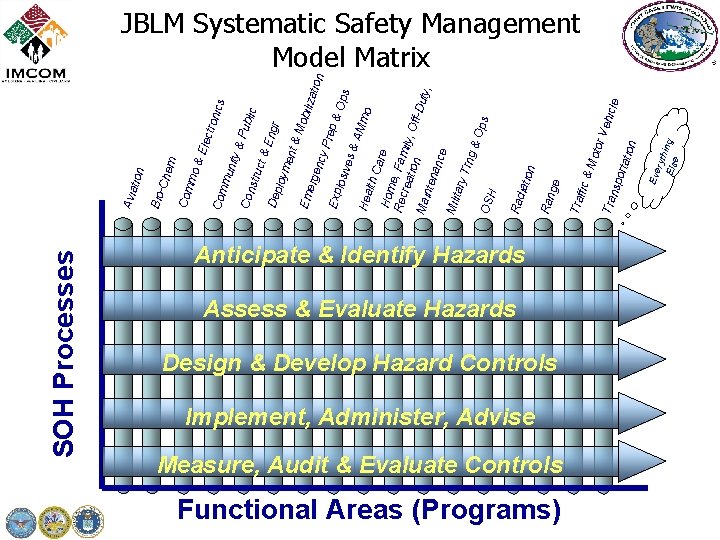
SOH Processes roni cs &E lect m Anticipate & Identify Hazards Assess & Evaluate Hazards Design & Develop Hazard Controls Implement, Administer, Advise Measure, Audit & Evaluate Controls Functional Areas (Programs) ryth Els ing e Eve rtati on &M otor nsp o Tra ffic Tra ge Ran iatio n Rad Con Veh icle Pub lic stru ct & Eng Dep r loym ent &M obil Em izat erge ion ncy Pre p& Exp losi Ops ves &A Mm Hea o lth C are Hom Rec e, Fam reat i ion ly, Off. Dut Mai y, nten anc e Mili tary Trn g& Ops OSH mun ity & Com mo Com Che Bio- Avia tion JBLM Systematic Safety Management Model Matrix
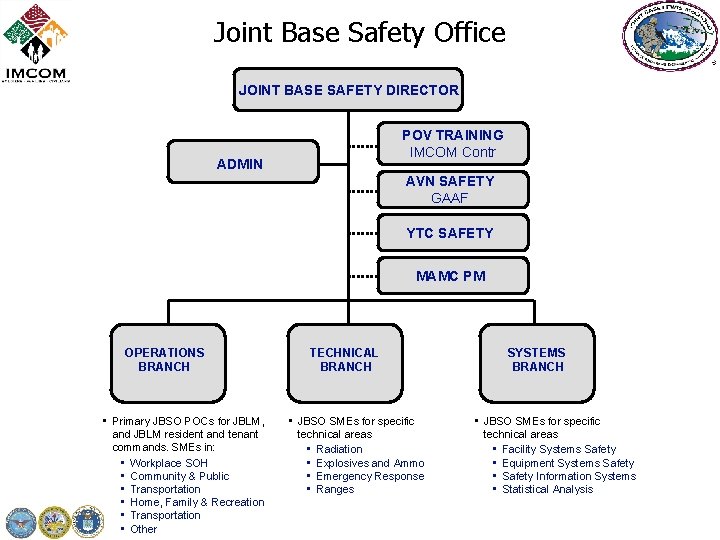
Joint Base Safety Office JOINT BASE SAFETY DIRECTOR POV TRAINING IMCOM Contr ADMIN AVN SAFETY GAAF YTC SAFETY MAMC PM OPERATIONS BRANCH • Primary JBSO POCs for JBLM, and JBLM resident and tenant commands. SMEs in: • Workplace SOH • Community & Public • Transportation • Home, Family & Recreation • Transportation • Other TECHNICAL BRANCH • JBSO SMEs for specific technical areas • Radiation • Explosives and Ammo • Emergency Response • Ranges SYSTEMS BRANCH • JBSO SMEs for specific technical areas • Facility Systems Safety • Equipment Systems Safety • Safety Information Systems • Statistical Analysis
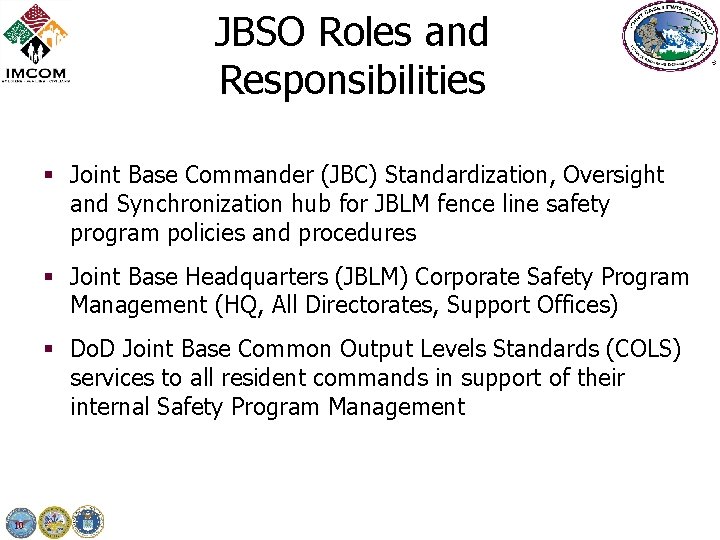
JBSO Roles and Responsibilities § Joint Base Commander (JBC) Standardization, Oversight and Synchronization hub for JBLM fence line safety program policies and procedures § Joint Base Headquarters (JBLM) Corporate Safety Program Management (HQ, All Directorates, Support Offices) § Do. D Joint Base Common Output Levels Standards (COLS) services to all resident commands in support of their internal Safety Program Management 10
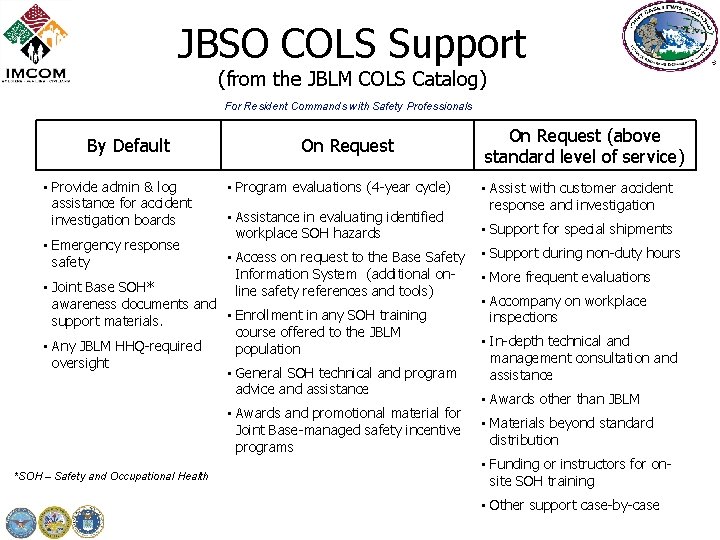
JBSO COLS Support (from the JBLM COLS Catalog) For Resident Commands with Safety Professionals By Default • Provide admin & log assistance for accident investigation boards • Emergency response safety On Request • Program evaluations (4 -year cycle) • Assistance in evaluating identified workplace SOH hazards • Access on request to the Base Safety Information System (additional online safety references and tools) • Joint Base SOH* awareness documents and • Enrollment in any SOH training support materials. course offered to the JBLM • Any JBLM HHQ-required population oversight • General SOH technical and program advice and assistance • Awards and promotional material for Joint Base-managed safety incentive programs *SOH – Safety and Occupational Health On Request (above standard level of service) • Assist with customer accident response and investigation • Support for special shipments • Support during non-duty hours • More frequent evaluations • Accompany on workplace inspections • In-depth technical and management consultation and assistance • Awards other than JBLM • Materials beyond standard distribution • Funding or instructors for onsite SOH training • Other support case-by-case
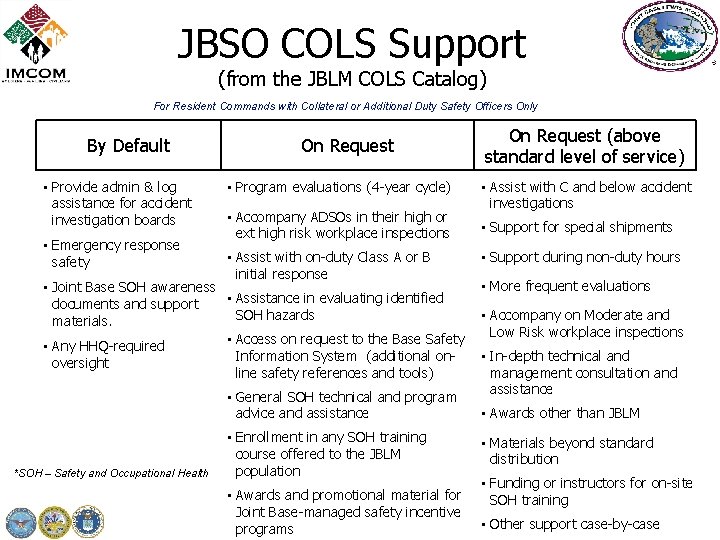
JBSO COLS Support (from the JBLM COLS Catalog) For Resident Commands with Collateral or Additional Duty Safety Officers Only By Default • Provide admin & log assistance for accident investigation boards • Emergency response safety On Request • Program evaluations (4 -year cycle) • Accompany ADSOs in their high or ext high risk workplace inspections • Assist with on-duty Class A or B initial response • Joint Base SOH awareness • Assistance in evaluating identified documents and support SOH hazards materials. • Access on request to the Base Safety • Any HHQ-required Information System (additional onoversight line safety references and tools) • General SOH technical and program advice and assistance *SOH – Safety and Occupational Health • Enrollment in any SOH training course offered to the JBLM population • Awards and promotional material for Joint Base-managed safety incentive programs On Request (above standard level of service) • Assist with C and below accident investigations • Support for special shipments • Support during non-duty hours • More frequent evaluations • Accompany on Moderate and Low Risk workplace inspections • In-depth technical and management consultation and assistance • Awards other than JBLM • Materials beyond standard distribution • Funding or instructors for on-site SOH training • Other support case-by-case
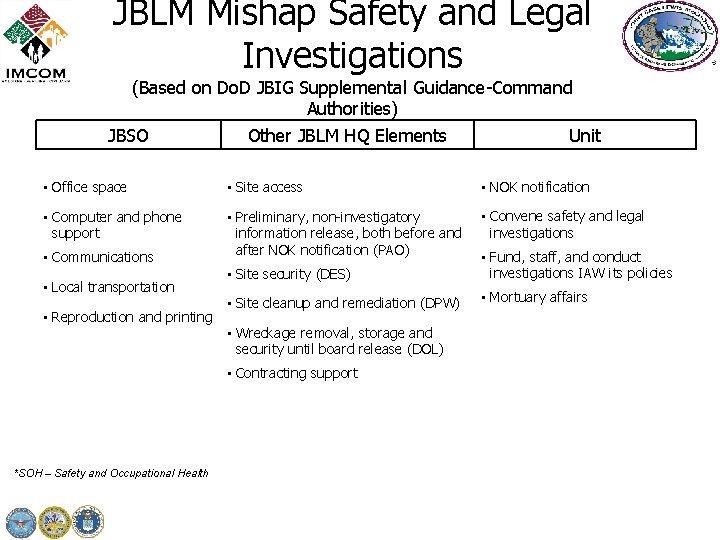
JBLM Mishap Safety and Legal Investigations (Based on Do. D JBIG Supplemental Guidance-Command Authorities) JBSO Other JBLM HQ Elements Unit • Office space • Site access • NOK notification • Computer and phone support • Preliminary, non-investigatory information release, both before and after NOK notification (PAO) • Convene safety and legal investigations • Communications • Local transportation • Reproduction and printing • Site security (DES) • Fund, staff, and conduct investigations IAW its policies • Site cleanup and remediation (DPW) • Mortuary affairs • Wreckage removal, storage and security until board release (DOL) • Contracting support *SOH – Safety and Occupational Health
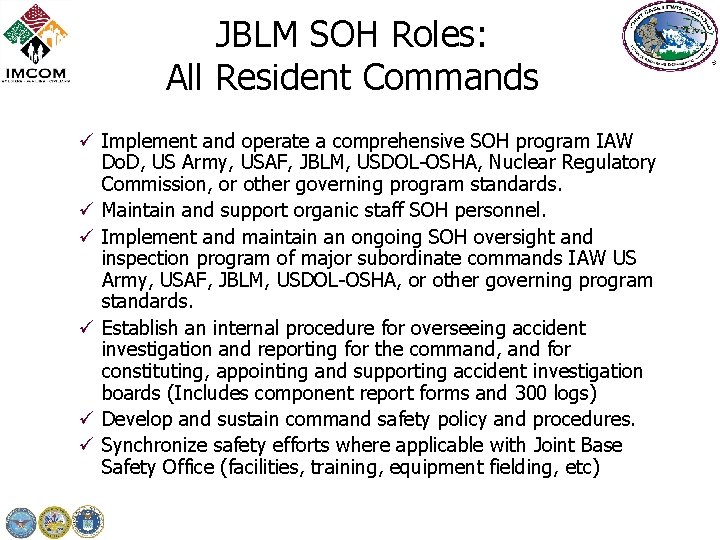
JBLM SOH Roles: All Resident Commands ü Implement and operate a comprehensive SOH program IAW Do. D, US Army, USAF, JBLM, USDOL-OSHA, Nuclear Regulatory Commission, or other governing program standards. ü Maintain and support organic staff SOH personnel. ü Implement and maintain an ongoing SOH oversight and inspection program of major subordinate commands IAW US Army, USAF, JBLM, USDOL-OSHA, or other governing program standards. ü Establish an internal procedure for overseeing accident investigation and reporting for the command, and for constituting, appointing and supporting accident investigation boards (Includes component report forms and 300 logs) ü Develop and sustain command safety policy and procedures. ü Synchronize safety efforts where applicable with Joint Base Safety Office (facilities, training, equipment fielding, etc)
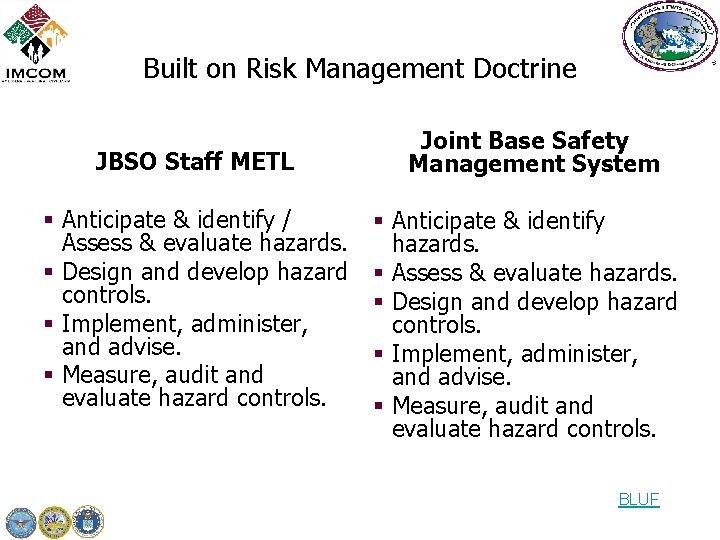
Built on Risk Management Doctrine JBSO Staff METL § Anticipate & identify / Assess & evaluate hazards. § Design and develop hazard controls. § Implement, administer, and advise. § Measure, audit and evaluate hazard controls. Joint Base Safety Management System § Anticipate & identify hazards. § Assess & evaluate hazards. § Design and develop hazard controls. § Implement, administer, and advise. § Measure, audit and evaluate hazard controls. BLUF
SOH METL Task Details METL List
SOH METL Task 1 (p. 1 of 4) 1. Anticipate, identify and evaluate hazardous conditions and practices. a. Develop methods to: (1) Anticipate and predict hazards from experience, historical data and other information sources. (2) Identify and recognize hazards in existing or future systems, equipment, products, software, facilities, processes, operations and procedures during their expected life. (3) Evaluate and assess the probability and severity of loss events and accidents which may result from actual or potential hazards. b. Apply these methods to conduct hazard analyses and interpret results. METL List
SOH METL Task 1 (p. 2 of 4) 1. Anticipate, identify and evaluate hazardous conditions and practices. c. Review, with the assistance of specialists where needed, entire systems, processes, and operations for failure modes, causes and effects of the entire system, process or operation and any subsystem or components due to: (1) System, subsystem, or component failures. (2) Human error. (3) Incomplete or faulty decision making, judgments or administrative actions. (4) Weaknesses in proposed or existing policies, directives, objectives or practices. METL List
SOH METL Task 1 (p. 3 of 4) 1. Anticipate, identify and evaluate hazardous conditions and practices. d. Review, compile, analyze and interpret data from accident and loss event reports and other sources regarding injuries, illnesses, property damage, environmental effects or public impacts to: (1) Identify causes, trends and relationships. (2) Ensure completeness, accuracy and validity of required information. (3) Evaluate the effectiveness of classification schemes and data collection methods. (4) Initiate investigations. e. Conduct research studies of existing or potential safety and health problems and issues. METL List
SOH METL Task 1 (p. 4 of 4) 1. Anticipate, identify and evaluate hazardous conditions and practices. f. Determine the need for surveys and appraisals that help identify conditions or practices affecting safety and health, including those which require the services of specialists, such as physicians, health physicists, industrial hygienists, fire protection engineers, design and process engineers, ergonomists, risk managers, environmental professionals, psychologists and others. g. Assess environments, tasks and other elements to ensure that physiological and psychological capabilities, capacities and limits of humans are not exceeded. METL List
SOH METL Task 2 (p. 1 of 2) 2. Develop hazard control methods, procedures and programs. a. Formulate and prescribe engineering or administrative controls, preferably before exposures, accidents, and loss events occur, to: (1) eliminate hazards and causes of exposures, accidents and loss events. (2) reduce the probability or severity of injuries, illnesses, losses or environmental damage from potential exposures, accidents, and loss events when hazards cannot be eliminated. b. Develop methods which integrate safety performance into the goals, operations and productivity of organizations and their management and into systems, processes, operations or their components. c. Develop safety, health and environmental policies, procedures, codes and standards for integration into operational policies of organizations, unit operations, purchasing and contracting. METL List
SOH METL Task 2 (p. 2 of 2) 2. Develop hazard control methods, procedures and programs. d. Consult with and advising individual and participating on teams (1) engaged in planning, design, development and installation or implementation of systems or programs involving hazard controls. (2) engaged in planning, design, development, fabrication, testing, packaging and distribution of products or services regarding SOH requirements and application of safety principles which will maximize product safety. e. Advise and assist human resources specialists when applying hazard analysis results or dealing with the capabilities and limitations of personnel. f. Stay current with technological developments, laws, regulations, standards, codes, products, methods and practices related to hazard controls. METL List
SOH METL Task 3 (p. 1 of 2) 3. Implement, administer and advise others on hazard controls and hazard control programs. a. Prepare reports which communicate valid and comprehensive hazard controls which are based on analysis and interpretation of accident exposure, loss event and other data. b. Use written and graphic materials, presentations and other communication media to recommend hazard controls and hazard control policies, procedures and programs to decision making personnel. c. Direct or assist in planning and developing educational and training materials or courses. d. Conduct or assist with courses related to designs, policies, procedures and programs involving hazard recognition and control. METL List
SOH METL Task 3 (p. 2 of 2) 3. Implement, administer and advise others on hazard controls and hazard control programs. e. Provide advice and counsel about compliance with safety, health and environmental laws, codes, regulations and standards. f. Advise others about hazards, hazard controls, relative risk and related safety matters when they are communicating with the media, community and public. g. Manage and implement hazard controls and hazard control programs. METL List
SOH METL Task 4 (p. 1 of 1) 4. Measure, audit and evaluate the effectiveness of hazard controls and hazard control programs. a. Establish and implement techniques, which involve risk analysis, costbenefit analysis, work sampling, loss rate and similar methodologies, for periodic and systematic evaluation of hazard control and hazard control program effectiveness. b. Develop methods to evaluate the costs and effectiveness of hazard controls and programs and measure the contribution of components of systems, organizations, processes and operations toward the overall effectiveness. c. Provide results of evaluation assessments, including recommended adjustments and changes to hazard controls or hazard control programs, to individuals or organizations responsible for their management and implementation. d. Direct, develop, or help to develop management accountability and audit programs which assess safety performance of entire systems, organizations, processes and operations or their components and involve both deterrents and incentives. METL List
- Slides: 25