
Joining of Different Type WingBody Surfaces of Aircraft

Joining of Different Type “Wing-Body” Surfaces of Aircraft Structure K. Leonavičius, Vilnius Gediminas Technical University, Antanas Gustaitis Aviation Institute Riga 2002

Joining of Different “Wing-Body” surfaces of Aircraft Structures Contents n n n Introduction 3 D models in aviation Modern modeling methods Basic types of surfaces Types of surfaces joining ¨ ¨ ¨ n n FUSELAGE – fin joining fuselage - FIN joining FUSELAGE – FIN joining Examples of models Conclusion 2

Joining of Different “Wing-Body” surfaces of Aircraft Structures Introduction n Development of the 3 D model – one of the most important stage of a design process in aviation. n Complex shapes in aviation - new possibilities of high technology: Modern computer aided design (CAD) and analysis (CAE) software ¨ Computerised manufacturing (CAM), new composite materials and technology ¨ n There is the strong demand of new 3 D design methods of complex shape objects in aviation 3

Joining of Different “Wing-Body” surfaces of Aircraft Structures Some features of aircraft modeling n Differences between aircrafts and other objects (cars, ships) shapes ¨ n One “Skin” instead of separate “Faces” Development of aircrafts shapes Lines, arcs - Conic curves – splines, Bezier curves ¨ Assimilation of separate airplane shapes (nose-cabin-tail) into one smooth surface. ¨ Joining of fuselage and wing surfaces ¨ 4

Joining of Different “Wing-Body” surfaces of Aircraft Structures 3 D design of light airplane n Shape is closely related to form of internal content – crew, load, powerplant, etc. n Influence of aerodynamic – max laminar flow, min drag area n Influence of strength – optimization of shape and weight n Influence of high tecnology ¨ ¨ CAM New composite materials Curve of Zmax 5

Joining of Different “Wing-Body” surfaces of Aircraft Structures Basic methods of airplane shape design n Buttock-planes method n Radiusography n Method of Conic curves n Splain, NURBS curves methods 6

Joining of Different “Wing-Body” Surfaces of Aircraft Structures Method of 3 D design using spline curves Step – by – step explanation Main views Draft project Initial layaut Internal components Coordinate system Contours Contour editing Basic sections Izocurves Temporary sections Shape editing Surface lofting Strength analysis Flow analysis Numerical mock-up Results 7

Joining of Different “Wing-Body” Surfaces of Aircraft Structures Types of surfaces • Lifting surface (wing, fin, stabilizer) Curves or surfaces composed by “clouds of points” (airfoils). Geometry is parameterized by coordinates of points. • “Free Form” surface (fuselage, fairing, cowling). The geometry of such surfaces is parameterized by mathematical functions (Conic curves, polynomic spline curves NURBS). 8
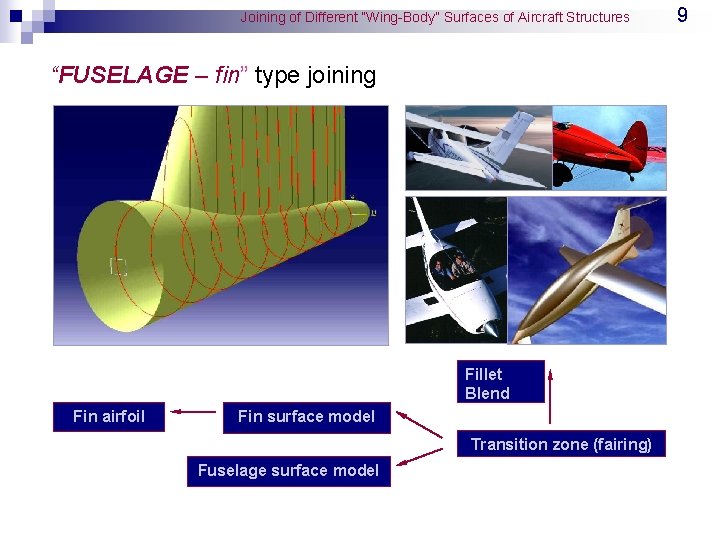
Joining of Different “Wing-Body” Surfaces of Aircraft Structures “FUSELAGE – fin” type joining Fillet Blend Fin airfoil Fin surface model Transition zone (fairing) Fuselage surface model 9

Joining of Different “Wing-Body” Surfaces of Aircraft Structures “fuselage – FIN” type joining Fin airfoil Fin surface model Fillet Blend Transition zone (front edge fairing) Fuselage surf. model 10
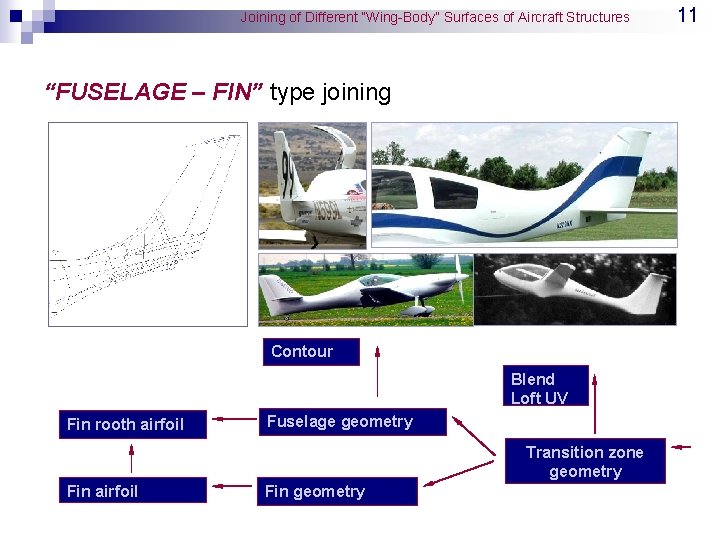
Joining of Different “Wing-Body” Surfaces of Aircraft Structures “FUSELAGE – FIN” type joining Contour Blend Loft UV Fin rooth airfoil Fuselage geometry Transition zone geometry Fin airfoil Fin geometry 11

Joining of Different “Wing-Body” Surfaces of Aircraft Structures Conclusions • Modern high technology in aviation allows very complex shapes to be developed and manufactured. The “Free Form” surfaces of double curvature are typical for a light and sport airplanes. • There are two basic methods of aircraft surface parameterization – numerical (fuselages, fairings, etc. ) and geometric (wings). Development of the transition zones between them creates an additional problems. • There are some typical ways to connect a surfaces of different type “Fuselage-fin”, “fuselage – Fin”, “Fuselage-Fin”. Proper CAD technique is recommended for every type of joining. • It is objective to change geometrically parameterized (by coordinates) curves into mathematically determined curves (Conic, NURBS). Special methods and software would be created and integrated with modern CAD-CAE packages. • Development of transition zones is possible by joining the design CAD software with the CAE strength (FEM) and flow (CFD) analysis software. 13
- Slides: 12