
JOHNSONS GREAT SOCIETY THE WAR ON POVERTY United
- Slides: 5
JOHNSON’S GREAT SOCIETY & THE “WAR ON POVERTY” United States History Domestic Policies Mr. Smith
Kennedy’s idea/Johnson’s action In 1963, shortly before he was assassinated, President Kennedy had asked his economic advisors to draw up some proposals to address the problem of American poverty. In Johnson's first State of the Union address on June 8, 1964, he called for an unconditional war to defeat poverty. He expanded and revised the proposals given to Kennedy and developed the Economic Opportunity Act of 1964.
Great Society Following the tradition of using catchphrases to describe major domestic programs started by Franklin D. Roosevelt, President Johnson announced his "Great Society" during the presidential campaign of 1964 at the University of Michigan. The Great Society had three central themes: Abundance and liberty for all. An end to poverty. An end to racial injustice
Economic Opportunity Act of 1964 Head Start Job Corps Work-Study program for university students VISTA (Volunteers in Service to America) - a domestic version of the Peace Corps Neighborhood Youth Corps CAPS (Community Action Programs) - CAPS turned out to be the most controversial part of the package, as it proposed the "maximum feasible participation" by poor people themselves to determine what would help them the most. CAPS was a radical departure from how government had run most social reform programs in the past. The Economic Opportunity Act was bold legislation, but it received only about $1 billion to divide among the various programs and remained critically under funded. By 1966, Congress appropriated $4 billion for the programs.
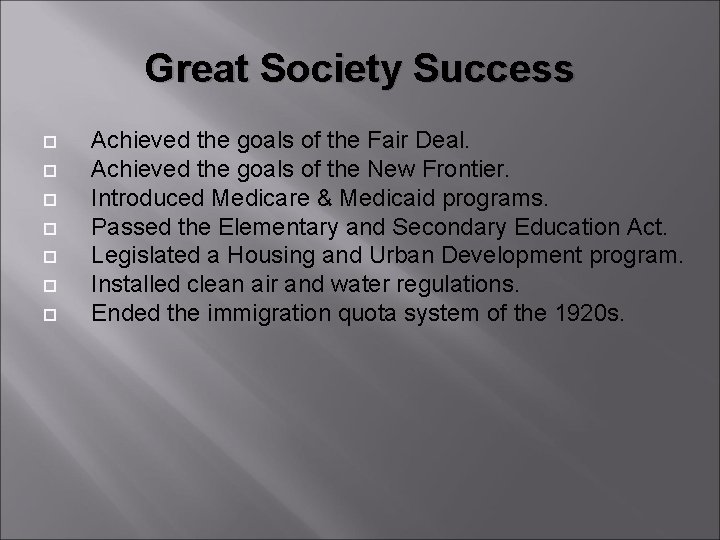
Great Society Success Achieved the goals of the Fair Deal. Achieved the goals of the New Frontier. Introduced Medicare & Medicaid programs. Passed the Elementary and Secondary Education Act. Legislated a Housing and Urban Development program. Installed clean air and water regulations. Ended the immigration quota system of the 1920 s.