
JOHN VENN 1834 1923 Cmp E 220 Fall
- Slides: 9
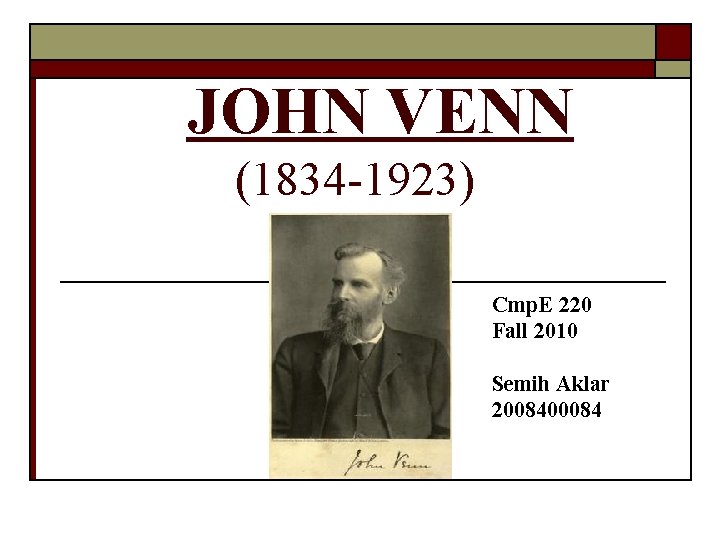
JOHN VENN (1834 -1923) Cmp. E 220 Fall 2010 Semih Aklar 2008400084
Life o John Venn was born in 1834 at Hull. o His mother Martha Sykes died while John Venn was only three. His father was the Reverend Henry Venn and John's grandfather played a prominent role in the evangelical Christian movement. o
Life o He attended London schools and got his mathematics degree from Caius College, Cambridge, in 1857. o He was elected a fellow of this college and held his fellowship there until his death.
Life o o He was ordained as a deacon at Ely in 1858 and became a priest in 1859. After that, he returned to Cambridge, where he develop programs in the moral sciences. In 1883, Venn was elected to the Royal Society. John Venn died in 1923 at Cambridge,
Works o He wrote The Logic of Chance which introduced the frequency interpretation of probability in 1866, Symbolic Logic which introduced the Venn diagrams in 1881, and The Principles of Empirical Logic in 1889
Works o Besides his mathematical work, Venn had an interest in history and wrote extensively about his college and family. Venn also enjoyed building machines.
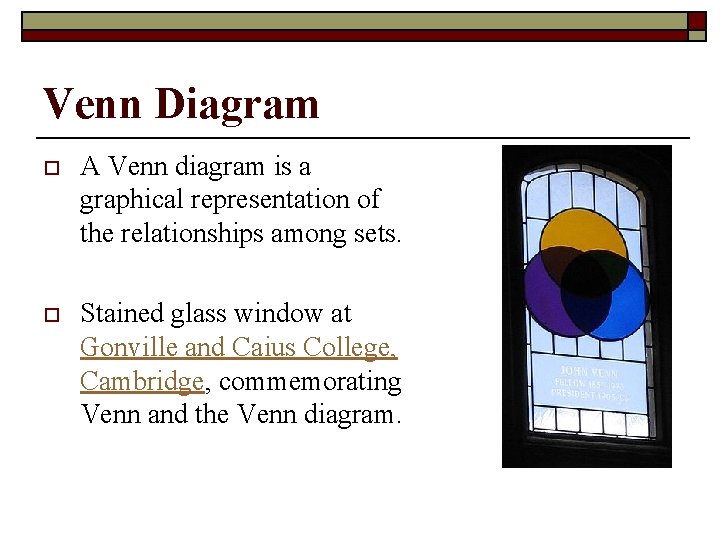
Venn Diagram o A Venn diagram is a graphical representation of the relationships among sets. o Stained glass window at Gonville and Caius College, Cambridge, commemorating Venn and the Venn diagram.
Venn Diagram o In Venn diagram the universal set U , which contains all the objects under consideration, is represented by a rectangle. Inside this rectangle, circles or other geometrical figures are used to represent sets. Sometimes points are used to represent the particular elements of the set. Venn diagrams are used to indicate the relationship between sets.
References o o o http: //en. wikipedia. org/wiki/John_Venn http: //www. newworldencyclopedia. org/entry/ John_Venn Kenneth H. Rosen, Discrete Mathematics and Its Applications, Sixth Edition, 113 -115.