
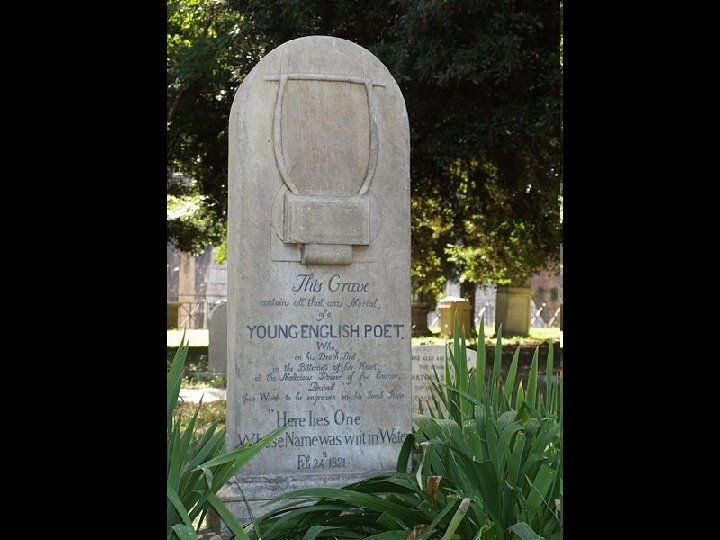
John Keats 1795 1821 Negative Capability several things
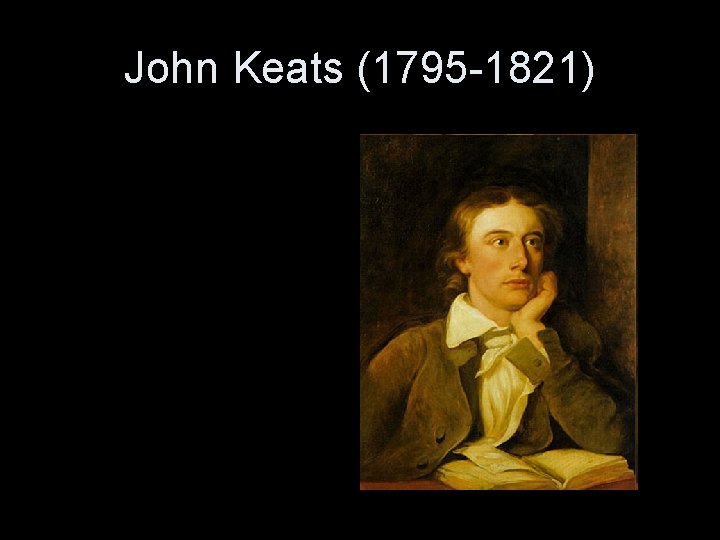
John Keats (1795 -1821)
Negative Capability “. . . several things dove-tailed in my mind, and at once it struck me what quality went to form a Man of Achievement, especially in Literature, and which Shakespeare possessed so enormously - I mean Negative Capability, that is, when a man is capable of being in uncertainties, mysteries, doubts, without any irritable reaching after fact and reason-. . . with a great poet the sense of Beauty overcomes every other consideration, or rather obliterates all consideration. " Letter to George and Tom Keats, 1817
Negative Capability "Now it is more noble to sit like Jove than to fly like Mercury - let us not therefore go hurrying about and collecting honey-bee like, buzzing here and there impatiently from a knowledge of what is to be arrived at: but let us open our leaves like a flower and be passive and receptive. . . I was led into these thoughts, my dear Reynolds, by the beauty of the morning operating on a sense of Idleness. " Letter to J. H. Reynolds, 1818

Nathan Starr, “Negative Capability in Keats’s Diction” To Keats (negative capability) came to be interpreted not as an injunction to content oneself merely with objectivity, in the literal sense – a condition not only too restrictive but virtually impossible for a man of Keats’s temperament. It meant rather a great expansion of experience, an identification with the wide area envisage by Shakespeare, and a determination to see the individual in its proper relation to this vast field, so that personal difficulties could be subordinated.
That this inevitably meant some surrender on the part of the individual goes without saying, but that was not the first consideration. This creed emphasized Keats’s concern with particulars outside himself, which inevitably caused a kind of tug-of-war between his inner and the outer world. His passion for the phenomena of experience, his extraordinary perception of sensuous delights, led him to a kind of universal kinship not only with all beauty, but even with the vividly active elements in experience. This resulted in an empathy quite extraordinary, of a degree and intensity scarcely ever equalled by an English poet. . . he says “I feel more and more every day, as my imagination strengthens, that I do not live in this world alone but in a thousands worlds. ”
He fount it impossible to be a negatively capable poet completely, to be a spectator only, for the world was constantly with him whether in the form of exquistie delights, or obsessive suffering. Keats: “I never can feel certain of any truth but from a clear perception of its Beauty. ”
I have clung To nothing, lov’d a nothing, nothing seen Or felt but a great dream! (“Endymion”) Pain had no sting, and pleasure’s wreath no flower: O, why did ye not melt, and leave my sense Unhaunted quite of all but nothingness? (“Ode on Indolence”)
- Slides: 9