
John F Kennedy Space Center EXPENDABLE LAUNCH VEHICLES
John F. Kennedy Space Center EXPENDABLE LAUNCH VEHICLES Mission Assurance Forum March 2001 Mission Assurance Forum - NASA/KSC ELV Launch Services
Agenda John F. Kennedy Space Center • • • March 2001 EXPENDABLE LAUNCH VEHICLES Organization Mission Integration Teams Manifest Launch Vehicle Certification Insight & Approval – Engineering Review Process – Engineering Review Board – Flight Anomaly Resolution – Mission Analysis – Verification Process – Resident Offices – Reviews Safety & Flight Assurance and Risk Management Launch Readiness Reviews Launch Operations Lessons Learned Process Mission Assurance Forum - NASA/KSC ELV Launch Services 2
John F. Kennedy Space Center EXPENDABLE LAUNCH VEHICLES Organization March 2001 Mission Assurance Forum - NASA/KSC ELV Launch Services 3
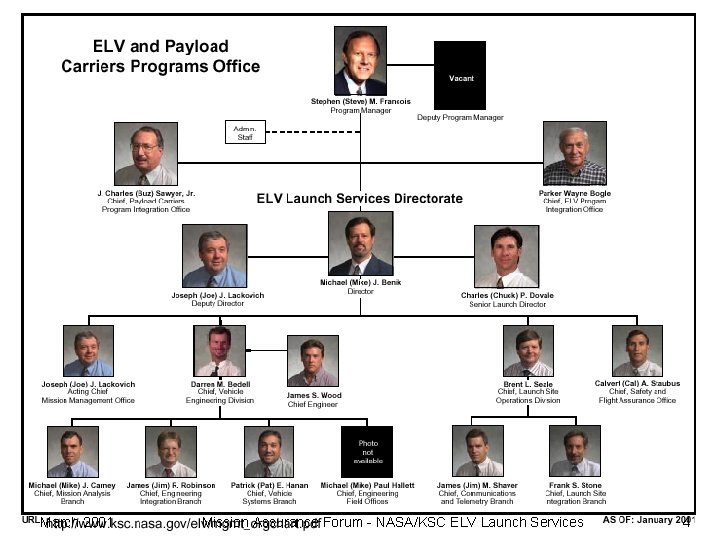
March 2001 Mission Assurance Forum - NASA/KSC ELV Launch Services 4
John F. Kennedy Space Center EXPENDABLE LAUNCH VEHICLES Mission Integration Teams March 2001 Mission Assurance Forum - NASA/KSC ELV Launch Services 5
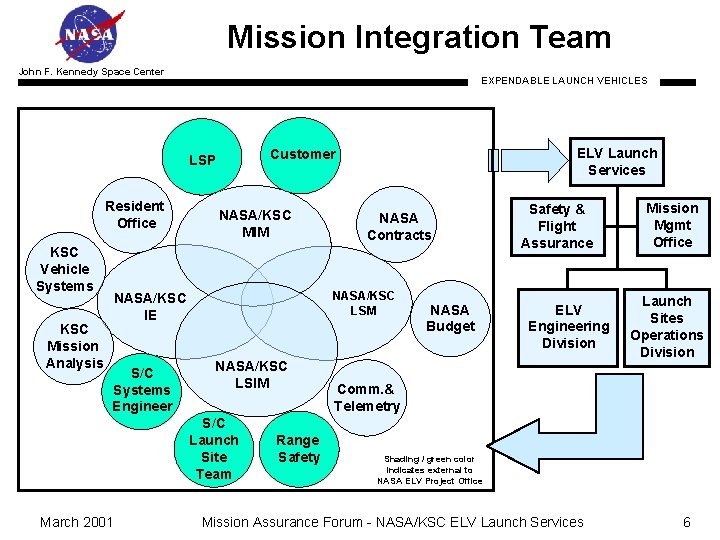
Mission Integration Team John F. Kennedy Space Center EXPENDABLE LAUNCH VEHICLES Resident Office KSC Vehicle Systems KSC Mission Analysis NASA/KSC MIM NASA/KSC LSIM S/C Launch Site Team March 2001 NASA Contracts NASA/KSC LSM NASA/KSC IE S/C Systems Engineer ELV Launch Services Customer LSP Range Safety NASA Budget Safety & Flight Assurance ELV Engineering Division Mission Mgmt Office Launch Sites Operations Division Comm. & Telemetry Shading / green color indicates external to NASA ELV Project Office Mission Assurance Forum - NASA/KSC ELV Launch Services 6
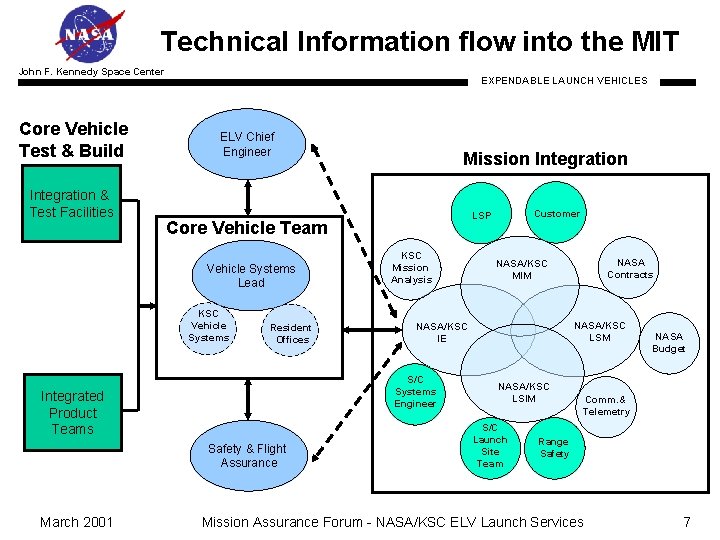
Technical Information flow into the MIT John F. Kennedy Space Center Core Vehicle Test & Build Integration & Test Facilities EXPENDABLE LAUNCH VEHICLES ELV Chief Engineer KSC Vehicle Systems Resident Offices KSC Mission Analysis Safety & Flight Assurance NASA Contracts NASA/KSC MIM NASA/KSC LSM NASA/KSC IE S/C Systems Engineer Integrated Product Teams Customer LSP Core Vehicle Team Vehicle Systems Lead March 2001 Mission Integration NASA/KSC LSIM S/C Launch Site Team NASA Budget Comm. & Telemetry Range Safety Mission Assurance Forum - NASA/KSC ELV Launch Services 7
John F. Kennedy Space Center EXPENDABLE LAUNCH VEHICLES Manifest March 2001 Mission Assurance Forum - NASA/KSC ELV Launch Services 8
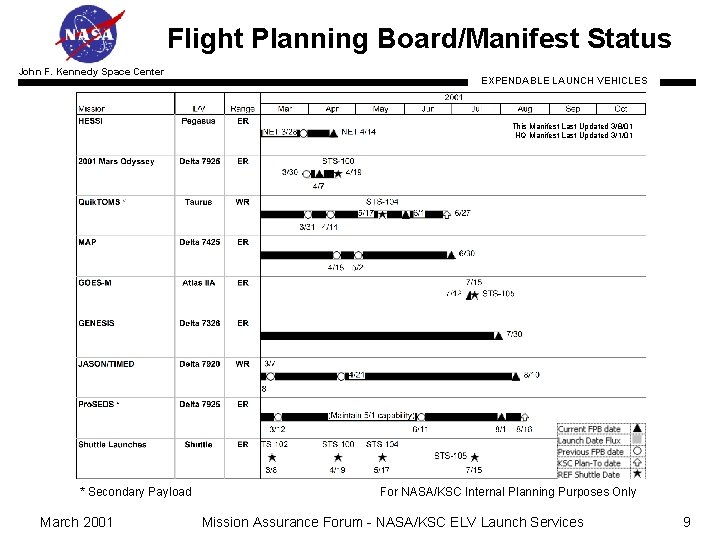
Flight Planning Board/Manifest Status John F. Kennedy Space Center EXPENDABLE LAUNCH VEHICLES This Manifest Last Updated 3/8/01 HQ Manifest Last Updated 3/1/01 * Secondary Payload March 2001 For NASA/KSC Internal Planning Purposes Only Mission Assurance Forum - NASA/KSC ELV Launch Services 9

Flight Planning Board/Manifest Status John F. Kennedy Space Center EXPENDABLE LAUNCH VEHICLES For NASA/KSC Internal Planning Purposes Only * Secondary Payload This Manifest Last Updated 3/8/01 HQ Manifest Last Updated 3/1/01 March 2001 Mission Assurance Forum - NASA/KSC ELV Launch Services 10
John F. Kennedy Space Center EXPENDABLE LAUNCH VEHICLES Launch Vehicle Certification Mission Assurance Forum - NASA/KSC ELV Launch Services
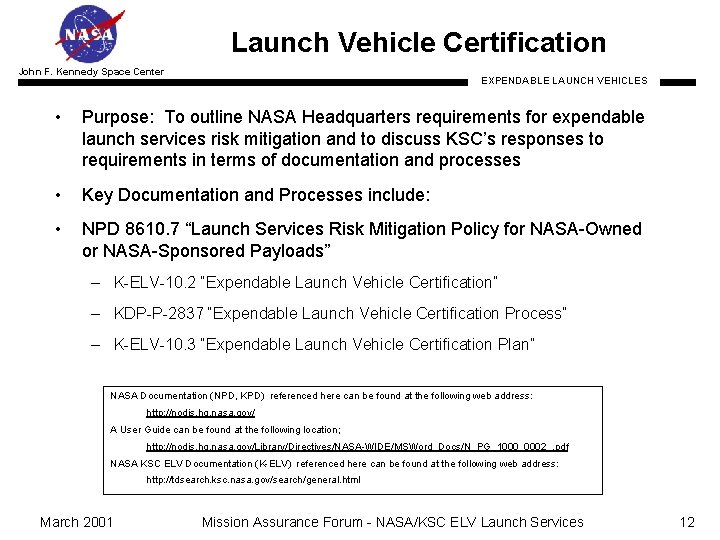
Launch Vehicle Certification John F. Kennedy Space Center EXPENDABLE LAUNCH VEHICLES • Purpose: To outline NASA Headquarters requirements for expendable launch services risk mitigation and to discuss KSC’s responses to requirements in terms of documentation and processes • Key Documentation and Processes include: • NPD 8610. 7 “Launch Services Risk Mitigation Policy for NASA-Owned or NASA-Sponsored Payloads” – K-ELV-10. 2 “Expendable Launch Vehicle Certification” – KDP-P-2837 “Expendable Launch Vehicle Certification Process” – K-ELV-10. 3 “Expendable Launch Vehicle Certification Plan” NASA Documentation (NPD, KPD) referenced here can be found at the following web address: http: //nodis. hq. nasa. gov/ A User Guide can be found at the following location; http: //nodis. hq. nasa. gov/Library/Directives/NASA-WIDE/MSWord_Docs/N_PG_1000_0002_. pdf NASA KSC ELV Documentation (K-ELV) referenced here can be found at the following web address: http: //tdsearch. ksc. nasa. gov/search/general. html March 2001 Mission Assurance Forum - NASA/KSC ELV Launch Services 12
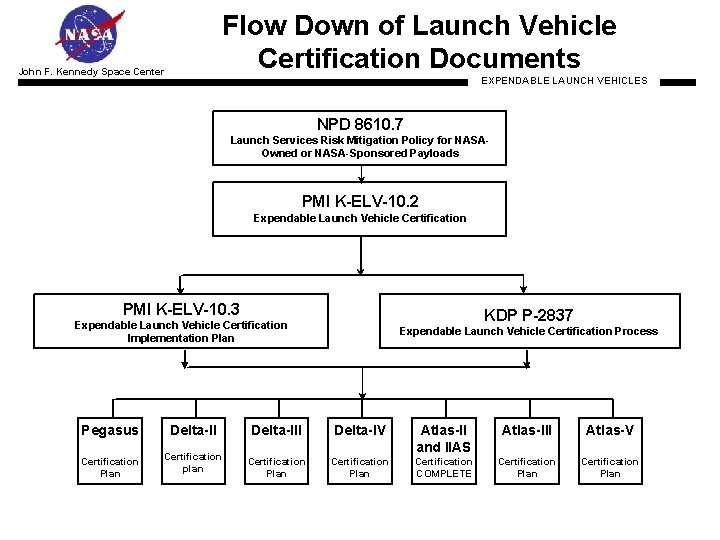
Flow Down of Launch Vehicle Certification Documents John F. Kennedy Space Center EXPENDABLE LAUNCH VEHICLES NPD 8610. 7 Launch Services Risk Mitigation Policy for NASAOwned or NASA-Sponsored Payloads PMI K-ELV-10. 2 Expendable Launch Vehicle Certification PMI K-ELV-10. 3 KDP P-2837 Expendable Launch Vehicle Certification Implementation Plan Expendable Launch Vehicle Certification Process Pegasus Delta-III Delta-IV Atlas-III Atlas-V Certification Plan Certification plan Atlas-II and IIAS Certification Plan Certification COMPLETE Certification Plan

NPD 8610. 7, “Launch Services Risk Mitigation Policy for NASA-Owned or NASA-Sponsored Payloads” John F. Kennedy Space Center • EXPENDABLE LAUNCH VEHICLES Requires U. S. launch services – Exceptions: » (1) Waiver by OSTP » (2) Foreign cooperative • Defines 3 categories of payloads: March 2001 Mission Assurance Forum - NASA/KSC ELV Launch Services 14

NASA ELV Certification Requirements John F. Kennedy Space Center EXPENDABLE LAUNCH VEHICLES NASA ELV CERTIFICATION REQUIREMENTS March 2001 Mission Assurance Forum - NASA/KSC ELV Launch Services 15
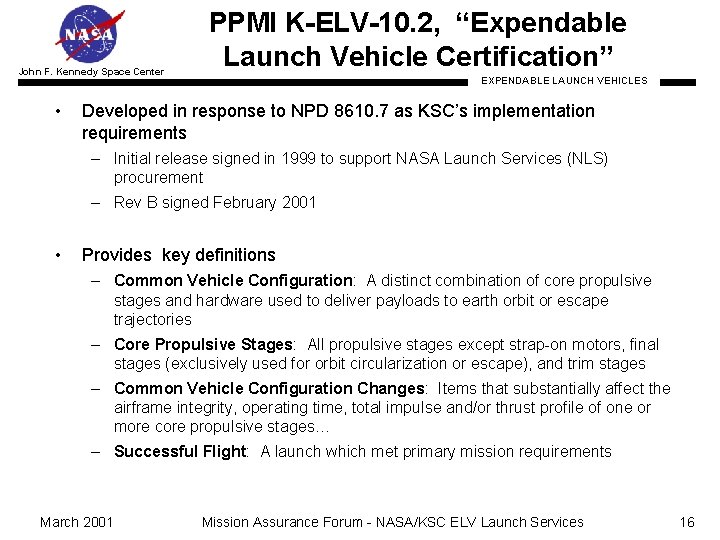
John F. Kennedy Space Center • PPMI K-ELV-10. 2, “Expendable Launch Vehicle Certification” EXPENDABLE LAUNCH VEHICLES Developed in response to NPD 8610. 7 as KSC’s implementation requirements – Initial release signed in 1999 to support NASA Launch Services (NLS) procurement – Rev B signed February 2001 • Provides key definitions – Common Vehicle Configuration: A distinct combination of core propulsive stages and hardware used to deliver payloads to earth orbit or escape trajectories – Core Propulsive Stages: All propulsive stages except strap-on motors, final stages (exclusively used for orbit circularization or escape), and trim stages – Common Vehicle Configuration Changes: Items that substantially affect the airframe integrity, operating time, total impulse and/or thrust profile of one or more core propulsive stages… – Successful Flight: A launch which met primary mission requirements March 2001 Mission Assurance Forum - NASA/KSC ELV Launch Services 16
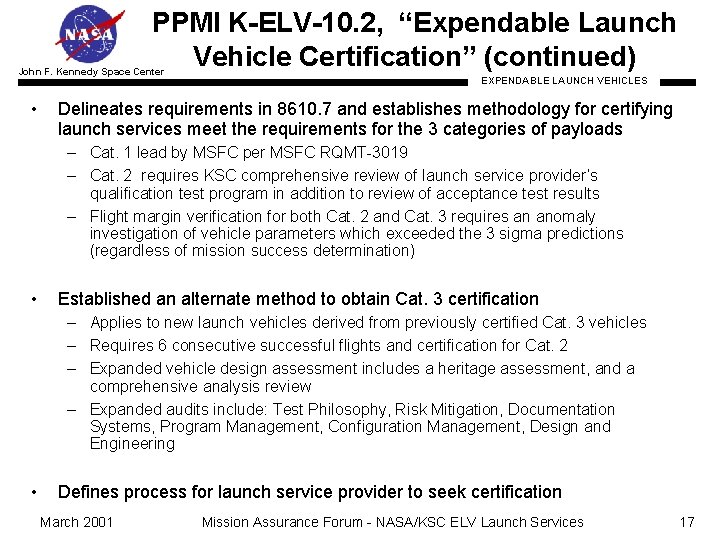
PPMI K-ELV-10. 2, “Expendable Launch Vehicle Certification” (continued) John F. Kennedy Space Center • EXPENDABLE LAUNCH VEHICLES Delineates requirements in 8610. 7 and establishes methodology for certifying launch services meet the requirements for the 3 categories of payloads – Cat. 1 lead by MSFC per MSFC RQMT-3019 – Cat. 2 requires KSC comprehensive review of launch service provider’s qualification test program in addition to review of acceptance test results – Flight margin verification for both Cat. 2 and Cat. 3 requires an anomaly investigation of vehicle parameters which exceeded the 3 sigma predictions (regardless of mission success determination) • Established an alternate method to obtain Cat. 3 certification – Applies to new launch vehicles derived from previously certified Cat. 3 vehicles – Requires 6 consecutive successful flights and certification for Cat. 2 – Expanded vehicle design assessment includes a heritage assessment, and a comprehensive analysis review – Expanded audits include: Test Philosophy, Risk Mitigation, Documentation Systems, Program Management, Configuration Management, Design and Engineering • Defines process for launch service provider to seek certification March 2001 Mission Assurance Forum - NASA/KSC ELV Launch Services 17
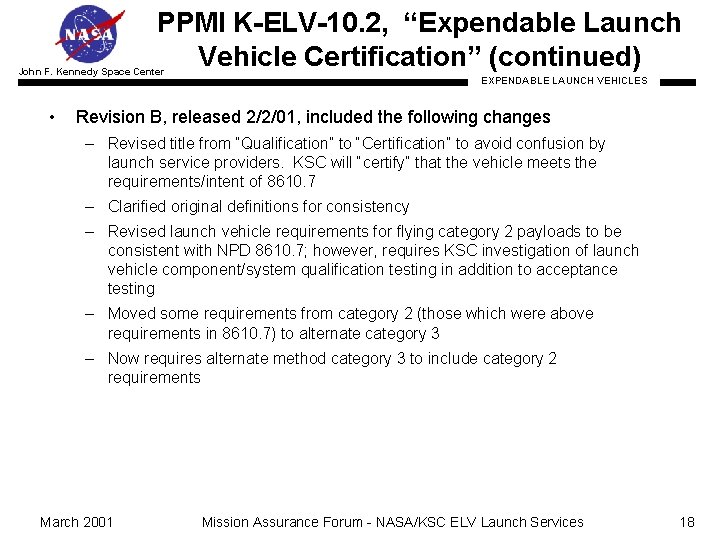
PPMI K-ELV-10. 2, “Expendable Launch Vehicle Certification” (continued) John F. Kennedy Space Center • EXPENDABLE LAUNCH VEHICLES Revision B, released 2/2/01, included the following changes – Revised title from “Qualification” to “Certification” to avoid confusion by launch service providers. KSC will “certify” that the vehicle meets the requirements/intent of 8610. 7 – Clarified original definitions for consistency – Revised launch vehicle requirements for flying category 2 payloads to be consistent with NPD 8610. 7; however, requires KSC investigation of launch vehicle component/system qualification testing in addition to acceptance testing – Moved some requirements from category 2 (those which were above requirements in 8610. 7) to alternate category 3 – Now requires alternate method category 3 to include category 2 requirements March 2001 Mission Assurance Forum - NASA/KSC ELV Launch Services 18
John F. Kennedy Space Center • KDP-P-2837, “ELV Launch Vehicle Certification Process” EXPENDABLE LAUNCH VEHICLES Further defines the process flow for certifying the launch vehicle – Utilizes existing ELV Project and Program decision forums • Establishes roles and responsibilities within KSC organization for completing certification process March 2001 Mission Assurance Forum - NASA/KSC ELV Launch Services 19
PPMI K-ELV-10. 3, “Expendable Launch Vehicle Certification Plan” John F. Kennedy Space Center EXPENDABLE LAUNCH VEHICLES • Recently developed - signature pending • Inclusive of 10. 2 requirements and KDP process, while providing engineering implementation details • Generic enough to apply to any launch vehicle undergoing 8610. 7 certification – Generically defines the LV data and documentation required to meet Cat. 2, 3, and alternate method 3 requirements – Refers to analysis and data products without regard to a launch service provider’s specific documentation – Further defines responsibilities within ELV Program for data review • Provides a phased approach and identifies relative timelines to implement certification • Provides the baseline for developing LV specific plans as required March 2001 Mission Assurance Forum - NASA/KSC ELV Launch Services 20
Launch Vehicle Certification Plans John F. Kennedy Space Center • EXPENDABLE LAUNCH VEHICLES A specific Launch Vehicle Certification Plan will be generated for each vehicle undergoing Cat. 2 or 3 certification – Will reference launch service provider specific documentation nomenclature – Will include planning schedule based on current development/flight status of the launch vehicle under consideration – Will consider uniqueness of launch vehicle under consideration • KSC Engineering intends to bring elements of the certification effort to the Engineering Review Board “as we go” – Will facilitate manageable work elements – Provides interested parties visibility into the progress of the certification effort March 2001 Mission Assurance Forum - NASA/KSC ELV Launch Services 21
Launch Vehicle Certification Today John F. Kennedy Space Center • EXPENDABLE LAUNCH VEHICLES ELV Program has received three requests for Cat. 3 vehicle qualification: – Lockheed Martin for Atlas II – Boeing for Delta II – Orbital for Pegasus XL • In response, KSC has/is applying the K-ELV-10. 2 Program Management Instruction, and the KDP-P-2837 process – Review vehicle hardware configuration – Verify ISO 9000 compliance – Perform flight margin verification for 14 consecutive successful launches • To date, the Program has granted certification to: – Lockheed Martin for Atlas II series – Boeing for Delta 792 x series – Boeing 732 x and 742 x series in work – Orbital Pegasus effort to be initiated • KSC Engineering is working on specific certification plans for Atlas III/V, and Delta III/IV March 2001 Mission Assurance Forum - NASA/KSC ELV Launch Services 22
Summary John F. Kennedy Space Center EXPENDABLE LAUNCH VEHICLES KSC Goals for Launch Vehicle Certification • Meet intent of NASA Headquarters requirements in NPD 8710. 7 – “launch services acquisition strategy shall seek to balance mission risk with launch vehicle demonstrated flight history and maturity” – Recognize that absolute compliance may not be achievable for fleets in development or other emerging vehicles » Alternate method for category 3 establishes additional requirements to balance the risk of having less than 14 consecutive successful flights » Create the ability to quantify the extent to which the vehicle meets the certification requirements » Determine the extent of the risk to be managed or accepted • Provide a documented process – Traceability • Provide a consistent process – Assure no appearance of favoritism March 2001 Mission Assurance Forum - NASA/KSC ELV Launch Services 23
John F. Kennedy Space Center EXPENDABLE LAUNCH VEHICLES Insight & Approval March 2001 Mission Assurance Forum - NASA/KSC ELV Launch Services 24
Insight and Approval John F. Kennedy Space Center EXPENDABLE LAUNCH VEHICLES • Purpose: To outline NASA Headquarters requirements for Launch Vehicle Technical Oversight and to discuss KSC’s responses to the requirements in terms of documentation and processes • Key documentation and processes include: – NPD 8610. 7 – K-ELV-10. 1 – K-ELV-02. 6 March 2001 “Technical Oversight of ELV Launch Services” “Implementation of NASA’s Insight and Approval Role for Expendable Launch Vehicle Services” “Engineering Review Process” Mission Assurance Forum - NASA/KSC ELV Launch Services 25
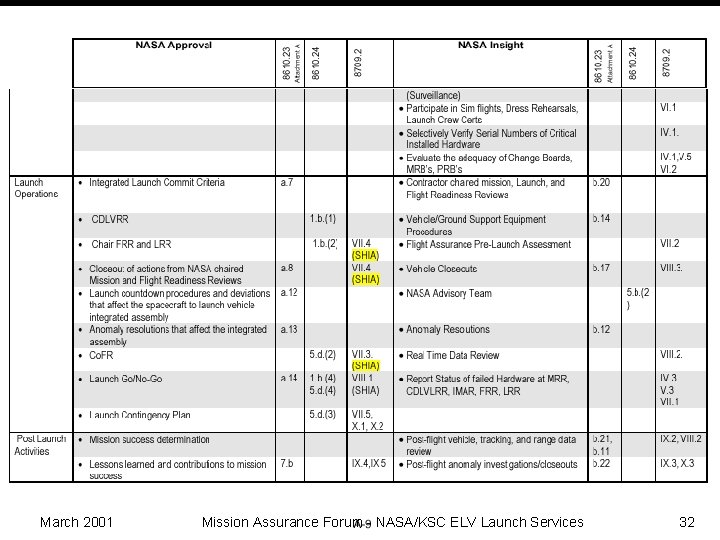
NPD 8610. 23 John F. Kennedy Space Center • EXPENDABLE LAUNCH VEHICLES NASA's technical oversight approach seeks to ensure the highest practicable probability of launch success by involvement in, and control of, the launch through technical oversight – Technical oversight- combination of focused approvals and technical insight of contractor launch activities – Insight-acquiring knowledge and understanding of contractor’s actions by monitoring of selected metrics and/or milestones through watchful observation, documentation review, meeting attendance, reviews, tests, and compliance evaluations. – Approval-providing the contractor authority to proceed and/or formal acceptance of requirements, plans, tests, or success criteria in specified areas • NASA retains the right to nonconcur with the contractor’s proposed actions based on knowledge obtained through insight • Policy applies to all NASA managed launches. Launches identified at the Flight Planning Board as able to tolerate higher risk may utilize a modified technical oversight approach March 2001 Mission Assurance Forum - NASA/KSC ELV Launch Services 26
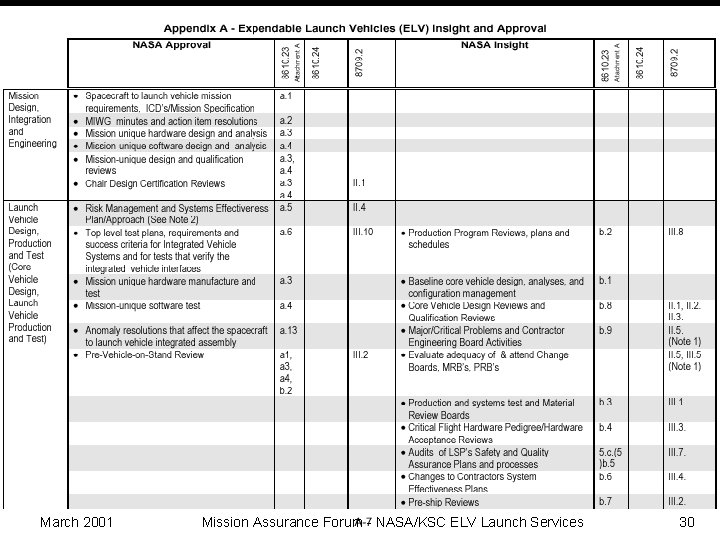
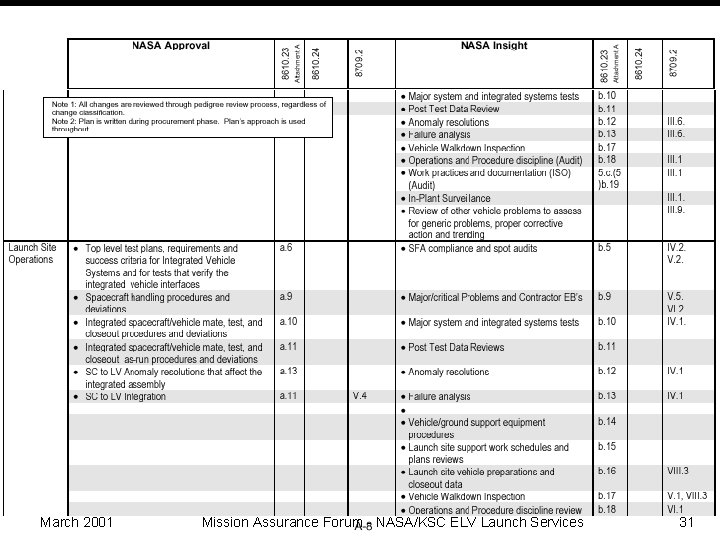
NPD 8610. 23 John F. Kennedy Space Center • EXPENDABLE LAUNCH VEHICLES Specific areas requiring government approval is focused on the interface with the spacecraft – – – – S/C to LV ICD’s documents and drawings Resolution/closeout of MIWG, MRR and FRR action items Mission unique hardware/software design, analysis, manufacture, and test Top level test plans, requirements, and success criteria for Integrated Vehicle Systems and for tests that verify the integrated vehicle interfaces Spacecraft handling procedures and deviations Integrated S/C to LV mate, test and closeout procedures, as run procedures and deviations Anomaly resolutions that affect the integrated S/C to LV assembly Launch commit criteria and Launch Go/No-Go March 2001 Mission Assurance Forum - NASA/KSC ELV Launch Services 27
NPD 8610. 23 John F. Kennedy Space Center • EXPENDABLE LAUNCH VEHICLES Specific areas open to government insight are widespread – Baseline vehicle design, analyses, and configuration management – Production, including reviews, plans, schedules, tests, post test data and MRB’s, Critical flight hardware pedigree – Major system and integrated systems tests – Post test data, anomaly resolution/closeout, failure analysis, – Launch site schedules, plans, vehicle preparation, closeout data, walkdowns, operations and procedure discipline – Post launch data and anomaly investigations/closeouts March 2001 Mission Assurance Forum - NASA/KSC ELV Launch Services 28
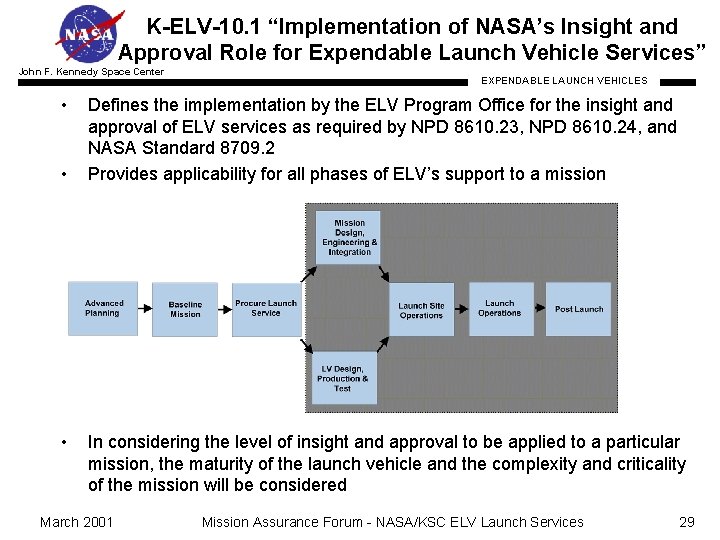
K-ELV-10. 1 “Implementation of NASA’s Insight and Approval Role for Expendable Launch Vehicle Services” John F. Kennedy Space Center • • • EXPENDABLE LAUNCH VEHICLES Defines the implementation by the ELV Program Office for the insight and approval of ELV services as required by NPD 8610. 23, NPD 8610. 24, and NASA Standard 8709. 2 Provides applicability for all phases of ELV’s support to a mission In considering the level of insight and approval to be applied to a particular mission, the maturity of the launch vehicle and the complexity and criticality of the mission will be considered March 2001 Mission Assurance Forum - NASA/KSC ELV Launch Services 29
March 2001 Mission Assurance Forum - NASA/KSC ELV Launch Services 30
March 2001 Mission Assurance Forum - NASA/KSC ELV Launch Services 31
March 2001 Mission Assurance Forum - NASA/KSC ELV Launch Services 32
K-ELV-10. 1 “Implementation of NASA’s Insight and Approval Role for Expendable Launch Vehicle Services” John F. Kennedy Space Center EXPENDABLE LAUNCH VEHICLES DEFINITIONS: • Audit: An independent review for the purpose of assessing compliance with hardware/software requirements, specifications, baselines, standards, procedures, instructions, codes, or contractual and licensing requirements. • Surveillance: The continual monitoring and verification of status of an entity and analysis of records to ensure that specified requirements are being met. Note: Surveillance can be performed in an insight, oversight, or a combined mode as determined by NASA using a risk-based decision process (NPG 8735. 2) March 2001 Mission Assurance Forum - NASA/KSC ELV Launch Services 33
VB-A 8 Engineering Field Offices Branch Chief, Mike Hallett (HB) Secretary, Carole Renfro (HB) Denver Manager Systems Mechanical Propulsion Electrical Huntington Beach Systems Electrical Mechanical Propulsion Integration Chandler Mechanical Pueblo Mechanical Electrical VAFB Mechanical Electrical Ground Software Vehicle Engineering Division VB-A Chief, Darren Bedell Chief Engineer, James Wood Mgr, Vehicle Enhancements Maria Littlefield Secretary, Patrice Thomas VB-A 4 VB-A 3 Mission Analysis Branch Chief, Mike Carney Flight Design Flight Software/Guidance Loads/Dynamics Dynamic Environments Controls and Stability Thermodynamics/aerodynamics Stress EMI Tool Development VB-A 7 Engineering Integration Branch Chief, Jim Robinson Vehicle Systems Branch Chief, Pat Hanan Vehicle System Leads Delta II, J. J. Joyner Atlas II, Dan Johnson Small Vehicles, Tom De. Laet Delta III/IV, Dave. Sollberger; Atlas IV/V, Doug Lindhorst GSE Mechanical Fluids Electronics & Power Ground Software Electrical Power GN&C RF and TM Instrumentation Mechanical Structures Pneumatics Ordnance Contamination Propulsion
John F. Kennedy Space Center EXPENDABLE LAUNCH VEHICLES Engineering Review Process K-ELV-02. 6 March 2001 Mission Assurance Forum - NASA/KSC ELV Launch Services 35
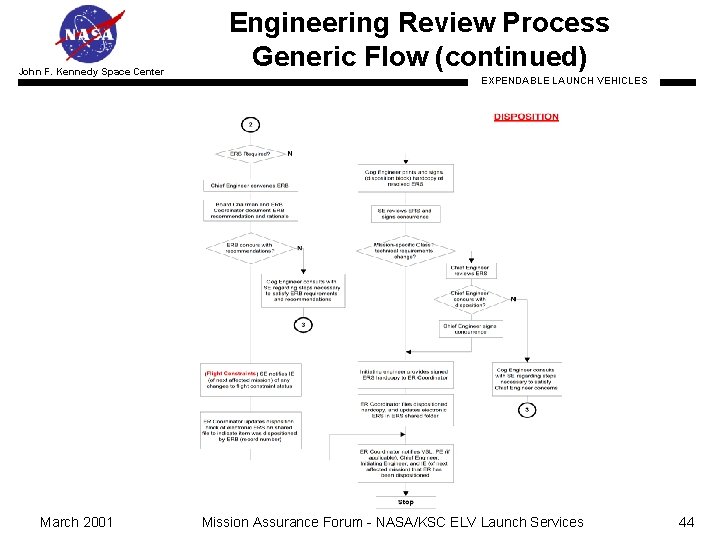
Engineering Review (ER) Process John F. Kennedy Space Center EXPENDABLE LAUNCH VEHICLES • Establishes criteria for documenting and evaluating certain technical issues that require engineering disposition • Process results in technical recommendations to the ELV Project • Rationale exclusively considers technical adequacy – Does not consider cost or schedule – Process goal is to establish a “technically adequate” solution, not the “best” solution – May consider multiple courses of action as required due to cost and schedule considerations and evaluate each independently on technical merit • Documented process released in Dec 2000 characterizes results of evolution since program consolidation in 1998, and adds near term improvements: – Engineering Review Sheet and database to facilitate issue documentation and information management – Additional attention to mission unique requirements – Tie between launch service provider design reviews and the Engineering Review Board March 2001 Mission Assurance Forum - NASA/KSC ELV Launch Services 36
ER Process Phases John F. Kennedy Space Center • EXPENDABLE LAUNCH VEHICLES Initiation – Acknowledge and document that an item requires engineering review • Resolution – Gather data to develop recommendations and rationale • Disposition – Senior engineers (or Engineering Review Board) concur with recommendations – Disposition becomes a project record, along with resolution history » Rationale and supporting data now captured for future reference March 2001 Mission Assurance Forum - NASA/KSC ELV Launch Services 37
Engineering Review Board John F. Kennedy Space Center • EXPENDABLE LAUNCH VEHICLES Engineering Review Board (ERB) is a NASA GRC/LMA-heritage tool adapted by KSC ELV following consolidation – Expanded by KSC ELV into a more-global process for engineering review – Used to disposition and provide technical reccomendations and rationale for a subset of engineering issues • ERB Membership – Chaired by ELV Chief Engineer » May designate alternate chair from permanent board membership – Permanent board membership consists of Engineering Division Chief and Branch Chiefs » Systems Engineering skills and a particular area of expertise required » Each permanent board member may designate an alternate as required March 2001 Mission Assurance Forum - NASA/KSC ELV Launch Services 38
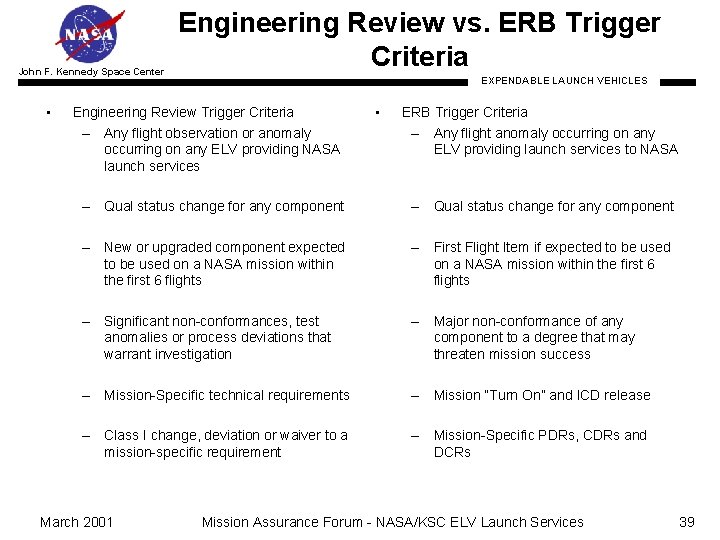
John F. Kennedy Space Center • Engineering Review vs. ERB Trigger Criteria EXPENDABLE LAUNCH VEHICLES Engineering Review Trigger Criteria – Any flight observation or anomaly occurring on any ELV providing NASA launch services • ERB Trigger Criteria – Any flight anomaly occurring on any ELV providing launch services to NASA – Qual status change for any component – New or upgraded component expected to be used on a NASA mission within the first 6 flights – First Flight Item if expected to be used on a NASA mission within the first 6 flights – Significant non-conformances, test anomalies or process deviations that warrant investigation – Major non-conformance of any component to a degree that may threaten mission success – Mission-Specific technical requirements – Mission “Turn On” and ICD release – Class I change, deviation or waiver to a mission-specific requirement – Mission-Specific PDRs, CDRs and DCRs March 2001 Mission Assurance Forum - NASA/KSC ELV Launch Services 39
ERB Reporting Path John F. Kennedy Space Center EXPENDABLE LAUNCH VEHICLES • Board chairman reports recommendations to ELV Engineering Division Chief and ELV Project Director • ELV Project Director dispositions recommendations – May require action by engineering, integration, program office, or any combination thereof • ERB recommendations are not technical direction to a contractor – Recommendations may be referenced in direction provided by a NASA Contracting Officer or Contracting Officer’s Technical Representative – Recommendations are provided to contractor for their insight to the NASA ERB process March 2001 Mission Assurance Forum - NASA/KSC ELV Launch Services 40
ERB Participation John F. Kennedy Space Center EXPENDABLE LAUNCH VEHICLES • NASA Vehicle Systems Lead and cognizant engineers are typically responsible for presentation of material • ERB is a completely open process – Launch Service Provider attendance always invited, either in person or by telecon » Visibility encourages higher quality » Purely engineering discussion needs no “government caucus” – Launch Service Provider representatives are free to ask questions and recommend actions • Launch Service Provider participation in an ERB is never interpreted to indicate contractor agreement with ERB recommendations – Preserves freedom of the team to achieve maximum benefit from technical interchange March 2001 Mission Assurance Forum - NASA/KSC ELV Launch Services 41
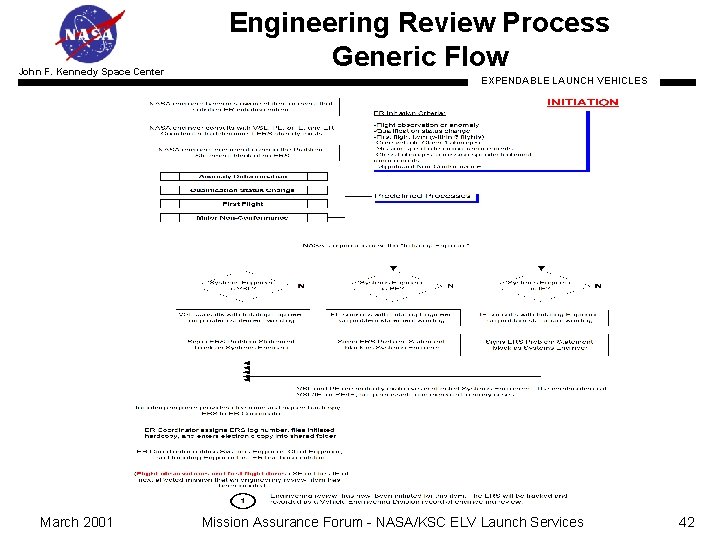
John F. Kennedy Space Center March 2001 Engineering Review Process Generic Flow EXPENDABLE LAUNCH VEHICLES Mission Assurance Forum - NASA/KSC ELV Launch Services 42
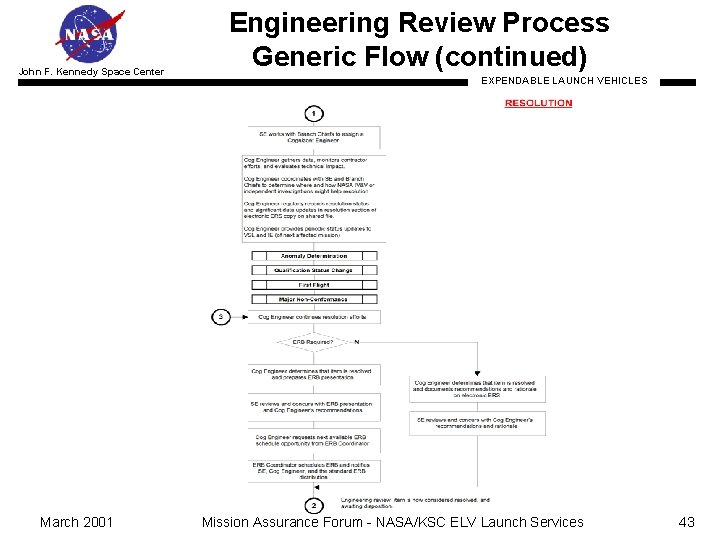
John F. Kennedy Space Center March 2001 Engineering Review Process Generic Flow (continued) EXPENDABLE LAUNCH VEHICLES Mission Assurance Forum - NASA/KSC ELV Launch Services 43
John F. Kennedy Space Center March 2001 Engineering Review Process Generic Flow (continued) EXPENDABLE LAUNCH VEHICLES Mission Assurance Forum - NASA/KSC ELV Launch Services 44
Flight Anomaly Resolution John F. Kennedy Space Center EXPENDABLE LAUNCH VEHICLES • NASA Anomaly Identification and Resolution Process is typical of a Launch Service Provider’ (LSP) Process • NASA identifies observations and anomalies by reviewing mission post-flight data, LSP post-flight reports, and normal insight practices and processes – Observation: An event occurring during vehicle flight that is unusual or unexpected » The ER Process will be initiated for all flight observations » An observation is not considered a launch constraint – Anomaly: A flight observation where concerns exist regarding the success of future missions » An anomaly is a launch constraint until dispositioned otherwise by an ERB • The determination whether a flight event is an observation or considered by NASA to be an anomaly is made by the NASA ELV Chief Engineer – NASA engineers and/or and Chief Engineer may or may not concur with a LSP’s determination – In practice, the ELV engineering rarely disputes the LSP Chief Engineer’s determination of observation versus anomaly March 2001 Mission Assurance Forum - NASA/KSC ELV Launch Services 45
Mission Analysis John F. Kennedy Space Center EXPENDABLE LAUNCH VEHICLES • Overall objective is to decrease mission risk thru review and verification of mission unique requirements/analyses and relevant fleet issues • Baseline approach is to review Launch Service Provider (LSP) analyses and documentation • Intend to obtain and/or develop launch vehicle models as practicable in all mission analyses areas – Philosophy is to get the models, learn to run the models, so we don’t always have to run the models – Detailed knowledge of models enables effective review of analyses – Models and enhanced systems knowledge will help solve technical issues in conjunction with the LSP – Use models for verification of critical mission unique requirements – Current status of model capability is a result of vehicle maturity and GSFC/GRC heritage March 2001 Mission Assurance Forum - NASA/KSC ELV Launch Services 46
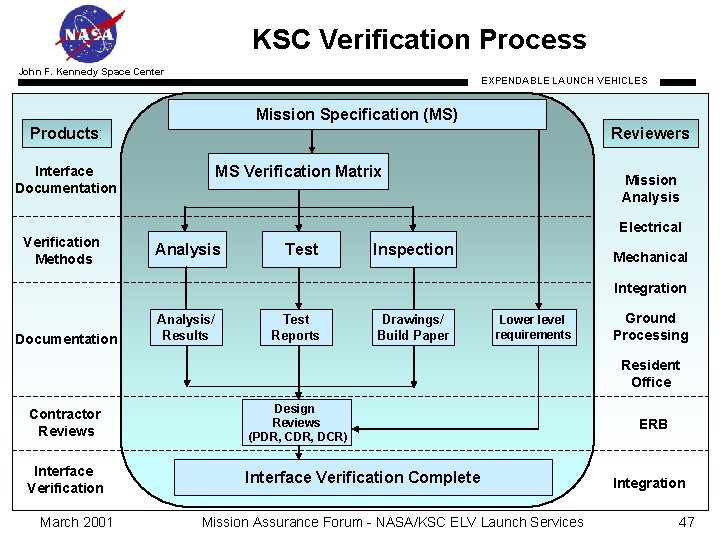
KSC Verification Process John F. Kennedy Space Center EXPENDABLE LAUNCH VEHICLES Mission Specification (MS) Products: Reviewers MS Verification Matrix Interface Documentation Verification Methods Mission Analysis Electrical Analysis Test Inspection Mechanical Integration Documentation Analysis/ Results Test Reports Drawings/ Build Paper Lower level requirements Ground Processing Resident Office Contractor Reviews Interface Verification March 2001 Design Reviews (PDR, CDR, DCR) Interface Verification Complete Mission Assurance Forum - NASA/KSC ELV Launch Services ERB Integration 47
Resident Offices John F. Kennedy Space Center EXPENDABLE LAUNCH VEHICLES • The Huntington Beach Office provides leadership and direction to the other offices, while focusing primarily on requirements, design engineering and integration issues • The Denver Resident Office focuses primarily on requirements, design engineering and integration issues • The Pueblo and Chandler Offices focus primarily on manufacturing and test issues and their resolution • Vandenberg focuses primarily on integration and launch issues. March 2001 Mission Assurance Forum - NASA/KSC ELV Launch Services 48
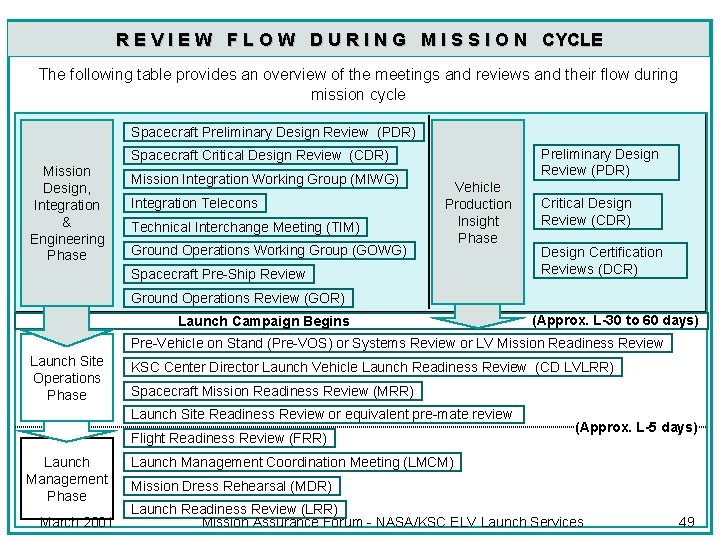
R E V I E W F L O W D U R I N G M I S S I O N CYCLE The following table provides an overview of the meetings and reviews and their flow during mission cycle Spacecraft Preliminary Design Review (PDR) Spacecraft Critical Design Review (CDR) Mission Design, Integration & Engineering Phase Mission Integration Working Group (MIWG) Integration Telecons Technical Interchange Meeting (TIM) Ground Operations Working Group (GOWG) Vehicle Production Insight Phase Spacecraft Pre-Ship Review Critical Design Review (CDR) Design Certification Reviews (DCR) Ground Operations Review (GOR) Launch Campaign Begins (Approx. L-30 to 60 days) Pre-Vehicle on Stand (Pre-VOS) or Systems Review or LV Mission Readiness Review Launch Site Operations Phase KSC Center Director Launch Vehicle Launch Readiness Review (CD LVLRR) Spacecraft Mission Readiness Review (MRR) Launch Site Readiness Review or equivalent pre-mate review Flight Readiness Review (FRR) Launch Management Phase March 2001 (Approx. L-5 days) Launch Management Coordination Meeting (LMCM) Mission Dress Rehearsal (MDR) Launch Readiness Review (LRR) Mission Assurance Forum - NASA/KSC ELV Launch Services 49
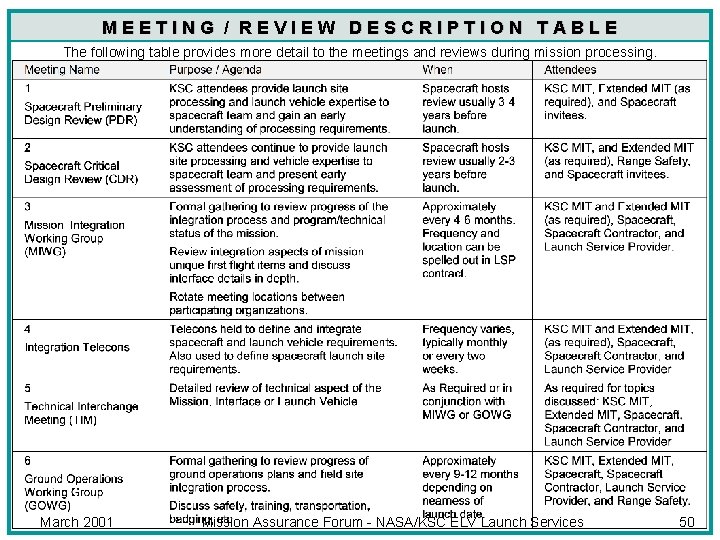
MEETING / REVIEW DESCRIPTION TABLE The following table provides more detail to the meetings and reviews during mission processing. March 2001 Mission Assurance Forum - NASA/KSC ELV Launch Services 50
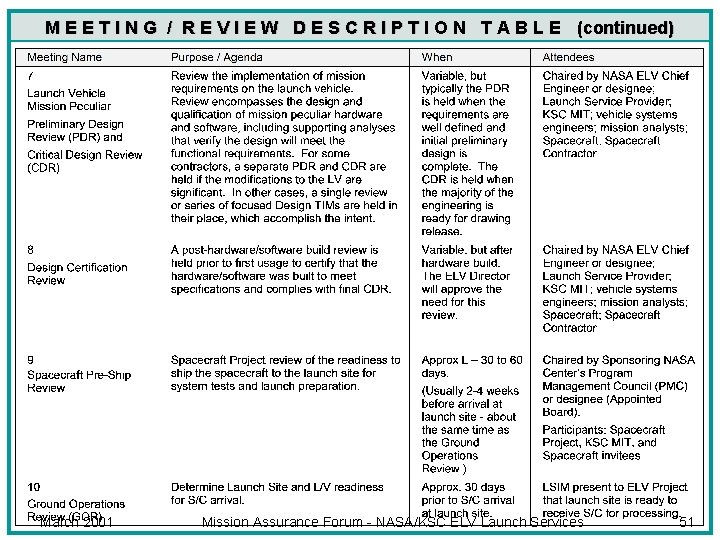
M E E T I N G / R E V I E W D E S C R I P T I O N T A B L E (continued) March 2001 Mission Assurance Forum - NASA/KSC ELV Launch Services 51
John F. Kennedy Space Center EXPENDABLE LAUNCH VEHICLES Safety & Flight Assurance and Risk Management March 2001 Mission Assurance Forum - NASA/KSC ELV Launch Services 52
SFAO Resources John F. Kennedy Space Center EXPENDABLE LAUNCH VEHICLES • Civil Service (11) • Contractor (8) • DCMA LODs (13, 000 hrs) • Strategically Located – Huntington Beach, CA Boeing Plant – Denver, CO LMA Plant – Chandler, AZ Orbital Plant – VAFB Western Range – CCAFS Eastern Range March 2001 Mission Assurance Forum - NASA/KSC ELV Launch Services 53
Roles And Responsibilities (Insight) John F. Kennedy Space Center EXPENDABLE LAUNCH VEHICLES • NASA STD 8709. 2 Safety & Mission Assurance Roles & Responsibilities for ELV Launch Services • Quality Assurance Quality Engineering, Reliability Engineering, surveillance, audits, process assessments, performance metrics, trend analysis, software assurance and numerous technical reviews. • Safety Assurance Industrial Safety & System Safety Engineering • Contingency Planning • Risk Management March 2001 Mission Assurance Forum - NASA/KSC ELV Launch Services 54
Roles And Responsibilities (continued) John F. Kennedy Space Center EXPENDABLE LAUNCH VEHICLES • Vehicle Assignments • Mission Assignments • Site Assignments • Developing Areas of Expertise • DCMA QAR March 2001 Mission Assurance Forum - NASA/KSC ELV Launch Services 55
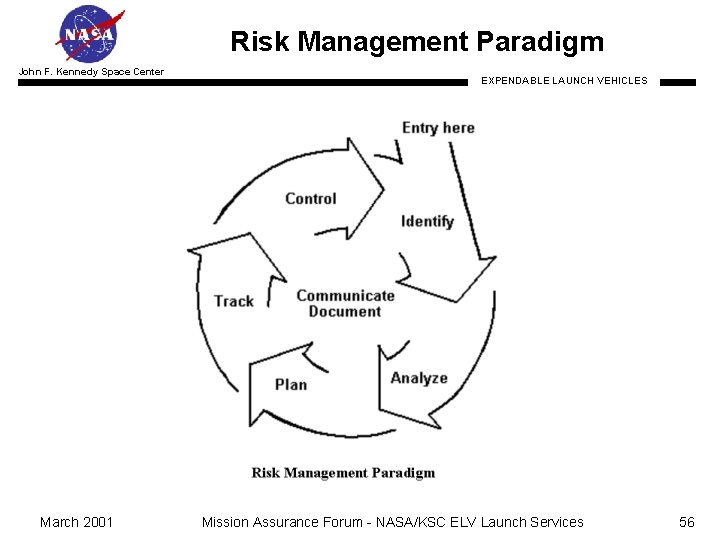
Risk Management Paradigm John F. Kennedy Space Center March 2001 EXPENDABLE LAUNCH VEHICLES Mission Assurance Forum - NASA/KSC ELV Launch Services 56
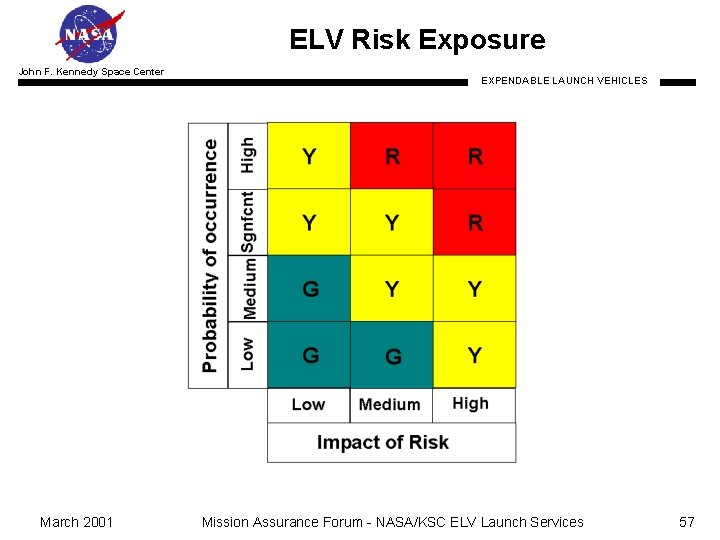
ELV Risk Exposure John F. Kennedy Space Center March 2001 EXPENDABLE LAUNCH VEHICLES Mission Assurance Forum - NASA/KSC ELV Launch Services 57
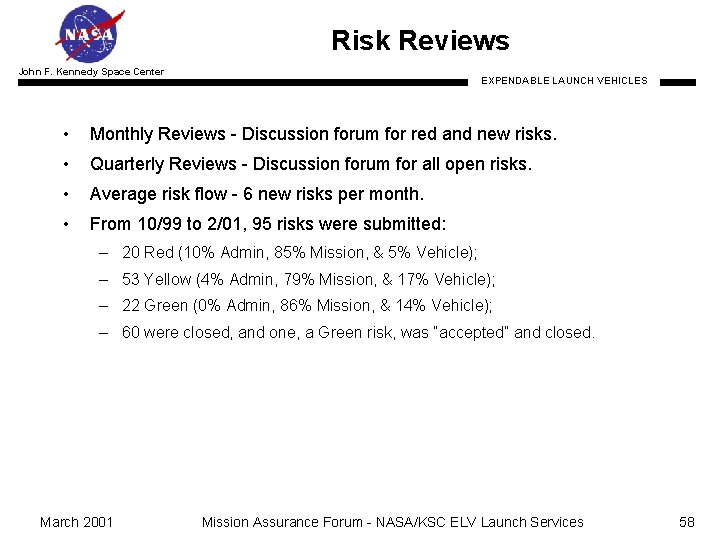
Risk Reviews John F. Kennedy Space Center EXPENDABLE LAUNCH VEHICLES • Monthly Reviews - Discussion forum for red and new risks. • Quarterly Reviews - Discussion forum for all open risks. • Average risk flow - 6 new risks per month. • From 10/99 to 2/01, 95 risks were submitted: – 20 Red (10% Admin, 85% Mission, & 5% Vehicle); – 53 Yellow (4% Admin, 79% Mission, & 17% Vehicle); – 22 Green (0% Admin, 86% Mission, & 14% Vehicle); – 60 were closed, and one, a Green risk, was “accepted” and closed. March 2001 Mission Assurance Forum - NASA/KSC ELV Launch Services 58
John F. Kennedy Space Center EXPENDABLE LAUNCH VEHICLES Launch Readiness Reviews March 2001 Mission Assurance Forum - NASA/KSC ELV Launch Services 59
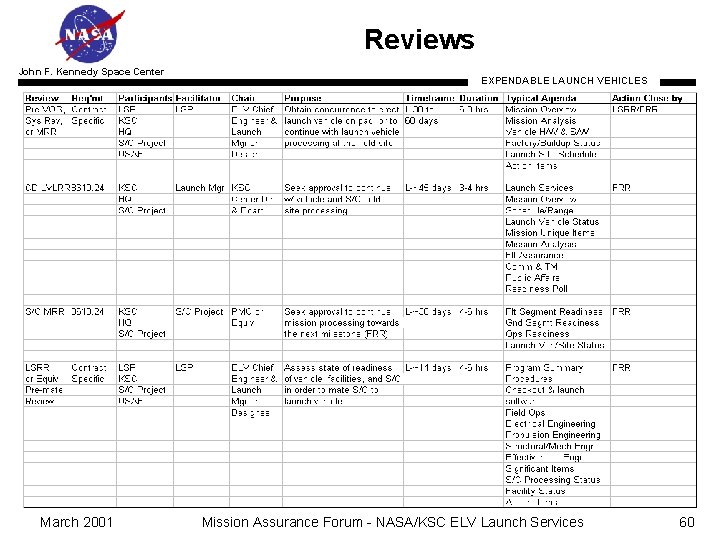
Reviews John F. Kennedy Space Center March 2001 EXPENDABLE LAUNCH VEHICLES Mission Assurance Forum - NASA/KSC ELV Launch Services 60
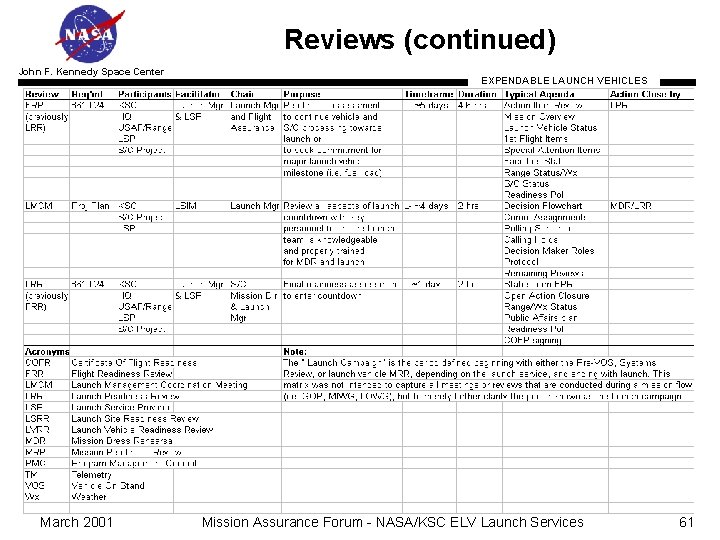
Reviews (continued) John F. Kennedy Space Center March 2001 EXPENDABLE LAUNCH VEHICLES Mission Assurance Forum - NASA/KSC ELV Launch Services 61
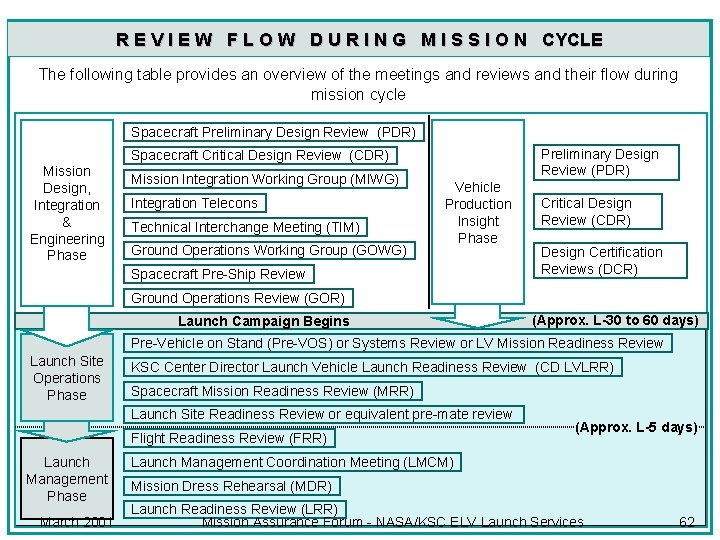
R E V I E W F L O W D U R I N G M I S S I O N CYCLE The following table provides an overview of the meetings and reviews and their flow during mission cycle Spacecraft Preliminary Design Review (PDR) Spacecraft Critical Design Review (CDR) Mission Design, Integration & Engineering Phase Mission Integration Working Group (MIWG) Integration Telecons Technical Interchange Meeting (TIM) Ground Operations Working Group (GOWG) Vehicle Production Insight Phase Spacecraft Pre-Ship Review Critical Design Review (CDR) Design Certification Reviews (DCR) Ground Operations Review (GOR) Launch Campaign Begins (Approx. L-30 to 60 days) Pre-Vehicle on Stand (Pre-VOS) or Systems Review or LV Mission Readiness Review Launch Site Operations Phase KSC Center Director Launch Vehicle Launch Readiness Review (CD LVLRR) Spacecraft Mission Readiness Review (MRR) Launch Site Readiness Review or equivalent pre-mate review Flight Readiness Review (FRR) Launch Management Phase March 2001 (Approx. L-5 days) Launch Management Coordination Meeting (LMCM) Mission Dress Rehearsal (MDR) Launch Readiness Review (LRR) Mission Assurance Forum - NASA/KSC ELV Launch Services 62
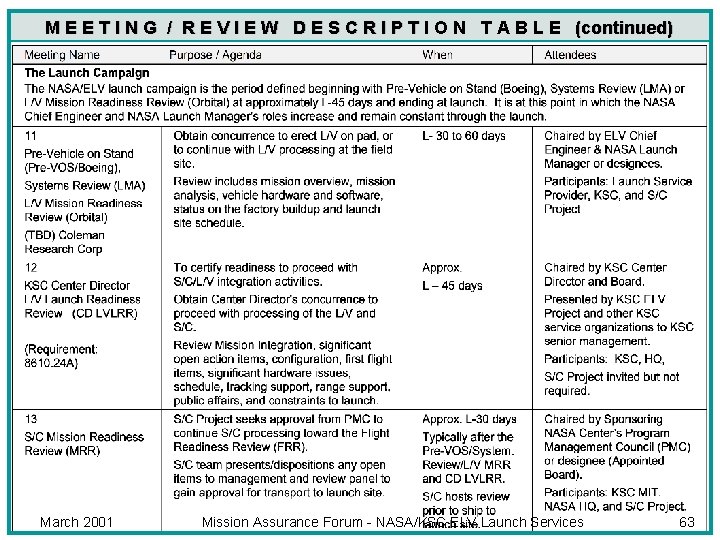
M E E T I N G / R E V I E W D E S C R I P T I O N T A B L E (continued) March 2001 Mission Assurance Forum - NASA/KSC ELV Launch Services 63
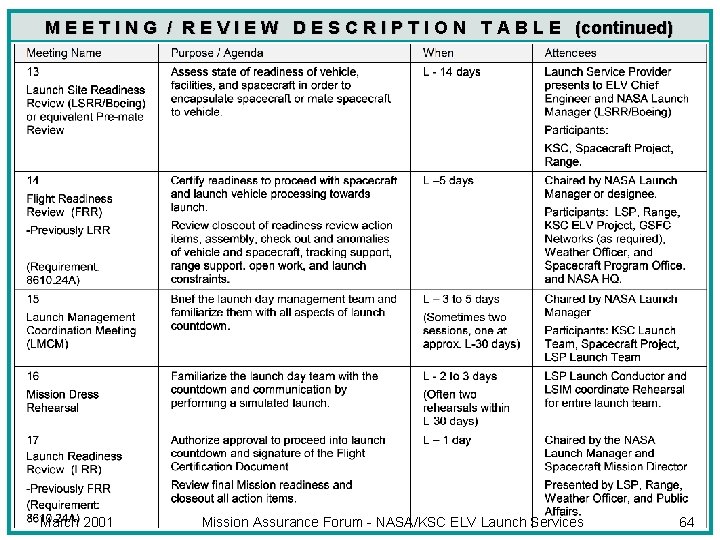
M E E T I N G / R E V I E W D E S C R I P T I O N T A B L E (continued) March 2001 Mission Assurance Forum - NASA/KSC ELV Launch Services 64
John F. Kennedy Space Center EXPENDABLE LAUNCH VEHICLES Launch Operations March 2001 Mission Assurance Forum - NASA/KSC ELV Launch Services 65
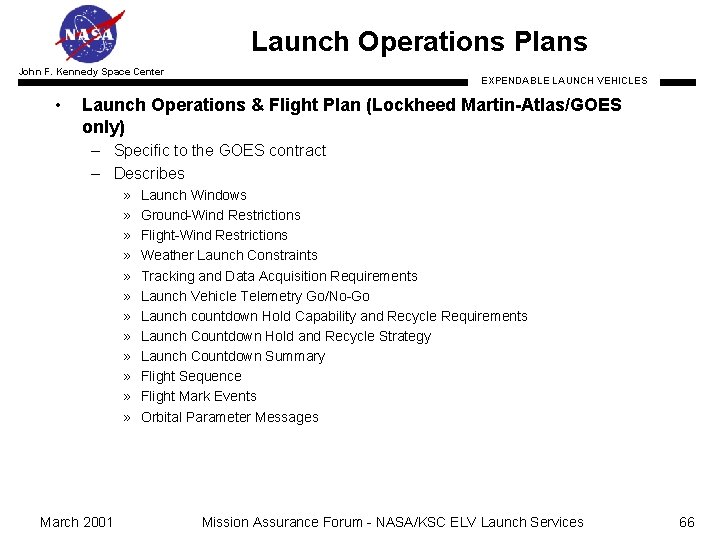
Launch Operations Plans John F. Kennedy Space Center • EXPENDABLE LAUNCH VEHICLES Launch Operations & Flight Plan (Lockheed Martin-Atlas/GOES only) – Specific to the GOES contract – Describes » » » March 2001 Launch Windows Ground-Wind Restrictions Flight-Wind Restrictions Weather Launch Constraints Tracking and Data Acquisition Requirements Launch Vehicle Telemetry Go/No-Go Launch countdown Hold Capability and Recycle Requirements Launch Countdown Hold and Recycle Strategy Launch Countdown Summary Flight Sequence Flight Mark Events Orbital Parameter Messages Mission Assurance Forum - NASA/KSC ELV Launch Services 66
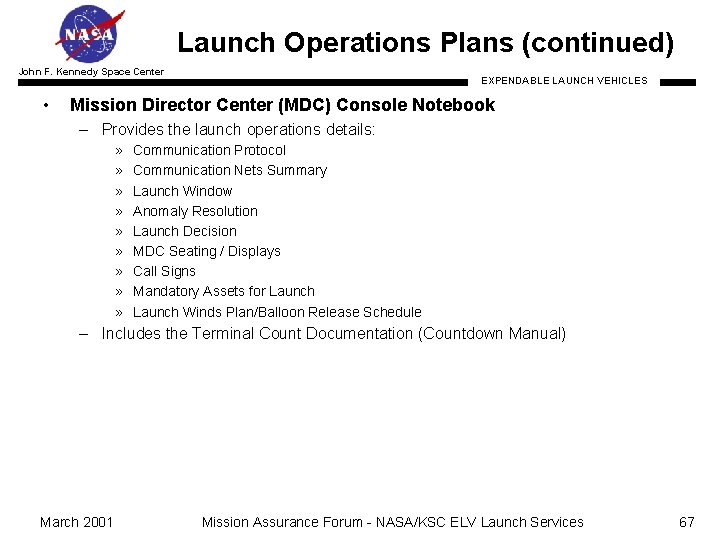
Launch Operations Plans (continued) John F. Kennedy Space Center • EXPENDABLE LAUNCH VEHICLES Mission Director Center (MDC) Console Notebook – Provides the launch operations details: » » » » » Communication Protocol Communication Nets Summary Launch Window Anomaly Resolution Launch Decision MDC Seating / Displays Call Signs Mandatory Assets for Launch Winds Plan/Balloon Release Schedule – Includes the Terminal Count Documentation (Countdown Manual) March 2001 Mission Assurance Forum - NASA/KSC ELV Launch Services 67
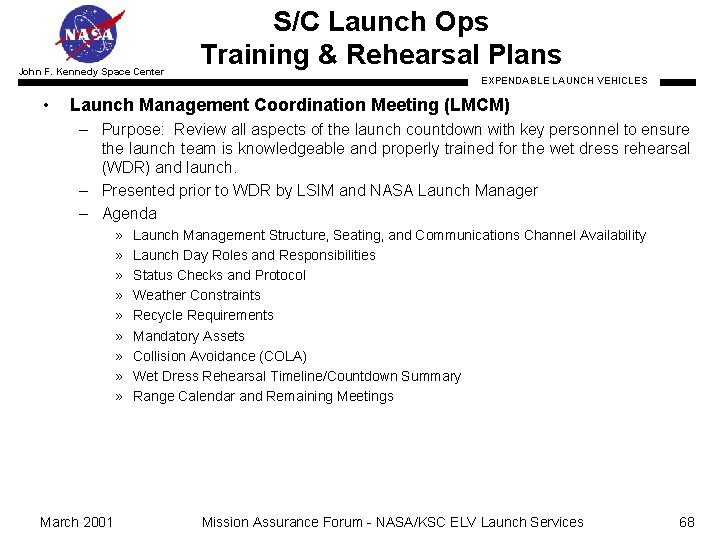
John F. Kennedy Space Center • S/C Launch Ops Training & Rehearsal Plans EXPENDABLE LAUNCH VEHICLES Launch Management Coordination Meeting (LMCM) – Purpose: Review all aspects of the launch countdown with key personnel to ensure the launch team is knowledgeable and properly trained for the wet dress rehearsal (WDR) and launch. – Presented prior to WDR by LSIM and NASA Launch Manager – Agenda » » » » » March 2001 Launch Management Structure, Seating, and Communications Channel Availability Launch Day Roles and Responsibilities Status Checks and Protocol Weather Constraints Recycle Requirements Mandatory Assets Collision Avoidance (COLA) Wet Dress Rehearsal Timeline/Countdown Summary Range Calendar and Remaining Meetings Mission Assurance Forum - NASA/KSC ELV Launch Services 68
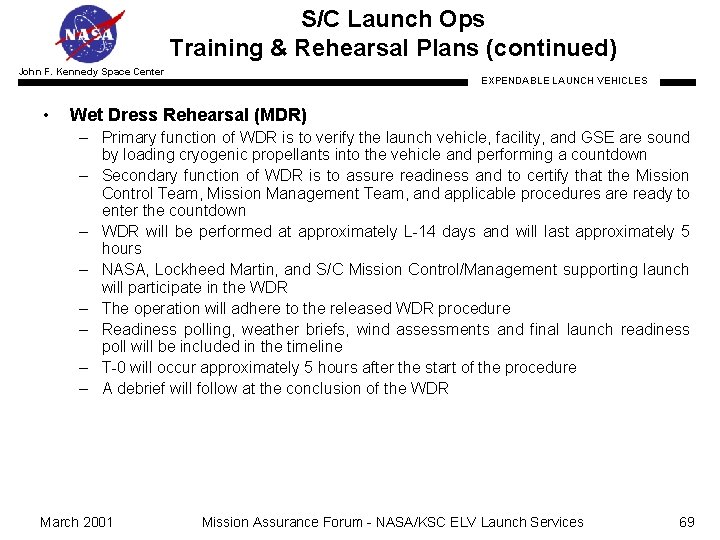
S/C Launch Ops Training & Rehearsal Plans (continued) John F. Kennedy Space Center • EXPENDABLE LAUNCH VEHICLES Wet Dress Rehearsal (MDR) – Primary function of WDR is to verify the launch vehicle, facility, and GSE are sound by loading cryogenic propellants into the vehicle and performing a countdown – Secondary function of WDR is to assure readiness and to certify that the Mission Control Team, Mission Management Team, and applicable procedures are ready to enter the countdown – WDR will be performed at approximately L-14 days and will last approximately 5 hours – NASA, Lockheed Martin, and S/C Mission Control/Management supporting launch will participate in the WDR – The operation will adhere to the released WDR procedure – Readiness polling, weather briefs, wind assessments and final launch readiness poll will be included in the timeline – T-0 will occur approximately 5 hours after the start of the procedure – A debrief will follow at the conclusion of the WDR March 2001 Mission Assurance Forum - NASA/KSC ELV Launch Services 69
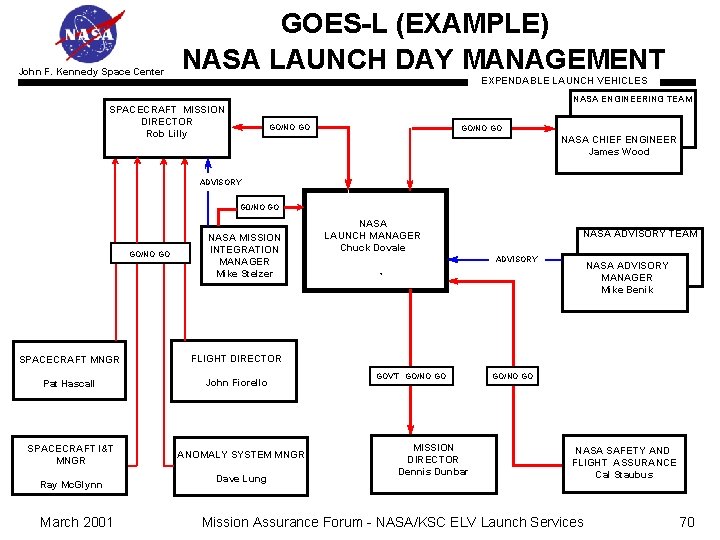
John F. Kennedy Space Center GOES-L (EXAMPLE) NASA LAUNCH DAY MANAGEMENT EXPENDABLE LAUNCH VEHICLES NASA ENGINEERING TEAM SPACECRAFT MISSION DIRECTOR Rob Lilly GO/NO GO NASA CHIEF ENGINEER James Wood ADVISORY G 0/NO GO GO/NO GO NASA MISSION INTEGRATION MANAGER Mike Stelzer SPACECRAFT MNGR FLIGHT DIRECTOR Pat Hascall John Fiorello SPACECRAFT I&T MNGR Ray Mc. Glynn March 2001 ANOMALY SYSTEM MNGR Dave Lung NASA LAUNCH MANAGER Chuck Dovale NASA ADVISORY TEAM ADVISORY GOV’T GO/NO GO MISSION DIRECTOR Dennis Dunbar NASA ADVISORY MANAGER Mike Benik GO/NO GO NASA SAFETY AND FLIGHT ASSURANCE Cal Staubus Mission Assurance Forum - NASA/KSC ELV Launch Services 70
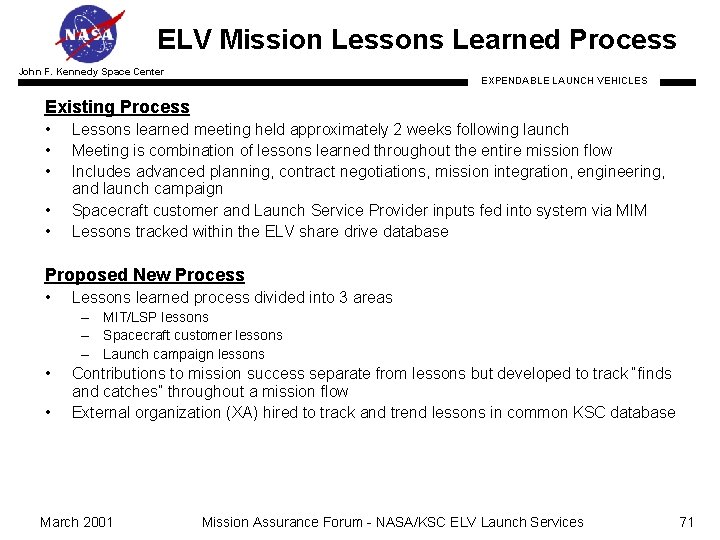
ELV Mission Lessons Learned Process John F. Kennedy Space Center EXPENDABLE LAUNCH VEHICLES Existing Process • • • Lessons learned meeting held approximately 2 weeks following launch Meeting is combination of lessons learned throughout the entire mission flow Includes advanced planning, contract negotiations, mission integration, engineering, and launch campaign Spacecraft customer and Launch Service Provider inputs fed into system via MIM Lessons tracked within the ELV share drive database Proposed New Process • Lessons learned process divided into 3 areas – MIT/LSP lessons – Spacecraft customer lessons – Launch campaign lessons • • Contributions to mission success separate from lessons but developed to track “finds and catches” throughout a mission flow External organization (XA) hired to track and trend lessons in common KSC database March 2001 Mission Assurance Forum - NASA/KSC ELV Launch Services 71
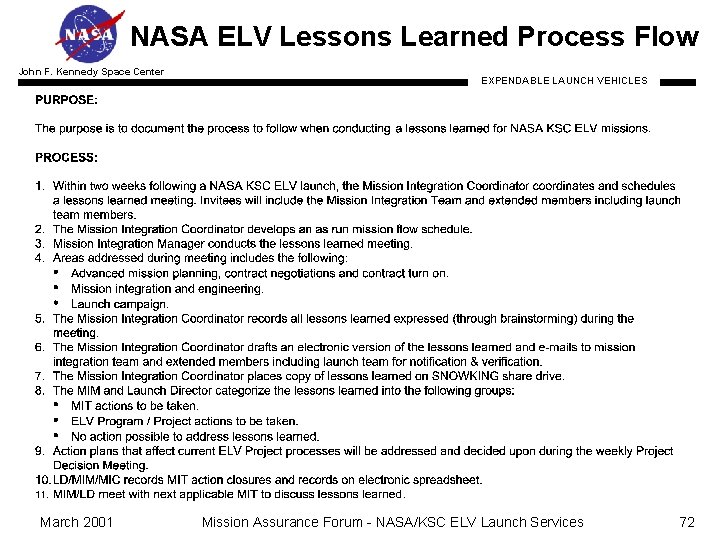
NASA ELV Lessons Learned Process Flow John F. Kennedy Space Center March 2001 EXPENDABLE LAUNCH VEHICLES Mission Assurance Forum - NASA/KSC ELV Launch Services 72
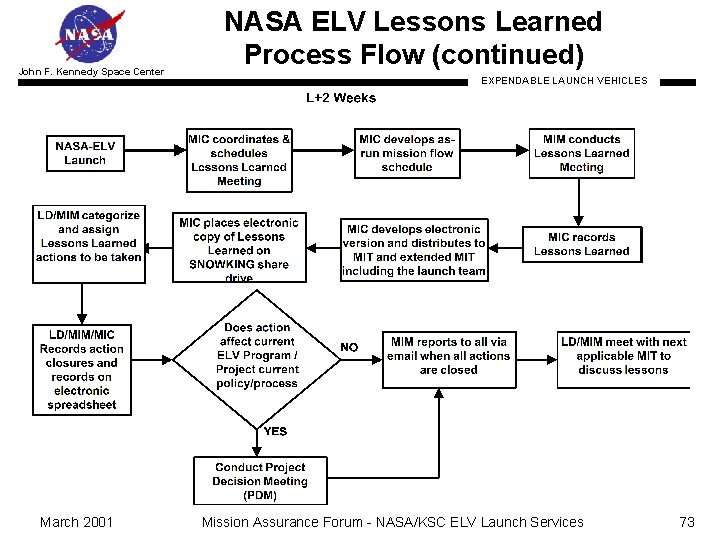
John F. Kennedy Space Center March 2001 NASA ELV Lessons Learned Process Flow (continued) EXPENDABLE LAUNCH VEHICLES Mission Assurance Forum - NASA/KSC ELV Launch Services 73
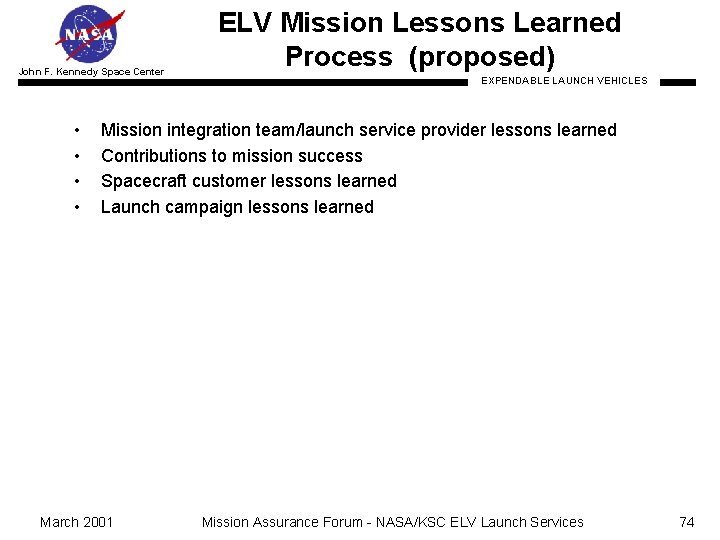
John F. Kennedy Space Center • • ELV Mission Lessons Learned Process (proposed) EXPENDABLE LAUNCH VEHICLES Mission integration team/launch service provider lessons learned Contributions to mission success Spacecraft customer lessons learned Launch campaign lessons learned March 2001 Mission Assurance Forum - NASA/KSC ELV Launch Services 74
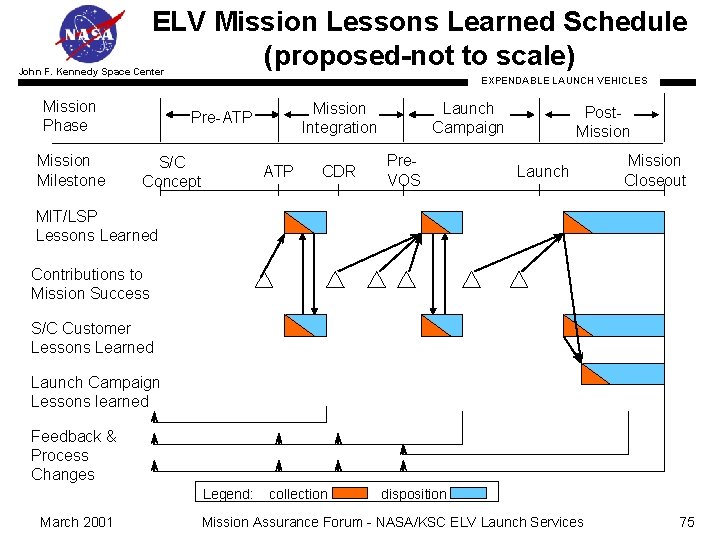
ELV Mission Lessons Learned Schedule (proposed-not to scale) John F. Kennedy Space Center Mission Phase Mission Milestone EXPENDABLE LAUNCH VEHICLES Mission Integration Pre-ATP S/C Concept ATP CDR Launch Campaign Pre. VOS Post. Mission Launch Mission Closeout MIT/LSP Lessons Learned Contributions to Mission Success S/C Customer Lessons Learned Launch Campaign Lessons learned Feedback & Process Changes Legend: March 2001 collection disposition Mission Assurance Forum - NASA/KSC ELV Launch Services 75
MIT/LSP Lessons Learned John F. Kennedy Space Center • • • EXPENDABLE LAUNCH VEHICLES Satisfies ELV Project requirement Lessons Learned collected after key milestones while findings are “fresh” Identifies and corrects constraints that affect the next phase of the mission Lessons Learned fed into database for analysis and disposition New knowledge fed back into process changes and future MITs March 2001 Mission Assurance Forum - NASA/KSC ELV Launch Services 76
Contributions to Mission Success John F. Kennedy Space Center • • • EXPENDABLE LAUNCH VEHICLES Satisfies requirement of NPD 8610. 23 Contributions collected throughout the mission Insight and Approval surveillance findings are dispositioned via the Engineering Review Process Mission-unique findings are collected with the MIT/LSP Lessons Learned All findings are fed into database for analysis and disposition March 2001 Mission Assurance Forum - NASA/KSC ELV Launch Services 77
Spacecraft Customer Lessons Learned John F. Kennedy Space Center • • • EXPENDABLE LAUNCH VEHICLES Satisfies requirement of NPD 7120. 4 for customer involvement Can be combined with MIT/LSP lessons or held separately, dependent on MIT Lessons learned fed into database for analysis and disposition March 2001 Mission Assurance Forum - NASA/KSC ELV Launch Services 78
Launch Campaign Lessons Learned John F. Kennedy Space Center • • • EXPENDABLE LAUNCH VEHICLES Satisfies requirement of NPD 8610. 24 Collects Launch Campaign-related Lessons Learned from other forums Identifies constraints to future launch campaigns March 2001 Mission Assurance Forum - NASA/KSC ELV Launch Services 79
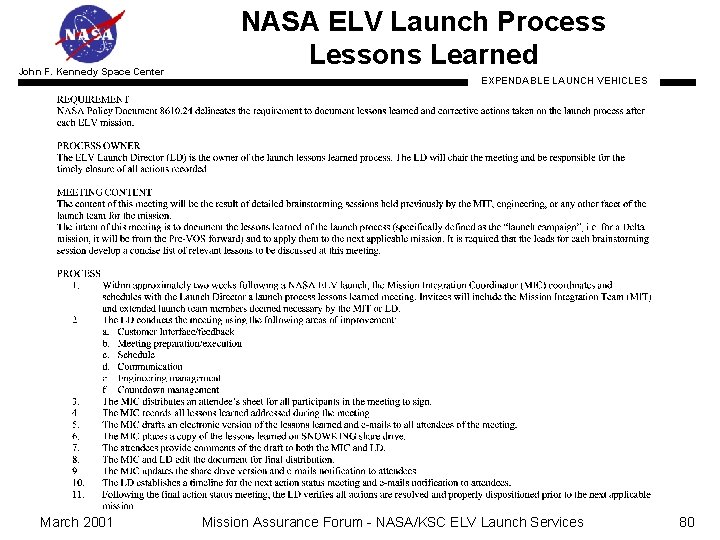
John F. Kennedy Space Center March 2001 NASA ELV Launch Process Lessons Learned EXPENDABLE LAUNCH VEHICLES Mission Assurance Forum - NASA/KSC ELV Launch Services 80
- Slides: 80