
John F Kennedy Foreign Affairs Election of 1960
![Kennedy Targets the Moon l “[We] commit … before this decade is out, to](https://slidetodoc.com/presentation_image_h2/900aadcb406bd88c3b7344c6d58e8fff/image-9.jpg "Kennedy Targets the Moon l “[We] commit … before this decade is out, to")
- Slides: 22
John F. Kennedy: Foreign Affairs
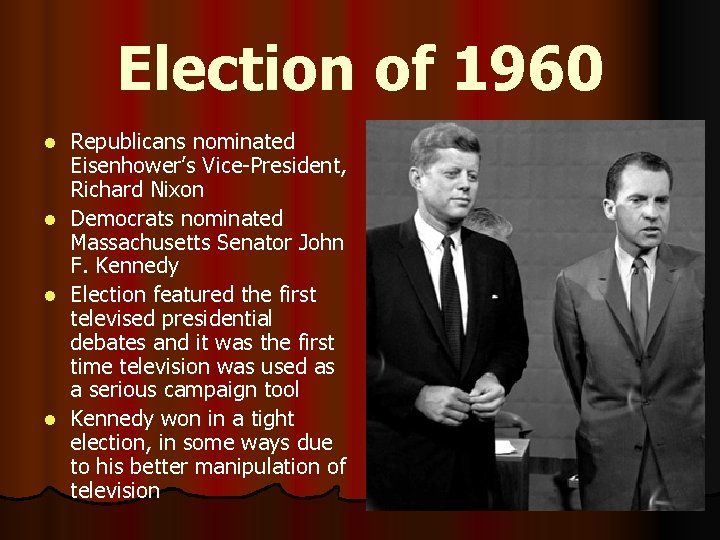
Election of 1960 Republicans nominated Eisenhower’s Vice-President, Richard Nixon l Democrats nominated Massachusetts Senator John F. Kennedy l Election featured the first televised presidential debates and it was the first time television was used as a serious campaign tool l Kennedy won in a tight election, in some ways due to his better manipulation of television l
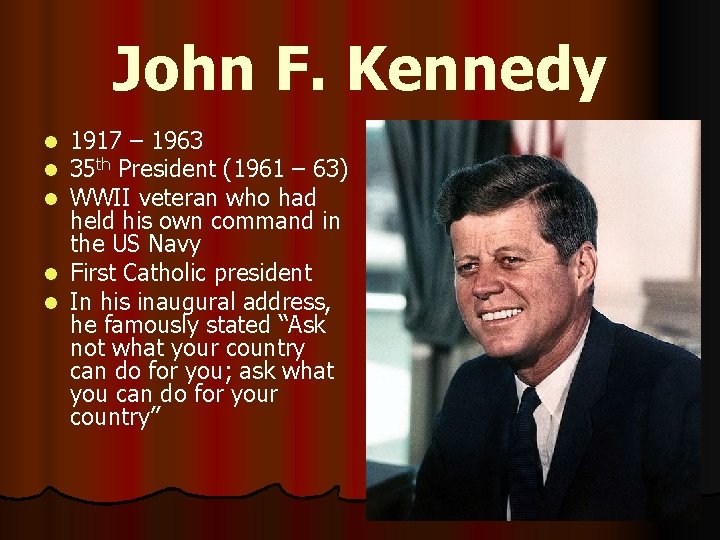
John F. Kennedy 1917 – 1963 35 th President (1961 – 63) WWII veteran who had held his own command in the US Navy l First Catholic president l In his inaugural address, he famously stated “Ask not what your country can do for you; ask what you can do for your country” l l l
The Peace Corps Created in 1961 Purpose is “To promote world peace and friendship … which shall make available to interested countries … men and women of the United States qualified for service abroad and willing to serve, under conditions of hardship if necessary, to help the peoples of such countries and areas in meeting their needs for trained manpower. ” l Since 1961, over 200, 000 college-educated American volunteers have served 2 -year commitments in foreign nations l l
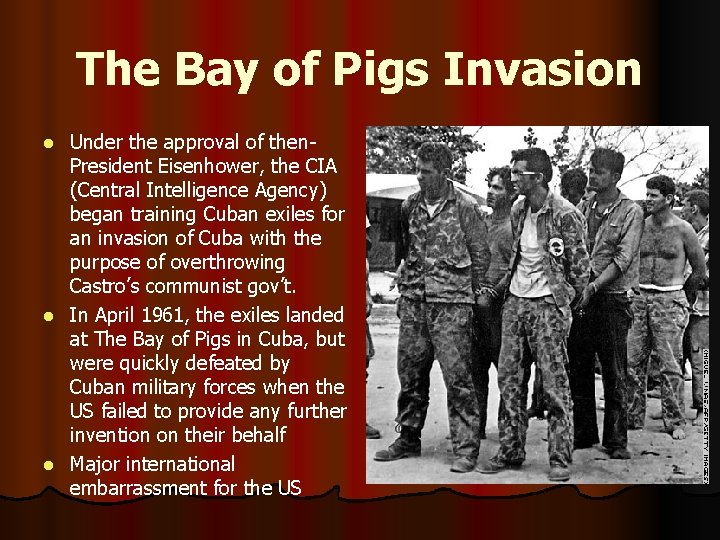
The Bay of Pigs Invasion Under the approval of then. President Eisenhower, the CIA (Central Intelligence Agency) began training Cuban exiles for an invasion of Cuba with the purpose of overthrowing Castro’s communist gov’t. l In April 1961, the exiles landed at The Bay of Pigs in Cuba, but were quickly defeated by Cuban military forces when the US failed to provide any further invention on their behalf l Major international embarrassment for the US l
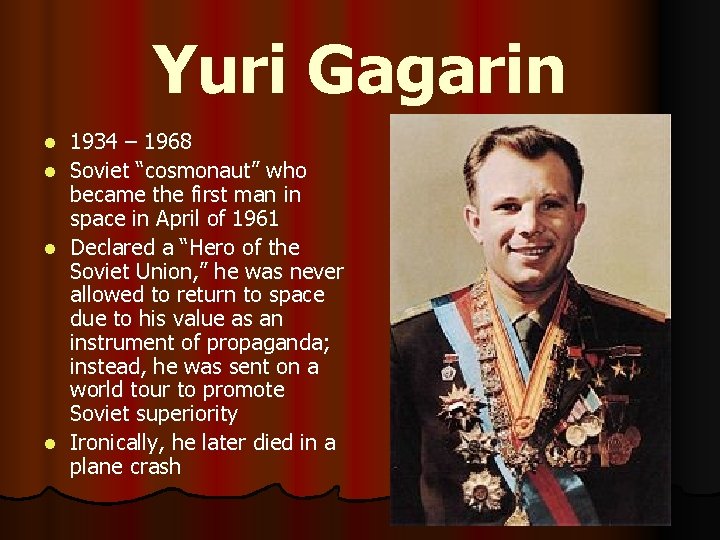
Yuri Gagarin 1934 – 1968 l Soviet “cosmonaut” who became the first man in space in April of 1961 l Declared a “Hero of the Soviet Union, ” he was never allowed to return to space due to his value as an instrument of propaganda; instead, he was sent on a world tour to promote Soviet superiority l Ironically, he later died in a plane crash l
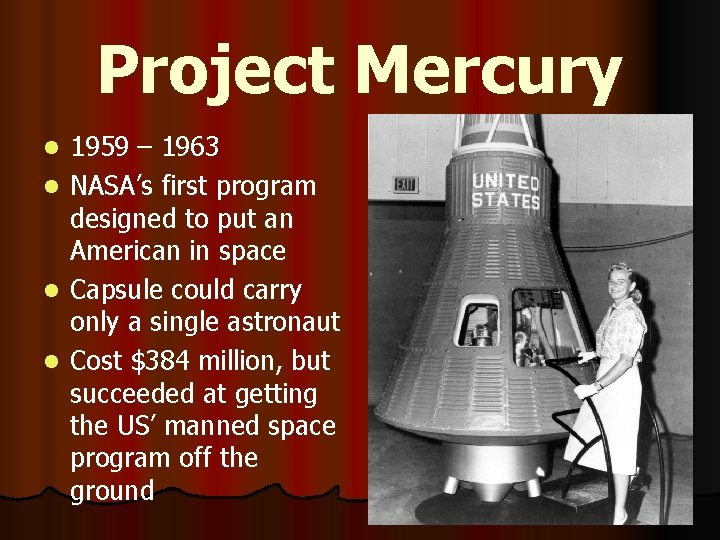
Project Mercury l l 1959 – 1963 NASA’s first program designed to put an American in space Capsule could carry only a single astronaut Cost $384 million, but succeeded at getting the US’ manned space program off the ground
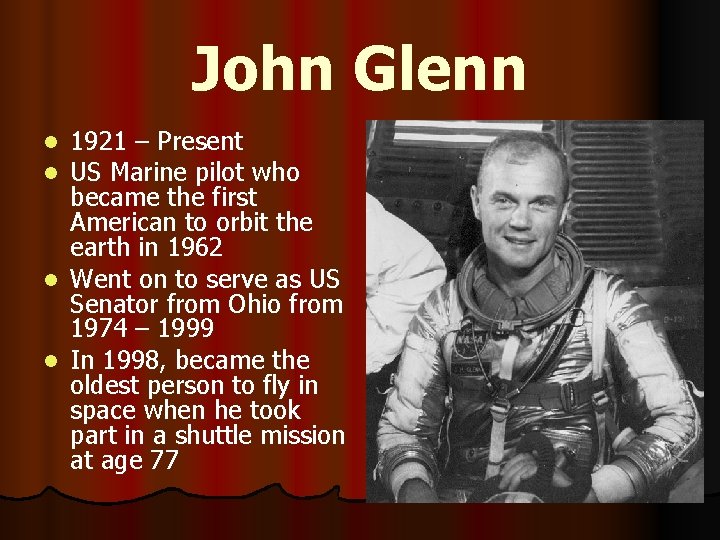
John Glenn 1921 – Present US Marine pilot who became the first American to orbit the earth in 1962 l Went on to serve as US Senator from Ohio from 1974 – 1999 l In 1998, became the oldest person to fly in space when he took part in a shuttle mission at age 77 l l
Kennedy Targets the Moon l “[We] commit … before this decade is out, to landing a man on the Moon and returning him safely to the Earth … But why, some say, the moon? Why choose this as our goal? And they may well ask why climb the highest mountain? …We choose to go to the moon in this decade and do the other things, not because they are easy, but because they are hard, because that goal will serve to organize and measure the best of our energies and skills, because that challenge is one that we are willing to accept, one we are unwilling to postpone, and one which we intend to win”
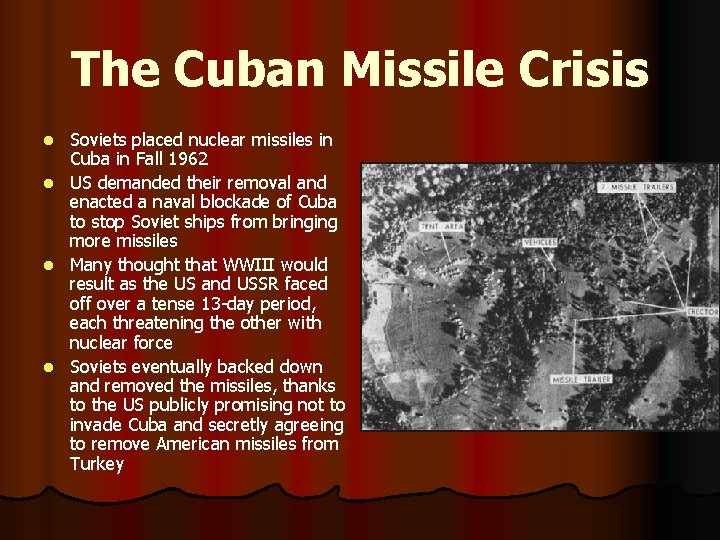
The Cuban Missile Crisis Soviets placed nuclear missiles in Cuba in Fall 1962 l US demanded their removal and enacted a naval blockade of Cuba to stop Soviet ships from bringing more missiles l Many thought that WWIII would result as the US and USSR faced off over a tense 13 -day period, each threatening the other with nuclear force l Soviets eventually backed down and removed the missiles, thanks to the US publicly promising not to invade Cuba and secretly agreeing to remove American missiles from Turkey l
Vietnam
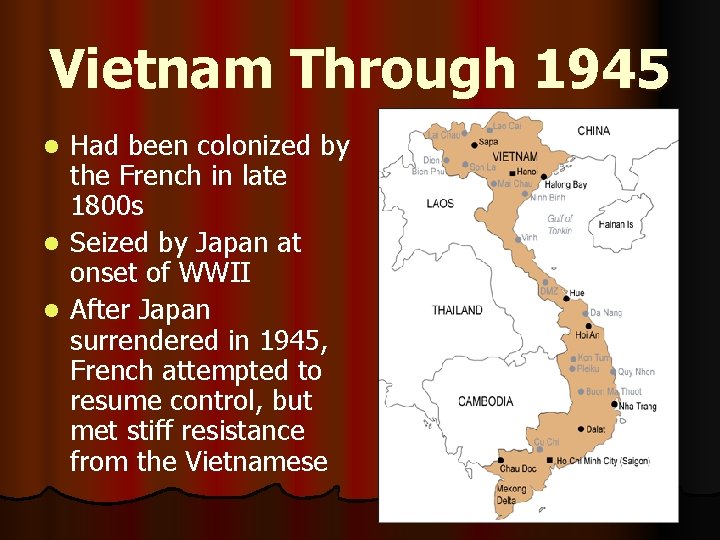
Vietnam Through 1945 Had been colonized by the French in late 1800 s l Seized by Japan at onset of WWII l After Japan surrendered in 1945, French attempted to resume control, but met stiff resistance from the Vietnamese l
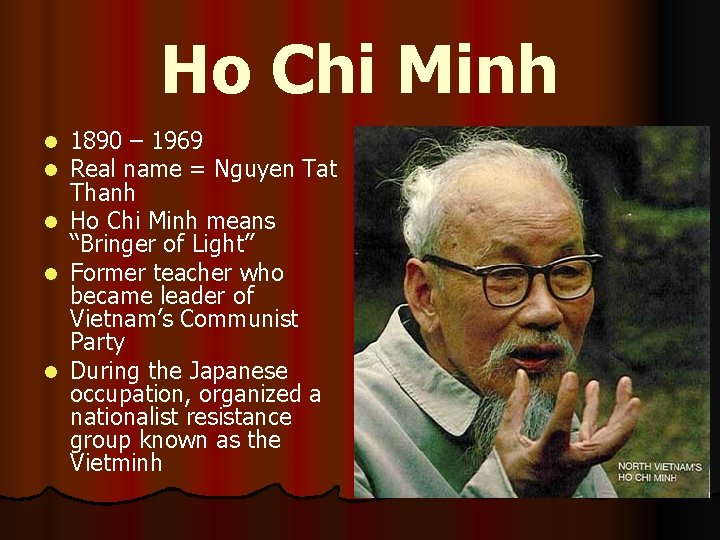
Ho Chi Minh 1890 – 1969 Real name = Nguyen Tat Thanh l Ho Chi Minh means “Bringer of Light” l Former teacher who became leader of Vietnam’s Communist Party l During the Japanese occupation, organized a nationalist resistance group known as the Vietminh l l
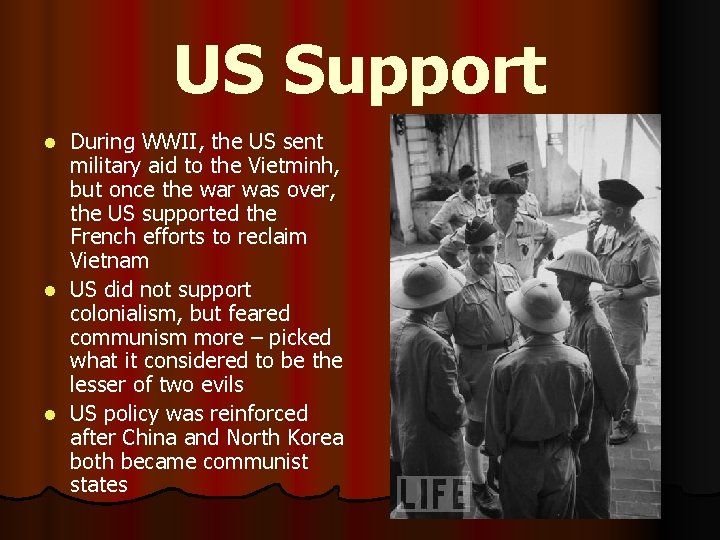
US Support During WWII, the US sent military aid to the Vietminh, but once the war was over, the US supported the French efforts to reclaim Vietnam l US did not support colonialism, but feared communism more – picked what it considered to be the lesser of two evils l US policy was reinforced after China and North Korea both became communist states l
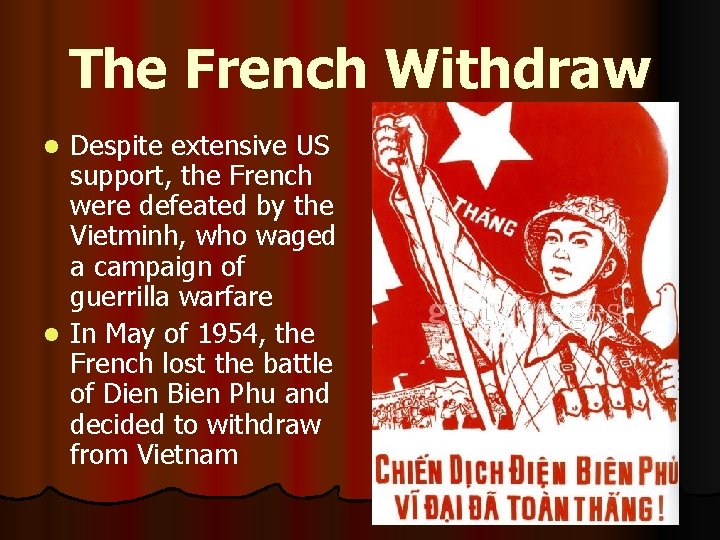
The French Withdraw Despite extensive US support, the French were defeated by the Vietminh, who waged a campaign of guerrilla warfare l In May of 1954, the French lost the battle of Dien Bien Phu and decided to withdraw from Vietnam l
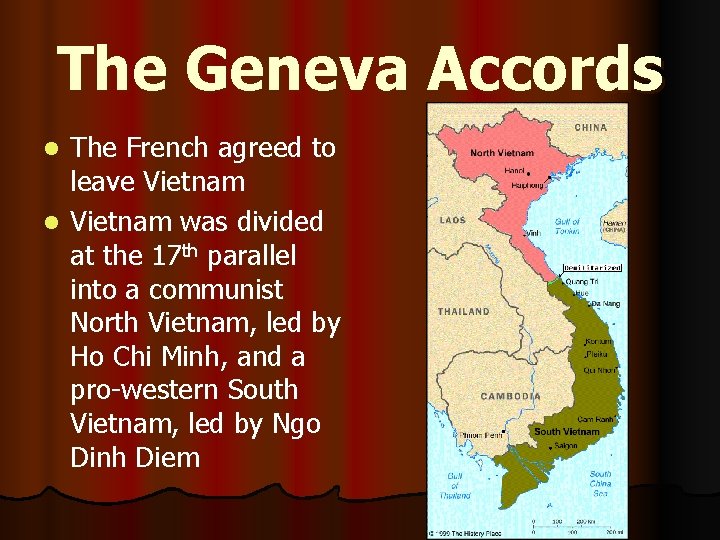
The Geneva Accords The French agreed to leave Vietnam l Vietnam was divided at the 17 th parallel into a communist North Vietnam, led by Ho Chi Minh, and a pro-western South Vietnam, led by Ngo Dinh Diem l
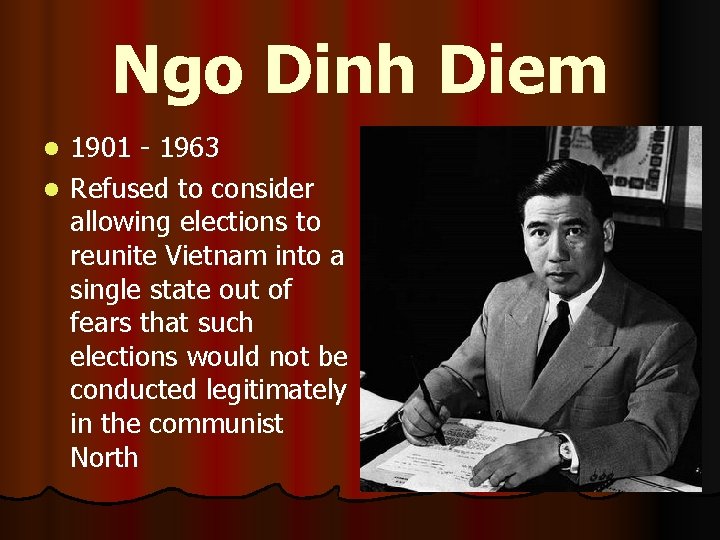
Ngo Dinh Diem 1901 - 1963 l Refused to consider allowing elections to reunite Vietnam into a single state out of fears that such elections would not be conducted legitimately in the communist North l
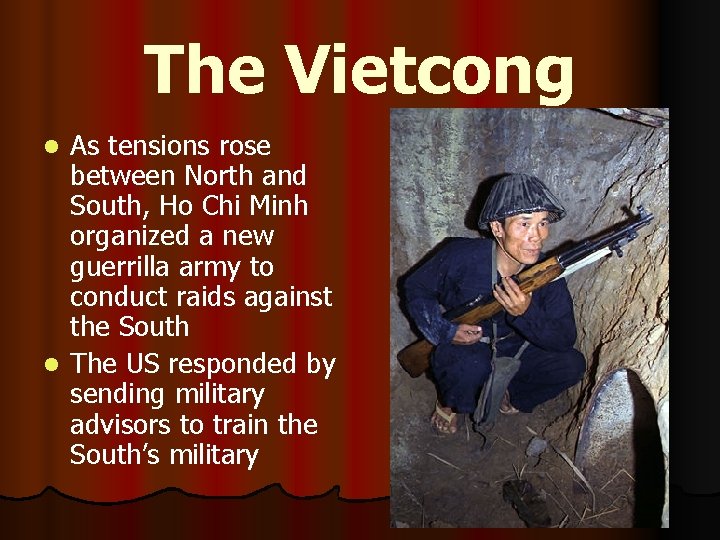
The Vietcong As tensions rose between North and South, Ho Chi Minh organized a new guerrilla army to conduct raids against the South l The US responded by sending military advisors to train the South’s military l
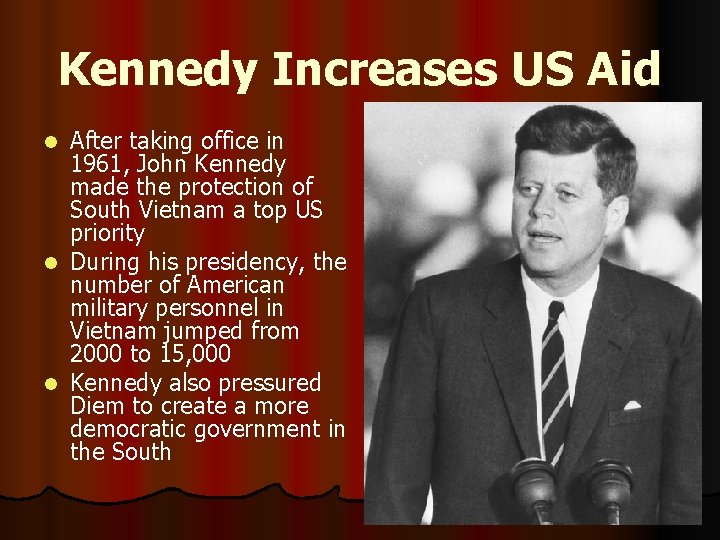
Kennedy Increases US Aid After taking office in 1961, John Kennedy made the protection of South Vietnam a top US priority l During his presidency, the number of American military personnel in Vietnam jumped from 2000 to 15, 000 l Kennedy also pressured Diem to create a more democratic government in the South l
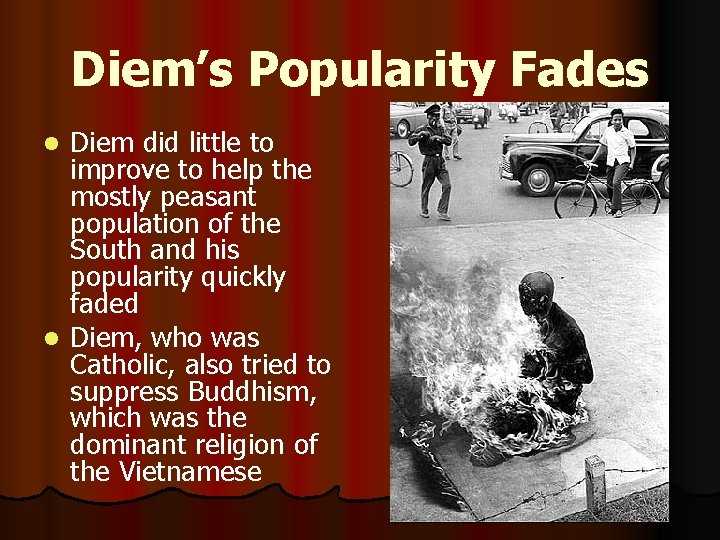
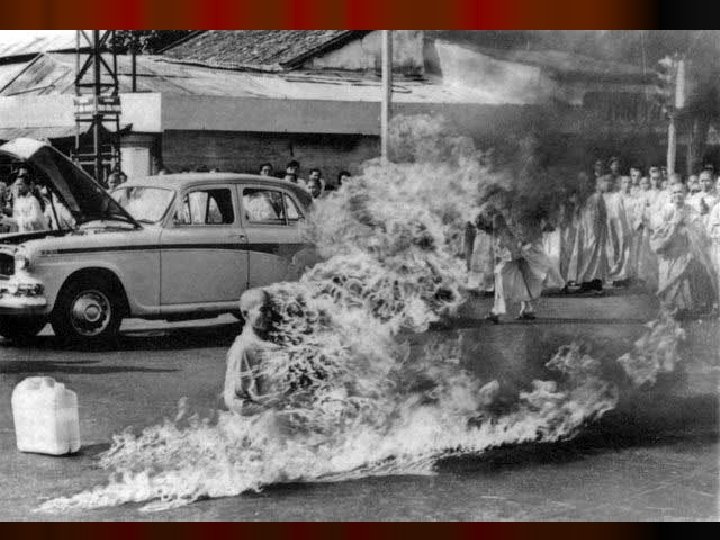
Diem’s Popularity Fades Diem did little to improve to help the mostly peasant population of the South and his popularity quickly faded l Diem, who was Catholic, also tried to suppress Buddhism, which was the dominant religion of the Vietnamese l
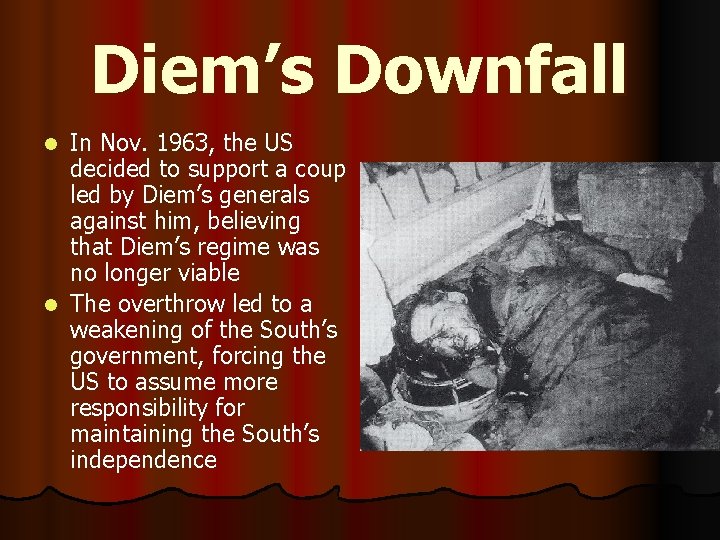
Diem’s Downfall In Nov. 1963, the US decided to support a coup led by Diem’s generals against him, believing that Diem’s regime was no longer viable l The overthrow led to a weakening of the South’s government, forcing the US to assume more responsibility for maintaining the South’s independence l