
John Dewey Ethics as Praxis Moral Theories a
- Slides: 31
John Dewey: Ethics as Praxis Moral Theories a. a. 2019 -20 Dr. Sarin Marchetti
John Dewey 1859 -1952 • 1859: born in Burlington, Vermont • 1875 -9: B. A. from the University of Vermont • 1882 -4: Ph. D from John Hopkins (George S. Morris, Stanley Hall, C. S. Peirce) • 1884 -1894: University of Michigan (George S. Morris) • 1894 - 1904: University of Chicago (G. H. Mead, James Tuft, Jane Addams) • 1905 -1930: Columbia University (F. J. E. Woodbridge, Ernest Nagel) • 1952: dies in NYC
Philosophical themes • From Hegelian to Darwinian community: centrality of relations and transactions • Experimentalism in science and in life • No perennial philosophical problems, but rather reconstruction of our culture in the making • Meaning is a function of what we expect from each other • Doing without certainty
Moral themes • Dewey’s early moral writings focus on methodology of ethics, while his later writings deal with the reconstruction of ethical theories • Early and late, ethics is studied from the point of view of human activities and practices • Importance of habits (training into experience) and intelligence (foreseeing new ways of putting together ends and means) • Experimentation in problematic situations
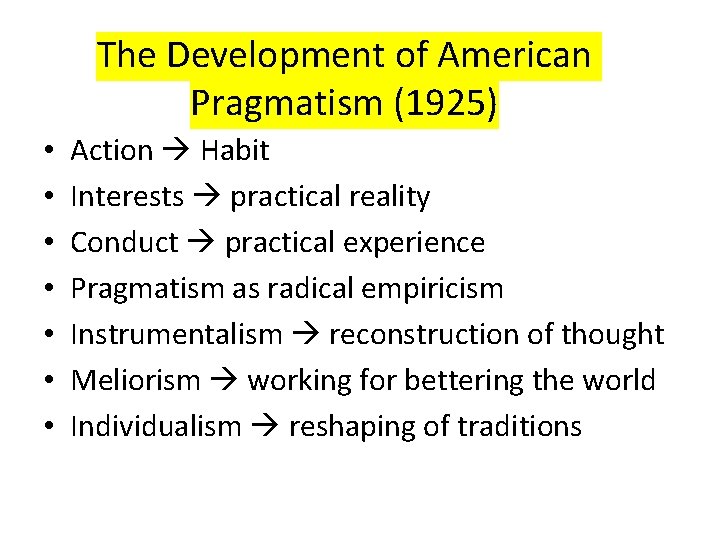
The Development of American Pragmatism (1925) • • Action Habit Interests practical reality Conduct practical experience Pragmatism as radical empiricism Instrumentalism reconstruction of thought Meliorism working for bettering the world Individualism reshaping of traditions
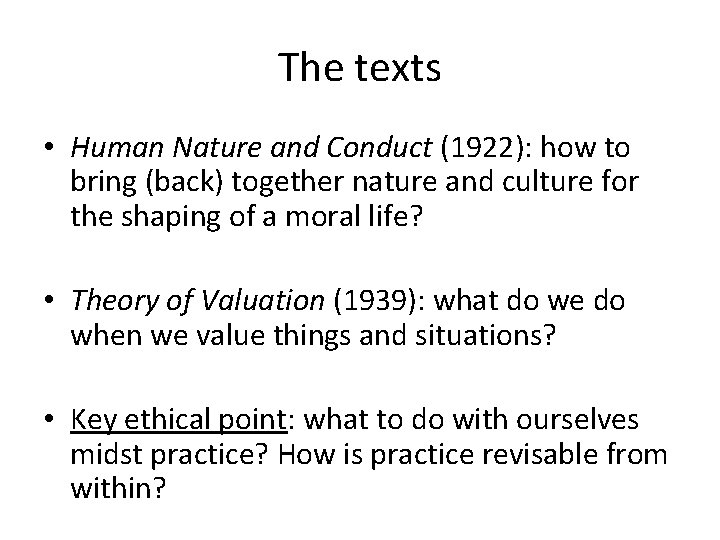
The texts • Human Nature and Conduct (1922): how to bring (back) together nature and culture for the shaping of a moral life? • Theory of Valuation (1939): what do we do when we value things and situations? • Key ethical point: what to do with ourselves midst practice? How is practice revisable from within?
1. Philosophical pragmatism: an introduction • The very word • Figures • Texts • Historical connections • Context • A revolution in philosophy
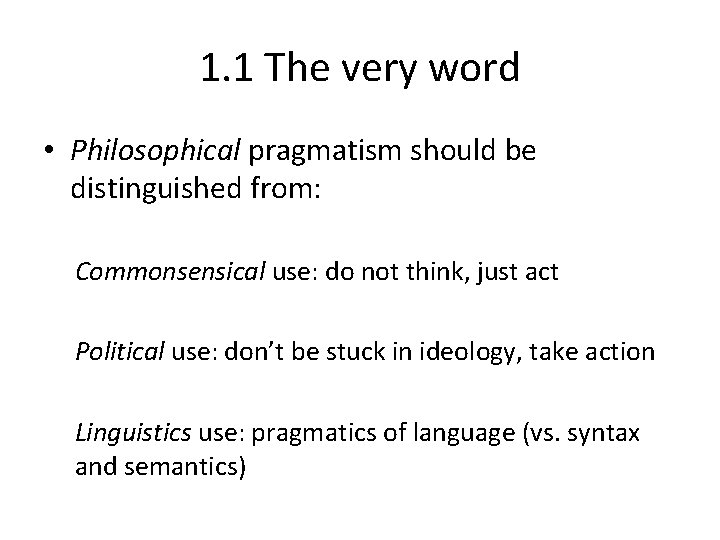
1. 1 The very word • Philosophical pragmatism should be distinguished from: Commonsensical use: do not think, just act Political use: don’t be stuck in ideology, take action Linguistics use: pragmatics of language (vs. syntax and semantics)
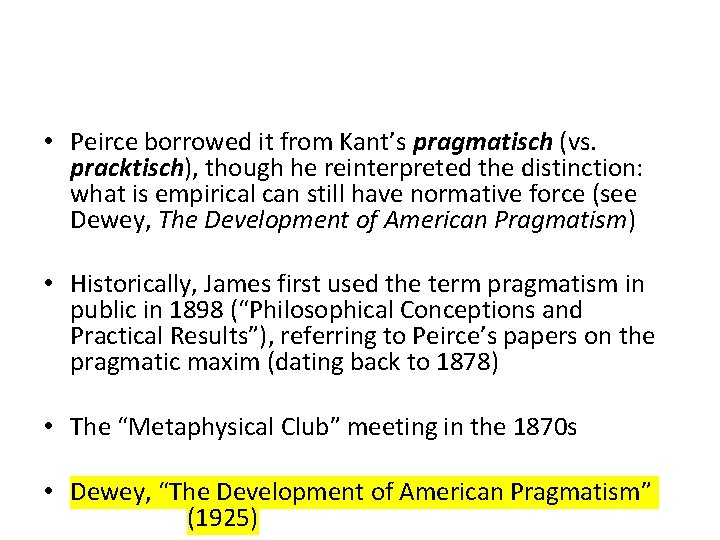
• Peirce borrowed it from Kant’s pragmatisch (vs. pracktisch), though he reinterpreted the distinction: what is empirical can still have normative force (see Dewey, The Development of American Pragmatism) • Historically, James first used the term pragmatism in public in 1898 (“Philosophical Conceptions and Practical Results”), referring to Peirce’s papers on the pragmatic maxim (dating back to 1878) • The “Metaphysical Club” meeting in the 1870 s • Dewey, “The Development of American Pragmatism” (1925)
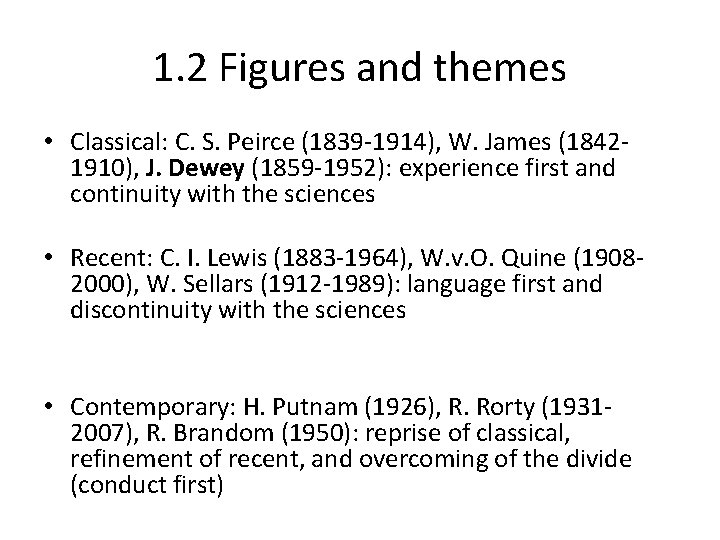
1. 2 Figures and themes • Classical: C. S. Peirce (1839 -1914), W. James (18421910), J. Dewey (1859 -1952): experience first and continuity with the sciences • Recent: C. I. Lewis (1883 -1964), W. v. O. Quine (19082000), W. Sellars (1912 -1989): language first and discontinuity with the sciences • Contemporary: H. Putnam (1926), R. Rorty (19312007), R. Brandom (1950): reprise of classical, refinement of recent, and overcoming of the divide (conduct first)
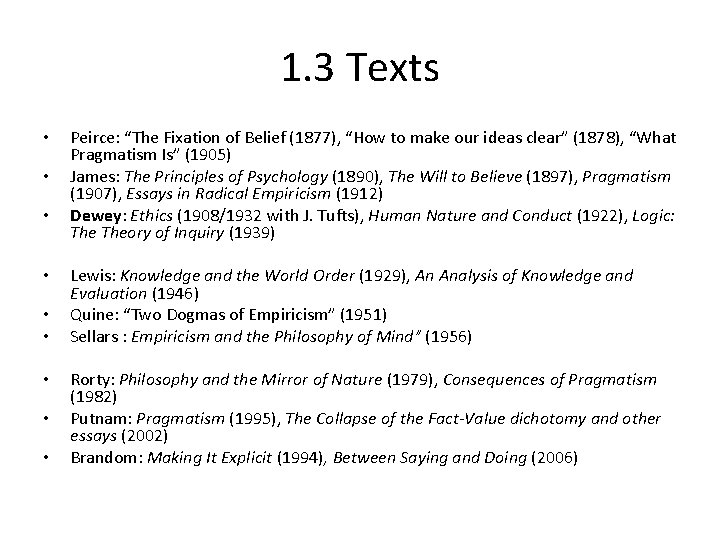
1. 3 Texts • • • Peirce: “The Fixation of Belief (1877), “How to make our ideas clear” (1878), “What Pragmatism Is” (1905) James: The Principles of Psychology (1890), The Will to Believe (1897), Pragmatism (1907), Essays in Radical Empiricism (1912) Dewey: Ethics (1908/1932 with J. Tufts), Human Nature and Conduct (1922), Logic: Theory of Inquiry (1939) Lewis: Knowledge and the World Order (1929), An Analysis of Knowledge and Evaluation (1946) Quine: “Two Dogmas of Empiricism” (1951) Sellars : Empiricism and the Philosophy of Mind” (1956) Rorty: Philosophy and the Mirror of Nature (1979), Consequences of Pragmatism (1982) Putnam: Pragmatism (1995), The Collapse of the Fact-Value dichotomy and other essays (2002) Brandom: Making It Explicit (1994), Between Saying and Doing (2006)
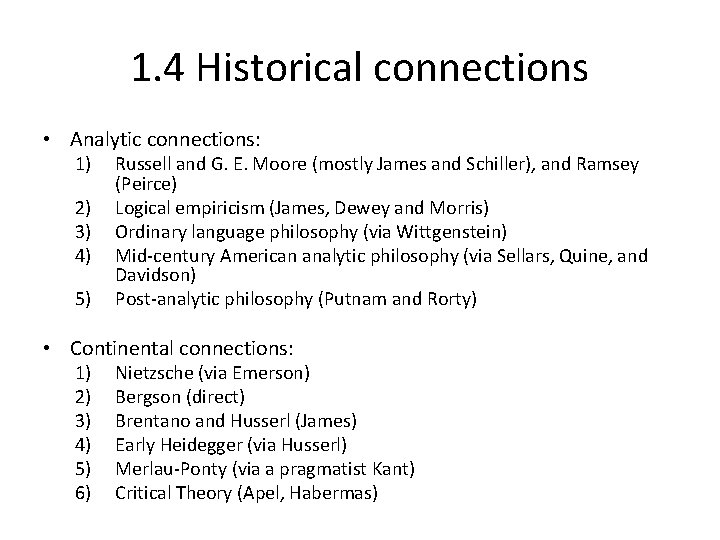
1. 4 Historical connections • Analytic connections: 1) 2) 3) 4) 5) Russell and G. E. Moore (mostly James and Schiller), and Ramsey (Peirce) Logical empiricism (James, Dewey and Morris) Ordinary language philosophy (via Wittgenstein) Mid-century American analytic philosophy (via Sellars, Quine, and Davidson) Post-analytic philosophy (Putnam and Rorty) • Continental connections: 1) 2) 3) 4) 5) 6) Nietzsche (via Emerson) Bergson (direct) Brentano and Husserl (James) Early Heidegger (via Husserl) Merlau-Ponty (via a pragmatist Kant) Critical Theory (Apel, Habermas)
1. 5 Context • • • Cultural: Emancipation of philosophy from theology in the US (first graduate program 1878 at John Hopkins) Search for a “philosophy Americana” Reaction to common sense realism (empiricism) and idealism (rationalism) Philosophy between (and beyond) the natural and the social sciences What do philosophers do? Systematization/justification vs. edification/critique
Intellectual: • Shift from fixities and faithful replication of reality to dynamic intervention in, and adaptation to, the environment (Darwinism’s emphasis on change and chance influenced the natural and social sciences) • From certainty to probability (esp. in the scientific enterprise, but also distrust of absolutes in politics) • Pluralism of conceptual systems (and not only of the objects falling under them) driven by practical considerations (e. g. multiple geometries or relativity in physics)
1. 6 A revolution in philosophy • Second Enlightenment: knowledge, like morality, is a matter of social interaction rather than authority • Naturalism with a normative turn • Primacy of practice/agency/conduct • From thoughts and things to deeds • Rationality and understanding are doings rather than states, processes rather than episodes • Battle against metaphysics
2. The Pragmatist philosophical agenda • Pragmatism as method • Pragmatist themes • Metaphilosophical ramifications
2. 1 Pragmatism as Method • The pragmatist orientation • The pragmatic maxim • Theories as tools
2. 1. 1 The pragmatist orientation • Pragmatism is first and foremost an intellectual and ordinary “attitude”, “habit”, or “orientation” “Pragmatism represents a perfectly familiar attitude in philosophy, the empiricist attitude, but it represents it, as it seems to me, both in a more radical and in a less objectionable form than it has ever yet assumed. A pragmatist turns back resolutely and once for all upon a lot of inveterate habits dear to professional philosophers. He turns away from abstraction and insufficiency, from fixed principles, closed systems, and pretended absolutes and origins. He turns towards concreteness and adequacy, towards facts, towards action, and towards power. That means the empiricist temper regnant, and the rationalist temper sincerely given up. It means the open air and possibilities of nature, as against dogma, artificiality and the pretence of finality in truth” (James 1907: 31)
“Philosophy forswears inquiry after absolute origins and absolute finalities in order to explore specific values and the specific conditions that generate them. . . The habit of derogating from present meanings and uses prevents our looking the facts of experience in the face; it prevents serious acknowledgment of the evils they present and serious concern with the goods they promise but do not as yet fulfill…The displacing of this wholesale type of philosophy will doubtless not arrive by sheer logical disproof, but rather by growing recognition of its futility” (Dewey 1909) “Philosophy recovers itself when it ceases to be a device for dealing with the problems of philosophers and becomes a method, cultivated by philosophers, for dealing with the problems of men” (Dewey 1917)
2. 1. 2 The pragmatic maxim • The pragmatic maxim as a criterion of significance (both of particular object and of the general conceptions we have of them) “Consider what effects, which might be conceivably have practical bearings, you conceive the object of your conception might have. Then your conception of these effects is the whole of your conception of the object” “in order to ascertain the meaning of an intellectual conception one should consider what practical consequences might conceivably result by necessity from the truth of that conception; and the sum of these consequences will constitute the entire meaning of the conception. ” (Peirce 1878)
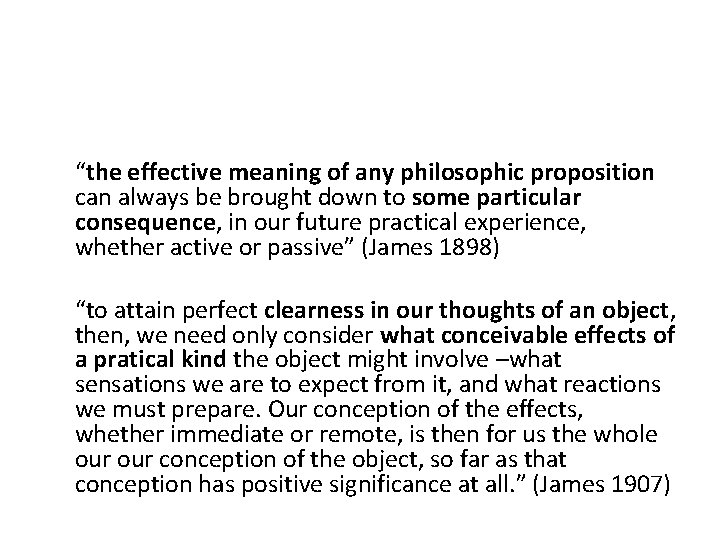
“the effective meaning of any philosophic proposition can always be brought down to some particular consequence, in our future practical experience, whether active or passive” (James 1898) “to attain perfect clearness in our thoughts of an object, then, we need only consider what conceivable effects of a pratical kind the object might involve –what sensations we are to expect from it, and what reactions we must prepare. Our conception of the effects, whether immediate or remote, is then for us the whole our conception of the object, so far as that conception has positive significance at all. ” (James 1907)
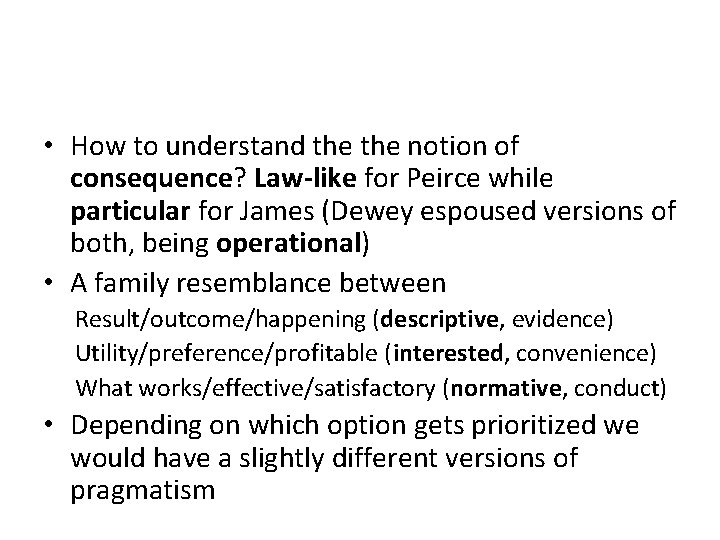
• How to understand the notion of consequence? Law-like for Peirce while particular for James (Dewey espoused versions of both, being operational) • A family resemblance between Result/outcome/happening (descriptive, evidence) Utility/preference/profitable (interested, convenience) What works/effective/satisfactory (normative, conduct) • Depending on which option gets prioritized we would have a slightly different versions of pragmatism
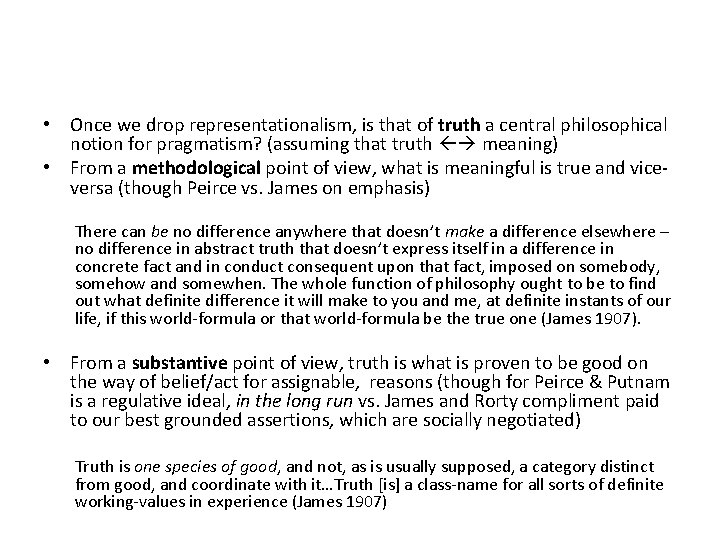
• Once we drop representationalism, is that of truth a central philosophical notion for pragmatism? (assuming that truth meaning) • From a methodological point of view, what is meaningful is true and viceversa (though Peirce vs. James on emphasis) There can be no difference anywhere that doesn’t make a difference elsewhere – no difference in abstract truth that doesn’t express itself in a difference in concrete fact and in conduct consequent upon that fact, imposed on somebody, somehow and somewhen. The whole function of philosophy ought to be to find out what definite difference it will make to you and me, at definite instants of our life, if this world-formula or that world-formula be the true one (James 1907). • From a substantive point of view, truth is what is proven to be good on the way of belief/act for assignable, reasons (though for Peirce & Putnam is a regulative ideal, in the long run vs. James and Rorty compliment paid to our best grounded assertions, which are socially negotiated) Truth is one species of good, and not, as is usually supposed, a category distinct from good, and coordinate with it…Truth [is] a class-name for all sorts of definite working-values in experience (James 1907)
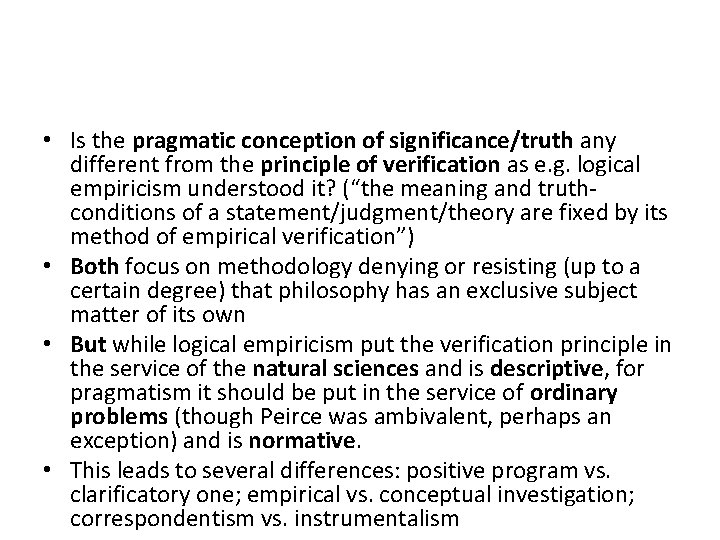
• Is the pragmatic conception of significance/truth any different from the principle of verification as e. g. logical empiricism understood it? (“the meaning and truthconditions of a statement/judgment/theory are fixed by its method of empirical verification”) • Both focus on methodology denying or resisting (up to a certain degree) that philosophy has an exclusive subject matter of its own • But while logical empiricism put the verification principle in the service of the natural sciences and is descriptive, for pragmatism it should be put in the service of ordinary problems (though Peirce was ambivalent, perhaps an exception) and is normative. • This leads to several differences: positive program vs. clarificatory one; empirical vs. conceptual investigation; correspondentism vs. instrumentalism
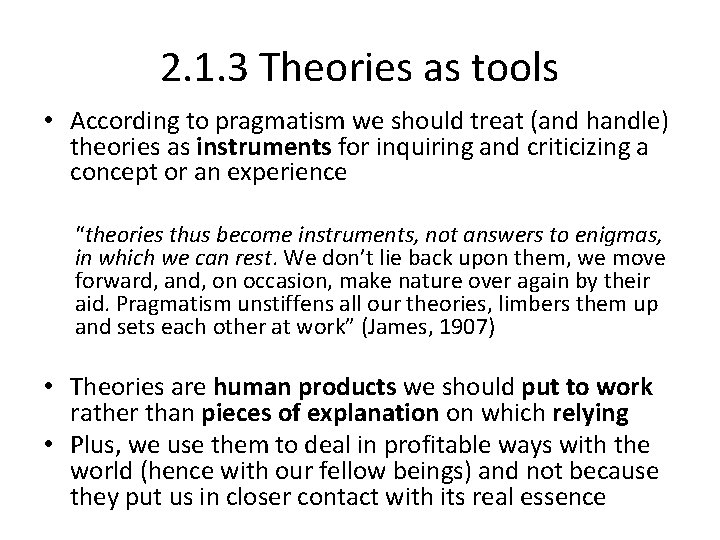
2. 1. 3 Theories as tools • According to pragmatism we should treat (and handle) theories as instruments for inquiring and criticizing a concept or an experience “theories thus become instruments, not answers to enigmas, in which we can rest. We don’t lie back upon them, we move forward, and, on occasion, make nature over again by their aid. Pragmatism unstiffens all our theories, limbers them up and sets each other at work” (James, 1907) • Theories are human products we should put to work rather than pieces of explanation on which relying • Plus, we use them to deal in profitable ways with the world (hence with our fellow beings) and not because they put us in closer contact with its real essence
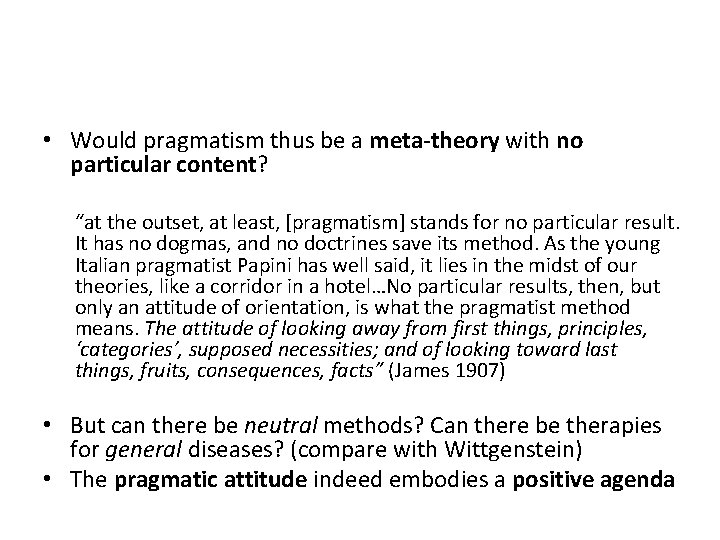
• Would pragmatism thus be a meta-theory with no particular content? “at the outset, at least, [pragmatism] stands for no particular result. It has no dogmas, and no doctrines save its method. As the young Italian pragmatist Papini has well said, it lies in the midst of our theories, like a corridor in a hotel…No particular results, then, but only an attitude of orientation, is what the pragmatist method means. The attitude of looking away from first things, principles, ‘categories’, supposed necessities; and of looking toward last things, fruits, consequences, facts” (James 1907) • But can there be neutral methods? Can there be therapies for general diseases? (compare with Wittgenstein) • The pragmatic attitude indeed embodies a positive agenda
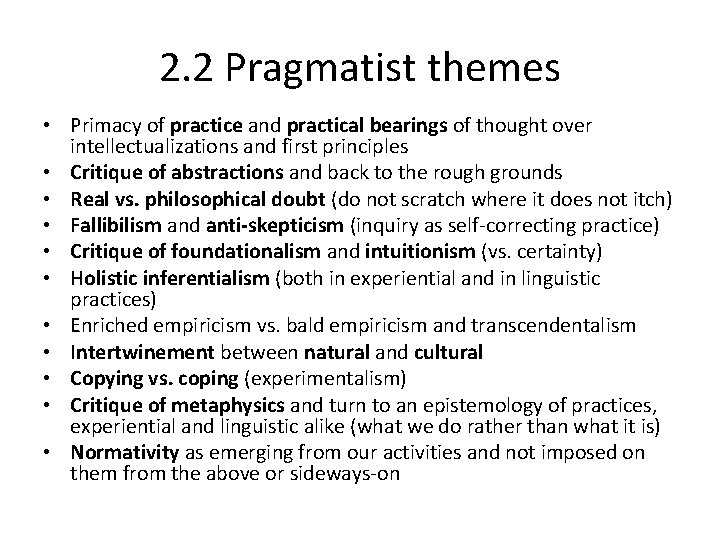
2. 2 Pragmatist themes • Primacy of practice and practical bearings of thought over intellectualizations and first principles • Critique of abstractions and back to the rough grounds • Real vs. philosophical doubt (do not scratch where it does not itch) • Fallibilism and anti-skepticism (inquiry as self-correcting practice) • Critique of foundationalism and intuitionism (vs. certainty) • Holistic inferentialism (both in experiential and in linguistic practices) • Enriched empiricism vs. bald empiricism and transcendentalism • Intertwinement between natural and cultural • Copying vs. coping (experimentalism) • Critique of metaphysics and turn to an epistemology of practices, experiential and linguistic alike (what we do rather than what it is) • Normativity as emerging from our activities and not imposed on them from the above or sideways-on
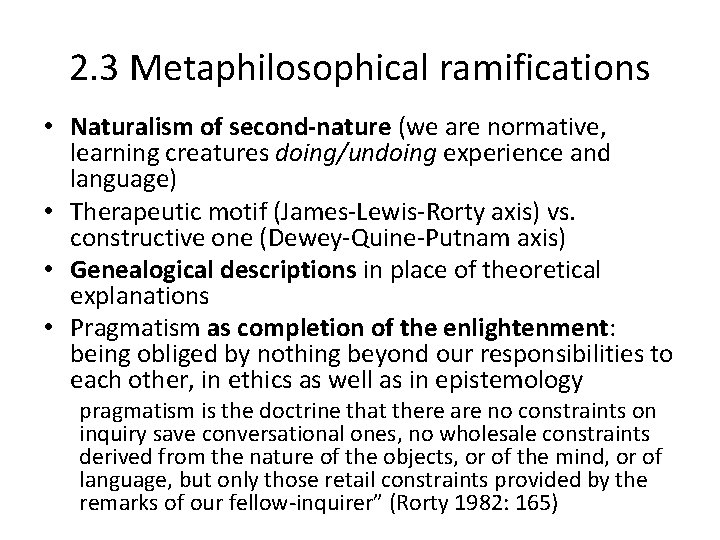
2. 3 Metaphilosophical ramifications • Naturalism of second-nature (we are normative, learning creatures doing/undoing experience and language) • Therapeutic motif (James-Lewis-Rorty axis) vs. constructive one (Dewey-Quine-Putnam axis) • Genealogical descriptions in place of theoretical explanations • Pragmatism as completion of the enlightenment: being obliged by nothing beyond our responsibilities to each other, in ethics as well as in epistemology pragmatism is the doctrine that there are no constraints on inquiry save conversational ones, no wholesale constraints derived from the nature of the objects, or of the mind, or of language, but only those retail constraints provided by the remarks of our fellow-inquirer” (Rorty 1982: 165)
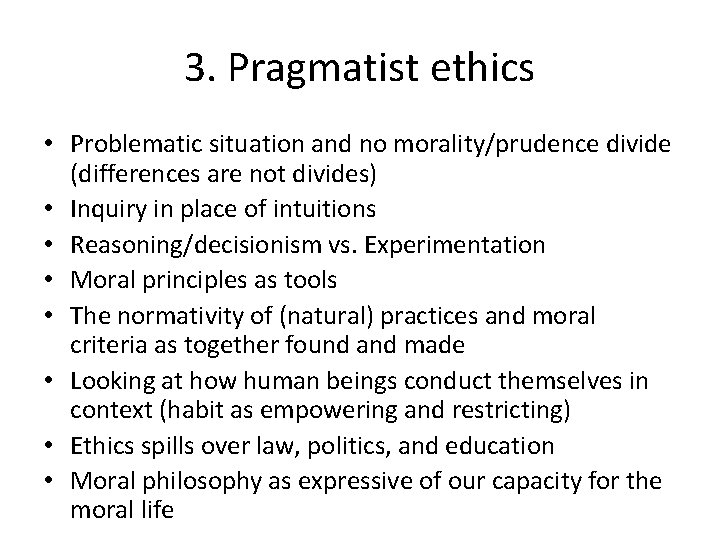
3. Pragmatist ethics • Problematic situation and no morality/prudence divide (differences are not divides) • Inquiry in place of intuitions • Reasoning/decisionism vs. Experimentation • Moral principles as tools • The normativity of (natural) practices and moral criteria as together found and made • Looking at how human beings conduct themselves in context (habit as empowering and restricting) • Ethics spills over law, politics, and education • Moral philosophy as expressive of our capacity for the moral life
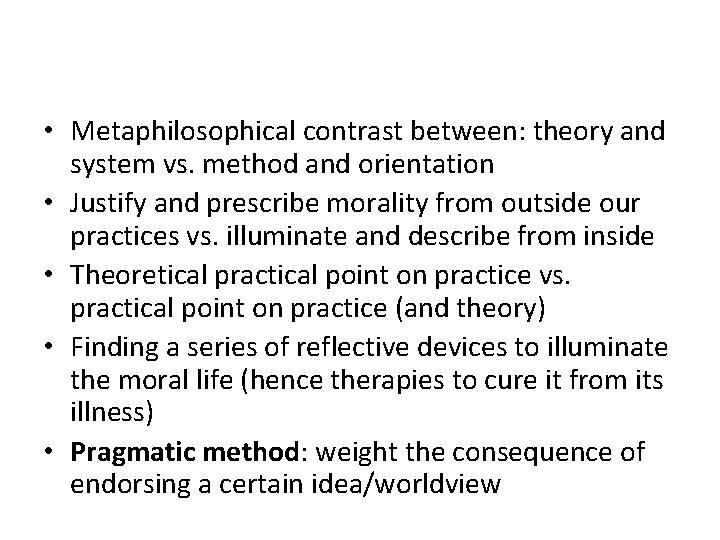
• Metaphilosophical contrast between: theory and system vs. method and orientation • Justify and prescribe morality from outside our practices vs. illuminate and describe from inside • Theoretical practical point on practice vs. practical point on practice (and theory) • Finding a series of reflective devices to illuminate the moral life (hence therapies to cure it from its illness) • Pragmatic method: weight the consequence of endorsing a certain idea/worldview
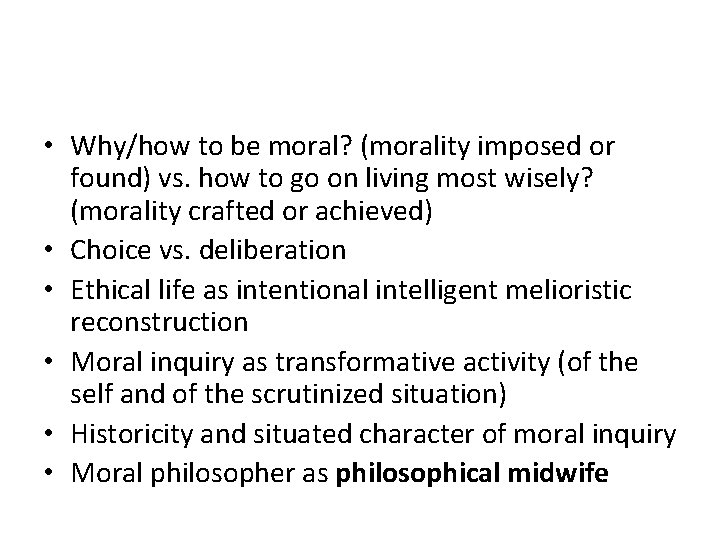
• Why/how to be moral? (morality imposed or found) vs. how to go on living most wisely? (morality crafted or achieved) • Choice vs. deliberation • Ethical life as intentional intelligent melioristic reconstruction • Moral inquiry as transformative activity (of the self and of the scrutinized situation) • Historicity and situated character of moral inquiry • Moral philosopher as philosophical midwife